This interview first appeared on the Muslim Home Newsletter July 12, 2023. It has been reprinted with the author’s permission and has been edited for content and length.
In a world where practicing Muslims grapple to navigate interactions with the LGBTQ+ community and the shifting societal landscape surrounding acceptance of diverse sexual orientations, gender identities, and same-sex unions, Muslims who face personal struggles with same-sex attraction or who have family members who identify as LGBTQ+ are often overlooked. Either scenario might be unsettling, but imagine being an imam and entrusted with guiding Muslims in faith matters and being confronted with a gay family member. How would he navigate this delicate relationship? Could he balance unconditional love for his relative while upholding Islamic principles? This is a reality for Imam Wesley Lebron, who had to learn to balance his religious convictions with his brotherly bond.
Imam Lebron is a New Jersey-born Puerto Rican who converted in 1998. He pursued Arabic studies at the Islamic University of Madinah, Saudi Arabia, from 2001 to 2002, and holds a B.A. in Islamic Studies from Mishkah University. Imam and director of programs and education for MAS New York Reverts Reconnect, he is also co-founder and president of 3 Puerto Rican Imams, a 501 (c) (3) non-profit humanitarian organization that provides disaster relief worldwide.
Imam Lebron’s unique experience as a Puerto Rican American convert, imam, leader, and family man provides a necessary perspective on dealing with differences within our communities. I interviewed him about how he manages his relationship with a close family member who identifies as LGBTQ+ while upholding his Islamic values in an ever-changing sociopolitical landscape.
Tell me about your family.
My parents are Puerto Rican; my father was born on the island and my mother is American born. I have three siblings from my mother and two from my father’s second marriage.
How important is your family and how do you keep close relations as a Muslim?
Family is everything. I was brought up with cousins, always visiting and playing together. Everyone from Puerto Rico lived in the same or surrounding area and our aunties and uncles often took care of us. I had a strong bond with my immediate family, as well. Even though my parents divorced when I was around 10 and my brother was five, we remained relatively close.
When I first converted, there was some distance because they did not understand my decision. I stopped drinking, smoking, and partying, and I would speak out against all that. A barrier emerged between us and time together was affected. Now that I’ve grown in faith and understanding, we try to keep in contact as much as possible.
One of your siblings is gay. How and when did you find out, and what was your reaction?
My little brother from my father’s side is gay. Initially, he hid it, but we heard he was crossdressing. In high school he came to live with me and our father and eventually confirmed he was gay.
Initially, it was not a big deal to me as I wasn’t a Muslim. I said it was his life and his choice. We respected each other. He was my little brother, and I didn’t look down on him, nor did I see him as defective or broken.
After you converted, how did you navigate your relationship with your brother while standing firm in your faith?
As a Muslim, I learned about Lut’s people being destroyed because of homosexual behavior. So, I took a stance that I don’t say living this lifestyle is an okay choice. I had children by that time so I needed to communicate what I was feeling. I sat down with my brother and came to an understanding regarding how we were going to maneuver this relationship – me as a Muslim with kids and him practicing homosexuality. How was that going to flow?
I was upfront with him, and he wanted to know if our relationship was going to change. We had rebuilt our adult relationship after being a bit distant as children and were enjoying a sense of brotherhood, so he wondered where our relationship was going and if I was going to hate him.
We went to dinner alone and had a very real conversation. We quickly decided to be respectful of one another and see how to continue building our brotherhood despite having opposite views on life, religion, homosexuality, and the LGBTQ+ movement, which wasn’t as prevalent as it is today.
During our chat, he asked, “How do we gauge love?” “How do we determine love?” He said, “Are you going to tell me if God places in my heart that I love someone, and because I love that person who has the same gender as I do, that I’m wrong, and then I’m going to hell?” With my then-limited Islamic knowledge, I answered, “We have a concept of hating and loving for the sake of Allah, and we love what God loves, and we hate what God hates. We dislike and hate those actions that were disliked by God; and from those actions that are clearly stated in the Quran and Bible are acts of homosexuality, same-sex relationships, and deviant sexual behaviors. We were taught we had to get married to the opposite gender, and that Allah created Eve for Adam, and that God punished Lot’s people because of homosexual practice. This story is found in both the Bible and the Quran.”
I added, “This doesn’t mean I don’t love you or consider you my brother. Love is an action of the heart, and it’s something we sometimes can’t control. We may not be able to control who we love, but we can control how we love. You must realize what you’re doing is a sin, and (as far as Islam is concerned) you’re involved in a sinful lifestyle. And yes, maybe you love a person, and you can’t control loving that person, but you can control the type of relationship you pursue. Just like a person loves to drink and learns to control that desire so he no longer consumes alcohol.”
Ultimately, I said while I did not support his choices, I still loved him as my brother, and I offered my assistance for anything he needed that wasn’t against God. I told him I respected him and expected respect for my faith in return. Alhamdulillah, we came to an understanding, and we’ve been able to maneuver our relationship around that understanding. For example, we agreed he would not bring a significant other around my children or he would refer to them as a friend. Once my children reached the age of discernment and puberty and understood homosexuality, then he could be open with them. By then I would have hopefully taught them enough so they would be making the right choices.
He respected these boundaries and never once disregarded them, mashallah. We built our relationship on respect and love, knowing we would make our own choices yet not allowing them to negatively impact our familial relationship. I have been Muslim almost 25 years now, alhamdulillah, and he’s been openly gay that entire time, and there has never been an issue of contention in our relationship.
How long have you been an imam, and how has it shaped your relationship with your brother?
I started working as an imam and educator around 2014. Alhamdulillah, because of my work, my brother’s impression of Muslims is positive, even though we don’t support LGBTQ. He understands why and knows most Muslims follow Quran and Sunnah. Regardless of their support or not for the LGBTQ movement, he loves the Muslim community.
He is impressed I started my own nonprofit as co-founder of the 3 Puerto Rican Imams and of our work. It has impacted him that I help people around the world who are in need, building water wells, sending food, and doing whatever is necessary. We also helped our non-Muslim relatives during difficult times, and he really appreciated it.
Has your brother ever considered converting to Islam? Why or why not?
Surprisingly, he listens to my Islamic studies classes sometimes, and he’ll make comments like, “I love that concept.” Over time he has become more religious, now believing in God, though we have not discussed him converting to Islam. It’s the same with the rest of my family. We lead by example, and, if they show interest, we talk to them, but I have never openly asked, “Do you want to become Muslim?” Everyone in my family who became Muslim has approached me to tell me they wanted to convert, and we facilitated their shahada based on that. I have given them Qurans. My brother keeps the Quran near his bed, and he reads it. My mother, who is Muslim now, talks to him about the Quran and Islam. Thankfully, he has always had a positive outlook on Islam and Muslims because of our relationship.
As LGBTQ+ inclusion becomes increasingly prominent in the U.S., even within some of our masājid, Muslim communities are still navigating how to respond with clarity, wisdom, and unity. When asked how other imams and lay Muslims can successfully interact with those who identify as LGBTQ+, Imam Lebron said this is a question the Muslim leadership must continue to address collectively. He also emphasized our response must be firmly rooted in Qur’an and Sunnah.
“As Allah tells us, ‘And hold firmly to the rope of Allah all together…’ (Quran 3:103), so insha’Allah, we can pave the way for ourselves before the tsunami hits us and we don’t know how to protect or defend ourselves, our faith, our beliefs, and the like… I think each individual and community will have to take a stand and support one another upon that,” he said.
These are not simple matters. They require collective effort and guidance from qualified leaders. While we should embody humility and resilience, we cannot compromise our principles. Welcoming individuals into our spaces should never mean abandoning our faith-based values; instead, it calls for a well-defined process, consistent policies, and open yet respectful dialogue. Imam Lebron’s experience—navigating the crossroads of faith, family, and identity—highlights the importance of addressing these challenges with compassion, conviction, and clarity. His story reminds us these conversations are no longer theoretical but are happening in Muslim homes and communities. As we face these complex realities, his voice adds an essential dimension to the broader discourse, one rooted in Islamic tradition and the human experience of love, loyalty, and leadership.


With her arrival, I could see clearly the manifestation of Allah’s names Al-Khaliq and Al-Mu’id. Al-Khaliq, or the Creator, brought life anew into our home, designing and orchestrating this miracle at the perfect time. And Al-Mu’id, the Restorer, replaced our sorrow with joy, restoring hope where grief had once resided. Just as plants wither in the winter only to bloom again in spring, Allah recreated life in our family, gently easing our sadness and reminding us that even after loss, He is the One who brings back all things: “For indeed, with hardship comes ease. Indeed, with hardship comes ease.” (Quran 94:5,6)
The U.S. Surgeon General recently said, “We are in the middle of a loneliness epidemic as one-in-two adults in America reported experiencing loneliness2.” The WHO defines loneliness as the emotional pain that arises when there is a gap between the relationships we long for and the ones we currently have3. While digital tools have made it easier than ever to stay in touch, many people still feel alone. Social media can feel more like anti-social media, offering constant updates but little real connection. This is especially true for young people. Up to 21 percent of those between the ages of 13 and 29 report feelings of loneliness. This age range includes many women of childbearing age, as well as youth in our communities, making it an issue that our faith spaces must take seriously.WHO’sreport also highlights that mothers and children from marginalized groups, including religious minorities such as Muslims, may face added barriers to building meaningful relationships. Discrimination, language challenges, relocation, or cultural differences all can make developing relationships more difficult.
Sometimes, companionship comes in unexpected yet comforting forms. If possible, consider adopting a pet. Animals offer emotional support, a sense of routine, and unconditional affection. Think about Abu Huraira, the beloved companion of the Prophet (peace and blessings be upon him), who was known as the “Father of the Kitten” because of his love for cats. His compassion for animals became part of his identity. Caring for a pet can even be a source of reward and mercy in Islam.
In 2019, I interviewed Imam Christopher Pavlicek and several of the group’s founding members, including Shirley Chun and Raúl Gonzalez, for an article about service to humanity. This new feature revisits that conversation, offering a deeper look into how their faith-based outreach has evolved. At the time, the Foundation had only been established in May of 2018. Yet even in its early stages, its work was making a notable impact. By that fall, Ojalá had launched Neighborly Deeds, a weekly outreach program that continues to this day. With fewer than a dozen volunteers in the beginning, they prepared warm meals and distributed clothing, blankets, hygiene products, and other essentials to the homeless in the west and southwest sides of Chicago. Every Friday since then, without fail, Ojalá has carried forward this faith-driven effort, touching countless lives with consistent generosity. It is a work steeped in love and faith.
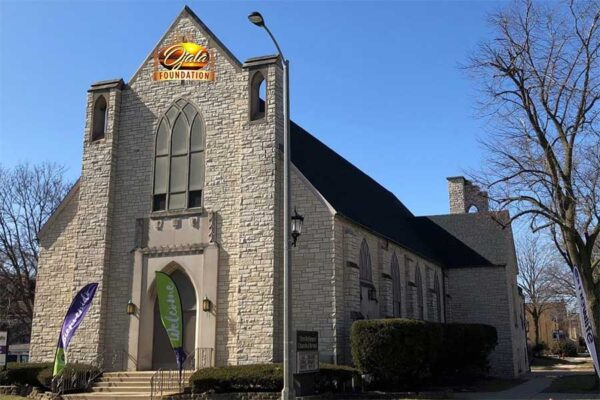
Allah says in the Qur’an, “Is there any reward for goodness except goodness?” (Qur’an 55:60) After years of serving others with limited resources and no headquarters, that goodness was returned to them in the form of the very community they helped build. In 2025, the Ojalá Foundation acquired an old church and converted it into a mosque and community center, establishing a permanent home. For Imam Chris, this space changes everything.
Hunger Action Month reminds us that the fight against hunger requires collective responsibility. A small effort like providing a meal or assistance to someone less fortunate, when done consistently, can spark a movement for social change. Imam Chris encourages other communities to take the first step.
A Forgotten History
I was one of the fortunate young converts who remained steadfast during that delicate period. My journey began at 15, when I first learned about Islam, and culminated in my conversion at the age of 20, alhamdulillah. One of the key people who supported me early on was the mosque’s youth coordinator. He warned me that the next two years would be especially difficult, as Shaytan would work relentlessly to pull me away from the straight path. Thanks to his guidance and the support of Muslim friends and their families, I was better prepared to face those tests. A few years later, I began participating in dawah work to assist others who were exploring Islam. Fast forward to today, and I have spent the last two decades volunteering and working with the Islamic Circle of North America (ICNA) and WhyIslam. Throughout this time, I have noticed a recurring trend: The Muslim community is obsessed with conversion stories yet gives little attention to what happens afterward. How do converts continue their learning, adjust to a new lifestyle, and find their place within the Muslim community?

As Pride gained momentum, public education systems began to provide curricula for every grade level describing the lifestyles and sexuality of LGBT people. Resultingly, expressing gender fluidity and “questioning” sexuality has become an acceptable norm for children, no matter their religious beliefs. Some school boards, such as in Montgomery County, Maryland, have even eliminated the option for parents to opt out of LGBT-centered instruction. This is where we Muslims must draw the line.
Recognize that the spectacle of Pride Month may appeal to children, especially younger ones who only see the surface-level colorful rainbows and innocent “Love is Love” slogans. They may associate it with seemingly fun holidays like Halloween, where teachers and students play dress-up and eat candy. Even older children and teenagers may empathize with the LGBT cause because of their peers or be coerced into participating in Pride celebrations because of social pressure. Gently remind them to stay true to their Muslim identity, be firm under pressure, and inform you of anything that violates their right to personal and religious objection. Be sure to emphasize compassion for fellow human beings while instilling a sense of pride in our beliefs. Our objections should never amount to harassment or violence against innocent individuals.
Teens might question how we know Allah exists and whether Islam is the truth. Encounters with people from different backgrounds can fuel this curiosity during self-discovery when young people are becoming more independent, following their interests, and relying on reason to make sense of the world. Living in the West means they’ll interact with people of diverse beliefs and practices, leading to questions about their understanding of God. This happened during the Islamic empire’s expansion after Prophet Muhammad’s (peace be upon him) death. Muslims met people from various traditions who understood God differently, some attributing human qualities to God, others imagining Him as part of the physical universe or confined to space. In response, kalam, or speculative theology, emerged to address these theological challenges. It became valuable for articulating and defending core beliefs about God’s existence, oneness, and attributes.
Answer: Allah’s perfection means He isn’t bound by human limitations. He created human beings to worship Him, making them dependent/contingent. Becoming human would imply change and imperfection, which contradict Allah’s nature as eternal and unchanging. As-Sanusi teaches that Allah’s attributes, like power and knowledge, are complete and absolute, not subject to the weaknesses of creation.