
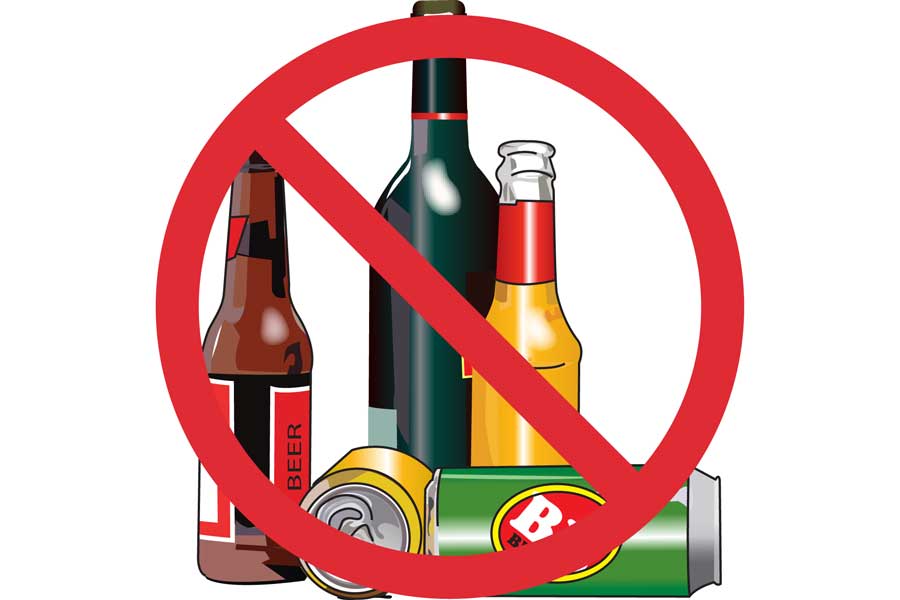
With January nearly over, it’s likely you’ve heard about Dry January when New Year’s resolutions inevitably come up. You’ve probably seen this term floating around your social media feed, talked about in your workplace, or popping up in turn-of-the-year and mid-January news articles. In late December, mentions of the month-long break from drinking alcohol are prevalent in pop culture as folks at home and abroad aim to cut out spirits in January, many in an effort to begin the year on a good footing, to give their body a break after an alcohol-soaked holiday season, or even to start on the road to sobriety.
Whatever the reason anyone might have to participate in Dry January, campaigns like this are just another reminder to me of Islam’s wisdom as well as the goodness and endless benefits we can derive from Allah’s guidance for our lives. As Muslims, we know Allah (SWT) has prohibited us from drinking alcohol and warned against its effects when he says, “O you who have believed, indeed, intoxicants, gambling, (sacrificing on) stone alters (to other than Allah), and divining arrows are but defilement from the work of Satan, so avoid it that you may be successful. Satan only wants to cause between you animosity and hatred through intoxicants and gambling and to avert you from remembrance of Allah and from prayer. So will you not desist?” (Quran 5:90-91)
With this revelation, along with the sunnah of Prophet Muhammad (peace be upon him), we understand we are to abstain from drinking alcohol and why sobriety was prescribed for us. Nevertheless, I am always rendered profoundly grateful for my faith when I see this wisdom manifest in secular society, and even more when it’s perpetuated in global challenges. Subhannallah!
History of Dry January
According to Time Magazine, a charity called Alcohol Change UK launched the Dry January campaign in 2013 after one of its employees gave up spirits during January 2011 and shared how the experiment resulted in improved sleep and more energy. The charity used the concept of Dry January as a way to encourage people to not only give their bodies a prolonged break from alcohol, but also to reset their relationship with drinking in general. The idea caught on and soon people throughout the United Kingdom were taking on the challenge, followed by people worldwide, particularly in the United States.
Effects of Drinking and Benefits of Quitting
Scientific research, recent studies in particular, has confirmed not only is no amount of alcohol safe – a line touted by the World Health Organization – but also that it is a carcinogen known to increase risks for liver, esophagus, throat, mouth, colon, and breast cancers. If that weren’t enough to deter from drinking, an article published in 2025 by Stanford Medicine reported alcohol’s “significant effects on the body” including higher death rate, specifically from cancer and cardiovascular disease. What’s more, the more alcohol consumed, the greater the risk of harm, as reported by the American Association for Cancer Research and the Journal of the American Medical Association. Other research has shown drinking alcohol can lead to digestive problems, a weakened immune system, stroke, as well as heart and liver disease.
However, eliminating alcohol promotes a clearer mind; reduction in liver fat and blood sugar; decreased risk of cancer and heart disease; lower rates of stillbirth and miscarriage, and less propensity for violence. Studies also show the longer a person abstains from spirits, the more his or her health improves.
Evolving Science
It’s also worth noting that studies conducted decades ago that claimed the occasional glass of red wine – specifically its antioxidants and polyphenols which have anti-inflammatory properties – is good for heart health are now being questioned. According to GoodRx.com, “the research on these potential health benefit isn’t as conclusive as you might think.” Researchers found that even though the polyphenols in red wine are beneficial, they also are found in dealcoholized wine, offering the same good effects but without the harm associated with alcohol.
For many believers, this might spark familiarity with Allah’s word. “They ask you about wine and gambling. Say, “In them is a great sin and (yet, some) benefit for people. But their sin is greater than their benefit.” (Quran 2:219)
Taking this information into account, it’s no wonder Allah (SWT) made strong mention of alcohol in His Holy Book, not only turning us away from it, but detailing its negative impacts on our body and mind. It’s also no surprise the scientific community’s decades-old recommendation of red wine for heart health is now strongly questioned and even rejected by major health organizations.
Letting Allah (SWT), Not Society, Be Our Guide
You might be wondering why I chose to write about such a settled issue in Islam as the prohibition on alcohol. I did so because drinking among Muslims – particularly young ones – is still a problem, leading to any number of health problems and broken relationships and families.
I write this, emphasizing the ever-evolving science on drinking, to underscore to my fellow Muslims that we need not look to modern-day experts and doctors when they advise us in ways that are against what our Creator has commanded for us, especially when their own research eventually leads them to Islam’s position, proving yet again that Allah (SWT) is All-Knowing.
I write this for Muslims who have expressed to me that, having never had alcohol in their life, sometimes secretly – and guiltily – wonder what they were missing out on, particularly when drinking is portrayed as such a fun and social activity.
Remember, the tide is turning on the lie of alcohol not only as heart healthy in some cases but also as a normal part of spending time with friends and family. Though the culture around alcohol in the United States has a long way to go before it will ever be considered taboo or even largely looked down upon, I have hope that continuing research into the health ills of alcohol and, yes, secular challenges like Dry January will continue to push the message that there is indeed no safe amount of alcohol and that we as a society would be better off eschewing it all together.
Until that time, we Muslims can take pride and comfort that our Lord, through His perfect religion, has already established our behavior around alcohol. May we all take it to heart, correct our course if we are being led astray, and may Allah (SWT) forgive us. Ameen.