

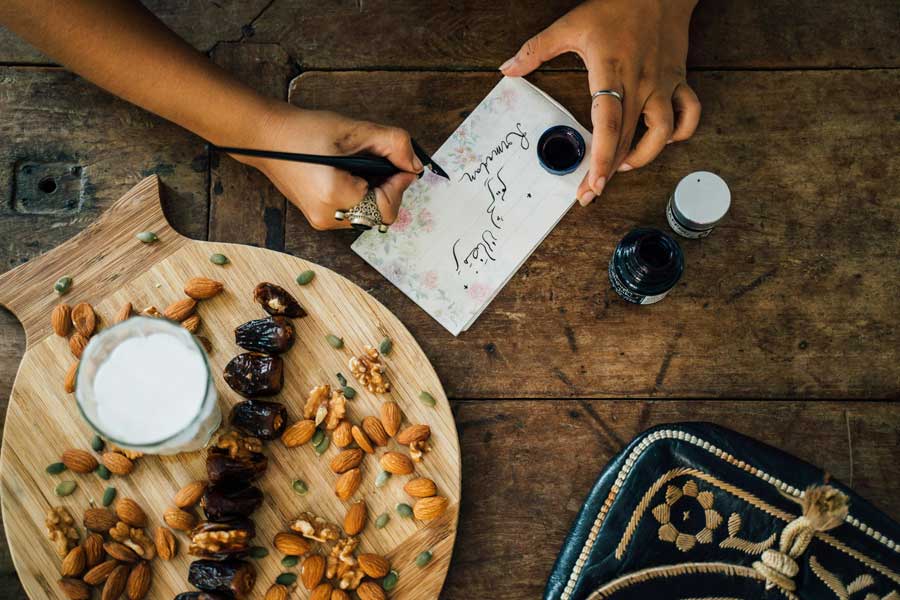
A few months ago, quite out of the blue, my oldest child, a teenager, said, “I’m excited about Ramadan.”
I won’t lie; I was pretty surprised. To verify whether this was a common theme amongst my teens, I turned to my middle kid for confirmation.
“Do you like Ramadan?” I asked.
“Yeah, it’s cool,” he said, without a hint of irony.
Subhan Allah!
Simplicity and Sacrifice for the Win
Now don’t get me wrong, I’m not saying I dread Ramadan – refer to my Ramadan article from last year – or that I expected my children to dread it. But as a convert Muslim mom raising Muslim children in America – where the months-long holiday season beginning with Halloween and ending with the spectacle that is Christmas and New Year reigns supreme – learning they look forward to Ramadan did throw me a bit. It was difficult to imagine that a month of fasting, praying, and – yes – sacrifice instilled in them any hint of excitement.
Alhamdullah for sure, but did I mention there is nary a Ramadan decoration to be seen in my home? No banners or twinkle lights hung from windows, no lanterns adorning the mantlepiece, no crescent moon-shaped tree set up in the living room. What’s more, my husband and I don’t take our children to community iftars at the local mosque, instead preferring to break our fasts in the quiet of our home, so it’s not as if our kids have these events to look forward to most evenings. And if you weren’t already convinced that we are indeed the most boring people to ever raise Muslim children, did I forget to tell you that we don’t go overboard on the Eid presents either?
So, what gives? What’s fueling the excitement? Well, I can’t be certain, but I have a few theories. When I first started fasting, I was struck by the subtle yet discernible shift in the air; “Ramadan just feels different,” was a common refrain. However, I attributed this feeling to me being a convert and experiencing something new and novel that I had no historical or communal connection to. In other words, when it came to my own kids, I figured being born into a Muslim home and seeing their parents fasting every year would have created a sense of humdrum when it came to Ramadan, especially coupled with my lack of festive décor and – if I’m being honest – the fact we celebrate it in a non-Muslim country.
But instead, there is indeed something in the air, a shift in the atmosphere, and my kids seem to have picked up on it, leading to anticipation and joy in their coming fast! Perhaps it’s because Ramadan represents a soft, quiet time in our house. Our days are slower, we stick closer to home, and my children frequently gather around me while I’m cooking the iftar meal, often pitching in with last-minute touches like setting the silverware, bringing the dates to the table, and filling the water pitcher. In other words, Ramadan brings new and comforting routines to our daily life that they’ve come to cherish and look forward to.
Celebrating Ramadan’s Inherent Beauty
What I also have come to understand is there is no need to copy non-Muslims’ celebrations and traditions in order to import a strong sense of meaning to our holy fasting month. Imam Omar Suleiman, founder of Yaqeen Institute and prominent author, addressed this issue. In a recent lecture, he referred to some U.S Muslims’ temptation to raise their children with what he termed “halal alternatives” to non-Muslims’ holiday traditions, such as Eid trees modeled after Christmas trees, and discouraged this practice.
“There doesn’t always have to be a halal alternative,” he said. “Sometimes it’s just bare sacrifice, and that’s OK.”
Suleiman said Muslim parents should instead celebrate what Allah (SWT) has made halal for us, such as Eid festivals and gatherings, and joyfully renew in ourselves “a spirit of sacrifice” to model for the youth.
“Don’t make your kids hate Islam, but don’t make them adverse to sacrifice either,” he said.
What Allah Decreed is Enough
 Reflecting on my teenagers’ attitudes about Ramadan and hearing from my youngest about how she is preparing this year for her first time fasting with her family, coupled with Imam Suleiman’s sage advice about encouraging our children to be satisfied and fulfilled with sacrifice for Allah’s sake, has filled me with so much peace and joy about this part of our faith and how my kids feel about it.
I have no doubt my fellow Muslim parents have worried from time to time about how their children will fare with fasting. Some of us may fret about their long nights spent in prayer, only to be followed by early-morning suhoor, school, or work, might affect their physical well-being. Others, like me, may have wondered if a simple and low-key Ramadan, lacking in seasonal sparkle and marked by discipline and hunger pains, was enough to inspire love of Islam in moody teenagers who regularly eat us out of house and home.
What I’ve learned however, and what I hope to share with you, is that Ramadan, with all its sacrifice, can be beautiful, special, and meaningful even when it’s celebrated simply, so long as it’s greeted with sincerity. So, this year, if you find yourself guiltily looking for “halal alternatives” or fancy decorations in an effort to create a sense of magic around Ramadan, rest assured that Ramadan is enough, what Allah has commanded for us is enough, and fulfilling that part of our faith and obeying Allah (SWT) is where we find our true happiness and satisfaction, especially, inshallah, in the hereafter. That is surely something to be celebrated!