بسم الله الرحمن الرحيم

Author: Samya Ali

  • Gratitude’s Influence on the Heart

    Gratitude’s Influence on the Heart

    Imam Raghib al-Isfahani (d. AH 502), the author of al-Mufradat fi gharib al-Qur’an, a dictionary of uncommon terms in the Qur’an, points to the distinctions among various terms used in the Qur’an to designate “heart.” One is qalb whose root meaning is “flipping or turning over.” This connotes a heart which is affected by the ebb and flow of life, feeling good at times and bad at times, with emotional and mental states in flux according to circumstances. Another term is fuaad which Imam al-Isfahani speaks of as a heart that has been kindled with eagerness or excitement. So at this deeper level — rather than the individual living life with ever-wavering “changes of heart” according to how his emotions, attitudes, decisions, etc. are being constantly affected by externalities — the individual has a heart that burns with passion, now able to be the compelling force, able to produce effects on people and events around him. Then there is lubb whose root meaning is marrow, pith, or the innermost core of something. It has thus been called the “heart of hearts.” In the Qur’an, Allah SWT refers to “people of lubb,” those who have insight and understanding, who see past the surface meanings and strive to understand the innermost reality of life and faith. They have moved beyond the ever-changing quality of the fickle heart; and they have penetrated beyond the passionate commotion and agitations of a burning heart; they find contentment by pushing further into the core where pretense falls away and true discernment resides.

     “None of you will believe until you love for your brother what you love for yourself”

    With these distinctions in mind, we can understand that our sense of gratitude might be contingent on the ebb and flow of life, easy to feel when things are going well for us but not so easy when things are difficult. We might be able to push further in our pursuit of self-awareness and feel gratitude even when things are bad, expressing our gratitude with things like, “Maybe I lost my job but at least I’m not homeless.” This is like looking on the “bright side of things” and perhaps we can say it is the burning flame of fuaad that throws light into our perception of such circumstances. But there is still a deeper level of gratitude, one which is independent entirely of our external circumstances in life and any given moment. This is gratitude that is able to see difficulties as gifts that deepen our understanding, our self-knowledge, and our faith. This is being thankful for life itself, for the air we breathe and the food and water that sustain our physical existence. This is gratitude that looks for the good in any situation no matter how trying it is, and knows deeply how a human being can affect others for good or ill and that it is our choice, even when someone wrongs us, to add or not to the overall currency of good.

    The deepest level of gratitude is that which has penetrated to the innermost being. As Imam ‘Abd al-Qadir al-Jilani has said, “When the thankfulness of the servant is genuine, it is not only a matter of utterance by the tongue, but also the heart’s acknowledgment of the Lord’s bestowal of gracious favor.” And there is a two-way effect of gratitude: the more one practices gratitude, even if it is hard to do, even if it is at first weak, the more it moves to deeper recesses of the heart. And the more gratitude has taken up residency deep within the heart, the more it influences our lives in countless positive ways. The following stories all, in one way or another, express the depth and magnitude of gratitude’s influence on the heart.

    Troubles are like dandelions

    A teenage girl was complaining to her mother about the difficulties in her life — it seemed like her teacher always criticized her, her best friend borrowed things and didn’t return them, there was a leak under her bathroom sink that had soaked everything stored under there, and she had stained her favorite shirt. Her mother listened patiently to the litany of complaints. Then she said, “Sweetheart, the troubles we face in life are like dandelions. Dandelions are unpopular, considered a weed, and grow profusely where they’re not wanted. And they’re nearly impossible to get rid of. But we can shift our perception of dandelions and all of a sudden they don’t look so annoying and unwanted.” The mother continued, “Did you know that dandelions have been used in Chinese traditional medicine for over a thousand years to help the liver remove toxins from the bloodstream. Did you know, honey, that more nutrition is packed into a dandelion than most vegetables? And the fact is, dandelions have wide-spreading roots that loosen and aerate hard-packed soil and prevent erosion.”

    The mother then pointed out the potential benefits of the troubles and challenges her daughter was facing, and would always face, in life: “Sweetheart, each trouble you encounter is a gift when you face it with patience and try to remember with gratitude the good things in your life. When you do that, you are using that difficulty or hardship or frustration, like a dandelion, to remove toxins from your mind and heart, toxins like impatience and discontentedness. Each inconvenience you endure with grace and gratitude is nutrition to strengthen your character. Each nuisance you deal with, staying rooted in your faith and values, loosens and spiritually aerates any hardness of your heart.” The mother then added, “Sweetheart, thank God for the dandelions. And then reframe any complaints you have about your life so that you see each difficulty as a gift.”

    The Prophet (S) said, “No fatigue, nor disease, nor sorrow, nor sadness, nor hurt, nor distress befalls a Muslim, even if it were the prick he receives from a thorn, but that Allah expiates some of his sins for that” (Bukhari).

    What can I find to be grateful for in this situation right now?

    A mother was at the grocery store with her 18-month-old son who lately had begun throwing temper tantrums whenever he couldn’t get his way. This morning he was asking for candy and when told it was almost time for lunch and he could have a candy after lunch, the toddler began whining and kicking while in the grocery cart seat. The mother started feeling her blood pressure rise and sweat on her brow. “Another tantrum!…This is getting to be too much. I can’t take it any more. He’s impossible to deal with.” Then she remembered a statement she had read in an article about gratitude and said to herself “What can I find to be grateful for in this situation right now?” That thought was an instantaneous interrupt of her spiraling out-of-control anger and resentment toward her son for acting up. Immediately she thought, “Wow, I feel angry and resentful toward a toddler! That’s ridiculous, astaghfirullah!”

    In that moment’s pause, her focus turned outward and she noticed a young man down the aisle walking with a shuffling gait, leaning on a cane for support. She thought, “May God help that man. And I am grateful for my own good health and having a child who is healthy.” This thought calmed her and she reached out and touched her son’s arm, a spontaneous reaching-out to reassure herself that yes, there he was, able-bodied and full of healthy vigor enough to squirm and whine like the childish human being that he was. Her touch also seemed to calm the boy just a little. Enough that the mother then thought, “What else can I find to be grateful for in this situation right now?” She looked around at the well-stocked shelves, food of every sort, fresh fruits and vegetables, meat, chicken…why, anything she might want. And she had money in her pocket to buy more than enough for her family. All those cans of soup and beans and… then an idea came to her and she said to her son with a big smile on her face, “Let’s count the cans of soup on this shelf and see if there are more than five!” Her son who loved to count got excited, forgot all about the candy, and started pointing to cans with his arm outstretched. “One, two, three….” The mother thought, “Let me count my blessings!”

    “And if you were to count Allah’s favors, you would not be able to number them; most surely Allah is Forgiving, Merciful” (16: 18).

    Oh, that’s my gratitude tree

    A man and the carpenter he had hired were restoring an old farmhouse and had just finished a rough first day on the job. Everything that could go wrong did, and at the end of the day the carpenter’s pickup truck refused to start. The boss told him he would drive him home and on the way they spoke about all the unforeseen complications on the job they had encountered. The carpenter was especially burdened that his truck would not start. When they reached the carpenter’s house, the carpenter invited his boss in to meet his family. As they walked toward the front door, he paused briefly at a tree with low lying branches, touching the tips of branches with both hands. They entered the house and the carpenter underwent an amazing transformation. He had the biggest smile and he hugged his two small children and his wife like he didn’t have a care in the world.

    A short time later, the carpenter walked the boss to his car and as they passed the tree, the man asked him about what he had seen him do earlier. “Oh, that’s my gratitude tree,” the carpenter replied. “I know there will always be issues during the workday, but I don’t want troubles to come between me and my family. So I just hang all my troubles on the tree every night when I come home, leaving them for God to take care of. Then in the morning I pick up whatever troubles are hanging on the tree.” He smiled as he said, “When I come out in the morning to pick them up, there aren’t nearly as many as I remember hanging up the night before. And that makes me feel so grateful to God. That tree helps me end my day feeling grateful for a wonderful family and begin each new day feeling grateful for God’s help and all His blessings.” (Author unknown)

    “If you are grateful, I will certainly give you more” (Qur’an 14:7).

    Be grateful for whatever you have

    A teenage boy named Ali was playing soccer in the park and put his jacket on a bench. A few minutes later a teenager named Tony walked by and took the jacket as the bench was hidden from view by a row of trees. Tony had begun hanging out with a tough crowd of kids who shoplifted from local stores and slit tires just for fun. Later that night Tony, wearing the stolen jacket, was retracing his steps on his way home and walked through the park, feeling pretty smug about his new jacket. Then something caught his eye and he was surprised to see a rock on the bench where the jacket had been. As he got closer, he saw that a piece of paper was tied neatly by rope around the rock.

    He removed the rope and started reading the note that was written on the paper. “To the person who took my jacket this afternoon — I was surprised when I came to get my jacket and found it was gone and at first I felt angry. Then I remembered what my grandma taught me from the time I was young. She said to always be grateful for whatever you have and love for others what you love for yourself. So I’m choosing to believe that you have been having a tough time and were unable to buy a jacket for the winter. So I would like you to have the jacket and consider it a gift from me to you. Keep warm and safe. The only thing I ask is that you remember to be grateful for good things in your life, even if they are few and far between, and to want for other people what you want for yourself.”

    Tony was stunned and didn’t know what to think. Part of the way he justified doing bad things was to tell himself that the world is unfair and people deserved whatever they got like having their jacket stolen or tires slashed. He continued on his way home, folding the note and putting it in his jacket pocket. He felt a bunch of coins in the bottom of the pocket and counted them. He stopped at a convenience store with the four dollars worth of change, got a sandwich and took it to the checkout. The cashier recognized Tony as one of the group of boys who sometimes came into the store and made trouble. He gave him a nasty look and grumbled something under his breath. Ordinarily this would have set Tony off and he would have reacted angrily to the cashier. But this day had been unusual and he found himself pausing and feeling no anger. He picked up his sandwich after paying for it and said, “Thanks, man, have a great night” and then he walked out into the chill of evening. As he crossed the street, he noticed a homeless man on the corner with a sign that said, “Will work for some food.” Tony saw that he was wearing only a thin T-shirt. He took off “his” jacket, walked over to him and handed him the sandwich and the jacket. The homeless man was speechless but as Tony walked away he heard, “God bless you.” And for the first time in a long time, for as long as he could remember, Tony felt grateful.

    The Prophet (S) said, “None of you will believe until you love for your brother what you love for yourself” (Bukhari and Muslim).

    Hearing and sight and hearts of gratitude

    A 10-year-old boy loved to work in the family’s small garden in their backyard. After a devastating storm wrecked their garden, an older man from the neighborhood heard that the boy had been really devastated that all his hard work was gone in an instant. This touched his heart so he offered to help clean up the garden and replant whatever needed to be replanted. While working on the garden, the boy expressed his thanks over and over to the man as they worked. The following week, the old man asked if the boy and his mother wanted to accompany him to volunteer at a food bank. They agreed, and while at the food bank, the boy saw that the fruits and vegetables were not fresh. He got the idea to grow produce to supply it to local shelters and food banks to ensure it would be fresh. A local farmer heard about the boy’s idea and offered an acre of land for the project.

    A professional landscaper and gardener saw the story in their local newspaper and offered to help plant the plots of tomatoes, cucumbers, peppers, and other crops. A number of people from the community, heartened by the goodwill effort, volunteered to help tend the large garden. Now the community garden supplies needy families, shelters, and food banks with fresh produce. Other cities are looking at the project started by a 10-year-old boy, and thinking to begin such a garden in their communities. The lesson we can learn is that if we listen and look and fill our hearts with gratitude, we can plant seeds of goodness everywhere.

    “It is He Who brought you forth from the wombs of your mothers when you knew nothing; and He gave you hearing and sight and hearts: that you may give thanks” (Qur’an 16:78).

    Sitting in gratitude before his hut

    There is an age-old African tradition that when a person wants to show his gratitude to someone, he goes and sits quietly for a period of time in front of that individual’s hut. That conveys not just gratitude, but also humbleness and reflectiveness. These are qualities that precede wisdom. This is shown in a story about a Muslim young man, who was considered by his community as religious, well-mannered, and much wiser than his years.

    One day he listened as another young man was speaking with a non-Muslim visitor to the mosque. The wiser young man heard the other debating some point about Islam with the visitor with a tone in his voice that sounded patronizing, almost condescending, like he was speaking to a child or someone who is ignorant. After the visitor left, the wiser young man spoke privately to the other youth and told him that his answer to the visitor was very articulate and passionate. He then said, “I wish that I could be that expressive and ready to debate with anyone; but I am so thankful to one of our scholars who provided really great advice about this and I’ve spent many nights thinking about it, trying to digest that wisdom.” The other asked him what that advice was. The wiser youth quoted Imam ash-Shafi’i, “Never do I debate a man with a desire to hear him err in his speech, or to expose the flaws in his argument, and thus vanquish him. Whenever I face an opponent in debate I silently supplicate, ‘O Lord, help him so that truth may manifest itself in his heart and on his tongue. If it be that the truth is on my side, may he follow me; and if the truth be on his side, may I follow him.”

    “Verily, in the creation of the heavens and the earth, and in the succession of night and day, there are indeed messages for all who are endowed with understanding [people of lubb]” (Qur’an 3:190).


  • Productive Interfaith Dialogue: Guidelines for Muslims

    Productive Interfaith Dialogue: Guidelines for Muslims

    Sh. Yusuf Al-Qaradawi relates the following account in his article Dialogue with the People of the Book and Exchange of Good Will on Holy Days:

    “Once, in one of the festivals, Abdullah bin Omar said to his servant: “Don’t forget our Jewish neighbor when you slaughter a sheep, or a similar action.” Each time he entered or left the house he would repeat the saying, “Don’t forget our Jewish neighbor.” The servant replied: “Truly you have been excessive in your exhortations concerning this Jew.” To which he replied: “Indeed, I heard the Prophet—may God bless him and grant him peace—say: ‘The Angel Gabriel kept exhorting me with regard to (the rights of) neighbors until I thought that he would give them the right to inherit.’”

    This exchange about a Jewish neighbor between Abdullah bin Omar and his servant point to the respect and care that a Muslim should have regarding his neighbor and those of other faith traditions. To respect and care about others, about their rights and their well-being, is central to the Islamic ethic. A pivotal point as well is the importance of inviting others to Islam. How would one do so unless he or she interacts with those who are not Muslim, engaging in dialogue, finding ways to cooperate for the common good, and discovering those similarities that unite all people who wish to live on earth in peace? For these reasons and many others, interfaith dialogue is a valuable and productive endeavor for Muslims.

    Interfaith Dialogue is Not the Place to Make Dawah – So Why Participate?

    There are those who say that interfaith dialogue is not the place to make dawah so they discourage Muslim participation. But we should consider the reality expressed in the well-known Christian adage, “Preach the Gospel at all times and when necessary use words.” This points to the reality that one’s generosity, truthfulness, kindness and a myriad of other benevolent and pious traits are ways to invite others to one’s faith. Words fall flat if the full-bodied expression of faith is not evident in one’s demeanor, attitudes, conduct, etiquette, and ethics. So, in a primary sense, participating in interfaith dialogue is a way to invite others, in a living, personally illustrative manner.

    Interfaith dialogue is a way of getting to know one’s “neighbors.” It is a way of mutual welcoming, with hospitality, to get to know one another’s beliefs and convictions, to build trust across faith traditions, and to create a shared vision of understanding, tolerance, and dignity for all people.

    Interfaith dialogue acknowledges that the various faith communities represent diverse perspectives, and strives to make space for the voices of the global community of races, cultures, and religions to testify to their belief in God and the universal religious imperative to do good.

    Interfaith dialogue recognizes that we are living in an interdependent world and that the scourges of poverty, injustice, oppression, and conflict can only be addressed by well-intentioned people the world over, cooperating and collaborating in efforts to provide for the needy, stand up for social justice, and commit to peacemaking.

    Guidelines for Muslims Who Participate in Interfaith Dialogue

    Interfaith dialogue rests upon principles of mutual respect, trust, and goodwill. The following guidelines can be useful for a Muslim participating in interfaith dialogue:

    Establish a primary goal of seeking to know the other participants and to learn from them, just as they can learn from you. This can only take place in an atmosphere of openness in which participants are willing to express themselves honestly and are willing to listen with the intention to understand rather than to judge.

    Agree to a first principle that all participants are worthy of respect, dignity, and a place to speak in the dialogue with his/her peers. Therefore, the aim is to honor the right of each one to his belief, and accept that at the table of dialogue all beliefs are equally present and legitimate. While adhering to your own convictions about your faith tradition, recognize that all come to the dialogue with their own, similarly deep and heartfelt, belief and conviction. Dialogue is not the place to discredit another’s belief; and dialogue can only proceed when participants see one another as equal peers rather than inferiors.

    Interfaith dialogue is not the venue for direct dawah. Promoting the correct understanding and rightful appreciation of the faith of each participant is an integral part of the dialogue and interaction, and this is expected and appropriate. But proselytizing in a blatant or obtrusive way, or criticizing or demeaning another faith, are to be categorically avoided.

    Each participant is representing a faith. Keep in mind, however, that true dialogue and deeper understanding occurs on a personal basis. Therefore, it is best to speak on a human level even when presenting doctrine. The point is to avoid being “doctrinaire.” And certainly one should avoid coming across in a dogmatic or arrogant way. Speaking from the heart touches others. Bringing one’s faith alive results from being genuine and humble about one’s devotion and conviction.

    When talking about one’s faith, avoid language that connotes superiority, exceptionalism, or being the best. For example, rather than saying “Islam is the fastest growing religion…” one could say, “We have seen a growing number of people inquiring about Islam.”

    Be careful about using vocabulary from your tradition that others may not understand. Instead of saying wudu, say ritual washing or ablution; instead of salat say daily prayer, etc.

    Present Islamic beliefs and teachings accurately. Do not dilute or skew some point in order to accommodate or win over others. They will respect your honesty and appreciate your fidelity and authenticity of faith.

    Remember that statements made by other participants that come across as offensive to Islam or Muslims are most likely due to misunderstanding or stereotypes. Respond to those who make such statements, not with defensiveness, hostility, or annoyance, but as if they have gifted you with a wonderful opportunity to gently and respectfully address those confusions and errors.

    Keep in mind that while learning about others’ religious beliefs and traditions, you can experience a fuller deepening appreciation and more mature conviction about your own beliefs. Knowing this, you can look upon the other participants as fellow aspirants to spiritual wisdom and self-transformation rather than as opponents or adversaries.

    Interfaith dialogue is a grand opportunity to practice faithful listening. This kind of listening is of the heart as much as of the ear. This kind of listening seeks greater understanding of oneself and others. It hears words with compassion and desire to understand, rather than judgment. Faithful listening is keen to affirm others’ viewpoints and experiences as valid for them, without the necessity to agree with them or believe what they believe. Faithful listening seeks always to learn and grow and to hear in an open way that allows continual examination of your own attitudes, assumptions, and judgments of others. Faithful listening is patient and willing to allow others to express themselves to completion.

    Focus on the prospects afforded by interfaith dialogue to join together in upholding the principle of freedom of conscience, that each may worship according to their choice; and the responsibility of conscience to advocate and defend the requisites of social justice. In this way, individuals of various faiths can work together toward a goal of creating social and political systems that honor the rights, needs, and dignity of all people.

    “To each is a goal to which Allah turns him; then strive together [as in a race] towards all that is good. Wheresoever you are, Allah will bring you together. For Allah has power over all things” (Qur’an 2:148).

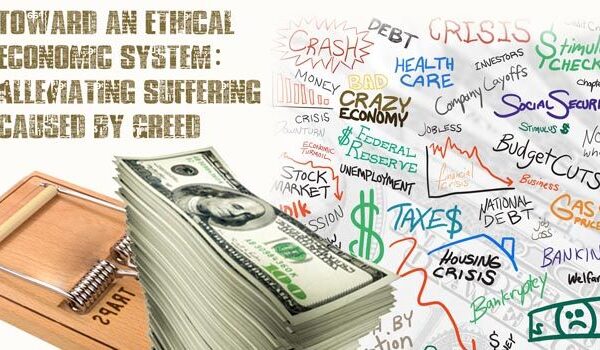
  • Toward an Ethical Economic System: Alleviating Suffering Caused by Greed

    Toward an Ethical Economic System: Alleviating Suffering Caused by Greed

    The Prophet (p) was asked which was the best kind of earning. He replied: “That for which a man works with his hands. And honest trading” (Ibn Hanbal). The Prophet himself was a trader and was well-known for his integrity. In fact, he was called “al-amin,” which means “the trustworthy,” by those who knew him.

    “It is He that has made you custodians, inheritors of the earth” (Qur’an 6:165)

    At a time when prices became high, people asked him to fix prices and he replied, “Allah is the One who fixes prices, who withholds, who gives lavishly, and who provides, and I hope that when I meet Him, none of you will have a claim against me for any injustice with regard to blood or property” (reported by Ahmad, Abu Dawud, Tirmidhi, and Ibn Majah). This points to the importance of fair trade and freedom of individuals to sell and buy without interference, allowing the market to fluctuate according to supply and demand. Price controls can result in a number of negative effects such as quality deterioration of good or services like a landlord reducing his maintenance of a rent-controlled apartment, a black market where goods are sold illegally, rationing being imposed to deal with shortages produced by the controls, and so on. However, when there is manipulation of prices by businesses or merchants in attempts to undermine market efficiency and fairness, then public interest takes precedence over individual freedom and “price controls do become permissible in order to meet the needs of the society and to protect it from exploitation and injustice” (An Islamic Perspective on Fair Trade, Ajaz Ahmed Khan and Laura Thaut).

    The importance of integrity and honor in business dealings is pointed to by the Prophet (p) saying, “A truthful and trustworthy merchant will be in the company of the Prophets, the upright, and the martyrs” (Tirmidhi). So what happens when corruption permeates the market and economies of nations and the global community are controlled by those who care little about fairness and social justice? What happens is that poverty and suffering afflict untold numbers of men, women, and children: more than 3 billion people in the world who live on less than 2 dollars a day; the people of Africa who own only one percent of the total wealth of the world; the six heirs of the Wal-Mart fortune having as much wealth as the bottom one-third of all Americans combined (roughly 100 million people); the top 0.01% of Americans making an average of $27,000,000 while the bottom 90% make an average of $31,000.

    A World System of Financial Control

    In Tragedy and Hope: A History of The World in Our Time, Professor Carroll Quigley of Georgetown University, (a teacher and mentor of Bill Clinton) wrote, “The powers of financial capitalism had another far reaching aim, nothing less than to create a world system of financial control in private hands able to dominate the political system of each country and the economy of the world as a whole. This system was to be controlled in a feudalist fashion by the central banks of the world acting in concert, by secret agreements, arrived at in frequent private meetings and conferences. The apex of the system was the Bank for International Settlements in Basle, Switzerland, a private bank owned and controlled by the worlds’ central banks which were themselves private corporations. The growth of financial capitalism made possible a centralization of world economic control and use of this power for the direct benefit of financiers and the indirect injury of all other economic groups.”

    So the central banks are at the core of this “world system of financial control,” a system “controlled in feudalist fashion” by central banks. What is this new feudalism? It’s giving every economic advantage, tax preference, and government subsidy to the “job creators,” the wealthy elites of industry and the corporate world, and attaching to that preferential treatment the mock notion that prosperity will trickle down to the general population. But in this system, everyday working men and women are like the vassals waiting outside the castle or estate wall hoping for some paltry generosity from the lord of the manor.

    A perception that the financial industry, as it is structured, is primed for unscrupulous outcomes is not without warrant. Mayer Amschel Bauer Rothschild, the 18th century banker who has been called the “founding father of international finance” is quoted as saying, “The few who understand the system, will either be so interested from its profits or so dependent on its favors, that there will be no opposition from that class” and “Let me issue and control a nation’s money and I care not who writes the laws.” Napoleon Bonaparte said, “…financiers are without patriotism and without decency; their sole object is gain.” In 1933 Franklin Roosevelt said, “The real truth of the matter is, as you and I know, that a financial element in the large centers has owned the government of the U.S. since the days of Andrew Jackson.”

    Thomas Jefferson said, “If the American people ever allow private banks to control the issue of their currency, first by inflation, then by deflation, the banks…will deprive the people of all property until their children wake-up homeless on the continent their fathers conquered…. The issuing power should be taken from the banks and restored to the people, to whom it properly belongs.” David Rockefeller wrote in his 2002 memoirs “Some even believe we are part of a secret cabal working against the best interests of the United States, characterizing my family and me as ‘internationalists’ and of conspiring with others around the world to build a more integrated global political and economic structure — one world, if you will. If that’s the charge, I stand guilty, and I am proud of it.”

    A Business Model Whose Sole Object is Gain

    Exploitation, fraud, and manipulation is the business model in international finance today, as the “sole object is gain.” Goldman Sachs made huge profits betting against investments they sold to their own clients. The big banks colluded to rig the public bids on municipal bonds, cheating cities and town of billions of dollars. Bear Stearns sold the same mortgage to multiple buyers as part of complex investments linked to mortgages. JP Morgan is being investigated for illegal manipulation of electricity markets, have been fined for violating embargo laws, and are cited in a Senate report on their $2 billion loss on derivatives about which they lied to investors and to Congress.

    This is the tip of the iceberg. Even the World Bank stands accused of fraud. Karen Hudes, who studied law at Yale Law School and economics at the University of Amsterdam, worked in the Legal Department of the World Bank from 1986 through 2007, eventually as senior counsel. She is now a whistleblower who has tried to expose questionable loan procedures involving hundreds of millions of dollars. She says, “I saw corruption. I saw that poor people weren’t getting what was coming to them. They were starving and the reason they were starving is because people made sure that the money that was intended for the poor was lining someone else’s pockets. ..The people in management wanted to make sure that the money continued to flow in the wrong direction.” She asserts that everyone in the world suffers because of the corruption at the World Bank, as it is an “international cooperative that’s owned by 187 countries including the U.S. which has a 20% share. And when there’s a breakdown in the rules of the World Bank what this basically means is that the entire financial system is broken.”

    She sounds the alarms, noting, “What I ultimately documented was something very serious which is called state-capture.“ In the literature of business and economics, state-capture is defined as “… efforts of firms to shape the laws, policies, and regulations of the state to their own advantages by providing illicit private gains to public officials” (Hellman and Kaufman, 2001). Citing a landmark Swiss study published in the PLOS ONE journal on the “network of global corporate control,” Hudes notes that a small number of entities — mostly financial institutions and especially central banks — dominate the international economy. “What is really going on is that the world’s resources are being dominated by this group.” Included in the core network of control, as noted in the study, are familiar names including Morgan Stanley, Citigroup, Merrill Lynch, Bank of America, JP Morgan Chase, Goldman Sachs, Bear Stearns, Lehman Brothers, and others. According to the study, 147 financial institutions and central banks, in particular the Federal Reserve, stand at the very core of this super-entity that, through its complex network, controls the international financial system. “This is a story about how the international financial system was secretly gamed, mostly by central banks — they’re the ones we are talking about.”

    Those Who are Ruled by Avarice

    There are many wealthy people in the world whose fortunes are acquired legally, through hard work, who live decent, moral lives, and who care about the poor and disadvantaged. But there is a percentage of the super wealthy who care nothing about fairness and social justice and seek to reign over the world’s population. They have the upper hand, poised as a ruling class, enjoying power and privileges that they do not want to relinquish or see diminished in any way. They typify those who are ruled by their avarice: “If the son of Adam were given a valley full of gold, he would love to have a second one; and if he were given the second one, he would love to have a third…” (Bukhari).

    Those who engage, as described by FDR, in “business and financial monopoly, speculation, reckless banking, class antagonism, sectionalism, [or] war profiteering” are willing to exploit ordinary people in order to ensure that surplus value produced by those who labor for a living is channeled exclusively towards the top, to the owners of capital. Workers are paid as little a wage as possible that allows, just barely, the survival of themselves and their families so that the elites may further hoard their wealth. This is contrary to the divine injunction to make sure that the distribution of wealth does not unfairly advantage some to the abject detriment of others. Abu Saeed Khudhri reports that the Prophet (p) said; “Anyone who possesses goods more than his needs, should give the surplus goods to the weak (and poor); and whosoever possesses food more than his needs should give the surplus food to the needy and the destitute” (Al-Muhalla by Ibn Hazm).

    Neo-Liberalism: Endorsing the Structural Imbalance

    A structural imbalance between capital and labor is embedded in the system to ensure the ascendancy of the elite class. This is the division of humanity into two groups: the great masses of humanity who toil in order to survive, and through their productivity create surplus wealth in which they do not share except in meager ways. Instead that wealth is directed to the ruling elite, a very small group who claim for themselves all the fruits of humanity’s labor including property, privilege, and leisure.

    Liberal social philosophy recognizes the need for the government to ensure that wealth and power are distributed in ways that create a more equitable and decent society. In opposition to liberalism as a social philosophy is the program of the ruling class, which is called, ironically, neo-liberalism. Liberalism as a social philosophy is often confused with economic liberalism or neo-liberalism. In our current political discourse, we continually hear sound bites about the free market, deregulation, cutting of social services, privatizing of state-owned assets, and the primacy of individualism over and against the collective needs of society. In fact, these are the interlocking characteristics of neo-liberalism:

    1. The market rules – the idea is that a “free” market, unimpeded by state imposed controls or interventions, would unleash the creative and innovative entrepreneurial spirit that fuels economic growth and prosperity for the entrepreneurial class which then “trickles” down to the middle class and the poor.
    2. Deregulation is the standard of the “free” market – unhindered by regulation, profits are maximized. This includes weakening or eliminating of unions and collective bargaining, reduction of wages or at least minimalizing and keeping them static. Labor laws including those regarding minimum wage, the eight-hour workday, health and safety, and anti-discrimination are to be weakened or dismantled.
    3. Cutting of social services – this is promoted under the guise of reducing the size and role of government. While subsidies to businesses and tax breaks and benefits for the wealthy are to continue, the safety-net for the poor and middle class is to be reduced. Cuts are to be made to education, health care, and maintenance of infrastructure including roads, bridges, and water supply systems.
    4. Privatization – infrastructure crumbles from lack of care as any semblance of a robust, activist government and its necessity spending is demonized; then the clarion call about government incompetence and inefficiency is made. The selling of state-owned enterprises to private investors is advocated, including toll roads, water systems, hospitals, prisons, education, etc.
    5. Elimination of regard for public good, of shared community and fellowship – the primacy of the individual is trumpeted, over and against any claims of the social collective and the common good. Emphasis is on individual responsibility to the extent that those who are poor or disabled or needy are left to their own resources and when unable to procure basic or adequate services in education, healthcare, etc., they are called lazy or irresponsible.

    Neo-liberalism, as a ruling class program, considers that the only legitimate purpose of the state is to safeguard individual and commercial liberty and property rights. It opposes any policy that would intervene in the elite-favoring distribution of wealth and power. In this paradigm, instances of inequality and social injustice are deemed morally acceptable as they are considered the result of freely made choices and decisions by individuals in a free market. Many capitalists who argue for a laissez-faire economic system cite what is known as “social Darwinism” which applies Charles Darwin’s principles of natural selection to human society. Fierce competition is thus considered natural in the fight for survival, and “survival of the fittest” means that the rich and successful individuals are the “fittest” and the poor and needy, the deprived, the disadvantaged, all are rightfully doomed to failure and misery.

    Rapacious Capitalism

    That cynical and selfish perspective results in what we have today — rapacious capitalism. William Deresiewicz in a piece in the New York Times in 2012, titled Capitalists and Other Psychopaths, wrote, “… Enron, BP, Goldman, Philip Morris, G.E., Merck, etc., etc. Accounting fraud, tax evasion, toxic dumping, product safety violations, bid rigging, overbilling, perjury. The Wal-Mart bribery scandal, the News Corp. hacking scandal — just open up the business section on an average day. Shafting your workers, hurting your customers, destroying the land. Leaving the public to pick up the tab. These aren’t anomalies; this is how the system works: you get away with what you can and try to weasel out when you get caught.”

    That is truly a description of capitalism gone wild in rapacious and dissolute abandon: using every sort of predatory and amoral tactic to plunder people and the environment for the satisfaction of greed. In tandem with this is the pushing of unbridled consumerism on the people of the world; this is central to the policy of perpetual economic growth. Yet, the idea of a perpetually growing economy is a flawed one. We live upon a finite planet with exhaustible resources and a finely-tuned and balanced ecology that can be tipped to an out-of-kilter state that cannot recover. Out-of-control growth is cancer. A healthy organism is in a state of homeostasis. As such, the earth has self-regulating mechanisms and feedback cycles that maintain stability, balance, and proportion. According to the U.S. Environmental Protection Agency , “Sustainability creates and maintains the conditions under which humans and nature can exist in productive harmony, that permit fulfilling the social, economic and other requirements of present and future generations.” There must be a proper interplay of the “three pillars” of sustainability: environment, social equity, and economic demands.

    Co-op Capitalism

    In contrast to greed capitalism is a concept called “co-op capitalism,” promoted by Noreena Hertz, a Cambridge University economist. Co-op capitalism unites businesses, governments, NGOs, and the general public in a collaborative task of creating business models and financial structures that encompass profits but also the social good. She mentions the Emilia-Romagna region in Italy which is “the seventh-most-successful economic region in Europe.” She stresses that they must be doing something right in using a cooperative model where workers own shares in the companies they work for. The co-ops are profit oriented but they take a long-term focus and success is a collective, collaborative success. On SolidarityEconomy.net, Frances Moore Lappe writes about the Emilia-Romagna region, “whose hub city is Bologna, is home to 8,000 co-ops, producing everything from ceramics to fashion to specialty cheese. Their industriousness is woven into networks based on what cooperative leaders like to call ‘reciprocity.’ All co-ops return 3 percent of profits to a national fund for cooperative development, and the movement supports centers providing help in finance, marketing, research and technical expertise. The presumption is that by aiding each other, all gain. And they have. Per person income is 50 percent higher in Emilia Romagna than the national average.”

    Islam Espouses an Ethical Economic System

    Islam is clear and straightforward in espousing the ideals of cooperation and solidarity. The Prophet (p) said, “Truly The faithful are to one another like a building—the different parts support the others” (Bukhari and Muslim). Islamic teachings stress the importance of social equity and justice. The Qur’an says, “God loves those who are fair and just” (Qur’an 49:9). Also advocated is protection of the weak from economic exploitation by the strong. Allah SWT says, “Give just measure and weight, and do not withhold from the people the things that are their due” (Qur’an 7:85). The importance of properly paying wages is referred to in the hadith: “Give the worker his wages before his sweat dries”(Tirmidhi and Ibn Majah). With reard to business transactions, the Prophet said, “…if both parties spoke the truth and described the defects and qualities (of the goods), then they would be blessed in their transaction, and if they told lies or hid something, then the blessings of their transaction would be lost” (Bukhari).

    As to those who engage in fraudulent activities and enterprises, the Qur’an says, “Woe to those who deal in fraud, those who, when they have to receive by measure from men, exact full measure, but when they have to give by measure or weight to men give less than due. Do they not think that they will be called to account on a Mighty Day, a day when mankind will stand before the Lord of the Worlds? (Qur’an 83:1-6). And in another verse, “And, O my people, give full measure and weight justly, and withhold not from people the things that are their due, and act not corruptly in the land making mischief” (Qur’an 11:85).

    Regarding protection of the environment, humans are appointed the stewards of the earth and this is a trust to be fulfilled with great responsibility and devotion. The Qur’an says, “It is He that has made you custodians, inheritors of the earth” (Qur’an 6:165). And Prophet Muhammad (p) said, “The world is green and beautiful, and Allah has appointed you His guardian over it” (Muslim). With regard to the impulse to greed and hoarding of wealth, the Qur’an says, “And let those who hoard gold and silver and do not spend them in the way of Allah know that a severe and painful punishment is awaiting them” (Qur’an 9:34). And in another verse, “By no means shall you attain piety unless you spend of that which you love; and whatever of good you spend, Allah knows it well” (Qur’an 3: 92). In contrast to the neo-liberal policy of disregarding the social good and shirking any responsibility for the poor and needy, the Qur’an says, “They ask you what they should spend. Say: whatever you spend of good must be for parents and kindred and orphans and the poor and the wayfarer; and whatever you do of good deeds, truly, Allah knows it well” (Qur’an 2: 215).

    Requisite Goals for a Fair and Economically Sustainable World

    Social justice and economic equitableness, respect for nature and protection of the environment, human and civil rights, peacemaking —these are requisite goals for a fair and economically sustainable world. In such a world, the markets would serve the interests of people and corporations would be socially responsible. GDP alone would not define success; quality of life and protection of the environment would be primary factors for consideration. Business schools would teach ethics and long-term thinking in their core curricula. Economics would not be reduced to mathematical formulae but elevated to take into account the social, ethical, and spiritual needs of humanity. Rather than the excesses, inequities, and biases of the current model, all things would be balanced fairly in the aim for social justice and harmony.

    What will it take to alleviate the suffering in the world caused by greed?

    “Men whom neither trade nor selling diverts from remembrance of God, nor from performing the prayer or giving in charity — they fear a day when hearts and eyes will be transformed ; that God may reward them according to the best of what they did and increase them from His bounty…”

    (Qur’an 24:37-38).


  • Empowering Women – Reinstituting the Divinely Ordained Balance

    Empowering Women – Reinstituting the Divinely Ordained Balance

    Most human authority, historically, has deemed itself privileged, preferred, and entitled. That has repeatedly resulted in debasement, harm, and denial of rights for countless human beings. Prophet Muhammad, peace be upon him, however, delivered to humanity a model of leadership based on serving, of being a servant — first to God and then to other people and the rest of the created world. In this model, there is no basis for an unquestioned supremacy of leaders, let alone a leader’s self-proclaimed super ordinate position.

    To put the leadership of the man within the family or society within divinely ordained bounds does not impinge on the honor, dignity, and empowerment of men. And neither does the empowerment of women impinge on men

    If our leaders do not have genuine spirit of service in their hearts, then we end up with corruption and widespread injustices and misery. Umar (RAA) is reported to have said to the people, “I have appointed over you governors and agents, not to beat your bodies or take your monies, but rather to teach you and serve you.” Those who understand the infrastructure of authority and obedience as serving a greater good, will teach and serve. Those who imperil their own souls with prideful self-aggrandizement, serve themselves and cavalierly turn a blind eye to maltreatment of others and denial of their rights and even the means of survival beyond subsistence. Those who serve themselves care only about reaching their own greatest potential, typically in terms of power, prestige, and wealth, even while denying to others the opportunities to progress and thrive.

    Authority & Obedience are Functional & Contractual

    Leadership in Islam is intended to serve the needs of the people and support the greater good. It also is meant to unlock the greatest potential, whose pivot is spiritual, in all human beings, both of the leader and those who follow that leadership. That only takes place when the leader understands the limits and qualifications placed upon his authority/power, and is devoted to the objectives of leadership according to Islamic teachings. With awareness that leadership in Islam ordains that both authority and obedience subscribe to the same system of belief, the same objectives and goals, the same adaab, selfsame surrender to the Lord, and to the same criteria of the permissible and the forbidden, much of the danger attached to the wielding of power is dismantled. Common wisdom is that power corrupts and absolute power corrupts absolutely, wherein a leader takes on attributes of arrogance and overweening pride. Islam, however, makes it crystal clear that authority and obedience are contractual, an agreement between two or more aiming for a common purpose; the root meaning of “contract,” in English, is “to draw in, to bring together.” This is in contrast to the leader having power over and against those within the domain of his authority.

    The European concept of the divine right of kings which held sway through the middle ages, asserted that the leader is legitimized and given the right to rule according to the direct will of God, without being conditional upon anything else. Islamically, the leader’s authority is conditional upon obedience to Allah SWT and His messenger, and obligated to standards of bil ma’ruf —in accordance with shari’ah and all that is good (discussed in more detail below). Leadership in Islam is a trust. The leader has been entrusted to guide and to serve those who follow him. And when a leader breaches that trust, whether by error or malfeasance, he is to be corrected. When Abu Bakr (RAA) was chosen as khalif, he made the following pronouncement to the people: “O people, I am appointed as your ruler. I am not the best among you. If I do good, help me; if I do wrong, straighten me. Truth is honesty and falsehood is treason. The weak among you is strong until I restore his right for him; and the strong among you is weak until I take the other’s rights from him, insha’Allah…Obey me as long as I obey Allah and His messenger. If I disobey them, you don’t owe me any obedience…” This is supported fully by the hadith, “There is no obedience to any created being in disobeying the Creator” (Ahmad).

    Now imagine Abu Bakr (RAA) or any of the other three rightly-guided khalifs declaring that he is superior to other people because he has been appointed the leader! Contrariwise, imagine if every husband announced to his wife upon marriage, “O dear wife, I have been appointed by Allah SWT as the ameer of the family. This does not mean that I am better than you. If I do good, help me; if I do wrong, straighten me. Truth is honesty and falsehood is treason. I will restore the rights of any family member who is rendered weak by circumstance; and I will ensure that my position of strength in the family never takes your or the children’s rights away, insha’Allah…Obey me as long as I obey Allah and His messenger. If I disobey them, you don’t owe me any obedience…”

    In fact, the man whose intention is to please Allah SWT seeks to reach his greatest potential in perfecting character. And this is only achieved if he desires and facilitates his wife and his children reaching their greatest potentials as well.

    Illustrating this in a practical way within the family is a story about a couple who went for Islamic counseling because they had differing views about how to discipline their children. The father was very authoritarian, believing that the children were obligated to respect and obey him unconditionally. He was extremely strict and when he perceived any instance of disrespect or noncompliance with the rules he had established for the children, he would lose his temper and grab for anything handy to hit the children with. When the mother would try to intervene and stop him from hitting one of their children, he would scream at her that she had no right to stop him and that her actions were undermining his authority. In a counseling session, the counselor asked the man to describe what his wife said and did when she intervened. The man admitted that she very calmly would put her hand on his shoulder and say something like, “Why don’t we sit down and talk about this situation and see if we can find some solution we can all learn something from.” The counselor asked if she had a disrespectful tone or attitude. The man said that she did not. The counselor also asked if he and his wife had discussed the matter of discipline privately, when the children were not around, in order to come to some consensus. They had spoken about it many times, according to the husband, but had found no common ground.

    The counselor pointed out that the intervening by the man’s wife falls under the category of enjoining the right and forbidding the wrong, as the father was acting out of anger and his harshness would harm the child. His temper also taught the child indirectly that the indulging of impulse and anger is acceptable, rather than teaching the virtue of self-restraint. She also was following the Qur’anic principle that we should “remind” our believing brothers and sisters about the teachings of Islam, because “reminding benefits believers.” The counselor also pointed out the hadith about helping your brother whether he is the oppressed or the oppressor, and that the way to help the oppressor is to stop his oppression. This was an entirely new way to look at the dynamic and the husband began to gain a broader awareness and deeper understanding of the issue of disciplining the children and of his wife’s efforts to calm the situation down when he got over-reactive.

    In fact, the man whose intention is to please Allah SWT seeks to reach his greatest potential in perfecting character. And this is only achieved if he desires and facilitates his wife and his children reaching their greatest potentials as well. Their strength of character is a great motivator and mirror for him, as his strength of character is for them. And while there is something of hierarchy advocated by Islam for every group — a group traveling or studying together, a communal group such as family or clan, a body politic such as a nation — in that they should select an ameer for an efficient and disciplined operation of the group, there is also a built-in egalitarian check and balance. If the leader does good, the others in the group are to assist and obey; and if he does wrong, they are to do what needs to be done to set things right.

    Those who lead based on an understanding of leadership as some kind of power and privilege over others, unqualified and absolute, are hard put to justify their position when confronted with the exemplary leadership of the Prophet (pbuh) and the companions. There is a story about Umar (RAA) when he was khalif that further illustrates the real-life application of these principles of Islamic leadership. It is both serious and humorous. He was walking through the streets of Medina one evening, making sure that all was peaceful and secure in the city under his rule. He heard sounds of some sort of depravity coming from a house. He became incensed and knocked on the door. No one answered, so he climbed upon on the wall of the courtyard and yelled down to the man in the inner courtyard, “Why are you breaking the law and allowing such behavior in your house?” The man replied, “No man has the right to speak to another in that manner. Maybe I have committed a wrong, but think how many wrongs you have committed — spying, despite Allah’s command, ‘you shall not spy’; breaking and entering by climbing over the courtyard wall despite the command of Allah to ‘enter a house by the door’; entering without the owner’s permission in defiance of Allah’s command to ‘enter no house without the owner’s permission’; and omitting the salaam, though Allah has commanded ‘enter no house without indicating that you are a friend and greeting with peace those within.’” Umar (RAA) withdrew in remorse saying, “I forgive you your wrong.” The man responded, “That is your fifth wrong; how can you say that you forgive what Allah has condemned as a wrong?”

    Authority is Qualified by Bil Ma’ruf

    The reason that authority is given the fullest respect and is owed obedience in Islam is because it commits itself to upholding the law first and foremost as applied to itself, and is willing to be corrected if it errs. Umar said, “May Allah bless the one who brings me my shortcomings as a gift.” The bottom line is that obeying those in authority is provisional on their adhering to the commandments of Allah SWT and the sunnah of the Prophet (pbuh), including speaking and acting according to bil ma’ruf. A verse in the Qur’an relates the incident of a group of women who came to the Prophet, peace be upon him, to pledge their loyalty to him and the Message. They were asked to obey the Prophet (pbuh) as long as what he commanded was bil ma’ruf: “O Prophet! When believing women come to you to take the oath of fealty to you, that they will not associate in worship any other thing whatever with Allah, that they will not steal, that they will not commit adultery, that they will not kill their children, that they will not utter slander, intentionally forging falsehood, and that they will not disobey you in any matter which is bil ma’ruf, then do receive their fealty, and pray to Allah for their forgiveness; for Allah is Oft-Forgiving, Most Merciful” (Qur’an 60:12).

    In the phrase “enjoin the right and forbid the wrong,” the word translated as “right” is ma’ruf. This Arabic word is very comprehensive. As already mentioned, ma’ruf is that which is in accordance with sharia and all that is good. That includes justice, fairness, respect, equity, caring, compassion, considerateness, kind regard, and what is Islamically customary. Now we know that the Prophet would never command that which was not bil ma’ruf. Yet Allah SWT qualifies obedience to the Prophet with this condition. Therefore, we can understand that obedience to any human being is contractual and functional, conditional on their leadership and command conforming to bil ma’ruf. Demonstrating disrespect or unfairness, or lack of compassion, considerateness, or kindness would be a betrayal of the condition of bil ma’ruf. Addressing husbands, the Qur’an says, “…Live with them on a footing of bil-mar’uf” (Qur’an 4:19).

    Reinstituting the Divinely Ordained Balance

    Some might think that discussion of this sort leads to a disempowering of men by a commensurate empowering of women. And they worry that empowering women might lead to female arrogance or rebellion or neglect of the primary duty of women to bear and raise children who enjoin the right and forbid the wrong, children who place their most precious values in the domain of the spiritual rather than the material, who establish prayer, who are sincere lovers of truth and persevere against all odds to worship Allah SWT and to make peace in the world. Muslim women know this is their primary responsibility — raising this caliber of children.

    And some caution that a social and political space that is inclusive of women will lead to fitna and, again, to dereliction of childbearing and childrearing. With regard to fitna, we only need to look at Islamic history in Mecca and Medina to see the full involvement of women and the positive contribution they made to the early success of the Islamic mission. With regard to dereliction of duty, we need to consider that children grow up and a woman (the mother) has then another ten or twenty or thirty years to engage in productive activities beyond childrearing, utilize her gifts and develop her skills, and to contribute to the welfare of society. Furthermore, studies also show that a full ten percent of couples are unable to conceive. The population of the world today is roughly seven billion. Approximately half are women. Of those 3½ billion women, 10 percent will be in marriages that are childless. That is 350 million women. That is a lot of human energy, talent, resource, and potential for contribution to the good of humanity.

    In addition, with regard to worry that empowering women will bring some negative effects, we should note that Allah knows that human beings are prone to transgress all bounds (96:6-14); to be ungrateful (7:10); inclined to hasty deeds (17:11;) given to impatience (70:19-21); prone to arrogance (75:31). And yet Allah SWT honors the children of Adam: humans are created in the best of molds (95:4), gifted with faculties (90:6-8), deputed with vicegerency on earth (2:30), and blessed by favors (16:4-8), including the freedom to choose what to believe: “Say, ‘The truth is from your Lord. Let him who will, believe; and let him who will, reject.’” (Qur’an 18:28-29). Such honor and distinction is imparted to all human beings, regardless of their flaws or potential for errors or sins. Such honor and distinction empowers them to use free will to strive for excellence and to properly and successfully deal with the tests that have been enjoined upon humanity — to eschew the promptings of the ego, of the lower self, and cultivate the aspects of self that strive for purity of heart and soul.

    To put the leadership of the man within the family or society within divinely ordained bounds does not impinge on the honor, dignity, and empowerment of men. And neither does the empowerment of women impinge on men. It also does not impinge on the honor of men to note that women by nature are the ones predisposed to cooperation, submission, inclination to peaceful relations rather than confrontation or conflict, to be cautious about asserting themselves beyond established boundaries. The predisposition of men, given the biological prompting of testosterone, are more inclined to competition, desire for dominance, willingness to engage in physical confrontation, given to push boundaries and claim new territories. This, of course, is part of the divine design, ensuring that humanity will survive, build, invent, progress, and thrive.

    But does not the standing up for justice and enjoining the right and forbidding the wrong require both male and female dispositions— both male courage and assertiveness and female compassion and devotion to the well-being of families, children, and those in need? Does not the progress and prosperity of human society require empowerment of both men and women? Can children be raised to be strong in character if mothers, their first teachers and most influential mentors, are indoctrinated to believe that they are weak and debilitated? Studies show that a child’s personality and basic attributes are already formed by age three to five. Empowered women raise empowered children.

    We can find ample indications of honoring and worthiness of the female gender in the divine scheme of things. The emotional predisposition of women has within its scope female intuition, compassion, and the general inclination to nurture. These attributes should be seen as noble and esteemed. But the emotional predisposition of women has often been presented as a liability, described in terms of instability, incapacity, hysteria — generally, inferiority. It is true that the intellect has been raised high in honor by the teachings of Islam. And the intellectual/logical predisposition of men as a gender has been rendered by scholars and writers as noble and esteemed. Yet, according to the Prophet (pbuh), the highest level of the intellect, after eman, is to be of service to the creation. To which gender does serving others come more naturally? Serving others is within the scope of the female inclination to nurture and to feel compassion toward others. The highest level of the intellect after eman, according to the Prophet, is not intellectualism, logic, or deductive reasoning. It is the serving of others. And that is predispositionally a female trait.

    Another example is the way the companions of the prophet understood the purpose of acquiring knowledge – that the primary purpose was to become more nurturing, caring, and merciful toward others. So the intellect, and its capacity and propensity to acquire knowledge, traditionally seen as a male domain, have ends and objectives which are more distinctly feminine and emotionally based (i.e., serving others, nurturing, caring, and being merciful). Further, the Prophet said, “Knowledge is a tool to facilitate obedience. Look to whose authority you take it [knowledge]” (Muslim). Obedience to Allah SWT is a fundamentally noble action. Obedience is conjoined to the ultimate challenge of surrendering wholly to Allah SWT. Here again, obedience and surrender are integral to the natural disposition of women, more-so than to the disposition of man. Obedience and surrender are acquired by man through knowledge of deen, refinement of the character, and training.

    The best example, however, that points to the honor that Allah SWT has bestowed on women as a gender has to do with mercy. We know that the foremost attribute of Allah SWT is rahmah. He is the Benevolent, The Merciful. And we know from hadith Qudsi that His Mercy prevails over His Wrath. Which gender, by nature, is the more merciful, compassionate one?

    The only intention in making these points is to underscore that Allah SWT has honored women just as He has honored men. Imagine if after citing these indications of female honor and dignity we then went further and declared that women are superior to men. We would have tipped the scale and instituted imbalance, with an egotistic desire pushing heavily on one side of the scale. But the most elegant and stable balance has been divinely ordained and must be observed, for it is God Who “understands the finest mysteries and is well-acquainted [with them] (Qur’an 33:34). And He (SWT) makes it clear that men and women, together, can serve the greater good and become worthy of His forgiveness and enduring reward:

    “Indeed, the submitting men and the submitting women, the believing men and the believing women, the obedient men and the obedient women, the truthful men and the truthful women, the steadfast men and the steadfast women, the reverent men and the reverent women, the charitable men and the charitable women, the fasting men and the fasting women, the chaste men and the chaste women, and for men and women who engage much in God’s praise — God has prepared for them forgiveness and a great reward” (Qur’an 33:35).

  • Towards a More Just and Equitable World

    With ever-greater clarity, Americans are realizing it is their right to expect basic human dignity and security and the fundamentals of a middle-class existence: a decent job with life-sustaining wages, an affordable home, access to health care, resources to provide a good education for their children; and especially, the right to full participation in governance of the country with a view to promote the common good and provide opportunity for security and prosperity for all citizens, not just the “high-born,” inheritors of dynastic wealth, and the select few who succeed beyond all measure.

    People everywhere are realizing that when the masses demand a more just and equitable world, their strength in numbers exceeds the money-backed monopolization of power by tyrants, “managerial aristocrats,” and government and their agents

    The middle class has, in fact, all but collapsed. In a Northeastern University study released in mid 2011, “The ‘Jobless and Wageless Recovery’ From the Great Recession of 2007-2009,” economists reported that the economic collapse which devastated American workers brought tremendous reward to the corporations. “Between the second quarter of 2009 and the fourth quarter of 2010, real national income in the U.S. increased by $528 billion. Pre-tax corporate profits by themselves had increased by $464 billion while aggregate real wages and salaries rose by only $7 billion or only .1% (one-tenth of one percent). Over this six quarter period, corporate profits captured 88% of the growth in real national income while aggregate wages and salaries accounted for only slightly more than 1% of the growth in real national income.” And further “The absence of any positive share of national income growth due to wages and salaries received by American workers during the current economic recovery is historically unprecedented.”

    Plutonomy: The Rich Getting Richer

    Two memos written by Citigroup analysts in 2005 and 2006 were leaked to the public domain. The memos examine the disparities of wealth and economic inequalities in the U.S. and around the world and how that is, and should be, viewed by the wealthy elite. The memos were written for Citigroup’s elite clients, to keep them abreast of what is really going on so that they could make optimal investment decisions. Citigroup has attempted to suppress the memos but they are widely available online. They coin the word “plutonomy” (as a variation of “plutocracy”) which is an economy in which the wealthy class dominates and, by extension, rules the people. It is an economy whose trajectory is that of the rich “getting richer” while the masses are cast aside and overlooked as insignificant. A summary of the memos is as follows:

    The world is composed of two groups – plutonomies which are countries in which the economy is powered by the wealthy few who are also the main and only important consumers; and other countries/economies which are not plutonomies and don’t really matter. The wealthy few are “The New Managerial Aristocracy” that comprise the top 1 percent of households and have a net worth greater than the other 90 percent. The non-wealthy, the memos go on to say, tolerate plutonomy because they believe that one day they might become a “Pluto-participant” which is the embodiment of the “American dream.” If they were to come to the conclusion that they would never be part of the upper economic echelon, they would more likely want “to divide up the wealth pie, rather than aspire to be truly rich.” The memos mention a further threat if a population comes to see its economy as a “Robber-baron” economy and that they have lost out to unfair practices. Therefore, the Citigroup analysts note that a “cleaning up of business practice” to
    the extent that the public would feel that conditions were more favorable to fair play could actually protect and sustain the plutonomy.

    People everywhere are realizing that when the masses demand a more just and equitable world, their strength in numbers exceeds the money-backed monopolization of power by tyrants, “managerial aristocrats,” and government and their agents

    With total honesty in conveying the current economic reality, the Citigroup analysts unabashedly talk about the disparities in wealth as a great contest that they have won and will continue winning. The memos conclude that the rich will continue getting richer and…well, to hell with the rest of the people.

    A Criminalized Financial Industry

    According to 2010 statistics, CEOs at some of the largest companies earn 343 times the amount the typical worker earns (that’s $5,480 per hour!) These are the individuals who “own” the country. This “managerial aristocracy” is crass and uncaring about anyone outside their privileged caste. Unfortunately, even those with the best intentions who find themselves with a career in the financial industry will have a hard time keeping to the straight and narrow path of ethical behavior as the culture that exists on Wall Street is one that galvanizes greed. Charles Ferguson of the British daily newspaper The Guardian writes, “It is no exaggeration to say that since the 1980s, much of the global financial sector has become criminalized, creating an industry culture that tolerates or even encourages systematic fraud. The behavior that caused the mortgage bubble and financial crisis of 2008 was a natural outcome and continuation of this pattern, rather than some kind of economic accident. “

    Narrated Ibn ‘Abbas: I heard the Prophet saying, “If the son of Adam (the human being) had two valleys of gold, he would wish for a third, for nothing can fill the belly of Adam’s son except dust; and Allah forgives the one who repents to Him.”

    Wealth Heightens Greed and Decreases Empathy and Altruism

    New research is showing that wealth appears to also decrease empathy and altruism. Dacher Keltner at the University of California, Berkeley has researched how wealth correlates to emotional intelligence and empathy. “The profound self-interest and social disconnect” of Wall Street bankers spurred his interest in this area of research. Keltner and his colleague Michael Kraus found that “the poorer subjects were more likely to use warmer and more expressive body language and gestures that signal engagement, while the richer participants were more stand-offish.” In another experiment to measure empathy, those with more prestigious jobs were less able to read the emotions expressed in photos of human faces, a test used to determine emotional intelligence. In testing altruism by whether a participant would share a reward, “people from less-privileged backgrounds tended to give more than those higher on the social ladder.” It was also shown that wealthier participants were more prone to unethical behavior than poorer participants. Hazel Rose Markus at Stanford University in California has also found in her research that the degree of caring about the welfare of others and altruistic impulses lessen with social and financial success.

    We can help change the balance of power, be part of a tenacious push of government officials and corporate executives to act responsibly and respond to the needs of the majority

    Not surprisingly, the Prophet, peace be upon him, said, “I don’t fear poverty for you, but rather I fear that you will compete with one another [in acquiring wealth]” (reported by al-Hakim and others). And in another hadith: “Two hungry wolves, if let loose amongst a flock of sheep, cause less harm than a man’s eagerness to increase his money and his prestige” (reported by al-Tirmidhi, Ahmad, and others).

    Elite Worry About Uprisings

    Elites have worried throughout time about uprisings by the poor or oppressed masses and this is not entirely without reason. As Howard Zinn writes in A People’s History of the United States, “The new industrialism, the crowded cities, the long hours in the factories, the sudden economic crises leading to high prices and lost jobs, the lack of food and water, the freezing winters, the hot tenements in the summer, the epidemics of disease, the deaths of children – these led to sporadic reactions from the poor. Sometimes there were spontaneous, unorganized uprisings against the rich.”

    When organized and resolute, the common people have demonstrated in effective ways to bring about political and social change. Some of these uprisings (and some argue the most effective) have been non-violent. Examples include Mahatma Gandhi’s campaign to win India’s independence from British rule, Martin Luther King’s movement to win civil rights for African Americans, Cesar Chavez’ struggle to improve the treatment of farm workers in California in the 1960s, the Velvet Revolution (sometimes referred to as the Gentle Revolution) in Czechoslovakia in 1989 that brought about the collapse of the Communist government, and the non-violent women’s peace movement led by Leymah Roberta Gbowee (awarded the Nobel Peace Prize in 2011) that brought an end the Second Liberian Civil War in 2003.

    Envy Is Not the Motivation

    Misery from the deplorable conditions that are caused by great disparities of wealth – not envy – brings about social reform movements. Most people don’t envy the CEO earning 343 times the amount of the median American income, as they view a wage of $5,480 per hour as just insanely profligate. Just as they view the minimum wage of $7.25 per hour equally insane, ridiculously insufficient to provide a livable wage that enables people to enjoy a dignified and moderately secure life without moment-to-moment worry about survival. Yet in this richest of countries so many families are unable to provide adequately for their food, shelter, and basic necessities; let alone have access to health care so that the threat of illness and disease does not hang like a wreaking ball above heads and outside the walls of their houses. The fact is that any reform in this country – whether the abolitionist movement to end slavery, labor rights to decent wages and safe working conditions, child labor reforms, women’s right to vote,

    civil rights for African Americans – has been won by efforts by the common people rather than being conceded by those in power.

    The Rallying Calls of Humanity

    What puts fear into the hearts of the ruling elite are the rallying calls of humanity insisting that the playing field be made level; that the non-rich be provided opportunity of education that allows them to thrive and succeed; that government institutions, economic policies, and social practices are fair to all; that obstacles are removed rather than increasingly placed in the way of the people striving to become educated, self-aware, socially conscious, and fundamentally secure in their homes and jobs and communities.

    There are many actions we can take to support and forward social justice and social reform movements:

    Make your political voice heard. Let your congressmen know that –

    The Gramm-Leach-Bliley Act needs to be repealed and a new Glass-Steagall Act passed so that there is definitive distinction of insurance companies, commercial banks, and investment banks.

    Taxpayer money must not be used for lobbying. For example, if a company gets bail-out money it should not turn around and use that money to lobby for legislation and policy that benefits business by hurting consumers.

    Repeal the carried-interest tax break (according to Suzanne McGee, writing for msn.money.com, carried interest allows wealthy individuals like Mitt Romney to pay an effective income tax of about 15 percent; she says, “Carried interest is what managers of different kinds of investment pools – venture capital funds, hedge funds and private equity funds like Romney’s former business, Bain Capital – earn by managing the money they raise on behalf of their limited partners.”

    Increase the number of investigators for the Financial Fraud Enforcement Task Force chaired by Attorney General Eric Holder and call for the U.S. Justice Department to aggressively prosecute financial crimes by Wall Street bankers.

    Increase funding for the Consumer Financial Protection Bureau which was set up by Elizabeth Warren to, according to the bureau, “promote fairness and transparency for mortgages, credit cards, and other consumer financial products and services.”

    Strengthen the Dodd-Frank Wall Street Reform and Consumer Protection Act.

    Become familiar with whistle-blowers in various industries as they provide a good overview of the corruption that needs to be addressed. A few examples are as follows:

    John Perkins – wrote Confessions of an Economic Hitman, an exposé of international corruption. According to Perkins, based on his first-hand experience, economic hitmen are “highly paid professionals who cheat countries around the globe out of trillions of dollars. They funnel money from the World Bank, the U.S. Agency for International Development (USAID), and other foreign ‘aid’ organizations into the coffers of huge corporations and the pockets of a few wealthy families who control the planet’s natural resources. Their tools include fraudulent financial reports, rigged elections, payoffs, extortion, sex, and murder. They play a game as old as empire, but one that has taken on new and terrifying dimensions during this time of globalization.”

    Catherine Austin-Fitts – served as managing director of the Wall Street investment bank Dillon, Read & Co. Inc., was Assistant Secretary of Housing and Federal Housing Commissioner at HUD in the first Bush Administration, and was the president of Hamilton Securities Group, Inc., an investment bank and financial software developer. As an insider, she blew the whistle on what she sees as a “financial coup d’état”: “The ‘strong dollar policy’ – including the housing and debt bubble, trillions in financial fraud, and the suppression of the gold price – was part of a intentional plan to move trillions out of North America, both overtly and covertly. I refer to this as a ‘financial coup d’état.’ Wall Street and Washington issued trillions in fraudulent securities, used it to gain control over trillions in assets, and then were able to engineer the taxpayers refinancing out the fraudulent paper. Think of this as a leveraged buyout of a planet. To the victors go the spoils. That is why we are seeing the people who engineered the coup so richly rewarded.”

    Wendell Potter – former public relations spokesperson for CIGNA and Humana Insurance, is the author of Deadly Spin: An Insurance Company Insider Speaks Out on How Corporate PR is Killing Health Care and Deceiving Americans. Potter has testified to Congress about the tricks used by health insurance companies to “dump the sick” and about the “obscene salaries executives rake in while denying benefits to patients.” Potter has been called the industry’s “worst nightmare.”
    Thomas Andrews Drake – a former senior executive of the National Security Agency (NSA), an Air Force and Navy veteran, was charged in 2010 with espionage and the “mishandling” of government documents. In June, 2011 the government agreed not to seek any jail time in return for Drake’s agreement to plead guilty to a misdemeanor of misusing the agency’s computer system. Drake maintains his full innocence and says he was targeted because he blew the whistle on the NSA’s Trailblazer Project, a secret surveillance program which, according to Drake, violates the Constitution and the Fourth Amendment.

    Support non-profit organizations and foundations which advocate moral capitalism, social responsibility for corporations, providing for the needy, and/or solutions to the world’s pressing issues of poverty and social injustice. A few examples are as follows:

    ICNA Relief USA – provides “domestic disaster relief and social services to underserved populations within the United States” particularly those “immigrants and minorities whose access to services has been obstructed by numerous hurdles, including language barriers and cultural misconceptions.”

    Caux Round Table-Moral Capitalism at Work – promotes moral capitalism and responsible government. According to Stephen Young, Global Executive Director, “The challenge of moral capitalism is to tip the balance of wealth creation toward humanity’s more noble possibilities and away from the dynamics of more brutish behavior.”

    Rainforest Action Network – puts pressure on companies such as Chevron, Cargill, and Bank of America to clean up their acts. Their first campaign was organizing a nationwide boycott of Burger King which was “importing cheap beef from tropical countries where rainforests are denuded to provide pasture for cattle.” After sales dropped 12% as a result of the boycott, Burger King stopped importing rainforest beef. “The rainforest issue also began to gain ground in the public’s awareness, and consumers began to appreciate the power they have to change things through their purchasing choices.”

    The Skoll Foundation – started by Jeff Skoll in 1999 to “pursue his vision of a sustainable world of peace and prosperity.” The foundation’s mission is to “to drive large scale change by investing in, connecting and celebrating social entrepreneurs and the innovators who help them solve the world’s most pressing problems.” The foundation supports the microfinancing non-profit organization Kiva which strives “to connect people through lending to alleviate poverty” by “leveraging the internet and a worldwide network of microfinance institutions”; and Water.org, a non-profit organization that provides access to clean water and sanitation across Africa, South Asia, and Central America.

    Reflect on and apply in one’s daily life the Islamic principles that form a basis for social reform and a just society. A few examples are as follows:

    Integrity and morality are the foundations for all human interactions, business, and government –

    “O you who believe – stand out firmly for God, as witnesses to fair dealing, and let not the hatred others have for you make you swerve to wrong and depart from justice. Be just; that is next to piety, and fear God, for God is well-acquainted with all that you do (Qur’an 5:9).

    The Prophet (pbuh) said, “The businessmen will be resurrected on the Day of Judgment among the sinful, except those who have taqwa of Allah, and are honest and truthful” (reported by al-Tirmidhi and al-Hakim); and in another hadeeth, “Allah’s Messenger (peace be upon him) forbade najsh” (Bukhari). Najsh means deceiving a potential purchaser by arranging for a third party to offer a higher price but with no intention to buy; this is price-fixing; read about the Libor rate-fixing scandal in which 16 banks are accused of rigging a key global interest rate used in contracts worth trillions of dollars.

    The Prophet (pbuh) said, “Any man to whom Allah has given the authority of ruling people and he does not look after them in an honest manner, will never encounter even the aroma of Paradise” (Sahih Muslim).

    Wealth is a trust: Zakat, which literally means “purification,” is a means to purify one’s heart of greed and to use one’s wealth for purposes that forward the common good and provide for the needy. Islam condemns greed, not wealth. The Prophet (pbuh) said, “Those with plenty [the rich] will be the lowest on the Day of Judgment, except the one who distributed his money left and right [i.e., in many and various ways], while earning from pure [means]” (reported by Ibn Majah, Ibn Hibban, Ahmad, and others).

    And the Prophet (pbuh) said, “Blessed is the wealth in the hands of a righteous man.”

    Human rights are at the very core of Islam. These include the following:

    haqq al-nafs or haqq al-ruh – the right to be respected as a human being
    haqq al-karama – the right to live with dignity
    haqq al-hurriya – the right of people and societies to self-determination
    haqq al-mal – the right to have one’s private property and means of production (in business) respected and protected
    Charity: The duty to provide for the needy and cultivate altruism is central to a just society. “None of you truly believes until he loves for his brother what he loves for himself.” (Saheeh Al-Bukhari)

    “By no means shall you attain righteousness unless you spend of that which you love….” (Quran 3:92)

    “They ask you what they should spend [in charity]. Say: Whatever you spend that is good is for parents and relatives and orphans and the destitute and the wayfarers. For, indeed, God is aware of the good things that you do” (Qur’an 2:215).

    Balance: Muslims are to be a community of the middle way, avoiding excess in all things including love of money, pursuit of power, and feelings of self-importance. “Thus have We made you a community of the middle way, that you might be witnesses over the nations…” (Qur’an 2:143).

    The Winds of Change Are Strong

    People everywhere are realizing that when the masses demand a more just and equitable world, their strength in numbers exceeds the money-backed monopolization of power by tyrants, “managerial aristocrats,” and government and their agents. We, the ordinary people, are becoming more geo-politically savvy and can no longer easily be kept estranged from the unifying actions that can bring true reform, more equitable economic opportunity, and greater social justice. The struggle, as noted by Howard Zinn, is often played out in many ways beyond the electoral process.

    Through engagement in our communities, we can contribute to a more informed awareness of, and willingness to question, the vested interests of the wealthy elite and their minions. We can help change the balance of power, be part of a tenacious push of government officials and corporate executives to act responsibly and respond to the needs of the majority, thus improving the daily lives of individuals, families, and communities everywhere.