Every year during Ramadan I attempt to learn more of Allah’s great and majestic names. I know a few friends who can recite all 99 names of Allah (SWT) from a song they learned in Islamic school as a child. While I never learned that song, I feel that surface-level memorization does more harm than good. Why? In my mind, this type of learning might give someone the illusion they truly understand the depths of Allah’s names when, in fact, if asked about what each one means they draw a blank. For example, can you distinguish between Al-Muhaymin (The Guardian) and Al-Mumin (The Supreme). Do you know what type of duas to make when invoking Al-Hasib (The Reckoner) or Al-Mani (The Withholder)? It’s so easy to recite al-asma ul husna (names of Allah), but how many of us can really say we know what they mean in our hearts and minds?
In striving to find connectedness with Allah’s names, I picked up Imam Fode Drame’s book, The 99 Names of Allah. The author breaks down the meaning of each name by chapter and cites an ayah from the Quran to illustrate its meaning. There are two names in particular I use on a daily basis, and it is in large part due to the understanding gained from this book: Al-Fattah and Al-Wadud.
Al-Fattah, The Opener
“Whatever mercy Allah opens up for men, there is none who can withhold it and whatever He withholds, there is none who can release it after Him, and it is He who is the All Mighty, The All Wise.” – (Quran 35:2)
Imam Drame describes Al-Fattah as Allah’s ability to open and close doors. Behind the metaphorical door is mercy, or understanding of truth. Allah has the ability to open doors to heaven. He alone grants access to the unseen world. He is the constrictor and enabler of goodness. Our ability to achieve closeness to Him (SWT) is our ticket to ultimate success in this life and the next.
In daily life, I ask for openings in places where I am lost. In the darkness of my own mind, I call upon Al-Fattah to guide me. When I was seeking employment, I asked Al-Fattah to open doors for me. When I sought pathways to marriage, I called upon Al-Fattah to guide my way to new prospects. There are many moments when outcomes seem impossible and solutions limited. But with tawakal, we can rely on Al-Fattah to create openings in the most unimaginable situations. He illuminates darkness so we can find the light. He creates openings in places we thought were closed.
Al-Wadud, The Loving or The All-Affectionate
“Indeed those who believed and did righteous deeds Al-Rahman (The All Merciful) will endow them with affection.” (Quran 19:96)
Imam Drame writes Al-Wadud is often paired with two of Allah’s other well-known names: Al-Rahim (The Most Merciful) and Al-Ghafur (The Oft-Forgiving). The companion names provide a gentle meaning that our Lord is both one who is a source of passion and one who inspires passion. Allah (SWT) invokes in humans the passion to do good and to ignore evil, to set up communities built upon families where we strive with one another to seek akhira. It is our passion to please Him that provides us ease and comfort when we have to endure some of this world’s more difficult tests.
For me, the name Al-Wadud provides comfort. When I make a mistake or when I see someone acting harshly, I find safety and respite with Allah. I understand Allah’s affection or love for his creation is so vast it is almost incomprehensible. There are many teachings which inform us that Allah’s kindness and mercy is even stronger than a mother’s when caring for her infant. He provides for us in ways we will never know. This type of love inspires us to return that love and garners a heightened sense of shakur, or gratitude. It is this gratitude that allows us to continue striving in this world. No matter what comes our way, Al-Wadud is watching over us, lovingly, without any other type of ill intention that may come from others. Allah is our ultimate protector.
Understanding Allah’s names in this very comprehensive manner has allowed me to feel closer to Allah (SWT), especially when I make dua. When I open my hands, I am calling upon Him with these attributes in mind. “Al-Wadud, please shower me with your affection and mercy. Provide me with a loving community that loves you. Al-Fattah, send openings for truth and justice.” Knowing Allah’s names is a powerful way to connect with Him and to seek His pleasure.


While there are many root causes for this crisis, I believe high rents and stagnant pay as well as high student debt are starting points for this causation. Studies show the spiral into homelessness can begin with someone getting sick, losing their job, or suffering from undiagnosed mental illness. Instability in work, family, and mental health can be the reason someone can’t afford rent and is subsequently forced into living out of their car or on the streets. Working with clients, I witnessed firsthand how one unexpected expense or emergency situation – a new car, an emergency room visit, or unemployment – can land a family in a hole of unpaid utility bills or rent. The dollar amounts can add up until people are way over their heads and are being served eviction papers. To make matters worse, an eviction can stay on a person’s record and make it very difficult for them to secure future housing opportunities.
In Islam, the principle of the ummah is central. We are taught to think beyond ourselves and consider how to support our family, friends, neighbors and institutions. Within our community, Muslims have stepped up to create shelters for women like Islamic Circle of North America’s Relief’s Transitional Housing for Women and NISA, the North American Islamic Shelter for the Abused. These shelters help Muslim women who are escaping abusive relationships and need help to figure out their next steps in life.
In the 2021 Netflix movie “Maid,” which is based on a memoir by the same name, we see a realistic depiction of emotional abuse where fights between the couple are heated but never rise to physical violence. At her breaking point, the woman escapes with her toddler and speaks to a social worker who informs her that, even though her partner never struck her, the emotional and financial abuse she suffered qualified as domestic abuse. Many Muslim communities lack the education needed to properly identify domestic abuse in all its forms. This article aims to educate on the topic and encourage people who are suffering in psychologically damaging households to seek help.
One way to recognize an emotionally abusive partner is when they exhibit signs seeking control. While jealousy is a natural human emotion and there are healthy ways to deal with it, controlling one’s partner is not one of them. Many people who have been in relationships with jealous spouses reported their partner’s unwarranted jealousy leads them to become controlling. The jealous spouse wants to know where their spouse is every hour of the day, often bombarding them with texts and calls. They question their partner’s intentions and accuse them of cheating with no evidence. They also begin to isolate the person from friends by inviting negativity into those relationships.

Millennials and Gen-Z: Different paths
Up first is the regional Southeast ICNA-MAS convention scheduled for Dec. 20-22 in Atlanta. This was preceded by the South Central regional ICNA-MAS convention in Houston the weekend after Thanksgiving and will be followed by a regional convention in San Francisco on July 4.
ICNA’s annual convention, which takes place in Baltimore, Maryland, May 24-26, shares the same theme as its regional events. In addition to a host of educational and religious sessions, there will be a Quran competition and debate tournament, as well. For more information, click 


In the Grants Pass suit, the plaintiffs argued that the lack of shelter openings made them “involuntarily” homeless, thereby forcing them to violate city ordinances due to the unavailability of shelter options. Although the District Court initially ruled in favor of the plaintiffs, ordering the city to cease enforcing the ordinances, the Supreme Court reversed this decision.
The Supreme Court’s decision has significant real-life consequences. Going forward, localities considering laws aimed at curbing homelessness through police sweeps will face less judicial resistance. Housing advocates will have fewer opportunities to challenge such laws, as the decision now limits only the type of punishment rather than the circumstances. Essentially, the Court’s ruling allows those who become homeless due to economic and racial realities to be criminalized.
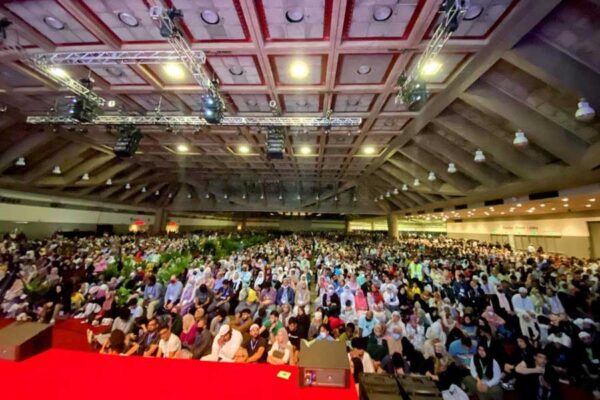
I remember my favorite part of the convention was getting to listen and interact in person with scholars that I follow closely on social media. This year, the discussions will be centered on some of the ongoing challenges Muslims are facing in America. The scholars will engage with the audience to discuss potential solutions within a practical and spiritual framework.
There is an opportunity for Muslim women to express themselves through the written word, in a Poetry Slam. Hosted by Strange Inc., a non-profit publishing house in New York, the Slam is an opportunity for twelve talented contenders to showcase their poetry skills and share their creative works in a safe space. They will be judged based on both the content of their work and their performance. There are two rounds of the competition. Interested participants must submit their work in advance, and only twelve winners will be invited to complete the final round on a live stage, on May 26, at 3:30 p.m. Those interested in performing should register here.
The number of opportunities to learn, grow in faith, network, and socialize are endless at the convention. Take advantage of the long holiday weekend and head to the 

Social housing was popular in the U.S. in the 1930s during the Great Depression. It was a mixed-income type of housing sponsored by tenant and labor unions. Last year,