بسم الله الرحمن الرحيم

Author: Sh. Abdool Rahman Khan

  • What Will Your Legacy Be?

    What Will Your Legacy Be?

    For each of us, our time in this world is limited. Knowing this, we must ask ourselves – how do we use our time effectively if we hope to make a meaningful impact?

    In one way, Allah (SWT) has answered this question with His command to prostrate ourselves in prayer and to give of ourselves and our wealth in charity. He (SWT) said: “And establish prayer and give zakat, and whatever good you put forward for yourselves – you will find it with Allah. Indeed, Allah of what you do, is seeing.” (Quran 2:110)

    However, many ignore this directive, only to regret it when confronted by the Angel of Death.  Of this instance, Allah (SWT) said, “(They persist in their evil) until when death comes to one of them, he says: ‘My Lord! Send me back (to life one more time) so that I may do the good things I have neglected.’ Never! It is simply a word that he speaks and (will never be allowed to go back), and behind them (the disbelievers) is a barrier until the day when they will be resurrected.” (Quran 23:99-100)

    How can we work toward making a positive legacy?

    We all hope to impart a positive and impactful legacy when we die. So, what can we do now to keep focused on what we leave behind?

    1. Clarify our purpose. We must reflect deeply on what matters most, specifically our beliefs, passions, values, and strengths. We also cannot rely on being born in a Muslim home and assume our priorities are intact. Instead, we must pay close heed to what Allah (SWT) said about our purpose. He (SWT) said, “I have not created the jinn and the humans except that they should worship Me (alone).” (Quran 51:56). With this clear explanation of our creation, we understand that worshipping Allah (SWT) is our overarching goal in life and should let this guide our actions and decisions. If we do, we will regularly assess and refine our life’s direction to ensure it aligns with genuinely held values, specifically worshipping Allah (SWT).
      But what does it look like if we eschew Allah’s (SWT) purpose for our existence? We risk drifting aimlessly, void of clear goals or direction. We also may find ourself spending valuable time on activities that don’t align with what we’ve been created for – worshipping Allah (SWT). What an emptiness of soul that would create! This purposeless wandering also may lead us to procrastinate endlessly, pushing us farther and farther away from the true meaning of life.
      Also beware of distractions, including excessive screen time, scrolling social media for hours each day or binge-watching television programs late into the night. Though these activities might bring fleeting moments of pleasure, they offer little long-term value. Let’s be honest about these vices and make every effort to break ourselves of bad habits and instead use that time to focus on Islamic study, worship, and performing good deeds or acts of charity.
    2. Be focused and consistent with our actions. This applies to all aspects of life, especially worship. Doing so helps us prioritize, allowing us to concentrate on activities with the greatest spiritual impact, specifically our long-term aspirations and lifelong goals. By prioritizing commitments and paying attention to core aspects of life, we ensure our energy is directed to pleasing Allah (SWT).
      Goal prioritization also aids in minimizing distractions that derail us and helps us stay consistent and disciplined when we feel motivation waning. Remember, small yet intentional steps compound into significant outcomes over time. Our beloved Prophet Muhammad (peace be upon him), in a hadith narrated by Aisha (may Allah be pleased with her), said, “The Messenger of Allah (peace be upon him) was asked about the act most pleasing to Allah. He replied: ‘That which is done continuously, even if it is small.’”

    Cementing our legacy

    When working to build a positive legacy, we must nurture our relationships with proper investment and care for others’ well-being. To do this, consider sharing knowledge, skills, and resources to uplift one another and to create a ripple effect of beneficial changes. We should also embrace gratitude and humility with the understanding that making our mark isn’t just about success, but also about significance, as our impact often lives on through those whose lives we touch. As Imam Ash-Shafe’ee – a scholar, jurist, and one of the four great Sunni imams – said, “Some people have died, yet their virtues live on, while others are alive, but among people, they are as good as dead.”

    Also, remember positive action begets positive actions. So, let us seek out opportunities to make a difference in our communities such as feeding the poor, youth counseling, working with the homeless or with battered women, or contributing to organizations working to prevent child abuse or for social justice.

    When we’re lacking motivation, we should reflect on the story of people who came to Muhammad (peace be upon him) in need. Jarir bin Abdullah, a companion of the Prophet (peace be upon him), reported desert Arabs clad in woolen clothes came to Allah’s messenger (peace be upon him), who saw they were in need. Muhammad (peace be upon him) then exhorted people to give charity, but they showed some reluctance until (signs) of anger could be seen on his face. Then someone from the Ansar came offering silver. Then came another person and then other people followed them in succession until signs of happiness could be seen on his (sacred) face.

    Thereupon Allah’s messenger (peace be upon him) said, “He who introduced some good practice in Islam which was followed after him (by people) he would be assured of reward like one who followed it, without their rewards being diminished in any respect. And he who introduced some evil practice in Islam which had been followed subsequently (by others), he would be required to bear the burden like that of one who followed this (evil practice) without theirs being diminished in any respect.” (Muslim)

    Conversely, when we don’t strive for an honorable legacy, we risk dwelling on negativity. This could be holding grudges, harboring regrets, or engaging in excessive worrying about things beyond our control, draining our energy and focus. We may even engage in self-doubt or negative self-talk. This attitude stifles potential and discourages progress. When we resist change or growth out of fear and/or complacency, we oftentimes find ourselves stuck in unproductive cycles, leading to constant stress and, essentially, training ourselves to live in that problematic state. If that happens, many of us would struggle to break free of the stress that plagues us, even during times of success.

    Slaves of Allah (SWT)! Remember that Islam guides us to a life of peace, goodness, and success. For a model, look to Muhammad’s (peace be upon him) companions, who recited Surat al Asr when parting. In this passage, Allah (SWT) said, “By time, indeed, mankind is in loss, except for those who have believed and done righteous deeds and advised each other to truth and advised each other to patience. (Quran 103:1-3)

  • The Prophet’s (peace be upon him) Strategy of Change

    The Prophet’s (peace be upon him) Strategy of Change

    In the Quran, Allah SWT said, It is He who sent His messenger with guidance and the religion of truth so that He makes it prevail over all religions even though the idolaters hate it.” (Qur’an 61:9)

    Arabia before Rasoolullah (peace be upon him)

    Consider Muhammad’s (peace be upon him) life and how he transformed not only Arabian society, but the world as well. Before Muhammad (peace be upon him), Arabs were of little or no significance. With no central protective laws, Bedouin tribes were forced to protect and to safeguard their members themselves. If a member was killed, revenge was inevitable. As such, the tribes were in a near constant state of conflict with one another. If tribes did seek to form an alliance, it was often to support one group against another. This resulted in decades-long wars between tribes such as Bakr and Taghlib, ‘Abs and Zhubyaan, Aus and Khazraj and more.

    Arabia’s prevailing lawlessness led to more havoc, including unprovoked attacks on caravans and weak settlements, further perpetuating its cycle of violence.

    During this time, other empires like the Byzantine, Roman, and Persian surpassed the Arabs’ civilization and political and economic stability. In short, before Rasoolullah (peace be upon him), no practical bond united Arabia’s tribes.

    A unique generation

    This changed under Rasoolullah (peace be upon him), who revolutionized Arabia, and it became unique, prevailing and ruling over a large part of the world for centuries. By Allah’s (SWT) will, Rasoolullah (peace be upon him) transformed Arabia into a fierce and faithful nation, one that abandoned its idols and whose people believed in the divine oneness of Allah (SWT). During the 23 years of Muhammad’s (peace be upon him) mission, Islam became the way of life for most of Arabia.

    Allah SWT reminded the Arabs: “Hold firmly, all of you together, to the rope of Allah (Qur’an) and do not be divided. Remember the favor of Allah on you, when you were enemies and He brought your hearts together, and you became brothers (unified) by His favor. You were on the brink of (entering) a pit of Fire, and He rescued you from it. This is how Allah makes His verses clear to you so that you may be guided.” (Qur’an 3:103)

    When reflecting on this achievement, we might ask how an entire society, initially hostile to Islam and Muhammad (peace be upon him), not only embraced Islam but then defended it with their lives and wealth. How did they transform from enemies of the faith to its torchbearers?

    Allah (SWT) recognized Arabia’s shift: You are the best community brought out from humanity. You enjoin what is right and forbid what is wrong and you believe in Allah.” (Qur’an 3:110)

    Methods of change
    1. Firm Islamic policies
      Through Islamically inspired policies, Rasoolullah (peace be upon him) elevated independent tribes, and they emerged anew within the Islamic ummah framework. Indeed, this faith-based band was and is a stronger, more enduring bond than tribalism, nationalism, or ethnicity.

      Allah (SWT) said:Do they wish to be judged according to (practices) at the time of ignorance (before Allah’s guidance)? Who could be better than Allah in judgment for a people with unshakable faith?” (Qur’an 5:50)

      When Rasoolullah (peace be upon him) passed away, his mission was complete. He established a social system far superior to the tribal one Arabs previously lived under, and they were united, creating cohesive religious unity where it had not been before.

    1. Shari’ah in harmony with imaan
      When an individual’s behavior revolves around the intention to please Allah (SWT), changes occur. There are worldly benefits in doing good, but the ultimate aim of righteousness is for Allah (SWT). Sharia’ah, both the Islamic law and the code of conduct, is of divine authority, which regulates religious matters as well as worldly affairs. However, all deeds ultimately return to Allah (SWT), who said, “And as for those who believed and did righteous deeds, He will give them in full their rewards and grant Rasoolullah (peace be upon him) prepared his companions for leadership, most remarkably the Khulafa’ee Rashideen, Abu Bakr, Umar, Uthman, and Ali (may Allah SWT be pleased them extra from His bounty.” (Qur’an 4:173)
    1. Preparing leaders
      Indeed, by the end of the Khulafa’ee Rashideen period, Islam had reached Palestine, Syria, Mesopotamia, Damascus, Jerusalem, Cairo, Alexandria, Iraq, Persia, North Africa, Cypress, Europe, and China. This achievement happened by the will of Allah (SWT) who blessed Rassoolullah (peace be upon him) with selfless dedication, commitment, and excellent leadership. Unfortunately, today we often find that those in leadership positions fail to produce leaders who will succeed them, leaving a huge void and chaos when they die.

      By contrast, Rasoolullah (peace be upon him) was selfless and wished for all his companions to experience the same zeal he had to propagate the deen. As a result, the sahaabah (may Allah be pleased with them) understood they also should prepare the next generation for leadership in the prophetic way.

    1. Demonstrating moral character
      Muhammad (peace be upon him) redefined and refined society’s morals. He softened people’s hearts and nature, preparing them for progress and advancement. For example, he banned the practice of burying baby girls alive, making him one of society’s greatest reformers.

      Muhammad (peace be upon him) was known for his forgiving nature and noble character traits of kindness, gentleness, compassion, patience, humility, and good dealings with people. He lived peacefully among people for 40 years, his relatives loved him dearly, and people of his city greatly respected his upright principles, honor, and integrity. He emphasized fairness and treated people equally regardless of social status, race, or background. He promoted rights of the poor, women, and marginalized groups, reshaping societal norms around justice. Allah (SWT) described him: “(O Muhammad PBUH), it is by Allah’s Mercy that you are gentle with them. Had you been severe and harsh-hearted, they would have turned away from you. Therefore, pardon them, pray for their forgiveness, and consult them in public affairs. Once you have taken a decision, then put your trust in Allah. Indeed, Allah loves those who put their trust in Him.” (Quran 3:159)

      His integrity and honesty encouraged people to practice empathy, forgive others, and to avoid revenge, fostering a more harmonious and peaceful society. He instilled in people a sense of personal responsibility, accountability, and ethics by encouraging them to fulfill their duties, be truthful, and uphold moral standards.

    How can we change?

    The transformation Rasoolullah (peace be upon him) inspired happened without mass media, technology, or high-tech communications equipment. So, what prevents us from using his sunnah to bring about positive changes in a world filled with distress, grief, and trials? Imaam Malik (may Allah’s mercy be on him) said: “The latter generation of this ummah will never be rectified except by means of which rectified the earlier generation.”

    To realize change, we must approach it on individual and collective levels. As individuals, we must understand Rasoolullah’s (peace be upon him) mission; have firm faith and attachment to Allah (SWT); possess honorable personal character and embrace a proactive approach to our actions. Collectively, we must practice brotherhood and love for one another, we must employ shura, or mutual consultation, and leaders must encourage discipline within the jamaa’ah, or community.

    May Allah (SWT) help us make these changes, for ourselves and for our brothers and sisters.

  • Remaining Steadfast

    Remaining Steadfast

    With the chaos and busyness of everyday life, it’s important for us to remain firm in our faith, to stand strong and upright without wavering in our beliefs. We also must share our Islamic knowledge with others, and regularly engage in conversations about our deen. Doing so strengthens us in our religion, particularly as we remind and support one another in our faith journey.

    Every week we have a chance to listen to a khutbah or to attend a lecture at the masjid or even online, offering us a wonderful opportunity to take those lessons learned and to discuss them with our family and friends. But there are even more rewards to be reaped! We can draw admonitions and learn lessons about what behaviors to avoid and what behaviors to emulate as spelled out in Prophet Muhammad’s (pbuh) hadith delivered during his last sermon: “All those who listen to me shall pass on my words to others and those to others again; and may the last ones understand my words better than those who listened to me directly. Be my witness, O Allah, that I have conveyed your message to your people.”

    When we consider our actions and how we spend our days, we must make sure our time is being well spent. Remember, whatever is done each day is recorded in our life’s record, and we will be accountable for those actions on the Day of Resurrection. Allah SWT says, “The earth will shine with the Light of its Lord, and the Book [of deeds] will be set [in place]. Then, the Prophets and witnesses will be summoned, and matters will be decided between them with justice and they will not be wronged. Each person will be paid in full for their deeds. He [Allah] is fully Aware of what they have done [in this world] (Qur’an 39:69-70).

    Steadfastness

    As we focus on spending our time wisely, performing good deeds and acts of worship, it’s important to remember that we must stay the course of goodness, to remain persistent in these blessed acts done only for the glory of Allah SWT, because doing what is righteous is our greatest honor. Whoever stays firm on performing good deeds, Allah SWT will protect him from destructive sins, and he will be among the first to enter Paradise. Allah SWT says: “Verily, those who say: ‘Our Lord is [only] Allah,’ and thereafter stand firm, on them shall be no fear, nor shall they grieve. Such shall be the dwellers of Paradise, abiding therein forever – a reward for what they used to do” (Qur’an 46:13-14).

    Remember that istiqaamah, which translates to uprightness, correctness, integrity, and soundness, has many virtues in this dunya as well as at death and in the Hereafter.

    Allah SWT says, “Indeed, those who declare, ‘Our Lord is Allah [alone],” and then stand firm (to their belief), the angels descend upon them [saying]: “Do not fear and do not stress, instead welcome the good news of the Paradise that you were promised. We are your (protecting) friends in this worldly life and the Hereafter. There you will have whatever your souls desire and whatever you ask for [without any restrictions] as a welcoming gift from the Most Forgiving, Most Merciful” (Qur’an 41:30-32).

    Steadfastness includes all aspects of Islam

    Staying the course of righteousness is a command from Allah SWT to both the believers and to Rasoolullah (pbuh). Allah SWT says, “So be firm as you are commanded and those who turn in repentance [unto Allah] with you and transgress not [Allah’s legal limits]. Verily, He is All-Seer of what you do” (Qur’an 11:112).

    But this command encompasses not just what we should do but also what we shouldn’t, and we must strive to remain steady to observe and abide by all of Allah’s SWT commands and prohibitions. We must do our best to consider the totality of our faith and remember there is blessing in remaining steadfast in faith and in everyday actions. Remember Rasoolullah’s (phuh) answer when Sufyan ibn Abdullah Ath-Thaqafi (RA) asked, “O Messenger of Allah! Tell me something concerning Islam about which I will never ask anyone else.” He said, “Say, ‘I have believed in Allah,’ and then be steadfast” (Muslim).

    When reflecting on this hadith of the Prophet (pbuh), who among the entire Ummah doesn’t say “I believe in God”? But we must ask ourselves, do our actions reflect that belief? Think of some of the customs associated with significant days in our lives like weddings, birthdays, aqeeqahs, and deaths of loved ones. In these moments, are we mixing the haram with the halal, confusing haq (truth) with batil (falsehoods)? Do we indeed have one foot firmly in Islam and the other in Jahiliyah (ignorance)? And when we act in this way, so many of us make excuses upon excuses!

    But Umar (RA) warned of this wayward behavior. He said, “Steadfastness: To remain upright and adhere to commands and prohibitions without evading them like foxes.”

    In fact, Allah SWT himself warned against making excuses when deviating from the straight path, from the Shari’ah, and instead choosing a different path.

    Allah SWT says to Prophet Muhammad, and by extension, to all of us, “We have put you on a clear way of [Our] commandment. So, follow it, and do not follow the desires of those who do not know. They cannot help you against Allah in any way. Indeed, the wrongdoers are helpers of one another, but Allah is the helper of the God-fearing” (Qur’an 45:18-19).

    Here Allah SWT is not only leading believers to the straight path, He also is urging them to be steadfast and to continue on the road of righteousness and encouraging them with the promise of His help.

    After giving His commands and prohibitions, Allah SWT says, These [commandments] are My Path, the straight way. So, follow it and do not follow other ways, as they will cause you to deviate from His Way. This is what He commands you, so perhaps you may become God-fearing” (Qur’an 6:153)

    Steadfastness is linked to the heart and leads to controlling the tongue

    When we think about remaining firm in our faith, we must look to the heart. Consider what Rasoolullah (pbuh), his companions, and leading scholars said about the heart and how its spiritually enduring health and resoluteness is linked to the spiritual health of the rest of the body and the critical role it plays in helping us to remain steadfast. Rasoolullah (pbuh) said: “Verily, in the body is a piece of flesh which, if sound, the entire body is sound, and if corrupt, the entire body is corrupt. Truly, it is the heart” (Muslim).

    Imam ibn Rajab al-Hanbali, a jurist, historian, and leading figure during the 14th century, linked one’s heart and its unwavering focus on monotheism to spiritual success. He said, “The foundation of steadfastness is the steadfastness of the heart upon monotheism.”

    For Abu Bakr (RA), the first caliph after the death of our beloved Prophet (pbuh), istiqaamah meant when the believers did not turn to anyone other than Allah for help. He said steadfastness in the heart is manifest in knowing Allah, fearing Him, respecting Him, revering Him, loving Him, desiring Him, hoping in Him, supplicating to Him, relying on Him in all things, and, finally, turning away from anything other than Allah.

    Imagine the heart is the body’s king and the limbs are its soldiers. If the heart is steadfast in obeying Allah in all things, so too will be the limbs. And if the heart is the body’s king and the limbs are its soldiers, what then is the most important limb of all? The answer is the tongue, because it is the interpreter of the heart, and it expresses what is inside. So, guard your tongue and set your heart on steadfastness to Allah, to obeying all His commands and adhering to all His prohibitions.

  • The Prophet’s Sunnah: Empowering the Disenfranchised

    The Prophet’s Sunnah: Empowering the Disenfranchised

    Denying individuals their full rights and privileges and their full participation in society is hardhearted. So it is very significant that Allah SWT addressed Rasoolullah in the Qur’an: “We have not sent you except as a mercy to all the worlds” (Qur’an 21:107). Yet, many people even today suffer discrimination due to their race, ethnicity, gender, social status, or other condition or situation. Rasoolullah (SAS) empowered the disenfranchised and we can learn from his reforms to benefit humanity today.

    During the time of Rasoolullah (SAS), slaves, servants, laborers, women, orphans, and Bedouin were all considered a lower class. Just like today, there was a class hierarchy in the Makkan society and at the top were rich and powerful men. Those of lower status were often exploited or abused by the more powerful.

    Women were kept out of discussions of substance, and often denied a place in the public square. They were considered property of men and therefore could be inherited. The depth of dishonor is revealed in the practice of burying female babies alive. Allah SWT tells us of the female infanticide prior to Islam: “He hides himself from the people because of the evil of that whereof he has been informed. Shall he keep her with dishonor or bury her in the earth? Certainly, evil is their decision” (Qur’an 16:59).

    Empowerment Begins with the Kalimah

    The greatest empowerment is in the Kalimah, la ilaha illallah, there is no deity but Allah. This succinct phrase conveys that there is no true and absolute sovereignty, power, or supremacy other than Allah SWT. Understanding this Kalimah breaks down all self-proclaimed human entitlement and privilege, or license to dominate or exploit others. With this Kalimah, no one should feel superior over another when in the end all must stand before Allah SWT for judgement. In this way it makes no difference: the weak and the strong, the rich and the poor, the black and the white — all equal, and the only thing that differentiates one from another is taqwa, which only Allah SWT measures. Our Salaah and Hajj teach us this and at the core is the reality that only Allah has the ultimate power, and the ultimate reward is with Him SWT.

    Allah SWT says: O people! We have created you from a male and a female and made you into nations and tribes so that you may know one another. Indeed, the most honorable in the sight of Allah is the one who is the most pious [and God-conscious] among you. Allah is certainly All-Knowing, All-Aware” (Qur’an 49:13). Taqwa has a comprehensive meaning and in addition to piety, it encompasses God-consciousness, love of Allah and, thus, fear of displeasing Him; as such, taqwa acts as a shield, a protection against disobedience and sin.

    Rasoolullah (SAS) reinforced this proclamation in the Farewell Pilgrimage sermon when he said: “O people, verily your Lord is One and your father [Adam] is one. Verily there is no superiority of an Arab over a non-Arab or of a non-Arab over an Arab, or of a red man over a black man, or of a black man over a red man, except in terms of taqwa.”

    All the sectarian wars ended, and the tribes came together under the banner of “there is no deity except Allah.” Those who were at the lowest level of society and the most vulnerable were not only liberated but many rose to fulfill important roles. Bilal (r) had lived as a slave of Umayyah ibn Khalaf but rose to become the Mu’azzhin of Rasoolullah (SAS). Abdullah ibn Umm Makhtoom (r), a blind man, was given the responsibility to teach the people of Al-Madinah before the migration of Rasoolullah (SAS) and the other Companions. On several occasions he (r) was left in charge of Madinah in the absence of the Prophet such as when Rasoolullah and the Companions left for Badr.

    Women were liberated from Jahiliyah and for the first time, rights were given to them. Having been politically ignored and kept out of the discourse on public affairs, women were now consulted as in the case of Umm Salamah (r) in the treaty of Hudaibiyyah when the Companions were hesitant to slaughter their animals to get out of Ihram. This angered Rasoolullah (SAS), but it was Umm Salamah (r) who advised him to cut his hair first and get out of Ihram and as he did the others would follow.

    Symbolic of the rights and honor bestowed by Islam on the female gender, Rasoolullah (SAS) said, “Whoever has three daughters whom he gives refuge to, provides for and shows mercy to, Paradise is certainly guaranteed for him.” A man asked, “And [for] two, O Messenger of Allah? “He replied: “And also [for] two [daughters]” (al-Bukhari).


    Further demonstrating how Rasoolullah made people aware of the need to protect the rights of every vulnerable or marginalized individual, he spoke about orphans, saying, “I and the one who looks after an orphan will be like this in Paradise.”  He raised two fingers and put them close together, barely separate (al-Bukhari). He also spoke about workers, those who labor for survival. He said, “Give the worker his wages before his sweat dries” (Ahmad).

    Conclusion

    Islam emphasizes human rights and justice for all individuals, regardless of race, gender, or socioeconomic status. As Muslims, it is our duty to advocate for social justice and to fight against all kinds of discrimination, ensuring that marginalized individuals are accorded dignity and social, economic, political, and civil rights, including equal opportunities in education, employment, etc. Further, Islam encourages giving assistance to those in need through Zakaah and Sadaqah. We can empower the disenfranchised by providing financial assistance, supporting community programs, and helping individuals become self-sufficient through our relief initiatives. And finally, we must create inclusive communities so that those who are too often discriminated against or ignored can participate and experience the full benefits of fellowship, a sense of belonging, and an opportunity to have their voices heard.

  • Laying the Foundation for The Ummah

    Laying the Foundation for The Ummah

    Allah SWT has sent about 124,000 Prophets and Messengers throughout history but there is something special about Rasoolullah (peace be upon him). All previous Prophets came only to preach to their particular nation primarily, or to their specific tribe, but Rasoolullah (pbuh) came with the Message to all of mankind, until the end of time.

    Allah SWT says, We have not sent you [O Muhammad] except as a messenger of good news and a warner to all people, but most people do not know” (Qur’an 34:28). Further, at the end of a long Hadith narrated by Jabir bin Abdullah (r), Rasoolullah (pbuh) said, “… Every Prophet used to be sent to his nation only, but I have been sent to all mankind” (al-Bukhari).

    Since Prophet Muhammad (pbuh) was sent to all humanity, then as his true followers, we are required to spread the Message by utmost sincerity and effort because no more Prophets or Messengers will be sent, and this Divine Message must be delivered. Yes! As Ahlus Sunnah wal Jamaa’ah [the people of the Sunnah and the Community who unite upon it], we do believe that in the end times, Prophet Jesus (a.s.) will be coming back, but he will not be coming with anything new. In fact, he will be following the Shari’ah of Muhammad (pbuh).

    Not judged by results

    Let us be clear that we will not be judged on the results in delivering this Message but on our efforts; the result is in the hands of Allah SWT. Today it seems that Da’wah revolves around numbers and speakers. In the Ahaadith it is reported in both Imaam al-Bukhari and Imaam Muslim that Rasoolullah (pbuh) said: “The nations were shown to me, and one or two Prophets would pass by me with a group [of followers], and a Prophet who had no one with him.” It is also narrated by at-Tirmidhi and an-Nasaa’i from Ibn ‘Abbaas, who said, “When the Prophet (pbuh) was taken on the Night Journey [Isra’ and Me’raj], one or two Prophets would pass by him who had a community with them, and one or two Prophets who had a small group with them, and one or two Prophets who had no one with them, until he passed by a great multitude…”

    Yet, all these Prophets carried out their responsibilities in delivering the message of Tawheed (The Oneness and Uniqueness of Allah SWT) to their people and preached against anything their people worshipped besides Allah. So, we have to go out and deliver the Message of the deen. And we do so with the wisdom and the methodology shown to us by Rasoolullah (pbuh). Allah SWT commands, “Invite to the way of your Lord with wisdom and good advice, and reason with them in a way that is best. Indeed, your Lord knows best who has strayed from His path, and He knows best who is guided” (Qur’an 16:125).

    Dear brothers and sisters — living as a minority here in the U.S., we have this responsibility to deliver the true Message to both Muslims and non-Muslims. The freedom of assembly and speech we have may not last for long, and we will be held accountable for the opportunities Allah SWT gives us to share this Message. The question we should constantly ask ourselves it this: “Did we fulfill our responsibility in delivering this Message as commanded by Allah SWT and His Messenger?” In fact, we should deliver the Message to the fullest extent of our ability, even if our ability is very limited, as Rasoolullah (pbuh) said in a hadith narrated by ‘Abd-Allaah ibn ‘Amr (RA): “Convey from me, even if it is one verse.”

    Al-Haafiz ibn Hajar (may Allah’s mercy be upon him) said in his book, Fath al-Baari: about this Hadith: “’Even if it is one verse’ means that everyone who heard him (pbuh) would hasten to convey whatever he heard of the verses, even if it was very little, so that in this manner everything that he (pbuh) brought would be conveyed.”

    Another scholar explains this Hadith in the following way: “If a person understands what he is calling people to, it makes no difference whether he is a great and prominent scholar or a seeker of knowledge who is serious in his pursuit thereof, or a regular person who has certain knowledge of the issue in question. The Messenger (pbuh) said, ’Convey from me, even if it is one verse,’ and he did not stipulate that the Daa’iyah [one who invites to Islam] should have reached a high level of knowledge, but it is essential that he should have knowledge of that to which he is calling people. But calling out of ignorance or calling based on emotion is not permissible.”

    How should we deliver this message of Islam to people?

    First, it is important to connect with the people as Rasoolullah (pbuh) did for 40 years of his life before receiving revelation. If we just give speeches to the people and do not interact with them, allowing them to know who we are, what our beliefs, attitudes, and behaviors are in everyday and commonplace ways, then they are not very likely to give full attention to lectures, or be moved or inspired by them.

    Secondly, we should stand for justice for everyone in society. We know when Rasoolullah (pbuh) was given the news of his Prophethood by Angel Jibreel (a.s.), he went home and told Khadija (r) what had happened and expressed some worries about his experience. She told him, “Never! By Allah, Allah will never disgrace you. You keep good relations with your kin, help the poor and help the needy, serve your guests generously, and assist those afflicted by calamity.” Note that Khadija (r) described his virtuous behavior that he was known for before he had begun his mission as a Prophet. So, if we help other people in their social and economic affairs, in taking care of their needs, it opens the door, insha’Allah, to their spiritual life.

    What are some challenges?

    First, the purpose of Shaitaan is to let Muslims feel content with the minimum. He makes us busy with Zhikr and Salaah, etc. While Zhikr and Salaah are an essential part of Islam, they are not the whole Islam. How can Zhikr and Salaah alone change the munkar (evil) in society?

    Another challenge is related to semantics. Sometimes lectures are more about the speaker’s eloquence and ability to play around with words in verses of the Qur’an. This kind of da’wah acts as a pacifier to the Ummah, often diverting attention from real issues. The Qur’an has not been revealed just for its linguistic beauty, but, more importantly, as a Book explaining he correct aqeedah, laws, and human actions. It is a guide for humanity to submit to Allah SWT, leaving off taghut or false idols, injustices, exploitation, and corrupt political and economic systems.

    A third challenge is living life with a victim mentality. We complain about “this and that” happening to us. Such a mentality can make us passive and unwilling to take full responsibility for our lives. Rasoolullah (pbuh) never indulged in the complaining and defeatism of victimhood, even though during his prophetic mission, he was victimized in so many ways. Just read the Seerah and see what he endured and yet never complained but continued his mission to the end with utmost faith and resoluteness.

    Dear brothers and sisters — we have to be courageous. If we act with a defeated mentality, our future generations will not survive. If all we can do is to complain about our situation despite the freedoms we enjoy, then when will we convey the Message that Rasoolullah (pbuh) came with?

    In conclusion, let us reflect on what Allah SWT says:

    “So, unto this [religion of Islam] then invite, and be steadfast as you are commanded, and follow not their desires, but say: ‘I believe in whatsoever Allah has sent down of the Book and I am commanded to do justice among you. Allah is our Lord and your Lord. For us our deeds and for you your deeds. There is no dispute between us and you. Allah will assemble us, and to Him is the final return’” (Qur’an 42:15).

  • Character Building: The Essence of a Believer

    Character Building: The Essence of a Believer

    All praises are for Allah, Lord of all that exists; and peace and blessings of Allah be on His final messenger and his household.

    Character is the solid foundation of a believer upon which both iman and amal (faith and practice) are based. It is what defines an individual and differentiates him or her from others. Character is that which will determine true success both in this world and the next as it will be among the heavyweight factors of positive value on the scales on the Day of Judgment.

    In a sound hadith of al-Tirmidhii, Abu Darda (r) reported that the Prophet, peace and blessings be upon him, said, “Nothing is heavier upon the scale of a believer on the Day of Resurrection than his good character. Verily, Allah hates the vulgar and obscene.” Jabir ibn Samurah (r) reported that the messenger of Allah (s), said, “Verily, obscenity and immorality are not part of Islam. Verily, the best people in Islam are those with the best character” (Aḥmad – sahih).

    In fact, the one who possesses good character will be in the company of Rasoolullah (s) on the Day of Judgment. Abdullah ibn Amr (r) reported that the messenger of Allah said, “Shall I tell you about the most beloved to me and the closest to my assembly on the Day of Resurrection? Those with the best character” (Musnad Aḥmad), and it is a sound hadith.

    On the other hand, those with evil character will be furthest away from Rasoolullah (s) on the Day of Judgment. Jabir ibn Abdullah (r) reported that the messenger of Allah (s) said, “Verily, the most beloved and nearest to my gathering on the Day of Resurrection are those of you with the best character. Verily, the most reprehensible of you to me and the furthest from my gathering on the Day of Resurrection will be the pompous, the extravagant, and the arrogant” (al-Tirmidhī – sahih).

    It is interesting to note that noble qualities tend to connect with one another and are inter-related. Someone who is sincere, and kind would most likely be honest, respectful, and just — or at least would strive to embody those virtues. This becomes a lifelong quest, aiming for excellence of character. The opposite is also true. A bad quality tends to pave the way for other bad qualities until such person is characterized by ignoble qualities. Abdullah ibn Mas’ud (r) reported that the messenger of Allah said, “You must be truthful. Verily, truthfulness leads to righteousness and righteousness leads to Paradise. A man continues to be truthful and encourages honesty until he is recorded with Allah as truthful. And beware of falsehood. Verily, falsehood leads to wickedness and wickedness leads to the Hellfire. A man continues to tell lies and encourages falsehood until he is recorded with Allah as a liar” (Muslim).

    Imaam Shafe’i, the great Muslim scholar, wrote in a couplet: “Many people have died, but their generosity lives on; And many are alive, but they are just as good as dead.” So, on whom must one model his character? Certainly not those who are void of morals but the one whose role was to perfect human character. He is none other than Muhammad (s). He has been sent by Allah SWT with many responsibilities, among which is as a teacher perfecting noble character. In a famous hadith, he (s) said, “I have been sent to perfect good character.” Allah SWT confirmed that by telling us in the Qur’an, “…You are not, [O Muhammad], by the favor of your Lord, a madman. And indeed, for you is a reward uninterrupted. And indeed, you are of a great moral character…” (68:2-5).

    Out of the Darkness and into the Light

    The result of the Prophet’s teaching should be evident to all of humanity. He (s) lived in a society where people would bury their female babies alive, out of societal shame. There was no sense of justice. They supported their tribe whether right or wrong. The strong took advantage of the weak and the rich exploited the poor.

    He (s) brought them out from the darkness of ignorance into the light of Islam. The sahabah (r), as they proved themselves, have stood out as the unique generation. They took on the responsibility of extending the influence of Islam out into the world and demonstrating the commitment to excellent character as taught by the Prophet (s).

    Just take the case of the second Khaliph Umar (r). Before converting to Islam, Umar (r) opposed the Prophet’s message and even threatened to kill him (s). He was adamant and cruel in opposing the messenger of Allah and very prominent in persecuting Muslims. But once he converted to Islam, he made a complete change in his life to the point that he was given the title of al-farouk, the one who distinguishes between right and wrong. He would often say, “Who is Umar without Islam?” Before Islam, his ignoble character would have taken him to eternal destruction. He now is in the company of the noblest of human beings.

    After the passing of Rasoolullah (s), the sahabah (r) too began to liberate men from the bonds of the darkness of jahiliyyah (pre-Islamic ignorance; unbelief) into the light of Islam. This historical achievement was the mark of a unique generation, the generation that Prophet Muhammad raised by instilling in them good and noble character. The Prophet (s) affirmed this when he said, “The best people are those of my generation, and then those who will come after them [the next generation], and then those who will come after them; and then after them, there will come people whose witness will precede their oaths, and whose oaths will precede their witness” (al-Bukhari).

    Developing and Strengthening Character

    The good news is that each individual has the potential to develop and strengthen his or her character, whatever their current status or nature — their personality traits and their moral and ethical qualities. One can develop qualities such as honesty, trustworthiness, integrity, compassion, sincerity, kindness and much more, as long as one strives on a daily basis with self-awareness and devotion. Indeed, these noble qualities combined together sum up a noble character and make one a true believer in Allah SWT and a great asset in society. Hasan Al-Basri, may Allah have mercy on him, in his book Jāmi’ Bayān al-‘Ilm, said: “Verily, from the character of the believer is strength in religion, determination with leniency, faith with certainty, eagerness for knowledge, sympathy with understanding, moderation in worship, mercy with effort, giving to those who ask, not wronging the one he hates, not sinning over the one he loves, dignified in turmoil, grateful in ease, content with what he has, speaking to impart understanding, being silent out of caution, and affirming the truth as a witness over him.”

    Usamah ibn Shareek reported, “I witnessed the Bedouins ask the Prophet, ‘O messenger of Allah, what is the best thing a servant may be given?’ The messenger of Allah, peace and blessings be upon him, said, ‘Good character’” (Sunan Ibn Mājah – sahih). One can begin in his own home. Abu Huraira (r) reported that the messenger of Allah (s) said, “The most complete of the believers in faith are those with the most excellent character, and the best of you are the best in behavior to their women” (al-Tirmidhi — sahih). A similar hadith was narrated by Aisha (r) with a slight variation. The messenger of Allah said, “Verily, the most complete of believers in faith are those with the best character and who are most kind to their families” (al- Tirmidhi – sahih).No doubt good character raises one’s status, as if he has done major acts of worship. Aisha (r) reported that the messenger of Allah, peace and blessings be upon him, said, “Verily, the believer may reach through his good character the status of one who regularly fasts and prays at night” (Sunan Abi Dawud – sahih).

    In conclusion, seeking good character by our daily efforts should be joined with making sincere du’a to Allah SWT, as Rasoolullah (s) has guided us to do. Jabir ibn Abdullah reported that the Prophet, peace and blessings be upon him, used to make this du’a: “O Allah, guide me to the best deeds and the best character, for no one guides to the best of them but you. Protect me from evil deeds and evil character, for no one protects from the evil of them but you.”

    O Allah, I ask you to grant us health, good character, and contentment with qadr. Ameen!

  • Reminder About the End Times: How Should Muslims Respond?

    Reminder About the End Times: How Should Muslims Respond?

    All praises are for Allah, The Almighty, and may His peace and blessing be upon His true servant and final Messenger, Muhammad, on his companions and his household.

    A very integral part of imaan (faith) is to believe in the Last Day, as Allah SWT informs us: “And the Hour is coming without any doubt, and Allah will raise up all those in the graves” (Qur’an 22:7). On that day, we will all have to face Allah the Almighty to be questioned, judged, and recompensed with regards to how we spent this life. We are accountable for all that we say and do in this life once we reach puberty, the age of discernment, or baaligh. On the Last Day, Allah’s attributes of justice and mercy will be in full manifestation as we stand before Him, fearing His wrath and hoping for His mercy and forgiveness, and a place in His Paradise.

    But before this Last Day arrives, a number of signs will be evident for all to witness. This will indicate that the world is near its end. Allah SWT tells us in The Qur’an, “Then do they await anything except the Hour, that it should come upon them unexpectedly? But already there have come  its indications. Then what good to them, when it has come, will be their remembrance?” (47:18). The end time signs have always been a topic of discussion by all prophets and messengers. Allah SWT informs us that the previous prophets warned their people of the Last Day. He SWT says about Prophet Muhammad, “This [prophet] is a warner like the former warners. The approaching Day has approached (Qur’an 53:56-57).

    The prophets warned their people of the coming of the Hour and described some of its indications. The ummah (religious community) of Muhammad (s) is the last of ummahs on earth before the Final Day arrives, and this makes it all the more important to pay attention to these signs as they will become more apparent and impactful than the signs were to the previous nations.

    Why Is Knowledge of the End Times So Important?

    There are several reasons why knowledge of the signs of the Last Day is so important. First, it serves as an encouragement for people to hasten in their obedience to Allah SWT and prepare themselves to stand before Him. For the believer it helps him to keep on persevering and striving in this world so as to attain a place in the abode of peace in the Hereafter. While for the heedless, it is an indication that time is running out, so it’s an encouragement to stop evil deeds and hasten to do good deeds.

    Secondly, the stronger one’s certainty of the Last Day, the more faith increases and the more one tends to be persistent in doing the deeds commanded by Allah SWT. The opposite is also true. One who is heedless pays no attention and continues to enjoy this life as Allah SWT says, “Then, for him who transgressed and preferred the life of this world, verily, his abode will be Hell-fire” (Qur’an 79:37-39). Another reason knowledge of the signs of the Last Day is so important is that signs of the end times were specified by the Messenger, Muhammad (s), over 1400 years ago and this indicates his truthfulness. There are so many signs of the Last Day that he stated all those centuries ago that are prevalent today. Such knowledge can only be granted by Allah Almighty. He SWT says, “[He is]  the All-Knower of the unseen, and He reveals to none His unseen except to a Messenger whom He has chosen, and then He makes a band of watching guards [angels] to march before him and behind him” (Qur’an 72:26-27). Last but not least, as the signs of the end times reveal themselves, a believer does not become a victim of the deceptions of the Dajjal or anti-Christ. They are warned against him as being one of the greatest trials in end times. Thus, the believer takes tremendous caution to protect himself from the evil of Dajjal.

    When Is the Hour?

    With all the chaos in the world today, talk about the end times takes place from the pulpit, around the dinner table, and at masaajid gatherings. The question about when the Hour will be has been asked since time immemorial. Almost every prophet has been asked and sometimes challenged about the Last Day. But Allah SWT answers this in the Qur’an. He says, “They ask you about the Hour: ‘When will be its appointed time?’ Say: ‘The knowledge thereof is with my Lord.  None can reveal its time but Him. Heavy is its burden through the heavens and the earth. It shall not come upon you except all of a sudden.’ They ask you as if you have a good knowledge of it. Say: ‘The knowledge thereof is with Allah but most of mankind knows not’” (Qur’an 7:187).

    Certainly no one knows the exact time of the Hour but Rasoolullah (s) indicated that there will be some minor signs; and then a series of big signs will occur marking the end of this world, and those are known as the major signs and they are ten in number, as laid out in the following hadith:

    Some companions were having a discussion when the Messenger of Allah (s) approached and asked what they were discussing. “They said, ‘We are discussing  the Last Hour.’ Thereupon he (s) said, ‘It will not come until you see ten signs before, and he made mention of the smoke, Dajjal, the beast, the rising of the sun from the west, the descent of Jesus son of Mary (Allah be pleased with him), the Gog and Magog, and land-slides in three places, one in the east, one in the west and one in Arabia at the end of which fire would burn forth from the Yemen, and would drive people to the place of their assembly’” (Sahih Muslim).


    Minor Signs

    The Prophet (s) indicated that there will be a number of minor signs and scholars have counted almost 140, based on authentic narrations. One should note that a lot of people today are quoting ahaadith without verifying their sources. This creates confusion and inaccuracy with regards to the end times. It should also be noted that some of these signs have already happened or are apparently happening in our time, and some are still yet to come.

    Some signs that have already occurred:

    • The advent of the final prophet, Muhammad (s), and his death.


    • The splitting of the moon that took place during the time of the Messenger of Allah, Muhammad (s).

    Some signs that are current:

    • The Messenger of Allah (s) said, “Be prompt in doing good deeds [before you are overtaken] by turmoil which would be like a part of the dark night. During it a man would be a Muslim in the morning and an unbeliever in the evening, or he would be a believer in the evening and an unbeliever in the morning and would sell his faith for worldly goods” (Muslim).
    • The Messenger of Allah (s) said, “Verily, it will be poured upon you, the evil from the sky, until it reaches unto the deserted wilderness (fayafi). A questioner then asked, ‘And what is the deserted wilderness, O Abu Abdullah?’ He then replied that it was the barren earth” (al-Musannaf ibn Abi Shaibah; it is Sahih). One possible interpretation of “the evil from the sky” that pours down upon humanity are the signals from satellites (roughly 2600 satellites are currently orbiting the earth). They have a number of good uses, but they are also used for surveillance and for entertainment-related purposes, pouring content down upon us in the form of music, TV, movies, etc., now reaching every nook and corner of this globe.


    • Another hadith tells us, “The Hour will not be established until trials and civil commotions become widespread, lying proliferates, and markets become closer” (Ahmad in his Musnad). Does not all the online shopping that is available sound like “markets become closer”?


    • Another detailed hadith indicates a number of things that will happen. Rasoolullah (s) said, “The Hour will not be established until two big groups fight each other whereupon there will be a great number of casualties on both sides and they will be following one and the same religious doctrine; until about thirty Dajjals (liars) appear, and each one of them will claim that he is Allah’s Apostle; until the religious knowledge is taken away; earthquakes will increase in number; time will pass quickly; afflictions will appear; al-harj, (killing) will increase; wealth will be in abundance — so abundant that a wealthy person will worry lest nobody should accept his zakat, and whenever he will present it to someone, that person will say, ‘I am not in need of it;’  the people compete with one another in constructing high buildings; a man, when passing by a grave of someone, will say, ‘If only I were in his place’” (Bukhari).


    • The Messenger of Allah (s) said, “Two are the types of the denizens of Hell whom I did not see: people having whips like the tails of the ox with them and they would be beating people; and women who would be dressed but appear to be naked, walking with an enticing gait. Their heads would be like the humps of the camel, inclined to one side. They will not enter Paradise and they would not smell its fragrance  whereas its fragrance would be smelled from such and such distance” (Muslim).


    • The Messenger of Allah (s) said, “The world would not come to an end until a day would come to the people during which the killer would not know as to why he has killed and the slain would not know as to why he has been killed. It would be said: ‘Why would It happen?’ To which he replied: ‘It would be because of general massacre and bloodshed. And the killer and the killed would be in Fire’” (Muslim).
    Other Adhadith that Indicate Signs of the Hour

    The Messenger of Allah (s) said:

    • “When honesty is lost, then wait for the Hour.” It was asked, “How will honesty be lost, O Allah’s Apostle?” He said, “When authority is given to those who do not deserve it, then wait for the Hour” (Bukhari).


    • “…The slave girl will give birth to her master and you will see barefoot, herdsmen compete in the construction tall buildings…” (Muslim).


    • “By the One in whose hand is the soul of Muhammad, the Hour will not begin until indecency and miserliness will prevail. The honest man is accused of treachery and the treacherous man is trusted. Al-wa’ool perish and at-tahoot prevail.” They said, “Messenger of Allah, what are al-wa’ool and at-tahoot?” He said, “Al-wa’ool are the prominent, noble people and at-tahoot are those [ignoble ones] who were under the people’s feet and no one knew about them” (Mustadrak Al Haakim).


    • “There will surely come upon people a time in which a man will not care from where he gets his wealth, lawfully or unlawfully” (Bukhari).


    • “From among the portents of the Hour is that the religious knowledge will be taken away [by the death of religious scholars] and general ignorance [of religion] will appear; and the drinking of alcoholic drinks will be very common, and illegal sexual intercourse will prevail…” (Bukhari).


    •  “…a man obeys his wife and disobeys his mother, he brings his friend near and drives his father far off, voices are raised in the mosques, the most wicked member of a tribe becomes its ruler, the most worthless member of a people becomes its leader, a man is honored through fear of the evil he may do, singing-girls and stringed instruments make their appearance, wines are drunk, and the last members of this people curse the first ones. Look at that time for a violent wind, an earthquake, being  swallowed up by the earth, metamorphosis, pelting rain, and signs following one another like bits of a necklace falling one after the other when its string is cut” (Tirmidhi).


    •  “One of the signs of The Hour will be an increase of sudden death” (at-Tabarani).


    • “’Forthcoming will be a time when the nations gather against you, just as people gather around a feast. A man said, ‘Will it be because we are few at that time, O Allah’s Messenger?’ He responded, ‘No, you will be numerous in those times, but you will be as useless as the froth of the sea, and Allah will remove the fear of you, that your enemies used to have, from their chests, and He will place al-wahn in your hearts.’ It was said, ‘What is al-wahn?’ He responded, ‘Love of life and hatred of death’” (Ahmad, Abu Dawud).


    • “Verily, Allah does not withhold knowledge by snatching it away from his servants, but rather he withholds knowledge by taking the souls of scholars, until no scholar remains and people follow ignorant leaders. They are asked and they issue judgments without knowledge. Thus, they are astray and lead others astray” (Bukhari and Muslim).


    • “Night and day will not cease until the most privileged of people in worldly affairs will be Luka’ ibn Luka’ [an evil person with no praiseworthy characteristics]” (Mu’jam at-Tabaraani al-Awsat).


    • “This world will not cease to be until it belongs to Luka’ ibn Luka” (Saheeh ibn Hibbaan).

    In conclusion, it would appear that most of the minor signs have taken place or are currently taking place, and so it would not be surprising if the major signs begin to happen. There is enough going on in this world for Muslims to be concerned about their faith and the faith of their children. Now would be a good time for Muslims to make use of time and hasten to do good deeds and plant that tree as Rasoolullah (s) said: If the Resurrection were established upon one of you while he has in his hand a sapling, then let him plant it (Musnad Aḥmad).

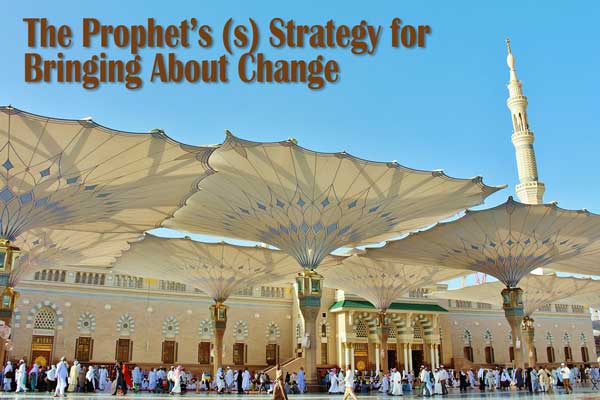
  • The Prophet’s (s) Strategy for Bringing About Change

    The Prophet’s (s) Strategy for Bringing About Change

    All praises are for Allah, The Almighty, and may His peace and blessing be upon His true servant and final Messenger Muhammad, on his Companions, and his family.

    One of the greatest achievements of Rasoolullah (s) was the way he transformed the Arabian society. Within 23 years of the start of his mission, Islam had become the way of life for most of Arabia. Knowing this awe-inspiring achievement, one asks how an entire society which, at first, was hostile to Islam and hostile to Prophet Muhammad (s) not only embrace Islam but defend it with their lives and their wealth. They were transformed from enemies of Islam to becoming the torchbearers of Islam.

    That first generation was known as the unique generation and the best generation of this Ummah. Rasoolullah (s) prepared them in such a way that many of them became leaders, and by the end of the Khulafa’ee Rashideen (the rightly-guided khalifs) period, Islam had reached Palestine, Syria, all of Mesopotamia, Persia, North Africa, Cypress, Europe, and China. This great achievement happened, first and foremost, by the Will of Allah SWT, and then with the selfless dedication, commitment, and great leadership Rasoolullah (s).

    What is also very amazing is the manner of such transformation when there was no mass media or technology like we have in modern times. The challenge for the Ummah today is how to use the Sunnah of Rasoolullah (s) to bring about positive changes in a world so filled with distress, conflict, and oppression. Today’s world is characterized by an unstable environment and an uncertain future. How eager is the world awaiting someone, some group, or some divine guidance to deliver it from its woes? How badly is the need to eradicate the evils of hatred, fascism, exploitation, racism, and injustice! Moreover, mankind now faces a public health devastation the likes of which has not been witnessed for almost one century: the COVID19 pandemic.

    Imam Malik (may Allah’s mercy be on him) said, “The latter generations of this Ummah will never be rectified except by means of that which rectified the earlier generation” (Majmoo’ Al-Fataawa by Ibn Taymiyyah). In examining the approach of Rasoolullah (s) in bringing about such positive changes, there are two main areas of focus.

    The first is the individual effort which covers the following:

    a) clarity about the mission
    b) firm faith and taqwa
    c) justice and mercy
    d) genuineness
    e) being pro-active
    f) dedication to Allah and sincerity

    The second area is the collective effort, and this includes the following:

    a) brotherhood and love
    b) mutual consultation
    c) collective discipline
    d) constructive criticism

    The Individual Efforts Exemplified by Rasoolullah (s)

    At the individual level, one of the fundamental focuses of Rasoolullah (s) was to provide clarity about his mission. Lack of direction gives way to confusion and doubt. Allah SWT says in the Qur’an, “He it is Who has sent His Messenger with guidance and the religion of truth to make it clear over all [other] religions even though the Mushrikûn [those who associate partners with Allah] hate [it]” (61:9).
    Rasoolullah (s) took every opportunity available to him to explain the Deen of Allah to humanity. He trained the best of the Ummah, making it clear that this mission is about the Creator and what He SWT wants from His creation. Even when pressed by Quraish to make compromises on faith, he stood firm about his Islamic mission, never wavering.

    The second point to note was the emphasis Rasoolullah (s) placed on taqwa (piety which includes humility; being conscious of Allah’s presence; and fearing Him at all times), not only for the leader but also for every believer. It is the only criterion by which people are judged in Islam. Allah SWT says, “O mankind! We created you from a single [pair] of a male and a female, and made you into nations and tribes, that you may know each other. Verily the most honored of you in the sight of Allah is the most righteous of you. And Allah has full knowledge and is well-acquainted” (Qur’an 49:13).
    Power and authority can easily make a person arrogant. While taqwa is much more than being humble, it is among the many meanings of the term. Humility is especially important for a leader since he is entrusted with the affairs of the community. Not seeking a leadership position is part of taqwa. One sees from the Seerah (biography) of the Prophet (s) that his personal honesty and integrity had already earned him the title of al-amin (the trustworthy one) in Makkah, even before being commissioned as Prophet. Similarly, modesty and humility were apparent in the conduct of the Khulafa ar-Rashidoon, rightly-guided successors, referring to the first four khaliphs following the death of the Prophet (s).
    In his first speech as khalifah of the Muslims, Abu Bakr Siddiq proved himself an ideal of modesty and humility. There was total absence of the kind of arrogance as can be found in modern-day rulers when they assume power. In his acceptance speech, Abu Bakr (r) said, “O People! Here I have been assigned the job of being a ruler over you while I am not the best among you. If I do well in my job, help me. If I do wrong, correct me. Truthfulness is fidelity and lying is treason. The weak shall be strong in my eyes until I restore to them their lost rights, and the strong shall be weak in my eyes until I have restored the rights of the weak from them. No people give up fighting for the cause of God, but God inflicts upon them miserable subjection; and no people give themselves to lewdness, but God envelops them with misery. Obey me as long as I obey God and His Prophet. But if I disobey God’s command or His Prophet’s, then no obedience is incumbent upon you. Rise to your prayer, that Allah SWT may bless you.”

    The third point to note in the individual effort of Rasoolullah (s) in bringing about such positive change is his justice and compassion throughout his mission. In order to bring about changes in the world, the Muslim Ummah must exemplify the qualities of ‘adl (justice) and rahmah (compassion) as demonstrated by Rasoolullah (s). Justice and compassion go hand in glove. Rasoolullah (s) was relentless in his pursuit of fairness and justice. As Allah SWT commands: “O you who believe! stand out firmly for Allah, as witnesses to fair dealing, and let not the hatred of people make you swerve to wrong and depart from justice. Be just— that is next to piety, and fear Allah. For Allah is well acquainted with all that you do” (Qur’an 5:08).

    In very clear terms, Rasoolullah (s) voiced his commitment to justice. Aisha (r) reported: “The Quraysh had been anxious about a woman who had committed theft and they said, ‘Who will speak to the Messenger of Allah about her?’ Some said, ‘Who would dare to but Usama, one beloved by the Messenger of Allah?’ Thus, Usama spoke to him and the Messenger of Allah, peace and blessings be upon him, said, ‘Do you intercede regarding a punishment prescribed by Allah?’ The Prophet then stood up and addressed the people, saying, ‘O people, those who came before you were destroyed because if a person of high status committed theft among them, they would spare him, but if a person of lower status committed theft, they would apply the punishment upon him. By Allah, if Fatima, the daughter of Muhammad, were to steal, I would have cut off her hand’” (Muslim).

    As to compassion, the greatest testimony to that is Allah SWT saying in the Qur’an, “And We have not sent you [O Muhammad], except as a mercy to the worlds” (21:107). Abu Hurairah relates that Rasoolullah (s) kissed his grandson Hasan ibn Ali. Aqr’a ibn Habis, who was with him at the time, said, “I have ten sons and have never kissed any of them.” The Prophet looked at him and said, He who has no compassion will receive none” (Bukhari and Muslim). The Seerah of Rasoolullah (s) is full of accounts and descriptions of his compassion for the people.

    Another aspect of the approach of Rasoolullah (s) to bring about change in society was his authenticity and genuineness in character. His entire life has been documented and preserved in a manner unmatched by any other person’s biographical account. And this was done at a time when all documentation and recording was done by hand, and even writing paper was very scarce. This body of information is known as the ahadith. These record the actions, statements, acknowledgements, and descriptions of Rasoolullah (s). All of this was documented, mostly by memory at first, and later codified by various hadith collectors, and preserved for all time. Rasoolullah’s Seerah covers all aspects of human life, from the most sublime such as beliefs and rituals of worship to the most practical such as details about cleanliness of the body.

    The next aspect of the individual qualities of bringing about change is getting involved in social justice issues, eradicating social illnesses, and empowering the underprivileged. These were some of the hallmarks of his activism even before prophethood. An example of that was the “Hulf al-Fudool,” a pact he helped to establish in Makkah before his prophethood. A powerful Makkan merchant cheated a trader from Yemen out of his fair due. The Yemeni made his claim in the Kaaba. A group of notables, among them young Muhammad, vowed to restore his right and thereafter that of anyone else who was wronged. The dedication of Rasoolullah (s) to social justice was testified to by his first wife. When he was given the first revelation, he became frightened and upon reaching home, he confided in Khadijah (r) about his encounter with Angel Jibreel (as). She calmly responded to him: “I swear by Allah that He shall never humiliate you. By Allah, you keep good relations with your kith and kin, you speak the truth, you bear people’s burden, you help the destitute, you entertain guests, and you help against the vicissitudes which affect people” (Muslim).

    Finally bringing about change at the individual level calls for dedication to Allah SWT with utmost sincerity. Rasoolullah (s) was always in a state of dedication to his Lord through prayer, fasting, charity, and with the most virtuous words and actions. He would pray till his knee would get swollen and when asked why so much worship when he is already granted forgiveness from his Lord, he simply replied, “Shall I not be a grateful servant?”(agreed upon). Throughout his entire life, he was known for his sincerity, even among his enemies. When Heraclius, the Byzantine emperor, questioned Abu Sufyan (who was not yet a Muslim) about the integrity of Muhammad (s), he had only the best characterizations to state about him. Later on, when Abu Sufyan became a Muslim, he related the details of the questioning and his answers about the sincerity of Rasoolullah (s).

    The Collective Efforts in the Approach of Rasoolullah (s) in Bringing About Positive Change

    Rasoolullah’s life was the best example of superlative personal character. He also, however, fully established, and showed by his example, the necessary efforts on a collective level in the efforts to bring about positive change,

    He taught, facilitated, and exemplified brotherly and sisterly love. He engaged in mutual consultation with his companions, demonstrating for all of us the way of cooperation, unselfish persuasion, and principled advocacy. He was always looking to unify the people, engaging them in the affairs of the community with the aim of guarding and enhancing the common good. He showed his companions, and by extension us and the whole of humanity, how to be disciplined on the individual and collective levels. This entails dedication to truth, striving for self-awareness, and practicing self-restraint, and encouraging the same in one another. He also exhibited the greatest ability to offer constructive criticism, to correct others without blaming or indulging in a sense of superiority or self-righteousness.

    Changes cannot be come about until and unless the Muslim individual and the Ummah as a whole strive to exemplify, through their lives, the teachings of Muhammad (s). Praising him at particular times does not represent being a true follower of Muhammad (s). The true follower will strive to revive the Sunnah of Rasoolullah (s). He will call others to be part of this movement that brings about good in society. He will walk the walk of Rasoolullah (s). Ibn Umar (r) used to put a slight bounce in his walk because he said this is how Rasoolullah (s) used to walk. He used to rest under a particular tree because he said Rasoolullah (s) rested under that tree. These examples simply show how the Companions were so eager to emulate Rasoolullah (s).

    The Sahabah (r) were the keenest to exemplify the way of Rasoolullah (s) and thus, after his passing, they took Islam with the same spirit to the whole world. In this pandemic and global disarray, the world needs men and women who can truly demonstrate the teachings of Rasoolullah (s) and bring wisdom and justice and mercy back to the forefront. The good thing in our time is that we have the means to communicate to the whole world, and we can present and represent Rasoolullah (s) to the whole world with the click of a button. Each and every one of us can spread the message of Rasoolullah (s). From our own living rooms, we can reach out to the world and let them know of the greatest benefactor to humanity: Muhammad Mustapha, salallahu alaihi wa salaam.

  • The Coronavirus Beyond the Fiqhi Discourse

    The Coronavirus Beyond the Fiqhi Discourse

    All praises are for Allah, The Almighty, and may His peace and blessing be upon His true servant and final Messenger Muhammad, his Companions and his household.
    The world is currently facing one of the worse epidemics in modern times. The Coronavirus disease (COVID-19) was first announced the end of December in 2019. In Wuhan, the capital city of Central China’s Hubei province, a virus had emerged that has a very high mortality rate. Most people in the West didn’t pay too much attention to it, thinking it was confined to China. In fact, many people shrugged off any possibility of this virus going beyond the borders of China.

    But then came a rude awakening! Over 7,000 miles from China, every Masjid and Islamic center in the U.S. realized they were in the midst of a fiqhi quagmire a lot more intense than the sighting of the new moon at the end of the month of Ramadhan to determine Eid-ul Fitr. It is the first time the Muslim community is faced with the problem of deciding whether to pray Salaatul Jumu’ah in the Masjid or to cancel it altogether. This is not a simple decision.

    American Muslims remember that one of their most fearful periods was the months and years that followed 9/11. Despite the tremendous fears, Muslims never thought of cancelling Jumu’ah. They always found a way and continued one of the greatest symbols of Muslims coming together each week to worship Allah SWT. Masjids did whatever it took to keep the attendees safe, from local brothers providing security to hiring police officers to keep guard; but the Salaah, and particularly Salaatul Jumu’ah, went on.

    Now things are different. COVID-19, SARS, and MERS are all Coronaviruses that cause acute respiratory syndromes. During the SARS outbreak in 2003, only eight Americans were diagnosed. And in 2014 only two Americans tested positive for MERS. But now COVID-19 has a foothold in most countries throughout the world, and as of the middle of March, there were more than 8,500 known cases reported in the U.S. This poses a problem for Muslims, as all Americans have been asked to practice social distancing, keeping at least six feet away from people and staying home as much as possible

    But while this discourse goes on in the Muslim community, there is an aspect of the epidemic that is beyond a fiqhi perspective and it is about how we process these difficult times and seek the deeper meaning about what is happening and why. After all, nothing happens except by the will of Allah SWT. As we are told in the Qur’an, “No misfortune can happen on earth or in your souls but is recorded in a decree before We bring it into existence; that is truly easy for Allah” (57:22). So, beyond the issue of Salaatul Jumu’ah, let us contemplate the reality of this challenge we are facing.

    An Epidemic Is from the Qadr of Allah SWT

    According to a Sahih Muslim hadeeth, everything that was going to happen throughout time was written down 50,000 years before the heavens and earth were created. So, when a Muslim hears of a calamity such as the Coronavirus, there should be no panic or depression. Instead, we understand first and foremost that it is from the Qadr of Allah SWT. Allah SWT says: “No disaster strikes except by permission of Allah. And whoever believes in Allah, He will guide his heart. And Allah is knowing of all things” (64:11). This is further explained in the hadith of Jabir (RA) who reported that Rasoolullah SAS said: ”No slave of Allah will truly believe until he believes in al-Qadr; its good and bad from Allah, and until he knows that what has befallen him was not going to miss him, and that what missed him was not going to befall him” (At-Tirmidhi). Muslims should not believe that everything will be good in this world; and when calamity befalls him, he must not question the Will of the Creator.

    Another famous hadith that we hear often is the one in which Ibn Abbas (RA)says: “I was riding behind the Messenger of Allah, SAS, when he said to me, ’Young man, I will teach you some words. Be mindful of Allah and he will protect you. Be mindful of Allah and you will find Him before you. If you ask, ask from Allah. If you seek help, seek help from Allah. Know that if the nations gathered together to benefit you, they will not benefit you unless Allah has decreed it for you. And if the nations gathered together to harm you, they will not harm you unless Allah has decreed it for you. The pens have been lifted and the pages have dried” (At-Tirmidhi).

    Allah SWT Is the Ultimate Power

    Every form of epidemic is from the Qudrah (Power) of Allah SWT. Viruses are microscopic pieces of genetic material He SWT uses to remind us of our weakness while showing His power. He says: “…Mankind was created weak” (4:28). And in another verse, “And none knows the forces of your Lord except Him. And it is not but a reminder to humanity” (74: 31). He SWT also tells us, “And to Allah belong the forces of the heavens and the earth. And ever is Allah Exalted in Might and Wise” (48:7). Time and time again, when mankind deviates and forgets who has the real power, He sends some calamity for humanity to reflect.

    Balancing Between Tawakkul (Trust in Allah) and Taking the Asbaab (Means)

    Islam requires from us to do two things. First, a Believer must have tawakkul, or trust in Allah SWT, that He is sufficient as our help. He SWT says: “And whoever relies upon Allah, then He is sufficient for him. Indeed, Allah will accomplish His purpose. Allah has already set for everything a measure” (65:3).

    Second, a believer must seek the means, or asbaab, whether it is by seeking protection or seeking treatment and medical intervention. Abdullah ibn Abbas reported: “Umar ibn al-Khattab (RA) went out to Syria until he arrived at Sargh. The commanders of the army, Abu ‘Ubaydah ibn al-Jarrah and his companions, met him and told him that an epidemic had befallen the land of Syria. Umar announced to the people, ’I will turn back in the morning, so you must as well.’ Abu ‘Ubaydah said, ‘Are you fleeing from the decree of Allah?’ Umar said, ’Would that another had said so, O Abu ‘Ubaydah! Yes, we are fleeing from the decree of Allah to the decree of Allah.’” Another hadeeth describes this well: “Do you not see that if you had camels descending in a valley with two fields, one of them fertile and the other barren, you would graze in the fertile field by the decree of Allah or you would graze in the barren field by the decree of Allah?” (Al-Bukhari ).

    What Are Some of the Asbaab for the Coronavirus?

    • Cleanliness is vitally important. This cannot be overemphasized. This should be the norm for Muslims at all times. Even before the appearance of the Coronavirus, there have been some unhygienic practices at the Masaajid especially during the flu months and in the month of Ramadan. Cleanliness, according to a hadith is half of faith. Allah SWT says: “Indeed, Allah loves those who are constantly repentant and loves those who purify themselves” (2:222).

    • Frequent handwashing with soap is necessary.
    • Do not shake hands or kiss others as a greeting.
    • Cough or sneeze into your elbow rather than your hands. Discard tissues immediately.
    • Stay at home except for necessary reasons such as work, food shopping, or trips to the pharmacy.
    • When you are out, keep six feet away from others.
    • Those who are sick must stay at home and contact their doctor for instructions on what to do.

    An Epidemic Can Be a Punishment from Allah SWT or a Trial in Life

    Allah SWT has prepared for those who deny Him and His Messengers punishment both in this world and the Hereafter. ”But those who strive against Our Signs, to frustrate them, for such will be a penalty, a punishment most humiliating” (34:5).

    Pharaoh called himself god and forced his people to worship him. Today, how many pharaoh-like leaders think they are unstoppable? Then comes something so minute, microscopic, among the minutest of Allah’s creation, and the entire world is impacted in every possible way, changing everyone’s life for the foreseeable future. When the Signs from Allah SWT came to Pharaoh including lice, locusts, and frogs, he was helpless. What an irony that when death approached while he was drowning, Pharaoh called upon Allah SWT for help!

    Muslims must understand that when a punishment comes, it may affect both believers and deniers of Allah SWT. Allah SWT says: “And fear a trial which affects not exclusively those of you who do wrong; and know that Allah is strict in punishment” (9:25). For believers it can be a test of faith. Trials and tribulations are part of life. Allah SWT informs us of, and warns us, that when we are afflicted, we should remember that it is ultimately He who controls all of our affairs. It is He who will provide help, as He says in the Qur’an: “Do you think that you will enter Paradise without such [trials] as came to those who passed away before you? They were afflicted with severe poverty and ailments and were so shaken that even the Messenger and those who believed along with him said, ‘When [will] the help of Allah [come]?’ Yes! Certainly, the help of Allah is near!” (2:214).

    How Should We React Spiritually When Such Calamities Appear?

    Be patient for patience in such time is very necessary.

    Allah SWT says: “We will certainly test you with some fear and hunger, and some loss of possessions and lives and crops. But give good news to the steadfast. Those who, when a calamity afflicts them, say, ’To God we belong, and to Him we will return’” (2:156-157).

    Aisha RA (the wife of the Prophet) reports that she asked Allah’s Apostle about plague, and Allah’s Apostle informed her saying, “Plague was a punishment which Allah used to send on whom He wished, but Allah made it a blessing for the believers. None [among the believers] remains patient in a land in which plague has broken out and considers that nothing will befall him except what Allah has ordained for him, but that Allah will grant him a reward similar to that of a martyr” (Al-Bukhari).
    Don’t give up on the Mercy of Allah SWT.

    Allah SWT tells us, “Say, ’O My servants who have transgressed against themselves [by sinning], do not despair of the mercy of Allah. Indeed, Allah forgives all sins. Indeed, it is He who is the Forgiving, the Merciful” (39:53). We learn from the example of Prophet Ayyub (AS). He was tested with a great illness. He lost everything — his family, wealth, and health. Yet he persevered and did not give up on the mercy of Allah SWT. Allah SWT says: “And Ayyub, when he called to his Lord, saying, ‘Adversity has afflicted me and You are the Most Merciful.’ So, We answered him and removed his affliction and We gave him his family and the like thereof along with them, as a mercy from Us and a reminder to worshippers” (21:83-84).
    Make lots of du’as.

    Du’a is the power and source of strength for the believers. Allah SWT commands by way of invitation and warning: “And your Lord says, ’Call upon Me; I will respond to you.’ Indeed, those who are too proud to worship Me will enter Hell in humiliation” (40:60). We are reminded that du’a is not always answered on our terms but by the Mercy and Wisdom of Allah SWT. Rasoolullah SAS said: “One of you may be answered so long as he is not hasty and says, ‘I made du’a but I got no response’” (Al-Bukhari, Muslim).
    Finally, Only Allah SWT Removes Calamities

    Allah SWT says, “And if Allah should touch you with adversity, there is no remover of it except Him; and if He intends for you good, then there is no repeller of His bounty. He causes it to reach whom He wills of His servants. And He is the Forgiving, the Merciful” (10:107).
    We pray that Allah SWT protect us all and save us from such calamity.

  • Purifying Your Intentions

    Purifying Your Intentions

    All praises are for Allah, The Almighty, and may His peace and blessing be upon His true servant and final Messenger Muhammad, on his Companions, and on his household.

    This topic, “purifying your intentions,” is a basic one and much talked about, as it permeates our everyday lives and all of our acts of ibaadah (worship). As such, it is never too much to be reminded of purifying the intentions. After all, it is the level of purity of intention that gives weight to a deed and which, in turn, will make the “scales” heavy on the Day of Judgment so that the deed gets the fullest reward. The opposite is also true. If the sincerity is light, so will be the deeds, the scales, and the reward.

    Deen Is Sincerity

    First and foremost, the entire deen (religion) is built upon sincerity and purification of intention. Deen is not how good one looks or how one performs. Indeed, everyone should strive for excellence in whatever has to be done, as Rasoolullah (peace be upon him) said: “Verily, Allah has prescribed excellence in everything…” (Muslim). But this excellence must come with pure intention.

    In another hadith narrated by Tameem Ad-Daari (RA), Rasoolullah (pbuh) said: “Religion is sincerity. We asked to whom and the Prophet (pbuh) said ‘To Allah, His book, and to his Messenger, and to the Muslims, and to the common folk of the Muslims” (Muslim). Here the words used are “ad-deenu naseehah,” roughly translated as “religion is sincerity.” Rasoolullah (pbuh) tells us that there are five aspects to this, the first of which is sincerity to Allah SWT.

    Sincerity to Allah SWT means there are certain requirements, and to assess our fulfilling of these requirements, we should try to answer some self-examining questions when getting ready to take action for Allah SWT. Here are examples of such questions:
    • Is the action done sincerely for Allah SWT alone?
    • Is the action done for the pleasure of Allah SWT alone?
    • Is the action done for the sake of Allah in the best possible way?
    • Is the action done, even partially, to be seen or talked about by others?

    Remember, one should not give that which is flawed or left over for Allah SWT’s sake. Such actions Allah SWT describes in Suratul Baqarah: “O you who have believed, spend from the good things which you have earned and from that which We have produced for you from the earth. And do not aim at getting anything which is bad, in order that out of it you may give away something, while you would not take it [yourself] except with closed eyes. And know that Allah is free of need and Praiseworthy” (2:267).

    Ali (RA) said, “Do not be concerned with the smallness of a deed; rather be concerned with the acceptance of that deed.” Obviously, acceptance means that it is done purely and sincerely for Allah SWT. Imam Aḥmad bin Hanbal said, “Before you do anything, check your intention. Ask yourself before performing an action, ‘Is this for the sake of Allah SWT?’”

    Actions Are by Intentions

    Every book of hadith or fiqh begins with this hadith: It is narrated on the authority of Amir al-Mu’minin (Leader of the Believers), Abu Hafs ‘Umar bin al-Khattab (RA), who said: “I heard the Messenger of Allah (pbuh), say, ’Actions are according to intentions, and everyone will get what was intended. Whoever migrates with an intention for Allah and His messenger, the migration will be for the sake of Allah and his Messenger. And whoever migrates for worldly gain or to marry a woman, then his migration will be for the sake of whatever he migrated for’” (related by Bukhari and Muslim).

    We can understand from this hadith that while the outward action may seem fair and good, like migrating in order to marry a woman, if that action is not subsumed by the more important intention of migrating for the sake of Allah SWT, then that action will be only for the sake of the outward intention (i.e., marrying a woman). The deeper one goes in examining his intentions, the more he might find that while he thinks he is doing something for the sake of Allah SWT, his more outward pursuit of some tangible benefit is holding sway.
    Also, the outward action has the same stress and tiredness of the migration. Imagine two people migrating to get married. Both persons have to climb the mountains and cross the desert. Both might be in the same caravan, but one walks for Allah SWT’s sake alone and so he seeks to marry to fulfill his religion and please Allah, and the other to get married to a woman solely for his own personal, human reasons. These two migrations do not have the same value and do not get the same reward.

    How about a Masjid full of worshippers? All the worshippers stand, bow, prostrate, and sit. All the worshippers stand in line, but how sincere the intention of each man or woman will determine the level of the reward. Rasoolullah (pbuh) said, “A person may offer a prayer and nothing of it is recorded for him except one tenth of it, one ninth of it, one eighth of it, one seventh of it, one sixth of it, one fifth of it, one quarter of it, one third of it, or half of it” (this hadith is classed as hasan). This should not be a reason to be despondent, rather a reason to examine the intention when doing acts of worship.

    Purifying the Intention Is a Part of Aqeedah (Matters of Belief and Faith)

    Allah SWT says in the Qur’an, “…whoever hopes for the meeting with his Lord, let him work righteousness and associate none as a partner in the worship of his Lord” (18:110). In this verse, Allah SWT directs mankind to prepare for meeting Him by fulfilling two conditions:
    1. Working righteousness: a deed must be saalih (righteous) by following the guidance of Rasoolullah (pbuh) and be within the framework of deen.
    2. Worshipping the Lord: there should be no shirk or association of any partner with Allah SWT.

    With regard to both, working righteousness and worshipping the Lord, the focus must be on doing any act of good or any act of worship correctly in the outward sense and, at the same time, on being sincere to the core. Rasoolullah (pbuh) sent a man to redo his salaah because he did not perform it properly, and that is the outward aspect of acts of worship. But more importantly, the inner aspect, the intention and the degree of sincerity, can a reason for the deed to be accepted or rejected. The inner self is such that no one can see it except Allah SWT. Oftentimes, the individual can be blinded by the lower nafs and fail to see what obstructs his deed from being accepted.

    Struggling to Achieve Sincerity — Beware of the Ego

    The battle to purify the intentions should not be taken lightly. It is a big struggle. Ikhlaas (sincerity) means that nothing should come between you and Allah SWT in your actions. The struggle is to strive to make one’s emotions, speech, and actions free from all impurities. To achieve ikhlaas, one has to battle one’s own ego as well as the whispers of Shaitaan.
    Sahl bin Abdullah (died 896 CE, Basra, Iraq) said, “There is nothing tougher upon the soul than ikhlaas. How many times have I tried to extinguish riyaa (showing off) from my heart and it is as if it has appeared in a different color!”

    One of the challenges of doing good deeds is to maintain sincerity for Allah SWT alone, throughout that deed. So, before the action, there is the niyah (intention); during the action there is the necessity of ittiba’ (adhering to the teachings of Qur’an and following the guidance of Rasoolullah (pbuh); and after the action there is shukr (thanking Allah SWT for His guidance, for being able to complete the act, and for not boasting about it).

    Some of the root causes of insincerity are 1) being overly concerned about others’ perceptions and the desire to make oneself appear good in the eyes of others. This is a heart that loves praise and hates criticism. It seeks being glorified by others; 2) yearning to obtain what which is possessed by other people.

    Abu Hurairah (RA) narrated the following:
    “I heard The Prophet of Allah, peace and blessings of Allah be upon him, say: ‘The first of people against whom judgment will be pronounced on the Day of Resurrection will be a man who died a martyr. He will be brought, and Allah will make known to him His favors and he will recognize them. [The Almighty] will say: And what did you do about them? He will say: I fought for you until I died a martyr. He will say: You have lied. You did but fight that it might be said [of you]: He is courageous. And so, it was said. Then he will be ordered to be dragged along on his face until he is cast into Hellfire.

    ‘[Another] will be a man who studied [religious] knowledge and taught it and who used to recite the Quran. He will be brought, and Allah will make known to him His favors and he will recognize them. [The Almighty] will say: And what did you do about them? He will say: I studied [religious] knowledge and I taught it and I recited the Quran for Your sake. He will say: You have lied. You did but study [religious] knowledge that it might be said [of you]: He is learned. And you recited the Quran that it might be said [of you]: He is a reciter. And so, it was said. Then he will be ordered to be dragged along on his face until he is cast into Hellfire.

    ‘[Another] will be a man whom Allah had made rich and to whom He had given all kinds of wealth. He will be brought, and Allah will make known to him His favors and he will recognize them. [The Almighty] will say: And what did you do about them? He will say: I left no path [untrodden] in which You like money to be spent for Your sake. He will say: You have lied. You did but do so that it might be said [of you]: He is open-handed. And so, it was said. Then he will be ordered to be dragged along on his face until he is cast into Hellfire’” (related by Muslim, at-Tirmidhi, and an-Nasa’i).

    The three men represent, respectively, those who look like they are willing to give of their lives, those who look like they are willing to give their time to become learned, and those who look like they spend of their wealth. All three thought they were taking action for the sake of Allah SWT. But they deceived themselves, falling victim to insincerity. The three represent people who allow their lower nafs/ego to dominate them, even when they think they are acting with sincerity and pure intention.
    Train the Soul Not to Crave Praise or Admiration:
    • Develop firm knowledge and conviction that there is no individual who can confer benefit upon you, and that the only true honor comes from Allah SWT being pleased with you.
    • Likewise, there is no individual who can inflict damage upon or disgrace you except Allah SWT.

    Train the Soul Not to Crave What People Possess:
    • Develop firm knowledge and conviction that Allah SWT alone possesses the treasures that are supreme and everlasting. What people possess is only temporary.
    • Likewise, know with conviction that no earthly pleasure or material possession can compare with the treasures that Allah SWT alone can bestow upon a person.

    These reminders are necessary as they help when the servant stands in front of the Creator on the Day of Judgment to answer for one after the other of his or her deeds. So, remember when we perform our good deeds, let us be cognizant that the intention needs to be purified. May Allah SWT facilitate for us the purifying of our intentions and the capacity to maintain sincerity in all that we do!