
A tribute from the Islamic Circle of North America to a teacher, author, and quiet servant of the American Muslim community.
Inna lillahi wa inna ilayhi raji’un. Indeed, to Allah we belong, and to Him we return.
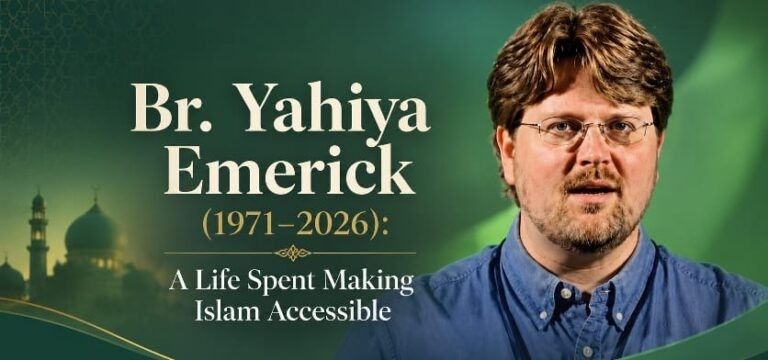
Islamic Circle of North America (ICNA) mourns the passing of Brother Yahiya John Emerick (1971–2026), rahimahullah, a Muslim American educator, author, publisher, and community teacher whose books shaped the Islamic literacy of a generation of North American Muslims. He died July 11, 2026. He was 55.14 Tributes from former students, fellow authors, school teachers, and readers who grew up on his books began circulating within days.
In his lifetime, Brother Yahiya was not a household name in the way some traveling scholars are. He preferred classrooms, printing quotes, and convention bazaars to the stage. But for tens of thousands of Muslim children who first learned about the Prophet (peace be upon him) from a textbook he authored, and for a generation of new Muslims who first sat down with an introductory volume that spoke to them in familiar English, Brother Yahiya was quietly foundational.
A Journey to Islam
Brother Yahiya was born in 1971 and raised in Lake Orion, Michigan,16, 17 to a Baptist Christian family. Three early influences appear repeatedly in his recollections: his grandmother, whose example taught him “what it meant to be an upstanding person with refinement and elegance;” a teacher he called Mr. Thomas and described as the most interesting person he had ever met; and J. R. R. Tolkien’s “The Hobbit,” which he said “opened my eyes to a world greater than my own.”2
The turning point in his religious life came when he was 15. He heard a Sunday sermon on the Trinity doctrine, and it, as he later put it, “made absolutely no sense.” 2 The question stayed with him through high school and into his first year of college.
He enrolled at Michigan State University and earned a bachelor’s degree in history and a master’s in education. In his freshman year, comparing the Islamic view of the Prophet Jesus (peace be upon him) with the Trinitarian Christian view, he “accepted Islam at the end of 1988,” later reflecting, “I had already been troubled by the trinity idea since I was about 15, so it was pretty easy to transition to Islam’s more logical position.”2
Shortly after becoming Muslim, Brother Yahiya started a newsletter for a nearby masjid, dove into the Qur’an and the classical literature, and in 1989 and 1990 began an early attempt at a modern-English translation of the Qur’an, a project that would resurface decades later in far more ambitious form.1
Early Da’wah with ICNA in Detroit’s Western Suburbs
Brother Yahiya’s first sustained community role after converting was with ICNA. In an interview for a University of Worcester doctoral thesis, he described his path into full-time Islamic education. “I became a teacher by accident. I was a member of ICNA and they charged me with starting a youth group in a growing Muslim community in Michigan.”2
He served the Muslim Community of Western Suburbs (MCWS), a congregation founded and incorporated in 1979 by young Muslim families in Canton, Detroit. Brother Yahiya continued to live in Lake Orion and drove on weekends to MCWS to work with the youth.2, 16 During those years, his ICNA-Michigan mentors were the late Brother Naeem Saroya and the Brother Ahmed Hussaini. They steered him toward organizing a youth group at the then-newly built Crescent Academy and the MCWS mosque under the ICNA-associated banner of Young Muslims for Faith and Action (YMFA).16 Of that time in his early 20s, Brother Yahiya described traveling to MCWS’s monthly community dinners and, after a great deal of struggle, “got the teens there to form a youth group.”2 Several of the young people he mentored would later serve in leading roles at Muslim community organizations across North America.16
During the same period, MCWS partnered with Muslim families from Dearborn to open a full-time Islamic school in Canton. The principal, Dr. Dawud Tawhidi, noticed how Brother Yahiya worked with the youth and, after some months, offered him a full-time teaching position. Brother Yahiya said, “At the time I was selling furniture for a living (hated it!) so I agreed so I could try something new. That was back in 1992. Even though I was really young, I got the teaching job.”2
That first classroom shaped two lifelong observations. The first was the scarcity of English-language Islamic materials written for people who lived in North America. The second was the vulnerability of Muslim youth growing up outside a majority-Muslim society; parents, he later wrote, “take it for granted that, well, a kid from a Muslim family will be and stay Muslim by osmosis and association,” when the reality demanded “da’wah to our own children in order to win their loyalty for life.”1 Everything he wrote addressed one or both issues.
Amirah Publishing and the Birth of a Genre
In 1992, while teaching in Canton, Brother Yahiya created a small, English-language hadith compilation titled “In the Path of the Holy Prophet” and had 300 copies made and bound. Months later, 300 copies of his first work of fiction, “The Seafaring Beggar and Other Tales,” were produced.1
Local reception was cool. “To this day,” Brother Yahiya wrote decades later, “not a single person ever told me they read it and/or enjoyed it.” Undeterred, he founded Amirah Publishing Company that same year to publish his own work and, over time, to build what he called “American-oriented literature on Islam.”1 Amirah was never a large operation; Brother Yahiya financed it himself and sold books at Muslim convention bazaars along the East Coast. Because he was the earliest documented author to label and publish work in juvenile English-language Islamic fiction, some in the Islamic literary community credit him as the genre’s “father.”
Moving to New York and Working in an Islamic School
In 1995, Brother Yahiya moved to New York to teach at an Islamic school. In the words of longtime ICNA-Michigan member Brother Amin Jibril, this move marked “a marriage of ICNA Michigan and ICNA New York.” Brother Yahiya had married Sister Reshma Baig from an ICNA New York family with a long record of Shura service.16 They remain married until his death and were blessed with a son.
It was in a New York Islamic school classroom where the Ahmad Deen series was born. Wanting to spike up a world history lesson for sixth graders, Brother Yahiya narrated an off-the-cuff adventure about “one Ahmad Jones” exploring some old ruins. The story got away from him, the students were mesmerized, and he spent the following week expanding the story into a short novel. The last-name reference to the Indiana Jones franchise was quickly swapped out for “Ahmad Deen,” in honor of one of his best students, and “Ahmad Deen and the Curse of the Aztec Warrior” went to a local printer.2
Over the following years, Brother Yahiya served as vice-principal of a full-time Islamic school in Westbury, Long Island.3 Alongside his classroom work, he was president of the Islamic Foundation of North America (IFNA), a nonprofit dedicated to the production of English-language textbooks and Islamic reading material.3 Through IFNA, in partnership with school-focused publisher Noorart Inc. which distributed his books from 1998 to 2008, his textbooks became fixtures of Islamic Studies classes across the country.
Relationship With ICNA
Brother Yahiya’s relationship with ICNA, which began in Michigan, unfolded through several channels over the following decades. From the early 1990s into the 2000s, he was a familiar presence at the annual ICNA-MAS Convention bazaars along the East Coast, first as a young teacher and author selling copies of “The Seafaring Beggar,” and later as an established publisher hauling boxes of his own textbooks and fiction titles.1 He wrote for Message International, ICNA’s flagship English-language magazine, on various subjects, including the Muslim view of Jesus (peace be upon him),11 the state of Islamic fiction,10 and Muslim compassion in public life. He spoke at the 35th Annual ICNA-MAS Convention in Hartford in 2010.12 Additionally, his textbooks, specifically “What Islam Is All About” and “Learning About Islam,” remained in active use by ICNA local chapters running youth education programs and Young Muslims quiz competitions for years after their publication.5
Brother Yahiya also served in ICNA’s governing bodies. Dr. Muhammad Yunus, a former ICNA President, recorded Brother Yahiya joined ICNA as a Member of the General Assembly (MGA) in the mid-1990s and was elected to ICNA’s Central Shura from 1994 to 1995, a two-year term:15
“I remember that he would attend ICNA Shura meetings regularly. He was well prepared about the items on the agenda. He would express candid, unbiased opinions to the best of his ability. His suggestions and proposals were based on great insight and desire for sincere implementation for the best outcome for the organization, especially American youth.”
A Classic Renewed
Among the many books Brother Yahiya wrote, edited, or adapted, one stands apart in its symbolic weight for the ICNA family, his revised edition of Sayyid Abul A’la Mawdudi’s “Towards Understanding Islam.” This book is one of the most widely read introductions to Islam ever written in a modern language. Composed by Mawlana Mawdudi in Urdu in 1932 as a Muslim student’s primer, it distilled the Islamic worldview into a brief, accessible volume. Translated into English by Khurshid Ahmad, and later by Khurram Murad, it became one of the foundational da’wah and study texts of the 20th century Islamic revivalist movement.
By the early 2000s, its English prose, originally rendered for a mid-20th century readership in South Asia and the United Kingdom, was beginning to feel dated to young North American readers. ICNA turned to Brother Yahiya, and in 2002 an ICNA-published edition of “Towards Understanding Islam” was produced (ISBN 9781883591014).7 A 2005 ICNA edition was built on Khurram Murad’s translation and revised by Brother Yahiya for a contemporary North American readership.8 In 2010, an expanded revision appeared under the title “Towards Understanding Islam: Updated for a Modern World,” this time under the joint imprint of Brother Yahiya, IFNA, and Amirah Publishing.9
Brother Yahiya’s edition took its place in study circles, youth halaqas, and new Muslims starter shelves where the original had long lived, a foundational read in accessible English for a new generation.
An Author for Classrooms, Families, and Young Readers
Brother Yahiya authored, edited, or translated more than 25 titles across a striking range of genres.1, 3 Any short list would be misleading, but the following reflects the shape of his mission.
His “Complete Idiot’s Guide to Understanding Islam,” issued by Alpha Books (an imprint owned by Penguin Random Books), brought a major American publishing brand to bear on an accessible, sympathetic introduction to Islam. It went through multiple editions, culminating in a substantially expanded third edition in 2011.4 Alongside it sat “How to Tell Others About Islam,” a da’wah training manual for Muslims presenting Islam to non-Muslim audiences, in continuous use through the 1990s.6 “Critical Lives: Muhammad” (Alpha Books, 2002) placed the life of the Prophet (peace be upon him) into Alpha’s serious-general-reader biography series alongside biographies of major historical figures.
Brother Yahiya’s engagement with the Qur’an ran through his entire career. In 2010, working through Amirah and IFNA, he issued a family of related volumes: “The Holy Qur’an in Today’s English,” “The Meaning of the Holy Qur’an in Today’s English,” and an extended study edition with a full commentary.1 He also produced dedicated Qur’anic reference material for school-age readers, including “The Holy Qur’an for School Children.”
“What Islam Is All About” and “Learning About Islam,” together with their companion Test Masters and workbook series, became standard-issue Islamic Studies textbooks in numerous North American Islamic schools during the 1990s and 2000s.5 Whole cohorts of American Muslim children learned their aqidah, their pillars of Islam, and the outlines of Muslim history from books Brother Yahiya authored. For younger children, “My First Book About Islam,” “My First Book About Eman,” and “Color and Learn Salah” gave Muslim parents age-appropriate resources when very few such books existed.
The Deen family adventures, the Ahmad Deen series, and the Layla Deen mysteries gave Muslim tweens and teenagers something that had barely existed before: adventure fiction with Muslim heroes whose Islam was integral to the story rather than incidental.2 “Isabella: A Girl of Muslim Spain” and “The Seafaring Beggar and Other Tales” rounded out an early attempt to build a serious body of English-language Islamic fiction (ELIF) for young readers.
Teaching Islam in an American Context
Brother Yahiya’s classroom experience was inseparable from his writing. He wrote frankly about the risk a Muslim child whose reading life contained no Islam would come to feel “the non-Muslim world is the ‘real’ world,” and that Islam belonged to some other, less real place. His educational philosophy was practical and direct. He wanted teachers to have textbooks they could actually teach from, parents to have books they could actually put on their children’s shelves, and young readers to have stories they could actually enjoy. Where he found gaps, he wrote a book. His writing voice – plain, warm, and often gently humorous – was the voice of a schoolteacher who had spent years listening to what actually connected with students.
His work served identifiable readers – Muslim teenagers who found in the Deen family novels characters that acknowledged the dual world they lived in; new Muslims who began with “What Islam Is All About” or the “Complete Idiot’s Guide”; parents assembling a coherent shelf for their children; teachers who used his textbooks in a period when Islamic school curricula were still being invented, and da’wah workers who reached for his introductory writing as both template and handout.
Activism, Interfaith Work, and Public Engagement
Alongside his teaching and writing, Brother Yahiya was involved in interfaith initiatives and Islamic public education, particularly through IFNA and his convention presence. In the aftermath of September 11, 2001, he was interviewed by mainstream press outlets, including the New York Daily News, and defended, thoughtfully, the pedagogical premises of Islamic school textbooks used in the New York area. His post-9/11 revisions of the “Complete Idiot’s Guide” added sections on the real meaning of jihad and on the American Muslim experience.4
In an essay in Message International, he described the generation’s responsibility bluntly: “Future generations will either have an easier time being Muslim or a harder time based on our groundwork today. That’s a big responsibility and it is what Allah (swt) requires of us.”10 A signed copy of one of his books to a former student contained a succinct inscription and summary of his life’s work: “Thinking long term.”13
Character
Those who worked with Brother Yahiya, who sat in his classrooms, or who bought books from his bazaar tables, recalled him in strikingly consistent terms. They described a teacher who was patient with children and slow to dismiss a question. They described an author who was more interested in whether a young reader had understood something than in whether the sentence sounded impressive. They described a publisher who ran his operation out of a P.O. box in Flushing, Queens, and who acknowledged that writing for the Muslim community was “a labor of love whose rewards are with the Almighty in the Next Life.” They described a Muslim who read constantly, who worried openly about the state of the community, and who kept writing anyway.
Brother Amin Jibril, an ICNA-Michigan member who worked closely with Brother Yahiya, remembered him as soft-spoken, friendly, and utterly without airs.16 In fact, he described himself as an “underpaid teacher in an Islamic school” who wrote around two jobs, produced dozens of books, ran his own press, and, until his final years, was still “surviving on a teacher’s salary.” He was not writing for prestige, he was writing because he thought Muslim children needed better books.
A Legacy Measured in Readers
A Muslim teenager who picks up an accessible edition of “Towards Understanding Islam” is not simply reading a book, but being handed a framework in which to think about God, prophethood, revelation, and moral responsibility, and a vocabulary to explain Islam to a curious classmate. The teen is being shown, in prose that treats him as capable, that the Islamic tradition is intellectually serious and personally addressable.
That is the legacy Brother Yahiya’s work built. It cannot easily be counted, and it does not appear on organizational charts. It surfaces years later, when someone realizes that the reason he could answer a hard question at the age of 19 was because he had read a certain paragraph when he was 13, or when a convert realizes his study group worked through a certain textbook. That is a considerable legacy for one man to leave behind, from one printer, one classroom, and one P.O. box in Queens.
Janazah and Memorial
Brother Yahiya’s Janazah prayer was held July 12, 2026, at the Muslim Center of New York in Flushing. He was buried at Washington Memorial Cemetery. May Allah have mercy on him and grant him the highest station in jannah.
Those who wish to support his family may do so through the memorial fundraising campaign at launchgood.com/YahyaEmerick.
A Statement from the ICNA President
Brother Saad Kazmi, president of Islamic Circle of North America, issued this statement:
The Islamic Circle of North America received the news of Brother Yahiya Emerick’s passing with deep sadness. In him we have lost a pioneering American Muslim who understood, perhaps better than most of his contemporaries, what indigenous da’wah in this land would require. Long before the conversation about serving new Muslims and second-generation American Muslims became widespread in our community, Brother Yahiya saw the gap and stepped into it – not to write about it or convene panels on it, but to fill it. He committed his time, his resources, and the labor of decades to producing the books, translations, and curricula that a growing community desperately needed and could find nowhere else.
Brother Yahiya was, in the truest sense of the term, an Islamic worker. He embodied what it means to live a life in service of this deen: quietly, consistently, without waiting to be asked, and without waiting for recognition. ICNA is indebted to him – for his early service on our Central Shura, for the generation of American Muslims he helped raise through his writings, and for the standard he set for what one committed believer can accomplish for the ummah in a single lifetime.
On behalf of the entire ICNA family, I extend our heartfelt condolences to his family and to all who loved and learned from him. We ask Allah (SWT) to accept his lifelong efforts, to forgive his shortcomings, to grant him the highest ranks of Jannat al-Firdaws, and to grant his family sabr al-jameel in the days ahead. Ameen.
A Legacy of Beneficial Knowledge
The Prophet (peace be upon him) taught when a person dies, their deeds are cut off except from three: an ongoing charity (sadaqah jariyah), a beneficial knowledge (’ilm yuntafa’u bihi), and a righteous child who prays for them.
By that measure, Brother Yahiya leaves behind a considerable inheritance. His textbooks continue to be taught. His introductory books continue to be handed to seekers. His revised edition of “Towards Understanding Islam” continues to sit on new Muslims’ shelves. The category of English-language Islamic fiction, which he helped invent, continues to grow, and a new generation of Muslim writers now works in the space he opened.
His life is also a reminder of a responsibility that outlives him. Making Islamic knowledge accessible in English, investing seriously in Muslim youth, supporting converts, and developing high-quality curriculum for the community all remain unfinished. Brother Yahiya, in his own quiet way, understood that. He signed, in that inscription to his former student, exactly the right words.
“Thinking long term.”
Closing Du’a
May Allah, the Most Merciful, forgive Brother Yahiya, cover his shortcomings, accept the years of teaching, writing, and da’wah he offered as sadaqah jariyah, illuminate his grave, and elevate his rank to Jannat al-Firdaws in the company of the Prophet (peace be upon him) and the righteous.
May Allah reward every student who benefited from his classroom, every reader who benefited from his books, and every teacher whose lesson plans he made possible, and may that reward continue to reach him.
May Allah grant his family, his colleagues, his students, and the many communities that carried his work sabr jameel, a beautiful patience, and comfort in this loss.
Inna lillahi wa inna ilayhi raji’un.
Ameen.
His Books
The Prophet (peace be upon him) taught a person’s deeds continue after their passing through three channels, including knowledge that continues to benefit others. Emerick’s books are a paradigmatic example of such knowledge, still in use in Islamic schools, halaqas, and family libraries across North America. Readers who wish to share in the ongoing reward for his work may purchase and read them through the links below.
Browse the full catalog: Amirah Publishing (his own press) or Amazon author page for the widest availability.
Introductions to Islam
- “The Complete Idiot’s Guide to Understanding Islam” (3rd Edition, 2011) – Amazon
- “How to Tell Others About Islam” – Amazon
Biography of the Prophet ﷺ
- “Critical Lives: Muhammad” – Amazon
Qur’anic works
- “The Holy Qur’an in Today’s English” – Amazon
- “The Meaning of the Holy Qur’an in Today’s English” – Amazon
- “The Holy Qur’an for School Children” (Juz ’Amma) – Amazon
Islamic school textbooks
Books for younger children
Fiction for young readers — the Deen Family Adventures
- “Ahmad Deen and the Curse of the Aztec Warrior” – Amazon
- “Ahmad Deen and the Jinn at Shaolin” – Amazon
- “Layla Deen and the Case of the Ramadan Rogue” – Amazon
- “Layla Deen and the Popularity Contest” – Amazon
Other fiction
Revised editions of classic works
- “Towards Understanding Islam: Updated for a Modern World” (Mawdudi, revised by Y. Emerick, 2010) – Amazon
May Allah reward every reader who benefits from these books and may that reward continue to reach Brother Yahiya.
Sources
- Amirah Publishing – “Our Story” – https://www.amirahpublishing.com/about-us
- Gilani-Williams – Literature-Based Character Development & Islamic Children’s Fiction (PhD thesis, University of Worcester, 2015) – https://eprints.worc.ac.uk/10298/1/PhD%20Thesis%20%20Fawzia%20Gilani%20Williams.pdf
- Penguin Random House – Yahiya Emerick author page – https://www.penguinrandomhouse.com/authors/275339/yahiya-emerick/
- Penguin Random House / DK – “The Complete Idiot’s Guide to Islam, 3rd Edition” (Nov 1, 2011) – https://www.penguinrandomhouse.com/books/359319/the-complete-idiots-guide-to-islam-3rd-edition-by-yahiya-emerick/
- WorldCat / OCLC – “What Islam Is All About: Student Textbook” (1997 ed.) – https://search.worldcat.org/title/47863926
- Kathleen M. Moore – “Da’wa,” Oxford Handbooks Online (Jan 2014) – https://escholarship.org/content/qt3fk0f2ts/qt3fk0f2ts_noSplash_5286fdf2ac0b9f0ceb56fd8579ab4d71.pdf
- “Towards Understanding Islam, ICNA edition” (2002), ISBN 9781883591014 – https://www.abebooks.com/9781883591014/Understanding-Islam-Abul-ALa-Mawdudi-1883591015/plp
- “Towards Understanding Islam,” 2005 ICNA edition (rev. by Y. Emerick) – https://www.pcabookstore.com/samples/14890.pdf
- “Towards Understanding Islam: Updated for a Modern World” (2010), ISBN 9781450552011 – https://www.abebooks.com/9781450552011/Understanding-Islam-Updated-Modern-World-1450552013/plp
- Yahiya Emerick – “Promoting Islamic Fiction: A Worthwhile Struggle,” Message International (Jan 30, 2014) – https://messageinternational.org/promoting-islamic-fiction-a-worthwhile-struggle/
- Yahiya Emerick – “The Call of the Creator of Earth and Light,” Message International (June 8, 2014) – https://messageinternational.org/the-call-of-the-creator-of-earth-and-light/
- Nihal Khan (MuslimMatters) – “35th Annual ICNA Convention: Save Family, Save Society” (June 17, 2010) – https://muslimmatters.org/2010/06/17/35th-annual-icna-convention-save-family-save-society/
- MuslimMatters – “Thinking Long-Term: The Legacy of Yahiya Emerick” (July 14, 2026) – https://muslimmatters.org/2026/07/14/thinking-long-term-the-legacy-of-yahiya-emerick/
- Bekim Belica – “The Measure of a Quiet Teacher” (July 2026) – https://medium.com/illumination/the-measure-of-a-quiet-teacher-b73473ef8fde
- Personal testimonial: Dr. Muhammad Yunus, Ex-ICNA President – “Remembering Yahiya Emerick, Rahimahullah” (July 2026)
- Personal testimonial: Brother Amin Jibril, Ex-ICNA Shura Member and ICNA-Michigan member (July 2026)
- Yahiya Emerick – Facebook post in the “Lake Orion High School – Class of 1986” group (Feb 13, 2021) – https://www.facebook.com/share/p/1BQvTGJ8ph/