”This is the fourth and final article in a series entitled “Under the Throne of Allah: Dua and Dhikr.”
Take a minute, take a few deep breaths, and focus on your heart.
Close your eyes and ask yourself, where is your heart today? What is it carrying?
If it’s carrying negative emotions, stress, or if you’re feeling overwhelmed or distracted, it’s OK, and it’s OK even if your heart isn’t fully focused on your goals and priorities. To have enough self-awareness to realize when something doesn’t sit right is an immense blessing. What’s more, if we pause, reflect, and ask ourselves, “Do I feel Allah’s mercy shining on me through all His blessings he bestowed upon me?” the answer will most definitely be yes.
Self-awareness is an incredible blessing. Knowing and naming how you feel is half the battle, but the rest is fought within, reframing reality through the lens of Allah’s mercy. In turn, we can prevent harmful emotions from festering and morphing into resentment, which could badly color how we interact with others and our relationship with Allah (SWT). We must strive to control our nafs and resist allowing our impulses and desires to control our lives. In other words, we must train our brains otherwise.
Harnessing Patience and Gratitude to Reset our Outlook
Allah’s Messenger (peace be upon him) said: “Strange are the ways of a believer for there is good in every affair of his and this is not the case with anyone else except in the case of a believer for if he has an occasion to feel delight, he thanks (God), thus there is a good for him in it, and if he gets into trouble and shows resignation (and endures it patiently), there is a good for him in it.” (Sahih Muslim 2999)
How beautiful! We learn here that by establishing sabr (patience) and shukr (gratitude), we train our brains to believe what happens to us is good. In every circumstance, we recalibrate our hearts to Allah and use our situation to draw closer to Him, to remember Him, to ask of Him. When we make dua to Allah, we remind ourselves that every dua nourishes our soul.
Dua as the Only Way to Change Your Reality
Nothing changes without Allah’s will. With dua, we align our lives with His decree. We ask Him to grant us patience in times of difficulty, we ask Him to grant us gratitude in times of celebration and ease.
Abu Sa’id al-Khudri reported: The Prophet (peace by upon him), said, “There is no Muslim who calls upon Allah, within which is no sin or cutting family ties, but that Allah will give him one of three answers: He will quickly fulfil his supplication, He will store it for him in the Hereafter, or He will divert an evil from him similar to it.” They said, “In that case, we will ask for more.” The Prophet said, “Allah has even more.” (Musnad Aḥmad 11133)
Imagine! Allah has more than all our wishes and hopes, no matter how silly or small. He has more than all our sins and mistakes. He has more!
Salman al-Farsi reported: The Prophet, peace and blessings be upon him, said, “Verily, Allah is conscientious and generous. He would be shy, when a man raises his hands to Him, to turn them away empty and disappointed.” (Sunan al-Tirmidhī 3556)
Dua turns hope into action, fear into courage, and grief into light. It reconnects us to the Divine when we are guilt-ridden, shame-filled, and sin-stained. We beg and plead, and we ask, and surely He will give to us. We know he will provide for us as He has time and time again.
Allah (SWT) himself says: When My servants ask you ˹O Prophet˺ about Me: I am truly near. I respond to one’s prayer when they call upon Me. So let them respond ˹with obedience˺ to Me and believe in Me, perhaps they will be guided ˹to the Right Way˺. (Quran 2:186)
Indeed, He is near. He wants us to ask, and when we do, He responds!
When this happens, our inner worldview shifts first —sincerity, patience, gratitude — and then the outer worldview follows. We train our brain to rely on Him, to ask of Him, to see all things through His mercy, to realize all good is from Him and we are grateful, because although difficulties are from Him, so we can turn back to Him, and have patience.
As Islam teaches, we know this is only for the believer, the one who believes in predestination, the one who believes in Allah, the one with tawakkul, absolute reliance on and complete trust in Allah’s plan, and, alhamdulillah, we are part of them.
Dua as a Pathway to Tawakkul
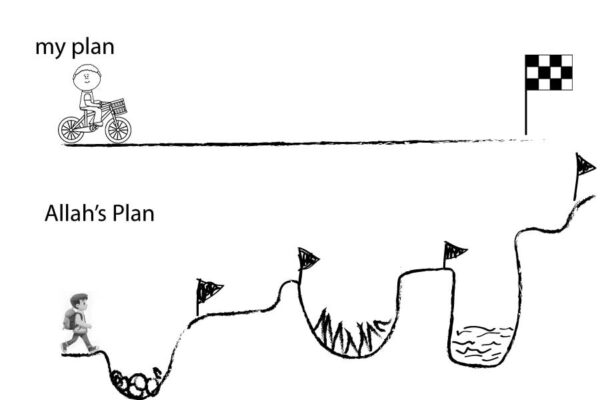
When we make dua to Allah, we understand we put all our matters into His hands; however, upon reflection, we know Allah always governed our affairs. Nevertheless, dua acts as a reminder to relinquish our burdens and give them to Allah while remembering the only plan is Allah’s plan, and He is the best of planners. Understanding this plants the seed of tawakkul in our hearts. Remember, tawakkul is not passive surrender but an active trust in divine decree. Dua feeds tawakkul. We plant the seed while making dua and we trust Allah for the rest. We then choose to take solace that whatever happens is exactly what was meant for us, and it is the best for us because it is what Allah wrote for us.
The Soul’s Transformation Through Dua
Dua builds spiritual and emotional resilience, acting as our anchor in storms. The dua for istikhara (written below) enables us to fortify our hearts against any waswas, or doubt or grief, that may arise. We make this dua to guide our hearts at crossroads, so we recognize that whatever decision we make is informed by Allah’s divine wisdom. We should understand we have taken our asbaab, our reasons, and whatever happens next is by Allah. With this beautiful internalization, we begin to truly understand everything will happen as it should and that it will be good.
O Allah, I seek Your guidance (in making a choice) by virtue of Your knowledge, and I seek ability by virtue of Your power, and I ask You of Your great bounty. You have power, and I do not. You know, and I know not, and You are the Knower of the unseen. O Allah, if You know that this matter [mention the thing to be decided] is good for me in my religion, my livelihood, my worldly affairs, and in the hereafter, then decree it for me, make it easy for me, and bless it for me. And if You know that this matter is bad for me in my religion, my livelihood, my worldly affairs, and in the hereafter, then turn it away from me and turn me away from it, and decree for me the good wherever it may be and make me content with it [Sahih al-Bukhari #6382].
The Beautiful Effects of Dua
Dua acts upon our soul in many beneficial ways. Spiritually, we feel Allah’s nearness and see His will in all things. Emotionally, dua diffuses anxiety and replaces despair with hope. Mentally, we develop a mindset of abundance as we understand Allah’s treasures are limitless.
So, make your duas. “O Allah, You are the Hearer of all whispers. I am here, I am needy, I am small, I am broken, and I am hurt. Ya ilahi. Ya rabbi, only you know what’s in my heart, only you know what I go through, I am frail but full of hope in You. Change what I cannot change, mend what I cannot fix, and place light where I see darkness.”
I urge you to take a moment to transform your reality with me. Place your hand on your heart, and feel the mercy of Allah shine on you and be present in all aspects of your life. We are so blessed, and we have so much good in our lives. Alhamdulillah!
Remember, your heart will forever find ease in remembrance of Allah. So call upon Him, for He is near.
Thank you for being part of this 4-part series. Here you can read parts 1, 2, and 3.


To live with dhikr is to weave remembrance of Allah into daily life, not through rigid checklists or guilt-driven goals, but through sincerity and consistency. Dhikr can be a whispered “subḥānAllāh” while washing dishes, a heartfelt dua in the car, or a moment of reflection in silence. The connection is what matters. 
However, in this modern age, our everyday lives are filled with distractions, making it difficult to always remember Allah (SWT). Nevertheless, the best thing we can do is to remember Allah (SWT) as much as we can because that is what our heart wants.
The Prophet (peace be upon him) encouraged us to read Surah Al-Kahf on Fridays for its blessings and protection from trials. He said, “Whoever reads Surat al-Kahf on the night of Jumu’ah, will have a light that will stretch between him and the Ka’bah.” (Sunan al-Darimi, 3407). He (peace be upon him) also said, “Whoever reads Surat al-Kahf on the day of jummah, will have a light that will shine from him from one Friday to the next.” (al-Bayhaqi, 3:249). Finally, Mohammad (peace be upon him) said: “Whoever memorizes ten verses from the beginning of Surah al-Kahf is protected from the trial of al-Dajjāl.”
As children, we’re taught the first word revealed in the Quran was “iqra” (read) in Surah Al-Alaq. If thoroughly reflected upon, we see this word comes in the surah that also detail’s man’s conception, al alaq, or the clot. This emphasizes the importance of seeking knowledge, how it begins at our conception and is a cornerstone of our faith. The ayah itself instructs Prophet Muhammad (peace be upon him) to “Read in the name of your Lord who created.”
Try your best to designate specific times for learning. Even 15-30 minutes daily can lead to significant growth over time. 
Carol Dweck, an American psychologist and Ivy League professor, has done extensive research (2006) into what a mindset is and has defined it as the collection of beliefs, attitudes, and assumptions that shape an individual’s thinking, behavior, and approach to life. It represents a person’s mental framework or perspective through which they interpret and respond to situations, challenges, and opportunities. She posits that beliefs provide the foundational framework upon which a mindset is built and significantly influence how individuals approach challenges, view their abilities, and perceive growth opportunities.
As Muslim parents, we understand that our role in the tarbiya, or rearing and nurturing, of our children is vital. The Prophet Muhammad (peace be upon him) said: “There is no gift that a father gives his child more virtuous than good manners.” (Sunan al-Tirmidhi, Hadith 1952). We also know the Qur’an offers a beautiful prayer of Prophet Ibrahim (peace be upon him): “My Lord, grant me [a child] from among the righteous.” (Surah As-Saffat, 37:100). We want our children to have good manners and be among the righteous; there is no question about that.
We also should strive for a mindset of continuous improvement. The Prophet Muhammad (peace be upon him) said: “Indeed, Allah has prescribed excellence (ihsan) in all things.” (Sahih Muslim, Hadith 1955). This includes our behavior and beliefs. Allah says, “He has succeeded who purifies the soul, and he has failed who corrupts the soul.” (Qur’an 91:9-10). This purification happens through the process of tazkiya (self-purification), and should be applied to our mindsets as well, leading us to believe Allah has given us our talents and gifts, but we can improve on them by refining our morals as well.
Resilience is essential for children due to the daily obstacles they encounter. Consider a child who faces bullying at school, struggles with a complex academic subject, or experiences family upheaval. Without resilience, these challenges could have long-lasting negative effects on their mental and emotional well-being. However, with the right tools and support, children can learn to navigate these hurdles, emerging stronger and more capable. This article explores the importance of building resilience in children and offers practical strategies for parents, educators, and caregivers to foster this critical trait. Understanding and applying these techniques can help children develop the inner strength needed to thrive in an ever-changing world.
To build resilience in children, practical strategies are essential. Modeling resilience is key, as children learn by observing adults. Parents should demonstrate positive ways to manage stress and recover from setbacks. They should avoid overreacting to situations and refrain from giving in to negative emotions such as intolerance, resentment, or anger.
During trying times, Muslims are urged to turn to prayer and ask Allah for wisdom, mercy, strength, and support. As the Qur’an says, “O you who have believed, seek help through sabr and prayer. Indeed, Allah is with those with sabr” (Qur’an 2:153). We can teach children the value of du’a and the importance of consistent salah. We can help them develop steadfast faith in God’s plan, supporting their resilience. Performing the five daily prayers offers regular opportunities to connect with Allah, seek guidance, and find solace in His presence. It is important to remind children to use these moments in prayer to seek strength and patience from Allah, especially during difficult times.


Factors for Prosocial Development
Warmth and affection
Active Monitoring
Consistent Disciplinary Strategies