بسم الله الرحمن الرحيم

Author: Dr. Riaz Khan

  • Prophet Muhammad’s (pbuh) Farewell Sermon

    Prophet Muhammad’s (pbuh) Farewell Sermon

    The following sermon was delivered by Prophet Muhammad, peace be upon him, on the 9th day of Dhul Hijjah 10 A.H. (632 C.E.) in the Uranah valley of Mount Arafat in Mecca.

    After praising and thanking Allah (SWT), he said:

    “O People, lend me an attentive ear, for I know not whether after this year, I shall ever be among you again. Therefore listen to what I am saying to you very carefully and take these words to those who could not be present here today.

    O People, just as you regard this month, this day, and this city as sacred, so regard the life and property of every Muslim as a sacred trust. Return the goods entrusted to you to their rightful owners. Hurt no one so that no one may hurt you. Remember that you will indeed meet your Lord, and that He will indeed reckon your deeds. Allah has forbidden you to take usury (interest); therefore all interest obligations shall henceforth be waived. Your capital, however, is yours to keep. You will neither inflict nor suffer any inequity. Allah has Judged that there shall be no interest and that all the interest due to Abbas ibn ‘Abd’al Muttalib [the Prophet’s uncle] shall henceforth be waived.

    Beware of Satan for the safety of your religion. He has lost all hope that he will ever be able to lead you astray in big things, so beware of following him in small things.

    O People, it is true that you have certain rights with regard to your women, but they also have rights over you. Remember that you have taken them as your wives only under Allah’s trust and with His permission. If they abide by your right, then to them belongs the right to be fed and clothed in kindness. Do treat your women well and be kind to them for they are your partners and committed helpers. And it is your right that they do not make friends with any one of whom you do not approve, as well as never to be unchaste.

    O People, listen to me in earnest, worship Allah, say your five daily prayers (salah), fast during the month of Ramadan, and give your wealth in the obligatory alms-giving (zakat). Perform hajj if you can afford to.

    All mankind is from Adam and Eve. An Arab has no superiority over a non-Arab nor a non-Arab any superiority over an Arab; also a white has no superiority over a black nor does a black have any superiority over a white except by piety and good action. Learn that every Muslim is a brother to every Muslim and that the Muslims constitute one brotherhood. Nothing shall be legitimate to a Muslim which belongs to a fellow Muslim unless it was given freely and willingly. Do not, therefore, do injustice to yourselves.

    Remember, one day you will appear before Allah and answer for your deeds. So beware, do not stray from the path of righteousness after I am gone.

    O people, no prophet or apostle will come after me and no new faith will be born. Reason well, therefore, O people, and understand words which I convey to you. I leave behind me two things, the Qur’an and my example, the sunnah, and if you follow these you will never go astray.”

    All those who listen to me shall pass on my words to others and those to others again; and may the last ones understand my words better than those who listen to me directly.  Be my witness, O Allah, that I have conveyed your message to your people”.


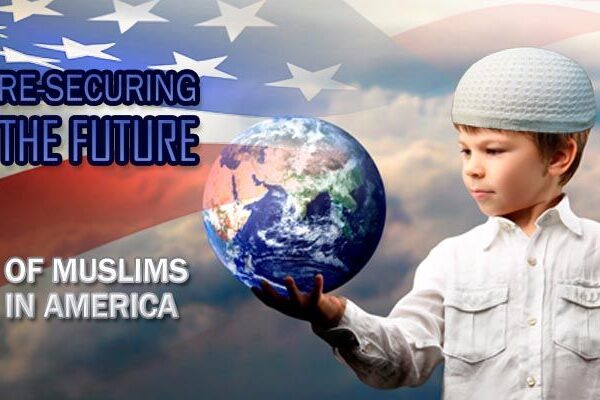
  • Re-securing the Future of Muslims in America

    Re-securing the Future of Muslims in America

    When a tragedy strikes, whether natural disaster or man-made catastrophe, there is death and destruction. Human suffering mounts as people are disoriented and mentally and emotionally devastated. This jolting experience changes their worldview forever. Neighbors, relatives, and friends come together to help shoulder the grief and provide moral and other forms of support they are able to offer. This is humanity at its best, though for unfortunate reasons.

    Strong, upstanding young Muslims, born and raised in America, confident and committed to their values, intellectually enlightened with a balanced global perspective

    As human beings, we all aspire to the surety that our children and grandchildren will enjoy a prosperous, bright, and secure future. The third generation of the immigrants who arrived in the United States from many parts of the Muslim world in the ‘60s and ‘70s is just about reaching college age. That first generation had various challenges to face. Their economic survival, social adjustment, and identity preservation were the major issues. There was no Muslim community to belong to, no masjid to go to, little awareness or availability of halal meat and other food items, and Islamic schools or riba-free financing were still consigned to the imagination.

    Today, al-humdulillah, Muslim communities are flourishing, thousands of masajid across the country provide anchor and inspiration, hundreds of full-time Islamic schools are up and running, halal meat stores are at every block in some major cities, and Islamic financing is offered by many groups and institutions. Moreover, several national and regional organizations represent and advocate Muslim views and concerns, and dozens of Muslims currently, with ever-growing numbers, hold public office at various levels of the government. This is amazing progress in just a few decades as so many have worked with devotion and sacrifice so that Muslims can shape their lives in an accommodating environment and support system.

    It is natural for those who have set this stage to expect the younger generation to take the Muslim presence to the next level, socially, intellectually, and politically. Unlike their predecessors, however, the challenges the younger generation faces are totally different. The horrific tragedy of 9/11 has, unfortunately, changed the social and political landscape of this country for Muslims. There is no question that those who committed this crime against humanity were twisted in their evil-minded purpose and terrorist operation. Nationals of some 90 countries lost their lives, including many Muslims.

    The whole world was shocked, condemning the evil act and standing firm against the barbarous violence. It was a moment of opportunity to create alliance through mature and rational discourse and a re-commitment to social justice everywhere as a means to ameliorate the conditions and dismantle the apparatuses systemic to a violence-prone world. Then an unyielding resolve to bring the perpetrators to account for their murderous deeds proceeds naturally, with sanction and moral rightness. Many Americans question whether the last decade of our national history has unfolded accordingly.

    Exacerbating the national tragedy, too many seized the event as an opportunity to exploit public fear and forward their own objectives. An army of experts on terrorism was born overnight, flooding the written media and airwaves with distortion and manipulating demagoguery, stereotyping Muslims and vilifying Islam. The collective impact of this feeding frenzy was that Islam, Muslims, and terrorism became synonymous in the public mind.

    There can be a natural bonding between Muslims and other Americans who cherish the same values and decry both radicalism and bigotry

    Others worldwide used the 9/11 tragedy as a pretext to advance their repressive agendas. Tyrants were empowered and emboldened to further subjugate, within their own populations, political opponents or enemies, or those who sought liberation — all in the name of fighting terrorism. Yemen, Bahrain, Egypt, Libya, and Syria are examples of such repressive regimes that got a free hand. During this time, many genuine reformist and pro-democracy movements suffered serious setbacks, losing foothold and momentum in their campaigns for freedom and justice.

    The tenth anniversary of 9/11 was recently observed across the country. Many Islamic organizations participated in the memorial ceremonies. The sad poignancy of what was being commemorated was very raw and all too real. Also real and disturbing is the cost of the “war on terror” over the last decade. According to a new report by the Eisenhower Research Project based at Brown University’s Watson Institute for International Studies, the wars in Afghanistan, Iraq, and Pakistan will ultimately cost between $3.2 and $4 trillion; the money borrowed to pay for the wars has resulted in $185 million in interest payments thus far, with an estimated $1 trillion more in interest alone accruing through 2020; deaths of military personnel (including Iraqi and Afghan security forces) exceed 30,000; a very conservative estimate of civilians killed is at least 135,000, and the number of refugees among Iraqis, Afghans, and Pakistanis is more than 7.8 million.

    Such is the costly aftermath of the reprehensible event of 9/11! Another damaging residual is the growth of Islamophobia, as already mentioned. This has played out in a number of ways including the anti-Shariah movement. In the November 2010 state elections, nearly 72 percent of voters in Oklahoma cast their votes in favor of banning state judges from considering Shariah in their court cases. By pushing similar bills, some 24 states have followed suit. Those who rant against Islam and Muslims ceaselessly engage in this fear-mongering campaign, trying to expand their influence by creating an adversarial environment. This is not a large group, but a very vocal, organized, well-funded, well-connected, and influential conglomerate of many interest groups. It has financial backing of several big corporations, charitable foundations, and wealthy individuals.

    A sincere engagement in the process of effectuating the greatest good and bringing peace to society is what is demanded of Muslims

    The editorial of the Message International magazine’s September-October 2011 issue comments: “This xenophobic minority has put its agents in most key sectors of society. Even intelligence and law enforcement agencies are falling prey to the Islamophobia industry by inviting self-proclaimed ‘terrorism experts’ to educate local officials and rank and file officers. These ‘experts’ are, in fact, spreading fear and misinformation…” Americans are being told: Muslims are not to be trusted; they are against your freedom, values, and culture. At the same time, the Islamophobes want to alienate and disempower Muslims themselves by sending them the message: You’re not welcome, you don’t fit in, you can’t be trusted to be loyal Americans, your values and culture are alien to us. Both sides are being victimized by the xenophobic and scare-mongering agenda.

    If we want to re-secure the future of our children and grandchildren in America, we have our work cut out for us. We need to reach out to the American people and connect with them genuinely and effectively through various programs such as interfaith dialogues, neighborhood get-togethers, local committees, and community organizations. We need to let them see that Muslims are loyal and hard-working citizens just like them, except that we practice a different religion. There can be a natural bonding between Muslims and other Americans who cherish the same values and decry both radicalism and bigotry.

    To those who have no tolerance for a Muslim presence in this country, those same actions — building bridges and reaching out to our fellow Americans — send a message that we are here to stay. We’re staying because we’re Americans by choice; those of us who have immigrated here have adopted this land as our home. And this has not come without sacrifice. We have left the lands of our birth, our parents, relatives, friends, language, and culture to make this new land our home. We cherish its rule of law, freedom of expression, the right to practice the religion of our choice, civil liberties, and social justice — all those values and rights that Islam champions as well. Muslims are a law-abiding, tax-paying, educated, hardworking, and family-oriented community. A Gallup survey in 2011 reports that Muslims are among the most integrated, most optimistic, thriving, and loyal of Americans. And the trajectory is a positive one — the survey reports that Muslims are more optimistic in 2011 than they were in 2008.

    America, a pluralistic and accommodating society, has its strength embedded in a multi-cultural, multi-ethnic, and multi-religious foundation. As Muslims, we are proud to be a part of this beautiful American tapestry. As responsible and knowledgeable citizens, we also will speak out and defend our rights as guaranteed under the U.S. constitution. That is an indispensable weave in the national fabric. Nobody will pay attention, however, unless we have a strong voice and an effective representation in all walks of civic society. We can offer ideas in education, finance, politics, the sciences, and all facets of life — ideas that promise tangible benefits to the society at large. But, above all, we must be strong in character.

    The strength of our character springs from our faith and trust in Almighty Allah. We must take pride in our beliefs, live by its guidance, stand tall with dignity while comporting ourselves with humbleness, and by all means, follow the law of the land. Let it be crystal clear that abiding by the law of the land is an Islamic requirement. No misinterpretation or manipulation of the Islamic doctrine, however, clever, can justify subversive viewpoints. Steady and gradual improvement is the Islamic approach to bringing about positive change, pursued through legal processes that demand patience and sustained effort. Our uncompromising morality must be demonstrated whether we spend our days as political activist, doctor, homemaker, teacher, custodian, or entrepreneur. In this way, we contribute to the common good — authenticating our full engagement in society, our sharing of concerns and caring about issues, our commitment to the well-being of all citizens.

    It’s also imperative to remind Muslim parents that without guiding and protecting the children, there is no hope for a better future. Parents must remain fully engaged so that they provide the role models, guidance, and influence on our children, rather than the internet, television, or popular youth culture. Our sons and daughters must be taught that extremism of any kind is prohibited in Islam, as well as acts of violence or terror in any form or manner, directed against anybody, under any circumstances. Thinking, speaking, and acting in a responsible and Islamic manner is the only way to address problems.

    Peaceful means must be deployed to resolve all issues, no matter how long it takes or painstaking the process may be. That is the true test and the real struggle that Islam commends so inspiringly. We must always remember that Islam is not results oriented. The process itself gives meaning and purpose to our striving. A sincere engagement in the process of effectuating the greatest good and bringing peace to society is what is demanded of Muslims. It is Allah SWT who produces results, as and when He chooses. His timetable and superintending of conditions are based on His immeasurable wisdom, knowledge, and mercy, an infinitude beyond the human calculus.

    There is a foundational three-step process that the Prophet, peace be upon him, described for raising children in a healthy and balanced way. First, parents should respect the intelligence of their children and protect and nurture their self-esteem. Second, when disciplining children, parents must be clear, up-front, and uncompromising with the message that rules must be followed and limits cannot be crossed. And third, parents must teach moral values by being excellent role models and practicing themselves, first and foremost, the rules established by Islam and by the parents themselves, as leaders of the family. To be a consistent, undeviating model of moral rectitude is the only way. Without that, children are confused and disheartened by the specter of hypocrisy. In the worldview of Islam, society is paramountly built on the foundation of stable family units, successful because they are havens of openness, honesty, and uprightness.

    Strong, upstanding young Muslims, born and raised in America, confident and committed to their values, intellectually enlightened with a balanced global perspective — these are the individuals, socially and politically progressive with impeccable character and sound judgment, who will be best positioned to participate in mainstream America and contribute to a better future. Each one will be the face of Islam in this great land of freedom and opportunity, each an ally at the very least, and an inspiration if God so wills, to all fair-minded, peace-loving fellow American citizens.

  • Divine Call for Helping Humanity

    Right from his conception until he breathes his last, man faces problems, difficulties, risks and dangers. These challenges may be in the form of health hazards, diseases, mental disorders, economic or social pressures, family or professional stresses, political crises or natural disasters. Young or old, rich or poor, black or white—all are equally exposed to these threats.

    “Man has been created in toil
    (and hardships).” (Qur’an, 90:4)

    Two conclusions are obvious: First, this life is full of challenges and must have a serious purpose that needs to be explored. Second, all elements and events that occur in this universe are components of a Master Design of the Creator. What appears random to the human eye is calculated in the Divine Administration. Generally, when people have a comfortable life, they tend to brag; but when a tragedy befalls someone, the person impatiently starts questioning: Why me?: When We give men a taste of Our benevolence, they start rejoicing in it; and when misfortune befalls them, as a result of what they have done themselves, they begin to despair. [Q, 30: 36]

    Hunger is a ‘silent epidemic’ in America that has risen to a reprehensible level

    Hence, there is a need to understand the nature of the conditions that constantly evolve around us and challenge us in a multitude of ways and develop appropriate responses when faced with harsh realities in order to continue living a normal life of conscience, endurance and dignity. Equally important is to understand the role of man in the universe around him and his relation to his Creator. These inquisitions are not unrelated; rather they have a common thread that underpins the purpose of life.

    Pursuant to that, the human sufferings must be looked at from five corners for a comprehensive vision of their origin, impact, and implications:

    Divine Scheme

    God, The Almighty, says in the Qur’an: “…indeed Allah ordains whatever He pleases.” [Q, 5: 1] None has a right to challenge His decision nor does anyone have power to alter it. Of course, God’s decisions are based on His infinite wisdom, knowledge and munificence. In addition, nothing can occur, good or bad, without His permission: No calamity can occur, except by the permission of Allah; and if any one believes in Allah, He guides his heart aright … [Q, 64:11]

    Even the prophets of Allah SWT have not been spared from such hardships. Obviously, they were the most obedient and closest to Allah SWT, yet they were being tested to set examples for others that one must earn what one aspires to: Do you think that you will enter Paradise while yet there has not come unto you the like of those who came before you? Affliction and adversity befell them; they were shaken as with earthquake, till the messenger (of Allah) and those who believed along with him said: When will come Allah’s help…? [Q, 2:214] Family, health, wealth, poverty, authority, and knowledge, for instance, are different forms of tests one may be subjected to.

    Non-Permanency of Life

    This world and everything in it is temporary. Nothing is durable or dependable, including the earthly life and its enjoyments: O my people! The life of this world is temporary; only the abode of the Hereafter is permanent. [Q, 40:39] Similarly, the conditions one must endure during this short stay on earth are also short lived. No judgment of success or failure can be passed about a person on the basis of transitory circumstances he lives under. So, sooner or later all conditions people face will come to an end, and what will really matter in the final analysis is how the subjected individual lived through them.

    Causes

    There are internal and external causes for the infliction of calamities on a person. Some wounds, tragically, are self-inflicted. For instance, poor health due to unhealthy diet or bad addictions, poverty due to irresponsible fiscal behavior, stress and mental problems due to material obsession and declining moral values, and dysfunctional family due to a lack of discipline and proper supervision are cases of self-created disasters. All such problems are caused internally because of a deviant and reckless lifestyle: Whatever misfortune strikes you, it’s for what your own hands have earned; and He forgives much. [Q, 42:30]

    On the other hand, there are many afflictions that are beyond one’s control. They are caused externally by the permission of Allah SWT and He alone knows the wisdom behind them: …Nothing (good or bad) can befall us except what Allah has destined for us…[Q, 9:51] Famines, draughts, floods, earthquakes, accidents, sicknesses, and loss of loved ones are examples of externally caused afflictions by Allah’s decree.

    Response of the Afflicted

    The appropriate response by a person who is suffering from a particular difficulty will depend on the cause of that difficulty. If this problem is caused by his own doings, he is the one who has to fix it. He must take the responsibility of his actions and follow the necessary steps, within his power, to correct the situation before relying on Allah SWT. This is a condition for seeking Allah’s help: …Allah does not change the conditions of people until they themselves initiate a change. [Q, 13:11] Change your lifestyle, for example, knock off bad habits that might have caused the problem in the first place, seek medical treatment if necessary and then turn to Allah for forgiveness and help. It’s just around the corner.

    If the problem is beyond your control, however, and not related to your actions, it’s from Allah SWT, as a temporary trial. Live through it as best as you can with patience. There is an opportunity in it to get closer to Allah SWT. Closeness to Allah SWT brings rewards from Him or invokes His forgiveness for past sins. Those who have faith, their hearts grow stronger in difficult moments, as they put their trust in Him: And if any one believes in Allah, He guides his heart aright, for Allah knows all things …[Q, 64:11] The Prophet Muhammad SAW says: When Allah SWT intends to favor a person, He puts him through difficulties. (Bukhari) He further says: Whatever sufferings a believer goes through, sickness, grief, or even a little thorn scratch, his sins are forgiven for that. [Bukhari and Muslim] The purpose behind these trials is to see how we behave when surrounded by extraordinary circumstances. We pass the test if our commitment to Allah SWT grows stronger and healthier. When challenged: …it only increases their faith and submissiveness. [Q, 33:22]

    Bear in mind, human beings are made of physical body and soul. Many voids can be filled only by reconnecting with Allah SWT and engaging in His remembrance, especially when faced with harsh times: …Without doubt, in the remembrance of Allah do hearts find peace. [Q, 13:28] In addition to actively seeking medical care, as appropriate, this is the most effective remedy for stress and blood pressure related ailments.

    There are certain things that we must not do, however. Exposing personal problems to others, whining and peevishly complaining in front of irrelevant people, for instance, is to only invite humiliation and more frustration. It’s a cry against Allah’s decision in vain. It is appropriate, though, to discuss problems with those who have expertise and can offer some advice, like a physician or a family counselor, while keeping full trust in Allah SWT. Most importantly, do not turn toward anybody considered saintly or holy for help other than Allah SWT: Do not call upon any apart from Allah – on those who have no power to benefit or hurt you… [Q, 10:106]

    Approaching those who themselves are dependent on Allah SWT for their survival is a serious violation of Allah’s Sovereignty and is considered a major sin (shirk): …For if you call upon others than Allah you will be reckoned among the wrong-doers. [Q, 10:106]

    Responsibility of the Society

    While it’s a test for a person or a group of people who is subjected to harsh conditions by Allah SWT, the bigger trial is, however, is for those who are around the victim(s), such as family members, relatives, friends, community members and society at large. The first and foremost thing that one must do is to be grateful to Allah SWT for being spared from the calamities that others could not escape. The best way to express this gratitude, however, is to do whatever possible to alleviate the sufferings of those who have fallen victims – an opportunity that must not be missed to stretch out a helping hand.

    Islam views humanity as one global family. The Prophet SAW frequently reminded us that loving and caring for fellow humans is the essence of Islam. He called himself a slave of Allah SWT and a servant of humanity. He described humanity as family of Allah, and the most beloved of Allah SWT is he who loves Allah’s family. The best among you, says the Prophet SAW, is he who is best to his fellow humans. He warns that Iman (faith) is not complete if your neighbor is in distress and you do nothing to help.

    It’s unconscionable in this day and age that the human sufferings continue in many fundamental ways. Despite vast resources, access to food, clean water, housing, and health-care (for instance) is beyond reach for many in several parts of the world. As mistakenly believed, this crisis is not limited to Third World countries alone. Even the most affluent and powerful society on earth bears this stigma on its forehead. A sizeable U.S. population, for example, is deprived even of food – the most basic human need. Hunger, is a ‘silent epidemic’ in America that has risen to a reprehensible level. A 2008 USDA survey revealed that about 49 million individuals (including 16.7 million children) in this leading country have food insecurity – a number 36% higher than what a similar survey found in 2006. The most recent nationwide study conducted by ‘Feeding America’ has shown that 320,000 people sought food assistance just in Eastern Massachusetts in 2009 (23% more than 2005). The key findings of the study also indicate that a majority (73%) of those in need of food assistance has a place to live and about half of them have to choose between buying food and paying heating or medical bills.

    While a lot of organizations do play an active role in fighting hunger in this country, it is obvious that they still fall far short of what we could do and achieve. Since the disastrous event of 9/11, Muslims have been on the defense and constantly fighting anti-Islamic propaganda and bigotry. However, programs like the food pantries initiative that ICNA Relief USA has launched are perhaps a better way to respond to misgivings—for this is what Islam speaks and stands for.