بسم الله الرحمن الرحيم

Author: Nadifa Abdi

  • Human Trafficking: The World’s Fastest-growing Crime

    Human Trafficking: The World’s Fastest-growing Crime

    Human trafficking is an international crime that spans 182 countries, victimizes millions of individuals, mostly women and children, rakes in billions annually for the traffickers, and has stymied the efforts of governments and law enforcement to curtail it.

    Human trafficking can take on many forms, but at a minimum, it is “the use of force, fraud, or coercion to obtain some type of labor or commercial sex act,” according to the Department of Homeland Security. It is, in fact, slavery, and it is at an all-time high in our contemporary times. Depending on the country, traffickers might trick, kidnap, or manipulate victims who are then exploited in-country or abroad. “Language barriers, fear of their traffickers, and/or fear of law enforcement frequently keep victims from seeking help, making human trafficking a hidden crime” (dhs.gov).According to a Department of State fact sheet, almost 25 million individuals worldwide are being exploited by human traffickers. That is roughly the entire population of Australia.A UNICEF estimate puts the number of exploited children at 5.5 million. Another organization estimates that “about 40 million people in 182 countries throughout the world [are] reduced to slavery…”

    Human trafficking, or modern-day slavery, is well entrenched in the West and almost impossible to stop, manage, or control. With its fluid borders, “…this is one of the most lucrative illicit businesses in Europe, where criminals are making around 2.5 billion per year through sexual exploitation and forced labour,” according to the UN Office of Drugs and Crime. UNODC also notes, “In Europe over half of the victims come from the Balkans (32 percent) and the former Soviet Union (19 percent), with 13 percent originating in South America, seven percent in Central Europe, five percent in Africa and three percent in East Asia.” As for the United States, it is estimated by the State Department that between 14,000 to almost 18,000 are brought in as trafficked individuals. That does not include those who are Americans trafficked within the U.S. According to the ACLU, there is a high occurrence of trafficked persons wherever a large number of immigrants reside, like California, New York, and Florida. They are often forced to work in “domestic service, agriculture, sweatshop and factory work, restaurant and hotel work and in the sex industry.”

    What makes human trafficking particularly heinous is that already vulnerable populations, those affected by poverty, war, or natural disasters are exploited the most. While Muslims should be concerned about any evil perpetuated in the world and do their utmost to combat it, we often only react when it is Muslims in peril, believing that others will care for the broader society. It should not surprise readers that impoverished or war-ravaged Muslim majority-countries are a major source of trafficked victims. Many Muslim-majority countries are experiencing political, social, and/or economic upheavals and this environment is conducive to all sorts of exploitation. Yet, it is all the more appalling that people in rich Muslim-majority countries receive and abuse trafficked individuals, treating them as less than human. The governments in these countries turn a blind eye, are ill-equipped to stop it, or simply do not care.

    The U.S. State Department’s Office to Monitor and Combat Trafficking in Persons has created a tier rating based on a country’s compliance with standards outlined in the Trafficking Victims Protection Act. The Muslim-majority countries of Iran, Eritrea, Syria, and Algeria “have appeared on the annual Trafficking in Persons report as Tier 3 countries consistently,” between 2011 to 2018, according to World Atlas.com. Tier 3 countries are those that don’t meet the minimum standards of the Trafficking Victims Protection Act.The tier rating system can be circumvented through waivers, which Saudi Arabia has received multiple years to avoid being graded a tier 3.

    Eritrean victims include those fleeing the country for better opportunities who are caught or lured by traffickers. Iranian women and children are being trafficked, some sent to the UAE and forced into sex work or sex trafficked across the Turkish border.The Iranian government often arrests the so-called sex workers, without verifying if they are victims of trafficking and then going after the traffickers and/or their clients instead.In Mauritania, a racial component is added where those of African or Moorish descent are trafficked for either sexual or domestic exploitation in Saudi Arabia and the Gulf countries. There are also cases of forced marriage of young girls who are sold by a network of agencies. Some countries, like Algeria, are used as points of transit for traffickers into Europe, while Kuwait and Libya are notorious destinations for forced labor and nonconsensual sex.

    Supporting the Fight Against Human Trafficking

    Many nonprofit organizations are dedicated to fighting human trafficking including the National Center on Sexual Exploitation (NCOSE), Shared Hope International, Exodus Cry, Rights4Girls, Demand Abolition, ECPAT International (Thailand), World Without Exploitation, Coalition Against Trafficking In Women, Polaris, Unseen, UNICEF, Liberty Asia, Hagar (Cambodia), Destiny Rescue, and The Code of Conduct for the Protection of Children from Sexual Exploitation in Travel and Tourism. There are countless others, but what is common in most of them is that they focus mainly on victim rehabilitation and/or advocacy. A few try to disrupt trafficking networks. Government and international entities that work to bring trafficking criminals to justice, as well as promote international laws to address trafficking, include the U.S. State Department’s Office to Monitor and Combat Trafficking in Persons, the UN Protocol to Prevent, Suppress, and Punish Trafficking in Persons, Especially Women and Children, the UN Global Programme Against Trafficking in Human Beings, Interpol, the International Labour Organization, and the International Organization for Migration, among others.

    Unfortunately, the Muslim response to human trafficking, in any organized way, is limited. There are dozens of Muslim nonprofits dedicated to relief and development operating in the U.S. and abroad. A few attempting to address human trafficking include Muslims Against Human Trafficking, Oasis House, and My Project USA. According to the founder of My Project USA, Muslim response to her nonprofit is that“Some donate, and others stay as far away as possible.” She believes that this is because in Muslim communities there is a stigma attached to making private or controversial matters public. However, as Allah SWT states in the Qur’an, “Stand firm for justice as witnesses for Allah even if it is against yourselves, your parents, or close relatives, be they rich or poor.ForAllah is nearer to both of them. So, do not follow desire lest you deviate. If you distort or refrain, then indeed Allah is All-Aware of what you do” (4:135).

    If Muslim nonprofits begin to take on human trafficking as another component of their advocacy or relief programs, that may go a long way towards normalizing the discussion in Muslim communities of this heinous crime. Muslim children can be targeted by traffickers so ignoring trafficking as “Western concerns” or “not our problem” is very short-sighted and leaves our children vulnerable like all others.But, beyond that, finding an organization that works to end trafficking or helps to rehabilitate victims and then supporting that organization is the least that we can do. Muslim organizations should take a position and develop a plan to help fight trafficking, promote victim support, or prioritize community education about the existence of these types of exploitation in Muslim countries and around the world. This could be a start towards justice. As Allah’s Messenger (s) said, “There is a sadaqa to be given for every joint of the human body; and for every day on which the sun rises there is a reward [for giving] of a sadaqa for the one who establishes justice among people” (Sahih Bukhari).

  • Native Americans and Muslims: Shared Experience of Historical Trauma

    Native Americans and Muslims: Shared Experience of Historical Trauma

    The first generation of Muslims living in North America, those who immigrated here in the mid-20th century, know a great deal about the impact of colonialism— because they either experienced it firsthand as children or grew up in its messy political aftermath. Name a Muslim-majority country and their history reads from the same colonialist playbook.Palestinians are one of the last examples of ongoing Western-style colonial oppression, under U.N. oversight and with more than 5.6 million Palestinians registered as refugees. In addition, the Palestinian NGO BADIL estimates “120,000 people have been displaced over the last four decades.” They add, “Accurate data on the scale of displacement is, however, scarce, and there are significant information gaps.” There are also some peculiar political designations such as calling any acts of Palestinian resistance terrorism; now calling the “occupied” territories “disputed” territories; the Zionist assertion that Palestinians exist but there is no Palestine.

    Muslims around the world continue to suffer injustices through war waged against them from the outside or through dictator ships within their own countries by so-called Muslim leaders.

    Those Muslims living in the West endure their own indignities,depending on the political climate, yet have political, economic, and social advantages that indigenous groups here do not. It is beyond the ability of anyone to catalogue the miseries heaped on native peoples of North America over the five centuries since the Spaniards first landed in Mexico, followed eventually by the British and French with their own brand of atrocities. For Muslims living on this continent, it is important to first understand, then empathize, and finally, to support indigenous people as they support other vulnerable populations here and abroad.It is antithetical to Islam to allow oppression if there is a means of preventing or combatting it.

    500 Years of Conquest and Subjugation

    Many common English words come from native American languages. Examples include squash, chocolate, barbecue, and hurricane. There are places, streets, sports teams, and 26 states whose names come from native American words. The history, however,of indigenous Americans has been whitewashed;Columbus Day is a U.S. national holiday, though no fair-minded person would consider Christopher Columbus the discoverer of the Americas as the indigenous peoples of the Americas were its inhabitants for thousands of years.Fairness and honesty require us also to recognize that Columbus invaded the Americas with the intent to subjugate the inhabitants for the Spanish Crown. What has followed is more than 500 years of conquest and subjugation. Public education superficially teaches about the Trail of Tears, Pocahontas, Spanish missions, and the first Thanksgiving but do not delve into how the surviving tribes exist post-1900.Students are not taught that those still living on reservations have the highest mortality and chronic disease rates, the lowest life expectancy, high levels of drug and alcohol abuse, domestic violence, suicide, overwhelming poverty, abysmal standard-of-living conditions, and lack of job opportunities — all this in the richest and most developed country in the world.

    Reservations, which on paper are autonomous, have to navigate through jurisdictional entanglement and confusion. An article in The Atlantic, On Indian Land, Criminals Can Get Away With Almost Anything, the author writes, “In 1978, the Supreme Court case Oliphant v. Suquamish stripped tribes of the right to arrest and prosecute non-Indians who commit crimes on Indian land. If both victim and perpetrator are non-Indian, a county or state officer must make the arrest. If the perpetrator is non-Indian and the victim an enrolled member, only a federally certified agent has that right. If the opposite is true, a tribal officer can make the arrest, but the case still goes to federal court.” Clearly this is an overly complicated interplay of tribal, state, and federal jurisdiction.

    Crimes like rape and murder of indigenous women and girls is becoming epidemic. The website, Honor the Earth, provides the following data: “Presently, 34% of American Indian and Alaska Native women will be raped in their lifetimes; 39% will be subjected to domestic violence in their lifetimes; 67% of Native women victims of rape and sexual assault report their assailants as non-Native individuals; and on some reservations, Native women are murdered at more than ten times the national average.” In an article on the American Psychological Association website, the author states, “Homicide is the third leading cause of death among Native girls and women aged 10 to 24, and the fifth leading cause of death for Native women aged 25 to 34.”

    ‘Historical Unresolved Grief’

    Rage, guilt, and despair exist on reservations and in the psyches of those natives who live outside of it.It is difficult to identify what continues to fuel those feelings and how to move beyond them to social, economic, and health equity.Western social scientists have tried to understand the causes of the continued damage and suffering, particularly that which is self-perpetuated. They termed the malaise Transgenerational Trauma in the 1960s, but a native social worker and researcher, Dr. Maria Yellow Horse Brave Heart,later referred to it as Historical Trauma and defined it as, “…the cumulative emotional and psychological wounding over one’s lifetime and from generation to generation following the loss of lives, land, and vital aspects of culture.” That aptly explains the psychological impact that manifests in the continued perpetuation of violence, chronic disease, suicide, and abject poverty which indigenous tribes continue to struggle with.

    According to the website, Dodgingbullets, Dr. Brave heart identified six phases of Historical Unresolved Grief, which can be understood as six events that correlate to the group trauma that spans generations of indigenous Americans:1) first contact[the shock of genocidal intentions of the colonizers];2) economic competition[the loss of physical and natural resources and spiritual sustenance];3) invasion/war period [attempts to exterminate; the victims become refugees];4) subjugation/reservation period[being confined, dependent on the oppressor];5) boarding school period[destruction of family system, abuse of the children, prohibition of native language and religion]; and 6) forced relocation.

    Barbara O’Neill (First Nations Trauma Recovery and Practice Practitioner) describes the trauma as follows: “Multiple massacres, dislocation to stations and missions, government policies that forcibly removed children from their families, often into servitude and sexual abuse, ensured that First Nations People were treated in their own country as less than human.” She was referring to the First Nations of Australia, yet their experience reflects the experiences of other indigenous groups across the planet.The destructive acts perpetrated by European dominant culture on indigenous peoples around the world is similar in nature and the traumatic results on the oppressed groups ongoing.

    Another term that is gaining traction in describing the experience of Native Americans is “holocaust.” Zionists, however, fight to retain itas applicable only in reference to WWII and Jewish people. Dr. Braveheart wrote a paper in 1998 called, The American Indian Holocaust: Healing Historical Unresolved Grief. There is even a resolution from the National Congress of American Indians to have the Smithsonian create space for a museum called the National American Indian Holocaust Museum. There are social movements among the native population to restore their cultures, languages, and connection to their spirituality to heal and revive their nearly depleted populations. According to the NCAI, between 1500 and 1900, their population decreased from a conservative estimate of 10 million to 237,000. Conscientious Americans today can support in whatever ways they are able, the Native American efforts to heal and find rejuvenation.

    ‘Then Let Him Assist Those in Need and in Distress’

    Muslims have a great deal in common with indigenous people regarding the experience of historical trauma resulting from European colonialism. What Muslims can share with indigenous people are resources: educational, financial, and political action. It is the political moment to support native communities across North America. With the outcry for police and prison reform, climate advocacy, support of Black Lives Matter (BLM)and other social justice movements, it is a long overdue obligation to right the injustices done to indigenous people.Muslims should be at the forefront of social justice reform.At a minimum, we should strive to gain knowledge about the struggles of indigenous tribes, participate in political initiatives, and encourage American Muslim relief organizations to include this population in their work.The Prophet (s) said,“…To command to do good deeds and to prevent others from doing evil is charity…” (Bukhari).The Prophet (s) also said, “Giving charity is an obligation upon every Muslim.” He was asked, “O Messenger of Allah, what about the one who does not find something to give?” He said, “Let him work with his hands and give in charity.” He was asked, “What if he still does not find anything to give?” He replied, “Then let him assist those in need and in distress…”

  • Marriage: Seeking a Soul-Satisfying Connection

    Marriage: Seeking a Soul-Satisfying Connection

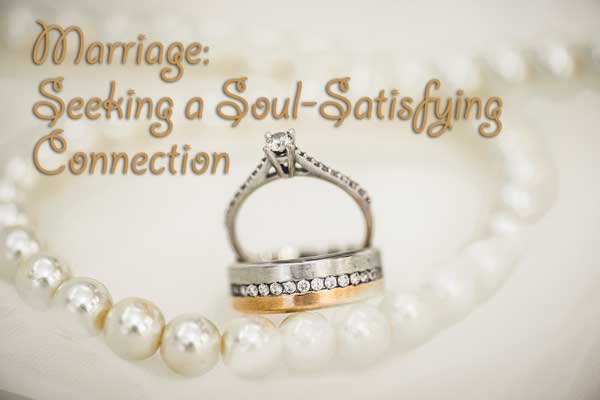
    Marriage in Islam has been described as a protective garment, a source of tranquility and comfort, and as the completion of our faith. It is the moral path to finding loving companionship and avoiding zina (unlawful sex). One of the most well-known, and well-quoted, marriage verses in the Qur’an sums up what every marriage-minded Muslim hopes and prays for: “And among His Signs is this, that He created for you mates from among yourselves that you may dwell in tranquility with them, and He has put love and mercy between you. Verily in that are Signs for those who reflect”(Qur’an 30: 21).

    It’s not just religious obligation that drives us. Allah designed our human nature to include feelings of love and passion and the desire to find a soul-satisfying connection to another human being. And society pushes romance and the happily-ever-after story at us through music, television, and film. Literature provides examples of love stories overlaid with tragedy, like Romeo and Juliet, Cleopatra and Mark Antony, or emperor Shah Jahan and queen Mumtaz Mahal. Tragic loss is often presented as the measure of a great love story for Western society.But Islam has given us a perfect standard for choosing a mate. The Prophet (s) said, “A woman is married for four things, her wealth, herlineage, her beauty, and her religion. So, you should marry the religious woman”(Bukhari and Muslim).

    Pressure on Young Adults to Marry

    For Muslim parents, facilitating marriage for their child is important. It seems a frantic process for those who fear their daughters may age out of their prime marriageable years (doomed to marry divorced men or become second wives), orthat their sons don’t have the right career or education level to attract a young woman’s family. It’s no wonder that parents, aunts, uncles, and even friends constantly pressure young adults to find a potential spouse and seal the deal. Some mothers form social networks sending out CVs or join social media marriage groups on Facebook, hoping to snag that most perfect mate for their child. A Muslim matrimonial ad reads something like this: “pious (insert ethnicity)girl’s family seeking an educated, tall, fit, practicing Muslim from (insert city, town, or village)…” Online matrimonial meetups are on the rise as well with engagements happening on a daily basis. But for every engagement, how many potential matchups dissolve after a few weeks of talking?

    With all that pressure on young adults to get married, how much emphasis is focused on what makes a good and lasting marriage? During the “getting to know” period, what questions are asked? To get an idea about what Muslims consider when looking for a spouse, we presented questions about compatibility, the importance of chemistry, goals, and mature communication to a small group of Muslim singles looking for prospective mates, as well as to married and divorced women.

    One single sister (26, TX), said, “Of course the first thing you have to get out of the way is what they’re about. Do they like the same things you do, have the same goals?” She added, “It’s obvious when you’re talking whether they can communicate, or not.” Another unmarried sister (24, OH), thought it was more important to have attraction between them, saying, “As long as there’s chemistry, I can work with the rest.” Communication is “vital” for a California single (23), who wanted a longer talking period (months) before agreeing to marriage or deciding to move on to another prospect. Four out of the six sisters wanted to find their own men, rather than a match being “arranged” because they felt that was old fashioned. The same four wanted to marry outside their cultural groups, but the two others wanted to marry someone from the same cultural background.All agreed, however, that they wanted the men to have been raised in America. All six sisters were afraid of marrying someone who wasn’t genuine and had a major secret like he was a womanizer or a homosexual. Several of the single brothers surveyed were not interested in being set up by parents or friends and preferred to be casual friends with a sister before deciding she was a good choice. A brother (24, VA) met a young woman at his university who he was talking to but hasn’t told his parents yet.

    In Retrospect

    When talking to some divorced sisters about their experiences and how they would have done things differently, their answers were surprisingly different from the singles. Three are in their late forties to early fifties and divorced from men whose cultures were different than theirs. Cultural compatibility followed by lack of communication were the biggest factors for them. A sister from Maryland said, “Culture can also lead to differences in religious understandings and expectations in many areas of marriage, child-rearing, and life. It can also create problems with in-laws.” Three women stayed in the marriage until their oldest children were at least in middle school. One sister waited until the childreng raduated high school, then she filed for divorce. Marital problems ranged from attitudes towards work outside the home, child-rearing differences between the two cultures, or communicating with the in-laws. The women also had expected Islamic behavior from their former spouses but realized that the men were either more cultural than religious Muslims or were just lax about their Islamic practice. Another sister considered compatibility as a minor concern, saying “Allah created us with differences so we can complete each other. Yes, it’s challenging to deal with someone who has a different culture/level of education/financial strength, etc. than yours, but with applying Islamic values, Allah eases it and those differences can turn into an asset to the family.”

    Married women also cited compatibility as an issue in their marriage and something that had to either be ignored or worked on to maintain the marriage. For these women, it wasn’t enough of an issue to cause a divorce, but it did present problems in the marriage. For a sister in Texas, married for over 24 years, her husband’s different culture “was not important,” but as she looks for spouses for her children, she will insist on pre-marriage counseling and “compatibility not only with the individuals but both families have to be compatible…individuals and family expectations, values and norms.”

    The Issue of Compatibility

    For young people looking to get married these days, there are many different avenues for finding someone, but laying a foundation for a successful marriage takes hard work. It is harder to stay married for this generation than for their parents’ generation because there was a great emphasis on staying married, and divorce was more taboo in Muslim communities. Today, divorce is commonplace, so if someone is unhappy, it’s easier to consider divorce. Research shows that among the common reasons for divorce are lack of commitment to the marriage and basic incompatibility.

    Those who were interviewed for this article, whether single, married, or divorced, had varying ideas about compatibility. Some thought about it in terms of culture, life goals, emotional connections, personality, or even hobbies. All are factors of compatibility. There is no single definition of compatibility because each person comes with their own ideas of what is important for a successful relationship. Honest and sincere communication,though, can bring two people together even if they have areas of difference.And what is meant to be will come to pass, as Islam teaches us. We should, however, take seriously what the Prophet (s) said — “Make a good choice of who will bear your children. Marry those who are compatible with you” (Ibn Majah, Al-Bayhaqi, and others). So, base your decision on who to marry on serious issues of compatibility, on things that make you and the prospective spouse a good fit, and on things that neither of you is willing to compromise on.The ability to communicate your wants, needs, fears, or even those things that are deal-breakers, is important in the spouse-selection process and as the relationship unfolds.

    The Prophet (s) said, “Souls are like troops gathered together — those who are compatible bond and have an affinity with each other; and those who are averse to each other are dissimilar and incompatible” (Bukhari and Muslim).

  • Interview with Imam Hassan Amin, Muslim Social Services

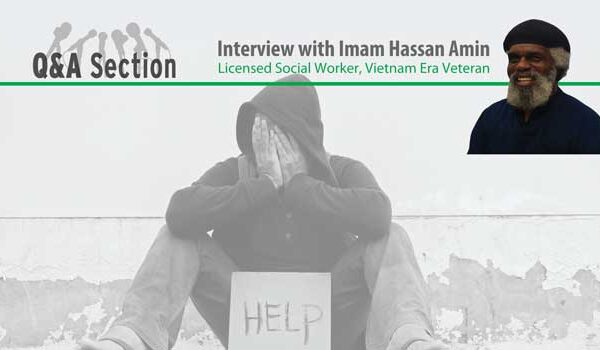
    Interview with Imam Hassan Amin, Muslim Social Services

    (Some editing for clarity and length)

    What organization do you work with?

    My organization is the Muslim Social Services Agency. Also, I am an imam at Johns Hopkins University and a chaplain at Johns Hopkins Hospital, and a board member of Masjid Ihsan in Baltimore city.

    What kind of help does MSSA provide to the community?

    Besides working with refugees, we at MSSA do marriage counseling, feed the needy, serve our seniors by providing personal items, and work with victims of domestic violence, helping to transition victims to a shelter or other home. We also provide fresh vegetables or canned goods to the people in the community who don’t have a lot of money. We are trying to set up a pantry at Masjid Ihsan to serve the community as well. We look for problems and we try to resolve them. During the Freddy Gray riots two years ago, we along with some ministers, encouraged people not to riot. The next day we organized a cleanup and cleaned up Baltimore City following the riots.

    How long have you been in this position or with this organization?

    I’ve been a chaplain at Johns Hopkins Hospital for 14-15 years, and imam at the university since 2011. I have been an Executive Director and founder of MSSA since 2003. We are primarily a local social services agency that connects people to resources and services to improve their quality of life. Clothing, housing, support for those who have been evicted, those kinds of things.

    How do you help Syrian refugees in your community?

    We have a responsibility to help humanity. When Syrians started coming to Baltimore city, I saw on TV a spokesperson from an international organization talking about Syrians coming here and he mentioned that he was going to connect the new refugees to jobs, schools, and church. So I said to myself, church — wait a minute, that will not be compatible with the Syrians’ backgrounds and their way of life since most of them are Muslim. I met with the organization to help with their resettlement. I met with them to assess their needs. On Oct. 12, 2015 we arranged a meeting and partnered with them to help Syrians resettle in the Baltimore area. They were very receptive to having a meeting because they look for community partners.

    How many new families have arrived over the past year that your organization or community is helping?

    So far we’ve been helping about thirty-five Syrian families; about 200 people. That is about 90-95 percent of the known Syrian refugees who come to our area. We are really up on those coming to the area. We have only one case manager and so we need to get more grants to hire more case managers to help because the need is so great. We want to make them independent as quickly as possible. That way we can help another family and so on.

    Are they arriving from Syria itself or from another transit country?

    Some of them come in from Jordan through an organization. One of the brothers who speaks fluently translates for that organization. A case manager works with them from MSSA. We got a grant from Mercy USA so that we could hire a fulltime case manager.

    What kinds of social challenges are the newly arrived Syrian refugees having?

    One of them is adjusting to the society in terms of the language. English is overwhelming to many of them. Many of them attend ESL classes in churches and other places. In one case the instructor told the women to take their trash bags off their heads, take their terrorist clothes off, and then gave them a Bible in Arabic. What we did, since my case manager speaks Arabic and I know a little, we started an ESL class for them. A college professor, my case manager, and I started that in October of last year. We go to their homes, pick them up, teach them, and then take them back home. We alternate between men on one day and women on another so there is someone home with the kids. We try to meet the needs of the students, and we got a grant from ABLE organization to help with the ESL class for materials.

    Some of them have PTSD, having come from a war zone and whatever trauma they have gone through. Some of them have an almost hoarding behavior because of what they are going through. So when they get something they hold on to it. Some of them don’t want their family members to go far from them for too long a period, fearing they will never see them again. One man was tortured by soldiers so he understandably has a trust issue. One child was forced by soldiers to walk past the dead bodies of fellow students.

    The children also have a challenge adjusting to school; they only know Arabic, may be harassed by other students for their language or dress, and have difficulty with understanding the homework. Some of the parents will bring their children’s homework to ESL class so that they can get help with the assignment.

    Are the schools helping?

    One of the schools has a multicultural population and they try to help them adjust to the school setting.

    What specific kinds of work challenges do the refugees have?

    Because of their limited English, the men are having a hard time finding jobs. They have to take menial jobs. The pay is around $9-$10. They often don’t get a full week of work because the company doesn’t have enough hours for them. Many of them get help from DSS (Dept. of Social Services) and they receive some supplement for food. They may receive a letter to get recertified and they don’t know what it says and then get cut off because they didn’t respond on time or at all. Our case manager goes and helps them fill out applications. He will attend their appointments and help to explain what the situation is. The agency doesn’t hesitate to put the people back on if their case is presented.

    How much help are the local social service agencies?

    They help a great deal. The organization they come through is IRC (International Rescue Committee) and they connect them directly to DSS to get food stamps, health insurance, and help with other needs. They only stay with IRC for three to eight months. After that they are on their own. MSSA comes in and helps them to continue to learn and get any additional help they need. We work with small, everyday skills like dealing with the mail, writing checks, going to the post office, besides helping with their English proficiency, appointments, and applications

    What types of educational backgrounds do these new refugees have generally?

    Some of the women have at least high school completed. The men may have an 8th or 9th grade educational level. They might have left school to find work to support their families. One of my advanced English students had an engineering degree. He has adjusted a little bit better and has a car. His goal was to go to college and open up a business. Many have skills like baking or jewelry making and had small businesses back in Syria. But many of them are trying to survive and can’t get into the mode of thinking about what else they want to do. They want to make sure that their families don’t end up on the street. They want one good job to help them stand on their own feet. That to me means they have some type of goal and don’t want to depend on others.

    That’s where Aleppo Kitchen comes in. We teamed up to get the Aleppo Kitchen to help with supplemental support. They have expanded to the point where families have gotten their own business cards and started their own catering businesses outside of Aleppo Kitchen. We are trying to find a place where they can have a commercial kitchen and have workforce development and learn different skills.

    What kind of help can the local Muslim community give to their Syrian brothers and sisters?

    First, is to make dua for them and the organizations that are helping them. They can also donate to organizations like MSSA and put on their donation “for Syria” so that we can help them better.

    Ramadan is around the corner, so please donate to help the refugees and get the barakah for that multiplied. If people donate enough money, we can get a facility so that we can train people to get high skilled jobs. Instead of giving people fish, give them a fishing pole so they can fish for themselves, as the old adage goes.

  • Interview with Raghad Bushnaq, Mozaic, in Herndon, VA

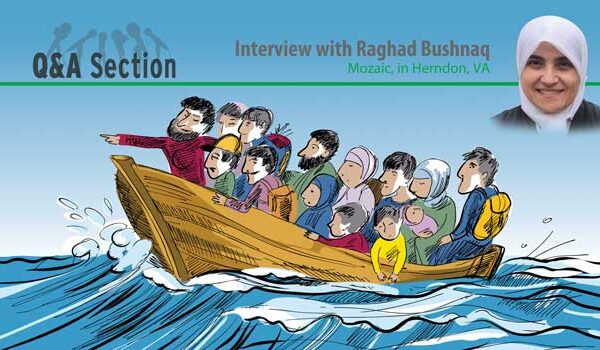
    Interview with Raghad Bushnaq, Mozaic, in Herndon, VA

    (Some editing for clarity and length)

    What is your background?

    I am Syrian — I was born and raised in Syria for 19 years of my life. I got married and moved to the DMV (D.C., Maryland, Virginia area) and lived here for 29 years. I have five kids, two boys, three girls. My two eldest are married and I am a grandmother and have three grandchildren. I worked as a teacher and instructor. I now work at Fawakih Institute (Herndon, Virginia) as a Quranic linguistics instructor. I am very happy with them.

    What pushed you to start an organization and begin helping Syrian refugees?

    Since the war, we started to see many tragic incidents happening. A lot of people started to seek refuge somewhere out of Syria and even in Syria. We felt that we can’t just look. Yes, we can pray and make dua and that is very important but that’s not all, we have to do something more. So the only thing I could do, I am good at cooking, I have talent in doing beads, so I thought let’s invest in that. So we tried to be involved in every bazaar. We cook, we sell food, get the money, and we send it to needy people. We helped people in Zaa’tari camp in Jordan. We brought about four containers and little by little we started to send clothes containers to the refugee camps in Turkey and Lebanon. We did a good job and then we started receiving refugees here. We received seven families and the first meeting we did as a Syrian community. We sat together and when we talked only about these seven families I can’t tell you the amount of pressure I felt. I felt like a nightmare is coming. How are we going to assist all of these people? They were only seven families.

    Alhamdulillah, all the community stood up for these seven families. A year after, we started to receive like three or four families every week. Six months later the number increased. Then we started to hear about more families in Norfolk, more families in Charlottesville. It was a lot of pressure. Many of the people who came to visit they couldn’t go back. They sat and applied for TPS (immigration status: “temporary protected status”) — now they have no work permits — they need financial assistance and rent. Since we know how to work together as a team, we thought that it was about time to establish our own organization. So we applied to the State Department and we were approved, alhamdulillah, as a non-profit with a tax ID number and that really boosted our help for people. Now we have legal status and if we ask people to donate, we can issue tax receipts and we are legal and can work on a legal basis. We can build credibility, and we can show people where their money went and how it was spent.

    How many families have you helped so far?

    Alhamdullilah, we were able to help 180 Syrian families. We helped a few Iraqi and Afghan families too. To be honest, I wanted to help more non-Syrian refugee families but it was too much. It was a heavy load.

    What kinds of social challenges do the refugees have?

    Each family has their own suffering and their own needs. We have a lot of widows and people with disabilities. We have many people that can’t provide for themselves for very legitimate reasons. A lot of illness among kids.

    Are the illnesses physical or mental, or both?

    Both. We have kids five-years-old seeing psychiatrists – they’ve been through a lot. They’ve seen the bombs. They’ve seen their houses were demolished – they were in the war zone. They have seen their own family members killed, sometimes two or three, in front of them. One man lost his wife and he doesn’t know where she is after a bomb in the market. Many, many devastating stories.

    How has the Muslim community responded to this crisis?

    As a Syrian, you understand the mentality of the Syrian refugees. Of course, many people have helped. Many people from all communities, masha’Allah. I’m very proud of the Muslim community, and non-Muslims helped a lot. So, alhamdulilah, many people have good hearts and they want to help. But Syrian families come back to you because you understand their mentality and their needs. At certain points you have to give them tough love, at other points you have to just deal with whatever anger they have. Sometimes you are able to endure it, and sometimes not, but you have to because you know they’re in difficult circumstances.

    The donations we receive is Amana and we have to put it in the right place — give it to the right people. But alhamdulillah we are able to help many families — with furniture, with rent and utilities, tutoring, whatever is need. Today we have at least nine families that we are responsible for, almost fully for their rent and other expenses.

    How long do the local agencies or the agency which brought the refugees to the U.S. help each family?

    The United Nations brought them here. It’s not how long, but how much. They give each person in the family $950 dollars. If it’s a family of four, it will be $950 times four. If the family is seven, $950 times seven. If the social worker is really a good person or he or she has good skills in money management, they would use it for them in the best way, would get decent furniture at the best price, and use the rest of the money for rent and utilities. Many social workers don’t have those skills. They rent them expensive houses that they don’t need so money is wasted. What we do here with Br. Khaled from IRC, we have a good relationship with him, all of the families that go to him he refers them to us ahead of time. With Br. Khaled, we were able to furnish most of the Landover, Maryland houses for about 25 families. For other families we were able to partially help, because they didn’t recently arrive but got our phone number from another family. We ask them what they need, how many are in their family, what was their occupation in Syria. I take that information because it will play a big role, later on with how I’m going to be able to help. If their needs aren’t great and they live too far, I order the things on Amazon, and they receive it to their home. Believe me, the new items they receive, they really love it.

    What is Mozaic Kitchen for Refugees?

    Our project, Mozaic Kitchen for Refugees, started in October of 2016. The purpose of this business was to bring all of the talents in cooking among refugees and for them to start catering, learning business building skills, learning the American standard in cleanliness, sanitizing, and all of that training, and bringing them all the supplies they need. Cooking for one’s family is different than cooking for 100 people. We put them on the right track. The other important thing is marketing because they don’t know anybody here. So It is our mission to bring customers and spread the word, do some promotion here and there. We have done many bazaars and events where we cater.

    Many of the refugees say that they can cook everything. The first step is that I order food for my house, and tell them to cook me this or that. I bring it home and try it. I’m a good cook and I give him or her feedback and say, this is good or maybe this has an odd flavor, maybe you need to put butter instead of oil. We try to increase the quality getting it as good as possible. Then we check where they are buying their food and supplies from. They have to go to the right stores so at least they can make a good profit and have fair prices and not be overpriced.

    As to pricing, we sit together and I advise them, but it is their choice in the end. I tell them that fair prices will not only bring customers but will keep them coming back. Then we start connecting them with people. We advertise by letting people know what types of food each chef cooks. We also started business cards for whichever chef is really professional. Whoever I see that has potential and is striving to get on their feet, and doesn’t want to live on aid and assistance, we immediately help them. Those are the good candidates.

    Who are the people involved in Mozaic?

    There are three officially, and our volunteers are over 100. Myself, I deal with the families one-on-one. Mona Darwish, the co-founder, she deals with the Virginia families. She’s been helping the Muslim community for over thirty years. The third board member is an accountant, Rana Hmaidan, and deals with all our accounting and giving us advise.

    Is an organization founded and run by women?

    Yes.

    Do you have assistance from your husbands?

    Well, it’s mostly moral support. The thing that my husband really helps me with are the personal visits. When we go to the families, he goes with me. I think that gives the males in the family a lot of support. He gives them advice from his own experience. He refers them to job opportunities.

    Are the people you help mostly in Maryland because it’s cheaper?

    Yes, when the official refugees arrive, they are placed in Maryland. In Virginia we have some in Norfolk and help them partially with Eid and through the winter drive, and connect them to people there who can help them more. The same for Charlottesville. We send trucks for them on Eid, and for winter, we send carpets, jackets, blankets— all of the stuff they need.

    Are you connected with other organizations in your work?

    Locally, we work with a lot of organizations like Islamic Relief, ICNA relief, and we have good connections with McLean Islamic Center, Adams Center, 17 Cents A Day, Kind Works, and many more.

    What do you see as the future of Mozaic?

    Our mission is not only helping refugees. Our mission is having projects— educational projects, training in life skills — and not only with refugees. This year it is refugees, because it’s a high demand, but when things settle, insha’allah, we will help other needy people. Our focus will be on women and children. We will give them all kinds of training, especially widows and divorced women, to make them independent and able to support themselves and their families.

  • Unity and Activism under a Trump Presidency: The Need of Our Times

    Unity and Activism under a Trump Presidency: The Need of Our Times

    On a rainy January 20, 2017 Donald J. Trump became the president of the United States after winning the Electoral College and losing the popular vote by over three million. The pomp and ceremony, military and police presence, even the somberness of the day lacked the celebration of at least the previous two inaugurations. The twitter-verse remarked that the “sky was crying” and dissent filled the air blocks away amid a wide range of socially disparate individuals from Muslims, immigrants, blacks, Latinos, and gays, to whites who blocked roads and held bold signs demanding impeachment and likening Trump to Hitler. With a nation politically divided along many fissures that have been growing over the past several decades, Muslims also found themselves separated along similar lines. Muslim Republicans, Democrats, and Independents voted their conscience and helped usher in one of the most divisive administrations America has ever seen. Economic concerns and social issues like illegal immigration, abortion, and gay marriage were uppermost in the minds of conservative Muslim voters. Most Muslim voters were concerned about eroding civil liberties, continued wars, and America’s foreign policies.

    Unity is a necessary goal, but not easy to achieve. Muslim-led organizations need to work with other groups on a grassroots level. There is certainly strength in numbers and the many diverse organizations working toward the same over-arching goals can achieve much more than singular, non-allied groups.

    The inauguration was a historic moment in many ways, the least of which was the visibly low turnout of spectators which Trump, in narcissistic fashion, continued to rail against in his early morning twitter rants. Nothing could stop the juggernaut ascension of Trump to the highest office in the land. The fervent wishes and voting choice of the majority of Americans got swallowed up by the Electoral College system, and the prayers of believers did not change the course that America has been set upon, for good or ill. What then is left in the repertoire of activists as they prepare for the coming years of a presidency run by an ill-equipped, self-obsessed, money-hungry, politically clumsy elitist, along with his chief strategist, Steve Bannon, a white nationalist, White House Chief of Staff Reince Preibus and Vice President Mike Pence, both right-wing powerhouses. Rule by oligarchs, corporate corruption, criminal war-making, oppression and occupation, and layers of disinformation — these all exist in the world today, but it can get so much worse. However dire the future looks, fear and hopelessness must be displaced by courage and conviction in hearts and minds of those aligned against this new world order.

    The Role Muslims Can Play

    For Muslims, particularly, it is a matter of faith. We should fear only Allah since we know that all things happen according to His will and plan. So we make our choices day to day, and determine to the best of our ability the course we are going to follow. We then leave the rest up to Allah (SWT). What remains then is how Muslims participate in this new political reality. Representation in government at the local, state, and federal levels, of Muslims and their concerns, is still limited but slowly increasing. In the fledgling Somali voting block of Minneapolis, Minnesota they elected the first Somali woman to state office. As more Muslim American state representatives continue to be elected, some of them will find themselves in national positions within the next ten years. The primary concern now is how to represent Islam in its totality, from its politics to its social ideals, and to advocate for Muslims. Imam Omar Suleiman, President of the Yaqeen Institute for Islamic Research, summed up in a speech at the ICNA/MAS convention in December, 2016 what the Muslim activist position should be: “If we allow fear to drive us to continue to do away with notions of our faith that others find problematic because of their ignorance and because of their racism and their bigotry, rather than standing boldly and explaining and defining those concepts and showing them in motion and in action and how they contribute to the betterment of society then we will slowly see our identity disappear.” He went on to say that Islam “should be in motion” as an active religion that betters all societies. Sometimes that means dissent within the confines of a unified front.

    Never has there been a more urgent time to stand tall and firm in speaking about Islam and countering all misrepresentations of the faith. Steve Bannon is an avowed Islamophobe with a belief in a coming apocalyptic battle between the Judeo-Christian world and Islam. And Jared Kushner, Trump’s son-in-law, is now senior advisor to the president. He is also purportedly being considered for the role of peace broker between Israel and the Palestinians, while his family has donated tens of thousands of dollars to illegal West Bank settlements, according to their tax forms. A negative perception of Islam is at the heart of this administration’s immigration and foreign policy agendas. It matters little to these ideologues in power how high American flags fly at Islamic centers, how often Muslims leaders and organizations condemn terror, or how often public officials are welcomed to address Muslim community and masjid events.
    ‘Get Up, Stand Up, Don’t Give Up the Fight’

    It is understandable that many Americans are worried, but we must maintain a long view and broad perspective. Allah (SWT) tells us in the Quran, “And obey Allah and His Messenger, and do not dispute and [thus] lose courage and [then] your strength would depart; and be patient. Indeed, Allah is with the patient” (Quran 8:46). Already there is some light shining in the politically divisive gloom — an unintended consequence of the new future with Trump is that a robust and growing opposition has risen against him and his absolutist, autocratic inner circle. Uniting to push back against hate, against division, is a myriad of groups who are protesting, filing legal actions, and vowing to keep America the land of diversity and tolerance.

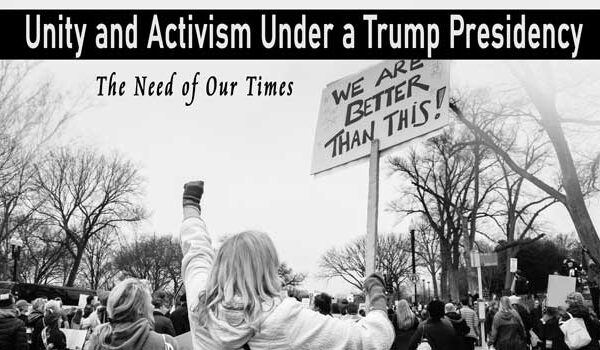
    Trump has become the symbol of both ultra-right zealotry and crass, profit-driven opportunism. Organizations and individuals working towards social and racial justice, immigration and migrant rights, national universal health care, women’s reproductive rights, and environmental protections have naturally and spontaneously united against the threat to our civil liberties and even our survival. The “Stop Trump” mantra speaks of a fragile unity, organic, without structure. It is reactive rather than a deeply entrenched, planned revolt. Yet, it took hold. The tiny spark of unified dissent was launched the day after the inauguration as the Women’s March took place across major cities in America and in several countries abroad as well, collectively numbering in the millions. An estimated 650,000 to over one million women and men took to the streets of Washington D.C. The signs held aloft on that day spoke eloquently of the fervor protestors felt: Get up, stand up, don’t give up the fight; We are better than this; Another world is possible; Babies against bigots; No white supremacists in the White House; Senate, have a spine, block Trump’s cabinet of horrors; Billionaires in the swamp; Muslim rights are human rights; Jews & Muslims stronger together; Refugees welcome; United we stand, divided we fall; No human being is illegal; Hate is un-American; Hatred’s greatest weapon is complacency.

    The march in Washington was co-organized by a young Palestinian-American Muslim woman, Linda Sarsour. You may be a social conservative and have an issue with Sarsour aligning herself with Planned Parenthood and various LGBTQ groups for the march, but we cannot deny the political impact that such an historic event had and will continue to have. Protests are the matchstick that sets a movement on fire. “It’s more than just a release for anger – taking to the streets is a necessary way to participate in democracy” notes Sarah Jaffe, a writer for Rolling Stone magazine. But without direction, a movement can fizzle out and disappear from the front pages or evening news as new distractions emerge, or it can organize and grow so as to significantly impact the political reality. So what comes after the euphoria of speeches, the camaraderie of protest, the zeal and fervor for change?

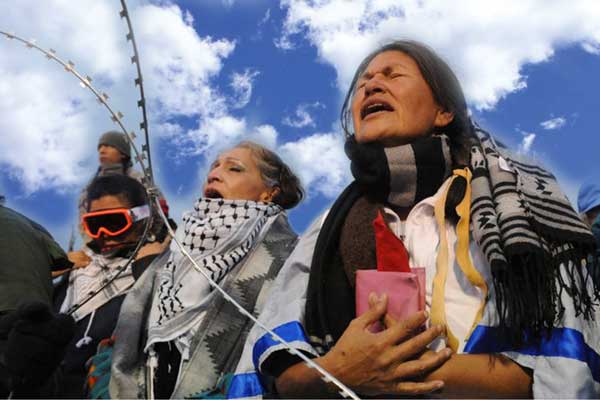
    For now, the motivation to continue standing up and being counted is strong, as Trump has been busy signing controversial executive orders and pushing through divisive cabinet appointments. In his first week he signed orders to gut major provisions of the Affordable Care Act, expedite infrastructure projects through environmental and business-related deregulations, build a 1,900-mile long wall, deport undocumented immigrants, and impose a travel ban against seven Muslim-majority countries. He also green-lighted the Keystone and Dakota Access Pipelines, the latter being close to Standing Rock Sioux tribal lands in North Dakota, threatening their sources of water.

    Jeremi Suri, in The Atlantic, warns, “With his barrage of executive orders, Trump is taking America back to the historical nightmares of the world before December 1941: closed borders, limited trade, intolerance to diversity, arms races, and a go-it-alone national race to the bottom. His executive order on ‘rebuilding the U.S. armed forces’ calls for ‘peace through strength,’ but this document and the others he signed offer nothing but unilateralism and militarization: more military spending, more nuclear weapons, more use of torture (which is illegal), and more promises to destroy ISIS and other terrorist threats. The executive orders promise to curtail American participation in international organizations, prohibit whole categories of foreigners from entering our country, and limit exchanges of ideas and goods.” David Leonhardt, writing in the New York Times, points out that countering Trump initiatives will demand a sustained effort. “If progressives want to have an effect — if they want to defend civil rights, protect the environment and keep millions of people from losing health insurance, among other things — the hard work hasn’t even begun.”

    Protests as Well as Political Participation

    People spontaneously took to the streets and airports to protest the most immediately executed of the executive orders — a ban on refugees and travelers on the basis of protecting American borders. Muslims were not at the forefront of those protests, but at the heart of it. Ordinary Americans, from all walks of life, came out to protest the discriminatory action against Muslims. When protests are needed for Mexicans facing deportation, native Americans protecting the land and vital resources, blacks losing more voting rights and facing increased police brutality, will Muslims stand and march and protest with them?

    Protests are imperative, but so is political participation. As David Brooks of the NYT put it, “Change happens when people run for office, amass coalitions of interest groups, engage in the messy practice of politics.” Organizations and even cities have filed lawsuits, including the Council for American-Islamic Affairs (CAIR) and the ACLU. In a February, 2017 article in Glamour magazine, Linda Sarsour summed up the immediate needs of activists at least until the midterm elections in 2018: “We need to translate the emotions and the frustrations right now, and the fear that people have right now, into massive polls numbers to win back the House of Representatives. Right now there are no checks and balances. We need to get control back of at least one branch of government.”

    Unity is a necessary goal, but not easy to achieve. Muslim-led organizations need to work with other groups on a grassroots level. There is certainly strength in numbers and the many diverse organizations working toward the same over-arching goals can achieve much more than singular, non-allied groups. Together, individuals and groups can support and inspire one another. Just remember the messages of the grass-roots demonstrators, holding high their heads and their ideals…and their signs, declaring that we must not give up; that as Americans we are better than this, and that another world, a better world, is possible. They said it, and it is true, that united we stand, divided we fall. As to hatred, bigotry, discrimination, and worship of profits over people — the greatest weapon of demagogues and vulgar profiteers is the complacency of people. To quote Omar Suleiman once again, “Now is the time dear brothers and sisters, now more than ever to stand up and to define ourselves, to show our Islam in motion, to stand with the oppressed and the vulnerable.”

  • Islamic Resource Center – Interview with Janan Najeeb

    Islamic Resource Center – Interview with Janan Najeeb

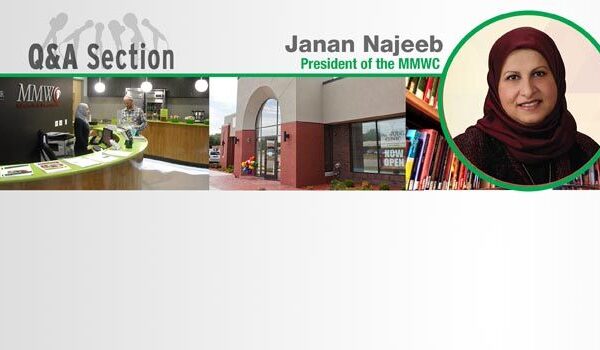
    Janan Najeeb is a speaker, educator, business leader, activist, mother, and the force and founder behind a unique non-profit, the Islamic Resource Center (IRC) in Milwaukee, Wisconsin. The lending library which allows patrons to borrow Islamic books, is the first of its kind in Wisconsin and was established in 2010. It is thought to be the first one in the United States that serves youth as well as adults in the same vein of a public library. Beyond books, the resource center serves as a meeting place for many social and educational activities.

    The IRC is the brainchild of the Milwaukee Muslim Women’s Coalition (MMWC) founded in 1994 by Najeeb, along with a group of professional Muslim women. The organization’s board is made up of highly respected doctors and educators, all women, and the mission statement encapsulates the ideas of these forward-thinking individuals: “To empower Muslim women by providing them with the skills and training necessary for self advocacy, leadership and economic security. To advocate for Islam and Muslims by promoting an accurate understanding of the faith, to encourage dialogue amongst all people, to protect civil liberties and to build relationships and coalitions that work for justice, harmony, peace and understanding.” Najeeb, a mother of five, has received several awards for her activism in Wisconsin from the State, CAIR, and the ACLU. She is also the first Muslim to lead the prayer at the Wisconsin State Assembly.

    The following is a Q&A with Janan Najeeb, the President of the MMWC, about the resource center.

    Was the resource center an initiative of the masjid or a separate committee/group?

    The MMWC runs the IRC. We are independent of the masjid and have our own 501c3. However, we have close ties with the main Masjid (Islamic Society of Milwaukee) in Milwaukee and with the full time Islamic School, Salam School. They are a few miles away from us. Most of the board members attend the main Masjid for Jumu’ah and other events.

    How many people does the center serve?

    In 2015, we had nearly 5000 visitors. More than half of these are individuals that are not Muslim.

    So it is open to Muslims and non-Muslims?

    Yes, definitely. That was the main intent of the endeavor, to create a library and Islamic cultural center that is transparent and welcoming for everyone.

    What are some of the programs that you offer at the library besides the summer reading program?

    We have book clubs; the majority of participants are not Muslim. We have monthly networking brunches on many topics. This month we will be bringing in speakers from Voces de la Frontera, a Latino immigrant rights organization. We have a monthly “So How’s It Going” dinner for reverts, a tafsir group for men and a tafsir group for women, and Arabic classes for middle school, high school, and adults taught by university staff. We host films and discussions at a monthly family film night. We have Islamic poetry/spoken-word slams for college students and young adults, host author talks, and we host a wide range of workshops, for teachers, social workers, students, etc.

    We have a number of professors from several universities that bring their students every semester to attend a panel discussion or a book discussion. We also are one of the designated sites for foreign guests of the State Department that come to Milwaukee. We have been the hosts of high school students from Northern Ireland, Yemeni imams, female leaders of NGOs, and Muslim journalists. They consider us unique in the country because we are an educational and outreach organization lead by professional Muslim women and we are highly sought after as speakers. We are a monthly meeting site for one of the main interfaith organizations in Milwaukee, and we co-host the Muslim-Catholic Leaders dialogue. We have hosted a number of art exhibitions, youth leadership trainings, and presentations on important social justice issues.

    How did you collect the books? What types of books do you have? Do you have anything else besides books in the library? Media sources? Computers, etc.?

    The library currently has about 2800 books, DVDs, CDs, and magazines for loan, just like a public library, but all devoted to Islamic topics. We add new resources every week. We also have two computers for public use. We have a wide variety of resources covering every possible subject including children’s books, theology, Muslim women, hadith, fiqh, Islamic art, interfaith relations, marriage guides, African American Muslims, etc. People get a library card like any public library and they can check out books and resources. They also pay fines for overdue material. We have a professional librarian on staff and we research books from the many Islamic book publishers and book stores and a wide number of others that are not Muslim but print quality material including places like Oxford press and Fons Vitae. It is important to us that we carry quality material with quality writing and printing. We feel there is no reason we should not be a professional first rate facility.

    We have a small café that sells cold drinks, coffee, tea and snacks. We also have a small bookstore that sells books, Islamic gifts, cards, prayer rugs, etc., and we have Islamic art exhibited throughout the center.

    Who supports the library?

    The library is completely sustained by donations. We purchase material as we get donations, and what better sadaqat jariyah [ongoing charity] than a library that promotes knowledge and understanding for Muslims and those of other faiths as well?

    Is this a program that could be duplicated elsewhere?

    The most important ingredients for the success of this endeavor are regular dua, tireless commitment, and an absolute insistence on professionalism in every aspect of the project. When Imam Zaid Shakir visited last year during his 50 city tour, he stated that this was one of the most unique endeavors he encountered and he said every single city with a sizable Muslim population should replicate it. You can watch his video on our website.

    How has the greater community (non-Muslim) taken to this library?

    Wonderful response! Universities send us students to intern for the semester and to conduct research using our unique book collection. We are one of the main “go-to resources” for the media, and more than 50 percent of our patrons are not Muslim. The many Masjids send those that call looking for resources to us. Many teachers, particularly non-Muslim elementary school teachers, come in to choose books, particularly children’s story books, to share with their classes during Ramadan. Muslims often refer their colleagues, neighbors, and friends when they are faced with questions they can’t answer or they want to provide resources. And we have people that are just passing by stop in. Since we are not a Masjid and we are a library, the public feels comfortable coming in. Some of our top volunteers are not Muslim! Our numbers grow every year, and at least one third of the attendees at our annual fundraising dinner are not Muslim. I think that says a lot.

    Do you have plans to expand the library?

    Insha’Allah, as we acquire donations we continue to expand.

    Do you have a relationship with the public libraries?

    Yes. Our librarian is often contacted by public libraries for suggestions, particularly regarding Islamic children’s books. She has created a list based on the books that are checked out the most by children.

    How many subscribe to the library?

    According to the librarian, we have nearly 500 regular library subscribers, this number increases every month. Many others come and read or research at the center.

    Is there anything else that you want to say about the library or your community?

    Before starting this project, I remember touring many cities across the U.S. I was looking for great examples of an Islamic library that I could get ideas from. Most often, what I found was Islamic bookstores that looked like they belonged in a third world country rather than here in the U.S. I found that very distressing and unacceptable. In addition, there did not seem to be too much concern for professional quality, some of the books had very poor grammar and the printing was uneven and printed on cheap paper. In addition, some of the material was, in my opinion, counterproductive to promoting understanding. So rather than finding a model Islamic library, what I acquired was a list of “what not to do.”

    Having an Islamic library and resource center is crucial not only for the general public but also for Muslim children who don’t see characters that look like them, and participating in activities familiar to them, in the books they read in public libraries or their public schools. You can just see the joy on the faces of the children when they open these books for the first time.

    Also, this is a very important resource for reverts that need access to accurate information, as there are many that get erroneous information from Muslims who base their understanding on culture, and the library provides them with solid resources. You will be amazed how many Muslim families do not have any Islamic book collection at home; where are these families and children going to get their information? YouTube videos will never replace a good book! We are always looking to expand our library and we welcome financial donations.

    For more information, visit www.irconline.info. Also see mmwconline.org/ for information on the founding organization, Milwaukee Muslim Women’s Coalition.

  • Is Islamophobia a Part of the Republican Agenda?

    Is Islamophobia a Part of the Republican Agenda?

    Presidential elections are supposed to give potential voters a look inside the minds of potential candidates seeking America’s highest office. Candidates representing our two party system typically give the public their platforms and agendas for the economy, security, and foreign relations. On the Republican side, there have always been some discriminatory remarks toward minorities, immigrants, women, or the poor. After the September 11, 2001 World Trade Center attacks, however, the public has also heard campaign rhetoric from Republican candidates and their surrogates that is rife with anti-Islam and anti-Muslim sentiment. This year is no different, except that the rhetoric is more hateful and outrageous, and has contributed to an unprecedented level of violence towards Muslims and their institutions. Presidential nominee Donald Trump has said he wants to prevent Muslims from entering the United States, and advocates for a Muslim identity card and national database. Between almost exclusively Republican led anti-Shariah legislation and Republican presidential candidates spewing anti-Muslim vitriol to garner votes, American Muslims are increasingly concerned that the Republican party seems intent on driving a wedge between the Muslims living in the U.S. and the general population.

    The network of anti-Islam groups collects yearly donations of $34 million on average, according to the 2016 report, Confronting Fear: Islamophobia and its Impact in the United States.

    Islam Plus Phobia Equals Hate

    A phobia is “a persistent, irrational fear of a specific object, activity, or situation that leads to a compelling desire to avoid it.” Islamophobia, as a term, was first used by the French as early as 1916. In an article by Professor Edward Said in 1985, “Orientalism Reconsidered,” the author bemoaned western Orientalists’ lack of understanding that Islamophobia, like anti-Semitism in the 19th century, “has stemmed from the same source, has been nourished at the same stream.” A more recent use of the word was in the 1991 UK publication, Runnymede Trust Report, which defined it as an “unfounded hostility towards Muslims, and therefore fear or dislike of all or most Muslims.” The Berkeley Center for Race & Gender (CRG) expanded the definition further to “a contrived fear or prejudice fomented by the existing Eurocentric and Orientalist global power structure…” which “reaffirms a global racial structure through which resource distribution disparities are maintained and extended.” Islamophobia has become a politically charged term in recent years, spawning reports and websites that attempt to understand this phenomenon which has gripped Europe and the United States to such a degree that governments are willing to create legislation to either support or combat it.

    This manufacturing of hate has monetized into a cottage industry, “currently comprised of at least thirty-three (down from thirty-seven in 2013) groups whose primary purpose is to promote prejudice against or hatred of Islam and Muslims.” This network of anti-Islam groups collects yearly donations of $34 million on average, according to the 2016 report, Confronting Fear: Islamophobia and its Impact in the United States, a collaborative research project of the UC Berkeley Center for Race and Gender (CRG) and the Council on American-Islamic Relations (CAIR). CAIR and others have rightly termed the anti-Islam groups a network because these groups regularly support each other — sharing leadership, funds, and the singular goal to “stop” or “destroy” Islam. It is not surprising to anyone that global and domestic terrorist attacks correlate to a rise in Islamophobia, measured by both the number of hate crimes against Muslims and media bias such as perpetuating, or at least not contesting, the canard that Muslims, and especially their leaders, don’t condemn terrorism.

    Republicans sponsored 80 out of 81 anti-Islam bills or amendments between 2013 and 2015

    Mosques and Islamic centers routinely release warnings to their communities to be extra vigilant in the wake of such attacks, while also issuing press releases condemning those attacks and simultaneously reminding the public that in Islam, “Whoever kills a person, unless [as punishment through due process] for murder or mischief in the land, it is as though he has killed all mankind. And whoever saves a life, it is as though he had saved all mankind” (Quran 5:32), as quoted in an ADAMS Center press release). What might surprise some outside the Muslim community is that Islamophobia has been an integral part of America’s election cycles, especially presidential ones, at least since 9/11. According to the Confronting Fear report, “both the 2010 spike in incidents and the late 2015 spike both occurred when Islam was an election campaign issue lends additional weight to the argument that ‘levels of anti-Muslim sentiment follow trends in domestic U.S. politics, not international terrorism.’”

    Who and What Is the Islamophobia Network?

    The Islamophobia network has several components which they meticulously use to create the perception that Islam is at war with America: religion, media, and legislation. CAIR identified 74 major groups in their latest report. These active groups provide financing, vast media support, and grassroots mobilization for protests and other public events, or votes for anti-Muslim legislation and Republican candidates. The religious right has several organizations that foment Islamophobia: The Eagle Forum, the American Family Association, the Tennessee Freedom Coalition, American Center for Law & Justice, and Christians United for Israel. Along with right wing media hosts like Rush Limbaugh, Sean Hannity, Mike Savage, Glenn Beck, Mark Levin, and Bryan Fischer, they promote anti-Islam ideas and sentiments with dogmatic consistency

    Right wing media such as Fox News, and certain fundamentalist Christian groups such as the Christian Broadcasting Network (CBN), certainly spend a great deal of time attacking Islam and Muslims.

    In fact, many of the so called experts that are interviewed on Fox and on conservative radio are also the leaders of organizations inside the Islamophobia network, including Pamela Geller’s Stop Islamization of America, Frank Gaffney’s Center for Security Policy, and Brigette Gabriel’s ACT! for America. Geller, Gaffney, and Gabriel are organizers and speakers at the largest Islamophobia summit, Values Voter Summit (VVS), where the religious right meets with conservative media representatives and Republican candidates running anti-Islam campaigns. Rand Paul, Ted Cruz, and Marco Rubio, all presidential hopefuls during this year’s GOP primaries, addressed the 2013 summit, while former Rep. Michelle Bachman, Sen. Rand Paul, and former Gov. Mike Huckabee spoke at the 2014 summit. Trump, Paul Ryan (current Speaker of the U.S. House of Representatives), and Ted Cruz are scheduled speakers at the summit in September of this year.

    According to the Fear Inc. 2.0 report, “segments of the religious right have been at the forefront of fear mongering about Muslims.” The report goes on to paint an even darker picture of the fundamentalist mindset. “Through their clash of civilizations discourse and even messianic ideas of fulfilling prophecy, religious right leaders have managed to make stigmatizations of Muslims politically valuable.” That eerily parallels another group also hastening the “end of days” through an interpretation of religious prophecy. The Islamic State has their own media wing, promoting an apocalyptic clash of civilizations. A researcher for The Institute for the Study of War, Harleen Gambhir, writes in “The ISIS Trap,” a report of the Center for American Progress (CAP): “ISIS’s plan [is] to eliminate neutral parties through either absorption or elimination, in preparation of eventual all-out battle with the West.” in the ISIS Trap, a report of the Center for American Progress (CAP).

    Legislating Hate State by State

    The 2008 elections marked the last time that Islamophobia held sway as a central issue in a national election. Although they failed to stop Senator Barack Obama from becoming President, the political right achieved quiet success using manufactured hate of Islam on a state level. Scared by the phony specter of Shariah law creeping into the judiciary, right-leaning Americans helped to not only pass state anti-Shariah laws but blocked the building and expansion of mosques. The publication of the Center for Security Policy (CSP) 2010 report, Shariah: The Threat to America, is responsible for many of the anti-Shariah laws that Republican legislators passed, or attempted to pass, across the country. Republicans sponsored 80 out of 81 anti-Islam bills or amendments between 2013 and 2015, note the authors of Confronting Fear, the CRG/CAIR 2016 report. They couldn’t have done any of that without a voter base that feels fear and aversion to Islam and Muslims. Gallup polls in 2007 and 2009 showed that “Fifty percent of those who report a great deal of prejudice toward Muslims say they are Republicans, compared with 17% of those who identify as Democrats and 7% as independents. Those who report no prejudice toward Muslims are more likely to be Democrats than Republicans, 39% to 23%, respectively.”

    The disenchantment of some Republicans with using blatant anti-Islamic speech began in the 2010 mid-election cycle, but became widely evident by the 2014 cycle. While Rep. Joe Walsh successfully used Islamophobic rhetoric to win a seat in the Illinois legislature in 2010, the loss by Brian Ellis in Michigan in 2014 to a Tea Party incumbent shows that these tactics of fear mongering are failing. As stated in the Center for American Progress report, Fear Inc., “After Republican leaders saw how these Islamophobic candidates fared in the election, they began to disassociate themselves from those fanning anti-Muslim sentiment.” The election cycle beginning in 2015 brought the heat and the hate to Muslims again, but from an unconventional source. Real estate mogul, reality star, and self-proclaimed billionaire, Democrat-turned-Republican Donald Trump set a new low for public discourse. Even with the high visibility that Cruz, Rubio, and Paul received during the Republican primaries, their own anti-Muslim positions had to take a backseat to the sheer audacity of Trump, a new Republican and the party’s ultimate presidential nominee.

    Has The Hate Machine Gone Too Far?

    So to return to the original question, is Islamophobia part of the Republican agenda? If one can believe organizations like Center for American Progress (CAP), CAIR, Berkeley’s Center for Race and Gender (CRG), and progressive mainstream media, the answer is a resounding yes…and no. It is not found outright in the 2016 Republican platform. But a number of the policies the platform forwards are objectionable, having anti-Muslim repercussions. An example is the designation of the BDS (boycott, divestment, and sanctions) movement as “anti-Semitic in nature” and seeking “to destroy Israel.”

    In the current political atmosphere, Trump has found that anti-Muslim, anti-immigrant, and misogynistic rhetoric resonates with his constituency. Yet, his highly publicized argument recently with a Muslim Gold Star family and his smear that President Obama “founded ISIS” has set his poll numbers back. Even with recent ISIS attacks in Paris, Germany, Turkey and Pakistan, establishment Republicans continue to distance themselves from Trump; and in a small way, from anti-Muslim hate speech. At some point, Republican officials realized that someone could, and did, take things too far. The next question should be: has the Republican party discarded Islamophobia for good, or is this a temporary withdrawal in the face of current public censure? Meanwhile, the Islamophobia network’s 73 groups are still collecting money, producing virulent anti-Islam propaganda, enjoying strong state representation, and maintaining a highly successful media presence. Violent attacks against Muslims and Islamic institutions continue to rise. The religious far-right may be a small part of the Republican base, but they turn out to vote in large numbers and are quite fanatical in their opposition to Islam in America. As long as that fanaticism remains the purview of a minority in America, saner voices calling for religious tolerance may be heard.