بسم الله الرحمن الرحيم

Author: Javeria Salman

  • Amerian Muslim Women’s Conference

    Amerian Muslim Women’s Conference

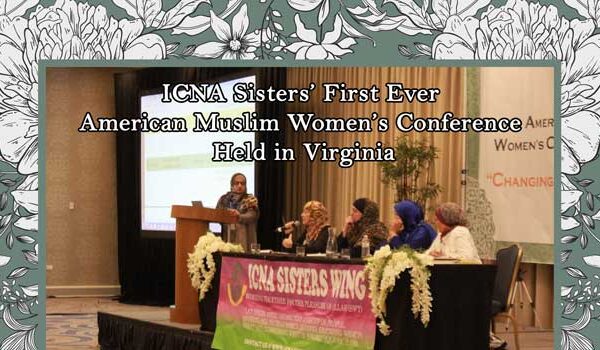
    Women from across the nation attended ICNA Sisters’ first ever American Muslim Women’s Conference Saturday, Oct. 7, in Chantilly, Virginia to talk about “Changing the Narrative” of Muslim women in the United States. The approximately 400 invited guests included female leaders not only from within ICNA’s own divisions, but also from several other prominent U.S. organizations, distinguished professors, civil rights organizers, doctors, and Islamic scholars.

    During the welcome address, ICNA Sisters president Sadia Salman said, “The women here represent the diverse Muslim women that make up our society. Which is why with the current situation of our nation, the world and our Ummah, it is more important than ever before for us to stand united as one. ”She added that despite the various organizations and platforms the women at the conference were a part of, it was their “duty to stand up and work together” regarding the challenges in society. The conference aimed to unite women leaders from across the nation to hear about, discuss, and highlight possible solutions to several pressing issues facing the American Muslim woman, according to Faizah Aslam, secretary general of ICNA Sisters.

    The morning portion of the event began with speakers Dr. Zainab Alwani, Aisha al-Adawiya, Farhana Matin, and Shaikh a Anse Tamara Gray discussing topics ranging from how the Muslim woman is defined in today’s society and the journey of American Muslim women in the U.S., to how American Muslim women are not only the backbone of the household but are also the rising leaders in society; and finally, how American Muslim women can tap into the power they have and use it to contribute to a successful society.

    Following lunch, the audience had the chance to attend two parallel panel sessions, “Oppression: What, Where, & When” with Alwani, Salma Abugideiri, Nahela Morales, and Zahra Billoo and “Through the Filters: Myth vs Reality” with Alia Salem, Hena Zuberi, MaryaBangee, and Rowaida AbdelAziz. The first highlighted and answered questions of how Muslim women are oppressed in the U.S. and what are the different forms of oppression, while the other handled questions of the portrayal of Muslim women in media and what can be done to change the perception of women in film and news media.

    The last main hall session focused on areas where American Muslim women are already contributing and building a counter-narrative to the one seen most frequently in media. The conference ended which opinions and feedback collected during the sessions which were read as a way to share with the audience possible initiatives and solutions to some of the issues discussed.

    “It was more successful than I anticipated,” Abeer Sher, ICNA Sisters vice-president said. “The reason being I didn’t expect to gather that many Muslim women leadership from across the United States under one roof, but alhamdullilah it happened. My heart is so warm from hearing during the sessions just how ready the Muslim women were to unite on every level.”

  • Impact of Media and Social Media on Islam and Muslims

    Do you remember what your life was like ten years ago? How you communicated with people? How you received your news? Shared information?  In this past decade our lives have been forever transformed and the power of media, specifically social media, has significantly impacted the world around us.
    In the last few months we have seen more than ever just how important social media is, as we watched three of the most powerful dictatorial regimes of the Arab and African world being toppled, organized and facilitated in no small part via social networking sites such as YouTube, Twitter, and Facebook.

    Even as those revolutions are changing the Middle-East region, it seems a transformation is also taking place within the Muslim community.  “Social networks and media have definitely changed the spread of Islam and the perception of Muslims in the minds of many,” said author and professor at DeVry University, Suzy Ismail in an email interview. “The impact of Facebook and Twitter in changing entire nations can be seen in the uprisings of the Arab Spring that were largely dependent on social media as a means of communicating and fueling the passions of the people who overthrew their countries’ dictators. The same can be said of Islam’s relation to social media.”

    Social media presents a huge opportunity for us to reach out to people who may not know about Islam or Muslims. Thousands of Americans have never met a Muslim but they have access to us through social media 

    Muslims Under the Media Microscope

    In the post 9/11 era, the growth of electronic and, in particular, social media has had a significant impact on the lives of Muslims around the world. Khurram T. Dara, author of the “The Crescent Directive: An Essay on Improving the Image of Islam in America” remarks that “every scandal, controversy, or violent terrorist attack perpetrated by Muslims is put under the microscope.” Dara goes on to say that it doesn’t necessarily mean that the media has been trying to “spin stories” one way or another about Muslims and Islam.  “Of course, you have commentators and networks out there with agendas they want to push, but for the most part the impact the media has had comes in its evolution into a 24/7 industry. Everything is covered, regardless of whether it is quality journalism from reliable sources.”

    Suzy Ismail believes that the media has played a crucial role in the way Muslims and Islam have been perceived over the years. “It would be hard for anyone to say that they have not ‘heard’ of Islam with the amount of coverage that our deen has received in recent years through so many different media outlets. However, because of media filters and biased reporting or media coverage, it’s impossible to control the presentation of the deen to those who may not be familiar with the concepts and tenets of Islam.” Ismail continued, stating that especially since 9/11 “Islam and Muslims have been both vilified and simultaneously victimized. There seems to be two extreme reactions to the deen itself. One is sincere curiosity and interest that motivates education and the other is blind hatred and misunderstanding that leads to scapegoating and stereotyping.”

    Being constantly in the media has been both a blessing and curse for Muslims and Islam. Due to the spike in media’s coverage of Islam in recent years it has “definitely increased general awareness of our faith,” said ICNA IT Department Content Manager, Rida Bint Fozi. “The portrayal varies across news outlets, but I think it’s great that Islam remains a hot topic in the media and people are curious and ask questions. It gives us the opportunity to answer them.”

    However, it also means often “having to hear a whole lot of nonsense about sharia and the threat of Muslims,” says Dara. “These days the media is a sort of ‘eye in the sky,’ able to scrutinize any and all actions. The best way to counter some of the negative coverage would be to prevent these types of situations from occurring.  We can use the media to our advantage if Muslims are the ones out there tipping off law enforcement about any sort of radicalism they see, or if Muslims are the ones on the frontlines stopping homegrown terrorists.”

    As  Muslims demonstrate their commitment and positive contribution to American society, “the media will (eventually) cover it, and if not, the people who have actually gotten to know Muslims will discredit media sources which report negatively about Muslims,” say Dara.

    To counteract the growing anti-Muslim backlash, many Muslims, especially the youth, have started using   media sites to create “virtual” communities where they are able to re-define themselves by coming together to debate pressing issues, connect with individuals in similar situations, ask questions and find answers. Social media has opened the “flood gates,” says Dara.  Social media allows “anyone [to] be a reporter or commentator. All kinds of views can be expressed.” This phenomenon has become a vital tool for Muslims to use to dispel negative stereotypes and misinformed notions about Islam.

    SM Increases Learning Opportunities

    In the past, seeking knowledge about Islam was mainly restricted to the Masjids, educational institutions, and learning from imams and sheikhs. These traditional learning opportunities remain intact. However, now Muslims are also able to learn, question, teach, and network through social networking sites. “There are more avenues by which to learn about Islam. The Internet has given the public access to all kinds of information and made Islamic literature so much more accessible,” said Fozi. On YouTube, for example, you can listen to a lecture in any language you want, whenever you want. Blogging sites such MuslimMatters.org and SuhaibWebb.com have become extremely popular with both Muslims and non-Muslims as a way to gain information and learn about Islam.

    Twitter and Facebook, though, have undoubtedly been the two networking sites with the most active Muslim users. These sites have allowed us to connect with imams and sheiks, political leaders, scholars, and journalists. Furthermore, they have enabled us, at a moment’s notice, to share news and information that matter to us. Nevertheless, Fozi points out that “unfortunately there’s a flipside to being in the limelight. Those who want to cast a negative light on Islam are just as active online and easily perpetuate stereotypes about Muslims through their posts, tweets and videos. It can be overwhelming to contend with, but we need to remember that social media has also empowered us and given us that same platform to express ourselves. We can increase the positive impact of media/social media on the portrayal of Islam by being more active and vocal about our faith.”

    The Muslims who are using these platforms are slowly but surely on the frontlines changing the perception of Islam from that of an old-fashioned, authoritarian religion to one people can comprehend and relate to. “Social media presents a huge opportunity for us to reach out to people who may not know about Islam or Muslims. Thousands of Americans have never met a Muslim but they have access to us through social media,” said Fozi. “We have to stop thinking of ourselves as lone individuals that can’t make a difference; get on Twitter and Facebook and YouTube and Instagram and add our voices to the mix.”

    Dara adds that if “we [Muslims] focus on our actions, build personal connections with our fellow Americans and display investment in American society, people will sift through the noise. If we develop better reference points for others on Islam, the irrational claims and hateful rhetoric will be washed away to the empty corners of the Internet.”