بسم الله الرحمن الرحيم

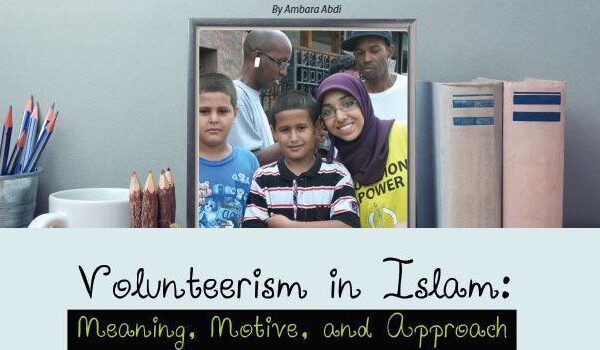
Author: Ambara Abdi

  • Preparing Youth for Success in Life, Service, and Leadership

    Preparing Youth for Success in Life, Service, and Leadership

    Looking metaphorically at the phenomenon of the “butterfly effect,” wherein, theoretically, the flapping of a butterfly’s wings in Japan could cause a tornado in Texas, it is likewise conceivable that the humble efforts of a single youth could positively and dramatically change the world. Despite this plausible reality, oftentimes we hear youth saying, “I’m young, what can I do?” Instead, perhaps, they should say,” I’m young—with the help of Allah (SWT)—what can’t I do?”

    We must provide constructive programs and outlets for youth to come together, discuss common struggles and challenges, and through specific projects, make a positive contribution to their communities

    It appears that our youth are not aware of the substantial role played by young people in Islamic history. Prophet lbrahim, for example, was a young man who challenged the disbelievers and destroyed their idols; at the age of 10, Ali ibn Abi Talib was the first male to accept Islam; Umair ibn Abi Waqqas joined the Battle of Badr around the age of 15; and Aisha (RA), who became the wife of the Prophet, narrated many hadith and was a leader in her own right during her youth.

    Devaluing the Potential Contributions of Youth

    It’s not only youth that underestimate themselves, but community leaders underestimate them as well. Muslim community leaders must realize the vital importance of youth and view them as valuable resources, rather than spoiled youngsters with little to offer, requiring video games and constant entertainment/stimuli to hold their interest. In fact, youth is the

    stage of life during which individuals are most enthusiastic, energetic, creative, open to learning, and physically strong. Allah (SWT) says in the Quran, “Allah is He who created you of weakness, then He appointed after weakness strength, then after strength He appointed weakness and grey hair…” (Quran 30:54). It is in the best interest of our communities to re-evaluate the strength and value of our youth, contemplate the substantial contributions they can make, and do our best to prepare them for success, service, and leadership.

    Mass Media Seek to Indoctrinate Youth

    The general society unquestionably values youth as a commodity. In fact, society elites and predatory marketers and advertisers recognize the intrinsic value of youth and spend a great deal of time and money to manipulate and control their behavior and shape their identity.

    Youth are not just the future; they can, today, be the endowment of our commitment and their own, benefiting and improving their own lives and that of their families, but also that of ummah and society

    In an article, “How Disney Magic and the Corporate Media Shape Youth Identity in the Digital Age,” author Henry J. Giroux writes, “Youth are now assaulted by a never-ending proliferation of marketing strategies that colonize their consciousness and daily lives…[i]n what has become the most ‘consumer-oriented society in the world,’…. youth now inhabit a cultural landscape in which, increasingly, they can only recognize themselves in terms preferred by the market. Multi-billion-dollar media corporations, with a commanding role over commodity markets as well as support from the highest reaches of government, have become the primary educational and cultural force in shaping, if not hijacking, how youth define their interests, values and relations to others.” For this reason, community leaders and parents need to be active players in this struggle to influence the hearts and minds of youth.

    Exemplary Youth Inspire Peers to Strengthen Iman

    Without exemplary youth providing a good example and positive peer influence, Muslim youth are left hanging in the balance. Popular culture with all its many vices are a continuous temptation and distraction for youth, and Muslim youth do not live in a vacuum. If they are not provided positive Islamic experience and acculturation, they will be susceptible to any and all negative influences from non-Muslim friends, popular culture, mass media, and profit-motivated advertisers. Youth leaders, in conjunction with more mature individuals in their communities, are needed to reach out to the youth and provide constructive programs and outlets for youth to come together, discuss common struggles and challenges, and through specific projects, make a positive contribution to their communities. Also, within this climate of Islamophobia, youth need, more than ever, the inner strength that comes from adequate Islamic knowledge and personal confidence. They can then stand tall against those in society who feel justified in hating and criticizing them because of their association with Islam.

    Youth Disenfranchised from Our Communities

    Obviously, youth who are disenfranchised and disconnected from the masjid and Islamic community run a greater risk of becoming wandering invisible Muslims who discard their Islamic practice and potentially stop identifying as Muslim altogether. Muslim youth who are not at the masjid are also not in some empty room staring at the walls. No, they are busy somewhere doing something.

    The reasons for youth being absent from the masjids vary. A few years ago, at a sisters’ halaqa, I met some new sisters and began talking about the community needs, etc. During the conversation, one sister mentioned that there were some Muslim youth and adults who were attending churches because they “provided better programs and activities.” I thought I had “heard everything,” but this revelation was unexpected and, unfortunately, true. If a masjid becomes merely a place to hold the five daily prayers and jumah, then it really is not providing the essential services needed to sustain a healthy, vibrant community.

    Another reason youth don’t regularly visit the masjids is because they don’t feel they are stakeholders and haven’t been empowered to make a significant contribution. Youth have a lot to offer their communities. It is time for masjid boards to show confidence in their youth, invite the older youth and young adults to join the masjid board, and empower them to reach out to other youth and develop programs to benefit the youth and the community at large.

    In order to attract youth to the masjid, activities must be provided that are interesting and stimulating to them. Comprehensive programs for them are needed and can be developed gradually. However, initially attracting them can be accomplished by having youth organize and advertise youth sports tournaments with pizza parties and ice cream socials. After that, the youth themselves can recommend other programs that interest them and keep them active in the masjid.

    “It takes a Village”— Parent and Community Partnership

    Preparing youth to succeed in their lives, to contribute to society, and to take on leadership responsibilities, requires that they have a deeper understanding of Islam. After learning the basic beliefs, the five pillars, surahs from the Quran, a collection of hadith, and other requisite Islamic knowledge — they should then attempt to understand some deeper Islamic concepts. A deeper understanding of Islam is a blessing from Allah (SWT). The Prophet (pbuh) said, “When Allah wishes good for a person, He causes him to understand the religion” (Bukhari).

    Parents and communities should form a partnership to provide children and youth the requisite Islamic knowledge necessary to become dynamic and successful members of the community and society. The partnership includes combining resources and disseminating Islamic information and training through full time Islamic schools, Sunday schools, masjid halaqas for youth, as well as workshops, visiting lecturers, and parent-guided educational activities. Ultimately it is the parent’s role to manage the logistics of providing their children and youth knowledge and Islamic leadership training —but they can utilize both home resources and community resources to obtain the desired outcomes. Knowledge is the foundation of religious commitment, and central to Islamic success, and for leadership. Whether it is spiritual or academic, it is essential, and Allah (SWT) will Insha’Allah make the knowledge sought attainable. The prophet (pbuh) said, “Whoever treads a path in seeking knowledge, Allah will make easy for him the path to Paradise” (Al-Tirmidhi).

    Helping Youth Understand Purpose and Meaning of Life

    Youth need to strive to better understand the purpose and meaning of life and how that relates to living as a Muslim and seeking to attain Paradise. Allah (SWT) tells us, “I created the jinn and humankind that they might worship Me” (Quran 51:56). Likewise, youth should be guided to contemplate the “test” of life. Allah (SWT) has taught that the creation of the heavens and the earth and of life and death is to test mankind. Allah (SWT) says, “And He it is Who has created the heavens and the earth in six Days and His Throne was over the water, that He might try which of you is the best in conduct. But if you were to say to them, ‘You shall indeed be raised up after death,’ those who disbelieve would be sure to say, ‘This is nothing but obvious magic.’” (Quran 11:7). Along the same lines, youth should also contemplate the meaning of true success in this world and realize that success is not measured by material possessions but by one’s good deeds and earning the pleasure of Allah (SWT). The deep study of Islam is a life-long endeavor, and both parents and the community should motivate youth to continuously expand their knowledge and understanding.

    Helping Youth Understand the Importance of Time

    Youth should realize time is one of the most precious resources on earth — and it is fleeting. A person can have all their worldly possessions taken from them, and spend many years working hard to replace what they lost. But time is one precious resource that can never be replaced. Every second that ticks away is gone forever. Surah Al-Asr should be studied and understood as it relates to life and the value of time. Allah (SWT) says, “By time, verily man is in loss, except such as have faith, and do righteous deeds, and [join together] in the mutual teaching of truth, and of patience and constancy” (Quran 103:1-3).

    There are certain major time wasters that should be cautioned against and avoided in order to better value time. Activities like spending hour after hour watching TV, playing video games, or being glued to a smart phone on social media can be detrimental, if not done in moderation and after other, more important activities have been fulfilled. Let’s say some youth spent six hours a day combining TV, video games, and social media. Doing the math, we calculate that they are spending 2,190 hours or nearly three full months over the period of a year. This is a startling figure. There are so many better ways to spend one’s time which could truly bring benefit such as reading and memorizing Quran, attending a halaqa, participating in sports-centered recreational activities with fellow Muslims, cleaning the masjid, and studying and increasing one’s knowledge. The Prophet (pbuh) has said, “Take advantage of five matters before five other matters: your youth before you become old; your health before you fall sick; your wealth before you become poor; your free time before you become busy; and your life, before your death” (Al Hakim and Musnad Ahmad).

    Helping Youth Prepare Academically and Intellectually

    Academics are an important part of training youth, and striving for excellence is one of the qualities of a good Muslim, contributing member of society, and leader. With regard to academics, youth should be life-long learners and always strive for excellence in their studies. They should be conscientious towards their school work, and when necessary, seek out the help of tutors to help them master challenging subject matter. By being an exemplary student, a Muslim improves the image of Muslims in society, and that is a form of indirect dawah. Regardless of whether they attend an Islamic school, public school, or college, they should have good character and lead by example. In addition, if students are focusing on beneficial activities like studying in their free time, then they should have no trouble excelling in school and becoming adequately prepared for any field of employment. This spirit of striving for excellence is a practice that is essential to all personal endeavors, family life, career, civic participation, and, of course, religious practice.

    Helping Youth Prepare Physically

    Overall heath is an important aspect of helping youth prepare for a successful life, for dedication to activism and contribution, and for leadership. The Prophet (pbuh) encouraged certain physical fitness activities like swimming, archery, and horseback riding. So in general, a variety of sports and fitness activities including joining a sports team and regular exercise could be beneficial in keeping oneself healthy and active. A highly recommended activity conducted by some Muslim communities is organizing children and youth competitive flag football and soccer leagues which is beneficial both socially and physically. In addition, it is important to teach youth to eat healthy from a young age. If a child or youth has a weight problem, then parents can take a more active role by not bringing unhealthy foods into the home, and not only modeling and encouraging healthy eating, but also providing an adequate amount of physical fitness activities for their child or youth.

    Helping Youth Choose Friends Wisely and Practice Kindness and Inclusiveness

    Peer pressure is very powerful, and negative peer pressure can lead our youth down the wrong paths. The prophet (pbuh) has said, “The comparison of a good friend and a bad friend is like a perfume seller and a blacksmith. The perfume seller will give you the gift of perfume or you can enjoy its fragrance. The blacksmith will either burn your clothes, or you may be exposed to his bad smell” (Bukhari and Muslim). The best of youth are leaders, not followers, and they are very careful of the company they keep. The Prophet (pbuh) was asked, “Which of our companions are best?” He replied, “One whose appearance reminds you of Allah, and whose speech increases you in knowledge, and whose actions remind you of the hereafter.”

    In addition, youth should understand the importance of inclusiveness and kindness towards all others including those who are new in the community or of different races or backgrounds. Youth should also be reminded to offer salaams, especially to those who are new, and find ways to focus on similarities rather than differences with those whom they are unfamiliar.

    Helping Youth Prepare for Service and Activism

    The best way to prepare our youth for service and activism is to, ourselves, be committed to service and activism. This starts with a frequent presence at the masjid, conveying that the masjid is our second home. We set the example by always looking for ways to improve things, to organize, to keep the masjid clean. And we approach this with an attitude of taking initiative, not waiting for someone to ask us to do something, but doing so for the sake of Allah (SWT).

    Being balanced and committed Muslims who not only serve the Muslim community, but the greater community at large, helps prepare our youth, through example, for service and activism. We have to engage with the greater community and strive to include our youth in these activities, like volunteering at soup kitchens, visiting with seniors at senior citizen homes, and participating in dawah activities to convey better understanding of Islam to the general public.

    Helping Youth Realize that Their Best Role Model is Prophet Muhammad (p)

    It is human nature to be enchanted with heroes and winners. The unfortunate reality is that some Muslim youth know more about the lives of sports stars and celebrities than our Prophet Muhammad (pbuh). We have to help our youth realize that there is no better role model than Prophet Muhammad (pbuh). Our Prophet was a mercy for humankind, and the best example of human maturity, fairness, caring, and spiritual success; and his message and example is available for posterity.

    By doing all we can to help our youth prepare for success, for service, and for leadership, we fulfill our responsibilities as parents and active community members. Youth are not just the future; they can, today, be the endowment of our commitment and their own, benefiting and improving their own lives and that of their families, but also that of their communities, the ummah, and society at large.

  • The Matter of Black Lives

    The Matter of Black Lives

    Every July 4th in the United States, citizens rush to the streets and parks to delight in the great spectacle of colorful and thunderous fireworks celebrating the anniversary of the adoption of the Declaration of Independence, a document declaring the 13 original American colonies’ demands for justice and independence from the British Empire. Within the pages of this famous document are the following universal words: “We hold these truths to be self-evident, that all men are created equal, that they are endowed by their Creator with certain unalienable Rights, that among these are Life, Liberty and the pursuit of Happiness.”

    It is unfair to generalize or suggest that all police officers are racist or quick to pull the trigger. The fact is that while law enforcement is crucial to maintaining law and order, African-American communities across the nation must feel confident that the police will deal with them fairly and humanely.

    These words, written in 1776, which profess to be true of “all men,” have unfortunately not been granted in full to everyone, especially the African-American community. Although race relations in the United States have certainly progressed leaps and bounds since the dark days of slavery, racial tensions in 2016 seem to be at a boiling point. And the notion of racial equality for all is more of a dream than a reality. The Black Lives Matter movement is currently at the forefront of the rallying cry to highlight injustices against the black community in America.

    Devaluing Life

    To begin with, it goes without saying that black lives absolutely do matter — they always have and always will — as do all lives, including blue lives (police officers). Islam rejects the notion that individuals or nations are superior because of color or race, or other arbitrary distinctions. Prophet Muhammad (peace be upon him) said in his final sermon: “All mankind is from Adam and Eve; an Arab has no superiority over a non-Arab nor a non-Arab any superiority over an Arab; also a white has no superiority over a black nor a black any superiority over a white, except by piety and good action.”

    Furthermore, life itself is sacred, and to kill anyone without lawful and moral cause is a travesty of justice. Allah (SWT) says in the Quran: “Whoever kills a person [unjustly]…it is as though he has killed all mankind. And whoever saves a life, it is as though he has saved all mankind” (Quran 5:32). Not only in America, but all around the world, whether on the battlefield or elsewhere, there is an unfortunate tendency to devalue the sanctity of life. This has been seen in the U.S. where some police officers have been found shooting and killing, rather than arresting, young unarmed black men. Likewise, around the world, innocent men, women, and children are viciously and senselessly slaughtered in the name of war. According to the Costs of War project at The Watson Institute for International and Public Affairs at Brown University, “Approximately 210,000 Afghan, Iraqi, and Pakistani civilians have died violent deaths as a direct result of the wars.” This is only one region, but this ongoing problem of devaluing life in general, and the lives and blood of black and brown people in particular, is at the heart of the movement called Black Lives Matter.

    The Black Lives Matter Movement

    The Black Lives Matter organization was established in 2013, following the controversial death of unarmed teenager Trayvon Martin who was gunned down by neighborhood watch volunteer, George Zimmerman. Trayvon was walking home after purchasing snacks at a convenience store in Sanford, Florida. When Zimmerman was ultimately acquitted of all charges, cries of foul play, protests, and demands for justice ensued.

    According to Alicia Garza on BlackLivesMatter.com, “I created #BlackLivesMatter with Patrisse Cullors and Opal Tometi, two of my sisters, as a call to action for Black people after 17-year-old Trayvon Martin was posthumously placed on trial for his own murder and the killer, George Zimmerman, was not held accountable for the crime he committed. It was a response to the anti-Black racism that permeates our society and also, unfortunately, our movements. Black Lives Matter is an ideological and political intervention in a world where Black lives are systematically and intentionally targeted for demise. It is an affirmation of Black folks’ contributions to this society, our humanity, and our resilience in the face of deadly oppression.”

    Two other nationally covered cases added fuel to the fire and seemed to further ignite the strength and breadth of the Black Lives Matter movement. The first of these occurred when unarmed 18-year-old Michael Brown was shot on February 12, 2014 in broad daylight by officer Darren Wilson in Ferguson, Missouri, after being stopped on suspicion of burglary. Some eyewitnesses asserted that at some point Brown held up his hands in surrender, but a Department of Justice report concluded that Brown likely didn’t have his hands up when he was shot and many of the witnesses were ultimately found to be not credible or admitted they lied. A second DOJ report, however, investigated the Ferguson police department and found broad-based racial bias, and routine violation of the constitutional rights of African-American citizens. After Wilson’s acquittal, Ferguson, Missouri was a hot spot for protests, and unfortunately there were instances of looting and the burning down of stores. Another case which drew national attention and outrage was the chokehold death of Eric Garner on July 17, 2014, for allegedly selling cigarettes without a license. He is heard pleading, “I can’t breathe” as he is restrained. The medical examiner found his death was due to chokehold, chest compression, and poor health.

    The question of injustice in these cases has to do with the fact that the ultimate punishment of death was outrageous, considering the circumstances of these incidents: walking down the street after purchasing snacks — Trayvon Martin; being suspected of shop lifting — Michael Brown; and selling cigarettes without a license — Eric Garner.

    The Difference the Black Lives Matter Movement Has Made

    As in past civil rights/social justice movements such as Gandhi’s Indian independence movement and Martin Luther King Jr.’s civil rights movement, civil disobedience and protests have been an effective means to garner the attention of the powers that be, and effect permanent change. The more protesters demand change and justice, the more political leaders take heed.

    Khury Petersen-Smith had this to say about the BLM movement in an article in the International Socialist Review entitled “Black Lives Matter–A new movement takes shape”: “In a matter of weeks, the (BLM) movement shattered what remained of the notion of a ‘post-racial’ America and reoriented the entire national conversation on anti-Black racism. The movement follows in a tradition of Black struggles in the United States whose impacts far exceed the numbers of people involved and go well beyond their point of origin …The strength of today’s Ferguson-inspired movement can be gauged in a number of ways. For one, the movement has been militant from its inception. One of the movement’s most popular refrains in street protests and social media is ‘shut it down!’ Beyond a rhetorical slogan, this has found expression in the real world as activists in dozens of cities have marched onto highways to disrupt traffic; linked arms across railroad tracks to stop trains; sat down in urban intersections; delayed sporting events; and temporarily occupied shopping malls, major retail stores, police departments, and city halls.” The growing lack of trust between the African-American communities and law enforcement has been a central focus of the BLM struggle.

    Justice From and Toward Law Enforcement

    Disappointment and outrage against law enforcement has been at the heart of the Black Lives Matter movement, and the fact that some police officers have been caught on video using excessive or deadly force when apprehending suspects of color has given credence to ongoing allegations of police brutality.

    But it is unfair to generalize or suggest that all police officers are racist or quick to pull the trigger. The fact is that while law enforcement is crucial to maintaining law and order, African-American communities across the nation must feel confident that the police will deal with them fairly and humanely. Certainly officers must be able to protect themselves while policing the community. But they must also be trained and predisposed to de-escalating rather than ratchetting up tense situations. They need to be trained to avoid stereotyping, profiling, or pre-judging individuals or circumstances based on any sort of racial, religious, or socio-economic class bias. The tragic consequence of distrust and anger toward law enforcement – when it is not adequately addressed and therefore allowed to grow and fester — is the horrific targeting of police such as the murder of five officers in Dallas, Texas in July of this year.

    Islam demands that justice be served to all parties and on all sides of an issue: “O you who believe! Stand out firmly for justice, as witnesses to Allah, even as against yourselves, or your parents, or your kin, and whether it be [for or against] rich or poor: for Allah can best protect both. ….and if you distort or decline to do justice, verily Allah is well- acquainted with all that you do” (Quran 4: 135).

    Educational Inequity

    The issues of discrimination, of social and economic inequities, that the black community in America faces is brought to the fore by the graphic violence and injustice of police brutality. Far too many African-Americans are in prison, and there is unequal and inferior education in the inner cities. Education is seen by many as the great equalizer—as an opportunity to reach one’s greatest potential, to climb the socio-economic ladder so as to achieve economic independence and success. When quality public education is lacking, serious questions of injustice can and should be raised. Seeking and acquiring education is critical in Islam, and was the theme of the first words revealed in the Quran: “Read in the name of your Lord who created. Created man, out of a clot of congealed blood. Read, and your Lord is the most Generous, Who taught by the pen, taught man that which he knew not” (Quran 96:1-5).

    Nearly 60 years after the 1954 landmark ruling in Brown v. the Board of Education, in which the U.S. Supreme Court declared public education is “a right which must be made available on equal terms,” racial inequities in school spending persist. An article entitled “Students of Color Still Receiving Unequal Education,” on Americanprogress.org, gives clear evidence that the historical problem of inequity in American education has not gone away. The article presents the following data to back up that claim:

    • Across the country schools spent $334 more on every white student than on every nonwhite student
    • Mostly white schools (90 percent or more white) spent $733 more per student than mostly nonwhite schools (90 percent or more nonwhite)
    • The United States spends $293 less per year on students in mostly nonwhite schools than on students in all other schools. That’s 7 percent of the median per-pupil spending.

    Although slavery is thankfully a thing of the past, “justice for all” is still, unfortunately, an American dream unrealized. We need groups like the Black Lives Matter movement to keep such injustices in the forefront of our minds.

     Beyond Protests: A New Vision Towards Policy Change and Justice

    According to an article on NBCnews.com, entitled “Black Lives Matter Releases Policy Agenda,” the movement has taken serious and unified steps to communicate and document clear goals and demands for policy changes to support racial equality and social justice. The plan, “A Vision for Black Lives: Policy Demands for Black Power, Freedom and Justice,” is the work of more than 50 organizations nationwide, and advances six core demands and 40 policy priorities. According to Montague Simmons of Organization for Black Struggle and the Movement for Black Lives Policy Table: “Our grievances and solutions extend beyond the police killing of our people; state violence includes failing schools that criminalize our children, dwindling earning opportunities…., and so much more…That’s why we united, with a renewed energy and purpose, to put forth a shared vision of the world we want to live in.” The six core demands are as follows:

    • End the war on black people
    • Reparations for past and continuing harms
    • Divestment from the institutions that criminalize, cage and harm black people; and investment in the education, health and safety of black people
    • Economic justice for all and a reconstruction of the economy to ensure our communities have collective ownership, not merely access
    • Community control of the laws, institutions and policies that most impact us
    • Independent black political power and black self-determination in all areas of society
    Global Solidarity Between the BLM Movement and the Palestinian Struggle

    There is a shared longing for change within the Palestinian and African-American struggles for justice. In an article entitled “Black Lives Matter Activists Declare Solidarity with Palestine” at in these times.com, it is noted that as far back as 1970, black activists published a full-page ad in the New York Times titled, “An Appeal by Black Americans Against United States Support of the Zionist Government of Israel.” This ad was signed by fifty-six writers, educators, and activists, and the first paragraph reads: “We, the black American signatories of this advertisement, are in complete solidarity with our Palestinian brothers and sisters, who, like us, are struggling for self-determination and an end to racist oppression.”

    The BLM platform of 2016 states: “The US military accounts for over 50 percent of discretionary federal spending, a total of 598.5 Billion dollars spent annually, as compared to 70 billion spent on education, 66 billion spent on healthcare, 63.2 billion spent on housing and 29.1 billion spent on social security and unemployment. In addition, approximately 3 billion dollars in US aid is allocated to Israel, a state that practices systematic discrimination and has maintained a military occupation of Palestine for decades… In the years since September 11 and the US-driven ‘global war on terror’, US military spending has increased by 50 percent. This war has led to the killing of 4 million civilians in the Middle East. US arms and military corporations have made billions of dollars in profit off of waging disaster and destabilization in the Middle East, while increasing western control over the land and resources of the region. In South America and the Caribbean the war on terror has combined with a long-running war on drugs intensifying forced migrations, land grabs, and political disenfranchisement. The war on terror, has not made us safer and has only increased hopelessness as our fears are realized.” The call for justice by the BLM movement, in conjunction with social justice organizations around the world, will continue until social, economic, and political justice objectives are achieved.

     The Need for the BLM Movement in America

    The Black Lives Matter movement and other civil rights and social justice campaigns in America and abroad are critical in bringing the existence of inequality to the fore and into the political discourse, and in demanding change. We can no longer turn a blind eye to attitudes of discrimination, racism, or rancid and retrogressive notions of the inferiority of persons of color. The United states is said to be a “land of opportunity,” and all people deserve an equal opportunity to “pursue happiness.” Justice and peace go hand in hand–where there is no justice, then there will likewise be no peace.

    The words of Martin Luther King Jr. in his “I have a Dream” speech still ring true: “There are those who are asking the devotees of civil rights, ‘When will you be satisfied?’ We can never be satisfied as long as the Negro is the victim of the unspeakable horrors of police brutality. No, no, we are not satisfied, and we will not be satisfied until ‘justice rolls down like waters, and righteousness like a mighty stream.’”

    Until education is equal, job opportunity is equal, and the police and courts treat all men and women equal—the Black Lives Matter Movement will remain necessary to lead the rallying cry against the systemic attitudes, policies, and behaviors that oppress African-Americans and other people of color.

    As the Quran teaches, humanity is one family—and there will never be universal peace until all of our brothers and sisters are treated with justice.

    “O mankind, We have created you from a male and a female and have made you into nations and tribes for you to know one another. Truly, the noblest of you with God is the most pious. Truly, God is All-Knowing, All-Aware” (Quran 49:13).

  • Safeguarding Faith Against Doubt

    Safeguarding Faith Against Doubt

    “Mankind will need some form of religion until there is a cure for death.” This bold statement spoken by a sociology lecturer rings true in many ways. After all, we humans didn’t create ourselves, nor did we create the world; yet we are part of a circle of life with many unknowns. The great questions intrigue human beings like what happens to loved ones when they pass away?—followed by the jolting reality that we too must one day depart into that same mysterious unseen world. What will become of us? Will we merely cease to exist after taking our last breath, or will there be an afterlife where we’ll meet our Creator, face punishment or reward, and have all our earthly and celestial questions finally answered? Religion, in fact, is a blessing for the “faithful” because it provides answers to these perplexing questions about the “unseen” world.

    Our faith is not stagnant, but constantly in motion, either growing or diminishing.

    Individuals from all walks of life elect to become followers of a chosen faith — and as such, a believer’s life is interweaved with feelings of satisfaction and, at times, doubt stemming from internal and/or external sources. When considering the various dimensions of doubt, it would first be helpful to examine the profound concept of faith itself, which in Arabic is “iman.”

    What is Iman?

    Put simply, iman is belief or faith. The Prophet (pbuh) said that iman is “to believe in Allah, His angels, His books, His messengers, the Last Day, and divine destiny, both the good and the evil thereof” (Muslim). The strength and vitality of one’s iman, or faith, is a testimony to his or her commitment to the religion of Islam. Our faith is not stagnant, but constantly in motion, either growing or diminishing.

    There is also likely no greater loss for the Muslim than the loss of faith — because it is faith which is the gate keeper for ultimate success, in this life and the life to come.

    As to one’s level of iman, this can perhaps be understood by asking the following: At any given moment, how much faith do you have that Allah (SWT) is aware of and judging all that you do, and that upon your death you will be questioned and either rewarded with the bliss of Jannah or the punishment of Hell?

    The greater one’s iman, the easier it is to perform obligatory acts of worship and thus earn a place in Jannah. Iman, which inclines a person to righteous actions and to avoidance of sin, is an enduring and profound human distinction. Other personal characteristics such as wealth, talent, beauty, intelligence, etc., are insignificant in comparison to the critical issue of faith. There is also likely no greater loss for the Muslim than the loss of faith — because it is faith which is the gate keeper for ultimate success, in this life and the life to come.

    Doubting Faith

    Doubting one’s faith, questioning the authenticity of revelation, or having uncertainty about the existence of realms beyond the material one, have been a part of the human condition since the earliest days of religious discourse. Some doubts originate with the arguments or critiques made by followers of other religions or by non-believers. Other doubts are the manifestation of the normal internal struggles faced by all believers in varying degrees. That struggle might be waking up before Fajr to offer the Qiyam al-Layl prayer or, for others, offering a single prayer in a week’s time may be the struggle. Another individual may be entertaining doubts about the Quran, while another has moved to the point that he or she is considering leaving Islam all together. Struggles and doubts such as these have been expressed over social media in recent times and it will be helpful to present an Islamic response.

    Unbelief Among Academics

    I recall the first day of my university philosophy class; my professor proclaimed that he was an atheist and the first class assignment was to give our best argument for the existence of God. None of our arguments, however, proved the least bit interesting, let alone, convincing, to him. Along the same lines, one of my relatives had an unsettling experience during her first sociology class — the professor looked straight at her as he told the class he disliked anyone “who thinks they can find all of life’s answers in a holy book.” She felt that he was singling her out and it understandably made her feel very uneasy. She promptly dropped his class and enrolled in the same class with another professor.

    Colleges and universities are generally beneficial institutions of higher learning where ideas are exchanged freely and academic knowledge is disseminated. However, students should be prepared for the possibility that his or her humanities or social science professors may have an agenda with the intention of “reeducating” religious-minded students. On his website, edwardfeser.blogspot.com, Edward Feser posts a passage from the book “University and Truth” written by philosophy professor, Richard Rorty, concerning Rorty’s views of the necessity of “reeducating” university students. “…..It is a concept which I, like most Americans who teach humanities or social science in colleges and universities, invoke when we try to arrange things so that students who enter as bigoted, homophobic, religious fundamentalists will leave college with views more like our own…. we do our best to convince these students of the benefits of secularization….we teachers do our best to be Socratic, to get our job of re-education, secularization, and liberalization done by conversational exchange… So we are going to go right on trying …to strip your fundamentalist religious community of dignity, trying to make your views seem silly rather than discussable. We are not so inclusivist as to tolerate intolerance such as yours…”

    In another article entitled, “How religious are American professors?” published in 2010 on the website whyevolutionistrue.wordpress.com, a study published in Sociology of Religion by Neil Gross, found that the more “elite” the university, the more “pervasive” was unbelief. At elite doctoral universities, 36.5 percent of all professors are agnostics or atheists. The area of study also made a difference with 29.3 percent of humanities professors being atheist, 32.6 percent for computer science and engineering, 39.4 percent for social sciences; and 60 percent of biologists and psychologists were reported to be agnostics or atheists.

    Claims that the Quran is Man-made

    It should come as no surprise that some humanities professors would have a problem with organized religion and holy books like the Quran, since a good number of them are atheists. One of the most common attacks on the Quran is the assertion that it is man-made, and yet one of the most significant miracles of the Quran is that it was revealed to Prophet Muhammad (pbuh) who was illiterate. So how is it that an illiterate man could produce such a profound book of wisdom? Allah (SWT) answers these detractors in the Quran: “And if you are in doubt as to what We have revealed from time to time to Our servant, then produce a surah like thereunto; and call your witnesses or helpers besides Allah, if your [doubts] are true. But if you cannot – and of a surety you cannot — then fear the Fire whose fuel is men and stones which is prepared for those who reject Faith” (Quran 2:23-24). If the Quran were man-made, it stands to reason that it would then be subject to error. However, Allah (SWT) rejects such fallacies: “Haven’t the unbelievers considered if this was from other than Allah, they would find within it many contradictions?” (Quran 4:82).

    Claims that the Quran Was Copied from the Bible

    Stating that the Quran is copied from the Bible must be a claim by an individual who hasn’t studied or even read the Quran and/or the Bible because the two are dramatically different. Both books tell the stories about prophets from God; and understandably so, as the Quran and the original books revealed to Moses and Jesus (peace be upon them both), come from the same divine source. Allah (SWT) says: “And this Quran is not such as could ever be produced by other than Allah, but it is a confirmation of [the revelation] which was before it, and a full explanation of the [former] scripture – wherein there is no doubt – from the Lord of the worlds” (Quran 10: 37).

    There are, in fact, many differences between the Quran and the Bible. Muslims believe that over time the original revelations to the previous faith communities were changed through error, translation, or other means. The Quran stands as a criterion by which to remedy those errors. For example, in the Bible, Eve is said to have tempted Adam to eat from the tree, while in the Quranic account, Shaytan tempted both Adam and Eve together to eat from the tree. The Bible also relays that Adam and Eve came to the earth in a state of sin and according to the Christian doctrine of Original Sin, the blood of Jesus (pbuh) is necessary to purify the sins of man. However, in the Islamic account, both Adam and Eve sought and were granted forgiveness, and thus from the Muslim perspective, there is no original sin, and the blood and death of Christ as a sacrifice of atonement for the sins of man is a false doctrine. Finally, the Quran is very clear that Jesus Christ, the son of Mary, was a prophet and not the son of God. These are all significant differences, demonstrating that the Quran is not copied from the Bible.

    The Truth, Guidance, and Miracles of the Quran

    Allah (SWT) declares in the Quran, “Verily, We have revealed the Book for the people in truth. So whoever accepts the guidance benefits his own soul; and whoever goes astray, he injures his own soul. And you [Muhammad] are not a manager over them” (Quran: 39: 41). One of the greatest treasures of this world is the Quran, and one needs to read it with sincerity before understanding or guidance can grow and flourish. If one is looking sincerely for “proof” of the validity of the Quran, they will find it within its miraculous chapters.

    There are many miracles in the Quran and instances where its verses confirm recent scientific findings. One such example is the detailed description of the stages of embryonic development in the womb which was later confirmed when high-powered microscopes were invented centuries later: “Man We did create from a quintessence of clay; then We placed him as a drop in a place of rest, firmly fixed; then We made the drop into a clot of congealed blood; then of that clot We made a lump; then We made out of that lump bones and clothed the bones with flesh; then We developed out of it another creature. So blessed be Allah, the best to create!” (Quran 23:12-14).

    The Brief Illustrated Guide to Understanding Islam, available at Islam-guide.com, notes that in 1981, during the Seventh Medical Conference in Dammam, Saudi Arabia, a leading scientist in the field of anatomy and embryology, Professor Emeritus Keith L. Moore, stated the following about the Quran’s detailed description of embryonic development: “It has been a great pleasure for me to help clarify statements in the Quran about human development. It is clear to me that these statements must have come to Muhammad from God or Allah, because almost all of this knowledge was not discovered until many centuries later. This proves to me that Muhammad must have been a messenger of God or Allah.”

    There are many other examples found in the Quran of verses speaking of natural phenomena which only in the modern era were confirmed by science, including the water cycle, the geological features of mountains, the origin of the universe, and much more. A detailed examination of these and many other examples of Quranic statements predating scientific understanding can be found at Islam-guide.com, and miraclesofthequran.com. These miracles show that the Quran and science are harmonious.

    The Harmony of Belief and Science

    In reviewing Islamic history, one finds that devout Muslims have made great advancements in science over the centuries. With their full acknowledgement that all discoveries stem from divine knowledge, Muslims have made unprecedented contributions to civilization in the areas of geography, mathematics, medicine, and astronomy, to name a few. In his article, “The Limitations of Science and the Teachings of Science from the Islamic Perspective,” available on i-epistemology.net, Zaghloul R. El Nejjar mentions that the Latin root for science is “scientia” which means knowledge. This, of course, would include knowledge which could be obtained from divine scriptures. He states: “So science is defined as all the knowledge men have achieved in different places and at all times, arranged according to their subject-matter. This includes knowledge gained through Divine revelation; or by the way of human thinking and creative intellect, as well as through human legacy and tradition in these two areas. The prevailing direction, however, tends to limit the term Science to natural and experimental studies of all that is within reach of the senses and intellect in this universe (i.e. matter, energy, living beings and natural phenomena).” He argues that to limit science to mere observations made in the natural world is to limit human knowledge and reject divine wisdom

    It is this “secularization of science” that Sohaib Baig, in his article, “Science or Scientism,” available at www.albalagh.net, blames for the devastating destruction of the planet. “In essence, the current environmental disaster is a very real disaster, and is a direct consequence of rejecting God’s authority and relevance over mankind…” There is a legitimate argument to be made that science and religion must find harmony through acknowledgement of the supremacy of divine and natural law. However, to continue a secularist approach in science is arguably destructive to both man and the natural world. Parting from Islam is not only destructive to science, but also to the individual.

    Replace Islam with What?

    For those Muslims who question and doubt their faith — what lifestyle instead of the spiritual and protective ways of Islam do they seek? Would they put all their faith in science with its many limitations and “missing links,” or indulge in behaviors prompted by the lower self which seeks pleasure with no regard to consequences? Sexually transmitted diseases, pregnancy out of wedlock, addiction to drugs or alcohol, depression resulting from a lack of meaning and purpose in life – these are all real and catastrophic to individuals, families, and society. Islam was sent to mankind to uplift us, enlighten us, bless us, and prevent us from harming ourselves and others. Choosing to give up the way of Islam is a decision with profound consequences. Allah (SWT) says: “Those who sell God’s covenant and their faith for a small price shall have no share the Hereafter” (Quran, 3:77). Growing nearer to Allah (SWT) and earning our place in the wondrous and blissful world of Jannah is the ultimate goal of this world, and to find success one needs to develop and maintain a strong sense of iman.

    Safeguarding Iman Against Doubt

    Everything in life needs nourishment, and iman, or faith, is no different. Our iman is always in motion, growing stronger or decreasing, and this movement is in direct response to the heedful actions we take, or neglect to take, to maintain a close relationship with Allah. He (SWT) says: “This is the Book; in it is guidance sure, without doubt, to those who fear Allah; who believe in the unseen, are steadfast in prayer, and spend out of what We Have provided for them” (Quran 2: 2-3). There are many actions we can take to safeguard our iman. Below are some examples.

    Seek Refuge in Allah Against the Accursed Shaytan: The first advice for individuals who are doubting their faith is to seek refuge in Allah (SWT) from Shaitan whose goal has always been to bring about the destruction of man. Shaytan said: “…I will lie in wait for them on Thy straight way: Then will I assault them from before them and behind them, from their right and their left: Nor will You find, in most of them, gratitude [for Thy mercies]” (Quran 7:16-17).

    Acquire an Armor of Knowledge

    One should first aspire to study and understand the Quran, then the hadith and sunnah of Prophet Muhammad (pbuh). Knowledge is strength and power, and Islam is built on a foundation of learning and growing. The first words of the Quran that were revealed tell us, “Read in the name of your Lord, and Cherisher…” (Quran 96:1) The Prophet (pbuh) has said, “Acquire knowledge: it enables its possessor to distinguish right from wrong, it lights the way to heaven; it is our friend in the desert, our society in solitude, our companion when friendless. It guides us to happiness; it sustains us in misery; it is an ornament among friends, and an armor against enemies.”

    Continually Polish the Heart

    Every Muslim is susceptible to suffering from a decrease in faith if their guard is down. But as Prophet Muhammad (pbuh) teaches, it is mindfulness of Allah which can bring about success. He says: “There is a polish for everything that takes away rust; and the polish for the heart is the remembrance of Allah” (Bukhari). We can polish our hearts with such endeavors as attending the blessed Jumah prayer, offering our five daily prayers on time, making regular dua throughout the day, and through reading and memorizing the Quran.

    Keep Good Company

    The people we spend time with have a big impact on our thoughts, perceptions, and behavior. It is important to choose to spend time with righteous Muslims at every opportunity.

    Prophet Muhammad (pbuh) said: “The example of a good companion and a bad companion is like that of the seller of musk and the one who blows the blacksmith’s bellows. So as for the seller of musk, then either he will grant you some, or you buy some from him, or at least you enjoy a pleasant smell from him. As for the one who blows the blacksmith’s bellows, then either he will burn your clothes or you will get an offensive smell from him.” Thus, for Muslim college students, it can be very beneficial to join Muslim student groups and have preferable companionship, gain blessings by giving dawah to non-Muslims, and be spiritually uplifted through positive peer encouragement. All of these undertakings can instill in the individual a stronger foundation of iman.

    Strive for Certainty

    Once one has sincerely studied Islam with an open heart, uniting their intellect and heart together in confirmation of the truth and divine wisdom they have found, they then have the opportunity to taste the “sweetness” of iman. Enjoying this blissful feeling of being under the umbrella of truth, one reaches a deep-rooted level of iman and can aspire to feel Allah’s (SWT) “guiding light” of yakeen (certainty). At this level, it becomes difficult for one to be swayed by the various distractions or “glitter” of this world, and the deep roots of faith become strong and enduring.

    “Allah is the light of the heavens and the earth. The example of His light is like a niche within which is a lamp; the lamp is within glass, the glass as if it were a brilliant star lit from a blessed olive tree, neither of the east nor of the west, whose oil would almost glow even if untouched by fire. Light upon light. Allah guides to His light whom He wills. And Allah sets forth parables to make people understand, and Allah knows all things” (Quran 24:35).

  • Living and Exemplifying Islam is the Best Remedy for What Ails Us

    Living and Exemplifying Islam is the Best Remedy for What Ails Us

    “Who are the Muslims, really?” “Are they friend or foe — with us or against us?” These are the unsettling questions which have troubled many non-Muslim Americans for the last decade and a half. Unfortunately, Muslims in America are facing major setbacks regarding the perceptions of who we are and what we stand for. History has shown that certain minority groups have had their turn at being despised, such as the American Indians or African Americans, or being labeled “outsiders” like the Italians and then later the Japanese. Regrettably, it seems, Muslims currently hold this dishonorable distinction.

    When we follow our religion, displaying the virtues and generosity of Islamic manners in every setting of our daily lives, thereby letting non-Muslims know us and, in turn, coming to know them.

    Interestingly enough, from about the late 1960s to the end of 2001, some Muslim organizations in the U.S. were either directly or indirectly urging followers to embrace a lifestyle of isolationism. The popular position was that devout Muslims shouldn’t associate with non-Muslims outside of work or school. Nor should they get involved in interfaith activities. And furthermore, the mere idea of getting involved in politics was out of the question, a veritable waste of time and highly undesirable — some even implied that to do so was disloyal or haram (forbidden). My own household was likewise influenced by this isolationist mentality. I remember that my parents disapproved of me attending high school sports events or getting involved in any extracurricular activities. The feeling was that participating and supporting such activities might somehow weaken my faith in Islam.

    Muslim Isolationism — A Failed Approach

    It seems pretty clear that the isolationist strategy promoted by some Muslim American organizations was a complete fallacy. This was blaringly apparent immediately after the horrific World Trade Center tragedy on September 11, 2001, an attack which was categorically condemned as a crime against humanity by Muslims in America and around the world. Prior to this horrific event, Muslims were considered somewhat “exotic” and intriguing to non-Muslim Americans. However, after the World Trade Center atrocity, some believed they knew all they needed or wanted to know about Islam and Muslims, and the proverbial “fingers of suspicion” were vehemently pointed in the face of Islam in America. Everyday life for Muslims in American consequently changed dramatically.

    A New American Muslim Social Strategy

    After the horrific 9/11 tragedy, suspicion toward Muslims became the norm in the United States. Some Muslim organizations then began frantically scrambling to rethink their prior strategies, while simultaneously attempting to reassure fellow Americans that mainstream Muslims were just as outraged and devastated by this disaster as they were. The dilemma was that a few individuals who called themselves Muslims were being blamed—and suddenly the entire religion of Islam was unjustly being tried in the court of public opinion. Yet, the attacks on September 11th violated the very essence of what Islam stands for. In fact, is there any greater tragic irony than to suddenly label Islam, a religion which has promoted peace and justice for over 1400 years, as the faith of violence and terror?

    Muslims know that service to fellow man is a fundamental principal in Islam, and all of us can do our part to be helpful, individually, when called upon.

    Being prompted by the attacks on September 11, and after much crises management and damage control think-tank sessions, most Muslim organizations came to similar conclusions regarding how best to guide members to move forward as Muslims in America. Thus, a new “social” era was born for Muslim American organizations: Instead of the ill-fated strategy of isolationism, they began to promote a policy of “integration or assimilation without compromise.” The new recommendations for Muslim American families was that they take steps to assimilate into the greater society without compromising their Islamic faith and values, or violating any principles of Islamic practice. In so doing, Muslims could become more deeply interwoven into the fabric of American society, would have a voice, and be viewed as contributing, conscientious, fellow Americans.

    Assimilation Without Compromise

    So how should average Muslim families proceed to assimilate into society without compromising their Islamic faith? First, Muslims can think of themselves, not as part of a “melting pot,” but rather as an important ingredient in a “tossed salad.” Muslims can integrate into the larger American community while maintaining their Islamic identity, and through strong faith and exemplary demeanor and conduct, they can navigate the social intricacies of daily life. It’s important to note that this is far from any notion of yielding to demands of “fitting in” in some unprincipled or conformist popular-culture way. Assimilating without compromise means exactly that – weaving into the American fabric without compromising one’s Islamic convictions and values.

    Muslims have been in America arguably from its establishment, and will continue to live in and make contributions toward its betterment.

    Allah (SWT) says: “….We created you nations and tribes that you may know one another” (Quran 49:13). Nowhere in the Quran does it say that Muslims should stay separate and isolate themselves in a protective bubble away from the rest of the world. Allah (SWT) explains why Muslims are a good example for others: “You are the best nation raised up [as an example] for mankind. You enjoin what is right and forbid what is wrong and believe in Allah” (Quran 3:10). When we follow our religion, displaying the virtues and generosity of Islamic manners in every setting of our daily lives, thereby letting non-Muslims know us and, in turn, coming to know them — and when we, further, stand shoulder to shoulder with those committed to social justice — we can begin to disprove the venomous lies being spread about Islam, Muslims, and the Prophet, and thereby dismantle the defamation campaign waged against us.

    In the Work Place

    America is known as the “land of opportunity,” and the fact is that Muslim American families work hard and make positive contributions to society as doctors, engineers, educators, business people, and in countless other professions. The work place is a fertile ground for Muslims to represent themselves as outstanding employees and employers. Muslims should strive for excellence whether as a server at a restaurant or the CEO of a major corporation. Prophet Muhammad (pbuh) has said: “Verily, Allah has prescribed excellence in all things…” (Muslim). As in all walks of life, Muslims must be honest employees, as exemplified by the Prophet Muhammad (pbuh), who was nicknamed Al-Amin, the trustworthy one. The restaurant owner should never worry that a Muslim employee would steal from the cash register, and a Muslim CEO should demonstrate great qualities of leadership and integrity, including treating all employees justly. Muslims should set a good example in the workplace by striving to be on time, meet all work-related commitments, and always give one hundred percent effort in their daily work routines as well as special projects.

    Excellence in Academic Environments

    Schools are a wonderful place for the dissemination of truthful information about Islam and Muslims. Nearly every student will have an opportunity at some point or another to give a presentation about Islam, interact in casual discussions about religion, or correct inaccurate information being taught during a lesson about Islam. All students, whether in high school or college, should take full advantage of these golden opportunities to convey authentic and correct information about Islam. They also should strive to exemplify the characteristics of ideal Muslim character — in actions and words, and should strive for excellence in academics. It’s not about obsessing over straight As, but about doing one’s absolute best and being a good role model. For those inclined toward sports and fitness, it also involves maintaining ones Muslim personality and manners while interacting with fellow athletes. This means being respectful to coaches, teammates, and showing good sportsmanship when losing by congratulating opponents. It also calls for being a moral leader — not a follower, and interacting without diminishing one’s Islamic commitment and resolve.

    School Involvement by Parents is Essential

    In addition to students playing an important role in representing Islamic character at school, parents too can play an important role by showing concern for the greater school community and participating in their PTA (parent teacher association). Parents should visit with teachers and principals and be active in helping with school functions including helping out with fundraisers, contributing snacks for class parties, or accompanying the class for field trips. It is very beneficial for parents to play an active role and show that they are involved and caring parents, community members, and fellow citizens.

    Kindness to Neighbors

    Average Americans should be happy to have Muslims as neighbors. Being a good neighbor is a wonderful opportunity for indirect dawah. Indeed, for a Muslim to be unjust in any way to his neighbor violates the letter and the spirit of Islam. The Prophet (pbuh) said, “One is not a Muslim if his neighbor does not feel safe from his mischief” (Bukhari). There are many ways to show the spirit of Islam to neighbors — helping them when they ask, bringing them gifts from one’s travel, giving them sweets during the holidays, and visiting them when they are sick. There is a beautiful story about one of the Prophet’s neighbors who used to regularly throw trash in his yard. One day the Prophet found no trash so he went to enquire about this neighbor and learned she was sick. The Prophet then visited her and she was so moved by his graciousness and caring that she embraced Islam.

    Muslims and the Political Process

    America is a land “of the people, for the people, by the people,” and as such, it is in Muslims’ best interest to be civically engaged, actively participating in the political process. This is the way to effect positive change in communities around the country, and also to influence how the U.S. deals with other nations around the world. Getting involved is not only about voting during elections or campaigning for candidates, but also, for those so inclined, running for office. Some Muslims including Rep. Keith Ellison of Minnesota and Rep. Andre’ Carson of Indiana have already paved the way for Muslims in politics. Joan Walsh, currently national affairs correspondent for The Nation, wrote in an article for the Minnpost.com, “The fact is, we need more Keith Ellisons in Congress. Not just because he’s a great progressive voice, supporting the president but challenging him strongly on his questionable austerity politics, but also because he’s a patriotic American who’s also a Muslim. He’s crucial right now.” For Muslims to become civically engaged, it’s more than just “talking the talk” about making positive change — it’s about walking the extra miles to change the narrative about Islam and improve American perception of Muslims and the religion.

    Interfaith Programs Help Counter Misinformation

    Through various interfaith programs, Muslims have an opportunity to represent the truth about Islam by not only educating non-Muslims about its rich heritage contributing great mathematical and scientific advancements for civilization, but also its 1400 year legacy of promoting peace and justice. Toward this end, masjids can have annual open houses, and Muslim individuals and groups can take part in programs and panel discussions set up by various religious groups in their places of worship. These programs go a long way in countering the lies and misinformation being disseminated.

    Representation in Media and Professional Sports

    Muslim Americans must have a voice in the media. How can we present the truth about Islam if we’re not part of the conversation? These days, alhamdullilah, we see more Muslims getting involved in producing films, being interviewed as experts on major news networks like CNN, and being visible in professional sports. As Muslims continue to be more prominently featured in the media, and non-Muslims begin to realize Muslims are making positive contributions, perhaps the tides will turn from suspicion to appreciation for Islam and Muslims.

    Muslim Social Service Exemplifying Islam

    Muslims know that service to fellow man is a fundamental principal in Islam, and all of us can do our part to be helpful, individually, when called upon. However, on a daily basis, millions of Americans are in need of various social services from shelter, to soup kitchens, even disaster relief. Those who provide such help are a lifeline for the destitute or afflicted. Prophet Muhammad (pbuh) said, “The most beloved of people according to Allah is he who brings most benefit to people.”

    This hadeeth is a “call to action” which all of us can answer in our own way. On a larger scale, however, although Muslim social service organizations have made steady progress in the realm of social services, they are still not known as the “go to” place for non-Muslim Americans in times of need or distress. This is due to a variety of factors including lack of resources. However, in years to come this could change. Insha’Allah once greater numbers of non-Muslims begin seeking and receiving crucial help in times of need from Muslim social service agencies, Islam will gradually be known for what it is — a religion of compassion, peace, and justice.

    Muslims have been in America arguably from its establishment, and will continue to live in and make contributions toward its betterment. Despite the fact that there are segments of the population which have motives to portray Muslims as the “enemy,” we should nonetheless remember that ultimately Allah (SWT) is in charge and has a greater plan for all our affairs. Each of us should work to deepen our faith individually, and also make dua to improve our collective situation.

    Allah (SWT) says in the Quran: “Assuredly you will be tried in your property and in your persons, and you will hear much wrong from those who were given the Scripture before you, and from the idolaters. But if you persevere and ward off [evil], then that will be a determining factor in all affairs” (Quran 3:186).

  • Loving the Biblical Prophets: Extending an Olive Branch

    Loving the Biblical Prophets: Extending an Olive Branch

    Loving the Biblical Prophets: Extending an Olive Branch to the People of the Book

    Throughout time, religion and politics have fueled conflicts.The Crusades, the ethnic cleansing during the Bosnian War, and the decades-longPalestinian-Israeli crisis have shown how deep rooted the tensions can beamong Muslims, Christians, and Jews.  Such strife,recurrent in history, leads one to wonder whether our three religious groups are fated to be at odds, or if thereis some common ground that can be the basis for reconciliation and understanding.

    Establishing common ground is arguably not only possible but perhaps easier than we may realize, and begins with opening our eyes and first recognizing our common humanity. Being human unites us, yet also makes us fallible and, thus, prone to competitiveness and potential conflict.  Even the angels anticipated future strife when God informed them of the creation of humankind in the Quran: Behold, thy Lord said to the angels: ‘I will create a vicegerent on earth.’ They said,‘Wilt Thou place therein one who will make mischief and shed blood, whilst we do celebrate Thy praises and glorify Thy holy (name)?’ He said: ‘I know what ye know not.’” (Quran 2:30).  Allah(SWT) had a divine plan in which human beings, given free will,could choose to live a life of worship and righteousness, as stated in the Quran: “I have created Jinn and humankind to worship me” (Quran 51:56 ).


    Our Common Heritage—Beginning with the Prophet Adam

    Prophet Adam was not only the first man created, he was also the first vicegerent of the earth and a prophet, and we are all the “children of Adam,” regardless of our race, religion or language.   Adam was the first in a long line of prophets and messengers sent to specific peoples at specific times throughout history. The essence of their message – to worship God and live a pious life – is available in all of God’s holy books, in the Torah, the Gospels, and the Quran.

    Allah says in the Quran, “Say:We believe in God, and in what has been revealed to us, and in what has been sent down to Abraham and Ismail and Isaac and Jacob and their offspring, and what has been revealed to Moses and Jesus and to all the prophets of our Lord. We make no distinction between them and we submit to Him and obey”(Quran 3:84).Loving the biblical prophets means also loving fellow man and recognizing that our commonalities far outweigh our differences.  The goal here is to highlight and celebrate our common ties through our prophets, and to show how understanding the lessons and life examples of the prophets helps to build our love and admiration for them.


    Love for All of God’s Prophets

    Islam teaches Muslims to honor and respect all of God’s holy books and His prophets and messengers.  In fact, out of love and respect, it is customary for Muslims to say, “peace and blessings be upon him” when mentioning or referring to any of God’s prophets. Muslims love and hold all of Allah’s prophets and messengers in high esteem because they were the best examples of human character,successfully enduring great trials, teaching unity, generosity, and justice.  The Quran mentions 25 prophets—most of whom are also in the bible, though it is believed that there were thousands more prophets throughout time, each sent with the same mission: to bring humankind back to the path of monotheism and the worship of the one true God and Creator of the universe.


    Monotheism:One God Despite the Differences

    By definition, the three monotheistic religions of Islam, Judaism, and Christianity believe that there is one true God, the Creator of the universe. I am amazed, then, to hear some non-Muslim leaders proclaim, “I don’t worship the God of the Muslims.” Their implication is that Muslims worship a false god. The Islamic explanation of the differences among the religions is more tenable, and in point of fact, more respectful, suggesting that all prophets taught the same essential message (while taking into account the historical and cultural differences), but that over time each prophetic message was changed, by error or deliberate action. Thus, while there are differences today among the doctrines of the three monotheistic religions, Islam sees no room for declaring that either the Jews or the Christians worship a false god, but indeed that all three religions worship the same God and Creator of the universe.


    One Creator withMany Names, Providing Universal Guidance

    Cultures around the world refer to the Creator of the universe by various names. This does notchange the fact that He is the one true God. For example, in English He is called God, in French He is called Dieu, in Greek Theos, in Italian Dio, in German Gott, in Hebrew Elohim, in Spanish Dios, and in Arabic He is called Allah.  It is important to note that even Christian Arabs refer to God as Allah. These various names are a necessary product of culturesand their varying languages. Through God’s books, messengers, and prophets, He conveyed His guidance to the various communities in their own languages. The records of the lives of the prophets, beginning with Prophet Adam, provide us wonderful life lessons, from which we can benefit immensely.


    The story of Prophet Adam teaches usmuch about the universal meaning of human life and the weakness of human nature.  It is through his story that we learn that life is a test, as God has endowed us with free will, but also that there arerewards for obedience and punishing consequences fordisobedience.Allah said to Adam,”O Adam! Dwell thou and thy wife in the Garden, and enjoy [its good things] as ye wish; but approach not this tree, or ye run into harm and transgression” (Quran 7:19).


    It is also important to note, that through the trials of Adam and Eve, we learn the importance of repentance.Although they disobeyed God in the garden and were sent to earth to struggle and be further tested, they asked for and received forgiveness. Allah(SWT) says in the Quran,“Thereupon Adam received words [of guidance] from his Sustainer, and He accepted his repentance; for, verily, He alone is the Oft-Returning, the Dispenser of Grace” (2:37).


    The Trials of Prophet Abraham—Acknowledging our Common Origins

    Prophet Abraham is widely regarded as the father of Judaism, Christianity, and Islam. While we should not construe this statement as suggesting greater theological commonality among the three faiths than actually exits today, it is helpful to interfaith engagement and cooperation, and helps us peel back the layers of our common origin to find that we have more in common than we have differences.  Prophet Abraham(pbuh) was a man who exhibited great obedience to the Creator. There are times in our own lives when we are tested with great trials and distress, but perhaps not to the degree of Prophet Abraham; he was not only told by God to sacrifice his son, but also to leave his wife and baby alone in a barren desert. The stories in the life of the Prophet Abraham (Ibrahim) teach us lessons of trust in our Creator, obedience, and patience.One of the significant events in the life of Prophet Abraham (pbuh) had to do with making the tough decision regarding his wife Hagar (Hajar), and their son.  One day Prophet Abraham instructed his wife Hagar to bring their baby Ishmael (Ismail) and embark with him on a long journey to the middle of a barren valley in the Arabian Peninsula.  After they arrived, Abraham prepared to leave his wife and baby alone in the desert with little food or water and began to walk away.  Hagar was very alarmed by his actions and asked him if Allah(SWT) had instructed him to leave her, to which he answered“yes” and then he left.

    Once Hagar’s food and drink ran out, shelaid down baby Ishmael and desperately ran between the two mountains of Safa and Marwa seven times searching for food or help. Prophet Muhammad (pbuh) said,”When she reached al-Marwa [for the last time]…she saw an angel at the place of Zamzam, digging the earth with his heel till water flowed from that place. She started to make something like a basin around it, using her hand in this way, and started filling her water skin with water with her hands and the water was flowing out.”Prophet Muhammad continued, “Then she drank water and suckled her child. The angel said to her, ‘Don’t be afraid of being neglected, for this is the House of Allah which will be built by this boy and his father, and Allah never neglects His people’” (Bukhari).The House of Allah referred to in the hadith is the Ka’bah, which is in Makkah, the holiest city for Muslims.


    The Miracles of the Prophet Jesus          

    Jesus Christ was born to the Virgin Mary, and thus had no father.  This was difficult for some people to believe and thus some began to think that perhaps Christ was the son of God, or a divine being himself.  However, Prophet Adam had no mother or father, and yet he is considered a human being created by God, rather than a son of God. Allah(SWT) says in the Quran, The likeness of Jesus before Allah is that of Adam; He created him from dust, and then said to him,‘Be,’ and he was. (Quran 3:59)In addition, while still a baby, he defended his mother’s honor, as some of her people began calling her an unchaste woman. She pointed to her baby son, Jesus,in the cradle, and let him speak on her behalf–as Jesus is quoted in the Quran: “I am indeed a servant of Allah. He hath given me revelation and made me a prophet.And He hath made me blessed wherever I be, and hath enjoined on me prayer and charity as long as I live.[He] hath made me kind to my mother, and not overbearing or miserable.So peace is on me the day I was born, the day that I die, and the day that I shall be raised up to life [again]!” (Quran19: 30-33).

    In addition, when Prophet Jesus was older, he could perform miracles like healing the sick, and raising the dead.According to the Quran, however, Jesus clearly stated that he was able to perform miracles only by Allah’s permission.The Quran states,”And Allah will teach him the Book and Wisdom, the Law and the Gospel; and [appoint him]a Messenger to the Children of Israel,[with this message]:‘I have come to you with a sign from your Lord, that I design for you out of clay, as it were, the figure of a bird, and breathe into it, and it becomes a bird by Allah’s permission.And I heal him who was born blind, and the leper, and I bring the dead to life by Allah’s Leave. And I inform you of what you eat, and what you store in your houses. Surely, therein is a sign for you, if you believe” (Quran 3-49).Prophet Jesus led a pious and God-conscious life. His devotion to God and his compassion for people make it easy for students of his life to feellove and respect for him.Then, 600 years later Prophet Muhammad was born. He clearly confirmed that Jesus and the other prophets were indeed messengers from God, and he brought the final universal guidance, the Quran, to humanity.
    If You Don’t know Prophet Muhammad, You Don’t Know Islam

    As part of the effort to engage in sincere dialogue among our three faiths, it would be helpful for our Jewish and Christian counterparts to read Prophet Muhammad’s biographyso as to better understand the final prophet.  Coming to know Prophet Muhammad holds the key to understanding the religion of Islam, and realizing that he too is a descendent of Prophet Abraham.  As Muslims, we love and respect all of God’s prophets, as they were all great teachers, mentors, and motivators, and the best human exemplars of how to gain spiritual success in this world and the next.  For this and many other reasons, Muslims do love and honor Prophet Muhammad as well as all the biblical prophets, and it is through understanding the history of each of these prophets that the three monotheistic religions can take a fresh look at our common history and tradition.


    Paving the Way to Friendship and Understanding

    Delving deeper into our common monotheistic heritage, we find that we are like estranged relatives that need to reconcile and reconnect.  Many interfaith activists and groups have been engaging in sincere dialogue and collaborative actions for some time. But individual Muslims can do their part by reaching out to their neighbors, co-workers, and community members more broadly.

    Although we may not agree on all issues of theology, we are not foreign to one another.  We stem from the same Creator, we are people of faith, and we have a distinctive common ground upon which to pave the way toward friendship and understanding.  We are,after all, the children of Adam, with God as our common source and destiny; together we can better face the challenge to bring righteousness and peace to a world of turmoil and unrest.Allah(SWT) says in the Quran: “O ye Children of Adam! We have bestowed raiment upon you to cover your shame, as well as to be an adornment to you. But the raiment of righteousness- that is the best. Such are among the Signs of Allah, that they may receive admonition!”

    Ambara Abdi is an educator and a media professional and one of the founders of the Muslim Youth of North America (MYNA).

  • Volunteerism in Islam: Meaning, Motive, and Approach

    Volunteerism in Islam: Meaning, Motive, and Approach

    A cornerstone of our Muslim tradition is that of service to our fellow human beings — be it offer in refuge to individuals in times of distress or volunteering with organizations as they champion important causes. Allah SWT says in the Quran: “You are the best nation produced [as an example] for mankind. You enjoin what is right and forbid what is wrong and believe in Allah” (3: 110).Muslims should be advocates of justice, working for the common good of all mankind in the spirit of moral uprightness and devoted service, offering solutions for the ills of society and helping to make positive changes for people everywhere.

    This spirit of service was clearly demonstrated by some of the early Muslims called the Ansar, an Arabic word which means “helpers.” The Ansar assisted our Prophet(peace be upon him) and the early Muslims by providing a safe haven for them when they migrated from Makkah due to persecution, and helping to establish the first Muslim city, Madinah. They displayed a beautiful example of selflessness and community. The human spirit has the capacity for great acts of selflessness that cuts through the things that too often separate people, like age, race, culture, or socioeconomic status.

    Many of us have experienced an “inner call” to act, or felt inclined to respond to requests from community activists to give of our time and other resources to aid individuals or noble causes

    When I think of selfless acts of kindness and generosity, the story of an elderly African American woman named Oseola McCarty comes to mind. I recall hearing of her inspiring story on national morning news programs in the mid-1990s. She obtained unsought celebrity at 87 years of age, with 70 of those years spent as a washerwoman – laundering and ironing clothes for a living. She lived alone most of her life, never having married. She considered her work to be a blessing and chose to live very humbly, and feeling no need to own a car, she would walk wherever she needed to go, cutting the toes out of her second-hand shoes if they were too small. It appeared she was completely penniless; however, only she and her local bank knew she was slowly saving nearly every penny she earned, and had managed to accumulate more than $150,000 over the years.

    This modest, unassuming woman then made the decision to donate the earnings from her life’s labor in the form of a monetary gift, her total savings of $150,000 minus a small amount for her to live on, to the University of Southern Mississippi. This gift was to be used for scholarships to needy African American students so they could get the education she never received. According to university representatives, her gift was an unprecedented act of generosity, coming from someone who seemed to have so little. In an archived article by Sharon Wertz, available on the University of Southern Mississippi website, Miss McCarty stated: “I can’t do everything, but I can do something to help somebody. And what I can do, I will do. I wish I could do more.”

    What Oseola McCarty demonstrated was that anyone who has the intention to contribute to the common good and betterment of others can do so. Most of us may not be in a position to give our entire life savings to serve our fellow man, but there are certainly countless ways in which we can volunteer our time and efforts to help those in need and assist worthy causes. Many of us have experienced an “inner call” to act, or felt inclined to respond to requests from community activists to give of our time and other resources to aid individuals or noble causes. As stated above, volunteerism is a cornerstone of our Muslim tradition, and we do well to take the call to action seriously.

    Meaning of Volunteerism

    The Random House Unabridged Dictionary defines volunteerism as “The policy or practice of volunteering one’s time or talents for charitable, educational, or other worthwhile activities, especially in one’s community.” From the Islamic perspective, volunteerism can be seen as a spiritual calling to show compassion and provide assistance, to the best of our ability, to any person or cause, whether Muslim or non-Muslim, whether in our immediate circle of contacts or around the globe. The spirit of volunteerism should be that of working in ways, small or large, to make the world a better place for all.

    Motives for Volunteerism

    Seeking Allah’s pleasure and reward: There can be many motivations for volunteering to help others. The most valuable of these is to please Allah SWT, seeking His blessings in this life and the ultimate reward of earning our place in paradise. The Prophet (pbuh) said: “Whosoever removes a worldly grief from a believer, Allah will remove from him one of the griefs of the Day of Judgment. Whosoever alleviates [the lot of] a needy person, Allah will alleviate [his lot] in this world and the next” (Muslim).Volunteerism is a wonderful pathway for increasing one’s blessings.

    Seeking justice for all: As we journey through the labyrinths of life, we quickly discover that injustice is common and widespread. This includes, but is not limited to, poverty and hunger, racial, religious, and gender discrimination and stereotyping, unequal educational opportunities, ignoring the needs of widows, orphans, and the elderly, wars of aggression, and economic exploitation. Prophet Muhammad (pbuh) has said, ”None of you truly believes until he wishes for his brother what he wishes for himself. ”Every individual has the right to food, clothing, shelter, education, self-actualization and dignity. Just as we want the best for ourselves in this world, we should want a dignified standard of living for fellow Muslims, and fellow human beings as well. Volunteering with the intention to help establish justice and equity for all people is a noble motive.

    Beneficial use of time: Time is one of the most valuable commodities on earth and there are many duties and responsibilities pulling at us to use our time for this or that purpose. After we’ve fulfilled our religious, employment, and/or family duties, then certain choices can be made as to how to occupy our “free time. ”But how is free time typically used? In taking an honest inventory of our time management, are there perhaps occasions in which we blatantly “waste” time or even, as the saying goes, “kill ”time? Allah SWT says in the Quran: “By time as it passes, verily man is in loss, except those who have faith and do righteous deeds and enjoin one another to truth, and enjoin one another to patience and constancy” (Quran 103:1-3).

    Within the 24 hours of a day, it is much more beneficial to use our limited free time to please Allah SWT and benefit mankind through various commendable volunteer activities. Wholesome activities that relax and rejuvenate us are certainly a healthy way to bring balance to our worship and work. But some engage in activities that may be harmful, leading to sin, like the unfiltered use of any and every type of content on the internet and cable TV. Engaging in acts of volunteerism is a highly beneficial use of time for all family members which can be both spiritually rewarding and personally enjoyable.

    Realizing help is needed from each of us: Oftentimes we don’t volunteer because we convince ourselves that our help is not needed. Thoughts may cross our minds like, “Someone else will do it ”or “They don’t need me.” But who is that someone else? If we look around our own local communities or open our eyes to the world around, we find there are certainly issues and problems that have been neglected. It is also possible to identify specific things we could do to make a difference. There’s a famous “call to action” quote which was proclaimed in a speech by John F. Kennedy, as well as other leaders before and after him: “If not us, who? If not now, when?” Imagine, for a moment, a world where every human being shrugged off acts of service and volunteerism, convincing themselves that “someone else will do it.” Conversely, imagine if each and every one of us felt deeply that we can and should give of our time and effort to help others.

    Approach

    Clarify intentions: In order to gain spiritual benefit from our work as volunteers, we must act solely for the sake of Allah SWT, seeking His pleasure. Beginning all our work by saying, “bismillah” (in the name of Allah) is the first step toward ensuring this. However, Shaytan is of course always lurking around the corner, waiting for the opportunity to muddy our perceptions and intentions. We should stay mindful of the tricks of Shaytan while also taking an earnest look at our actual intentions. We must avoid, at all costs, engaging in charitable activities for reasons of personal gain like seeking praise, desiring to be called generous, or wishing to be seen as religious. Prophet Muhammad (pbuh) has said: “Actions are but by intention and every man will have what he intended….” (Bukhari and Muslim).

    Choose your area of service: It’s very important to identify the appropriate area in which to volunteer. Oftentimes this can be achieved by matching our talents and interests with needs in our community. There are obviously some tasks which are simple. For instance, one doesn’t need a bachelor’s degree to pull weeds around the masjid or pass out sandwiches to the homeless. On the other hand, if one is a certified accountant, then offering to work with the masjid board as a treasurer could be a good match. The sky is the limit regarding available volunteer activities to choose from. Whether you’re ready to organize the masjid fundraising dinner or are a doctor ready to help at a free medical clinic, there’s plenty of work for everyone. It is important, though, to volunteer in areas for which you are qualified and to be willing and able to complete the project or task.

    Be trustworthy and dependable: Once suitable volunteer work has been identified, it is essential to be a dependable and trustworthy worker, completing all the tasks you are assigned to do in the allotted time to the best of your ability. The Messenger of Allah (pbuh) said: “There are four characteristics, and whoever has them all is a pure hypocrite: when he speaks he lies, when he makes a promise he breaks it, when he makes a covenant he betrays it, and when he disputes he resorts to obscene speech. Whoever has one of them has one of the characteristics of hypocrisy, until he gives it up” (Bukhari, Muslim). It’s also necessary to say “Insha’Allah” (Allah willing) when agreeing to do any task. This reminds us that everything is ultimately in Allah’s hands. In addition, when it comes to giving one’s word regarding completing tasks, a good rule of thumb is to “under-promise and over-deliver” rather than “over-promising and under-delivering.”

    The spirit of volunteerism should be promoted within families, schools, and Islamic centers. There is an unlimited amount of volunteer work available which we should engage in regularly for the sake of Allah SWT, sincerely hoping to contribute to the betterment of the world around us. Allah SWT says in the Quran: “Let there arise out of you a group of people inviting to all that is good, enjoining what is right and forbidding what is wrong. They will be the successful” (Quran 3: 104).

  • Muslim Youth and the Rise of Atheism

    Muslim Youth and the Rise of Atheism

    If you were asked what the state of your eman (faith) is at this moment regarding the existence of Allah (SWT) and the reality of the hereafter, how would you respond? This is an important question because scholars often remind us that our faith is not static or unchanging. Rather, our eman is in a state of flux— either strengthening or weakening depending on various factors such as acts of worship or their neglect, or the commission of good or bad deeds. Despite the fact that our eman is in constant motion, most of us would surely declare that our eman is strong and that we could never imagine leaving this world except as Muslims. In addition, for most of us it is our knowledge of Islam and glimpses of the wisdom and joy it holds for us, as well as those occasional moments of profound prayerful connection with our Creator, that keeps our commitment to Islam firm and unwavering.
    Muslims must continuously endeavor to strengthen their eman, but to keep the Muslim ummah strong, we must also make imparting the beauty of Islam to the next generation tantamount to our most important goals. After all, it is the youth who will carry on the banner of this blessed religion in the homes and Islamic centers of tomorrow. However, there have been serious shortcomings in the guidance and education of our youth, to such a degree that an unfathomable reality has already infiltrated our Muslim communities. Gone are the days when we only had to worry about Muslim youth neglecting their prayer or complaining about fasting. These were phases that tended to be a temporary part of growing up and accepting full accountability before Allah (SWT). The shocking reality is that today there is a small but steady number of Muslim youth who are throwing away all that Islam has to offer and rejecting the very existence of Allah (SWT) altogether. These young ex-Muslim atheists claim complete and utter kufr (disbelief).

    If you were asked what the state of your eman (faith) is at this moment regarding the existence of Allah (SWT) and the reality of the hereafter, how would you respond?

    As shocking and unthinkable as this reality is, we cannot afford to keep our heads in the sand and pretend that it is not happening or that it could never happen to our youth. The fact is that every young Muslim is our child, the responsibility of the ummah, and we need to be informed of this new disease infecting portions of our Muslim community so that we can provide the solutions to contain this problem before it spreads and places the future of Muslim communities at serious risk. We need to identify some of the causes of our youth being pulled toward atheist ideology and what Muslim families and communities can do to thwart this phenomenon. Some of the findings and solutions presented here arise from my work with youth for twenty-plus years through the organization Muslim Youth of North America and with Islamic schools, Muslim camps, conferences, and halaqas.

    Some of the Causes of Muslim Youth Falling into Atheism

    Lack of Islamic Education or Parental Role Modeling in the Home:

    Parents who don’t prioritize Islamic education and practice in the home are at greatest risk of their children straying off the path of Islam. The first armor against doubt is education and it is not enough to send a child to Sunday school. Parents must teach their children about Islam, but they must also practice what they preach by being good role models. Parents must themselves practice the religious rituals such as salat and fasting and do so with regularity, as well as exemplify the moral code of Islam so as to confirm and reinforce, rather than contradict, whatever the children are learning about the proper way to conduct themselves as Muslims. This allows them to internalize their commitment to Islam. Here is an excerpt from an article written by a Muslim youth from Singapore who became an atheist. It illustrates that lack of practice in the home is a common thread to later incidences of leaving Islam: “I’m a 20-year-old Atheist and former Muslim from Singapore. Like many other Muslims, I was raised while being taught Islamic values and attended Madrasah/Sunday school until I was 16. I didn’t wear hijab or pray daily but I claimed I was proud to be a Muslim.” Obviously if she lived in a home that did not require prayer or other aspects of Islamic practice, then she didn’t truly have an Islamic education or a good example set by her parents.

    Associating With a Bad Crowd of Friends:

    Parents must have full knowledge of who their children associate with on a daily basis. This is essential because one never knows what negative influences these friends might bring. During an interview on the Deen Show, Ustadh Nouman Ali Khan of the Bayinnah Institute, spoke of his own internal religious struggle which led to him leaving Islam and turning to atheism as a youth. He relays that it began with him befriending non-believing peers in high school which in turn eventually led to a loss of religion and him adopting the atheist ideology. Falling into that crowd and not being around any Muslims, he reached the point that, as he says, “I had a hatred for the concept of God. It was by the Mercy of Allah that Allah opened many doors that led me back to Iman and to my Faith, and conviction.” The Prophet (pbuh) said, “A good friend and a bad friend are like the perfume seller and a blacksmith: The perfume-seller might give you some perfume as a gift, or you will get a good smell from him; as for the blacksmith, he might singe your clothes or you will get a bad smell from him” (Bukhari).

    Negative Influence of Social Media:

    Oftentimes it is through social media that atheist ideologies are promoted. Parents need to monitor their children’s time on the internet. It is very easy for youth to happen upon, or even search for, information that can lead them into doubt about religion. In an article entitled “Pakistani Youths Turning Into Atheists” on IBN live, the writer notes, “A Facebook group has been floating for Pakistan’s atheists by Hazrat NaKhuda, a former Pakistani Muslim. At last count, the group had over a 100 members.” A thread was started on the discussion board entitled “How did you become an atheist.” Members of the group are from all over including the United States.

    Emotional or Psychological Troubles:

    Underlying emotional issues that a young Muslim is facing might cause him to doubt and lead to atheism. Ustadh Nouman Ali Khan states that atheism is rooted in emotional trauma: “Atheism is a conscious decision. It does not occur naturally… It is not rooted in something intellectual—that’s the facade. It’s actually rooted in something psychological. These people are either traumatized or they had a really bad experience in life, or they’ve seen something that they were emotionally disturbed by—they decided to blame God for it, and as part of their reaction against God—you know, what is the biggest offense I can do—[to say] He doesn’t even exist.”

    Interweaving Culture with Islam:

    Muslims commonly confuse cultural tradition with Islamic practice. In his recent article about the rise of atheism, Mohamed Ghilan, a Ph.D. candidate in neuroscience at the University of Victoria in Canada and a student of Islamic jurisprudence, makes the point that this is a major cause of the rise of atheism: “In fact, the problem is not with Islam; it’s with modern day Muslims. It’s where some Muslims coming to the West from the East have decided that cultural customs are actually absolute parts of Islam. Having their children grow in the West and raising them to be cultural schizophrenics who unjustifiably feel guilty about their adopted culture is now showing its ugly face. We now have a growing movement of young educated Muslims who all of a sudden discovered that what they took for granted as absolutes turned out to be nothing more than relative cultural manifestations of Islam… After realizing they’ve been duped the whole time as a result of their own and their parent’s ignorance of Islam, the whole religion became an open question. …Interestingly, the places where cultural baggage is being exported as an absolute part of Islam happen to also be the places with the most vocal and strongest growing atheist ex-Muslim movements.”

    Protecting Youth from Atheism: Some Solutions

    After Allah (SWT), the two greatest protections against Muslim youth falling off the path of Islam are parents and local Muslim communities. There are a number of things parents can do to protect their children.

    Have Children Attend Full-time Islamic School and Islamic Sunday School:

    One of the first steps in building a sense of Islamic identity is to surround youth with Muslims and Islamic teaching. By attending Islamic school, children will make salat, read the Qur’an, and practice their religion daily in a supportive environment.

    Establish Salat in the Home as a Family Practice:

    Children and youth must be required to make their prayer (salat) daily. A wise person once said: “If one does not pray, they become easy prey for Shayton (the devil).” In the home, adopt a “no playing before praying” rule, meaning that children must do their daily prayers so as not to lose the privilege of playing; this includes video games, watching TV, and time spent online. Furthermore, if the prayer time comes in while they are engaged in any other activity, they must be required to leave that activity to perform the prayer and if time permits, to then return to that activity.

    Require Children to Read the Qur’an Daily:

    Establish for your children the habit of reading Qur’an every day for ten minutes to an hour. Teach them to read the Qur’an in Arabic, and to learn its meaning as well. Reading Qur’an not only provides blessings, but also increases eman and inspires a stronger commitment to Allah (SWT) within the heart.

    Attend Islamic Conferences and Events as a Family:

    Attending annual Islamic conventions and conferences like ICNA, ISNA, and other smaller events helps strengthen the youths’ Islamic identities and give them a sense of fellowship and solidarity with other Muslims. Oftentimes Muslims feel their status as a minority, but while attending Islamic conferences, Muslim youth can feel like part of a majority, surrounded with like-minded individuals, like they would in a Muslim country.

    Send Children to Muslim Youth Camps and Conferences:

    Quality Muslim youth camps can be cornerstones in helping youth develop Islamic identity. What sets Muslim youth camps and conferences apart from the Islamic studies class, is that youth are not “talked at,” but rather encouraged to “talk to” each other. When youth talk together in workshops and open forums about common challenges and problems, they internalize the information more and gain confidence by realizing they are not alone. One quality youth conference can change a Muslim youth’s life for the better.

    Have Your Older Children Attend a Regular Muslim Youth Halaqa:

    Our older children must come together with other youth on a regular basis and discuss Islam and take turns researching and teaching one another various Islamic topics. By the youth themselves relaying hadeeth and Qur’anic verses, the information is retained and internalized more effectively. If there is currently not an available halaqa, then parents can start one in their local masjid, and invite other youth to attend. The Prophet (pbuh) said: “Whoever seeks a way to acquire knowledge, Allah will make easy his way to Paradise” (Muslim).

    More Solutions at the Community Level

    There are also a number of things local communities can do to protect our children.

    Provide Regular Quality Youth Conferences, Camps, Halaqas, and Sports Programs:

    Youth certainly need to be involved in youth workshops and conferences where they speak to, teach, and debate one another about Islam and its practical application in life, as well as engage in discussion about Islamic work and other Islamic topics. They also need recreation programs which can provide enjoyment and provide opportunity for them to develop lasting friendships with fellow Muslim youth.

    Develop Leadership Training Programs:

    In order for youth to fully internalize their faith in action, they must take ownership of their Islamic work. This means giving the youth responsibilities and positions within Islamic centers which help them to feel responsible and that they are a dynamic part of the community. This encourages youth to engage in community service and think long term about how to carry on the vital work needed in our communities.

    Invite Motivational Muslim Speakers Specifically for Youth:

    Many Muslim speakers have great experience talking to the youth and they can be the role models needed to inspire youth to strengthen their eman and Islamic identity.

    Hold Youth Forums Highlighting the Many Muslim Contributions to World Civilization:

    Special workshops can be held to spotlight the many contributions made by Muslims in the way of science, technology, mathematics and inventions. Muslim youth are inundated with negative stereotypes about Muslims in the media. One way to counterbalance that negativity is to highlight for the youth the part that Islam and Muslims have played in advancing knowledge in zoology, astronomy, geography, navigation, architecture, medicine, and mathematics, as well as in founding great libraries, making advancements in bookmaking, designing decorative geometric art, calligraphy, and fine textiles, and so on. Realizing this extensive and important heritage can give youth confidence and inspiration to continue the tradition of future contributions to civilization.

    Final Thoughts

    If a Muslim youth is going astray, take a gentle approach. It is important to befriend them with an uncritical and non-judgmental manner. This is the best way to deal with these youth who are already feeling somewhat alienated. Ustadth Nouman Ali Khan attributes this approach to helping him leave the atheist lifestyle and re-commit to Islam: “One of the most important messages that benefited me that I hope other Muslims can benefit from is, number one, there is nobody that is hopeless. I was one of those guys (people would have called hopeless), but then someone decided not to judge me and to just think of me as a human being who has some goodness in them. And we have to do that for other people. We have to have some patience with them in giving them Islam, and it’s not going to happen overnight. This brother that helped me never actually gave me dawah to Islam: he never told me to pray, he never told me about the Qur’an. But just through his company and his kindness and generosity, little by little, and it was a good year-long process that —Subhan’Allah I came toward the Deen.”
    Share with youth why you love Islam. We must find the words to communicate the beautiful legacy of Islam to our Muslim youth—words which help to inspire them to internalize the beauty of its message. We cannot assume that youth have already heard the message. We must relay the message to them, and give them reasons to feel awe for their religion and thankfulness for being Muslim. Explain to them how Islam took Muslims out of the darkness and into the light of knowledge. Relay to them how we should be thankful that it answers life’s biggest question directly – why we are here on earth: “And I did not create the jinn and mankind except to worship Me”(Qur’an 51:56). Convey to the youth how thankful you are that with this religion came our beloved Prophet Muhammad (pbuh) who was a beacon among men and a mercy to humankind, promoting peace, justice, kindness, morality, and honor and rights to women. And through Prophet Muhammad came the Glorious Qur’an, the final message to mankind, which is both a blessing and a miracle in so many ways including its incorruptible, healing, and awe-inspiring text which is memorized word for word by millions. This is just a small part of the beauty and uplifting legacy of Islam which must be properly imparted to the youth of today and tomorrow.
    Our Muslim youth are the next generation of Islamic workers and community leaders, and it is the responsibility of both parents and the local communities to work together, striving to instill in our children’s hearts and minds a deep-seated love for Islam and strong Islamic identity. We must be certain that they are hearing and understanding the message of Islam. Only then can they internalize its beauty and truth and develop a realization that our Lord is ever near. May they be of those who reach out to Him for mercy and guidance and find their place among those of whom it is said, “They were the youth who believed in their lord and we increased them in Guidance” (Qur’an 18: 13).

  • Looking Inward: Racism in our Muslim Communities

    Looking Inward: Racism in our Muslim Communities

    Racism is a polarizing topic and one that many in the Muslim community would rather avoid, lest finger pointing begin—and where finger pointing is concerned, a wise person once said: “When you point one finger at another, look at your hand, and you will see that three fingers point back at you.” The goal here is not to encourage finger pointing, but rather to open a sincere discussion that each of us can first have within our own hearts and subsequently with our Creator, seeking His guidance regarding the appropriate rationale and conduct in race relations.

    Where race is concerned, all is not as it may seem, and in fact we all have more commonalities than differences.

    Allah (SWT) has given mankind the Quran and Sunnah as rules to live by. He has taught us right and wrong and then allowed freedom of choice — to choose right and just actions or the contrary. Within that realm of choice also lies the freedom to make mistakes. Whatever choices we make, good or bad, with sound or ill judgment, there are consequences that result, sometimes in this life and certainly on the Day of Judgment. Racism, within this schema, is a choice. One can engage in it overtly or covertly, consciously or subconsciously. Some Muslims say that it doesn’t exist in our communities, but this is simply an outright lie or evidence of them living in denial of a clear and apparent reality in our Muslim communities.

    Whenever I’ve spoken to non-Muslims about Islam and the topic of racism has come up, I’ve always ardently explained to them that Islam provides the only religious teaching which directly addresses and answers the question of racism. Allah (SWT) has said in the Qur’an: “O mankind! We created you male and female, and made you nations and tribes so that you may know one another [not despise one another]. Verily, the most honored of you, in the sight of Allah, is the most righteous of you. Allah is Knower, Aware” (Quran 49:13).

    Islam has answered the question of racism and set the standard for racial equality, and yet ironically most, if not all, Muslims have fallen at one time or another into the trappings and ignorance of racism. In the previous Quranic ayah, Allah (SWT) explained that He created us differently for the sake of variety and the opportunity to increase our knowledge and awareness of others and, thereby, our own selves —not to despise each other or make antagonistic divisions among ourselves. According to the Merriam-Webster dictionary, the word despise means to look down on with contempt or aversion, and to regard as negligible, worthless, or distasteful. Despising others and viewing them as being inherently inferior is part of what lies at the root of racism.

    Roots of Racism

    Before we can look ahead for solutions to this problem of racism in our communities, it is helpful to look back and examine some of its roots. In fact, throughout history and around the world, racism has existed in varying degrees, and has been found in oppressive and exploitative ideologies and practices like white supremacy, colonialism, military occupation, and apartheid–all systems intended to oppress, exploit, and discriminate against people of color for the purpose of, among other things, maintaining economic and/or political advantage.

    There are other factors to consider as well. According to an article in Science Magazine written by Elizabeth Culotta, “Racial prejudice apparently stems from deep evolutionary roots and a universal tendency to form coalitions and favor our own side. In experiments, people easily form coalitions based on meaningless traits or preferences—and then favor others in their ‘group.’ Researchers have explored these innate biases and begun to ask why such biases exist. Several avenues of research are probing the origins of what many psychologists call in-group love and out-group hate.” Racism has quite the checkered past, and in American society today racist beliefs, attitudes, and behaviors still exist, though they are more subtle. However, racism’s overtly oppressive grip was an open reality not so long ago during the slave trade days. As if slavery itself wasn’t humiliating enough, there was also the three-fifths clause formerly found in the American Constitution in Article 1, Section 2, Paragraph 3 which stipulated that in determining a state’s population, to the number of free persons in that state would be added “three fifths of all other Persons [slaves].” In effect, a slave was counted not as a whole person, but rather three-fifths a person.

    Racism has clearly been a world-wide phenomena throughout history —and unfortunately the Muslim community has not been immune to it’s venomous grip. Although societal and cultural influences and pressures can be considered contributing factors to the existence of racism in the Muslim community, ultimately every individual is accountable to Allah (SWT) for his or her own actions and behaviors toward fellow Muslims and fellow man. Perhaps at the heart of the racism discussion are a number of questions that Muslims should ask themselves: “Do I believe that an individual born with white or lighter skin is superior to an individual born with darker or black skin?” “If I think this, am I further willing to entertain the notion that Allah (SWT) favors one skin color or ethnic group over another?” “In everyday activities, do I give preferential treatment or greater respect to individuals with white or lighter skin, while discriminating subtly or overtly against individuals with darker or black skin?”

    However one answers these questions, it is imperative to know, without equivocation, that Islam promotes equality of worth and dignity and spiritual potential, a veritable foundation for unity rather than division, and rejects any notion that Allah (SWT) favors a skin color, a race, or an ethnicity, one over another. Prophet Muhammad (saws) has said: “Verily, Allah does not look to your faces, to your lineage, or to your wealth, but He looks to your hearts and your deeds” (Muslim).

    Examples of Racism Among Muslims

    Racism, as already stated, is not a problem confined to the non-Muslim world. The harsh reality is that members of the Muslim community have engaged in various racist practices. Within our Muslim communities, there are reports of a dynamic that plays off a light-skin / dark- skin hierarchy. This dynamic is seen in the African American, Arab, Latino, and South Asian communities, amongst others, wherein the lighter the complexion the more respected and privileged the person is. In addition, there is also ignorant racial stereotyping in our communities. This particular phenomena was recently addressed by Dawud Walid, Executive Director of the Michigan chapter of the Council on American-Islamic Relations (CAIR-MI) where he talks about how there is still name calling and put-downs in our Muslim communities directed by some at African American Muslims:

    “A hurtful symptom of the disease of racism among us is seen in the derogatory terms that are used by many Muslims to describe people of various racial groups. From my observations it appears that Black Americans are the subjects of the majority of this name calling. It is not uncommon for Arabs from the Levant to refer to Blacks as abeed (slaves). In the South Asian community, Blacks or people with darker skin are sometimes referred to negatively as kallu (Black person). In the Somali community, it is also not uncommon to hear other Blacks being called jareer (nappy head) and adoon (slave). And even among some Nigerians and Ghanaians, there is widespread usage of the word akata (wild animal) to describe descendants of their former enslaved tribesmen, who are Americans.” This practice is insulting and humiliating and is meant to demean others, and to declare the superiority of the one ethnic group over another. This practice is a violation of the rights of our fellow Muslims, and Allah (SWT) cautions us against this in the Quran. “And do not insult one another and do not call each other by [offensive] nicknames (49:11).”

    In addition, there have been complaints of racial injustice rearing its ugly head within the walls of Masjids and Islamic schools. Incidents have been reported such as people of certain immigrant ethnic groups being paid far better compared to African Muslims or African American Muslims for the same positions in Islamic schools and Islamic organizations. Other examples include the unwillingness of some immigrant Muslims to hire African-American Muslims or African Muslims in a leadership role like principal of a school, or to vote them in as president of an Islamic center. And there have been some cases where African or African-American Muslims are hired for such a position or voted into office but then soon after ousted or fired as a result of some provoked or contrived controversy. There are also complaints that some Arab Muslims promote the idea that they alone should be leaders because of their knowledge of the Arabic language and the Quran, even though they may be lacking in leadership skills, organizational competence, or other relevant traits.

    Another problem is the ethnic isolationism that has become commonplace in our Muslim communities. Masjids are becoming exclusive to one ethnic group, creating congregations dividing along racial lines – the Pakistani masjid, the Arab masjid, the African American masjid, the Turkish masjid, the Somali masjid, and so on. These masjids are typically run solely or predominantly by a particular ethnic group and the khutbas are often delivered in the corresponding language of that group. This problem of isolationism becomes even more severe when members of other cultures or ethnic groups feel unwelcome, and each ethnic community becomes a world unto its own, with the broader goal of Muslim unity completely broken down.

    Likewise, ethnic isolationism also takes place inside the masjid itself. Within masjids attended by various ethnic groups, a hurtful but commonplace activity is the unfortunate tendency of some Muslims to offer the Islamic greeting “Salamu Alaikum” exclusively to one’s own ethnic group, treating others, consciously or not, as invisible or insignificant. Although some Muslims may use shyness as an excuse for this tendency, they should consider that fellow Muslims of other ethnic groups could feel hurt by this and believe they are being ignored solely because of their race or culture. To avoid hurting or excluding fellow Muslims in this regard, we should heed the words of our Prophet Muhammad (saws) who said: “Should I direct you to a thing which, if you do, will foster love amongst you? Offer the salutation to one another by saying ‘as-salamu alaikum’“(Muslim).

    Interracial and Intercultural Marriages

    Some Muslims marry exclusively within their own racial, ethnic, or cultural groups. The question of interracial and intercultural marriage within the Muslim community is a delicate topic. On the one hand, it is understandable that some people have an affinity for their own culture and prefer to find mates who share similarities of language, traditions, and perhaps even family ties. After all, these commonalities can provide a good marriage foundation. However, problems arise when a potential spouse is rejected solely on the basis of race or culture, even when he or she appears to be a compatible match in terms of personality, life vision, and religious dedication. This problem usually surfaces when children of immigrant parents express interest in marrying someone outside of their family’s race or culture. Yet, there are several hadeeth which speak about ideal characteristics to look for in choosing a marriage partner, and skin color or race is never one of the criteria.

    Allah (SWT) says in the Quran, “And among His Signs is this – that He created for you mates from among yourselves, that you may dwell in tranquility with them, and He has put love and mercy between your (hearts): verily in that are Signs for those who reflect. And among His signs are the creation of the heavens and the earth, and the variations of your languages and colors; surely in these are Signs for people of knowledge” (Quran 30:21-22). Islam clearly permits interracial and intercultural marriage, and it is important to point out that Allah (SWT) follows the verse about marriage with one that describes the diversity of human languages and skin colors as one of His Signs.

    In Islamic history there have been examples of interracial marriage. After the death of his first wife Khadijah bint Khuwaylid, Prophet Muhammad (saws) married Maria Al-Kibtiyyah, a Coptic who was born in Egypt. The Prophet (saws) also encouraged an interracial marriage for one of his Sahaba, Bilal Ibn Rabah, who married an Arab woman. In fact, Bilal’s father was Arab and his mother was Ethiopian. Marriage is a family issue, and some individuals and their families are more comfortable with a marriage within their own ethnic/cultural group. This is not an issue if that choice is not sullied by racism.

    Muslim Marriage Opportunities

    With the rise of immigrant families settling in North America, there are unique opportunities for their children when they reach the age of marriage. These children have cultural influences from their family’s heritage as well as the experience of growing up within the American culture. When these individuals come of age, they have the opportunity to consider partners who, like themselves, were born and/or raised in North America while maintaining their ethnic heritage, to one degree or another. That ethnic heritage might be the same or might be different. For example, a Pakistani-American young man and young woman might find themselves a wonderfully compatible match; but so might two young adults raised in America but with different ethnic backgrounds or races. These respective couples all have the common experience of being raised Muslim in America. These are matches that are potentially successful, and are certainly acceptable Islamically. The common denominator in all these matches is that each individual is Muslim and that is the most important identifier.

    An Anthropological Look at Race

    Where race is concerned, all is not as it may seem, and in fact we all have more commonalities than differences. As such, racism and the “race war” can seem somewhat ironic. Those who studied Anthropology 101 in college may recall that research shows that there are three primary races—and every human being fits into one or a mixture of these three races: Caucasoid, Mongoloid, and Negroid. The three primary races share 99.99 percent of the same genetic material. Thus, all human beings have almost total genetic commonality, with negligible genetic differences. The distinctions that we make that divide us arise out of a desire for feeling superior to others. We should keep in mind that this was the error of Iblis (Shaitan) when he stated that he was better than Adam. Allah (SWT) reproaches him, telling him he is arrogant and because of that he shall be despised and humiliated (7:12-13). For sure, Islam sets the record straight, teaching us that we all descend from the same first humans – Adam and Eve. Then, according to Islamic teachings, unity rather than division is a means of moral and spiritual upliftment. And still further, we are taught that only taqwa, a God-conscious righteousness, elevates a person in the sight of God, for taqwa represents superior faith and character and that is what counts.

    Islam rejects any notion that certain races are superior to other races. The Prophet Muhammad (saws) said in his last sermon. “All mankind is from Adam and Eve, an Arab has no superiority over a non-Arab nor a non-Arab any superiority over an Arab; also a white has no superiority over a black, nor a black any superiority over a white – except by piety and good action. Learn that every Muslim is a brother to every Muslim and that the Muslims constitute one brotherhood. Nothing shall be legitimate to a Muslim which belongs to a fellow Muslim unless it was given freely and willingly. Do not therefore, do injustice to yourselves” (Bukhari).

    Celebration of Diversity and Multiculturalism

    We all come from Adam and Eve, and Allah (SWT) says in Surah Hujurat (49:13), as cited above, that we are created as nations and tribes so that we can know one another. Life is so much more interesting in its diversity, with many languages, cultural traditions, ethnic foods, manners of dress, and so on. Yielded out of Allah’s infinite wisdom, there are over 6,000 spoken languages in the world today. And we are blessed to enjoy such culinary variety as biryani, mansaf, falafel, spaghetti, tacos, sushi, pizza, or even halal hot dogs. After all—isn’t “variety the spice of life”? We need to appreciate our differences rather than using them to build walls of segregation.

    Our Communities Must Be Exemplars of Non-Discrimination

    Rather than dehumanizing, despising, and discriminating against one another, Muslims in our communities should promote and practice in everyday affairs unity and a respect for diversity. Masjids should be inclusive, allowing people of various ethnic groups to have a voice and hold positions on the boards. If we are to be the “ummah, justly balanced,” that Allah (SWT) speaks of in the Quran (2:143), then we must practice justice, and promote equality and mutual respect. Prophet Muhammad (saws) said: “Thank God Who has removed from you the blemish of ignorance and its arrogance. O people, men are divided into classes – the pious and righteous, who are honorable in the sight of Allah, and the sinful and vicious, who are contemptible in the sight of Allah; whereas all men are the children of Adam and Adam was created by Allah from clay” (Muslim).

  • Finding Comfort and Countless Other Blessings in Dua

    Finding Comfort and Countless Other Blessings in Dua

    I was listening to National Public Radio a few years ago and the topic of prayer came up. Several random people were asked the question, “When was the last time you prayed?” I was surprised to hear responses like, “I haven’t prayed since my daughter was in the hospital six years ago.” Or “I haven’t prayed since I visited a church two years ago.” The prayer that was being referred to on the radio program could be likened to what Muslims refer to as du’a (supplication), and I remember reflecting on how fortunate Muslims are in their obligation to offer salat (ritual prayer) five times a day—thus maintaining a daily connection with our Creator. The fulfillment of this obligation not only provides the blessings derived from our obedience, but also imparts spiritual benefits enabling us to draw nearer to Allah (swt), thus enjoying peace of mind and spirit. Allah says in the Quran: “Verily in the remembrance of Allah hearts find rest” (Quran 13:28).

    In making du’a, we acknowledge that Allah exists, has imbued the creation with a meaning and purpose, has created us to worship Him, and has the power to answer our supplication and improve our circumstances.

    In addition to salat, however, is du’a and this discussion about prayer begs the question: do we truly recognize the innumerable benefits and blessings of making du’a (supplication) to Allah (swt)? Du’a, supererogatory prayer beyond the obligatory salat, is a humble and earnest entreaty to the Lord which can be made at any time of day or night, for any reason, major or minor, whether for comfort, guidance, relief, or inspiration. Without doubt, there are times in our lives when difficult circumstances are beyond our control. Feelings of helplessness may overcome us due to losing a job, having financial difficulties, a loved one becoming sick, or any of the other countless personal or family challenges humans face. Still at other times we may be frustrated by the lack of peace and justice around the world and the many complex and unsolved global problems like poverty and hunger. It often seems that our ability and power to make change in the world, or even in our own lives, have limits. However, one of our most powerful and useful tools in seeking a better life in this world and in the next comes from making sincere du’a.

    Du’a is an Islamic term which means to call out, to supplicate, to communicate with our Creator, Allah (swt). It is an act which acknowledges our dependence on Him and demonstrates our faith in His power to bring about positive change in our lives. Making du’a is empowering and fulfilling as it provides us a means of hope by which the solutions to our deepest concerns, problems, and hardships will be found and relief granted. As such, the following are some of the many benefits and blessings in making du’a.

    The blessing of recognizing that du’a is a form of worship

    The Prophet (saws) has said, “Du’a is ibadah (worship)” (Tirmidhi). Thus, blessings are derived from the act of worship made through supplication. In addition, in Allah’s infinite Mercy, He has included a du’a for guidance within surah Fatihah which Muslims recite at least 17 times a day during the daily prayers – “Show us the straight path. The path of those on whom You have bestowed Your grace, not the path of those who have earned Your anger or who have gone astray” (Quran 1: 6-7).

    Du’a helps to strengthen our eman (faith)

    In making du’a, we acknowledge that Allah exists, has imbued the creation with a meaning and purpose, has created us to worship Him, and has the power to answer our supplication and improve our circumstances.

    Du’a helps us to grow closer to Allah (swt)

    Allah says, “And when My servants ask you concerning Me, then surely I am very near; I answer the prayer of every supplicant, when he calls on Me… (Quran 2: 186).

    Du’a helps to prevent feelings of isolation and despair

    When we firmly believe in Allah, we realize that Allah (swt) is not only our Creator but also a protecting friend who is always ready to listen to and aid us. Allah says in the Quran, “Allah is the protector of the believers” (Quran 2:257). In addition, Allah says, “…for Allah loves those who turn to Him constantly…” (Quran 2: 222).

    The du’a of repentance provides forgiveness of our sins

    We should never lose hope in Allah’s willingness to forgive our transgressions, and we should also not assume that we are entitled to Allah’s forgiveness without first asking for that forgiveness. Allah (swt) says in Hadith Qudsi: “ …Oh son of Adam, were your sins to reach the clouds of the sky and were you then to ask forgiveness of Me, I would forgive you.”

    Making du’a is a means by which Allah (swt) answers our prayers

    Du’a provides an opportunity for us to have our wishes granted, for blessings to be showered on us, and for protection to be provided to us. The prophet (saws) has said, “Every Muslim who supplicates to Allah with a supplication which is not haram, shall be granted what he asked for in one of three ways – either Allah (swt) answers his supplication quickly, or answers his supplication in the hereafter, or exchanges his supplication for a hardship that was to befall him” (Ahmed).

    It is quite interesting hearing stories from Muslims of how their du’a have been answered. I, myself, have seen my du’a answered, at times, years later with something better than I had initially asked for, and I also have witnessed my du’a being answered immediately, as well. I recall an incident which took place when I was 13-years-old when my younger brother was playing with a child in our neighborhood on a white gravel road in front of our house. My brother showed this young neighbor his new sling shot. The young neighbor then pointed and shot the sling shot directly at my brother’s face. My brother came running into the house crying, with blood all over his face. My mother immediately tried to assess his injuries. She found that his front tooth had been broken in half, and urged me to go to the road where they were playing and find the tooth on the gravel road. I did as she asked and searched for the broken white tooth on the white gravel road. I felt like I needed a miracle so I began making du’a. SubhanAllah about two minutes later my eyes focused and zoomed in on the broken white tooth sitting on the white gravel road. I was amazed and uttered, “alhamdullilah” at the awesome discovery.

    Regardless of how daunting a difficulty is, or seemingly insurmountable a problem or hardship can seem, never underestimate the benefits of making du’a. Remember that Allah (swt) is All-Powerful and promises to answer our call. Allah (swt) says, “… And whoever fears Allah—He will make for him a way out and will provide for him from where he does not expect …” (Qur’an 65:2-3).


  • Gratitude in Times of Hardship

    Gratitude in Times of Hardship

    When I was in the hospital laboring with the hardships of having my first child, the discomfort of the contractions was so great at times that it was nearly impossible to see past the pain. In fact, there was no escape from the tortuous grip of labor pains, and the ordeal off and on felt more like a punishment than anything positive. Yet, in the back of my mind, I tried to remind myself that insha’Allah it would all be worth it once my wonderful “bundle of joy” was born. Then during a quieter time of my labor experience, I had a visit from family friends. They had some interesting advice: they suggested that during the moments of intense pain, I should continuously say “alhamdulillah” and remind myself to be grateful. I smiled at their advice, but found it very odd—I was confronted for the first time with this interesting question: Is thankfulness an appropriate reaction to hardship?

    Prophet (pbuh) said, “Whoever loses a loved one from the people of this world and then seeks recompense with his Lord, will be compensated with Paradise.

    I decided to take their advice, and during and between painful contractions I uttered the words “alhamdullilah.” Finally, the moment arrived and my first child was born. I was understandably overcome by immense feelings of relief and gratitude, not only for the blessed gift of the new child, but also that the ordeal of labor and the previous nine months of pregnancy were finally a thing of the past. During my labor experience I didn’t fully grasp the concept of being grateful in the face of hardship. However, after a great deal of reflection and examination of the issue, I came to discover many positive benefits of feeling gratitude even in the midst of life’s greatest trials, tribulations, and challenges.

    Struggles and hardships are universal human experiences, and all of us have been faced by the dilemma of how to respond to such difficulties when they strike. We can all be somewhat comforted by the fundamental fact that misfortunes and adversities are a natural part of life. After all, a perfect life without hardships and tribulations sounds more like Paradise than life on earth. Obviously this “dream life” of perfection is not meant for this world —but is certainly promised to the righteous in the next life. Allah (SWT) says in the Quran, “Or do you think that you will enter Paradise without such [trials] as came to those who passed away before you? They were afflicted with suffering and adversity and were so shaken in spirit that even the Messenger and those of faith who were with him cried: ‘When will the help of Allah come? ’Ah! Verily, the help of Allah is always near” (Qur’an 2:214).

    Although hardships by definition are experiences we would naturally prefer to avoid, they can bring with them positive change, unexpected blessings, and an opportunity for developing a stronger level of faith. Unless we realize the importance of practicing gratitude in every circumstance of daily living, the perpetual ups and downs of life can lead us to ingratitude. Allah (SWT) says in the Quran: “If you become ungrateful, then [know that] indeed Allah is independent of you; and He does not like the ungratefulness of His servants; and if you give thanks, He is pleased with you; and no burdened soul will bear another soul’s burden; then to your Lord is your return; and He will tell you the truth of what you used to do. Verily, He knows what lies within the hearts” (Al Zumar 39:7).

    To practice gratitude at all times, it is helpful to realize that everything good we have in our life is from Allah (SWT), and we could never enumerate all the blessings He has bestowed on us. It also helps to explore additional motivations that can inspire us in our practice of gratitude during the various trials and tribulations in our lives.

    Gratefulness for the Relief Promised to Us

    To begin with, we can feel grateful that the pain of whatever hardship has struck us will not last forever, and Allah does not burden us with any difficulty beyond what we can handle. This is a beautiful gift to us from Allah (SWT), worthy of sincere thankfulness. Allah says in the Quran: “Allah puts no burdens on any person beyond what He has given him. After a difficulty, Allah will soon grant relief ” (65:7). And in another verse Allah(SWT) says, “So verily with every hardship there is relief” (94:5). Any promise made to us by Allah(SWT) is a guarantee. We can have peace of mind in the knowledge that most hardships are temporary, and relief is soon to follow. For that we should be grateful.

    Opportunity to Come Closer to Allah (SWT)

    When we are tested by a difficulty, often our first reaction is to turn to Allah for help. Whatever our spiritual state and level of faith prior to the hardship, the adversity itself has shown us how much we are in need of Allah (SWT), and the act of turning to Him through sincere prayer and du’a of yearning for His help brings us closer to Him, increases our faith, and grants us the blessings that come from increased worship. This is one of the purposes of hardship. Allah says in the Quran: “And We have sundered them in the earth as [separate] nations. Some of them are righteous, and some far from that. And We have tried them with prosperity and adversity in order that they might return” (Al-A’raf 7: 168).

    Another benefit of remembering Allah is that a distressed person can find peace. Allah says: “Verily in the remembrance of Allah, hearts find rest” (13: 28).Our Prophet Muhammad (pbuh) was so exemplary in his turning to and worshiping of our Creator. It was narrated that the Prophet (pbuh) used to pray so much that his feet would become swollen, and when he was asked as to why he prays so much, he said, “Shall I not be a thankful servant (to Allah)?” (Bukhari).

    Opportunity to Become More Humble

    In our busy lives, it is easy to become forgetful of Allah (SWT) and start to look at our success as “self- made.” It is easy to fall into denial that it is Allah (SWT) who granted us the intellect and will to strive and achieve; and it is by His leave that we have been accorded opportunities, accomplishments, and successes. Allah says in the Quran: “And whatever of blessings and good things you have, it is from Allah” (al-Nahl 16:53).Yet we can deceive ourselves and lose our humbleness bit by bit, sliding ever more into arrogance. Allah (SWT) cautions us about this: “So when some hardship reaches man, he prays to Us; then later when We bestow a favor upon him, he says, ‘I obtained this only because of some knowledge [I have]’; in fact it is a test, but most of them do not understand” (Al Zumar 39:49).

    In another verse, Allah (SWT) indicates that hardship itself is intended to keep the human being humble: “We have sent [Messengers] unto people that were before thee, and We afflicted them with tribulation and adversity, in order that they might grow humble”(Al-An‘am 6:42). Thus, hardship serves as a purification of the soul, helping us to learn and remember that we are not self sufficient, but rather it is Allah (SWT) who has granted us success and blessings, and thus deserves our praise and thanks.

    Gratefulness Brings an Increase in Blessings

    Perhaps our hardship is a loss of some worldly possession. Or it might be that we lost our job, our business failed, our car was wrecked in an accident, or our home was somehow destroyed. Facing any of these difficulties involves a sense of loss and misfortune. Yet, this is precisely the time to look at all the other blessings that Allah has bestowed on us and thus realize that we can put our loss in a larger perspective and refocus our attention to all the things we still have to be thankful for. Perhaps we lost our job, but we still have health and intelligence and faith, and trust in Allah SWT that when one door closes, others open that can bring us something equal or better to what we lost.

    There was a Muslim sister who was feeling a great sense of loss because her marriage had failed. She shared that it was the remembrance of Allah and thankfulness for all the other favors and blessings in her life that helped her to cope with the loss of her relationship. The fact is that we can never count all the blessings given to us by Allah (SWT), and it is precisely during times of loss that we should express gratitude and thanks to Him and acknowledge all the blessings we still have in our lives after the loss. In so doing, we are promised that Allah will increase our bounty. He says: “And [remember] when your Lord proclaimed: ‘If you give thanks, I will give you more; but if you are thankless, verily, My punishment is indeed severe” (Ibraheem 14:7).

    Gratitude for the Removal of Sins

    Sickness and physical ailments are hardships that every Muslim faces at some point in his or her life and in varying degrees of severity. However, we should always keep in mind that the suffering caused by this, as with all afflictions, can purify us and erase sins. Knowing this can help us to better cope with the distress, and gives us a reason to be grateful for the hardship. In one hadith, a man visited Prophet Muhammad (pbuh) while he was suffering from a high fever. He touched him and said, “Oh Allah’s Apostle! You have a high fever.” Allah’s Apostle (pbuh) said, “Yes, no Muslim is afflicted with harm because of sickness or some other inconvenience, but that Allah will remove his sins as a tree sheds its leaves” (Bukhari). And Aisha (may Allah be pleased with her) reported that the Messenger of Allah (pbuh) said, “For any adversity a Muslim suffers, Allah erases some of his sins, even though it may be no more than a thorn pricking him” (Bukhari).

    Blessings of Surrender to Allah’s Decree

    One of the greatest challenges to cope with is the death of a loved one. When someone we care about passes away, the best we can hope for is to see them again in the hereafter. So how can we possibly justify feelings of gratitude for such a loss? Well to begin with, we must acknowledge that everything in Allah’s creation belongs to Him and will return to Him. Gratitude in this instance would include being thankful for the time we were able to spend with our loved one during their life. In addition, we can feel grateful they lived a good life, and insha’Allah died in a state of belief.

    We can also be appreciative for the opportunity to offer du’a for the loved one that has passed away. It is narrated that the Messenger of Allah said: “When a man’s child dies, Allah, may He be exalted, says to His angels: ‘Have you taken the soul of the child of My servant?’ They say, ‘Yes.’ He then says: ‘What did My servant say?’ They say: ‘He praised You and said inna lillahi wa inna ilayhi raji’un (verily to Allah we belong and unto Him is our return).’ Allah, may He be glorified and exalted, says: ‘Build a house for My servant in Paradise and call it the house of praise’” (Tirmidhi). In declaring the words “To Allah we belong and to Him we return,” one finds a certain peaceful surrender, trust, and a fundamental gratefulness for one’s belief and faith. It displays the understanding that all of creation belongs to and will return to Allah at the appointed time. In addition to this realization, we can also be grateful for the rewards that come from this surrender to Allah’s decree. After all, is there any greater reward than a home built for us in Paradise? Prophet Muhammad (pbuh) said, “Whoever loses a loved one from the people of this world and then seeks recompense with his Lord, will be compensated with Paradise.

    Gratitude for the Good We May Not Be Able to See

    There are times in our lives when we are faced with a situation that seems negative at first glance, but perhaps has good in it that we only at a later time become aware of. These are situations that may cause us stress at first or even anger, but then later we find that the situation was in fact, a blessing in disguise. I recall a story about a man who was overseas trying to catch an international flight. Unfortunately, he was late by several minutes and the boarding agents had already closed the gate. The man was furious and argued with the boarding agent, demanding to get on the plane. The agent refused and the plane left without him.

    The next day the man learned that the flight he had missed crashed, and his life was thus spared. He, of course, now was overtaken with gratitude for being late for the flight and not allowed to board. This is a reminder to us that we should show gratitude in times of hardship, keeping in mind that everything happens for a reason and we are often unable to comprehend the wisdom of Allah. Allah (SWT) says: “…it may be that you dislike a thing which is good for you and that you like a thing that is bad for you. Allah knows but you do not know” (Al-Baqarah2:216). We need to trust in Allah (SWT) and express gratitude for both ease and difficulty in our lives. There are countless blessings that await us when we do so.

    Hardships are Sent Because of Allah’s Love for Us

    Finally, what if a hardship is sent to us out of Allah’s love for us? Knowing this possibility is all the more reason to be thankful in times of difficulty. Realizing that hardships can bring us closer to Allah SWT, humble us, or even bring us unexpected bounties, and knowing that Allah SWT, in His wisdom, provides times of hardship for our purification and betterment, and that all of that is out of His love for us — that should certainly uplift our perspective on hardships! The Prophet (pbuh) said, “When Allah loves a servant, He tests him” (Tirmidhi). The Prophet (pbuh) also said, “Whoever Allah wishes good for, He inflicts him (with hardship)” (Bukhari). The fact is, this life is about tests —testing of our faith, our character, and our commitment to striving for good. We cannot possibly comprehend the wisdom of Allah (SWT) in every case, or understand the purpose behind every hardship. But we can certainly trust in our Creator and show gratitude, and look for the positive, as well as the opportunity, in any difficulty.

    Whenever a difficulty befalls us, we should place our trust in Allah and express gratitude. We should avoid at all costs becoming ungrateful servants, or even worse, failing the test by losing faith, and turning away from Allah (SWT). Allah says, “And of the people is he who worships Allah on an edge. If he is touched by good, he is content; but if he is struck by trial, he turns on his face. He has lost [this] world and the Hereafter. That is the manifest loss” (Al Hajj, 22:11).

    Although this life is not a paradise and will always be filled with uncertainties and challenges, losses and sorrows, we can strive to live according to an Islamic principle that elevates us to a higher degree of wisdom and eman — seeking the good in all things. The Messenger of Allah (pbuh) describes this: “How amazing is the affair of the believer; there is good for him in everything. If he experiences something pleasant, he is thankful, and that is good for him; and if he comes across adversity, he is patient, and that is good for him” (Muslim).