Click here for the timeline of major milestones related with Islam and Muslims in American Politics
Tag: Quran
-

Hajj in the Bible
When many Jews and Christians view Islam from the outside, they find parallels to their own faiths that usually inspire a great deal of curiosity. These parallels are often doctrinal, sometimes regarding the biographies of Prophets shared between the three Abrahamic faiths like Moses and Jesus (peace be upon them). Yet, sometimes striking parallels are found by the more discerning eye. Deep inquests often reveal textual and lexical similarities that are difficult, if not impossible, to explain by mere theories of one tradition borrowing from another.
The book of Exodus contains the following verse in reference to a Hajj in the time of Moses: “And this day shall be unto you for a memorial; and ye shall keep it a feast to the LORD throughout your generations; ye shall keep it a feast by an ordinance forever” (Exodus 12:14).
As millions upon millions of Muslim devotees engage in the rites of the Hajj pilgrimage, one of the five pillars of Islam, we can peer into the terms used in this age-old practice that lead us to a time long before the Prophet Muhammad (pbuh) was even born. Let us look at the word al-Hajj itself. Typically, the entire Arabic vocabulary, like its sisters in the Semitic linguistic group, consists of words structured from trilateral tri-consonantal roots. In this case the root is hajaj. According to the classical Arabic lexicon Lisan al-Arab it is defined as follows: “Purpose. As in, ‘So-and-so did hajj unto us,’ which means he presented himself before us.”
So the general lexical meaning of the word is “intended purpose.” In the context of the Hajj, the Ka`bah within the Meccan Sanctuary is the intended destination and purpose. To list usages of this word in an Islamic context would be, for most Muslims, an appeal to the very obvious as stories of its wonder and splendor that have been related to them since childhood. However, if we peer beyond the context of Islamic rites and deep into the past, do we find this word used in the previous traditions of the Old Testament? The answer is in the affirmative. The book of Exodus contains the following verse in reference to a Hajj in the time of Moses: “And this day shall be unto you for a memorial; and ye shall keep it a feast to the LORD throughout your generations; ye shall keep it a feast by an ordinance forever” (Exodus 12:14).
In this verse, the King James translators rendered the uninflected noun Khag as “feast.” This word Khag is wholly cognate to the Arabic Hajj. Elsewhere in the verse the word Khag is inflected as khagotem and takhaguhu. One must pay attention to the fact that the Hebrew phonetic “kh” is the pharyngeal fricative “h” in Arabic. Also, one must note that the phonetic “g” is cognate to the Arabic “j.” So for analytical purposes in this context the verse would be rendered: “And this day shall be unto you for a memorial; and ye shall keep it a Hajj to the LORD throughout your generations; ye shall keep it a Hajj by an ordinance forever.” Another verse using this root is the following: “And afterward Moses and Aaron went in, and told Pharaoh, ‘Thus saith the LORD God of Israel, Let my people go that they may hold a feast unto me in the wilderness” (Exodus 5:1).
“This Qur’an could not have been authored by any other than God, as it rectifies what came before it and elucidates what was in the previous scriptures. Let there be no doubt that this is, indeed, from the Lord of all Worlds” (Qur’an 10:37).
The inflected word that the King James translators rendered “feast” is yakhugg? which is cognate to the Arabic “yuhajju,” so for analytical purposes the verse would be rendered in this context as: “And afterward Moses and Aaron went in, and told Pharaoh, Thus saith the LORD God of Israel, Let my people go, that they may hold a Hajj unto me in the wilderness.” This is not to suggest that Moses and Aaron went to Mecca and performed Hajj as Muslims know it today. It is merely to exemplify that a consecrated journey and pilgrimage unto God at His Temple did, indeed, precede the rise of Islam in the 7th Century CE. An additional and astonishing dimension to this that makes the concept of lexical borrowing between the Old Testament and the Qur’an improbable, if not outright impossible, is found in an alternate form of the root in Hebrew, Khug. Friedrich Wilhelm Gesenius (1846) defines this word: “To describe a circle, to draw a circle, as with compasses. Job 26:10…m. a circle, sphere, used of the arch or vault of the sky, Pro. 8:27; Job 22:14; of the world, Isa. 40:22.” Let us look at the verses he has cited:
“When he prepared the heavens, I was there: when he set a compass upon the face of the depth” (Proverbs 8:27).
“Thick clouds are a covering to him, that he seeth not; and he walketh in the circuit of heaven” (Job 22:14).
“It is he that sitteth upon the circle of the earth, and the inhabitants thereof are as grasshoppers; that stretcheth out the heavens as a curtain, and spreadeth them out as a tent to dwell in” (Isaiah 40:22).
Thus, this word not only means sacred pilgrimage and feast unto God in the Bible, it also means to encircle. To any Muslim this will be a striking discovery.
Semitic languages have been, since time immemorial, broad and deep systems of expression where one word’s many variant, but supplementary, meanings all coalesce to a greater understanding of that lexeme. So in this case we have a root which has a form meaning a feast, also meaning a pilgrimage, and in one form meaning to encircle! The Hajj pilgrimage, which is at its core an encircling of the Ka`bah, called Tawaf, is concluded with none other than the Feast of the Sacrifice, Eid al-Adha, to commemorate Abraham’s willingness to sacrifice his son at God’s command. Borrowing all these meanings buried in lexica that did not even exist until hundreds of years after the life of the Prophet Muhammad (pbuh) would require nothing short of a Semitic linguist and Biblical scholar. It should be noted that the Bible itself would not be available until 200-300 years after the passing of the Prophet Muhammad (The International Standard Bible Encyclopedia, vol. 4, Geoffrey W. Bromiley, p. 982). Such lexical depth and lucidity is consistently found throughout the Qur’an as God has stated therein:
“This Qur’an could not have been authored by any other than God, as it rectifies what came before it and elucidates what was in the previous scriptures. Let there be no doubt that this is, indeed, from the Lord of all Worlds” (Qur’an 10:37).
—–Shibli Zaman—-
Did Jesus (pbuh) personally claim divinity?
The response to this question could be found in the following Qur’anic verses: “At length she brought the (babe) to her people, carrying him (in her arms). They said: ‘O Mary! Truly an amazing thing hast thou brought! O sister of Aaron! Thy father was not a man of evil, nor thy mother a woman unchaste!’ But she pointed to the babe. They said: ‘How can we talk to one who is a child in the cradle?’ He said: ‘I am indeed a servant of Allah. He hath given me revelation and made me a prophet; And He hath made me blessed wherever I be, and hath enjoined on me Prayer and Charity as long as I live; (He) hath made me kind to my mother, and not overbearing or miserable; So peace is on me the day I was born, the day that I die, and the day that I shall be raised up to life (again)!’ Such (was) Jesus the son of Mary: (it is) a statement of truth, about which they (vainly) dispute. It is not befitting to (the majesty of) Allah that He should beget a son. Glory be to Him! When He determines a matter, He only says to it, ‘be’, and it is. Verily Allah is my Lord and your Lord; therefore serve Him: this is a Way that is straight. But the sects differ among themselves: and woe to the unbelievers because of the (coming) Judgment of a Momentous Day! How plainly will they see and hear, the Day that they will appear before Us! But the unjust today are in error manifest! Warn them of the Day of Distress, when the matter will be determined: for (behold,) they are negligent and they do not believe! It is We Who will inherit the earth, and all beings thereon; to Us will they all be returned” (19:27-40).
Actually, the Quranic verses cited above point out that Jesus, himself, proclaimed his humanity and that he was a servant of Allah and a prophet, clearly not divine. He actually rebuked the people who would develop those philosophical ideas after he is gone. An example is when Satan came to Prophet Jesus and tried to tempt him as it appears in the book of Matthew (4:1-11). Now the question is how can Satan tempt God? This is only conceivable if the person who is subjected to temptation is a human being and that is what Jesus spoke of. Also, on many occasions Jesus had gone to the wilderness or mountains to pray. Now what does it mean that Jesus is praying? He is praying to someone who is greater than himself. He is praying to his God and Lord, and in accordance to the definition of the Trinity this doesn’t make sense. Nobody prays to himself; so why would Jesus pray to himself if he was God?
In the book of Matthew, Jesus denies any knowledge of the unseen or the last hour (24:36). Again the knowledge of the unseen is definitely one of the divine attributes and if somebody doesn’t know the future then he is not God – he is a human being. He may be pious, he may be a messenger, but he is not God. Additionally, the Gospel of Mark says that when someone ran after Jesus and said ‘Good Master’ Jesus would reply, “Why do you call me good? No one is good—except God alone” (10:17-18). Here this doesn’t mean that Jesus is not good but that goodness, in the absolute sense, is a divine attribute and that is not to be used as a description of him. In the Gospel of John, Jesus admits and says that “father is greater than I” (14:28), which is very clear evidence he never meant that he is divine and even denied it and clarified that he is simply a human and messenger of God. That is exactly what the Qur’an, 600 years later, confirms.
-
The Quranic Model: A Harmony of Faith and Reason
John Locke, in his book “An Essay Concerning Human Understanding,” suggests: “For till it be resolved how far we are to be guided by reason, and how far by faith, we shall in vain dispute, and endeavor to convince one another in matters of religion.” But there are more fundamental questions: Do faith and reason have to always be in conflict? Can God’s existence and attributes be established by reason alone or faith alone? Why is it that the exponents of reason complain of restraint by exponents of faith? And why do exponents of faith complain of being dismissed or marginalized by the exponents of reason? Is there a boundary for each, and under what circumstances can they combine and interact?
The Qur’an, from its very inception, guides our thoughts towards the unseen, and at the same time it engages us in things that are physical and that appeal to reason
Since early times until now great philosophers, thinkers, and religious scholars have tried their best to tackle these questions. Many theories and concepts have been posited but ultimately there still appears to be a conflict between faith and reason. Some conclude that if you believe and have faith, you need not look for any intellectual conviction regarding your belief. While others say that all evidence for what is reality must be rational and can only be explained by using logical argument and what is observable to the senses. But a good argument can be made that the question of faith versus reason goes back to some larger issues in metaphysics such as belief in the unseen. Is there something beyond the physical world that humans must accept as real even though they cannot see or measure it? If so, what is it? Those who believe in an unseen realm find in faith their primary source for understanding reality. On the other hand, those who disbelieve in divine and transcendental realities will surely deny faith and reject revelation and, thus, rely on reason as the only means to determine reality.
As Muslims we believe that beyond this physical world and the physical things we see around us is a world of the unseen, or ghaib. In fact, The Qur’an, from its very inception, guides our thoughts towards the unseen, and at the same time it engages us in things that are physical and that appeal to reason. Allah SWT says, “Alif, Lam, Meem. This is the Book about which there is no doubt, a guidance for those conscious of Allah, who believe in the unseen, establish prayer, and spend out of what We have provided for them” (Qur’an 2:1-3). In these verses Allah SWT combines faith and belief in the unseen as first and foremost elements of guidance. Then come the practical attributes of that faith and belief such as performing prayers and helping others who are in need.
In fact, praying to the Lord and giving charity to the needy can be reasoned out once a person has attained to faith. Nothing combines faith and reason more than the acts of worship. One who prays goes through physical motions that make sense from a spiritual point of view, from standing in qiyaam to bowing in ruku to prostrating in sujood. But while these physical movements and positions metaphorically direct the mind and heart beyond this world to a higher realm, toward sincere surrender to Allah SWT, they are firmly grounded in a here-and-now sense experience. And beyond that, the prayer is structured, deliberate, and systematic in motivating a person to think and reflect. Similarly, a person who helps someone in need does so both at a physical level as well as within a spiritual context.The human being is equipped to observe, contemplate, understand, and draw conclusions. Thus, the Qur’an challenges man to use his faculty of reasoning to recognize and worship the One and Only God – Allah SWT
It should be mentioned here that out of the six pillars of Imaan only two have a physical correlative, while the rest are based solely on faith in the unseen. Belief in Allah SWT, the Angels, the Last Day, and Qadr are all metaphysical in nature. The Prophets were physical beings during their lifetimes, but for us today, only belief in the Books, and for us specifically the Qur’an, has a physical counterpart that we can touch, see, and investigate firsthand. In fact, the Qur’an is a book that challenges us to read, to study, to contemplate, and to use our reason, all leading us to faith in the unseen.
The Qur’an teaches that Allah SWT, the Creator of everything, has created the means, and He is Lord and Controller of the means, or what is known as the Rabbul-Asbaab. This is what makes the Qur’an so powerful in its argument that both faith and reason are necessary and work in harmony. In Islam, reason is not a separate entity void of any connection to faith. Rather faith and reason work together and complement each other (though faith is higher grade than reason in the ultimate schema) and brings about balance and harmony at the individual level, the societal level, and the global level.
The human being is equipped to observe, contemplate, understand, and draw conclusions. Thus, the Qur’an challenges man to use his faculty of reasoning to recognize and worship the One and Only God – Allah SWT. The Qur’an itself is a unique merging of faith and reason, of religion and philosophy, and there is no contradiction therein. No doubt, reason plays an important role in the quest for truth. Thus, faith and reason in Islam must be, and are, complementary. In fact, the Qur’an repeatedly enjoins human beings to observe the natural world as a way to realize that there must be a Creator: “Have they not looked at the sky above them – how We structured it and adorned it and it has no rifts? And the earth – We spread it out and cast therein firmly-set mountains and and produced therein every kind of beautiful growth, giving insight and a reminder for every servant who turns [to Allah]” (Qur’an 50:6-8). There are so many verses in The Qur’an that challenge man to use his senses and his intellectual faculties to rationally conclude that there is a Creator and, again, through reason, that there is only One God. So we look at creation around us, not in an unthinking way, but by reflection and reason, and recognize the power, the omniscience, the greatness of the Creator.
Indeed, because Allah SWT is All-Knowing, there is a perfect harmony in the universe, and through the use of reason and observation, one’s faith in the divine is fortified and increased. How beautiful is the divine order in Allah’s creation! He SWT says: “And a Sign for them is the night – We withdraw therefrom the day, and behold, they are in darkness. And the sun runs on its fixed course for a term [appointed]. That is the Decree of the All-Mighty, the All-Knowing. And the moon, We have measured for it mansions [to traverse] till it returns like the old dried curved date stalk. It is not for the sun to overtake the moon, nor does the night outstrip the day. They all float, each in an orbit” (Qur’an 36:37-40). The Qur’an then challenges man to examine the verses of the Qur’an and see if he can find any contradiction therein: “Then do they not reflect upon the Qur’an? If it had been from other than Allah, they would have found within it much contradiction” (Qur’an 4:82). It is clear from the above verses that Allah SWT does not ask of the human being a dogmatic and blind faith. In fact, following blindly and without question or intelligent assessment the ways of one’s forefathers is condemned in the Qur’an: “When it is said to them, ‘Come to what Allah has revealed and unto the Messenger,’ they say, ‘Enough for us is that which we found our fathers following,’ even though their fathers had no knowledge whatsoever and no guidance” (Qur’an 5:104). Indeed, it is the intellect that distinguishes man from the rest of created beings.
In almost 50 verses of the Qur’an Allah SWT talks about using the intellect. Further, the word “knowledge” and its derivatives are found over 800 times. In conclusion, both reason and faith are necessary and work in harmony in humanity’s quest for the truth. A proper balance of the two is required in order to fully grasp reality and to fulfill due diligence with regard to worldly and spiritual obligations. The Qur’an has indeed provided us with a good command of both faith and reason and it is up to us to use these blessings to create harmony and peace in the world. -
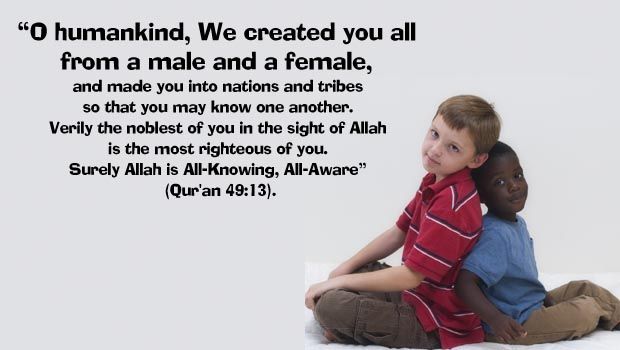
Tafseer of Verse 13 of Surah Al-Hujurat
In this verse, the whole of mankind has been addressed to reform it of the great evil that has always caused disruption in the world, that is, the prejudices due to race, nationality, or other group affiliation. On account of these prejudices, man in every age has generally drawn around himself some closed circles, and regarding those born within those circles, they are seen as his own people, and those outside the accepted group as “others.” These circles have been drawn on the basis of accidental birth and not on rational or moral grounds. Born in a particular family, tribe, or race, or in some particular geographical region, or in a nation having a particular ethnicity or speaking a particular language – these are the chance factors by which the circles are established.
The Creator divided human communities into nations and tribes for that was a natural way of creating cooperation and affection-enhancing social experience
Superiority of One’s Own Group
Discrimination toward “others” involves looking upon one’s own group as superior, and this has resulted in the worst forms of hatred, conflict, and tyranny. New philosophies have been propounded based on such supremacism, new religions invented, new codes of law developed, and new moral principles framed; so much so that nations and empires have made this distinction a permanent way of life. A supremacist mindset gave birth to class distinctions (varnashrama) among the Hindus, according to which superiority of the Brahmins was established and all other human beings came to be regarded as inferior and unclean, and the shudras (the working, servant caste, the lowest of the four varna) were subjugated in the depths of disgrace and degradation. Jewish people regard themselves as the chosen people of God and even in the practice of their religious rites look upon non-Jews as inferior in rank and human worth. It is a tragic irony that the concept of the chosen people and its conflation with superiority as claimed by Jewish people was ruthlessly matched by the supremacist ideology of Nazi Germany.
Another example is in the atrocities that have been committed against people of color in Africa and America on account of the white man’s notion of his own supremacy. The treatment that the Europeans meted out to the indigenous Indian race in America and to the weak nations of Asia and Africa has the same concept underlying it. These ethnocentrists thought they had the right to plunder the wealth of other peoples and take them as their slaves, exterminating them if need be to advance their agenda of exploitation.
Three Cardinal Truths
One can easily see how devastating is the error of fanatic tribal loyalty to one’s own group, unequivocally condemned by the above Qur’anic verse. In just two lines, AIlah has drawn the attention of all mankind to three cardinal truths:
(1) The origin of all human beings is one and the same. The human species has sprung up from one man and one woman. Thus, aII races found in the world today are, in fact, the branches of one initial race that started with one mother and one father. In this process of creation there is no basis whatever for the artificial divisions and distinctions which humans have established based on false notions. One God alone is the Creator of all, having made all people from one and the same substance. it is not the case that some people have been made from some pure and superior substance and some others from an impure and inferior substance.
(2) In spite of being one in origin, it is natural that human beings have been divided into nations and tribes. Obviously alI individuals on the earth could not belong to one and the same family. With the increase of the population, it was inevitable that countless families should arise, and then tribes and nations emerging in time. Similarly, it was inevitable that after settling in different regions of the earth, the various populations developed distinctive genetic traits such as color of skin and facial features due to geography, climate, and reproductive separateness from other groups. Distinct social features such as language also developed among the particular populations. But these natural differences never demanded that distinctions of human value and rank should be established, that one group should claim superiority over others, that skin color or any other accident of birth should bring favor and preference to one and deprivation and abasement to another. The Creator divided human communities into nations and tribes for that was a natural way of creating cooperation and affection-enhancing social experience and a common way of life among them. But due to ignorance, those natural differences among mankind – created by Allah to be a means of recognition, a way to acquire greater understanding and awareness of the human condition – became an expression of ego, overweening pride, and impulse to debase and exploit others. Every kind of injustice and tyranny emerged from that ignorance.
(3) The third cardinal truth proclaimed in verse 49:13 is that the only basis of surpassing merit and excellence is that of piety and moral elevation, yielded by God-consciousness. The substantive thing that makes one person superior to any other is that he or she, with greater God-consciousness, is a devoted avoider of evils, a follower of the way of piety and righteousness. Such an individual, regardless of race or nation, is elevated on account of personal merit. And the one who is bereft of that merit of character is of less stature, whether black or white, male or female, born in the east or the west.
Confirming the Superiority of Taqwa
These same truths that have been stated in this brief verse of the Qur’an, have been explained in greater detail by the Holy Prophet in his addresses and traditions. In the speech that he made on the conquest of Makkah, after going round the Ka’bah, he said: “Thank God Who has removed from you the blemish of ignorance and its arrogance. O people, men are divided into classes: the pious and righteous, who are honorable in the sight of Allah, and the sinful and vicious, who are contemptible in the sight of Allah; whereas aII men are the children of Adam and Adam was created by Allah from clay” (Baihaqi, Tirmidhi).
On the occasion of the Farewell Pilgrimage, in the midst of the Tashriq days (the eleventh, twelfth and thirteenth of Dhu’l-Hijjah, during which the Prophet forbade fasting), the Prophet addressed the people, and said: “O people, be aware: your God is One. No Arab has any superiority over a non-Arab, and no non-Arab any superiority over an Arab, and no white has any superiority over a black, and no black any superiority over a white, except on the basis of taqwa (piety). The most honorable among you in the sight of Allah is he who is the most pious and righteous of you. Say if I have conveyed the Message to you?” And the great congregation of the people responded, saying: “Yes, you have, O Messenger of Allah.” Thereupon the Holy Prophet said: “Then Iet the one who is present convey it to those who are absent” (Baihaqi).
In a hadith he has said: “You are all the children of Adam, and Adam was created from dust. Let the people give up boasting of their ancestors, otherwise they will stand more degraded than a mean insect in the sight of Allah” (Bazaar). In another hadith the Holy Prophet said: “Allah will not inquire about your lineage on the Day of Resurrection. The most honorable in the sight of AIIah is he who is most pious” (Ibn Jarir). In still another hadith he said: “Allah does not see your outward appearances and your possessions, but He sees your hearts and your deeds” (Muslim, lbn Majah).
These teachings cannot remain confined to words only, as Islam aims to establish a universal brotherhood of the believers on such basis, disallowing any distinction on account of color, race, language, or nationality, bestowing on all human beings equal rights. Even the opponents of Islam have had to admit that no match is found in any religion or any ideological system as to the principle of human equality and unity that has been given practical shape in the Muslim society. Islam is the only religion which has united multiple races and communities, scattered to all corners of the earth, into one universal Ummah.
A Misunderstanding in the Case of Marriage
In this connection, a misunderstanding needs to be addressed. In the case of marriage, the importance that Islamic law gives to the likeness of socio-economic status between prospective spouses has been taken by some people to imply that a person of the upper class is better than one who is of a lower socio-economic status, and that marriage between these two is objectionable. But this, in fact, is a wrong idea. According to Islamic law, any Muslim man can marry any Muslim woman, but the success of the matrimonial life depends on maximum harmony and understanding between the spouses as regards characteristics, habits, ways of living, family traditions, and economic and social status. Where there is unusual difference and disparity between the man and the woman in this regard, lifelong companionship will be difficult. That is why Islamic law discourages such marriages; not, as claimed by some, that one of the spouses is elevated and the other lowly.
As we have shown in this article, the true character and merit of a human being is defined by Allah. The standards of distinction that human beings have set up of their own accord and by their own design are not acceptable to or approved by AIIah. It may be that the one who has been regarded as a person of high rank in this world will be declared as the lowest of the low in the final judgment of AIIah; and maybe the one who has been looked upon as a very lowly person here, will attain to a very high rank in the Hereafter. The real importance is not of the honor or dishonor of worldly considerations and its emphasis on ego aggrandizement, but of the honor or dishonor that one will receive from Allah. Therefore, what every human being should be most concerned about is that he should create in himself those genuine qualities and characteristics which make him worthy of honor in the sight of AIlah.
-
Alhamdulillah – A Linguistic Miracle of the Quran
Writing about the literary dimension of the Quran for an audience that may or may not have background in Arabic grammar and rhetoric can be rather challenging. I am going to attempt to navigate around technical lingo as much as possible. Building a basic familiarity with the subject is my goal, not presenting it in a sophisticated fashion.
-
list 1
- Coffee
- Tea
- Milk
-
List 2
- Coffee
- Tea
- Milk
-
list 3
- Coffee
- Tea
- Milk
-
list 4
- Coffee
- Tea
- Milk
The words Alhamdu Lillah are most commonly uttered from Muslim lips around the world. After the basmalah (the tag name used for Bismillahi Alrahmani Alraheemi)¸ it is the first statement mentioned in the opening surah, Al-Fatiha. One way to explore the beauty, precision, and thought-provoking eloquence of the Quran’s words is to explore the very choice of each word. Arabic is a rich language full of terms similar in meaning.
Hamd, commonly translated ‘praise,’ has sister terms like shukr, madh, and thanaa.
Comparing Madh’ Hamd and Thanaa’
Madh: Praise + Mention of noteworthy qualities and actions attributed to someone or something.
Hamd: Praise + Acknowledgement of noteworthy qualities and actions done out of genuine love, veneration, reverence, gratitude, and appreciation.
Madh can be made for the living as well as the non-living, for beings of intellect (humans, angels, and jinn) and animals.
Hamd is exclusively directed at the Living and Intellectual.
Madh is possible before a noble deed or after (as a result of it). It is therefore possible to make Madh of a person who may not have done anything good and no good deed may ever have been attributed towards him/her.
Hamd can only be made after a noble/ praiseworthy contribution of some sort.
Thanaa’ is a more eloquent, more impressive, more flattering than Madh.Use of Hamd Instead of Madh or Thanaa’
We acknowledge Allah as Eternally living
We recognize His attributes and decisions as Hamd worthy
There is an element of sincerity in our praise of Him stemming from love and reverence
We not only praise His incredible being, attributes and works; we appreciate them as favors for which we are gratefulComparing Hamd
with ShukrShukr (thanks) is a consequence of whatever good comes to a person from someone else.
Hamd is a consequence of good whose effects go beyond an individual favor. Shukr is exclusively related with favors and does not include appreciation or praise of any noteworthy attributes. For instance, you do not thank someone for being smart or wise or athletic. Hamd is made because of favors and over noteworthy attributes even if they do not benefit one directly. For example, I say Alhamdu Lillah when I hear that my friend passed his midterms.
Madh is too wide in scope and using it would not be precise enough
Shukr is too narrow in scope and using it would not be comprehensive enough
Hamd as opposed to Shukr and Madh also implies a genuine motiveThe Word Allah in Alhamdulillah
We looked briefly at the choices that would have represented alternatives to the word Hamd in the divinely revealed phrase Alhamdu Lillah. Let us now take a look at the word Allah itself. It is the unique name of our Lord. We learn through His revelation that He possesses and rightfully owns the best Names and Attributes. Why is it most appropriate to use His unique Name in this phrase rather than AlRahman (the exceedingly merciful), Al Khaaliq (the creator), etc.? Simply because any of these names might imply that His Hamd is associated with that particular power or attribute. By using the word Allah, Hamd is acknowledged for Him independent of any of His attributes or for all of them simultaneously!
A Variety of Ways to Make Hamd of Allah
Arabic offers great flexibility in communication. There are varying degrees of emphasis with which a statement can be made. There are multiple options that can be manipulated in sentence structure. Similar statements can be made such as:
“I praise Allah.”
“We praise Allah.”
“Praise Allah!”
All of the above are Jumal Fi’liyyah. This sentence structure necessarily implies the occurrence of an act bound by time. Alhamdu Lillah is Jumlah Ismiyyah, which, for one, is a far more emphatic form of declaration in Classical Arabic by comparison. Secondly, it implies continuity, stability, and permanence. Another unique feature of the Ismiyyah structure is that it communicates a decisive statement.
Jumlah Fi’liyyah exclusively attributes an act to a specific subject. In the suggested alternatives above, ‘I’, ‘we’ and ‘you all’ are the specific subjects, respectively. being a Jumlah Ismiyyah, does not identify the subject that makes it a universal declaration. I, we, you, they, people, animals, rocks, trees, rather all of creation can be understood as the subject! There is another beautiful subtlety here. Whether anyone or anything makes Hamd of Allah or not, is still for Allah!
The Jumlah Fi’liyyah renditions above are limited by time and applicability. The original statement is timeless and has universal applicability. Through the way in which the praise is made is kept unspecified while in the Fi’liyyah format, the praise would be by the tongue.
In Jumlah Fi’liyyah, there is the possibility of doing an act for an object that is not worthy of it. For instance, ‘I paid him’. It may be that ‘he’ did not deserve to get paid. In Jumlah Ismiyyah, the necessary implication that this praise is actually rightfully placed is naturally implied, ALHAMDULILLAH!
In saying we are also acknowledging that Hamd is the property of Allah while this is not implied in alternative fi’liyyah renditions. When using the command form ’Praise Allah’ instead of Alhamdulillah, there are a number of shortcomings. Firstly, there is the sense that this praise is being asked of the audience. By comparison, declares the existence of Hamd without dependence on an audience responding to an imperative. The imperative may also imply a response that may or may not be voluntary while Alhamdulillah is an observation of the voluntary praise done by all forms of creation.
Why the ‘Al’ in Alhamdu?
Alhamdu is definite or proper as I like to call it in my intro course. As Dr. Fadel puts it in his article, the Al serves the meaning,
The distinguished, universally acknowledged form of Hamd known among you belongs particularly to Allah. The ‘Al’ also serves the implication of ‘istighraq’, a kind of absolute totality (All Hamd is Allah’s). None of these enhancements would come forth in the indefinite version Hamdun.Why Not Inna Alhamda Lillah?
Have you ever heard a khateeb say Innal Hamda Lillahi? The word Inna means ‘certainly’ and is used to emphasize a statement. What benefit would there be in not emphasizing Alhamdulillah in the Fatiha? You see, Arabic sentences are divided and categorized from different angles and perspectives. One of these angles is Jumlah Khabriyyah vs. Jumlah Insha ‘iyyah. What this categorization basically means is that statements in the language are either declarative (which can be judged as either true or false) or they are statements communicating an emotion. The latter are a form of subjective communications that do not necessarily communicate facts, but rather serve to vocalize feelings and sentiments. When a statement has Inna, it can only serve to be informative, and the emotional dimension of it is removed. By not stating the Inna, the phrase retains informative and emotional potential depending on the context. Think of it this way: If a bus whizzes by you missing you by half an inch, and you say ‘Alhamdulillah’, you are not really making a statement of fact, but rather vocalizing your internal feelings. The emotionally charged dimension of Alhamdulillah is kept intact by not using the INNA.What About Lillahilhamdu?
In Hajj season, we say Allahu Akbar wa Lillahi Alhamdu! We reverse Alhamdu lillah with Lillahi Alhamdu. This is a form of Taqdeem in Arabic grammar and serves to color a sentence with a shade of exclusivity that ‘Hamd belongs only to Allah’. It is appropriate particularly on the occasion of Hajj because that blessed house was misused for Shirk, so in response, a strong denial of it is implied even when we say Lillahi Alhamdu. This Taqdeem also serves the function of Izaalat Alshak ‘removing doubt’. Why not say it this way in the Fatiha then? The context of the Fatiha is not one that demands the removal of doubt. Also, exclusivity exists in response to a challenge to the original statement. If somebody is attributing Hamd to Allah and other than Him, he or she should be taught that Hamd is only for Allah. The Fatiha is not a response in debate with those who falsely associate with Allah. But, we do find LillahilHamdu in the Quran. Interestingly, it appears in Al Surah Jathiah, verse 36.
The context, unlike Fatiha, is one where disbelievers credit life and death to other than Allah. Here, the exclusive, emphatic mode of declaration is more befitting, so we see Lillahilhamdu. The Fatiha declares certain universal truths that are completely in line with the embedded fitrah (natural pre-disposition) that you and I are born with. In our fitrah, there is no competition between belief and disbelief, tawheed and shirk, iman and kufr. Rather, our faith is an unchallenged manifest truth seeded deep within our conscience. In Fatiha, this truth is therefore uttered in a fashion (Alhamdulillah and not Lillahilhamdu ) that does not even indicate the existence of an alternate point of view because within our genuine conscience, there isn’t one.