Tag: ICNA
-
Safeguarding Faith Against Doubt
“Mankind will need some form of religion until there is a cure for death.” This bold statement spoken by a sociology lecturer rings true in many ways. After all, we humans didn’t create ourselves, nor did we create the world; yet we are part of a circle of life with many unknowns. The great questions intrigue human beings like what happens to loved ones when they pass away?—followed by the jolting reality that we too must one day depart into that same mysterious unseen world. What will become of us? Will we merely cease to exist after taking our last breath, or will there be an afterlife where we’ll meet our Creator, face punishment or reward, and have all our earthly and celestial questions finally answered? Religion, in fact, is a blessing for the “faithful” because it provides answers to these perplexing questions about the “unseen” world.
Our faith is not stagnant, but constantly in motion, either growing or diminishing.
Individuals from all walks of life elect to become followers of a chosen faith — and as such, a believer’s life is interweaved with feelings of satisfaction and, at times, doubt stemming from internal and/or external sources. When considering the various dimensions of doubt, it would first be helpful to examine the profound concept of faith itself, which in Arabic is “iman.”
What is Iman?
Put simply, iman is belief or faith. The Prophet (pbuh) said that iman is “to believe in Allah, His angels, His books, His messengers, the Last Day, and divine destiny, both the good and the evil thereof” (Muslim). The strength and vitality of one’s iman, or faith, is a testimony to his or her commitment to the religion of Islam. Our faith is not stagnant, but constantly in motion, either growing or diminishing.
There is also likely no greater loss for the Muslim than the loss of faith — because it is faith which is the gate keeper for ultimate success, in this life and the life to come.
As to one’s level of iman, this can perhaps be understood by asking the following: At any given moment, how much faith do you have that Allah (SWT) is aware of and judging all that you do, and that upon your death you will be questioned and either rewarded with the bliss of Jannah or the punishment of Hell?
The greater one’s iman, the easier it is to perform obligatory acts of worship and thus earn a place in Jannah. Iman, which inclines a person to righteous actions and to avoidance of sin, is an enduring and profound human distinction. Other personal characteristics such as wealth, talent, beauty, intelligence, etc., are insignificant in comparison to the critical issue of faith. There is also likely no greater loss for the Muslim than the loss of faith — because it is faith which is the gate keeper for ultimate success, in this life and the life to come.
Doubting Faith
Doubting one’s faith, questioning the authenticity of revelation, or having uncertainty about the existence of realms beyond the material one, have been a part of the human condition since the earliest days of religious discourse. Some doubts originate with the arguments or critiques made by followers of other religions or by non-believers. Other doubts are the manifestation of the normal internal struggles faced by all believers in varying degrees. That struggle might be waking up before Fajr to offer the Qiyam al-Layl prayer or, for others, offering a single prayer in a week’s time may be the struggle. Another individual may be entertaining doubts about the Quran, while another has moved to the point that he or she is considering leaving Islam all together. Struggles and doubts such as these have been expressed over social media in recent times and it will be helpful to present an Islamic response.
Unbelief Among Academics
I recall the first day of my university philosophy class; my professor proclaimed that he was an atheist and the first class assignment was to give our best argument for the existence of God. None of our arguments, however, proved the least bit interesting, let alone, convincing, to him. Along the same lines, one of my relatives had an unsettling experience during her first sociology class — the professor looked straight at her as he told the class he disliked anyone “who thinks they can find all of life’s answers in a holy book.” She felt that he was singling her out and it understandably made her feel very uneasy. She promptly dropped his class and enrolled in the same class with another professor.
Colleges and universities are generally beneficial institutions of higher learning where ideas are exchanged freely and academic knowledge is disseminated. However, students should be prepared for the possibility that his or her humanities or social science professors may have an agenda with the intention of “reeducating” religious-minded students. On his website, edwardfeser.blogspot.com, Edward Feser posts a passage from the book “University and Truth” written by philosophy professor, Richard Rorty, concerning Rorty’s views of the necessity of “reeducating” university students. “…..It is a concept which I, like most Americans who teach humanities or social science in colleges and universities, invoke when we try to arrange things so that students who enter as bigoted, homophobic, religious fundamentalists will leave college with views more like our own…. we do our best to convince these students of the benefits of secularization….we teachers do our best to be Socratic, to get our job of re-education, secularization, and liberalization done by conversational exchange… So we are going to go right on trying …to strip your fundamentalist religious community of dignity, trying to make your views seem silly rather than discussable. We are not so inclusivist as to tolerate intolerance such as yours…”
In another article entitled, “How religious are American professors?” published in 2010 on the website whyevolutionistrue.wordpress.com, a study published in Sociology of Religion by Neil Gross, found that the more “elite” the university, the more “pervasive” was unbelief. At elite doctoral universities, 36.5 percent of all professors are agnostics or atheists. The area of study also made a difference with 29.3 percent of humanities professors being atheist, 32.6 percent for computer science and engineering, 39.4 percent for social sciences; and 60 percent of biologists and psychologists were reported to be agnostics or atheists.
Claims that the Quran is Man-made
It should come as no surprise that some humanities professors would have a problem with organized religion and holy books like the Quran, since a good number of them are atheists. One of the most common attacks on the Quran is the assertion that it is man-made, and yet one of the most significant miracles of the Quran is that it was revealed to Prophet Muhammad (pbuh) who was illiterate. So how is it that an illiterate man could produce such a profound book of wisdom? Allah (SWT) answers these detractors in the Quran: “And if you are in doubt as to what We have revealed from time to time to Our servant, then produce a surah like thereunto; and call your witnesses or helpers besides Allah, if your [doubts] are true. But if you cannot – and of a surety you cannot — then fear the Fire whose fuel is men and stones which is prepared for those who reject Faith” (Quran 2:23-24). If the Quran were man-made, it stands to reason that it would then be subject to error. However, Allah (SWT) rejects such fallacies: “Haven’t the unbelievers considered if this was from other than Allah, they would find within it many contradictions?” (Quran 4:82).
Claims that the Quran Was Copied from the Bible
Stating that the Quran is copied from the Bible must be a claim by an individual who hasn’t studied or even read the Quran and/or the Bible because the two are dramatically different. Both books tell the stories about prophets from God; and understandably so, as the Quran and the original books revealed to Moses and Jesus (peace be upon them both), come from the same divine source. Allah (SWT) says: “And this Quran is not such as could ever be produced by other than Allah, but it is a confirmation of [the revelation] which was before it, and a full explanation of the [former] scripture – wherein there is no doubt – from the Lord of the worlds” (Quran 10: 37).
There are, in fact, many differences between the Quran and the Bible. Muslims believe that over time the original revelations to the previous faith communities were changed through error, translation, or other means. The Quran stands as a criterion by which to remedy those errors. For example, in the Bible, Eve is said to have tempted Adam to eat from the tree, while in the Quranic account, Shaytan tempted both Adam and Eve together to eat from the tree. The Bible also relays that Adam and Eve came to the earth in a state of sin and according to the Christian doctrine of Original Sin, the blood of Jesus (pbuh) is necessary to purify the sins of man. However, in the Islamic account, both Adam and Eve sought and were granted forgiveness, and thus from the Muslim perspective, there is no original sin, and the blood and death of Christ as a sacrifice of atonement for the sins of man is a false doctrine. Finally, the Quran is very clear that Jesus Christ, the son of Mary, was a prophet and not the son of God. These are all significant differences, demonstrating that the Quran is not copied from the Bible.
The Truth, Guidance, and Miracles of the Quran
Allah (SWT) declares in the Quran, “Verily, We have revealed the Book for the people in truth. So whoever accepts the guidance benefits his own soul; and whoever goes astray, he injures his own soul. And you [Muhammad] are not a manager over them” (Quran: 39: 41). One of the greatest treasures of this world is the Quran, and one needs to read it with sincerity before understanding or guidance can grow and flourish. If one is looking sincerely for “proof” of the validity of the Quran, they will find it within its miraculous chapters.
There are many miracles in the Quran and instances where its verses confirm recent scientific findings. One such example is the detailed description of the stages of embryonic development in the womb which was later confirmed when high-powered microscopes were invented centuries later: “Man We did create from a quintessence of clay; then We placed him as a drop in a place of rest, firmly fixed; then We made the drop into a clot of congealed blood; then of that clot We made a lump; then We made out of that lump bones and clothed the bones with flesh; then We developed out of it another creature. So blessed be Allah, the best to create!” (Quran 23:12-14).
The Brief Illustrated Guide to Understanding Islam, available at Islam-guide.com, notes that in 1981, during the Seventh Medical Conference in Dammam, Saudi Arabia, a leading scientist in the field of anatomy and embryology, Professor Emeritus Keith L. Moore, stated the following about the Quran’s detailed description of embryonic development: “It has been a great pleasure for me to help clarify statements in the Quran about human development. It is clear to me that these statements must have come to Muhammad from God or Allah, because almost all of this knowledge was not discovered until many centuries later. This proves to me that Muhammad must have been a messenger of God or Allah.”
There are many other examples found in the Quran of verses speaking of natural phenomena which only in the modern era were confirmed by science, including the water cycle, the geological features of mountains, the origin of the universe, and much more. A detailed examination of these and many other examples of Quranic statements predating scientific understanding can be found at Islam-guide.com, and miraclesofthequran.com. These miracles show that the Quran and science are harmonious.
The Harmony of Belief and Science
In reviewing Islamic history, one finds that devout Muslims have made great advancements in science over the centuries. With their full acknowledgement that all discoveries stem from divine knowledge, Muslims have made unprecedented contributions to civilization in the areas of geography, mathematics, medicine, and astronomy, to name a few. In his article, “The Limitations of Science and the Teachings of Science from the Islamic Perspective,” available on i-epistemology.net, Zaghloul R. El Nejjar mentions that the Latin root for science is “scientia” which means knowledge. This, of course, would include knowledge which could be obtained from divine scriptures. He states: “So science is defined as all the knowledge men have achieved in different places and at all times, arranged according to their subject-matter. This includes knowledge gained through Divine revelation; or by the way of human thinking and creative intellect, as well as through human legacy and tradition in these two areas. The prevailing direction, however, tends to limit the term Science to natural and experimental studies of all that is within reach of the senses and intellect in this universe (i.e. matter, energy, living beings and natural phenomena).” He argues that to limit science to mere observations made in the natural world is to limit human knowledge and reject divine wisdom
It is this “secularization of science” that Sohaib Baig, in his article, “Science or Scientism,” available at www.albalagh.net, blames for the devastating destruction of the planet. “In essence, the current environmental disaster is a very real disaster, and is a direct consequence of rejecting God’s authority and relevance over mankind…” There is a legitimate argument to be made that science and religion must find harmony through acknowledgement of the supremacy of divine and natural law. However, to continue a secularist approach in science is arguably destructive to both man and the natural world. Parting from Islam is not only destructive to science, but also to the individual.
Replace Islam with What?
For those Muslims who question and doubt their faith — what lifestyle instead of the spiritual and protective ways of Islam do they seek? Would they put all their faith in science with its many limitations and “missing links,” or indulge in behaviors prompted by the lower self which seeks pleasure with no regard to consequences? Sexually transmitted diseases, pregnancy out of wedlock, addiction to drugs or alcohol, depression resulting from a lack of meaning and purpose in life – these are all real and catastrophic to individuals, families, and society. Islam was sent to mankind to uplift us, enlighten us, bless us, and prevent us from harming ourselves and others. Choosing to give up the way of Islam is a decision with profound consequences. Allah (SWT) says: “Those who sell God’s covenant and their faith for a small price shall have no share the Hereafter” (Quran, 3:77). Growing nearer to Allah (SWT) and earning our place in the wondrous and blissful world of Jannah is the ultimate goal of this world, and to find success one needs to develop and maintain a strong sense of iman.
Safeguarding Iman Against Doubt
Everything in life needs nourishment, and iman, or faith, is no different. Our iman is always in motion, growing stronger or decreasing, and this movement is in direct response to the heedful actions we take, or neglect to take, to maintain a close relationship with Allah. He (SWT) says: “This is the Book; in it is guidance sure, without doubt, to those who fear Allah; who believe in the unseen, are steadfast in prayer, and spend out of what We Have provided for them” (Quran 2: 2-3). There are many actions we can take to safeguard our iman. Below are some examples.
Seek Refuge in Allah Against the Accursed Shaytan: The first advice for individuals who are doubting their faith is to seek refuge in Allah (SWT) from Shaitan whose goal has always been to bring about the destruction of man. Shaytan said: “…I will lie in wait for them on Thy straight way: Then will I assault them from before them and behind them, from their right and their left: Nor will You find, in most of them, gratitude [for Thy mercies]” (Quran 7:16-17).
Acquire an Armor of Knowledge
One should first aspire to study and understand the Quran, then the hadith and sunnah of Prophet Muhammad (pbuh). Knowledge is strength and power, and Islam is built on a foundation of learning and growing. The first words of the Quran that were revealed tell us, “Read in the name of your Lord, and Cherisher…” (Quran 96:1) The Prophet (pbuh) has said, “Acquire knowledge: it enables its possessor to distinguish right from wrong, it lights the way to heaven; it is our friend in the desert, our society in solitude, our companion when friendless. It guides us to happiness; it sustains us in misery; it is an ornament among friends, and an armor against enemies.”
Continually Polish the Heart
Every Muslim is susceptible to suffering from a decrease in faith if their guard is down. But as Prophet Muhammad (pbuh) teaches, it is mindfulness of Allah which can bring about success. He says: “There is a polish for everything that takes away rust; and the polish for the heart is the remembrance of Allah” (Bukhari). We can polish our hearts with such endeavors as attending the blessed Jumah prayer, offering our five daily prayers on time, making regular dua throughout the day, and through reading and memorizing the Quran.
Keep Good Company
The people we spend time with have a big impact on our thoughts, perceptions, and behavior. It is important to choose to spend time with righteous Muslims at every opportunity.
Prophet Muhammad (pbuh) said: “The example of a good companion and a bad companion is like that of the seller of musk and the one who blows the blacksmith’s bellows. So as for the seller of musk, then either he will grant you some, or you buy some from him, or at least you enjoy a pleasant smell from him. As for the one who blows the blacksmith’s bellows, then either he will burn your clothes or you will get an offensive smell from him.” Thus, for Muslim college students, it can be very beneficial to join Muslim student groups and have preferable companionship, gain blessings by giving dawah to non-Muslims, and be spiritually uplifted through positive peer encouragement. All of these undertakings can instill in the individual a stronger foundation of iman.
Strive for Certainty
Once one has sincerely studied Islam with an open heart, uniting their intellect and heart together in confirmation of the truth and divine wisdom they have found, they then have the opportunity to taste the “sweetness” of iman. Enjoying this blissful feeling of being under the umbrella of truth, one reaches a deep-rooted level of iman and can aspire to feel Allah’s (SWT) “guiding light” of yakeen (certainty). At this level, it becomes difficult for one to be swayed by the various distractions or “glitter” of this world, and the deep roots of faith become strong and enduring.
“Allah is the light of the heavens and the earth. The example of His light is like a niche within which is a lamp; the lamp is within glass, the glass as if it were a brilliant star lit from a blessed olive tree, neither of the east nor of the west, whose oil would almost glow even if untouched by fire. Light upon light. Allah guides to His light whom He wills. And Allah sets forth parables to make people understand, and Allah knows all things” (Quran 24:35).
-
100 Commandments and Doctrines from the Quran
- Do not be rude in speech (3:159)
- Restrain anger (3:134)
- Be good to others (4:36)
- Do not be arrogant (7:13)
- Forgive others for their mistakes (7:199)
- Speak to people mildly (20:44)
- Be moderate in your bearing and the volume of your speech (31:19)
- Do not ridicule others (49:11)
- Be dutiful to parents (17:23)
- Do not say a word of disrespect to parents (17:23)
- Do not enter parents’ private room without asking permission (24:58)
- Commit to writing any transaction involving the taking or giving of loans (2:282)
- Do not follow anyone blindly (2:170)
- Grant more time to repay if the debtor is in hard times (2:280)
- Don’t be involved with usury or interest (2:275)
- Do not engage in bribery (2:188)
- Do not break any promise (2:177)
- Keep and fulfil all trusts (2:283)
- Do not mix the truth with falsehood (2:42)
- Judge with justice between people (4:58)
- Stand out firmly for justice (4:135)
- Wealth of the dead should be distributed among his family members (4:7)
- Women have the right of inheritance (4:7)
- Do not take for yourself the property of orphans (4:10)
- Protect orphans (2:220)
- Do not consume one another’s wealth unjustly (4:29)
- Facilitate peace between those in conflict (49:9)
- Avoid being suspicious (49:12)
- Spend wealth in charity (57:7)
- Encourage feeding of the poor (107:3)
- Seek out the needy and help them (2:273)
- Do not spend money extravagantly (17:29)
- Do not invalidate charity by bragging about your generosity (2:264)
- Honor guests (51:26)
- Enjoin virtue to others only after practicing it yourself (2:44)
- Do not engage in or spread corruption (2:60)
- Do not prevent people from going to houses of worship (2:114)
- Never engage in fighting as an aggressor but only in defense (2:190)
- Do not engage in compulsion regarding religion (2:256)
- Believe in all prophets (2:285)
- Do not have sexual intercourse during the menstrual period (2:222)
- Do not commit adultery (17:32)
- Choose leaders based on their merit (2:247)
- God does not burden a person beyond his capacity; nor should we (2:286)
- Do not become divided (3:103)
- Think deeply about the wonders of nature and the creation of this universe (3:191)
- Men and women have equal rewards for their deeds (3:195)
- Do not marry those related to you by blood (4:23)
- The man is the protector and supporter of the family (4:34)
- Do not be miserly (4:37)
- Do not envy others (4:54)
- Do not support or be an advocate for those who betray their trusts (4:105)
- Support one another in virtue and piety, not in sin or enmity (5:2)
- Be just and do not let hatred swerve you from justice (5:8)
- Do not consume dead animals, the blood of animals, or pork (5:3)
- Avoid intoxicants and alcohol (5:90)
- Do not gamble (5:90)
- Do not insult other people’s deities (6:108)
- Be honest; don’t cheat in any of your dealings (6:152)
- Eat and drink but be not excessive (7:31)
- Wear good clothing during prayer times (7:31)
- Protect and help those who seek protection (9:6)
- Strive for purity (9:108)
- Never give up hope of Allah’s Mercy (12:87)
- Know that Allah forgives a wrong done out of ignorance if the person repents and corrects himself (16:119)
- Inviting others to the way of God should be done with wisdom and graciousness (16:125)
- No one can bear another person’s sins (17:15)
- Do not kill your children for fear of poverty (17:31)
- Avoid vain talk (23:3)
- Respect other people’s privacy, especially in their own homes (24:27)
- Know that God provides security and peace to those who worship Him and act virtuously (24:55)
- Be modest and humble (25:63)
- Strive for reward in the Hereafter but do not neglect your affairs in this world (28:77)
- Invoke not any other deity along with God (28:88)
- Do not engage in homosexuality (29:29)
- Enjoin the right and forbid the wrong (31:17)
- Women should not display or flaunt their beauty and charms (33:33)
- God forgives all sins when the sinner repents and turns to Him (39:53)
- Repel evil by something that is better (41:34)
- Decide affairs by consultation (42:38)
- Know that there should be no monasticism in religion (57:27)
- Those who have knowledge will be given a higher rank by God (58:11)
- Treat non-Muslims in a kind and fair manner (60:8)
- Stay away from greed and stinginess (64:16)
- Do not ignore or push away the needy (93:10)
- Pardon and forgive the mistakes of others (3:135)
- Establish prayer and give in charity (31:4)
- Know that the bounty of God is better than anything man can amass or hoard (10:58)
- God puts love and affection between the hearts of those who believe in Him (8:63)
- Those who purify their souls succeed, and those who corrupt their souls fail (91:10)
- Those who believe in God find satisfaction in remembering Him (13:28)
- Those who believe and do good are given joy and peace of mind (13:29)
- Enjoin patience and compassion (90:17)
- Know that God gave humans hearing, sight, intelligence, and affections so that they might be grateful (16:78)
- Compete with one another in doing good (21:90)
- Know that God created the universe with meaning and purpose (3:191)
- Guard your modesty (23:5)
- Know that being just is next to piety (5:8)
- Fight when necessary to defend yourselves but do not aggress (2:190)
100. Know that it is only righteousness that makes a person noble (49:13)
-
Taqwa Must Enter the Heart
The word “taqwa” comes from the Arabic root letters wa, qaf, and ya. Its meaning is broad, signifying consciousness of Allah (SWT), love and fear of Him, and righteousness. In Quran, Allah (SWT) uses the word taqwa 151 times. We read these verses and get in-depth understanding of what this word really means as we ponder its profound significance. We realize that taqwa is a shield which prevents us from doing immoral acts. We internalize that Allah (SWT) sees and hears all things, and this awareness keeps us away from sins. One time, some companions asked the Prophet (peace be upon him) about taqwa. He tapped his fingers over his chest and said that “taqwa is here.” He repeated that three times. This indicates that taqwa involves more than an intellectual grasp of the divine reality. Consciousness of Allah (SWT) must enter the heart and inform one’s character, so that love and fear of Him bears its fruit in a person’s actions.
A farmer knows the secrets of getting a good harvest. He chooses a good location with plenty of sunlight, cleans the ground from weeds, ensures that the soil is fertile, plants good quality seeds, and gives the right amount of water. He continues to work hard for a good harvest. In the same way, if we want to cultivate taqwa in our hearts, then we have to locate ourselves well — surrounding ourselves with good people, sound ideas, and wholesome pleasures.
Once Umar (r) queried Kaab (r) about taqwa. Kaab (r) then asked Umar (r) if he had ever walked through a thorny path. Umar (r) said that he had done that many times. Kaab (r) then asked Umar (r) to describe how he moves amongst the thorns. Umar (r) responded that he walks carefully with all his clothes collected close to his body so they are not ripped by the thorns. Kaab (r) said that this is the answer to his question about taqwa. Indeed, this world is a place surrounded by the thorns of temptations, provocations, deceptions, and pretenses. We must carefully tread this life’s journey to protect ourselves from the traps of Shaitaan, our own base desires, and worldly snares. If we are successful, then we are a “muttaqi” – a person with taqwa.
How Can We Attain to Taqwa?
In Surah al-Baqarah, Allah (SWT) says, “O mankind! Worship your Lord, Who has created you and those before you, so that you may become righteous [attain taqwa]” (2:21). This verse indicates that if we really want to cultivate taqwa in our hearts, we can do so through ibadaat, our acts of worship, like fasting, daily prayers, charity, and other acts. As we increase the sincerity and devotion of our ibadaat, taqwa increases – we become more conscious of Allah (SWT), our love and fear of Him permeates our daily lives, and our behavior reflects our feelings of closeness to Him.
The Benefits of Taqwa
We should keep in mind the full meaning of taqwa when we read Quranic verses. So when the translation of “ittaqullah” is rendered as “be conscious of Allah” or “fear Allah” or “be righteous,” the original in Arabic encompasses all the meanings.
Taqwa brings about the following benefits:
- Allah will facilitate our self-reform and forgive our sins: “O you who believe! Be conscious of Allah (have taqwa), and speak words directed to what is right. He will [then] make your conduct whole and sound and forgive you your sins: he that obeys Allah and His Messenger, has already attained the highest achievement” (33:70-71).
- We will attain to an honored status: “Verily the most honored of you in the sight of Allah is [he who is] the most righteous of you [has the most taqwa]. And Allah has full knowledge and is well acquainted [with all things]” (49:13). The criterion for high ranking in the sight of Allah (SWT) is taqwa, not appearance, wealth, status, or other worldly attribute.
- We will find ease in affairs, have bad deeds pardoned, and our reward magnified: “… and for those who fear Allah [have taqwa], He will make their path easy… And if anyone fears Allah, He will remove his ills from him, and will enlarge His reward” (65:4-5).
- We will be able to discern right from wrong and have our sins forgiven: “O you who believe! If you fear Allah, He will grant you a criterion [to distinguish between right and wrong], and remove from you all evil and forgive you” (8:29).
All the above blessings are available to us in this world and will result, insha’Allah, in earning the pleasure of Allah (SWT) and gaining us entry into Jannah with His mercy. Ameen.
Concluding Remarks
A farmer knows the secrets of getting a good harvest. He chooses a good location with plenty of sunlight, cleans the ground from weeds, ensures that the soil is fertile, plants good quality seeds, and gives the right amount of water. He continues to work hard for a good harvest. In the same way, if we want to cultivate taqwa in our hearts, then we have to locate ourselves well — surrounding ourselves with good people, sound ideas, and wholesome pleasures. Then we plants seeds of taqwa with devotion, nourishing ourselves with the light of truth. We also have to regularly clean our minds and hearts from negative thoughts and feelings, and enrich and soften the loam of our souls with our tears.
There are countless ways to plant seeds of taqwa: a kind word, a charitable act, support of social justice, turning away from temptation and refraining from wrongdoing, a focused and sincere prayer, and so on. And remembering Allah (SWT) is a continuous dedication to producing a good harvest in our souls. The best time to do this is at tahajjud time when others are sleeping. We leave the comfort of our beds to remember Allah (SWT), to make dua to Him for qulb-e-saleem (a sound heart) and for nafs-ul-mutmainnah (a tranquil soul).
Insha’Allah, He will accept our duas and give us the taufiq (good fortune) to remain conscious of Him always, to love and fear Him so that we follow His commands and the wisdom of His guidance, and to be of those who attain righteousness. For then, taqwa has entered the heart. Ameen.
-
Quran as a Psychological Healing
As he gathered his thoughts, he wondered if he could ever recover from his sense of loss. The death of a close friend so unexpectedly had left him feeling so devastated that he could not muster up the strength to stand up straight. This was his friend who had been there for him, caring and supportive, through graduation, through the death of his father, through his marriage and the birth of his beloved child. And now this wonderful friend had left this world. How could he get through all of the pain and become whole again? He somehow rose to his feet and began walking down the hallway to his study. Books were something he turned to when he needed some kind of inspiration or solace. This was one of those times. He searched the shelves until his eyes fell on the Holy Quran, a copy his friend had given him when his father had passed. It served as a comfort then and must serve as one now. He picked it up and sank into his armchair, allowing the tears to flow even before he opened to the first chapter, “The Opening.” He trusted that the Quran would open his heart, sooth his emotions, and bring a light unto his mind. He would sit and read and reflect, soaking in all the wisdom the Lord from on high had to offer that would heal his broken heart.
When an individual is undergoing a harsh trial, one suggestion psychologists give to him/her is to focus on gratitude. This does not mean dismissing or denying the feelings of sadness, anger, etc., but to experience gratitude as shelter in a violent storm.
As humans, we will all endure difficulties in life for this is the nature of the life of this world. Allah (SWT) has created us to test us, and some of those tests that we encounter may be extremely painful. There are many resources for us to turn to in these times of sadness, loss, hardship, and struggle such as family members, friends, imams, therapists, support groups, etc. But one essential resource is the Holy Quran itself. Allah (SWT) says about the Quran, “And We send down of the Quran that which is a healing and a mercy to those who believe…” (Surah Al-Israa, 17:82). He (SWT) describes the Quran as a healing, something that soothes hearts and souls. We must believe in its ability to heal us when we are going through trials, particularly the psychological anguish that comes along with these tribulations. The sadness, anger, guilt, regret, and other negative emotions that arise within us can be soothed by the recitation of, and reflection on, the words of Allah (SWT).
When an individual is undergoing a harsh trial, one suggestion psychologists give to him/her is to focus on gratitude. This does not mean dismissing or denying the feelings of sadness, anger, etc., but to experience gratitude as shelter in a violent storm. The storm is still there and the wind is howling, but gratitude provides a safe haven, a place to momentarily rest and breathe deeply and endure with patience. The Quran contains numerous passages on gratitude as Allah (SWT) reminds the believers of what they have been given from Him: “And whatever of blessings and good things you have, it is from Allah” (Surah al-Nahl, 16:53). This verse, among many, reminds us of how blessed we are even in the darkest of times. It is a reminder of the One who has given us all that we have, a reminder to thank Him and turn to Him for solace.
Another characteristic we learn from the Quran that can help heal hurting hearts is sabr, which is patience and perseverance. When one is going through a trial, the practice of sabr ensures that the one who is suffering is able to endure the trial and remain firm throughout. Sabr is a beautiful quality that Allah (SWT) describes in the Quran as a feature of the people who earn Jannah. If one struggles through a hardship and endures patiently, he/she will be rewarded greatly. Even knowing this fact brings comfort to the heart in harsh times. The promise of Allah (SWT) is true, and trusting in, and depending on that promise is often the strength that pushes a person forward despite being in distress. The Quran says, “Be sure we shall test you with something of fear and hunger, some loss in goods or lives or the fruits [of your toil], but give good news to those with sabr who, when afflicted with calamity, say, ‘Truly, to Allah we belong and truly, to Him we shall return.’ Those are the ones upon whom are blessings from their Lord, and mercy. And it is they who are the guided ones” (Surah al-Baqarah, 2:157). This promise of the blessings and mercy of Allah (SWT) is a beautiful one that can be remembered in challenging times for support and consolation. The Messenger of Allah (pbuh) said, “Strange is the affair of the believer; verily, all his affairs are good for him. If something pleasing befalls him, he thanks [Allah] and it becomes better for him. And if something harmful befalls him, he is patient and it becomes better for him. And this is only for the believer.”
Recitation and reflection on the words of Allah bring solace and healing. Gratitude is a safe haven because even in difficult times there are moments in which to focus on the many blessings to be grateful for. Sabr (patience and perseverance) is a virtue to practice at all times but especially when we are struggling with the tests of this life because the promise of Allah (SWT) is true: that the one who practices sabr in hard times surely deserves Paradise. The very thought of Paradise can be a solace for us in difficulty. We can close our eyes, imagine a place in Jannah that we are longing for, a place of complete ease and comfort and joy, and strive to earn that reward. Allah (SWT) tells us, “Now no person knows what delights of the eye await them [in the life to come] – as a reward for all that they did” (Surah as-Sajdah, 32:17). In harsh circumstances, if we remind ourselves of this beautiful place, it will provide a comfort to our hearts that will carry us through the pain towards a place of contentment.
-
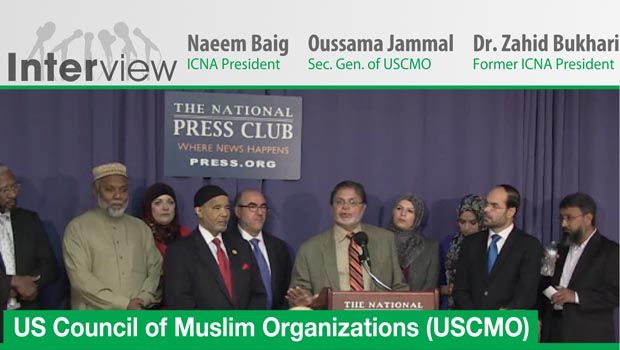
Interview: US Council of Muslim Organizations (USCMO)
What was the driving force, situation, or event that triggered the idea and brought about the formation of the US Council of Muslim Organizations (USCMO)?
Naeem Baig and Dr. Zahid Bukhari: There were essentially two driving forces that triggered this idea of a unified organization. The first trigger was due to the resulting situation after the 9/11 tragedy and consequential backlash the Muslim American community experienced, and the media’s harshness and biased coverage following these events. Additionally, recent terrorist events and the anti-Muslim rhetoric from the Republican presidential candidates fanned further the flames across the country and even beyond. It was clear then that no one individual will be able to respond to this effectively and that we needed an organization to represent the community in a unified manner, to be able to present our concerns, priorities, and response to this Islamophobia that was picking up pace.
The other driving force was ICNA’s continuous efforts, since the mid-90s, to find a platform for uniting the Islamic organizations under one umbrella for the purpose of taking action on issues common to all American Muslims, such as fighting Islamophobia. The Islamic Shura Council was an example of this effort but it did not gain traction. It took 4 to 5 years of continuous meetings and discussions before we were successful and able to announce the USCMO initiative in late 2014.
It was when I (Dr. Bukhari) came across an article while working on a project at Georgetown University that this idea struck me most prominently. It was a project funded by two charitable trusts where representatives were asked to perform a study on their own respective communities, American Muslims being one of these communities. John W. Foster, Secretary of State under former president Dwight D. Eisenhower, wrote an article advising the Jewish communities of that time to unify themselves to help enhance their voice and presence and help address and resolve their concerns. This advice resonated with me with regards to the Muslim communities in America dealing with the racism and hateful rhetoric that is being spewed around us.
This organization can help us to redefine our struggles and help in the cause to bring back America to its true values.
What is unique about this organization’s mission and purpose that sets it apart from the rest of the Muslim/Islamic coalitions that exist in the United States?
Naeem Baig: This organization is unique in the sense it is a national coalition that is not specific to one city or regional area and as a result brings more strength and potential impact to our common causes. It is also unique because it is bringing together professionals from all areas that contribute their diverse skills to enhance the organization’s capacities to complete tasks and accomplish goals. Our next phase includes opening membership to local and regional organizations, Islamic centers and mosques, from various parts of the country.
As President of ICNA, an organization that already unites Muslims across North America, and with you already shouldering the responsibility of leading this organization, what motivated you to help build this new USCMO coalition?
Naeem Baig: ICNA has always been part of this struggle, for many years now, so this new coalition was already implanted in the roots of our planning and organizing. We truly need to work together as this is a commandment from Allah (SWT) in Surah Al-Imran, reminding us, “And hold fast to the rope of Allah together…” We are one body that has different parts and functions, striving together as an Ummah. We are in earnest need of this endeavor so I strongly believe in engaging in this type of community work.
We understand that one of the major campaigns that this organization has undertaken is the “One America” campaign. Please describe this initiative including what the motivation was for this campaign and what it hopes to accomplish?
Naeem Baig: In our USCMO National Leadership Summit held in December, where we had approximately 120 Muslim leaders from all over the country, this was one of the ideas brought forth after a series of discussions and debates. This initiative is to motivate Muslim Americans as well as other minorities such as Latinos, African Americans, etc. to register themselves to vote by setting up voter registration booths at mosques and other community venues to reach as many people as possible. After seeing the current racist narratives out there against Muslims and minorities, especially from the Republican presidential candidates, we need to counter this with a positive force. No one should be trying to isolate American Muslims from the rest of the country and to treat them as unworthy of being true Americans. Therefore, we need to register to vote so we always have a voice, and an impactful one.
What has been the progress so far on this drive to register one million Muslim voters? What are your expectations of reaching the goal?
Naeem Baig: Our plan as a major Muslim organization is to use ICNA’s 40 chapters throughout the US to set up booths at Islamic centers and mosques to help facilitate voter registration. We are also inviting Latino Americans and African Americans to come and register at these booths. We have gained progress on motivating the public but are still working towards our goal of registering as many citizens as we can, regardless of religion or race.
Have you encountered any resistance to the idea of a national umbrella organization, or heard any criticism from Muslims or non-Muslims?
Dr. Zahid Bukhari: From non-Muslims, we did not receive criticism but rather encouragement. Up to 37 churches of all different denominations have actually been encouraging Muslims to form this type of organization. They feel that it is a positive step for Muslim communities to have a unified voice. As for Muslims, there usually is always some type of reservation due to natural differences of opinions but we have worked with and gained membership with several major organizations. Among those who do not have a formal membership in USCMO, some have participated with us in press conferences or events such as our National Leadership Summit that we recently conducted. Alhamdulillah, there have been no major criticisms towards this initiative and we hope to grow in membership in the coming years as we become more rooted and established in our current landscape.
Do you feel that the rise of Islamophobia combined with the hateful rhetoric in the current presidential campaign has made it easier to convince US Muslim organizations to unite, despite any differences, so as to face this threat together as a single entity?
Dr. Zahid Bukhari: Absolutely correct. Essentially, two ideas became prominent that made for an easier pathway to unifying ourselves: first, everyone was convinced that there must be unity among us to generate a strong reaction to the anti-Muslim and hateful rhetoric that is occurring during the current presidential campaign. And second, Donald Trump’s and Ben Carson’s bigoted and hateful speech essentially put Muslims and their reactions to the bigotry in the spotlight, front and center in the prime-time news coverage. Hence, we get the opportunity to represent our community in a strengthened and unified way.
Oussama Jammal (current Secretary General of USCMO): It is healthy to have different specialties among American Muslim organizations and more so with respect to their views and opinions. Yet, the unity of purpose and shared destiny is an obligation. Within the current climate of Islamophobia and hateful rhetoric, disunity among Muslim organizations becomes a sin.
What issues or limitations do you see among the American Muslim population that may still be a hindrance to forming a unified and effective front against this tide of Islamophobia?
Dr. Zahid Bukhari: One limitation is in regards to first generation citizens who have migrated here from countries that do not have strong democratic institutions and therefore do not always have enough experience to know where and how to make an impact in the political framework here in the U.S. They tend to focus on major elections such as the one for president, but do not realize there is significance and value in participating in local politics and voting in local and state elections as well. Secondly, there is a communication gap between the first and second generation of Muslims, those who have migrated here from a different country and the younger generation which are born and raised in the American culture. Ideas and thoughts can then sometimes conflict or get lost in translation.
Oussama Jammal: I believe the leaders of Muslim organizations around the country need to understand the scope of this danger not only to the Muslim community but to our society at large and that the only effective response is to come together in unison. Different opinions and views are healthy and needed to enrich understanding and decision-making, but should not be the cause for divisions. The biggest hindrances are narrow-mindedness and ego.
What are your suggestions for increasing emergency preparedness for Islamic institutions and individual Muslims to address the rising number of hate incidents nationwide?
Oussama Jammal: Clearly we need to do the following to help ourselves be prepared: Connect with local law enforcement and establishing direct communication protocols; increase vigilance around Islamic institutions as well as individual homes; receive training on safety and security measures including evacuation plans, soft lockdown, active shooter scenarios, and fire drills; install enhanced security and surveillance systems; and develop emergency plans for institutions and individuals such as a close network of people or contacts and specific numbers to call.
What do you think the American Muslim community, and more specifically USCMO member organizations, can and should do to address the real and present threat of violent extremist groups that are preying on young people via the Internet and who twist the meaning of the Quran to justify their atrocities?
Oussama Jammal: This is a serious problem and requires a much more comprehensive approach than the current government approach. It will require several components in order to counter violent extremism. The main components include:
- Develop counter narrative curricula for Imams, youth directors and mentors, teachers, and parents to deconstruct the extremists’ narrative and to show that their ideology is false;
- Utilize scholars, prominent speakers, and leaders to deliver the message;
- Mount a social media youth-to-youth campaign on Facebook, Twitter, Instagram, and YouTube
- Organize and/or utilize workshops, programs on mental health issues, and youth camps to discuss the danger of extremism and extremist groups;
- Establish principled parameters for cooperation between “Muslim leadership” and the FBI to counter domestic and foreign violent extremists;
- Engage in political campaigns to address root causes of violent extremism and its connection to counterproductive and damaging foreign policies such as support of dictatorships.
USCMO held a National Leadership Summit in December 2015. Please explain why USCMO felt this event was necessary and what it hoped to accomplish? What were the key takeaways that American Muslims should be aware of in this current politically charged climate? What do American Muslims need to do in order to counter this negativity?
Oussama Jammal: After the San Bernardino shootings and the following increase of hateful speech toward American Muslims, the community was under extreme pressure and fear and needed leadership. USCMO rose to the occasion and called upon Muslim leaders to come together and discuss strategies to address the concerns of the community. Focus was on the hatemongering ideology of some politicians and public figures, the rise of Islamophobic rhetoric, and the need for immediate safety measures especially after frequent reports of hate crimes against the Muslim community. The summit showed that we have the ability to bring Muslim leaders together from around the country, even on a short notice, sending a comforting message to the community that its leaders are actively addressing issues of importance to them. The summit provided a forum for discussion and exchange of ideas and strategies, with great benefit from the contributions of diverse groups representing different organizational specialties including civil rights, grassroots and community organizing, academic think tanks, education, religious organization, and so on. The diversity also encompassed various leadership levels, gender, age, and ethnic backgrounds. At the summit, we took note that we should always feel and act as Americans of equal rights and never give in to intimidation. Also that engaging with our fellow citizens on common issues concerning our society will help dispel myths about Muslims and Islam. Building alliances and coalitions with other minorities and like-minded groups is vital for our survival especially under the current politically charged climate.
Are there resources available to Muslim communities, masjids, and other organizations that they can use to help educate their community members and implement positive changes?
Oussama Jammal: USCMO is working with its member organizations and specialists in the relevant areas on developing, compiling, and sorting materials needed to educate the community. Several of our organizations, CAIR, MAS, ICNA, MLFA, and MUNA, have already started some training and campaigning in their respective areas of expertise.
USCMO organized the first of its kind international conference in February 2016 in Washington, D.C. Please describe the mission and goal of this conference?
Oussama Jammal: We began with collecting ratings on what were considered the most alarming issues affecting our community, such as racism/bigotry, radicalization of Muslim youth, etc., to help get a handle on what we should focus on first. We discussed the role that the media plays in disseminating false information and fear about Muslims and how much influence it has in creating the negative climate. We took surveys on how active our community is in engaging in activities that counters the Islamophobia, and which political parties we feel best represent our interest and concerns. We gathered as much information as possible about the attributes and activities of our community so we can most effectively direct our energy on programs that address the most critical issues. And I am happy to say we already jump started programs in those areas.
Elaborating on this international conference, please describe the key accomplishments of this gathering of Muslim officials from around the world?
Dr. Zahid Bukhari: Establishing the Annual Muslim Capitol Hill day, an original initiative of CAIR, is a great achievement. In the past, this event allowed us to hold up to 280 meetings with general councils, a valuable effort on outreach campaigns. The National Leadership Summit and Open Mosque day are also great initiatives and successful campaigns that are mobilizing our efforts and abilities to voice our narrative and address issues and concerns.
Oussama Jammal: One very significant and strategic objective the conference was able to achieve is the formation of a Western entity to function as an umbrella organization for Muslim groups. The formation of committees, work groups, and task forces will facilitate the momentum of working together, sharing information, coordinating efforts, utilizing resources, enhancing communication, and facilitating planning. The conference also helped to introduce Muslim leaders and organizations to one another and create networking opportunities, and also to learn about Muslim minorities living in various countries. In addition, the conference sent an uplifting message of unity to our local communities, with assurance that their leadership is thinking ahead about their safety, security, and their future.
What are the next steps that must be taken in order for the mission of this international conference to maintain its momentum and to achieve its aims? Do you see any obstacles that may need time to overcome?
Dr. Zahid Bukhari: We want to see the One America campaign reach its goal of registering one million voters. The other is Open Mosque day where we have representatives inviting non-Muslims to mosques and talking about Islam, passing out accurate information, and raising political awareness. This is already in the planning and executing phases so insha’Allah the momentum will continue to grow and flourish.
Oussama Jammal: By the grace of Allah, a steering committee was formed to explore options, develop structure, and present the results to the leadership. The committee is meeting regularly since its formation immediately following the last day of the conference. I must say that I’m very pleased and confident of the ability of this committee to accomplish the tasks at hand and deliver results because of the high spirit of unity, cooperation, and commitment of all its members that I witnessed and experienced firsthand.