What was the driving force, situation, or event that triggered the idea and brought about the formation of the US Council of Muslim Organizations (USCMO)?
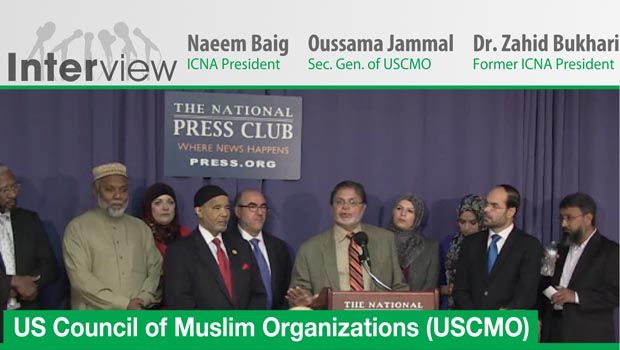
Naeem Baig and Dr. Zahid Bukhari: There were essentially two driving forces that triggered this idea of a unified organization. The first trigger was due to the resulting situation after the 9/11 tragedy and consequential backlash the Muslim American community experienced, and the media’s harshness and biased coverage following these events. Additionally, recent terrorist events and the anti-Muslim rhetoric from the Republican presidential candidates fanned further the flames across the country and even beyond. It was clear then that no one individual will be able to respond to this effectively and that we needed an organization to represent the community in a unified manner, to be able to present our concerns, priorities, and response to this Islamophobia that was picking up pace.
The other driving force was ICNA’s continuous efforts, since the mid-90s, to find a platform for uniting the Islamic organizations under one umbrella for the purpose of taking action on issues common to all American Muslims, such as fighting Islamophobia. The Islamic Shura Council was an example of this effort but it did not gain traction. It took 4 to 5 years of continuous meetings and discussions before we were successful and able to announce the USCMO initiative in late 2014.
It was when I (Dr. Bukhari) came across an article while working on a project at Georgetown University that this idea struck me most prominently. It was a project funded by two charitable trusts where representatives were asked to perform a study on their own respective communities, American Muslims being one of these communities. John W. Foster, Secretary of State under former president Dwight D. Eisenhower, wrote an article advising the Jewish communities of that time to unify themselves to help enhance their voice and presence and help address and resolve their concerns. This advice resonated with me with regards to the Muslim communities in America dealing with the racism and hateful rhetoric that is being spewed around us.
This organization can help us to redefine our struggles and help in the cause to bring back America to its true values.
What is unique about this organization’s mission and purpose that sets it apart from the rest of the Muslim/Islamic coalitions that exist in the United States?
Naeem Baig: This organization is unique in the sense it is a national coalition that is not specific to one city or regional area and as a result brings more strength and potential impact to our common causes. It is also unique because it is bringing together professionals from all areas that contribute their diverse skills to enhance the organization’s capacities to complete tasks and accomplish goals. Our next phase includes opening membership to local and regional organizations, Islamic centers and mosques, from various parts of the country.
As President of ICNA, an organization that already unites Muslims across North America, and with you already shouldering the responsibility of leading this organization, what motivated you to help build this new USCMO coalition?
Naeem Baig: ICNA has always been part of this struggle, for many years now, so this new coalition was already implanted in the roots of our planning and organizing. We truly need to work together as this is a commandment from Allah (SWT) in Surah Al-Imran, reminding us, “And hold fast to the rope of Allah together…” We are one body that has different parts and functions, striving together as an Ummah. We are in earnest need of this endeavor so I strongly believe in engaging in this type of community work.
We understand that one of the major campaigns that this organization has undertaken is the “One America” campaign. Please describe this initiative including what the motivation was for this campaign and what it hopes to accomplish?
Naeem Baig: In our USCMO National Leadership Summit held in December, where we had approximately 120 Muslim leaders from all over the country, this was one of the ideas brought forth after a series of discussions and debates. This initiative is to motivate Muslim Americans as well as other minorities such as Latinos, African Americans, etc. to register themselves to vote by setting up voter registration booths at mosques and other community venues to reach as many people as possible. After seeing the current racist narratives out there against Muslims and minorities, especially from the Republican presidential candidates, we need to counter this with a positive force. No one should be trying to isolate American Muslims from the rest of the country and to treat them as unworthy of being true Americans. Therefore, we need to register to vote so we always have a voice, and an impactful one.
What has been the progress so far on this drive to register one million Muslim voters? What are your expectations of reaching the goal?
Naeem Baig: Our plan as a major Muslim organization is to use ICNA’s 40 chapters throughout the US to set up booths at Islamic centers and mosques to help facilitate voter registration. We are also inviting Latino Americans and African Americans to come and register at these booths. We have gained progress on motivating the public but are still working towards our goal of registering as many citizens as we can, regardless of religion or race.
Have you encountered any resistance to the idea of a national umbrella organization, or heard any criticism from Muslims or non-Muslims?
Dr. Zahid Bukhari: From non-Muslims, we did not receive criticism but rather encouragement. Up to 37 churches of all different denominations have actually been encouraging Muslims to form this type of organization. They feel that it is a positive step for Muslim communities to have a unified voice. As for Muslims, there usually is always some type of reservation due to natural differences of opinions but we have worked with and gained membership with several major organizations. Among those who do not have a formal membership in USCMO, some have participated with us in press conferences or events such as our National Leadership Summit that we recently conducted. Alhamdulillah, there have been no major criticisms towards this initiative and we hope to grow in membership in the coming years as we become more rooted and established in our current landscape.
Do you feel that the rise of Islamophobia combined with the hateful rhetoric in the current presidential campaign has made it easier to convince US Muslim organizations to unite, despite any differences, so as to face this threat together as a single entity?
Dr. Zahid Bukhari: Absolutely correct. Essentially, two ideas became prominent that made for an easier pathway to unifying ourselves: first, everyone was convinced that there must be unity among us to generate a strong reaction to the anti-Muslim and hateful rhetoric that is occurring during the current presidential campaign. And second, Donald Trump’s and Ben Carson’s bigoted and hateful speech essentially put Muslims and their reactions to the bigotry in the spotlight, front and center in the prime-time news coverage. Hence, we get the opportunity to represent our community in a strengthened and unified way.
Oussama Jammal (current Secretary General of USCMO): It is healthy to have different specialties among American Muslim organizations and more so with respect to their views and opinions. Yet, the unity of purpose and shared destiny is an obligation. Within the current climate of Islamophobia and hateful rhetoric, disunity among Muslim organizations becomes a sin.
What issues or limitations do you see among the American Muslim population that may still be a hindrance to forming a unified and effective front against this tide of Islamophobia?
Dr. Zahid Bukhari: One limitation is in regards to first generation citizens who have migrated here from countries that do not have strong democratic institutions and therefore do not always have enough experience to know where and how to make an impact in the political framework here in the U.S. They tend to focus on major elections such as the one for president, but do not realize there is significance and value in participating in local politics and voting in local and state elections as well. Secondly, there is a communication gap between the first and second generation of Muslims, those who have migrated here from a different country and the younger generation which are born and raised in the American culture. Ideas and thoughts can then sometimes conflict or get lost in translation.
Oussama Jammal: I believe the leaders of Muslim organizations around the country need to understand the scope of this danger not only to the Muslim community but to our society at large and that the only effective response is to come together in unison. Different opinions and views are healthy and needed to enrich understanding and decision-making, but should not be the cause for divisions. The biggest hindrances are narrow-mindedness and ego.
What are your suggestions for increasing emergency preparedness for Islamic institutions and individual Muslims to address the rising number of hate incidents nationwide?
Oussama Jammal: Clearly we need to do the following to help ourselves be prepared: Connect with local law enforcement and establishing direct communication protocols; increase vigilance around Islamic institutions as well as individual homes; receive training on safety and security measures including evacuation plans, soft lockdown, active shooter scenarios, and fire drills; install enhanced security and surveillance systems; and develop emergency plans for institutions and individuals such as a close network of people or contacts and specific numbers to call.
What do you think the American Muslim community, and more specifically USCMO member organizations, can and should do to address the real and present threat of violent extremist groups that are preying on young people via the Internet and who twist the meaning of the Quran to justify their atrocities?
Oussama Jammal: This is a serious problem and requires a much more comprehensive approach than the current government approach. It will require several components in order to counter violent extremism. The main components include:
- Develop counter narrative curricula for Imams, youth directors and mentors, teachers, and parents to deconstruct the extremists’ narrative and to show that their ideology is false;
- Utilize scholars, prominent speakers, and leaders to deliver the message;
- Mount a social media youth-to-youth campaign on Facebook, Twitter, Instagram, and YouTube
- Organize and/or utilize workshops, programs on mental health issues, and youth camps to discuss the danger of extremism and extremist groups;
- Establish principled parameters for cooperation between “Muslim leadership” and the FBI to counter domestic and foreign violent extremists;
- Engage in political campaigns to address root causes of violent extremism and its connection to counterproductive and damaging foreign policies such as support of dictatorships.
USCMO held a National Leadership Summit in December 2015. Please explain why USCMO felt this event was necessary and what it hoped to accomplish? What were the key takeaways that American Muslims should be aware of in this current politically charged climate? What do American Muslims need to do in order to counter this negativity?
Oussama Jammal: After the San Bernardino shootings and the following increase of hateful speech toward American Muslims, the community was under extreme pressure and fear and needed leadership. USCMO rose to the occasion and called upon Muslim leaders to come together and discuss strategies to address the concerns of the community. Focus was on the hatemongering ideology of some politicians and public figures, the rise of Islamophobic rhetoric, and the need for immediate safety measures especially after frequent reports of hate crimes against the Muslim community. The summit showed that we have the ability to bring Muslim leaders together from around the country, even on a short notice, sending a comforting message to the community that its leaders are actively addressing issues of importance to them. The summit provided a forum for discussion and exchange of ideas and strategies, with great benefit from the contributions of diverse groups representing different organizational specialties including civil rights, grassroots and community organizing, academic think tanks, education, religious organization, and so on. The diversity also encompassed various leadership levels, gender, age, and ethnic backgrounds. At the summit, we took note that we should always feel and act as Americans of equal rights and never give in to intimidation. Also that engaging with our fellow citizens on common issues concerning our society will help dispel myths about Muslims and Islam. Building alliances and coalitions with other minorities and like-minded groups is vital for our survival especially under the current politically charged climate.
Are there resources available to Muslim communities, masjids, and other organizations that they can use to help educate their community members and implement positive changes?
Oussama Jammal: USCMO is working with its member organizations and specialists in the relevant areas on developing, compiling, and sorting materials needed to educate the community. Several of our organizations, CAIR, MAS, ICNA, MLFA, and MUNA, have already started some training and campaigning in their respective areas of expertise.
USCMO organized the first of its kind international conference in February 2016 in Washington, D.C. Please describe the mission and goal of this conference?
Oussama Jammal: We began with collecting ratings on what were considered the most alarming issues affecting our community, such as racism/bigotry, radicalization of Muslim youth, etc., to help get a handle on what we should focus on first. We discussed the role that the media plays in disseminating false information and fear about Muslims and how much influence it has in creating the negative climate. We took surveys on how active our community is in engaging in activities that counters the Islamophobia, and which political parties we feel best represent our interest and concerns. We gathered as much information as possible about the attributes and activities of our community so we can most effectively direct our energy on programs that address the most critical issues. And I am happy to say we already jump started programs in those areas.
Elaborating on this international conference, please describe the key accomplishments of this gathering of Muslim officials from around the world?
Dr. Zahid Bukhari: Establishing the Annual Muslim Capitol Hill day, an original initiative of CAIR, is a great achievement. In the past, this event allowed us to hold up to 280 meetings with general councils, a valuable effort on outreach campaigns. The National Leadership Summit and Open Mosque day are also great initiatives and successful campaigns that are mobilizing our efforts and abilities to voice our narrative and address issues and concerns.
Oussama Jammal: One very significant and strategic objective the conference was able to achieve is the formation of a Western entity to function as an umbrella organization for Muslim groups. The formation of committees, work groups, and task forces will facilitate the momentum of working together, sharing information, coordinating efforts, utilizing resources, enhancing communication, and facilitating planning. The conference also helped to introduce Muslim leaders and organizations to one another and create networking opportunities, and also to learn about Muslim minorities living in various countries. In addition, the conference sent an uplifting message of unity to our local communities, with assurance that their leadership is thinking ahead about their safety, security, and their future.
What are the next steps that must be taken in order for the mission of this international conference to maintain its momentum and to achieve its aims? Do you see any obstacles that may need time to overcome?
Dr. Zahid Bukhari: We want to see the One America campaign reach its goal of registering one million voters. The other is Open Mosque day where we have representatives inviting non-Muslims to mosques and talking about Islam, passing out accurate information, and raising political awareness. This is already in the planning and executing phases so insha’Allah the momentum will continue to grow and flourish.
Oussama Jammal: By the grace of Allah, a steering committee was formed to explore options, develop structure, and present the results to the leadership. The committee is meeting regularly since its formation immediately following the last day of the conference. I must say that I’m very pleased and confident of the ability of this committee to accomplish the tasks at hand and deliver results because of the high spirit of unity, cooperation, and commitment of all its members that I witnessed and experienced firsthand.