
بسم الله الرحمن الرحيم

Tag: tawakkul

  • Tawakkul: Leading to the Fullest Reward

    Tawakkul: Leading to the Fullest Reward

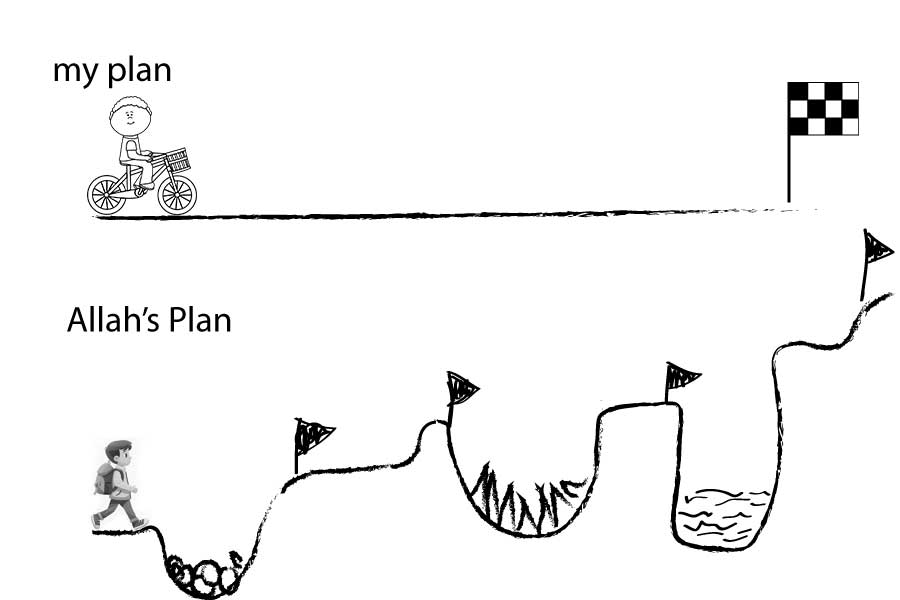
    As Muslims, we believe that tawakkul, trust in and reliance on God, is one of the most important core principles and values in maintaining our spiritual identity and continued growth toward closeness to Allah. The concept of tawakkul is highly emphasized in the Qur’an and ahadith and by many great scholars. However, in this day and age, we have unfortunately come to oversimplify the meaning and understand it as a one-dimensional and depthless trust in God. But in reality tawakkul is a nuanced concept with far-reaching and profound implications. With everything going on in the world, it is important that we don’t lose sight of the foundation of relying on Allah and understanding that not everything is in our control.

    Tawakkul:  Qur’an and Ahadith

    Allah says in the Quran, “And whoever has tawakkul, then Allah is all that he needs” (Qur’an 65:3).  This verse illustrates how tawakkul is directly connected to reaching a state of contentment where we feel that God is all we need. Allah also tells us to “rely upon Allah, and sufficient is Allah as disposer of affairs” (Qur’an 33:3). The phrase “rely upon Allah” encourages believers to put their complete trust in Allah and rely on Him for guidance, help, and protection. It requires acknowledging that Allah is the ultimate source of strength and that He is fully capable of managing and taking care of all affairs. Truly tawakkul is one of the most important keys to living a life that is in accordance with the Qur’an and sunnah and gives us the security to thrive and flourish, to achieve our full potential.

    This tawakkul in Allah gives us the strength to stay steadfast in our decisions as well. Allah says in the Qur’an, “So when you have decided, then rely upon Allah. Indeed, Allah loves those who rely” (Qur’an 3:159). We get the comfort of knowing our decisions have God’s support when we have tawakkul. Making decisions and taking action, interwoven with tawakkul, earns Allah’s love! What more could we want for ourselves? It gives the understanding that no matter what happens, that is what was meant for us because that is what Allah decreed. It gives us the motivation to continually renew our faith in qadr (divine destiny).

    There is a beautiful hadith of the Prophet: “Strange are the ways of a believer for there is good in every affair of his, and this is not the case with anyone else except in the case of a believer. If he has an occasion to feel delighted, he thanks [Allah], thus there is a good for him in it; and if he gets into trouble and demonstrates sabr [patience and perseverance], there is a good for him in it” (Sahih Muslim). This hadith very clearly lays out how to construct our thoughts and attitudes around all types of events that befall us or surround us. If something good happens, we say “alhamdulillah,” and if something that we perceive as negative happens, we stay steadfast and patient and rely on Allah, knowing that this is what was written for us. The cultivation of these beliefs ensures that nothing can break our resolve and steadfastness in our belief in God and the meaning and purpose of our lives.  How amazing to live a life in which encountering both favorable and unfavorable conditions and circumstances leaves us surrendered to, and content with, the decree of our Lord.

    Prophet Muhammad (s) also said, “If you were to rely on Allah with the required reliance, then He would provide for you just as He provides for the birds. They go out in the morning empty and return full” (Sunan at-Tirmidhi). I may have nothing, come from nothing, and start the day with nothing, but with tawakkul, I know God will always provide what is needed.

    Our Prophet (s) also said, “If you ask, ask from Allah, and if you seek help, seek help from Allah” (Sunan Abu Dawood). Why should we turn to anyone other than God? In Surah Ra’ad (13:28) Allah says “…those who believe and whose hearts find comfort in the remembrance of Allah, surely in the remembrance of Allah do hearts find comfort.” We can choose to remember Allah constantly, and in times of trial and tribulation, we can find comfort in dhikr, ultimately leading us back to tawakkul. We know that this is what was meant for us and this is the best for us. Ibn Abbas reported that the Prophet (s) said, “Seventy thousand from my nation will enter Paradise without reckoning. They are those who do not rely on incantations, nor believe in omens, but rather they trust in their Lord” (Sahih al-Bukhari). Not only will this trust help us in our earthly lives, it will more than suffice us if we can enter paradise without reckoning!

    From this brief overview, we can conclude that tawakkul involves placing trust in and reliance on Allah in all aspects of our lives.  It is intertwined with other Islamic values such as patience, gratitude, and acceptance of Allah’s decree. Tawakkul also teaches Muslims to have faith in Allah’s wisdom, providence, and guidance, knowing that He truly is the ultimate provider and controller of all affairs. Tawakkul requires active and sincere effort, aligning our beliefs and behaviors in such way that trust in Allah’s wisdom and decree imbues our lives with ultimate meaning, purpose, resolve, and sustenance.

    From these ayahs and ahadith, we are encouraged to rely on Allah, seek His help through prayer and supplication, and trust that He will guide and support us. This belief then fosters inner peace, contentment, and a sense of surrender to the Divine Will.

    Tawakkul: Scholarly Commentary

    Ibn Taymiyyah

    Sheikhul Islam Ibn Taymiyyah discusses in his various writings the concept of tawakkul, a fundamental aspect of faith, and how it positively affects the believer’s heart and actions; and he emphasizes the significance of tawakkul in one’s relationship with Allah and in getting closer to Allah. Ibn Taymiyyah highlights the need for Muslims to trust in Allah’s decree and have full confidence in His wisdom and plan. He emphasised that tawakkul involves recognising that all matters are ultimately in Allah’s hands and that relying on Him is the source of true tranquillity and peace, especially through hardship. He also makes the point that tawakkul must rest upon a foundation of adherence to the teachings of Islam and striving to please Allah.

    Al-Ghazali

    Imam al-Ghazali addressed the topic of tawakkul within the broader context of Islamic spirituality and ethics in “Ihya Ulum al-Din” (Revival of the Religious Sciences). He emphasised the importance of trusting in Allah’s plan and submitting to His will. He stresses that true tawakkul involves recognising that everything happens by the decree of Allah and that the believer accepts His wisdom, even in situations that may appear unfavourable or challenging. Al-Ghazali views tawakkul as an integral part of one’s spiritual development. He believed cultivating trust in Allah deepens one’s connection with the Divine and brings inner peace and contentment. Tawakkul allows individuals to detach themselves from excessive worry and anxiety, relying on Allah’s power and mercy.

    Ibn Qayyim

    Ibn Qayyim al-Jawziyya discussed the concept of tawakkul in “Madarij al-Salikin” by stating “Tawakkul is half of the religion, the other half is inaabah, turning to Allah.” He also emphasised that tawakkul involves placing one’s complete trust and reliance on Allah in all aspects of life and trusting in Allah’s wisdom, and accepting His decree, even if at times it may not align with our desires or expectations. He asserts that tawakkul involves submitting to Allah’s will and believing that whatever He decrees is ultimately for our best interests and that tawakkul should be accompanied by seeking Allah’s assistance through supplication (du’a), seeking His forgiveness, and engaging in acts of worship.

    All three of these scholars maintained that there should be a balanced approach between human effort and reliance on Allah. While we should make sincere efforts and take practical steps, we should also understand that the outcomes are ultimately determined by Allah’s decree and we should find peace and contentment in that, expressing our tawakkul and faith in qadr, all the while still trying our best and making du’a. This action and expression of pure submission and reliance on Allah and an obedient lifestyle become the foundation upon which we can build character traits such as sabr (patience and perseverance), shukr (gratitude), and qana’ah (contentment with whatever Allah SWT bestows upon us). Striving in this way leads to emotional stability, mental resilience, and overall well-being. The ultimate result? — Allah SWT assures us of the fullest reward.

    “And that there is not for man except that for which he strives. And that his effort is going to be seen – then he will be rewarded for it with the fullest reward” (Qur’an 53:39-41).


  • Tawakkul: Trust and Reliance in Allah (swt)

    Tawakkul: Trust and Reliance in Allah (swt)

    Tawakkul means perfect reliance and trust. The root of tawakkul is wao-kaf-lam. One of the words derived from this root is wakil – the person whom we trust. The person who trusts someone is called mutawakkil. Naturally, every one of us wants the best wakil for guidance in all our affairs, and who could we trust more than our Creator, Allah (SWT)? In Surah Al-Imran, Allah (SWT) says, “Allah [alone] is sufficient for us, and He is the best Disposer of affairs” (Qur’an 3:173). Is anyone more capable to guide us than Allah (SWT)? But unfortunately, because of our weak eman, we put our trust in worldly sources of advice and assistance to resolve our problems. This includes, but is not limited to, visiting graves of saints, making du’as to dead people, putting one’s entire trust in a doctor or specific treatment for a cure. On the contrary, Allah (SWT) tells us in Surah Ibrahim, “And in Allah let the believers put their trust” (Qur’an 14:11).

    In our everyday life, we should remember the meaning of tawakkul (trust) exhibited to us by the Prophet (pbuh).

    Ibn Abass (RA) narrated that the Prophet (pbuh) said that he was shown a huge crowd of people and was told, “This is your nation out of whom seventy thousand shall enter paradise without reckoning.” Then the Prophet (pbuh) entered his house without telling his companions who they (the 70,000) were. So the people started to wonder about these 70,000. When the Prophet heard of their discussions, he came out and said, “Those people are those who do not treat themselves with amulets, nor do they believe in bad or good omens, nor do they get themselves branded [cauterized], but they put their trust in their Lord” (excerpted from a hadith in Sahih Bukhari). This is truly a great reward for the mutawakallen in the Hereafter. May Allah (SWT) make us one of them, ameen.
    On the contrary, for people who depend on worldly means more than Allah (SWT), they may succeed in this dunya in terms of wealth or fame or other worldly accomplishments, but these are only temporary things which will vanish when they die or on the Day of the Judgment, whichever comes first. They will be held accountable for their deeds and have to face the torment as they excluded themselves from the list of believers who put trust in Allah (SWT) alone.
    In Surah Al-Imran, Allah (SWT) says, “O you who believe! Fear Allah as He should be feared, and die not except in a state of Islam” (Qur’an 3:102). To die as a Muslim with complete submission to Allah (SWT), we have to follow the Qur’an and Sunnah, to try to be Ibad-ur-Rahman, servant of the Beneficent. We have to be like Yaqoob (AS) when his two sons Yusuf and Bin-Yameen were separated from him, instead of begging the rulers of the time, he turned to Allah (SWT), and said, “I expose my distress and anguish only onto Allah…” (Qur’an 12:86). This is the ideal behavior of a true believer as he is fully aware that for everything the final decision is from our Creator and Sustainer, Allah (SWT). We notice the firm conviction of Yaqoob (AS) in his trust in Allah as the story progresses. When his sons tell him about the allegation that Bin Yameen stole a cup and was detained in Egypt, he said, “So patience is most fitting! It may be that Allah will bring them all unto me. Lo! He, only He, is the Knower, the Wise” (Qur’an 12:83). Allah (SWT) responded to his trust by reuniting the entire family in Egypt.
    When Ibrahim (pbuh) declared the truth that Allah (SWT) is the only one who deserves to be worshipped and He does not have any partners, his people decided to punish him by throwing him into the fire. According to the hadith in Sahih Bukhari (narrated by Ibn Abass), Prophet Ibrahim (pbuh) reacted by saying, “For us Allah suffices. He is the best disposer of affairs.” We are told that the angels of fire and rain were waiting for Allah’s orders to extinguish the fire, but Allah (SWT) directly spoke to the fire, “We said ‘O Fire, be cool and safe for Ibrahim (AS).’” Jabir (RA) narrated an incident that happened during the Dhat-ur-Riqa’ expedition. The Prophet (pbuh) was resting under a shady tree, and a non-believer sneaked up on him. He drew his sword and said to the Prophet who was at that moment unarmed, “Who will stop me from killing you now?” The Prophet peace be upon him answered, “Allah!” In one version of the hadith, the sword then fell from the man’s hand. This incident highlights the Prophet’s (pbuh) immense confidence and trust in Allah (SWT).
    In our everyday life, we should remember the meaning of tawakkul (trust) exhibited to us by the Prophet (pbuh). He said to one of his companions, “Tawakkul means that you should tie your camel first and put your trust in Allah (SWT).” Definitely Allah (SWT) is the One who provides for us, but this does not mean that we simply sit idle and wait for miracles. Rather, we have to struggle in every aspect of our lives and then put our trust in Allah (SWT) for favorable results. To achieve these qualities, we must again turn to the Sunnah. According to the narration of Ibn Abbas (RA), the Prophet (pbuh) used to pray, “Allah, to You I have submitted and have become obedient; in You do I believe and in You do I seek my judgment. O Allah, I seek refuge with You through Your Honor; there is none worthy of worship except You alone that You safeguard me against deprivation. You are the eternal who never dies whereas human beings and jinns will all die” (Agreed upon).
    May Allah (SWT) grant us wisdom to follow the verse from Surah Al-Ahzab, “And put your tawakkul in Allah, for Allah is Sufficient as a Wakil [trustee and disposer of affairs]” (Qur’an 33:3). May Allah (SWT) give us the tawfiq (good fortune) to have fullest conviction of Allah’s Lordship – and the patience and thankfulness that are yielded from that conviction – to be, each one of us, a mutawakkil. Ameen.

  • Seeking God

    Seeking God

    Common sense informs us that there are inner aspects and outer aspects of created beings. And hardly do the exterior aspects of a created being display the inner charms.  Then the inner realities call out to him or her, we are only a trial so believe not. Subhan’Allah. We seek Allah SWT as al-salik – that is the person who has undertaken a way, a path, to a certain destination. And here it means a person who takes the path — I hope that is all of us — to his or her spiritual destination, with the most resolute of hearts. And to whom?  To Allah SWT. This resoluteness is“hima” which is not just the intention, it is the drive with resolve. Intention is a state previous to hima. Hima is an internal resoluteness and drive toward that which was intended. So this person, imagine, this salik, has a hima and this hima is to arrive at a spiritual destination with his or her qalb (heart) fully surrendered and devoted to Allah SWT. And on the way certain things happen—an unraveling, an unveiling, a displaying. It could be an unraveling of confusions in my thinking or a freeing from complications and difficulties that have afflicted me. It could be unveiling of deeper meanings so that my understanding of things becomes more firm and stable. It could be a displaying in my everyday life of greater devotion to Allah SWT. Indeed, there are many types of unraveling, displaying, unveiling.

    First of all as we alhamdulillah begin to walk the path to Allah SWT and we feel our taubah growing stronger, then we start to perform salat on time and establish zakat and perform some dhikr of Allah SWT. And so in performing the obligatory and also extra dedication in voluntary worship, and doing some good works insha’Allah of learning and sharing and teaching and helping others, then we begin to feel and experience certain beneficial effects and  we begin to like the effort and striving to please Allah SWT;  we begin to feel more peaceful and balanced. Then my hima, as it is aware of that new state that I am in, it wants to stay in a sense and stop and enjoy it. Maybe that’s it. When that happens, you could be hearing with physical ears or spiritual ears the hatif of the haqqiqah which is the voice of truth. It could be a call inside of your qalb. While what I observe or hear is part of my own mental and emotional being, it is nonetheless the haqqiqah, the underlying truth that speaks to me. The underlying truth is the essence, not the outward, superficial meaning of something. For example, the haqqiqah of the human being is not the way we look physically, the external look.

    The haqqiqah of the human being is not physical. It is deep within the inner recesses of the heart. The prophet of Allah said that everything has a haqqiqah and the haqqiqah speaks to the heart. And sometimes the heart wants to stop because the heart of the journeyer, the traveler on the path to Allah SWT, finds delight in reflecting on the inner realities or might find a need for a deserved pause. Then a call from within that speaks to him or her about the realities of things and its vastness, brings reminder that there is more to seek and to be careful not to stop striving. That call from within reminds us, “Don’t think you got itall.  Don’t think there is nothing beyond that. What you seek is still beyond.”