
بسم الله الرحمن الرحيم

Tag: Muslim Women

  • Women and the Future of the United States

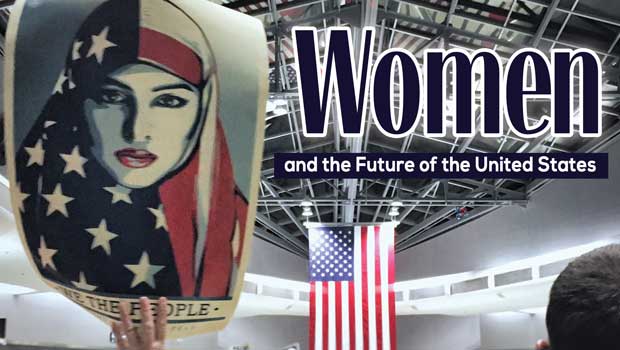
    Women and the Future of the United States

    There has been perhaps no more celebrated an icon of immigrants’ dreams and aspirations of freedom than the Statue of Liberty. Crafted by the French sculptor Frederic Auguste Bartholdi and financed by the government of France, the imposing depiction of Libertas, the Roman goddess of liberty, was dedicated on Ellis Island, off the shores of Manhattan, on October 28, 1886. The inscription on Lady Liberty reads, “Give me your tired, your poor, your huddled masses yearning to breathe free, the wretched refuse of your teeming shore…” As the statue was immortalized in prose, poetry, and the hearts of countless immigrants over the many decades, a tad more than 50 percent of the U.S. population — women — continue to yearn and fight for their freedom and equality to reach full fruition.

    Perceptions of women must be recalibrated in the minds of men so that they realize the honor and respect due to the female gender. When men deny women their rights, ordained by Allah SWT, they have doomed themselves and society to imbalance and defect

    The first women’s rights convention in the United States was the Seneca Falls Convention held in western New York state on July 19-20, 1848. It was organized by local Quaker women in conjunction with Elizabeth Stanton, a women’s rights activist, and Lucretia Mott, a Quaker from Philadelphia. At the time of the historic convention, women were generally not allowed to speak in public meetings or religious gatherings or vote; in various states, only women who were married were permitted to own property, but they were not allowed to manage it except when their spouse was incapacitated. Lucretia Mott was a true maverick and reformer, an articulate and outspoken advocate for the rights of women during an age when women were politically powerless and constrained to an inferior social status. Attendees at the Seneca Falls Convention focused on issues such as denial of property rights, inequality of opportunities in education and employment, being deprived of the right to vote, denial of the right to participate and be represented in government, and other rights and privileges customarily granted to men.

    Frederick Douglass, an advocate for social justice, abolitionist, and orator, was also a prominent supporter of women’s rights. He attended the convention and eloquently expressed, “In respect to political rights, we hold woman to be justly entitled to all we claim for men. We go further and express our conviction that all political rights which is expedient for men to exercise, it is equally so for women. And if that government only is just which governs of a woman, and if that government only is just which governs by the free consent of the governed, there can be no reason in the world for denying to woman the exercise of the elective franchise, or a hand in making and administering the law of the land.” Susan B. Anthony, a friend of Elizabeth Stanton, was an anti-slavery activist, leader in the temperance movement, and the primary leader of the Women’s Suffrage Movement. The sustained efforts of the Movement resulted in Congress passing the 19th Amendment to the U.S. Constitution in 1920, allowing women to vote in all American states.

    While much progress has been made in granting women their full rights, more needs to be done. According to the U.S. Census Bureau, women constituted 50.8 percent of the U.S. population in 2017 and comprised approximately half of the workforce. Yet, roughly one in eight women in 2016 lived in poverty. Pew reports that 42 percent of working women say they have experienced some form of gender discrimination at work and roughly 22 percent report being sexually harassed in the workplace. As of 2018, White women were paid 77 cents for every dollar paid to White men, Black women were paid 61 cents, Native American women 58 cents, and Latinas 53 cents. In 2006, according to the World Economic Forum, the U.S. ranked third worldwide in economic gender equality; by 2016, the U.S. had dropped to 26th place. To understand that discrimination and negative attitudes toward women have consequences beyond economic status, consider that eight and a half million women each year are victims of domestic violence and three or more women are murdered by their partners each day.

    There are many obstacles placed in front of women that account for the income and education gaps between males and females in this nation. El Hajj Malik Shabazz (Malcolm X) so astutely noted, “One thing that I became aware of in my traveling recently through Africa and the Middle East, in every country that you go to, usually the degree of progress can never be separated from the woman. If you are in country that’s progressive, the woman is progressive…But in every backward country you’ll find the women are backward, and in every country where education is not stressed it’s because the women don’t have education.”

    Perceptions of women must be recalibrated in the minds of men so that they realize the honor and respect due to the female gender. When men deny women their rights, ordained by Allah SWT, and the opportunities to fulfill their greatest potential, they have doomed themselves and their society to imbalance and defect. In contrast, fully supporting the rights of women can bring light and grace to this nation.
  • Amerian Muslim Women’s Conference

    Amerian Muslim Women’s Conference

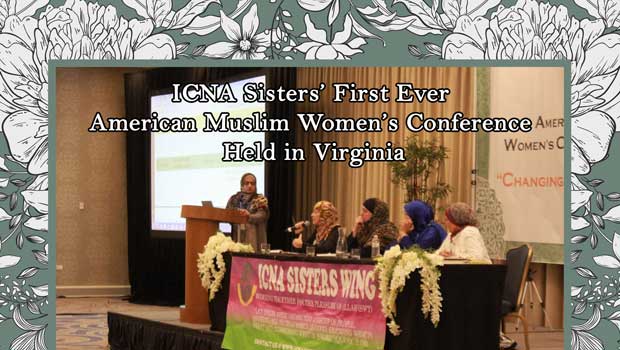
    Women from across the nation attended ICNA Sisters’ first ever American Muslim Women’s Conference Saturday, Oct. 7, in Chantilly, Virginia to talk about “Changing the Narrative” of Muslim women in the United States. The approximately 400 invited guests included female leaders not only from within ICNA’s own divisions, but also from several other prominent U.S. organizations, distinguished professors, civil rights organizers, doctors, and Islamic scholars.

    During the welcome address, ICNA Sisters president Sadia Salman said, “The women here represent the diverse Muslim women that make up our society. Which is why with the current situation of our nation, the world and our Ummah, it is more important than ever before for us to stand united as one. ”She added that despite the various organizations and platforms the women at the conference were a part of, it was their “duty to stand up and work together” regarding the challenges in society. The conference aimed to unite women leaders from across the nation to hear about, discuss, and highlight possible solutions to several pressing issues facing the American Muslim woman, according to Faizah Aslam, secretary general of ICNA Sisters.

    The morning portion of the event began with speakers Dr. Zainab Alwani, Aisha al-Adawiya, Farhana Matin, and Shaikh a Anse Tamara Gray discussing topics ranging from how the Muslim woman is defined in today’s society and the journey of American Muslim women in the U.S., to how American Muslim women are not only the backbone of the household but are also the rising leaders in society; and finally, how American Muslim women can tap into the power they have and use it to contribute to a successful society.

    Following lunch, the audience had the chance to attend two parallel panel sessions, “Oppression: What, Where, & When” with Alwani, Salma Abugideiri, Nahela Morales, and Zahra Billoo and “Through the Filters: Myth vs Reality” with Alia Salem, Hena Zuberi, MaryaBangee, and Rowaida AbdelAziz. The first highlighted and answered questions of how Muslim women are oppressed in the U.S. and what are the different forms of oppression, while the other handled questions of the portrayal of Muslim women in media and what can be done to change the perception of women in film and news media.

    The last main hall session focused on areas where American Muslim women are already contributing and building a counter-narrative to the one seen most frequently in media. The conference ended which opinions and feedback collected during the sessions which were read as a way to share with the audience possible initiatives and solutions to some of the issues discussed.

    “It was more successful than I anticipated,” Abeer Sher, ICNA Sisters vice-president said. “The reason being I didn’t expect to gather that many Muslim women leadership from across the United States under one roof, but alhamdullilah it happened. My heart is so warm from hearing during the sessions just how ready the Muslim women were to unite on every level.”

  • Carving Out a Role for Muslim Women in the 90’s

    Carving Out a Role for Muslim Women in the 90’s

    As we move into the next decade, we face the ritual reviewing of the worn and torn pages of the diary of our lives before we turn a new page. We will reflect on our achievements and failures. And then we will approach that ever dreaded, yet paradoxically inviting task of setting new goals. As Muslims we face the new decade with a bittersweet hope; expectations of new triumph in the knowledge that with the passing of each decade we are moving closer to the Final Goal – the day when we will stand in front of our Creator.

    Getting down to the more mundane, yet essential issues of the new decade, we come to the question of the role of women in Islam. Sisters, it is time to redefine our attitudes and ideas. Let’s try to streamline ourselves and move on by throwing out old misconceptions that have been slowing us down.

    Naturally, there are exceptions where Muslim women have not attained the status that Allah Almighty has ordained for them. And naturally, these exceptions are exploited and stigmatized by non-Muslims.

    The feminist movement of our society is coming to a major crisis as women in the West are deciding that they are tired of pretending that they are men. At the same time, many Muslim women are deciding that they are tired of pretending they are Western women. Yet they are also frustrated with the typical stigma of being the “oppressed” Muslim woman. The recent controversy over the “20/20” commentary on Pakistani women explains our feelings of uncertainty about our position in the society.

    Most of us will agree that IF and WHEN horrifying excesses take place against Muslim women> they do so because of the twisted nature of the individuals involved and have nothing to do with the Islamic law. There is absolutely no correlation, let alone causation, between the Islamic law and oppression of women. Almighty Allah gave us these laws in order to prevent social injustices. Over­ generalizations are dangerous and unacceptable. Shall we use recent American statistics on crimes to conclude that the democratic system incites people to commit acts of violence?

    As Muslim women of North America we have to find ways to deal with these misconceptions. The name of Islam must be kept free of all taints and tarnish. The question is: why are Muslim women considered the most op­ pressed when non-Muslim women across the globe are going through a worse experience?

    The role of women in Islam is really no different from other women. Muslim women strive to achieve religious and worldly education, to support the social network of the community, to maintain harmony and growth with their immediate and extended family, to achieve personal goals, and above all, to work for religious piety. Is this really in contrast with other societies, cultures, and religious groups?

    However, methodology is not only different, but also misunderstood. In most of the Western world, women are analogous to feathers, they blow where the wind blows them. They have freedom in the sense that they can fly any way with no restrictions. However, their flight is usually initiated by the directing breezes of environmental factors. When they finally land, they are often fettered and ravaged by the harshness of society.

    In contrast, a Muslim woman is treated as a precious jewel. As a child she is polished and perfected for her performance as an adult. When she attains maturity, she is protected and guarded like a treasure. Those factors are not to be considered restrictions, rather they are used to enhance her position. Thereafter, her presence commands respect rather than dismissal or neglect. She establishes her own niche in life rather than aspire for positions of others. When she shines in the glow of success, she has a complete social support Network to enjoy her happiness. Her experiences are progressive rather than regretful. She be­ comes skilled in cooperation and harmony rather than compliance. She is a woman with the status and position that Allah Almighty has given her and her alone.

    Naturally, there are exceptions where Muslim women have not attained the status that Allah Almighty has ordained for them. And naturally, these exceptions are exploited and stigmatized by non-Muslims.

    However, we must be tolerant of others’ perception of our religion if we want to change their views. A famous saying of social psychologists is: We are they to them. Our opinions are as wrong to them, as theirs are to us. As long as we have no mutual tolerance, there can be no successful communication, nor a proper representation of Islam and its real ideals. The way we fend off an attack on Islam is not through vehement condemnation of Westerners. It is said that a true warrior will not harm an enemy who refuses to fight. I believe that what we need most to correct mis­conceptions about Islam is talk to our adversaries and explain to them why we believe in some things. and reject others. In school, I was never able to tolerate discussions about Islam because they always ended in frustration and a competition to see which faith would score more points. When I stopped considering non-Muslims my deadly opponents, then people whom I spoke to, had no choice but to listen to my point of view as well.

    Allah is the Ultimate and Glorious Protector of our religion. Our duty as Muslim women in North America is to learn and teach with gentle understanding. Our aim is to create a peaceful environment, not a threatening one.

    Let us take a first step of the ’90s in removing stigma of the “oppressed Muslim women” by refusing to be threatened or upset. We don’t need anyone to tell us what our status or position is. But we do need to be persistently patient in telling the misinformed and the mis­ guided that we enjoy a good life under Islam.