بسم الله الرحمن الرحيم

Tag: muslim history

  • De Mexico a Medina: La Historia de Rafael

    De Mexico a Medina: La Historia de Rafael

    Mi interés en el islam nació cuando apenas tenía 17 años. Comencé a leer el Corán en español desde mi computadora y lo termine completamente, alhamdulillah. Aunque inicialmente mi intención era común, simplemente por leerlo sin interés en particular, desde el principio supe que no se trataba de un libro común y corriente como cualquier otro que había leído antes. Pues desde la primera página se hacían agradecimientos y se engrandecía a Dios de una manera especial y distinta a lo que yo estaba familiarizado. Seguía leyendo y tenía una sensación extraña, sin afán de exagerar sentía mucha paz y tranquilidad cuando me sentaba frente a mi computadora a leerlo, contemplando verso por verso.

    Siempre me ha gustado la ciencia, y me impresionó que muchos hechos demostrados científicamente en los últimos siglos aparecieran en el Corán. Hechos como la teoría del Big Bang, la expansión del universo, la composición de la tierra y del espacio, los procesos embrionarios, entre muchos otros; los identifiqué y me asombró que estaban descritos de una manera entendible para cualquier persona con cualquier nivel de educación. Además, encontré al Corán completo en cuanto a regulaciones familiares, sociales, militares, en asuntos de justicia, de creencia, de modales… en fin, de todo. Entonces no demoré prácticamente nada en aceptar que el Corán no era sino revelación divina y decidí aceptar el Islam.

    En un día feriado de mi país, que luego me enteré coincidía con la noche número 27 de Ramadán, tomé la bicicleta de mi padre para ir al lugar donde los musulmanes de mi ciudad se reunían. Aunque estaba lejos de mi casa y tuve que pasar por lugares peligrosos para llegar hasta allá, todo resultó perfecto. Hice mi Shahada (el testimonio de la fe) y me trataron de manera excelente. Me regalaron un tapete para rezar y libros. Todo lo escondí bajo mi playera para que mis padres no supieran cuando llegué, luego de media noche. Mi familia, que es católica, no supo de mi conversión al Islam hasta un par de años después, pues escondía signos de mi cambio. Sin embargo ya notaban algunas diferencias en mí, como cuando me escondía a ciertas horas para rezar mis cinco oraciones y no comía ni tomaba todo lo que ellos preparaban.

    Después de mi Shahada, he sido muy bendecido, y noto que ciertamente Alá es Quien escucha las súplicas, pues cada una de las cosas por las que llego a quejarme, o que necesito, recibo más de lo necesario desde que pongo mis asuntos en manos de Alá.

    Alhamdulilah, tuve la oportunidad de asistir a la Universidad Islámica de Medina en Arabia Saudita, donde estudié por alrededor de 1 año. Pude aprender a leer el Corán en árabe, y aprendí un poco del idioma cuando había llegado sin saber si quiera las letras del alfabeto árabe. Allí conocí excelentes personas quienes exhortan e invitan al bien y a practicar el Islam de la mejor manera cada vez. Además del conocimiento que uno obtiene, que realmente es invaluable, recibí la herencia de los profetas, la motivación para enseñar a los demás acerca del Islam.

    También tuve la ventaja de conocer bonitos lugares. El simple hecho de visitar una mezquita ya era de gran valor para mí, pues en mi ciudad no contamos con ninguna. Y ¿qué mejor que llegar a la ciudad que acogió a nuestro amado Profeta Muhammad, que la paz sea con él, y después tener la posibilidad de realizar el Hajj (la peregrinación)? Es algo inolvidable que espero todos tengamos la oportunidad de hacer. Aconsejo a todos francamente que se esfuercen para ir, especialmente aquellos que desestiman esta obligación del musulmán. Ir a la Meca y realizar el Hajj, te cambia la vida.

    Tuve que regresar de Medina por motivos familiares, y aunque debo reconocer que eso me entristeció, a los pocos meses Allah me concedió poder tener matrimonio con una excelente mujer con quien soy feliz y me siento orgulloso de compartir mis momentos.

    Actualmente el Islam en mi ciudad, Guadalajara, continúa creciendo aunque lentamente. Puede decirse que cada mes hay nuevos(as) musulmanes(as). Tenemos menos de 5 musalas (salas para rezar), pero generalmente la gente no nos molesta si rezamos en público o invitamos a las personas al Islam abiertamente. Podría decir que es más el interés y la curiosidad que los acosos y malos comentarios. Sin embargo, es un triste hecho que las mujeres son las más propensas al maltrato de la gente.

    Insha’Allah, la situación de los musulmanes mejore en todo el mundo. Sin embargo antes tenemos que estar conscientes que el cambio debe darse primero de nuestra parte, teniendo buenas intenciones, haciendo e invitando hacia al bien, y reprobando el mal. Para esto, no hay algo mejor que buscando el conocimiento en el Sagrado Corán, o revisando la vida ejemplar de nuestro Profeta, que Allah le conceda la paz y las bendiciones.


  • La paz que faltaba

    La paz que faltaba

    Mi camino hacia el Islam ha tomado muchos giros y vueltas a lo largo de Latinoamérica y aquí en los Estados Unidos, donde finalmente me convertí en musulmán. Mis padres son de Chile. Eran refugiados políticos exiliados a México por ser socialistas. En los años 70, ser un socialista en América Latina era sinónimo de ser un rebelde. No había muchas opciones en ese momento; eras de la izquierda o eras de la derecha. En 1973, Chile sufrió uno de los más crueles golpes de estado que la humanidad jamás había visto. Mi padre fue encarcelado y torturado antes de ser exiliado. Unos meses después conoció a mi madre, que era también una refugiada política chilena. En 1976, yo nací en la Ciudad de México. Mis padres, mi hermana y yo vivimos relativamente felices como una típica familia mexicana de clase media, excepto por una cosa: mis padres eran agnósticos. No ser católico en México era casi impensable.

    En 1989, cuando la democracia fue reestablecida en Chile, mis padres decidieron regresar. En ese tiempo tenía 12 años de edad. Chile es un país pequeño dominado por una de las iglesias más conservadoras del mundo. Como en México, crecí rodeado de mensajes católicos en la radio, en la televisión, y en las calles. En mi propia inocencia, siempre me había gustado la idea de Dios, de un solo Dios, pero eso no era lo que estaba presenciando. ¿Cómo podría un chico de una familia agnóstica siempre creer en Dios? En mi casa ese asunto nunca fue un tema de conversación. “La religión es el opio de las masas”, mi padre solía decir. Sin embargo, con los años, mi deseo por una conexión espiritual siguió aumentando.

    Cuando era adolescente, fui expuesto a la Capoeira, una danza brasileña y arte marcial, durante unas vacaciones con mis padres en Brasil. En Chile, comencé a tomar clases de Capoeira que ayudaron a llenar el vacío de mi espiritualidad carente. En el año 2000, fui aceptado a la facultad de negocios en Chile y también estudié Capoeira todos los días. Mi vida se volvió muy ocupada, “demasiado ocupada” para la religión.

    En 2003, conocí a mi esposa, una hermosa mujer estadounidense que estaba enseñando Inglés en Santiago, Chile. Ella venía de una familia católica y por lo tanto me acercó más a la religión. En 2005, me trasladé a los EE.UU. y en el 2006 nos casamos en una iglesia católica en Richmond, Virginia. En 2008, abrí mi propio estudio para enseñar diversos estilos de artes marciales, el ejercicio y el baile. Ese mismo año, mi primera hija, Priya, nació, y en 2010 me convertí en propietario de una casa. En un período de sólo cinco años había logrado el “sueño americano”, cosas que algunas personas no logran en toda su vida. Sin embargo, aún algo faltaba.

    El 2012 fue uno de los años más difíciles de mi vida. Mi arrogancia me llevó a romper mi tendón rotuliano y tardé casi un año en recuperarme. Ese mismo año, mi segunda hija, Mireya, nació. En 2013, comencé mi búsqueda espiritual. Empecé a investigar la religión yoruba, la santería, pero no me sentí identificado con ella.

    En diciembre de 2014, pasé la Navidad con mi familia en Chile. Después de la cena de Navidad fui a mi habitación a dormir, pero quedé despierto sentado en mi cama. Los recuerdos de mi adolescencia y mi juventud vinieron a mí y comencé a llorar. Llore mucho. No recuerdo por cuánto tiempo, tal vez cinco o 10 minutos, pero recuerdo poniendo mis rodillas en el suelo y los brazos en una posición de súplica. Y me quedé allí, preguntando, pidiendo realmente, a Dios que me guiara y me ayudara a acercarme a Él. Después de eso, encendí la televisión y mostraban un programa sobre la vida de Jesús. Una gran cantidad de preguntas vinieron a la mente como, “¿Será él Dios”? Entonces busqué en Google la palabra “Jesús” y de alguna manera aterricé en una página de discutiendo Jesús y el Islam. Entonces investigué las palabras “Islam” y “Profeta Muhammad”. Al final, no pude dormir hasta las 5 o 6 de la mañana.

    Alrededor de las 11 de la mañana, me desperté. Mi madre me dijo que debí haber estado cansado por lo mucho que había dormido. Le dije entonces que yo quería convertirme en musulmán pero ella no me creyó. Cuando llegué a los Estados Unidos de nuevo, llamé a un amigo musulmán para ver si me podía llevar a una mezquita. Allí, sentí tanta paz y armonía. Luego, otro amigo, que es de Turquía, me ayudó a tomar mi Shahada, el testimonio de la fe. También conocí a un hermano de Gambia, un estudiante en mi estudio, que me ayudó a visitar diferentes mezquitas y reunirme con algunos imanes. Al llegar el mes de Ramadán, me di cuenta que estaba rodeado por una buena comunidad de hermanos para ayudarme en mi camino.

    Mi esposa ha sido un gran apoyo para mí. Hemos estado casados ya por 10 años. Me considero una persona impulsiva y solía enfadarme con ella por cosas insignificantes. Pero ahora trato de recordar este hadiz: “El hombre fuerte no es quien sabe luchar; el hombre fuerte es aquel que puede controlarse a sí mismo en un momento de ira”. (Sahih Bujari, Libro 73, #135)

  • Una Nueva Traduccion del Sagrado Coran al Idioma Espanol

    Una Nueva Traduccion del Sagrado Coran al Idioma Espanol

    Se despertó en mí el interés de hacer una traducción del Sagrado Corán que se preocupara me-nos por parecer árabe o por intentar imitar la calidad literaria del texto original, y estuviera pen-sada más en transmitir de forma correcta y directa todos aquellos significados, profundos y espi-rituales, pero también de un gran orden social, que había comprendido al leerlo y estudiarlo en su idioma original.

    –Isa García

    Un poco de historia

    Cuando acepté el Islam y lo asumí como forma de vida, estaba sediento de saber, quería conocer lo mejor posible la fuente primera del conocimiento, la revelación divina: el Sagrado Corán. Sabía desde el principio que el Corán fue revelado en árabe, y que este texto es original: ha sido pre-servado y mantenido intacto a lo largo de más de 14 siglos. Pero al no saber árabe, tuve que re-mitirme a diferentes traducciones que se han hecho al español.

    Lo que encontré llegó en ocasiones a decepcionarme, pues el texto aparecía muchas veces con-fuso o incongruente.

    Comprendí que esto se debía, principalmente, a dos factores. El primero, que muchas traduccio-nes han sido elaboradas por personas que no tenían el suficiente conocimiento del Islam, su mensaje y su historia, y que por ello confundían conceptos o incluso, en algunos casos de forma premeditada, trastocaban los sentidos para desacreditar al Islam y su libro sagrado.

    El segundo, que en su mayoría las traducciones son demasiado literalistas, imitan el estilo árabe en la traducción, no solamente en la expresión del significado sino en el orden mismo de las pa-labras, de modo que no se apegan a la gramática del español y por ello resultan confusas. A esto debe agregársele que algunas de las traducciones al español utilizan un lenguaje antiguo y lejano al que solemos utilizar en el continente americano, y que a la vez carecen en su mayoría de notas aclarativas sobre el contexto histórico o las implicaciones legales.

    Más tarde, cuando tuve la oportunidad de estudiar el idioma árabe y acceder a los significados del Sagrado Corán en su idioma original, comprendí que en la traducción me había perdido de mucho. Si bien es cierto que ninguna traducción podrá jamás acercarse a la belleza narrativa, poética y retórica del Corán, ni reproducir a la vez su sonoridad y las múltiples formas en que puede ser recitado, también es cierto que las traducciones, unas más que otras, fallan en trans-mitirle al lector la verdadera esencia del mensaje coránico.

    Esto despertó en mí el interés de hacer una traducción del Sagrado Corán que se preocupara menos por parecer árabe o por intentar imitar la calidad literaria del texto original, y estuviera pensada más en transmitir de forma correcta y directa todos aquellos significados, profundos y espirituales, pero también de un gran orden social, que había comprendido al leerlo y estudiarlo en su idioma original.

    Gracias a Dios pude por fin embarcarme en una traducción del Sagrado Corán pensada para la población hispanoparlante del mundo, pero principalmente para el público latinoamericano. Jun-to con un equipo de colaboradores expertos, he procurado poner al alcance de musulmanes y de no musulmanes, el mensaje del Islam de la forma más cercana posible a la revelación original en idioma árabe, pero utilizando a la vez un lenguaje sencillo y explicaciones claras de los términos, de manera que el contenido del texto resulte fácil de comprender.

    Antecedentes

    Si bien el Islam no es hoy día una de las religiones con mayor número de fieles en América Latina, se está expandiendo rápidamente por todo el continente. Ya existen mezquitas en todas las ca-pitales y ciudades importantes de Hispanoamérica y también está creciendo mucho entre la po-blación latina de Estados Unidos.

    Teniendo en cuenta la mala imagen que proyectan los medios de comunicación del Islam y de los musulmanes, contar con una traducción del Corán al idioma español que transmita de forma di-recta y sencilla el verdadero mensaje del Islam, cada vez se hace más importante y urgente por dos razones:

    Primera, porque los musulmanes que no conocen el idioma árabe necesitan leer los significados del Corán en su idioma para comprender y practicar mejor su religión, y así ser buen ejemplo de lo que es realmente un musulmán.

    Segunda, porque los no musulmanes que desean conocer el Islam necesitan tener una fuente confiable de información, que les permita formarse una opinión basada en lo que enseña real-mente el Corán, y no en estereotipos y concepciones erróneas que han permanecido durante siglos en muchas obras de orientalistas y en algunas de las traducciones del Corán.

    De ahí que el objetivo de esta traducción es presentar a los hispanoparlantes el verdadero men-saje del Corán, tal como ha sido conocido, entendido y practicado por los eruditos del Islam y por los musulmanes devotos durante más de 1.400 años, para ello se basa en un lenguaje claro, sen-cillo, directo y actual, pensando en el público latinoamericano.

    Distribución de copias impresas y versión digital

    El objetivo de esta traducción es su distribución gratuita para que de esta manera llegue al máxi-mo público posible.

    Para conseguir este objetivo se ha distribuido una versión digital en formato PDF, se ha agregado a distintas aplicaciones con múltiples traducciones y en breve saldrá una aplicación propia para lectura y audio.

    También se han hecho múltiples impresiones para su distribución gratuita. La primera de ellas fue de 50.000 copias de tamaño bolsillo para distribuir durante la Copa Mundial de Futbol en Brasil 2014.

    También se imprimieron 100.000 copias en Qatar para distribuir a nivel mundial, y en América La-tina se han hecho pequeñas impresiones en países como Bolivia, Colombia, Guatemala y México. En España ha comenzado un proyecto de distribución para el que ya han impreso 10.000 copias.

    Creo que es necesario que los musulmanes se unan y colaboren en la impresión de esta traduc-ción con el objetivo de acercar el mensaje del Islam a los musulmanes y no musulmanes.

    Sobre el traductor

    Isa García nació en Argentina, es licenciado en Lengua Árabe y en Teología Islámica de la Univer-sidad de Umm Al-Qura de la ciudad de La Meca en Arabia Saudí, especializado en la misma en los “Orígenes de las tradiciones Proféticas”. Cursó estudios en mediación y resolución de conflictos en Estados Unidos. Ha sido director del departamento de español en las editoriales International Islamic Publishing House y Darussalam, y de diferentes páginas web islámicas. Permanentemen-te dicta conferencias en diferentes países de América Latina y Europa, y en Estados Unidos. Ha trabajado como traductor del árabe y del inglés al español durante los últimos 15 años, y es tam-bién autor de obras sobre teología islámica y distintos temas sociales que afectan a la comunidad islámica. Fue nombrado por la revista The Muslim 500 como uno de los musulmanes más influ-yentes del mundo en los años 2013 y 2014.

  • Una Mision de Amor

    Una Mision de Amor

    A medida que inicié mi viaje más importante de Dawah a México, me puse a reflexionar y pensar en mis últimas tres misiones de divulgación. “¿Por qué era este el más importante?”, Me pregunté a mí misma, siendo que estaba viajando con menos equipaje y sola. Sin embargo, la respuesta era que iba para llamar a mi abuelita al Islam, mientras se encontraba en su lecho de muerte, y no sería algo fácil. Ver a mi familia angustiada y sentimental sería difícil, también. Hice este viaje en exclusiva para ella, para mi abuelita. Ella pidió verme y yo tomé esta solicitud como mi última oportunidad para transmitir el mensaje del Islam a ella. Mientras estaba volando sobre el Golfo de México le supliqué al Todopoderoso que abriera su corazón e hiciera que sus últimas palabras sean las mejores palabras, las palabras de Tauhid.

    Ha sido bastante tiempo desde que soy musulmana y he pasado por varias pruebas pero esta era la primera vez que Alá me estaba probando con la muerte. La muerte siempre parece estar tan lejos hasta que lo estás presenciando realmente. Para una conversa, la muerte es aún más aterradora y una de nuestras peores pesadillas. La idea de perder a un familiar me recuerda a nuestro amado Profeta Muhammad, la paz sea con él, cuando intentó llamar a su tío, Abu Talib, al Islam sin éxito.

    Hoy estoy experimentando esto con la posibilidad de perder a mi abuela quien me acogió desde los 3 meses hasta los 5 años. Durante visitas previas, nos habíamos sentado a conversar pero debido a su edad, siempre terminaba la conversación para evitar molestarla. He suplicado muchísimo, pidiéndole a mi Creador que me ayude con las mejores palabras para decirle. Como dije anteriormente, este viaje era diferente porque no llevaba 10, 11, o 12 maletas llenas de donaciones para los musulmanes de México, ni iba con un grupo de voluntarios. En el pasado, visitaba a mi familia por algunos días antes de visitar a las comunidades musulmanas para proporcionarles materiales islámicos, para dar una lectura o para ayudar a restaurar una mezquita. Sin embargo, me sentí más bendecida en poder compartir una conversación privada con este ser tan maravilloso quien me cuidó incondicionalmente.

    Al llegar, rompí en llanto viéndola tan débil, delgada y con oxígeno; como mínimo fue devastador. Una tía me aconsejó que saliera y me lavara la cara porque mi abuelita me necesitaba fuerte y no llorando. Cuando regresé al cuarto me fije en una pintura de la Virgen de Guadalupe, una imagen de María, la madre de Jesús, que es venerada e incluso adorada en México, y claro, me incomodó un poco porque la consideraba un obstáculo para mi misión.

    Mi abuela se despertó y al ver que yo estaba allí, ella sonrió y me pidió que me acercara. La abracé como siempre, apretándola con todas mis fuerzas. Ella gritó y dijo: “¡Tú me vas a romper!” Nos reímos y nos contemplamos la una a la otra. Yo le dije que la amaba y que todo iba a estar bien. Ella preguntó por mi hijo y le dije que estaba bien y en la escuela. Le dije, “Estoy aquí para ti, para cuidarte sin interrupciones, sólo tú y yo”.

    Mi visita fue corta pero pareció larga debido a los momentos agradables que pasamos juntas. Yo tuve la oportunidad de darle de comer, bañarle y durante todo tuvimos varias conversaciones acerca de la unicidad de Dios. Una hermana de la comunidad de la Ciudad de México llamada Nabíla se unió a mí para ofrecer su apoyo, el mejor regalo que Dios me envió, mashaAllah. Con su ayuda, pudimos hablar con ella y el resto de mi familia sobre el Islam. También durante su visita dimos Shahada a una joven local que se encontró con ella en el autobús de camino a verme. Al tercer día de mi visita, mientras la hermana Nabíla y yo salimos, el retrato de la Virgen de Guadalupe había sido retirado de la pared.

    La última noche que pasé al lado de mi abuelita le pregunté si creía en Dios como el Todopoderoso y el único Creador y ella me respondió que sí. Le pregunté: “¿Quién es Jesús?” Ella respondió: “Un mensajero de Dios”. Le pregunté si ella cree que él es el hijo de Dios, a lo que ella respondió que no. Trate de introducir la segunda parte del testimonio de la fe, pero ella se sintió abrumada. Me pidió que dejara las cosas así, ya que nunca había oído hablar del Profeta Muhammad, la paz sea con él. Al regresar a los Estados Unidos le comenté al imam local del incidente y él me informó que debido a su edad avanzada (104 años) y condición, fue suficiente, y Alá sabe mejor.

    Hoy me siento aquí muy agradecida por la oportunidad de completar esta misión y la oportunidad de ver a mi abuela por diferentes motivos. Fue maravilloso pasar tiempo con ella a pesar de que extrañe mucho a mi hijo, ya que nunca había estado lejos de él. Tampoco había visto a toda mi familia tan unida y dispuesta a escuchar lo que tenía que decir. Todos hicieron muchas preguntas y, por primera vez, después de todos estos años, sentí su aceptación y amor. Le pido a Dios que guíe nuestras familias, que nos dé la sabiduría para transmitir el hermoso mensaje del Islam, que los colme con la misma dulzura que hemos sido bendecidos y que nos permita vernos tanto en esta vida como la siguiente. Amen.

  • A Mission of Love

    A Mission of Love

    As I embarked on my most important dawah trip to Mexico, I began to reflect and think of my past three outreach missions. “Why was this the most important?” I asked myself, “I am traveling with the least amount of luggage and alone.” The answer was that I was going in order to call my elderly grandmother to Islam, while she lay on her deathbed, and it would not be easy. Seeing my family in distress and emotional would be hard, as well. I booked this trip exclusively for her, my “Abuelita,” my grandma. She requested to see me, and I took this request as my last opportunity to convey the message of Islam to her. As I was flying over the Gulf a Mexico I prayed for the Almighty to open her heart and make her last words be the best words, words of tawheed.

    It’s been quite some time since I became Muslim and I have been tested in various ways but this was the first time Allah was testing me with death. Death always seems so distant until you are actually experiencing it. As a convert, death is even more frightening, and one of our biggest challenges is losing a family member who does not embrace Islam. I am reminded of our beloved Prophet, peace be upon him, when he called his uncle, Abu Talib, to Islam, but to no avail.

    Today I am experiencing this with the possibility of losing my grandmother who took care of me from the tender age of 3 months until I was almost 5 years old. In previous visits we sat and had several conversations but due to her age I have always dropped the conversation to avoid upsetting her. I have made tons of du’a and asked my Creator to help me with the best words to say to her. Again, this trip was different because I was not carrying 10, 11, or 12 pieces of luggage full of donations for the Muslims in Mexico, nor did I have a group of volunteers. In the past I would come to visit my family a couple of days at a time before visiting Muslim communities to either provide them with Islamic material, give a talk, or help restore/rebuild a masjid. However, I feel more blessed to be able to have a one-on-one conversation with this wonderful woman who unconditionally cared for me.

    Upon my arrival, I broke down so see her so weak, thin and with oxygen; it was devastating to say the least. I was advised by an aunt to step out, wash my face, and come back. She told me that she needed me to be strong and not crying, so I did just that. When I came back to the room I noticed a huge poster of the virgin of Guadalupe, a depiction of Mary, the mother of Jesus, that is revered and even worshipped in Mexico, and of course, I was a bit bothered by it because I saw it as an obstacle to my mission.

    My grandmother woke up and when she saw that I was there, she smiled and asked me to come close. I hugged her as always, so tight and with all my might. She yelled and said, “You are going to break me!” We both laughed and gazed at each other. I told her I love her and that everything was going to be okay. She asked about my son and I told her he was fine and at school. I told her, “I am here for you, to care for you without interruptions, just me and you.”

    My visit was short but seemed long because of the quality time we spent together. I got a chance to feed her, bathe her and throughout all that we had several conversations about the oneness of God. A sister from the Mexico City community named Nabila joined me to offer her support, the best gift Allah sent my way, mashaAllah. With her help, we were able to speak to her and the rest of my family about Islam. Also during her visit we gave Shahada to a local young girl whom she ran into on the bus on her way to see me. By the third day of my stay, while Sister Nabila and I had stepped out, the poster of the virgin of Guadalupe had been removed from the wall.

    The last night I spent by my grandmother’s side I asked her if she believed in God as the Almighty and sole Creator and she said yes. I asked her, “Who is Jesus?” She replied, “A messenger of God.” I asked if she believed he is the son of God, to which she replied no. We tried covering the second part of the testimony of faith but she was overwhelmed. She asked me to leave it at that, since she had never heard of the Prophet Muhammad, peace be upon him. Upon returning to the States I asked the local imam about the incident and he informed me that due to her advanced age (104) and condition, it was enough and Allah knows best.

    Today I sit here so grateful for the opportunity to complete this mission and the opportunity to see my grandmother on different grounds. It was wonderful to spend quality time with her even though I missed my son so much, as I had never been apart from him. I had also never seen my entire family so united and willing to hear what I had to say. Everyone asked tons of questions and for once, after all these years, I felt their acceptance and love. I ask Allah to guide our families, to give us the wisdom to convey the beautiful message of Islam, to shower them with the sweetness we have been blessed with, and to allow us to see one another both in this life and the next. Ameen.


  • Combating Domestic Violence as a Muslim Woman

    Combating Domestic Violence as a Muslim Woman

    Violence against women is a matter that should concern us all, yet it seems only a few people are concerned. Throughout the world, one in three women is beaten or suffers some type of abuse in her lifetime. According to data from the World Health Organization, 70 percent of women who are killed, die at the hands of their partner or ex-partner.

    Violence against women is present in all societies in the world regardless of political or economic system, regardless of social status of perpetrator or victim, level of education, ethnicity, financial situation, culture, or religion. This everyday reality is manifested many different ways and it takes place in a number of settings; and my own country, Mexico, is of course no exception. In Mexico, violence against women is a social problem that hides itself within the home. Many female victims of domestic violence live with their enemy in the same house and are exposed to danger day to day.

    I am a psychologist working for an institution that provides psychological support to women who have been victims of family violence. Every day I hear stories of how their husbands beat them, threaten them, are unfaithful to them, insult them, and sadly some women have also died while making an attempt tto escape the violence. This is a hidden reality many choose not to talk about. My work is a positive challenge in my life, alhamdulilah; it is what I love doing. I feel very blessed for having the opportunity to be able to listen to women who put in my hands their hope of coming out of a problem that affects their lives and the lives of their children.

    I am Muslim, Mexican and defend women’s rights. This probably comes as a surprise to many of the women who come into my office; some of them even think it is contradictory. “Are you telling me that it is not?” A woman once asked me, “How can a woman who covers her head out of submission (she said referring to my hijab), tell me how I can escape the violence I am dealing with, when she herself cannot escape her own submission?” I smiled smiled and answered her with confidence. My hijab is my best tool for giving dawah.

    In fact, it was my inconformity and sense of injustice regarding violence against women that brought me closer to Islam. I also had a wrong idea about the situation of Muslim women, which I see now reflected in the faces of many of my patients when they see me for the first time; many express their surprise, and others – even if they don’t say anything – have a look of astonishment or shock on their faces.

    I could say that I do see my old self mirrored in some of them; who I was when I first met Muslim women smiling and happy, when they talked to me about the value of women in Islam, when I read about the rights of women in Islam. I used to ask myself, “Is this possible?” trying to understand. And this is why I do enjoy so much explaining to them why I am a Muslim, with my own words and with my behavior.

    Islam came to complement my life and it has helped better understand the work I do. It helped me understand my own value as a woman. Men mistreat women because of ignorance and failure to properly understand power dynamics. Muslims, men and women, must work together to combat domestic violence.

  • Duas from the Quran

    Duas from the Quran

    [button size=large style=round color=gray align=none url=https://messageinternational.org/wp-content/uploads/2016/09/Duas-from-Quran.pdf]Click here for Duas from the Quran[/button]

  • Quran: The Divine Guidance

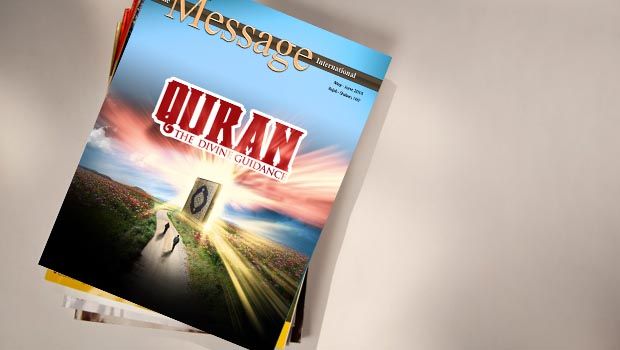
    Quran: The Divine Guidance

    “We have sent our messengers with clear evidences and sent down with them the Scripture and a balance that the people may maintain [their affairs] in justice” (Quran 57:25).

    “Surely, this Quran guides to that which is most just and upright” (Quran 17:9).

    The primary purpose of the Quran is to define the true set of beliefs with regard to the Creator and His creation, and to implement these beliefs in a system of laws that will benefit humanity in this life and the next.

    These are just two out of many verses in which the Quran describes itself. Those familiar with the subject matter of the Quran, no matter whether they recognize it as divine scripture, would agree that it is a book providing guidance for individuals, families, and society. It is a book that has profoundly influenced people around the world for centuries. The Quran continues to enlighten, and to change the lives of people from all walks of life. After simply reading a few passages of this magnificent book, a good number of people have embraced Islam. And the number of converts increases day by day. This is indeed one of the miraculous powers of the Quran.

    One analyst rightly says, “The primary purpose of the Quran is to define the true set of beliefs with regard to the Creator and His creation, and to implement these beliefs in a system of laws that will benefit humanity in this life and the next” (see “The Eternal Miracle of the Qur’an” by Yasir Qadhi in The Message International, May-June 2011, p.21). Interestingly, while there are people in the West who are obsessed with propagating a tag line that Islam oppresses women, those who convert to Islam in the West are overwhelmingly female. And these women are typically not unsophisticated individuals or social misfits; they are rather well-educated and accomplished. They have read the Quran, studied Islam, and made an informed decision. They were not deceived by those who spread fictions about the Quran. Instead they were moved to check it out for themselves. To quote Ustad Nouman Ali Khan, “This book has been attacked before and it will be attacked again. It is Allah’s word and no amount of criticism is going to take away from its glory” (see “Quran and Me,” in The Message International, May-June 2011, p.25).

    Any close and careful reading of the Quran reveals that this unique book presents a comprehensive system that balances human beings’ personal needs with the general good. It gives humanity a formula that speaks to moral and spiritual issues as well as practical, everyday affairs and aspirations. It has been said that there are three pillars upon which social justice in Islam is built: the absolute freedom of conscience; human equality as to worth, rights, and opportunities; and the reality of human and social interdependence. Each one of these pillars is necessary to the integrity and stability of social justice. Freedom of conscience, for example, allows the human being to choose voluntarily what he or she believes about God and the meaning and purpose of life. The one who chooses submission to God finds psychological and emotional liberation from thralldom to other people, material things, or any other earthly influence or relative power. That individual realizes it is Allah who creates man, provides him with sustenance, and holds him accountable in a final reckoning as to his belief and his deeds. Allah, the Almighty, says in the Quran: “Say: O people of the scripture [Jews and Christians], come to a word that is just between us and you, that we worship none but God, and we associate no partners with Him, and that none of us shall take others as lords besides God” (3:64).

    Interlocking with man’s freedom of conscience and right to choose his ultimate destiny is the principle of equality. Islam presents this principle to the world, that in spite of outward differences, all human beings are equal in human worth, in their basic civil, political, social, and economic rights, and in their claim to fair opportunity, without discrimination or politically imposed impediment. The Quran declares, “O people, We have created you from a male and a female, and formed you into nations and tribes that you might know one another. Indeed, the noblest of you in the sight of Allah is the most righteous of you. Surely Allah is wise and all-knowing” (49:13). This verse makes it clear that the diversity of nationalities, races, and cultures among human beings allows for greater discernment and understanding of the human condition. False notions of superiority set the stage for discrimination based on outward, superficial characteristics. This is nothing but folly, leading to injustice and conflict.

    The third pillar, human and social interdependence, is further commitment to mutual understanding and tolerance. Humanity is one family and each person is integral to the common good and social progress. This interdependence ties people together through empathy and affection; it also fosters positive, moral, and concrete action such as helping the needy and vulnerable.

    Social justice is one of the most important values and gifts of Islam, and Prophet Muhammad and his companions built a strong, stable society that reflected fraternity and fairness across the board. Those who want to understand firsthand, are invited to read the Quran, to experience for themselves the beauty and powerful appeal of Divine guidance and wisdom in its uncompromising call for social justice and peace.

  • Why Have We Normalized Islamophobia?

    Why Have We Normalized Islamophobia?

    The horrific attacks in Paris and San Bernardino have captured headlines and triggered responses from journalists, politicians, and religious leaders. Some Western heads of government have once again threatened a global war against terrorism, while some political commentators have even invoked World War III.

    A cottage industry of ideological, agenda-driven, anti-Muslim polemicists has sprung up, consisting of pundits, bloggers, authors, lobbyists, elected officials, and their resourceful and wealthy funders.

    In the United States, Republican presidential candidates and some thirty governors have called for a freeze on accepting refugees fleeing the civil war in Syria. Donald Trump, the leading Republican candidate for president of the United States, has pushed the envelope to its extreme, advocating a temporary freeze on all foreign Muslim immigration, as well as the monitoring or even the forced closure of American mosques. The result? Trump soared in the polls, as did fellow presidential candidate Ben Carson, who stated that “for a Muslim to become president of the United States…you have to reject the tenets of Islam.” In Europe, far-right political candidates continue to make political headway. The far-right Front National party of Marine Le Pen won nearly 30% of the vote in the recent French regional elections; although the party did not win any of the regions outright, the strong showing positions Le Pen as a future presidential candidate.

    Fear of Islam and Muslims in general—not just Muslim extremist and terrorist movements specifically—have become normalized in popular culture in both America and Europe. The anti-Islamic and anti-Muslim hate speech, bias, discrimination, and hate crimes—commonly referred to as Islamophobia—are on the rise. Islam Muslims and the vast majority of Muslims have been brush-stroked by and often equated with the kind of militant extremism and terrorism practiced by a mere fraction of Muslims, obscuring the fact that the vast majority of terrorist victims are themselves Muslim. This, in turn, has had a significant impact on the growth of Islamophobia as well as the domestic policies that have threatened Muslim civil liberties. But what are its causes?

    Is Islam the primary cause and catalyst for terrorism?

    Major polls have consistently reported that Islam is a significant component of religious and cultural identity in Muslim countries and communities globally, and thus an attractive tool for violent extremists as an instrument for legitimation and mobilization. However, the primary catalysts for extremism and terrorism are political grievances often intertwined with the use or misuse of religion. Osama Bin Laden and others like him appealed to long-standing political grievances among many in the Muslim world, the mainstream non-violent majority and extremists alike: Western influence, invasion, occupation; Western support for authoritarian regimes that claim to speak for all Muslims; uncritical bias and support for Israel from the American government in the Palestinian-Israeli conflict. Add to this the Iraqi and Syrian (Shiah-dominated) governments’ repression and killing of tens of thousands of civilians and other crimes.

    “Trump is ISIS’s greatest triumph: the perfect Manchurian Candidate who, instead of offering specific and realistic policies, preys on the fears of the public, doing ISIS’s job for them.”

    ISIS has shown a particular talent for coopting and exploiting all of these issues. Their execution videos, released when ISIS called itself the Islamic State of Iraq (October 2006–April 2013, Al-Furqan Media Foundation), underscored the importance of political grievances for legitimation of their actions and as a tool for recruitment.

    In addition to this, public displays of Islamophobia in the West, from political speeches and demonstrations to negative portrayals of Muslims in the media and hate crimes, are also effective tools for recruitment. Major studies have also found that Islamophobia increases significantly not only with incidents of domestic terrorism but also at election time, as seen in the 2008 and 2012 presidential and the 2010 Congressional elections. During those races, Newt Gingrich, Rick Santorum, Herman Cain and others sought to gain attention by making reckless statements about Muslims. In 2010 in particular, the public debate over the so-called “Ground Zero” mosque in New York became fodder for candidates looking for media coverage. Today, that trend continues with candidates such as Trump, Carson, Cruz, and others.

    Most Americans—who live in a country with a relatively small Muslim population—say they know little or nothing about Islam. Thus, it is not surprising that when terrorists commit their acts of violence in the name of Islam in Paris and San Bernardino, they are drawn to demagogues in America like Donald Trump and in Europe who bring Muslims and the Islamic faith to the forefront of the political debate.

    As Kareem Abdul-Jabbar recently wrote in the New York Times: “Trump is ISIS’s greatest triumph: the perfect Manchurian Candidate who, instead of offering specific and realistic policies, preys on the fears of the public, doing ISIS’s job for them.”

    To what extent has media contributed to the problem?

    Media Tenor, in its 2011 report “A New Era for Arab-Western Relations,” found that out of nearly 975,000 news stories from US and European media outlets, networks significantly reduced coverage on events in MENA to actions of Muslim militants. A comparison of media coverage in 2001 versus 2011 demonstrates the shocking disparity of coverage. In 2001, 2% of all news stories in Western media presented images of Muslim militants, while just over 0.5% presented stories of ordinary Muslims. In 2011, 25% of the stories presented militant image, while the images of ordinary Muslims remained stuck at 0.5%.

    The net result is an astonishing imbalance of coverage: an exponential increase in coverage of militants but no increase at all over the 10 year period in the coverage of ordinary Muslims—and that despite census figures confirming a rapidly growing Muslim population. The situation got worse, for example—between 2007 and 2013, 80% of all American news coverage about Muslims/Islam was negative.

    Over the past decade, there has been an explosion of social media websites targeting the Muslim community, with serious international and domestic consequences. A cottage industry of ideological, agenda-driven, anti-Muslim polemicists has sprung up, consisting of pundits, bloggers, authors, lobbyists, elected officials, and their resourceful and wealthy funders.

    An August 2011 Center Report, Fear, Inc., documented, based on IRS information, that $42.6 million flowed from seven foundations over ten years to support Islamophobic authors and websites. A CAIR Report in 2013, “Legislating Fear: Islamophobia and its Impact in the United States,” reported that the inner core of the US-based Islamophobia network enjoyed access to at least $119,662,719 in total revenue between 2008 and 2011.

    Totally lost or obscured in the fear and fog of war are the facts on the ground regarding American Muslims. Data from major polls (Gallup, Pew and others) and studies have reported that the vast majority of Muslims in America, for example, are educationally, economically, socially, and religiously an integral part of our American mosaic: members of Congress, the military, corporate, education and religious leaders, physicians, lawyers, engineers, scientists and small business owners. American Muslims were among the victims and first-responders on 9/11. In contrast, Muslim terrorists are a fraction of a fraction of 1%. No wonder that the US Attorney General, Senior Pentagon and Department of Homeland Security, as well as leaders in the Democratic and Republican parties, have rejected Donald Trump’s outrageous and inflammatory rhetoric and its threat to American principles and values and to the civil liberties of American Muslims.

    House Speaker Paul D. Ryan (R-Wis.) offered the simplest and most direct rebuttal Tuesday, the day after Trump called for a ban on Muslims entering the United States: “Freedom of religion’s a fundamental constitutional principle,” Ryan said.

    “It’s a founding principle of this country….This is not conservatism. What was proposed yesterday is not what this party stands for, and more importantly, it’s not what this country stands for. Not only are there many Muslims serving in our armed forces dying for this country, there are Muslims serving right here in the House, working every day to uphold and to defend the Constitution…. Some of our best and biggest allies in this struggle and fight against radical Islamic terror are Muslims—the vast, vast, vast majority of whom are peaceful, who believe in pluralism, freedom, democracy, individual rights. I told our members this morning to always strive to live up to our highest ideals, those principles in the Constitution on which we swear every two years that we will defend.”

    As President Barack Obama recently observed: “[I]t is the responsibility of all Americans—of every faith—to reject discrimination. It is our job to reject religious tests on who we admit into this country. It is our responsibility to reject proposals that Muslim Americans should somehow be treated differently. Because when we travel down that road, we lose…We were founded upon a belief in human dignity—that no matter who you are, or where you come from, or what you look like, or what religion you practice, you are equal in the eyes of God and equal in the eyes of the law.”

    A lot of things went wrong this past year, but there may be a silver lining. As Islamophobia intensified and gained more media attention, many Americans and the international community took notice. Google searches of the term “Islamophobia” spiked dramatically after Paris and San Bernardino. Prominent journalists, government and religious leaders, politicians, scholars, and members of the general public started calling out Islamophobia with more force, and leaders on both the right and left stood in solidarity with Muslims. Dozens of interfaith efforts also popped up around the country. So, despite the fact that Islamophobia was at its worst in 2015, there are reasons to hope that we are turning a corner.

  • The Universal Ethos of Moderation: Dismantling Extremism

    The Universal Ethos of Moderation: Dismantling Extremism

    Discussion continues among Americans about terrorism, extremism, jihad, and Islam. The discourse has three basic viewpoints. Put in simplistic frames, the anti-Islam perspective sees Islam as the “mother lode of bad ideas” and Muslims as an irredeemable enemy who evokes the specter of extremism and barbarity convulsing out of religious affiliation. The anti-Islam group voice alarm at the danger lurking at unsecured borders and in unsurveilled living rooms. The liberals, representing the second perspective, recoil at blanket condemnations of Islam and Muslims. Appreciators of pluralist society and multi-culturalism, they eagerly call for respect of Islamic and all other cultural traditions. This voice defends Muslims as a vast majority of peace-loving individuals who have had their religion taken hostage by extremists. The liberals are alarmed at the spreading bigotry that resonates with a wide swath of the American population, as fear and aversion cut through minds and hearts, ratcheted up by bellicose ultra-nationalists and ideologues. The third voice in this discourse, the Muslim one, is largely unceasing recitals of Islamic first principles — “Islam is peace” or the like — and dissimilitude to so-called “jihadists.” The response, both by choice and public demand, is an effort to answer for the political radicalization and terroristic behavior of individuals who commit incomprehensible violence and destruction — all in the name of Islam.

    Trying to Change the Narrative

    When Muslims say “Islam is peace” or “terrorism is un-Islamic” or “Muslim Americans are loyal to America” or “the extremists have hijacked the religion,” it makes no dent in the mindset of the antagonist of Islam. He seems determined to ignore any facts or any pronouncements that are contrary to his preconceived notion of who Muslims are and what Islam teaches. Yet, Muslims have been condemning terrorism ever since 9/11, with sincerity, without fail, loudly and clearly, as reflected in the public record. But the pronouncements are never enough to satisfy minds intent on ostracizing. And so demands for Muslim denunciation of terrorism continue unabated, and like a carnivorous plant, the antagonist sets his traps and gobbles up the condemnations like a feast of delectable insects. But his appetite is insatiable.

    When Muslims say “Islam is peace” or “terrorism is un-Islamic” or “Muslim Americans are loyal to America” or “the extremists have hijacked the religion,” it makes no dent in the mindset of the antagonist of Islam.

    With abhorrence deep-seated and habitual, he declares over and over that Islam and the Quran teach hatred and violence. Yet, going directly to the Quran, one is hard-pressed to find a scintilla of evidence of the purported malevolence. That does not stop the maligning of Islam, the faith of nearly one-fourth of the world’s population, even in academic circles. In the past 15 years, the dominant literature on “Islamic terrorism” has characterized the phenomenon as expression of religious fanaticism, intrinsic to Islam. An influential expositor on religious terrorism, Bruce Hoffman, in his book “Inside Terrorism,” writes, “For the religious terrorist, violence is first and foremost a sacramental act or divine duty executed in direct response to some theological demand or imperative. Terrorism thus assumes a transcendental dimension, and its perpetrators are consequently unconstrained by the political, moral or practical constraints that may affect other [secular] terrorists.”

    Liaquat Ali Khan, professor of law at Washburn University School of Law, writing in the Washburn Law Journal in 2005, describes the mindset of Hoffman and his ilk in his article, “The Essentialist Terrorist”: “There is a coordinated effort on part of academics, scholars, think-tankers, journalists and others to create a profile of Muslim militants as essentialist terrorists who commit heartless violence because they are spiritually addicted to violence. These authors argue that no concrete grievances or violations of rights cause Muslim militancy.” Khan notes that these writers obscure, knowingly or ignorantly, the core beliefs of Islam, thus making the case, quite successfully for those not familiar with authentic sources of the religion, that Islam and terrorism pivot from the same violence-prone provenance.

    Modern-Day Universal Civil and Political Rights

    Before taking a look at primary sources of Islamic doctrine appertaining to violence, warfare, taking of life, and related issues, it is useful to note that modern-day international law codifies rules for military action. In brief, these prescribe that wars be fought to achieve stated lawful aims; that military engagement should be brought to an end as quickly as possible; that unnecessary destruction should be avoided; that prisoners of war should be treated humanely and justly; that all civil and political rights must be respected; and that non-combatants should be protected from harm and hardship, among other rights of people and constraints upon warring parties.

    A Muslim cannot control how other people live their lives, can take responsibility only for his or her own words and actions, and regardless of the ignorance of any other person(s), the duty is to spread peace (28:55).

    International law also codifies the right to defend against aggression and to resist colonial and foreign domination and foreign occupation. In accordance with international human rights law, there are real and legitimate grievances — political, social, and economic — suffered by Muslims. Countries in the Middle East are targeted again and again by exploitative external actors, often colluding with internal authoritarians, resulting in egregious and contemptible violations of human rights. A birthright of individuals, the claim to self-determination, is encoded in Article 1 of the International Covenant on Civil and Political Rights (ICCPR). This treaty asserts the right of all peoples to “freely determine their political status and freely pursue their economic, social and cultural development,” among many other stipulated rights. The majority of nations in the world, including the United States, have ratified and signed on to this international treaty. The ICCPR, along with the Universal Declaration of Human Rights, and provisions in the U.N. Charter, comprise the body of international human rights law. Accordingly, human beings and states have the right to resist an aggressor and defend sovereign territory, including the right to use force. These legal forms of violence are also accorded legitimacy in any struggle for “liberation from colonial and foreign domination.”

    A great number of U.N. General Assembly resolutions have affirmed this legal right of resistance. United Nations General Assembly Resolution A/RES/33/24 of 29 November 1978 states, in part, that it “Reaffirms the legitimacy of the struggle of peoples for independence, territorial integrity, national unity and liberation from colonial and foreign domination and foreign occupation by all available means, particularly armed struggle” (emphasis added). Accordingly, the Iraqis who rose up to fight the military invasion in 2003 were not insurgents or terrorists. They were engaged in a lawful armed struggle to resist a foreign invasion.

    Universal Ethical Principles and Rights Codified in Islam

    The ethical principles codified in contemporary international law (albeit, too often ignored by modern states) with regard to warfare, prisoners of war, protection of civilians, and so on, were heralded centuries ago in Islamic law and tradition. Islam makes clear that there are uncompromising political, moral, and practical constraints in place. There are some general principles expressed in Quran and hadeeth that apply to any conflict or response to being wronged. For example, verse 41:34 instructs believers to repel the evil deed with something better; and there are Prophetic sayings such as “There should be neither harming nor reciprocating harm” (Ibn Majah and others); and “Do not be people without minds of your own, saying that if others treat you well, you will treat them well; and that if they do wrong, you will do wrong to them. Instead, accustom yourselves to do good if people do good, and not to do wrong [even] if they do evil” (Al-Tirmidhi). Getting more specific, there are many Quranic verses that speak to the constraints placed upon Muslims who engage in armed conflict. Some of these are as follows:

    Muslims are not to aggress or begin hostilities (see Quran 2:190)

    If the enemy inclines to peace, Muslims must do the same (Quran 8:61); if the enemy desists from fighting, then hostility must cease (see Quran 2:193)

    Those who are wronged or oppressed have every right to defend themselves, but they must guard against requiting that grievance with actions that may, in turn, slide into evil; so that making peace is preferable, if possible, and rewarded by God (Quran 42:40-42). Muhammad Asad writes in his commentary, “Hence, most of the classical commentators (e.g., Baghawi, Zamakhshari, Razi, Baydawi) stress the absolute prohibition of ‘going beyond what is right’ (i’tida’) when defending oneself against tyranny and oppression”

    Islam is, indeed, a religion of moderation, not one of extremism;.. peace is the objective, not conflict or war.

    While humans are given the right to defend themselves against wrongdoing and oppression, they are nonetheless advised to be patient in adversity and ultimately to forgive (Quran 42:43)

    Captives of war are to be set free or ransomed (Quran 47:4) — perhaps with the exception of war criminals, according to Shaykh Yusuf Al-Qaradawi in “Fiqh of Jihad”).

    Consider the Prophetic saying that there should be neither harm nor reciprocating harm, along with this verse: “…take not life, which God has made sacred, except by way of justice and law: thus does He command you, that you may understand” (6:151). These two Islamic teachings — on their own — dismantle the myth that “violence is first and foremost a sacramental act or divine duty” disseminated by the “violence is intrinsic to Islam” propagandists. These two teachings also demolish the justifications made by those who engage in terror in the name of Islam, who target non-combatants and civilians. Add to them the following hadith: “All creation is the family of God, and the person most beloved by God is kind and caring toward His family” (Agreed upon). These are not doctrines that proffer violence as divine duty; these are doctrines, promulgated a millennium and a half ago, that predate and foreshow the loftiest of contemporary humanitarian law.

    As to why fighting is sometimes necessary, the Quran cogently states: “And if God had not enabled people to defend themselves against one another, corruption would surely overwhelm the earth: but God is limitless in His bounty unto all the worlds” (2:251). And another verse: “And how could you refuse to fight in the cause of God and of the utterly helpless men and women and children who are crying, ‘O our Sustainer! Rescue us from this town whose people are oppressors, and raise for us, out of Thy grace, a protector, and raise for us, out of Thy grace, one who will bring us succor!” (4:75).

    In addition, the Prophet (pbuh) put in place many guidelines including the prohibition on killing children, women, the elderly, the sick or wounded, individuals in places of worship, or animals except for food; the forbidding of destruction of towns or villages or any places of human habitation; the prohibition of spoiling cultivated fields and gardens or uprooting or destroying trees. The many Quranic and Prophetic guidelines and instructions provide ethical principles of warfare, clearly and compellingly forwarded by Islam, very similar in detail and substance to modern-day laws of warfare.

    Skewing the Definition of Terrorism

    One important point should be made here. When it comes to Muslims, the following are all lumped together: acts of self-defense against an invading force, acts of resistance against colonialist domination, desperate acts of rage against tyranny and oppression, or deranged acts of murder by the criminally-minded, by one individual or a group. All these acts get labelled as terrorism, even if the targets are military rather than civilian. But the untold millions of men, women, and children killed by bombs, drone attacks, political sanctions, and all the other “counter-terror” or “counter-insurgency” campaigns, are whitewashed as unfortunate collateral damage in the “War on Terror.”

    Section 2656f(d) of Title 22 of the United States Code defines the term “terrorism” as “premeditated, politically motivated violence perpetrated against non-combatant targets by subnational groups or clandestine agents.” It is not unintentional that “subnational” groups only fit the definition. What about “national” groups, i.e., countries, which engage in “politically motivated violence perpetrated against non-combatant targets”? To cut to the chase, we can quote Noam Chomsky as he poses the obvious question: “I don’t know what name you give to the attack that’s killed maybe a million civilians in Iraq and maybe a half a million children, which is the price the Secretary of State [Madeline Albright] says we’re willing to pay. Is there a name for that?”

    Skewing the Meaning of Jihad

    The Arabic word jihad means “struggle,” or exerting oneself to the utmost in any good or beneficial endeavor. Yet, mention of the word causes immediate paroxysms of fear and disdain in the minds of many Americans. Sheikh Rashid Al-Ghannoushi, points out in “What is New about Al-Qaradawi’s Fiqh of Jihad?” (available online) that Shaykh Al-Qaradawi makes clear distinction between jihad and qital (fighting), noting that the Quranic command to undertake jihad is a Makkan verse, at a time when there was no fighting. Jihad in that verse referred to the jihad of dawah. Al-Qaradawi quotes Shaykh Ibn Taymiyya, that jihad “can be with the heart, by calling to Islam, by countering invalid arguments, by advising or facilitating what is beneficial to Muslims, or by one’s body — that is, fighting.” Shaykh Al-Ghannoushi stresses, though, that “The natural state of affairs in relations between Muslim and others is peace and cooperation in goodness. Islam abhors war and only engages in it unwillingly and as a necessity.”

    Professor T.J. Winter (Shaykh Abdal Hakim Murad), the Shaykh Zayed Lecturer of Islamic Studies in the Faculty of Divinity at Cambridge University and Director of Studies in Theology at Wolfson College, has aptly noted, “Terrorism is to jihad what adultery is to marriage.” Al-Ghannoushi, along these lines, observes that irhab, terrorism, as carried out by groups in the name of Islam, is illegitimate, that declaring “war on the whole world is an illegitimate use of jihad in an inappropriate setting, terrorizing innocent people – Muslims and non-Muslims – in order to achieve alleged political ends inside or outside Muslim lands, flagrantly contravening the principles and ethics of jihad in Islam. Hence Al-Qaradawi [in Fiqh of Jihad] condemned violent acts committed by extremist groups in Muslim and non-Muslim countries against innocent people, whether tourists or others. He further stripped the indiscriminate killing and shedding of innocent lives committed by these groups of any legitimacy.”

    Bernard Lewis, Professor Emeritus at Princeton University, is considered in Western circles to be a leading scholar and expert on the Middle East. He is an unapologetic critic of modern Muslim societies and cannot, therefore, be accused of being an apologist for Islam. Yet, he writes quite forthrightly in his book, “Islam: The Religion and the People”: “Muslim fighters are commanded not to kill women, children, or the aged, unless they attack first; not to torture or otherwise ill-treat prisoners; to give fair warning of the opening of hostilities or their resumption after a truce; and to honor agreements… At no time did the classical jurists offer any approval or legitimacy to what we nowadays call terrorism. Nor indeed is there any evidence of the use of terrorism as it is practiced nowadays” (p. 151). Writing in the Wall Street Journal on September 27, 2001, following the 9/11 attacks, Lewis states: “What the classical jurists of Islam never remotely considered is the kind of unprovoked, unannounced mass slaughter of uninvolved civil populations that we saw in New York…For this there is no precedent and no authority in Islam.”

    Dismantling Extremist Ideology

    Shaykh Al-Ghannoushi writes, “Al-Qaradawi is extremely careful to distinguish between extremist groups that declare war on the whole world, killing indiscriminately, tainting the image of Islam and providing its enemies with fatal weapons to use against it, on the one hand, and on the other groups resisting occupation. And as much as he condemns the former and delegitimizes its foundations, he defends the latter, and calls on the Ummah to support them, particularly in Palestine, as long as their operations are against military targets.” Al-Ghannoushi goes on to summarize Shaykh Al-Qaradawi’s dismantling of each and every argument used by those who wage war on the world. The ideology of ISIS is founded on the theory of the entire world being the abode of war if it is not the abode of Islam, with corresponding aberrations including expansion of territory under their control through use of ultraviolent and terroristic means, including suicide bombings against Muslim authority such as in their May 2015 offensive against Ramadi, in Iraq; forcible conversions to Islam; and acts of cruelty, persecution, and murder against local populations, both Muslim and non-Muslim, that shock and appall the staunchest heart.

    In order to achieve their dominationist ambitions, they must disregard the multitude of verses in the Quran, above and beyond the many already cited, that declare that even when fighting becomes inevitable against aggressors, Muslims are not to exceed limits of morality and decency (2:190); that there is no compulsion in religion (2:256); that when an individual rejects Islam, Muslims are to remember that their responsibility is only to deliver the message (3:20).

    This point, that there is no coercion in Islam and that Muslims are only to deliver the Message and leave the decision to embrace or reject as a matter between that individual and God — there are so many verses in the Quran that convey this same principle: the Prophet was not sent as a “keeper over them” (4:80, 6:104, 6:107, 27:92); that nothing is incumbent on the Prophet but to deliver God’s message (5:99); that Muslims must keep in mind that whoever cleaves to the truth does so for his own good and those who stray harm only themselves, and that, again, the Prophet, and by extension, Muslims in general, are not custodians over them (10:108); that Muslims are to exhort others wisely and discuss with them in the best manner, knowing that God sees who is on the right path and who goes astray (16:125); that a Muslim cannot control how other people live their lives, can take responsibility only for his or her own words and actions, and regardless of the ignorance of any other person(s), the duty is to spread peace (28:55).

    Those who founded and direct ISIS, and all those who follow their ideology and participate in their terror campaign, must ignore all the above verses and the many more that are spread throughout the Quran. They have to ignore the divine injunctions, listed above, that warn against aggression, or refusing to accept overtures of peace, about not allowing persecution to ultimately turn the persecuted into a persecutor.

    They spurn the Quranic ordinance that all people have the right to due process, that life may be taken only within the parameters of justice and law, that Islam must not be forced upon any individual in that only by voluntary choice does it have any meaning and value for that person. Extremists also have to ignore all the Prophet’s warnings about not harming non-combatants, restraining from treachery, destruction of vegetation or animals, or places of human habitation. And then there is a clincher: “And if your Lord had pleased, surely all those who are on the earth would have believed — all of them; will you then force men till they become believers?” (10:99).

    Moderation, Not Extremism

    In what universe could the verse just cited conjure up a world in which Muslims are bent on world domination, where non-Muslims are forced to convert, where intolerance rules the day?! Shaykh Al-Qaradawi writes, “[W]e can live, under Islam, in a world that promotes peace and security rather than fear, tolerance rather than fundamentalism, love rather than hatred. We can live with the United Nations, international law, human rights conventions and environmentalist groups.” Al-Ghannoushi underscores that “Al-Qaradawi has developed a principal theory in contemporary Islam, from which all his views and stances emanate, and to which he tirelessly calls, widening its appeal and marginalizing its opponents – that is the principle of Islamic Wasatiyya or moderation. This was inspired by the verse in the second chapter of the Qur’an, ‘And thus we made you into a middle (wasat) nation.’ Thus, he presents Islam as the middle position between opposing and conflicting rigid positions; as the middle ground that brings all together, a middle position between materialism and spiritualism, between individualism and collectivism, between idealism and realism, etc.”

    One cannot read the many verses and hadeeth throughout this article and come away with anything but conviction that Islam is, indeed, a religion of moderation, not one of extremism; that is seeks to bring succor to the world, not terror; that peace is the objective, not conflict or war; that freedom of conscience is to be safeguarded rather than corralled or obliterated. Next time someone asks you about Islam’s position on violence, terrorism, or jihad, have ready on your tongue some of the salient points, some of the eloquent verses, some of the revealing hadith. It may be your coming-of-age child who asks, so learn the points, verses, and hadith by memory, so that you can speak from the heart. Make that a spiritual jihad against terrorism.

    Will the antagonists listen to an authentic reading of Islam? Some yes, some no. “And say: ‘The truth is from your Lord.’ Then whosoever wills, let him believe, and whosoever wills, let him disbelieve” (Quran 18:29).