بسم الله الرحمن الرحيم

Tag: Islamophobia

  • A Singular Struggle: How Black Muslim Woman Experience Islamophobia and Racism

    A Singular Struggle: How Black Muslim Woman Experience Islamophobia and Racism

    In 2020, I wrote an article titled “On Being Othered In Muslim & Non-Muslim Spaces” where I discussed the anti-black racism, colorism, prejudice, and Islamophobia black Muslim women face. Five years later, I wish I could say these issues have faded, but, sadly, they persist. Some might say this topic has been discussed endlessly, but how can one grow tired of a story that keeps repeating itself? How can you ignore an experience that continues to shape your everyday life?

    Islamophobia is an irrational fear, hostility, or hatred directed at Islam and Muslims. It can manifest in hate crimes, stereotypes, negative media portrayals, employment discrimination, and policies designed to exclude or monitor Muslim populations. This hostility is often fueled by misinformation, political rhetoric, and a fundamental lack of what Islam teaches.

    On the other hand, anti-black racism is deeply rooted in the legacies of slavery, colonialism, and segregation. It shows up racial profiling, economic disparities, police brutality, cultural erasure, and exclusion from professional and social opportunities.

    For black Muslim women, these two forces collide in ways that create a distinct and often overlooked form of discrimination. In most environments, we are either being racially discriminated against or religiously profiled, and many times, both experiences overlap, intensifying our challenges.

    The Crossroad

    In the West, Islamophobia is heavily racialized, centering predominantly on Arab and South Asian Muslims. When stories of Islamophobic violence, discrimination, or prejudice make headlines, the faces and names that dominate the conversation typically belong to these communities. For decades, the media and political discourse has portrayed Islam as something foreign, as something that belongs to the Middle East or South Asia. This narrow framing erases the presence of black Muslims, despite the fact we make up a significant portion of the global Muslim population.

    Black Muslims have played an integral role in shaping Islamic history and culture, yet our struggles with Islamophobia are frequently dismissed or ignored. This erasure is so common that when black Muslims face discrimination, it’s rarely recognized as part of the broader Islamophobic landscape. Instead, these experiences are often categorized solely as anti-black racism, as if our religious identity has no bearing on the biases we encounter.

    This creates what can be described as double invisibility, which leaves black Muslims vulnerable to both anti-black racism and Islamophobia while receiving little to no advocacy or support. Hate crimes, workplace discrimination, police surveillance, and racial profiling affect black Muslims just as they do other Muslim communities. However, because mainstream narratives rarely associate blackness with Islam, these stories remain in the shadows, leaving black Muslims to navigate these injustices alone.

    Unique Struggles

    Imagine going to work, knowing you have the experience, knowledge, and qualifications for a leadership role, yet continually being overlooked. When promotions arise, they always go to someone else, someone who never looks like you. Or learning that you have more years of experience, yet your salary is significantly lower than that of your lateral colleagues.

    Then, after enduring these challenges, you arrive at your local masjid, only to be met with skepticism about your faith. You’re questioned about how authentic your Islamic knowledge is, how much of the Qur’an you’ve memorized, or whether you are a “real” Muslim because your ancestry oftentimes isn’t seen as valid, or does not trace back to a Muslim-majority country.

    These are not hypothetical scenarios. They are realities many black Muslim women have experienced for decades and continue to face today.

    In addition to racial and religious discrimination, black Muslim women also face colorism and identity policing within both Muslim and non-Muslim spaces. Western beauty standards, which glorify fair skin, straight hair, and uncovered femininity, dominate mainstream media and pop culture. These ideals infiltrate Muslim spaces as well, where black Muslim women often are placed at the bottom of the hierarchy. For example:

    • We’re often the last to be invited to speak at Islamic lectures.
    • We’re frequently the last to be acknowledged for our religious or secular scholarship.
    • We’re usually the last to be represented in Muslim media.

    Within the broader Muslim community, our voices are almost always excluded from mainstream platforms; within non-Muslim spaces, we’re either tokenized or ignored. It’s an exhausting cycle of invisibility and hypervisibility, constantly proving we belong while fighting against the forces that try to erase us.

    Black Muslim Women Own Their Narratives

    Despite these challenges, black Muslim women have never allowed these barriers to define or limit us. Instead, we’ve built our own platforms, movements, and communities, using our voices to reclaim space and tell our own stories.

    For over a decade, the strength and resilience of black Muslim women have been magnified through social media platforms like X (formerly Twitter), Instagram, YouTube, and TikTok. Through these digital spaces, we’ve shared our experiences, built communities, and documented our histories; stories that mainstream Muslim and non-Muslim platforms often ignore.

    Take for example Dr. Su’ad Abdul Khabeer, the creator of “Sapelo Square,” an award-winning media and education collective that produces and archives the black Muslim experience in the U.S. Her work has been instrumental in preserving the voices and histories of black Muslims, ensuring our narratives are not erased.

    Or Hakeemah, the visionary behind “Double Pin It.” While her platform is centered on modest fashion, she’s spoken openly about facing both Islamophobia and anti-black racism in Muslim spaces. Her work not only highlights the intersectionality of these struggles but also serves as an example of a black American Muslim woman staying true to her faith and identity despite societal pressures.

    Black Muslim women have always been at the forefront of community-building, advocacy, and storytelling. We refuse to be invisible, and we continue to create spaces where we are seen, heard, and valued.

    Moving Forward

    One thing that remains true about black women is that we are always on the front lines of solidarity and support for others. But how often are those sentiments truly reciprocated?

    It’s time for other ethnic communities within Islam to amplify black Muslim women’s voices, not just in moments of crisis but as an ongoing commitment to inclusion and justice. Here are a few ways this can be done:

    • Support black Muslim-led organizations and initiatives.
    • Invite black Muslim women onto your platforms and into your spaces, not as an afterthought but as valued contributors.
    • Educate yourself on the history of black Muslims, particularly in the U.S.
    • Speak out against racism and prejudice within your own circles, families, and ethnic communities.

    True solidarity isn’t just about sharing hashtags, it’s about creating inclusive spaces where all Muslims, regardless of race, feel a sense of belonging.

    When we push past our discomfort and engage in honest conversations, we often realize that our struggles, though unique, are deeply connected. Instead of allowing our differences to divide us, we can use them as opportunities for deeper understanding and community-building. Because at the end of the day, justice is only justice when it includes all of us.

  • Un-Islamic, Radical Terrorists: A Tool for Election Hype

    Un-Islamic, Radical Terrorists: A Tool for Election Hype

    Neighbors were frightened of Mohamed Lahouaiej-Bouhlel, the man who plowed a truck into a celebratory crowd in Nice, France, killing more than 80 people and injuring over 200. People who knew him explained that he was anything but a devout Muslim. He had a record of petty crime, often displayed unrestrained bouts of anger, drank alcohol, used drugs, and neglected to pray or fast. Bouhlel, in recent times, was convicted of assaulting a motorist, and abused his estranged wife. In fact, he had a history of mental illness documented by visits to psychologists in Tunisia. What remains unclear is whether or not he had any direct links to terrorist networks.

    Inflammatory speech invariably has a negative impact on the unity of our nation

    Gunman Omar Mateen, who opened fire inside a nightclub in Orlando Florida, had a long history of behavioral problems, documented by school records over the years. He was expelled, arrested and eventually enrolled in an alternative high school after numerous fights in which he injured other students, and what one of his teachers noted as his “inability to show self-control.” According to witness Patience Carter, who survived the Orlando rampage, Mateen announced his motive as he murdered club-goers, saying he wanted “Americans to stop bombing his country.” His parents were originally from Afghanistan.

    Richard Reid, also known as “the shoe bomber,” attempted to take down an American Airlines passenger plane in 2001 by igniting explosives contained in his shoes. Upon his arrest, he told officials conducting his interrogation, “Your government has sponsored the torture of Muslims in Iraq and Turkey and Jordan and Syria with their money and weapons. It’s in your hands.” Like the others, Reid had a history of delinquency and criminal offences. When he was born, his father was absent, having been incarcerated for car theft. After dropping out of school at the age of 16, Reid pursued a life of crime, often winding up in prison himself.

    “Do you think that you will enter Paradise without such [trials] as came to those who passed away before you? … Yes! Certainly, the Help of God is near!” (Quran 2:214)

    ISIS entry form documents of roughly 4,000 foreign recruits recently released to the Associated Press prove what Muslims have been saying for years. In an August 19 article in the Times of Israel, the authors note that the terrorist organization known as ISIS, “preys on those with minimal connection to Islam, because the more they know the less likely they are to endorse its methods.” Recruiting members largely ignorant of Islamic teachings, allows extremist organizations to indoctrinate them with a distorted version of Islam, designed to help advance its aggressive territorial expansion and slaughter of innocent men, women, and children.

    Compulsive Use of Misnomer: ‘Islamic’ Terrorism

    According to these and many more examples, it appears that an overwhelming number of terrorists display similar characteristics: ignorance and lack of devotion to Islam, mental illness, recurrent criminal behaviors, and violence towards innocent people. They are motivated – not by religion – but by geopolitical grievances and a thirst for vengeance. Despite these glaring facts, and their availability to the public, we continue to witness the term “Islamic” consistently being attached to heinous terrorist crimes and their perpetrators.

    Certain politicians, TV personalities, and pundits help form public sentiment surrounding attacks, branding them as “Islamic” while the shock and horror are fresh, and details that undermine the “Islamic terror” narrative are yet unavailable. Information acquired in the investigations following attacks, in most of the cases, tends to paint an entirely different picture: individuals with a criminal history and psychological and behavioral issues, who are motivated by anger and driven by very real and disturbing geopolitics.

    The confidence with which the initial speculations were presented, and the subsequent time that elapses in which people return to their daily routines, inevitably renders subsequent investigations and analysis far less newsworthy. The lack of sensation and inconsistency with the favored theme of “Islamic terror” renders almost inconsequential the ensuing findings such as non-existent religiosity, lack of clear ties to terrorist networks, no overtly political motivations, records of criminal activity, and/or histories of mental health problems.

    A Tool for Election Hype

    While we can’t always assume that the statements made by political candidates are intentionally misleading, this election season is a perfect example of disinformation about Islam and Muslims being used for political gain. From the inflammatory rhetoric of reality star and now presidential candidate, Donald Trump, to the attempts to garner attention by former Republican Speaker of the House Newt Gingrich, we are seeing a lot of very strong words being thrown around without much concern for the real consequences they have for average Muslim citizens. And inflammatory speech invariably has a negative impact on the unity of our nation. Polarizing rhetoric such as Trump’s infamous call for Muslims to be banned from entering the United States, and his blanket (and frequently grammatically challenged) statements like “I think Islam hates us,” have done more than raise eyebrows.

    Newt Gingrich, on national television went so far as to say, “Western civilization is in a war. We should frankly test every person here who is of Muslim background and if they believe in sharia, they should be deported. Sharia is incompatible with Western civilization.” Statements like these have proven to elicit intense levels of bigotry, hatred, and violence that have apparently been pent-up in a portion of the American electorate.

    The Pressure of Polarization

    These alarmist calls from powerful people to equate Islam with terrorism urge the general populations of Western countries to associate all Muslims with violence and danger, thus engendering distrust and fear of all things Islamic. Consequently, we are seeing an unprecedented rise in crimes against Muslims in the United States and elsewhere ranging from verbal abuse and discrimination to physical assaults, and sadly, hate-motivated murder. We can sense the increasingly negative sentiments in our neighborhoods and communities. Many of us feel awkward, ashamed, and even frightened to go to public places immediately after tragedies such as the recent attacks in France, San Bernardino CA, and Orlando FL. The pressure may be felt even more by those of us who outwardly appear to be Muslim, primarily women who cover and men who choose to wear ethnic clothing and kufis.

    David Lisnard, mayor of Cannes in southern France, fueled controversy with incendiary statements regarding Muslim women who choose to go swimming, yet insist on covering their bodies while doing so. Referring to a ban on Muslim swimwear he said, “I simply forbid a uniform that is the symbol of Islamic extremism.” Thierry Migoule, Cannes’ head of municipal services, echoed the mayor’s sentiments, saying, “We are not talking about banning the wearing of religious symbols on the beach… But ostentatious clothing, which refers to an allegiance to terrorist movements which are at war with us.” Yes, they both just said that any Muslim woman who chooses to cover her body while swimming is displaying support for terrorism and extremism. Do they hope to force Muslim women to acquiesce to their standards of fashion and stop standing out so confidently in their voluntary modesty? Whatever it is behind those words, the result is the same: an increasingly polarized population, pitting the general population against Muslims.

    These politicians have whitewashed the complexity of reality and presented a simplistic picture to the public: good vs. evil – and they are defining what means good and what means evil. People are afraid for their lives, for their futures. These politicians are capitalizing on that fear and telling all of us: choose a side – or else. This, in turn causes innocent people to appear guilty.

    The Heat is On

    Being under constant suspicion can cause individuals to feel guilty – even when totally innocent. Dalia Mogahed explained how she felt after 9/11, saying, “Not only had my country been attacked, but in a flash, somebody else’s actions had turned me from a citizen to a suspect… for the first time in my life, [I was] afraid for anyone to know I was a Muslim.” This guilt by association is advanced and reinforced by few, but very loud voices. After the Nice attacks, Kelvin Mackenzie, a columnist from the UK’s Sun newspaper, wrote a controversial column questioning why a “young woman wearing a hijab” had been allowed on television to report on the attack in Nice. He was horrified that the reporter, Fatima Manji, was visibly Muslim. He asked. “Was it appropriate for her to be on camera when there had been yet another shocking slaughter by a Muslim?”

    Avoiding the Herd Mentality

    More than one-third of those killed by the attacker in Nice were Muslims. According to a report published by the Counter Terrorism Center at the US Military Academy, Al-Qaeda kills over seven times more Muslims than non-Muslims. The majority of ISIS’ victims are Muslims. If it’s offensive for a Muslim to report a terror attack on television, is it also offensive for us to mourn our dead? We have to reject this idea outright and think critically: was it wrong for a Christian to report on the murder of Dr. George Tiller by anti-abortionist terrorist Scott Roeder in 2009, or the Centennial Olympic Park bombing in 1996 by Eric Rudolph who had ties to the white supremacist “Christian Identity” theology and movement? In fact, both Roeder and Rudolph had ties to another Christian terrorist group, The Army of God. To suggest that a Christian reporter should not cover a terror act committed by a fellow Christian is clearly, easily, and immediately recognized as preposterous.

    In the face of this monumental and growing problem, I refuse to allow others to determine how I feel about myself. As Muslims, we have to be the masters of our own thoughts and allow no one to convince us we are guilty by association due to our faith. That our modest attire or names or beards are incriminating, that the word “Islamic” must appear next to its antithesis, terrorism… No! The Quran differentiates between human beings who reason and those who follow the crowd without intelligent thought: “Or do you think that most of them listen or use their reason? No, they are but like cattle. Rather, they are even less conscious of the right way” (Quran 25:44).

    Fighting Doubts

    Prophet Muhammad said, “The people will see a time of [much-needed] patience in which someone adhering to his religion will be as if he were grasping a hot coal” (Tirmidhi). It’s becoming clearer that this applies to our current time. Some of us feel like giving up. Being under constant scrutiny, guilt-tripped, cursed at, ridiculed, and hated – it is exhausting. It might appear easier if we just took our headscarves off, shaved our beards, and changed our names. The thing is, though, the solution is in the same hadith – the heart of the issue — that we adhere to our faith. Letting go of it will never lead us to success or ease.

    We’ve Got a Choice to Make

    It’s election season. Time to make a decision. And while it’s important to exercise your right at the polls, there’s an even more important choice to make, right now. Allah says, “The truth is from your Lord, so whoever wills – let him believe; and whoever wills – let him disbelieve” (18:29). Our akhirah is waiting and the choices we make today will be there for us to see, either as witnesses against us or in our favor. It helps to remind ourselves again and again:

    “Do you think that you will enter Paradise without such [trials] as came to those who passed away before you? … Yes! Certainly, the help of God is near!” (Quran 2:214). All of this life is intended to be a test. If it weren’t this or that test, it would be something else. So, remember the advice of Jacob to his sons, “Despair not of relief from God. Indeed, no one despairs of relief from God except the disbelieving people” (Quran 12:87).

    All the Information We Need

    It’s about time that we turn off our TVs, sign out of our social media accounts and turn to the Quran. The Quran provides the bigger picture and lays out a plan for the future – putting everything into proper perspective: “So be patient. Indeed, the promise of God is truth. And ask forgiveness for your sin and exalt with praise of your Lord in the evening and the morning. Indeed, those who dispute concerning God’s signs without authority having come to them – there is not within their hearts except pride, [the extent of] which they cannot reach. So seek refuge in God. Indeed, it is He who is the Hearing, the Seeing” (Quran 40:55-56).

    Allah’s plan is geared towards our success, if we choose to follow it. With Allah’s help, we can make our ummah great again. “O you who believe! Persevere in patience and constancy; vie in such perseverance; strengthen each other; and fear Allah that you may be successful” (Quran 3:200).

  • Is Islamophobia a Part of the Republican Agenda?

    Is Islamophobia a Part of the Republican Agenda?

    Presidential elections are supposed to give potential voters a look inside the minds of potential candidates seeking America’s highest office. Candidates representing our two party system typically give the public their platforms and agendas for the economy, security, and foreign relations. On the Republican side, there have always been some discriminatory remarks toward minorities, immigrants, women, or the poor. After the September 11, 2001 World Trade Center attacks, however, the public has also heard campaign rhetoric from Republican candidates and their surrogates that is rife with anti-Islam and anti-Muslim sentiment. This year is no different, except that the rhetoric is more hateful and outrageous, and has contributed to an unprecedented level of violence towards Muslims and their institutions. Presidential nominee Donald Trump has said he wants to prevent Muslims from entering the United States, and advocates for a Muslim identity card and national database. Between almost exclusively Republican led anti-Shariah legislation and Republican presidential candidates spewing anti-Muslim vitriol to garner votes, American Muslims are increasingly concerned that the Republican party seems intent on driving a wedge between the Muslims living in the U.S. and the general population.

    The network of anti-Islam groups collects yearly donations of $34 million on average, according to the 2016 report, Confronting Fear: Islamophobia and its Impact in the United States.

    Islam Plus Phobia Equals Hate

    A phobia is “a persistent, irrational fear of a specific object, activity, or situation that leads to a compelling desire to avoid it.” Islamophobia, as a term, was first used by the French as early as 1916. In an article by Professor Edward Said in 1985, “Orientalism Reconsidered,” the author bemoaned western Orientalists’ lack of understanding that Islamophobia, like anti-Semitism in the 19th century, “has stemmed from the same source, has been nourished at the same stream.” A more recent use of the word was in the 1991 UK publication, Runnymede Trust Report, which defined it as an “unfounded hostility towards Muslims, and therefore fear or dislike of all or most Muslims.” The Berkeley Center for Race & Gender (CRG) expanded the definition further to “a contrived fear or prejudice fomented by the existing Eurocentric and Orientalist global power structure…” which “reaffirms a global racial structure through which resource distribution disparities are maintained and extended.” Islamophobia has become a politically charged term in recent years, spawning reports and websites that attempt to understand this phenomenon which has gripped Europe and the United States to such a degree that governments are willing to create legislation to either support or combat it.

    This manufacturing of hate has monetized into a cottage industry, “currently comprised of at least thirty-three (down from thirty-seven in 2013) groups whose primary purpose is to promote prejudice against or hatred of Islam and Muslims.” This network of anti-Islam groups collects yearly donations of $34 million on average, according to the 2016 report, Confronting Fear: Islamophobia and its Impact in the United States, a collaborative research project of the UC Berkeley Center for Race and Gender (CRG) and the Council on American-Islamic Relations (CAIR). CAIR and others have rightly termed the anti-Islam groups a network because these groups regularly support each other — sharing leadership, funds, and the singular goal to “stop” or “destroy” Islam. It is not surprising to anyone that global and domestic terrorist attacks correlate to a rise in Islamophobia, measured by both the number of hate crimes against Muslims and media bias such as perpetuating, or at least not contesting, the canard that Muslims, and especially their leaders, don’t condemn terrorism.

    Republicans sponsored 80 out of 81 anti-Islam bills or amendments between 2013 and 2015

    Mosques and Islamic centers routinely release warnings to their communities to be extra vigilant in the wake of such attacks, while also issuing press releases condemning those attacks and simultaneously reminding the public that in Islam, “Whoever kills a person, unless [as punishment through due process] for murder or mischief in the land, it is as though he has killed all mankind. And whoever saves a life, it is as though he had saved all mankind” (Quran 5:32), as quoted in an ADAMS Center press release). What might surprise some outside the Muslim community is that Islamophobia has been an integral part of America’s election cycles, especially presidential ones, at least since 9/11. According to the Confronting Fear report, “both the 2010 spike in incidents and the late 2015 spike both occurred when Islam was an election campaign issue lends additional weight to the argument that ‘levels of anti-Muslim sentiment follow trends in domestic U.S. politics, not international terrorism.’”

    Who and What Is the Islamophobia Network?

    The Islamophobia network has several components which they meticulously use to create the perception that Islam is at war with America: religion, media, and legislation. CAIR identified 74 major groups in their latest report. These active groups provide financing, vast media support, and grassroots mobilization for protests and other public events, or votes for anti-Muslim legislation and Republican candidates. The religious right has several organizations that foment Islamophobia: The Eagle Forum, the American Family Association, the Tennessee Freedom Coalition, American Center for Law & Justice, and Christians United for Israel. Along with right wing media hosts like Rush Limbaugh, Sean Hannity, Mike Savage, Glenn Beck, Mark Levin, and Bryan Fischer, they promote anti-Islam ideas and sentiments with dogmatic consistency

    Right wing media such as Fox News, and certain fundamentalist Christian groups such as the Christian Broadcasting Network (CBN), certainly spend a great deal of time attacking Islam and Muslims.

    In fact, many of the so called experts that are interviewed on Fox and on conservative radio are also the leaders of organizations inside the Islamophobia network, including Pamela Geller’s Stop Islamization of America, Frank Gaffney’s Center for Security Policy, and Brigette Gabriel’s ACT! for America. Geller, Gaffney, and Gabriel are organizers and speakers at the largest Islamophobia summit, Values Voter Summit (VVS), where the religious right meets with conservative media representatives and Republican candidates running anti-Islam campaigns. Rand Paul, Ted Cruz, and Marco Rubio, all presidential hopefuls during this year’s GOP primaries, addressed the 2013 summit, while former Rep. Michelle Bachman, Sen. Rand Paul, and former Gov. Mike Huckabee spoke at the 2014 summit. Trump, Paul Ryan (current Speaker of the U.S. House of Representatives), and Ted Cruz are scheduled speakers at the summit in September of this year.

    According to the Fear Inc. 2.0 report, “segments of the religious right have been at the forefront of fear mongering about Muslims.” The report goes on to paint an even darker picture of the fundamentalist mindset. “Through their clash of civilizations discourse and even messianic ideas of fulfilling prophecy, religious right leaders have managed to make stigmatizations of Muslims politically valuable.” That eerily parallels another group also hastening the “end of days” through an interpretation of religious prophecy. The Islamic State has their own media wing, promoting an apocalyptic clash of civilizations. A researcher for The Institute for the Study of War, Harleen Gambhir, writes in “The ISIS Trap,” a report of the Center for American Progress (CAP): “ISIS’s plan [is] to eliminate neutral parties through either absorption or elimination, in preparation of eventual all-out battle with the West.” in the ISIS Trap, a report of the Center for American Progress (CAP).

    Legislating Hate State by State

    The 2008 elections marked the last time that Islamophobia held sway as a central issue in a national election. Although they failed to stop Senator Barack Obama from becoming President, the political right achieved quiet success using manufactured hate of Islam on a state level. Scared by the phony specter of Shariah law creeping into the judiciary, right-leaning Americans helped to not only pass state anti-Shariah laws but blocked the building and expansion of mosques. The publication of the Center for Security Policy (CSP) 2010 report, Shariah: The Threat to America, is responsible for many of the anti-Shariah laws that Republican legislators passed, or attempted to pass, across the country. Republicans sponsored 80 out of 81 anti-Islam bills or amendments between 2013 and 2015, note the authors of Confronting Fear, the CRG/CAIR 2016 report. They couldn’t have done any of that without a voter base that feels fear and aversion to Islam and Muslims. Gallup polls in 2007 and 2009 showed that “Fifty percent of those who report a great deal of prejudice toward Muslims say they are Republicans, compared with 17% of those who identify as Democrats and 7% as independents. Those who report no prejudice toward Muslims are more likely to be Democrats than Republicans, 39% to 23%, respectively.”

    The disenchantment of some Republicans with using blatant anti-Islamic speech began in the 2010 mid-election cycle, but became widely evident by the 2014 cycle. While Rep. Joe Walsh successfully used Islamophobic rhetoric to win a seat in the Illinois legislature in 2010, the loss by Brian Ellis in Michigan in 2014 to a Tea Party incumbent shows that these tactics of fear mongering are failing. As stated in the Center for American Progress report, Fear Inc., “After Republican leaders saw how these Islamophobic candidates fared in the election, they began to disassociate themselves from those fanning anti-Muslim sentiment.” The election cycle beginning in 2015 brought the heat and the hate to Muslims again, but from an unconventional source. Real estate mogul, reality star, and self-proclaimed billionaire, Democrat-turned-Republican Donald Trump set a new low for public discourse. Even with the high visibility that Cruz, Rubio, and Paul received during the Republican primaries, their own anti-Muslim positions had to take a backseat to the sheer audacity of Trump, a new Republican and the party’s ultimate presidential nominee.

    Has The Hate Machine Gone Too Far?

    So to return to the original question, is Islamophobia part of the Republican agenda? If one can believe organizations like Center for American Progress (CAP), CAIR, Berkeley’s Center for Race and Gender (CRG), and progressive mainstream media, the answer is a resounding yes…and no. It is not found outright in the 2016 Republican platform. But a number of the policies the platform forwards are objectionable, having anti-Muslim repercussions. An example is the designation of the BDS (boycott, divestment, and sanctions) movement as “anti-Semitic in nature” and seeking “to destroy Israel.”

    In the current political atmosphere, Trump has found that anti-Muslim, anti-immigrant, and misogynistic rhetoric resonates with his constituency. Yet, his highly publicized argument recently with a Muslim Gold Star family and his smear that President Obama “founded ISIS” has set his poll numbers back. Even with recent ISIS attacks in Paris, Germany, Turkey and Pakistan, establishment Republicans continue to distance themselves from Trump; and in a small way, from anti-Muslim hate speech. At some point, Republican officials realized that someone could, and did, take things too far. The next question should be: has the Republican party discarded Islamophobia for good, or is this a temporary withdrawal in the face of current public censure? Meanwhile, the Islamophobia network’s 73 groups are still collecting money, producing virulent anti-Islam propaganda, enjoying strong state representation, and maintaining a highly successful media presence. Violent attacks against Muslims and Islamic institutions continue to rise. The religious far-right may be a small part of the Republican base, but they turn out to vote in large numbers and are quite fanatical in their opposition to Islam in America. As long as that fanaticism remains the purview of a minority in America, saner voices calling for religious tolerance may be heard.

  • Anti-Muslim Rhetoric and Its Violent Consequences

    Anti-Muslim Rhetoric and Its Violent Consequences

    It’s been a volatile summer for American Muslims.

    In New York, an Imam and his assistant were brutally murdered outside a local mosque shortly following prayer services. In Oklahoma, a 37-year-old Arab American man was gunned down on his porch by his neighbor who presumed he was Muslim, less than an hour after contacting police to express fear that his soon-to-be murderer would harm him. The neighbor had previously run over the family’s matriarch with his vehicle, and then left the scene of the crime where the victim was seriously injured.

    election2In Illinois, two American Muslim women were assaulted by another female in a parking lot. The perpetrator called them “ISIS” and bystanders encouraged her. In Texas, a caller threatened a local mosque, saying, “We will cut all of your heads off,” while describing Islam as a “violent religion” and calling for a “Christian crusade.” In South Carolina, a postcard threatened an attack against a mosque unless Dylan Roof, the white supremacist responsible for a mass shooting at a black church last year, was released.

    And, that’s just a snapshot of the most egregious acts or threats of anti-Muslim violence reported in the news media during the first few weeks of August, 2016. The month commenced with Republican presidential nominee Donald Trump’s disparaging statements about Khizr and Ghazala Khan, Gold Star parents of an American Muslim soldier who lost his life while serving his country in a controversial war in Iraq, a war premised on a claim of WMDs that never were.

    As you may recall, Khizr Khan had publicly criticized Mr. Trump at the Democratic National Convention for consistently attacking the character of the American Muslim community. He questioned Mr. Trump’s sacrifices for our nation and his knowledge of the U.S. Constitution while, now famously, offering to lend his copy after pulling it out from his suit jacket pocket. Significantly, the harrowing acts and threats of anti-Muslim violence described above fit a larger pattern that has emerged during the current 2016 U.S. presidential election season.

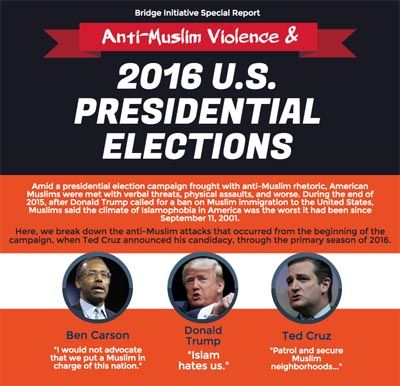
    election4Indeed, earlier this year, Georgetown University’s Bridge Initiative, where I research, write and speak about Islamophobia, released a study titled, When Islamophobia Turns Violent: The 2016 U.S. Presidential Elections. Our study examined the relationship between anti-Muslim political rhetoric by presidential candidates and acts and threats of violence targeting the minority faith community, from March 23, 2015 through March 2016.

    We made the following key findings:

    • The 2016 U.S. presidential season began against a backdrop of already rising Islamophobia in 2015, threatening American Muslim religious freedom.
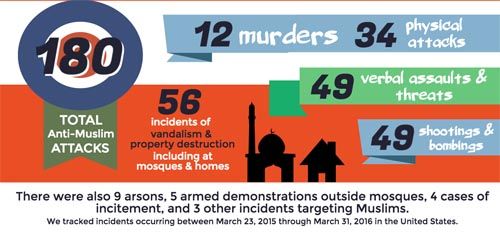
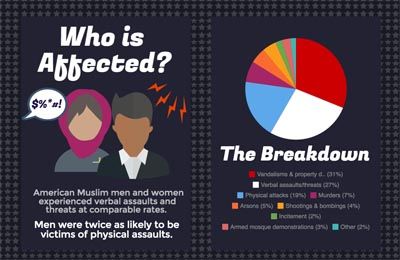
    • During the course of 2015, there were approximately 174 reported incidents of anti-Muslim violence and vandalism, including: 12 murders; 29 physical assaults; 50 threats against persons or institutions; 54 acts of vandalism or destruction of property; 8 arsons; and 9 shootings or bombings, among other incidents.
    • Anti-Muslim violence remained significantly higher in 2015 than pre- 9/11 levels with American Muslims approximately 6 to 9 times more likely to suffer such attacks. The number of incidents in 2015 is also higher than the total number of anti-Muslim hate crimes reported in 2014: 154.
    • In 2015, American Muslim men were twice as likely to be victims of physical assaults and 5 to 6 times more likely to be victims of murder than American Muslim women.
    • Since the first candidate announced his bid for the White House in March 2015, there have been approximately 180 reported incidents of anti-Muslim violence, including: 12 murders; 34 physical assaults; 49 verbal assaults or threats against persons and institutions; 56 acts of vandalisms or destruction of property; 9 arsons; and 8 shootings or bombings, among other incidents.election3
    • Since the start of the presidential election cycle, American Muslim men have been twice as likely to be victims of physical assaults and about 11 times more likely to be the victims of murder than their female counterparts.
    • Also during each period, Muslim murder victims were most likely to be aged 18 to 24.
    • Children and youth – as young as 12 years old – were among those responsible for acts and threats of anti-Muslim violence.
    • Although Islamophobia made an appearance during the first GOP debate in August 2015, the first surge of anti-Muslim political rhetoric occurred in September 2015.
    • It corresponded with an international development: the Syrian refugee crisis. The deepening crises dominated news media headlines in the U.S. and Europe potentially highlighting the media impact on political discourse.
    • This surge in September 2015 was accompanied by approximately 10 reported incidents or threats of violence, including 3 murders. In comparison, there was one (1) such incident in August 2015 representing a significant increase in anti-Muslim violence over the course of one month.
    • Donald Trump escalated anti-Muslim vitriol in the wake of the terrorist attacks in Paris, France in November 2015 rather than urge calm or international unity. The attacks signify an international event that triggered a second surge in Islamophobic rhetoric in addition to the uptick in bias attacks.
    • Trump made many anti-Muslim statements during televised appearances on mainstream news media outlets, impacting millions of viewers across the U.S. and around the world.
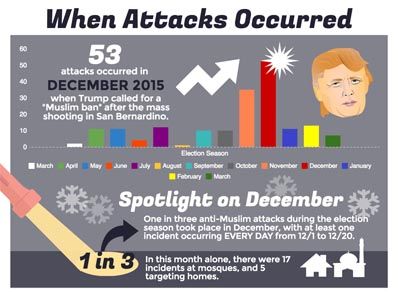
    • As Mr. Trump called for shutting down mosques in the wake of the Paris terrorist attacks and the mass shootings in San Bernardino, California in December 2015, anti-Muslim attacks initially tripled with nearly half of those attacks directed against mosques.
    • Anti-Muslim attacks surged once more in December 2015. There were 53 total attacks that month, 17 of which targeted mosques and Islamic schools and 5 of which targeted Muslim homes. By comparison, when the presidential election season began just 9 months earlier, there were only 2 anti-Muslim attacks. Attacks on Muslims during this month constitute approximately 1/3 of all attacks last year. In fact, in December 2015, anti-Muslim attacks occurred almost daily and often multiple times a day.
    • At least three separate incidents of violence involved perpetrators who were public supporters of presidential candidate Donald Trump. There was otherwise a strong perception among American Muslim leaders that political rhetoric created fertile ground for threats and acts of anti-Muslim violence.
    • While anti-Muslim political rhetoric gives cause for alarm, the ensuing violence has inspired expressions of solidarity with the American Muslim community, too.

    Several additional observations are worth noting here. First, as highlighted above, our research demonstrated a spike in anti-Muslim violence post-Paris attack in November 2015 and again in December 2015, in the aftermath of the San Bernardino mass shooting. While the violence appeared to level off in the beginning of 2016, it still remained 3 to 5 times higher than pre-election levels. Significantly, the Paris and San Bernardino attacks by self-identifying Muslims were also accompanied by anti-Muslim political rhetoric and policy posturing by GOP presidential candidates, including now Republican presidential nominee Donald Trump.

    election1In the immediate wake of the San Bernardino attack, Trump issued a public statement calling for his now notorious ban on Muslim immigration that he continues to revisit and expand upon during press interviews and campaign rallies. It is important to highlight that many of his discriminatory remarks and proposed policies have received massive coverage in the news media, thereby amplifying the reach and impact of Trump’s Islamophobic message. His rhetoric is not only impacting hundreds or thousands of attendees at political campaign events or rallies, but millions of Americans across the country and even more people around the world.

    Second, the violence our report exposes is part of a larger trend of growing Islamophobia that pervades so many aspects of American life today. Indeed, research suggests that there has been a steady rise in Islamophobia in recent years. The FBI’s 2014 hate crime statistics, for example, show that bias crimes generally went down across the board except where American Muslims were concerned. Similarly, in 2015, the Equal Employment Opportunity Commission (EEOC), the federal government agency responsible for handling employment discrimination cases, experienced an increase in religious discrimination claims involving Muslim employees. While Muslims constitute approximately 1% to 2% of the entire U.S. population, their claims account for 40% of cases.

    In addition, anti-Muslim bullying in our schools seems to be getting worse, if not evolving. A recent report from the Southern Poverty Law Center examining the impact of the presidential elections on students found that at least a 1/3 of the teacher respondents saw an increase in anti-Muslim sentiment in their classrooms. Some reported suicidal ideation among some Muslim students related to bias-based bullying. But there is an alarming trend that goes beyond conventional bullying. Whereas we typically think of school bullying as peer-on-peer harassment, research suggests that adults – essentially the very people responsible for ensuring a healthy learning environment – are increasingly the perpetrators of Islamophobia. Indeed, all of these indicators evidence Islamophobia as a growing American problem.

    Finally, as our report suggests, anti-Muslim political rhetoric during the course of the presidential election season has contributed to this very real religious-freedom challenge. It is important to acknowledge other factors, however, that may help contribute to this dangerous phenomenon. The rise of ISIS, as well as actual terrorist attacks on U.S. and European soil, has also played a role, for example. This, together with foreign military interventions in Muslim majority countries such as Iraq and Afghanistan, has contributed to American fears concerning a potential enemy within our borders that constitutes a potential national security threat.

    Additionally, news media coverage of terrorism as an exclusively Muslim phenomenon — even though study after study suggests that a greater domestic threat lies with far right extremists and white supremacists — helps perpetuate the stereotype of Muslims as the “terrorist other.” When an American knows a Muslim or Muslims personally, this helps counter the negative media depictions. Since Muslims only represent about 1% to 2% of the total population, however, the chances of an average American encountering Muslims at work, school or in their neighborhood is slim. Most Americans get their information about the minority faith community from whatever they consume on the computer, TV and smart phones. Research shows that last year alone, 9 out of 10 news media stories about Muslims and Islam in the U.S., U.K. and Germany were in the context of violence: war or terrorism.

    So, is it truly surprising that there is a palpable fear of and hostility towards Muslims, or those perceived to be, particularly in absence of any alternative positive portrayals of the minority community? And, of course, there is the multi-million-dollar Islamophobia industry that has been exposed in the Center for American Progress’s report, Fear Inc., as well as in various CAIR publications. If there is a silver lining to growing Islamophobia in the U.S., it may be the responses of American Muslims — which have proven just as diverse as the community itself — to the stereotyping, bigotry, and threats of violence, which have proven just as diverse as the community itself. During the election season alone, we have witnessed heroic efforts to counter anti-Muslim prejudice and discrimination by the most ordinary citizens, from Rose Hamid to Khizr and Ghazala Khan. We have witnessed social media campaigns from American Muslim women, like #CanYouHearUsNow, to challenge stereotypes about, and attacks against, the minority faith community. We have also seen increased political engagement, from more voter registration drives to visible participation of Muslims at the Democratic National Convention and other political forums. We have also seen American Muslim youth showing extraordinary strength and resiliency in the face of bigotry, from Texan “clock boy” Ahmed Mohamed to Oklahoman Samantha Elauf who took her religious discrimination claim against the popular retailer Abercrombie & Fitch all the way to the U.S. Supreme Court — where she won.

    It’s rather extraordinary.

    election0

  • Latinos Make America Great Again, and Again

    Latinos Make America Great Again, and Again

    The current presidential race has left many unbiased Americans stunned and not-so-broadminded others rejoicing, as we all witness a surge in derogatory attacks by candidates against entire minority groups, such as Muslims, African-Americans, and immigrants, particularly Latinos/Hispanics. The drama continues to unfold in what could potentially be the most controversial election in the history of the United States of America. While unity has often been declared the focal point in shaping American society, this election has polarized the American people and contributed to a rise in racially-driven violent hate crimes, xenophobia, and islamophobia.

    Republican nominee Donald Trump and his GOP rivals who fell to the side during the primaries, like Ben Carson and Ted Cruz who are, ironically, descendants of immigrants or minorities themselves, have all contributed their share of attacks against members of the Islamic community and Latinos, through their campaigns, town hall meetings, news interviews, and even through social media. Their xenophobic and Islamophobic rhetoric questioning the allegiance and morality of Muslims and Latino immigrants, is reminiscent of the Second Red Scare during the McCarthy era, in which a hysterical fear of communists (Reds) caused panic throughout the U.S.

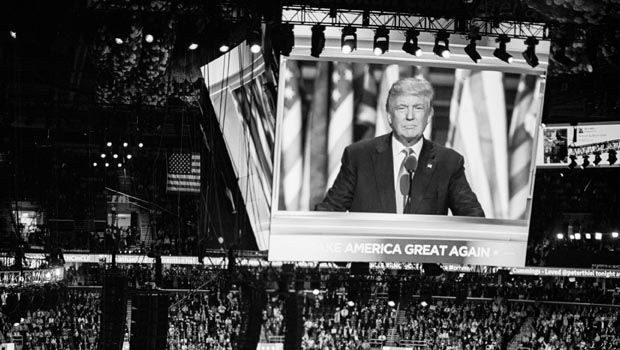
    Of course, the most vocal of the GOP presidential hopefuls and the most controversial has been Trump, the business tycoon and former reality TV personality who starred in NBC’s The Apprentice from 2004 to 2014. Trump has since laid to rest his famous catch phrase, “You’re fired!” and replaced it with his campaign slogan, “Let’s Make America Great Again.” He began his primary race for the Republican nomination with harsh criticisms of Mexican immigrants. Speaking from the Trump Tower Atrium in Manhattan on June 16, 2015, he said, “When Mexico sends its people, they’re not sending their best. They’re not sending you. They’re not sending you. They’re sending people that have lots of problems, and they’re bringing those problems with us. They’re bringing drugs. They’re bringing crime. They’re rapists”; after smearing almost the entire Mexican population, he sympathetically added, “And some, I assume, are good people.” One of Trump’s diehard political plans to curb illegal immigration from Mexico is to build a wall separating the border between the U.S. and Mexico. He claims that the Mexican government will be paying for the construction of the wall, and Trump has even outlined exactly how they will be persuaded to do so on his promotional website.

    History Provides a Deeper Perspective

    In order to understand the level of absurdity in the statements about Mexico and the Mexican people, it becomes necessary to explore the history of the United States and its southern neighbor. What is today Mexico, Texas, Arizona, New Mexico, Colorado, Utah, and California were once colonies belonging to Spain. In 1822, Mexican settlers, following the example of the American Revolution, rebelled against the Spanish government and won their own war of independence. Less than 25 years after Mexico became a free nation, by 1846, the U.S. had invaded and entered into war with Mexico in order to obtain their territories north of the Rio Grande River and westward all the way to California. In 1848 Mexico surrendered to the terms set by the U.S., transferring ownership of New Mexico, California, Texas, Utah, most of Arizona, Colorado, and Wyoming, for $15 million (An Historic Overview of Latino Immigration and the Demographic Transformation of the United States, David G. Gutiérrez, PhD., University of California).

    These states were already populated by Mexicans; 75,000 to 100,000 former citizens of Mexico chose to remain north of the new border at the end of the war and were granted automatic citizenship by the U.S. government (The Treaty of Guadalupe Hidalgo: A Legacy of Conflict, Norman: University of Oklahoma Press, 1990). In reality, while Trump and his followers blame Mexicans for stealing jobs from Americans, bringing crime to the U.S., and causing other problems, the fact is that much of the Western part of the U.S. was built and inhabited by Mexicans. It was, in reality, Americans who first sent troops over the border in order to incite a war against Mexico and gain territorial dominance.

    Immigration from Mexico into the U.S. thereafter became a complicated love-hate relationship, where the U.S. government would open its borders and welcome Mexicans to come and perform jobs that Americans were either unable or unwilling to do, and later would begin mass deportation when Mexicans were no longer needed or desired. Beginning in the late 1800s, U.S. companies began to fill a rising demand for labor in agriculture, mining, construction, and transportation with Mexican laborers. During the Great Depression, when average Americans were struggling to find jobs, local, state, and federal government agencies began forcing Mexicans out. A short time later, when the U.S. entered World War II and experienced a farm labor shortage, the Federal Government signed an agreement with Mexico to allow Mexican workers to again enter the U.S. and work. Much the same pattern has ensued ever since.

    This is America, Speak Spanish!

    In a childish move during the GOP primaries, Donald Trump insulted former opponent, John Ellis “Jeb” Bush, by tweeting, “Jeb Bush is crazy, who cares that he speaks Mexican, this is America, English !!” (Twitter account, @realdonaldtrump, Donald J. Trump, 7:14 PM – 24 Aug 2015). There are many things wrong with this ignorant statement. First of all, Trump confused the nationality, Mexican, with the language, Spanish, a simple fact that everyone hopes a candidate to the presidency of the U.S. would know. Secondly, the statement, “this is America, (speak) English!” implies that as Americans, everyone should give up their native tongues and trade them for English only. It is a matter of fact, however, that America consists of both North and South America, and the vast majority of the Americas is Spanish-speaking. Not to mention that hispanophones (those who speak Spanish) inhabited or explored territories of the present-day U.S. way before English settlers stepped foot on the land.

    Spanish is the second most widely spoken language in the world and, more specifically, in the U.S. It is also the language most studied by Americans. The Spanish influence in the nation is everywhere from the names of states, counties, and cities, such as Florida, Colorado, Montana, Nevada, Las Vegas, Santa Fe, El Paso, etc., to the names of bodies of water, valleys, forests, mountains, and forts. American English has borrowed common, everyday words from the Spanish language as well, such as rodeo, ranch, banana, alligator, armadillo, barbecue, and chocolate. The bottom line is this — not only the Spanish language, but Latino/Hispanic culture as well, are deeply woven into the fabric of U.S. history and heritage.

    Understanding the Latino/Hispanic Identity

    Some people not so well-versed in geography, often categorize all Latin-Americans as Mexican. However, there are a total of 21 countries in the world where Spanish is the official language. The majority of those are in Central and South America, as well as the Caribbean. Mexico is the only Spanish-speaking country that shares a border with the U.S. Thus, the majority of Hispanics in the U.S. are Mexican or of Mexican origin (64.6 percent in 2011 according to the Pew Research Center). However, all Spanish-speaking countries are represented throughout the U.S.

    The Merriam-Webster dictionary defines a Latino as “a person who was born or lives in South America, Central America, or Mexico or a person in the U.S. whose family is originally from South America, Central America, or Mexico”; whereas Hispanic means “coming originally from an area where Spanish is spoken.” Hispanic origin is based on ancestry, lineage, heritage, nationality and/or country of birth and, therefore, Hispanic people come from a variety of countries, backgrounds, and social strata. Whites, blacks, and Asians are all considered racial groups. Hispanics are an ethnic group, which means that although they share a common language and heritage, they do not share a common race. They can be black or white or Asian, or be descendants from indigenous peoples of a place colonized by Spain.

    South American and Caribbean Hispanic immigration in the U.S. experienced the fastest growth beginning in the mid-1900s until the present day. According to the U.S. Census Bureau, as of 2013 more than one-quarter (28 percent) of the foreign-born population in the U.S. came from Mexico, 9.6 percent from the Caribbean, 7.7 percent from Central America, and 6.7 percent from South America.

    Latin-American Contributions to the US

    Hispanic immigrants, as well as second and third generation immigrants from Latin America, have had a major impact on shaping the course of U.S. history. They strengthen the economy, serve in the military, defend the country during times of war, and hold offices in government. In addition to influencing the political sphere, they have also had significant imprint on American culture, arts, sciences, and education. Entrepreneurship in the Latino community helps the U.S. economy tremendously. According to the American Immigration Council, “One out of every five people in the country is Latino or Asian. Together, Latinos and Asians (both foreign-born and native-born) wield $2 trillion in consumer purchasing power, and the businesses they owned had sales of $857 billion and employed 4.7 million workers at last count. Immigrant, Latino, and Asian workers, taxpayers, and entrepreneurs are integral to the U.S. economy—and they are a potent electoral force” (Strength in Diversity: The Economic and Political Power of Immigrants, Latinos, and Asians, January 1, 2015).

    Back in June of 2013, Donald Trump tweeted, “Sadly, the overwhelming amount of violent crime in our major cities is committed by blacks and hispanics-a tough subject-must be discussed” (Twitter account, @realdonaldtrump, Donald J. Trump, 4:05 AM – 5 Jun 2013). He reiterated this sentiment in 2015 when he accused Mexicans of being rapists and drug dealers. However, nothing can be further from the truth. In a special report, published on July 13, 2015 by the American Immigration Council, entitled The Criminalization of Immigration in the United States, researchers affirm that, “immigrants are less likely to commit serious crimes or be behind bars than the native-born, and high rates of immigration are associated with lower rates of violent crime and property crime. This holds true for both legal immigrants and the unauthorized, regardless of their country of origin or level of education.” In addition, Census data from 2010 found that the incarceration rate of undocumented immigrant men from countries such as Mexico, Guatemala, and El Salvador is significantly lower than that of males born in the U.S. In other words, what the American people are witnessing during this presidential election are outright lies and sensationalist propaganda used to sway public opinion and stir controversy in order to garner attention, support, and votes from a xenophobic sector of the American constituency.

    Just as all racial, ethnic, and religious groups are part of the diverse and vibrant fabric of the U.S., Hispanic Americans are revitalizing the nation’s diversity as contributors to society, doing their part to uplift and uphold the standards that make this country great. There are countless Latinos and descendants of Latinos serving the nation as government officials, lawyers and judges, advocates and activists for social justice, and military personnel. There are Latino athletes, with immigrant parents, who proudly competed for Team U.S.A. in the just-completed 2016 Olympics. There are Hispanics contributing to all sectors of society, from the laborers who work to build the residences and commercial spaces where businesses thrive to the entrepreneurs providing opportunities for countless Americans to work; from the Latino teachers who contribute to the education of our youth to the doctors who provide healthcare. All are working for the benefit of themselves, their families, and the collective American success story.

    Immigrants in this country work hard to make a better life, and they do not take their new home for granted, but rather cherish the opportunities it provides. This is the United States of America, and they are an integral part of the whole, striving to fulfill the U.S. potential as a tolerant and inclusive land of great hope and opportunity for all its inhabitants, as well as a beneficial force for good throughout the world.

  • Model for Civic Engagement – Dar al-Noor Masjid (MAV) in Manassas, VA

    Model for Civic Engagement – Dar al-Noor Masjid (MAV) in Manassas, VA

    Civic engagement for America’s Masajid could not be more crucial than now. America is facing challenges that can only be overcome by propelling the voices of reason into public and civic life and driving the voices of bigotry and closed- mindedness out of the public spotlight. We are facing the public rise of anti-Islamic sentiment while some of the country’s political leadership, both at the local and state levels and in Washington, D.C., have become detached from reality. Consequently, the safety and security of our families have become a growing concern for everyone. Muslim-Americans must engage in the civic arena in order to ensure, by Allah’s permission and will, that we contribute to the betterment of America, something that we, and all fair and decent citizens, want for ourselves and for our children.

    With civic engagement, your Masjid will have a voice in government decisions both big and small; your Masjid can achieve solutions for issues in the community; and your Masjid can do its part to ensure social justice and equality for all – with Allah’s guidance and help. Muslim-Americans’ civic engagement with their communities and our participation in the political process is a mutually beneficial affair. Engaging with our elected and public officials guarantees that the voices of Muslim-Americans are heard, especially on topics such as presenting accurate information about Islam, countering terrorism and violence in our communities, and finding sensible solutions to community issues.

    The Muslim Association of Virginia (MAV) has, in fact, been active in the civic arena for some 16 years now. Alhamdulillah, MAV has been successful in achieving major accomplishments for our community including the successful defeat of the anti-Sharia legislation in the Virginia Congress; the introduction and passing of a Halal bill in Virginia to regulate the labeling, identification, and sale of Halal products; lobbying for legislation granting students a religious holiday for Eid; and active voter registration which resulted in registering over 200 voters during Ramadan this year.

    MAV has identified some crucial steps and activities in a successful civic engagement program, and encourages all Masajid and Muslim organizations who have not already done so, to develop their own civic engagement program. Some of the steps and activities include:

    Set Up Voter Registration

    Your primary leverage with elected officials is demonstrating that you represent a large group of voters. In order to effectively represent your Masjid, you must ensure that its members are registered to vote. There are two ways to accomplish this goal: (1) your Masjid can set up its own voter registration team with registration tables at Jumu’ah prayers; or (2) you can bring in an outside organization that focuses on getting voters registered.

    Provide a Forum for Community Engagement

    The Masjid is a perfect space for school board or town hall meetings, and for debates between local, regional, and even national candidates. Not only does this benefit your community by bringing the information directly to your Masjid, but this also allows some non-Muslim members of the community an opportunity to set foot inside a Masjid for the first time in their lives. That opportunity to introduce community members of other faiths to your Masjid and their Muslim neighbors is critical to the success of your civic engagement program.

    Assist Homeless Shelters

    Show your community how vital charity is in Islam. Assist with food drives, help find shelter for families in need, visit the elderly at senior centers, become mentors/tutors for disadvantaged youth, volunteer at local schools or hospitals — your involvement in charity outside the Masjid demonstrates that you are dedicated to improving the community and, more importantly, that we care about our fellow citizens, Muslims and non-Muslims alike.

    Build a Relationship with Local Law Enforcement

    The security, good will, and community building that your Masjid receives from fostering a good relationship with local law enforcement is vital to the success of your civic engagement program. When a tragic event injures or takes the life of an officer protecting your community, be proactive about supporting the police station and the families of the officers. Your support of law enforcement events, memorials, and parades establishes a relationship of trust between the Masjid, its community, and local law enforcement. Inviting local law enforcement leaders to the Masjid is a great way to begin that relationship.

    Encourage Members of your Masjid to Get Involved

    Members of your Masjid should strive to serve on school boards, commissions, and civic associations, and to run for elected office. Having Muslims in those positions amplifies the voice of your Masjid and the Muslim community, from the grassroots level and up.

    Participate in Public Events

    Announce at your Masjid public events like parades and 4th of July celebrations and encourage attendance. If possible, provide transportation to such events to ensure turnout and that your community supports these events as a unified group. The more the wider community interacts with the members of your Masjid, the more successful your civic engagement program can, and will be, insha’Allah.

    Offer Elected Officials Speaking Time During Jumu’ah and Eid Prayers

    Invite local, state, and federal elected officials and candidates to speak at your Masjid. This benefits your Masjid in the following ways: 1) gives your members an opportunity to hear directly from officials and candidates; and 2) offers an opportunity for your members to speak directly to their elected official, asking questions to learn where that official stands on important issues. Set aside time (approximately 10-15 minutes) before the start of prayers to allow elected officials to speak to your community (for those officials who did not get to speak, acknowledge them and their attendance). It is vital that you make every effort to invite all candidates who are running for an elected office, regardless of party affiliation. Ensure that you are keeping a record of those invitations so that the non-profit status of your Masjid is protected and not placed in legal jeopardy.

    Support Sensible Elected Officials Regardless of Party Affiliation

    Do not engage with only one side of the political spectrum. Not every issue your Masjid encounters will be a shared concern of the major political party you (may) typically affiliate with. There are sensible elected officials in every party and it is important to have the opportunity to speak with them and raise issues, regardless of their political affiliation.

    Work Towards Common Goals

    When you engage an elected official, work towards achieving common goals rather than debating divisive issues. Your Masjid’s civic engagement program cannot solve every issue. Identify what issues are feasible for that elected official to accomplish and focus on those. Aggressively pursuing issues that the elected official is strongly opposed to, or where an agreement cannot be achieved, will usually result in little being accomplished and can burn rather than build bridges of understanding and cooperation. Choose your battles carefully.

    Organize with Others When Meeting Elected Officials

    Communicate with other Masajid, interfaith organizations, civic organizations, and local entities to encourage leaders from those organizations to attend meetings with elected officials alongside you. Showing unity and representation of a large voting bloc is important when speaking with elected officials. Don’t show up at the elected official’s office with a mob, however. Carefully choose leaders that represent a variety of organizations with goals and concerns in common with your Masjid.

    Know your Strengths and Abilities

    If you know you have large numerical or widespread support in the community – and can demonstrate or document it – strategically and tactically let officials know. Do not be hostile or overbearing at any time. Do not exaggerate your capabilities and strengths. Accentuate your good relations with other elected officials who support your position(s) and who may be allies to the particular official you are meeting with. Be organized in your presentations, making sure to highlight the key objectives or issues on your list.

    Establish Interfaith Engagement

    Reach out to other faith organizations in your area and work with them in all aspects of your civic engagement program. They likely already have some activities and strategies in place and may be willing to share what they have learned. And many faith organizations share similar values with Muslims. Remember, the more unity, the better!

    Promote on Social Media

    Remember that most Americans get their news and social views from what is on their social media feeds. Promote your Masjid and community events on social media and connect with other local organizations and your wider community.

    Determine the Intentions of Those Who You Engage With

    There are three reasons why another organization or an elected official is engaging with your Masjid:

    • They are focused on the best interests of the community
    • They are there for their own self-interest
    • They just need your Masjid for a photo opportunity
    • Know what you want to accomplish with those your Masjid engages with and focus your efforts on those who can produce positive results.

    Designate a Credible Spokesperson

    Your Masjid’s civic engagement program must have a credible spokesperson who can meet with elected officials, other organizations, and the wider community to successfully engage in the civic arena. The designated spokesperson does not need experience in politics; they just need to be able to accurately and effectively convey the community’s issues and messaging to elected officials.

    REMEMBER:

    In order for 501(c)(3) organizations to participate in civic political engagement, they must invite all candidates who are involved in an election and they must announce that they do not endorse or oppose any candidate.
    ——
    This article is compiled by Dar al-Noor Masjid (MAV) in Manassas, VA.

  • Planting Seeds of Hope: Raising Muslim Kids in an Era of Islamophobia

    Planting Seeds of Hope: Raising Muslim Kids in an Era of Islamophobia

    I’m one of those parents who stares at her kid as she sleeps. I notice every curve of her face and arch of her eyebrows. I know what her steady breathing sounds like. I’ve memorized the intonation of her laughter and the way she throws her head back and giggles when I tickle her. She is so effortlessly mine as I am hers… she’s from me, as though a piece of my being broke off and claimed its own place in this world. But with this belonging and this connection comes a heavy sense of responsibility. Raising her in an era fueled by social upheaval and warring political parties that often bring out the worst in people is daunting to say the least.

    A day will come when our kids’ awareness of themselves and their environment will be heightened. With all our hearts we want that day to be one of unfolding maturity and self-assurance, not a day that might cause them to retreat into themselves, intimidated by bigotry and hatred directed toward them.

    Think about it for a moment – as adults we struggle every day to maintain a strong and holistic Muslim identity. I recently heard a Muslim woman say that she sometimes feels “itchy” in her own skin. She is so hyper-aware of all the negative stereotypes that people have about Muslims that she has become uncomfortable with herself. She is trapped in a self-imposed panopticon of sorts – assuming that she is being observed and judged from every angle. If these are the very real and palpable struggles of adults, how do our children fare? They’re still frighteningly malleable and they’re still being shaped and molded into the people they will become. It’s only natural that we should worry about our children having an even harder time navigating this current political climate.

    As parents, we yearn to shelter our young ones from the hatred and suspicion geared towards people who are visibly Muslim. More than anything, we want them to have normal childhoods full of bike riding, popsicle-eating, sleepovers, and unbridled fun. But a day will come when their awareness of themselves and their environment will be heightened. With all our hearts we want that day to be one of unfolding maturity and self-assurance, not a day that might cause them to retreat into themselves, intimidated by bigotry and hatred directed toward them. I comfort myself with the knowledge that it’s often in times rife with great difficulty that strong, confident change-makers and leaders are born. Rather than looking at the political climate with despair and asking ourselves, “How is my kid going to survive with his or her faith intact in such a messed up world?”

    we should raise children who we sincerely believe will be a part of the solution. Of course, that’s easier said than done! But here are some ways we can get started.

    Foster a Strong Sense of Identity

    Before occupying ourselves with whether our kids have eaten a proper breakfast, or whether they’re too warm or cold in what they’re wearing, or how well or poorly they’re doing academically, we need to ask ourselves – does my child feel comfortable in his own skin? Are our children comfortable being Muslims? Do they know what they believe in and why? Fostering a strong sense of identity starts when our children are young. I’m a great believer in books and storytelling as a way to ingrain a sense of self-acceptance. I still remember the books I read when I was a child and how they, to this day, affect the way I process my feelings and realities. Thankfully, we’re living in a time where great stories about Muslim kids are not hard to come by. Find these books and read these stories to your kids. Normalize and together cherish their names and faith and cultures, as we live in a place where their names will often be mispronounced and their faith and cultures misunderstood. Make their faith a source of comfort, love, and inspiration. Only then will they embrace their Muslim identities without discomfort or resentment. Make Eids meaningful celebrations for them. Let them feel joy and ease in their faith instead of feeling judged or forced. Help them find a second home in the mosque by creating fun and welcoming programs for them.

    One of the most important contributions we can make to nurturing our children’s identities is to ensure they have good like-minded companions. It’s important to make an effort to connect with other strong Muslim families whose kids can become companions for yours. A man asked Prophet Muhammad (peace be upon him) about the Hour (Day of Judgment), saying, “When will the Hour be?” The Prophet (pbuh) replied, “What have you prepared for it?” The man said, “Nothing, except that I love Allah and His Apostle.” The Prophet said, “You will be with those whom you love.” The company we keep has a very real and direct effect on our level of faith, and our standing in the sight of God. In a world where a child’s group of friends is instrumental to his or her development and self-concept, making sure that they have good companions is paramount to their success.

    Leave Your Bubble and Get Involved!

    While it’s important to build a great foundation for our children around other Muslims and within the Muslim community, that absolutely must not translate into segregating ourselves or our kids from the wider community where we live. Distancing ourselves from the non-Muslim population will just lead to the unhealthy practice of “othering.” Our beloved messenger Muhammad (pbuh) was known for decades in his community as a trustworthy individual – he lived with the people, he was one of them, he had real relationships with them. He celebrated with them, and mourned with them, all before ever receiving wahi (revelation) from God. When he began to preach the message of guidance, he was already familiar with the mindset and traditional ways of his people. No doubt it was an uphill battle, but there was a level of trust of the Prophet (pbuh) present, even amongst those who never accepted Islam.

    It was not his practice to segregate himself or his family from those who didn’t believe in his message. Quite the contrary! He interacted with them a great deal – he was generous with them, he was just towards them, and he kept his promises to them. While we’re working on strengthening our children’s Muslim identities, we shouldn’t forget that they need to know how to navigate the greater community as well. They are part of that community, integral to its existence and its well-being.

    I strongly believe that getting involved in positive activist work is one of the most important ways to instill a sense of purpose and confidence in our children. Enjoining good and forbidding evil is an important and well-known cornerstone of our faith. In the Quran, Allah (SWT) praises the believers who support and promote good actions and who prevent evil actions. Prophet Muhammad (pbuh) said, along these lines, “Whoever amongst you sees an evil, he must change it with his hand; if he is unable to do so, then with his tongue; and if he is yet unable to do so, then with his heart — and that is the weakest form of faith.” As Muslims, our faith instructs us to be beacons of justice. But that means leaving our comfort zones. It means taking on a responsibility to change both our Muslim community and broader community for the better.

    Teaching our kids to align themselves with groups and communities that face similar challenges to those that Muslims face will ensure they not only “integrate,” but also become active contributors. Building meaningful alliances is about supporting everyone facing injustice. Black Lives Matter is an instrumental example of this. For as long as black Americans have lived in the U.S., rampant racism has been the foundation of their experience. Although the civil rights movement brought about many positive changes, racism and unequal treatment of black Americans is, unfortunately, still the default in so many places and aspects of our society. From police brutality to unequal education opportunities, the intergenerational cycle of poverty and discrimination subjects black communities to ongoing experiences that reflect a multitude of trickle-down effects of slavery.

    It’s important to understand that we cannot separate ourselves from the struggles of black Americans. We are often the same community, and Muslims of African-American heritage also face a double-edged sword when it comes to prejudice. But even when our identities do not overlap, their struggle is our struggle. It must be. When we come together as communities to fight Islamophobia, racism, classism, and any form of injustice, we become stronger, more skilled, and more capable. Brick by brick, we build the bridges that we may need to cross someday.

    Be Your Child’s First Role Model

    Prophet Muhammad (pbuh) lived at a time of ignorance. Families were ashamed to have daughters instead of sons, people were judged by the color of their skin, and those who held onto their Islamic faith were humiliated and severely oppressed. Through all this, the Prophet was not discouraged in the least. His message of mercy and guidance rang true and shone a bright light that pierced the darkness. He brought a message of hope, a message of mercy, love, and fair treatment for all people regardless of race, gender, nationality, or religion. His patience and perseverance transformed his community and the entire world. There is barely a place on this globe that has not been touched by this light.

    Prophet Muhammad (pbuh) and his companions did not hide away, ashamed of who they were or what they believed. They stood tall in the face of criticism and abuse, continuously striving to establish justice and equality. They did the work needed to actually better their community. Our children are intelligent beyond words. As parents, if we emulate and exemplify those early Muslims, pushing through the darkness of hatred to create light and hope, our children will see and recognize that virtuous and strong character in us.

    There have been so many days when I’ve worried about how to teach my daughter to be kind and charitable, to share, and to ask for forgiveness when she makes a mistake. I used to lose sleep over it, looking at her napping cherub face and wondering: how can I help her become a good person? I was in a constant state of apprehension, searching for good Islamic books and resources to help me convey to her the beauty of good character. While I still scour Islamic conference bazaars for helpful resources, I have come to understand that the answer is actually quite simple – I must be who I want her to be. I should speak to her the way I expect her to speak to others. I should pray the way I expect her to eventually pray. I should dress the way I wish for her to dress; I should exude confidence the way I wish for her to. In me, my daughter has her first role model. In me, she has the person who she will – without her consciously understanding it – imitate. And while verbal instruction is important, actions are overwhelmingly what will determine what our children learn and internalize. As we all know, it’s a running joke that we eventually become our parents!

    Seek Help from Allah

    This point should be number one on the list. We are not capable of doing a single thing until Allah (SWT) wills it. But we do have a tool in our tool chest that unfortunately can go unused for long periods of time. Prophet Muhammad (pbuh) said, “Three supplications will not be rejected [by Allah] — the supplication of the parent for his child, the supplication of the one who is fasting, and the supplication of the traveler.” We can employ every parenting trick in the book, expose our kids to only the best books and media, get them involved in positive activism and volunteer work, and make sure they’re around good role models – but when all is said and done, it is only Allah (SWT) who is the controller of hearts. So be steadfast in asking Him to guide your children, and to make them grow and mature in a way that renders them fit to be leaders of the believers. Our hope always remains pinned on Allah’s all-encompassing mercy.

    “Our Lord! Grant to us from our spouses and our offspring the comfort of our eyes, and make us models for the righteous (Quran 25:74).

  • Why Have We Normalized Islamophobia?

    Why Have We Normalized Islamophobia?

    The horrific attacks in Paris and San Bernardino have captured headlines and triggered responses from journalists, politicians, and religious leaders. Some Western heads of government have once again threatened a global war against terrorism, while some political commentators have even invoked World War III.

    A cottage industry of ideological, agenda-driven, anti-Muslim polemicists has sprung up, consisting of pundits, bloggers, authors, lobbyists, elected officials, and their resourceful and wealthy funders.

    In the United States, Republican presidential candidates and some thirty governors have called for a freeze on accepting refugees fleeing the civil war in Syria. Donald Trump, the leading Republican candidate for president of the United States, has pushed the envelope to its extreme, advocating a temporary freeze on all foreign Muslim immigration, as well as the monitoring or even the forced closure of American mosques. The result? Trump soared in the polls, as did fellow presidential candidate Ben Carson, who stated that “for a Muslim to become president of the United States…you have to reject the tenets of Islam.” In Europe, far-right political candidates continue to make political headway. The far-right Front National party of Marine Le Pen won nearly 30% of the vote in the recent French regional elections; although the party did not win any of the regions outright, the strong showing positions Le Pen as a future presidential candidate.

    Fear of Islam and Muslims in general—not just Muslim extremist and terrorist movements specifically—have become normalized in popular culture in both America and Europe. The anti-Islamic and anti-Muslim hate speech, bias, discrimination, and hate crimes—commonly referred to as Islamophobia—are on the rise. Islam Muslims and the vast majority of Muslims have been brush-stroked by and often equated with the kind of militant extremism and terrorism practiced by a mere fraction of Muslims, obscuring the fact that the vast majority of terrorist victims are themselves Muslim. This, in turn, has had a significant impact on the growth of Islamophobia as well as the domestic policies that have threatened Muslim civil liberties. But what are its causes?

    Is Islam the primary cause and catalyst for terrorism?

    Major polls have consistently reported that Islam is a significant component of religious and cultural identity in Muslim countries and communities globally, and thus an attractive tool for violent extremists as an instrument for legitimation and mobilization. However, the primary catalysts for extremism and terrorism are political grievances often intertwined with the use or misuse of religion. Osama Bin Laden and others like him appealed to long-standing political grievances among many in the Muslim world, the mainstream non-violent majority and extremists alike: Western influence, invasion, occupation; Western support for authoritarian regimes that claim to speak for all Muslims; uncritical bias and support for Israel from the American government in the Palestinian-Israeli conflict. Add to this the Iraqi and Syrian (Shiah-dominated) governments’ repression and killing of tens of thousands of civilians and other crimes.

    “Trump is ISIS’s greatest triumph: the perfect Manchurian Candidate who, instead of offering specific and realistic policies, preys on the fears of the public, doing ISIS’s job for them.”

    ISIS has shown a particular talent for coopting and exploiting all of these issues. Their execution videos, released when ISIS called itself the Islamic State of Iraq (October 2006–April 2013, Al-Furqan Media Foundation), underscored the importance of political grievances for legitimation of their actions and as a tool for recruitment.

    In addition to this, public displays of Islamophobia in the West, from political speeches and demonstrations to negative portrayals of Muslims in the media and hate crimes, are also effective tools for recruitment. Major studies have also found that Islamophobia increases significantly not only with incidents of domestic terrorism but also at election time, as seen in the 2008 and 2012 presidential and the 2010 Congressional elections. During those races, Newt Gingrich, Rick Santorum, Herman Cain and others sought to gain attention by making reckless statements about Muslims. In 2010 in particular, the public debate over the so-called “Ground Zero” mosque in New York became fodder for candidates looking for media coverage. Today, that trend continues with candidates such as Trump, Carson, Cruz, and others.

    Most Americans—who live in a country with a relatively small Muslim population—say they know little or nothing about Islam. Thus, it is not surprising that when terrorists commit their acts of violence in the name of Islam in Paris and San Bernardino, they are drawn to demagogues in America like Donald Trump and in Europe who bring Muslims and the Islamic faith to the forefront of the political debate.

    As Kareem Abdul-Jabbar recently wrote in the New York Times: “Trump is ISIS’s greatest triumph: the perfect Manchurian Candidate who, instead of offering specific and realistic policies, preys on the fears of the public, doing ISIS’s job for them.”

    To what extent has media contributed to the problem?

    Media Tenor, in its 2011 report “A New Era for Arab-Western Relations,” found that out of nearly 975,000 news stories from US and European media outlets, networks significantly reduced coverage on events in MENA to actions of Muslim militants. A comparison of media coverage in 2001 versus 2011 demonstrates the shocking disparity of coverage. In 2001, 2% of all news stories in Western media presented images of Muslim militants, while just over 0.5% presented stories of ordinary Muslims. In 2011, 25% of the stories presented militant image, while the images of ordinary Muslims remained stuck at 0.5%.

    The net result is an astonishing imbalance of coverage: an exponential increase in coverage of militants but no increase at all over the 10 year period in the coverage of ordinary Muslims—and that despite census figures confirming a rapidly growing Muslim population. The situation got worse, for example—between 2007 and 2013, 80% of all American news coverage about Muslims/Islam was negative.

    Over the past decade, there has been an explosion of social media websites targeting the Muslim community, with serious international and domestic consequences. A cottage industry of ideological, agenda-driven, anti-Muslim polemicists has sprung up, consisting of pundits, bloggers, authors, lobbyists, elected officials, and their resourceful and wealthy funders.

    An August 2011 Center Report, Fear, Inc., documented, based on IRS information, that $42.6 million flowed from seven foundations over ten years to support Islamophobic authors and websites. A CAIR Report in 2013, “Legislating Fear: Islamophobia and its Impact in the United States,” reported that the inner core of the US-based Islamophobia network enjoyed access to at least $119,662,719 in total revenue between 2008 and 2011.

    Totally lost or obscured in the fear and fog of war are the facts on the ground regarding American Muslims. Data from major polls (Gallup, Pew and others) and studies have reported that the vast majority of Muslims in America, for example, are educationally, economically, socially, and religiously an integral part of our American mosaic: members of Congress, the military, corporate, education and religious leaders, physicians, lawyers, engineers, scientists and small business owners. American Muslims were among the victims and first-responders on 9/11. In contrast, Muslim terrorists are a fraction of a fraction of 1%. No wonder that the US Attorney General, Senior Pentagon and Department of Homeland Security, as well as leaders in the Democratic and Republican parties, have rejected Donald Trump’s outrageous and inflammatory rhetoric and its threat to American principles and values and to the civil liberties of American Muslims.

    House Speaker Paul D. Ryan (R-Wis.) offered the simplest and most direct rebuttal Tuesday, the day after Trump called for a ban on Muslims entering the United States: “Freedom of religion’s a fundamental constitutional principle,” Ryan said.

    “It’s a founding principle of this country….This is not conservatism. What was proposed yesterday is not what this party stands for, and more importantly, it’s not what this country stands for. Not only are there many Muslims serving in our armed forces dying for this country, there are Muslims serving right here in the House, working every day to uphold and to defend the Constitution…. Some of our best and biggest allies in this struggle and fight against radical Islamic terror are Muslims—the vast, vast, vast majority of whom are peaceful, who believe in pluralism, freedom, democracy, individual rights. I told our members this morning to always strive to live up to our highest ideals, those principles in the Constitution on which we swear every two years that we will defend.”

    As President Barack Obama recently observed: “[I]t is the responsibility of all Americans—of every faith—to reject discrimination. It is our job to reject religious tests on who we admit into this country. It is our responsibility to reject proposals that Muslim Americans should somehow be treated differently. Because when we travel down that road, we lose…We were founded upon a belief in human dignity—that no matter who you are, or where you come from, or what you look like, or what religion you practice, you are equal in the eyes of God and equal in the eyes of the law.”

    A lot of things went wrong this past year, but there may be a silver lining. As Islamophobia intensified and gained more media attention, many Americans and the international community took notice. Google searches of the term “Islamophobia” spiked dramatically after Paris and San Bernardino. Prominent journalists, government and religious leaders, politicians, scholars, and members of the general public started calling out Islamophobia with more force, and leaders on both the right and left stood in solidarity with Muslims. Dozens of interfaith efforts also popped up around the country. So, despite the fact that Islamophobia was at its worst in 2015, there are reasons to hope that we are turning a corner.

  • The Universal Ethos of Moderation: Dismantling Extremism

    The Universal Ethos of Moderation: Dismantling Extremism

    Discussion continues among Americans about terrorism, extremism, jihad, and Islam. The discourse has three basic viewpoints. Put in simplistic frames, the anti-Islam perspective sees Islam as the “mother lode of bad ideas” and Muslims as an irredeemable enemy who evokes the specter of extremism and barbarity convulsing out of religious affiliation. The anti-Islam group voice alarm at the danger lurking at unsecured borders and in unsurveilled living rooms. The liberals, representing the second perspective, recoil at blanket condemnations of Islam and Muslims. Appreciators of pluralist society and multi-culturalism, they eagerly call for respect of Islamic and all other cultural traditions. This voice defends Muslims as a vast majority of peace-loving individuals who have had their religion taken hostage by extremists. The liberals are alarmed at the spreading bigotry that resonates with a wide swath of the American population, as fear and aversion cut through minds and hearts, ratcheted up by bellicose ultra-nationalists and ideologues. The third voice in this discourse, the Muslim one, is largely unceasing recitals of Islamic first principles — “Islam is peace” or the like — and dissimilitude to so-called “jihadists.” The response, both by choice and public demand, is an effort to answer for the political radicalization and terroristic behavior of individuals who commit incomprehensible violence and destruction — all in the name of Islam.

    Trying to Change the Narrative

    When Muslims say “Islam is peace” or “terrorism is un-Islamic” or “Muslim Americans are loyal to America” or “the extremists have hijacked the religion,” it makes no dent in the mindset of the antagonist of Islam. He seems determined to ignore any facts or any pronouncements that are contrary to his preconceived notion of who Muslims are and what Islam teaches. Yet, Muslims have been condemning terrorism ever since 9/11, with sincerity, without fail, loudly and clearly, as reflected in the public record. But the pronouncements are never enough to satisfy minds intent on ostracizing. And so demands for Muslim denunciation of terrorism continue unabated, and like a carnivorous plant, the antagonist sets his traps and gobbles up the condemnations like a feast of delectable insects. But his appetite is insatiable.

    When Muslims say “Islam is peace” or “terrorism is un-Islamic” or “Muslim Americans are loyal to America” or “the extremists have hijacked the religion,” it makes no dent in the mindset of the antagonist of Islam.

    With abhorrence deep-seated and habitual, he declares over and over that Islam and the Quran teach hatred and violence. Yet, going directly to the Quran, one is hard-pressed to find a scintilla of evidence of the purported malevolence. That does not stop the maligning of Islam, the faith of nearly one-fourth of the world’s population, even in academic circles. In the past 15 years, the dominant literature on “Islamic terrorism” has characterized the phenomenon as expression of religious fanaticism, intrinsic to Islam. An influential expositor on religious terrorism, Bruce Hoffman, in his book “Inside Terrorism,” writes, “For the religious terrorist, violence is first and foremost a sacramental act or divine duty executed in direct response to some theological demand or imperative. Terrorism thus assumes a transcendental dimension, and its perpetrators are consequently unconstrained by the political, moral or practical constraints that may affect other [secular] terrorists.”

    Liaquat Ali Khan, professor of law at Washburn University School of Law, writing in the Washburn Law Journal in 2005, describes the mindset of Hoffman and his ilk in his article, “The Essentialist Terrorist”: “There is a coordinated effort on part of academics, scholars, think-tankers, journalists and others to create a profile of Muslim militants as essentialist terrorists who commit heartless violence because they are spiritually addicted to violence. These authors argue that no concrete grievances or violations of rights cause Muslim militancy.” Khan notes that these writers obscure, knowingly or ignorantly, the core beliefs of Islam, thus making the case, quite successfully for those not familiar with authentic sources of the religion, that Islam and terrorism pivot from the same violence-prone provenance.

    Modern-Day Universal Civil and Political Rights

    Before taking a look at primary sources of Islamic doctrine appertaining to violence, warfare, taking of life, and related issues, it is useful to note that modern-day international law codifies rules for military action. In brief, these prescribe that wars be fought to achieve stated lawful aims; that military engagement should be brought to an end as quickly as possible; that unnecessary destruction should be avoided; that prisoners of war should be treated humanely and justly; that all civil and political rights must be respected; and that non-combatants should be protected from harm and hardship, among other rights of people and constraints upon warring parties.

    A Muslim cannot control how other people live their lives, can take responsibility only for his or her own words and actions, and regardless of the ignorance of any other person(s), the duty is to spread peace (28:55).

    International law also codifies the right to defend against aggression and to resist colonial and foreign domination and foreign occupation. In accordance with international human rights law, there are real and legitimate grievances — political, social, and economic — suffered by Muslims. Countries in the Middle East are targeted again and again by exploitative external actors, often colluding with internal authoritarians, resulting in egregious and contemptible violations of human rights. A birthright of individuals, the claim to self-determination, is encoded in Article 1 of the International Covenant on Civil and Political Rights (ICCPR). This treaty asserts the right of all peoples to “freely determine their political status and freely pursue their economic, social and cultural development,” among many other stipulated rights. The majority of nations in the world, including the United States, have ratified and signed on to this international treaty. The ICCPR, along with the Universal Declaration of Human Rights, and provisions in the U.N. Charter, comprise the body of international human rights law. Accordingly, human beings and states have the right to resist an aggressor and defend sovereign territory, including the right to use force. These legal forms of violence are also accorded legitimacy in any struggle for “liberation from colonial and foreign domination.”

    A great number of U.N. General Assembly resolutions have affirmed this legal right of resistance. United Nations General Assembly Resolution A/RES/33/24 of 29 November 1978 states, in part, that it “Reaffirms the legitimacy of the struggle of peoples for independence, territorial integrity, national unity and liberation from colonial and foreign domination and foreign occupation by all available means, particularly armed struggle” (emphasis added). Accordingly, the Iraqis who rose up to fight the military invasion in 2003 were not insurgents or terrorists. They were engaged in a lawful armed struggle to resist a foreign invasion.

    Universal Ethical Principles and Rights Codified in Islam

    The ethical principles codified in contemporary international law (albeit, too often ignored by modern states) with regard to warfare, prisoners of war, protection of civilians, and so on, were heralded centuries ago in Islamic law and tradition. Islam makes clear that there are uncompromising political, moral, and practical constraints in place. There are some general principles expressed in Quran and hadeeth that apply to any conflict or response to being wronged. For example, verse 41:34 instructs believers to repel the evil deed with something better; and there are Prophetic sayings such as “There should be neither harming nor reciprocating harm” (Ibn Majah and others); and “Do not be people without minds of your own, saying that if others treat you well, you will treat them well; and that if they do wrong, you will do wrong to them. Instead, accustom yourselves to do good if people do good, and not to do wrong [even] if they do evil” (Al-Tirmidhi). Getting more specific, there are many Quranic verses that speak to the constraints placed upon Muslims who engage in armed conflict. Some of these are as follows:

    Muslims are not to aggress or begin hostilities (see Quran 2:190)

    If the enemy inclines to peace, Muslims must do the same (Quran 8:61); if the enemy desists from fighting, then hostility must cease (see Quran 2:193)

    Those who are wronged or oppressed have every right to defend themselves, but they must guard against requiting that grievance with actions that may, in turn, slide into evil; so that making peace is preferable, if possible, and rewarded by God (Quran 42:40-42). Muhammad Asad writes in his commentary, “Hence, most of the classical commentators (e.g., Baghawi, Zamakhshari, Razi, Baydawi) stress the absolute prohibition of ‘going beyond what is right’ (i’tida’) when defending oneself against tyranny and oppression”

    Islam is, indeed, a religion of moderation, not one of extremism;.. peace is the objective, not conflict or war.

    While humans are given the right to defend themselves against wrongdoing and oppression, they are nonetheless advised to be patient in adversity and ultimately to forgive (Quran 42:43)

    Captives of war are to be set free or ransomed (Quran 47:4) — perhaps with the exception of war criminals, according to Shaykh Yusuf Al-Qaradawi in “Fiqh of Jihad”).

    Consider the Prophetic saying that there should be neither harm nor reciprocating harm, along with this verse: “…take not life, which God has made sacred, except by way of justice and law: thus does He command you, that you may understand” (6:151). These two Islamic teachings — on their own — dismantle the myth that “violence is first and foremost a sacramental act or divine duty” disseminated by the “violence is intrinsic to Islam” propagandists. These two teachings also demolish the justifications made by those who engage in terror in the name of Islam, who target non-combatants and civilians. Add to them the following hadith: “All creation is the family of God, and the person most beloved by God is kind and caring toward His family” (Agreed upon). These are not doctrines that proffer violence as divine duty; these are doctrines, promulgated a millennium and a half ago, that predate and foreshow the loftiest of contemporary humanitarian law.

    As to why fighting is sometimes necessary, the Quran cogently states: “And if God had not enabled people to defend themselves against one another, corruption would surely overwhelm the earth: but God is limitless in His bounty unto all the worlds” (2:251). And another verse: “And how could you refuse to fight in the cause of God and of the utterly helpless men and women and children who are crying, ‘O our Sustainer! Rescue us from this town whose people are oppressors, and raise for us, out of Thy grace, a protector, and raise for us, out of Thy grace, one who will bring us succor!” (4:75).

    In addition, the Prophet (pbuh) put in place many guidelines including the prohibition on killing children, women, the elderly, the sick or wounded, individuals in places of worship, or animals except for food; the forbidding of destruction of towns or villages or any places of human habitation; the prohibition of spoiling cultivated fields and gardens or uprooting or destroying trees. The many Quranic and Prophetic guidelines and instructions provide ethical principles of warfare, clearly and compellingly forwarded by Islam, very similar in detail and substance to modern-day laws of warfare.

    Skewing the Definition of Terrorism

    One important point should be made here. When it comes to Muslims, the following are all lumped together: acts of self-defense against an invading force, acts of resistance against colonialist domination, desperate acts of rage against tyranny and oppression, or deranged acts of murder by the criminally-minded, by one individual or a group. All these acts get labelled as terrorism, even if the targets are military rather than civilian. But the untold millions of men, women, and children killed by bombs, drone attacks, political sanctions, and all the other “counter-terror” or “counter-insurgency” campaigns, are whitewashed as unfortunate collateral damage in the “War on Terror.”

    Section 2656f(d) of Title 22 of the United States Code defines the term “terrorism” as “premeditated, politically motivated violence perpetrated against non-combatant targets by subnational groups or clandestine agents.” It is not unintentional that “subnational” groups only fit the definition. What about “national” groups, i.e., countries, which engage in “politically motivated violence perpetrated against non-combatant targets”? To cut to the chase, we can quote Noam Chomsky as he poses the obvious question: “I don’t know what name you give to the attack that’s killed maybe a million civilians in Iraq and maybe a half a million children, which is the price the Secretary of State [Madeline Albright] says we’re willing to pay. Is there a name for that?”

    Skewing the Meaning of Jihad

    The Arabic word jihad means “struggle,” or exerting oneself to the utmost in any good or beneficial endeavor. Yet, mention of the word causes immediate paroxysms of fear and disdain in the minds of many Americans. Sheikh Rashid Al-Ghannoushi, points out in “What is New about Al-Qaradawi’s Fiqh of Jihad?” (available online) that Shaykh Al-Qaradawi makes clear distinction between jihad and qital (fighting), noting that the Quranic command to undertake jihad is a Makkan verse, at a time when there was no fighting. Jihad in that verse referred to the jihad of dawah. Al-Qaradawi quotes Shaykh Ibn Taymiyya, that jihad “can be with the heart, by calling to Islam, by countering invalid arguments, by advising or facilitating what is beneficial to Muslims, or by one’s body — that is, fighting.” Shaykh Al-Ghannoushi stresses, though, that “The natural state of affairs in relations between Muslim and others is peace and cooperation in goodness. Islam abhors war and only engages in it unwillingly and as a necessity.”

    Professor T.J. Winter (Shaykh Abdal Hakim Murad), the Shaykh Zayed Lecturer of Islamic Studies in the Faculty of Divinity at Cambridge University and Director of Studies in Theology at Wolfson College, has aptly noted, “Terrorism is to jihad what adultery is to marriage.” Al-Ghannoushi, along these lines, observes that irhab, terrorism, as carried out by groups in the name of Islam, is illegitimate, that declaring “war on the whole world is an illegitimate use of jihad in an inappropriate setting, terrorizing innocent people – Muslims and non-Muslims – in order to achieve alleged political ends inside or outside Muslim lands, flagrantly contravening the principles and ethics of jihad in Islam. Hence Al-Qaradawi [in Fiqh of Jihad] condemned violent acts committed by extremist groups in Muslim and non-Muslim countries against innocent people, whether tourists or others. He further stripped the indiscriminate killing and shedding of innocent lives committed by these groups of any legitimacy.”

    Bernard Lewis, Professor Emeritus at Princeton University, is considered in Western circles to be a leading scholar and expert on the Middle East. He is an unapologetic critic of modern Muslim societies and cannot, therefore, be accused of being an apologist for Islam. Yet, he writes quite forthrightly in his book, “Islam: The Religion and the People”: “Muslim fighters are commanded not to kill women, children, or the aged, unless they attack first; not to torture or otherwise ill-treat prisoners; to give fair warning of the opening of hostilities or their resumption after a truce; and to honor agreements… At no time did the classical jurists offer any approval or legitimacy to what we nowadays call terrorism. Nor indeed is there any evidence of the use of terrorism as it is practiced nowadays” (p. 151). Writing in the Wall Street Journal on September 27, 2001, following the 9/11 attacks, Lewis states: “What the classical jurists of Islam never remotely considered is the kind of unprovoked, unannounced mass slaughter of uninvolved civil populations that we saw in New York…For this there is no precedent and no authority in Islam.”

    Dismantling Extremist Ideology

    Shaykh Al-Ghannoushi writes, “Al-Qaradawi is extremely careful to distinguish between extremist groups that declare war on the whole world, killing indiscriminately, tainting the image of Islam and providing its enemies with fatal weapons to use against it, on the one hand, and on the other groups resisting occupation. And as much as he condemns the former and delegitimizes its foundations, he defends the latter, and calls on the Ummah to support them, particularly in Palestine, as long as their operations are against military targets.” Al-Ghannoushi goes on to summarize Shaykh Al-Qaradawi’s dismantling of each and every argument used by those who wage war on the world. The ideology of ISIS is founded on the theory of the entire world being the abode of war if it is not the abode of Islam, with corresponding aberrations including expansion of territory under their control through use of ultraviolent and terroristic means, including suicide bombings against Muslim authority such as in their May 2015 offensive against Ramadi, in Iraq; forcible conversions to Islam; and acts of cruelty, persecution, and murder against local populations, both Muslim and non-Muslim, that shock and appall the staunchest heart.

    In order to achieve their dominationist ambitions, they must disregard the multitude of verses in the Quran, above and beyond the many already cited, that declare that even when fighting becomes inevitable against aggressors, Muslims are not to exceed limits of morality and decency (2:190); that there is no compulsion in religion (2:256); that when an individual rejects Islam, Muslims are to remember that their responsibility is only to deliver the message (3:20).

    This point, that there is no coercion in Islam and that Muslims are only to deliver the Message and leave the decision to embrace or reject as a matter between that individual and God — there are so many verses in the Quran that convey this same principle: the Prophet was not sent as a “keeper over them” (4:80, 6:104, 6:107, 27:92); that nothing is incumbent on the Prophet but to deliver God’s message (5:99); that Muslims must keep in mind that whoever cleaves to the truth does so for his own good and those who stray harm only themselves, and that, again, the Prophet, and by extension, Muslims in general, are not custodians over them (10:108); that Muslims are to exhort others wisely and discuss with them in the best manner, knowing that God sees who is on the right path and who goes astray (16:125); that a Muslim cannot control how other people live their lives, can take responsibility only for his or her own words and actions, and regardless of the ignorance of any other person(s), the duty is to spread peace (28:55).

    Those who founded and direct ISIS, and all those who follow their ideology and participate in their terror campaign, must ignore all the above verses and the many more that are spread throughout the Quran. They have to ignore the divine injunctions, listed above, that warn against aggression, or refusing to accept overtures of peace, about not allowing persecution to ultimately turn the persecuted into a persecutor.

    They spurn the Quranic ordinance that all people have the right to due process, that life may be taken only within the parameters of justice and law, that Islam must not be forced upon any individual in that only by voluntary choice does it have any meaning and value for that person. Extremists also have to ignore all the Prophet’s warnings about not harming non-combatants, restraining from treachery, destruction of vegetation or animals, or places of human habitation. And then there is a clincher: “And if your Lord had pleased, surely all those who are on the earth would have believed — all of them; will you then force men till they become believers?” (10:99).

    Moderation, Not Extremism

    In what universe could the verse just cited conjure up a world in which Muslims are bent on world domination, where non-Muslims are forced to convert, where intolerance rules the day?! Shaykh Al-Qaradawi writes, “[W]e can live, under Islam, in a world that promotes peace and security rather than fear, tolerance rather than fundamentalism, love rather than hatred. We can live with the United Nations, international law, human rights conventions and environmentalist groups.” Al-Ghannoushi underscores that “Al-Qaradawi has developed a principal theory in contemporary Islam, from which all his views and stances emanate, and to which he tirelessly calls, widening its appeal and marginalizing its opponents – that is the principle of Islamic Wasatiyya or moderation. This was inspired by the verse in the second chapter of the Qur’an, ‘And thus we made you into a middle (wasat) nation.’ Thus, he presents Islam as the middle position between opposing and conflicting rigid positions; as the middle ground that brings all together, a middle position between materialism and spiritualism, between individualism and collectivism, between idealism and realism, etc.”

    One cannot read the many verses and hadeeth throughout this article and come away with anything but conviction that Islam is, indeed, a religion of moderation, not one of extremism; that is seeks to bring succor to the world, not terror; that peace is the objective, not conflict or war; that freedom of conscience is to be safeguarded rather than corralled or obliterated. Next time someone asks you about Islam’s position on violence, terrorism, or jihad, have ready on your tongue some of the salient points, some of the eloquent verses, some of the revealing hadith. It may be your coming-of-age child who asks, so learn the points, verses, and hadith by memory, so that you can speak from the heart. Make that a spiritual jihad against terrorism.

    Will the antagonists listen to an authentic reading of Islam? Some yes, some no. “And say: ‘The truth is from your Lord.’ Then whosoever wills, let him believe, and whosoever wills, let him disbelieve” (Quran 18:29).

  • Living and Exemplifying Islam is the Best Remedy for What Ails Us

    Living and Exemplifying Islam is the Best Remedy for What Ails Us

    “Who are the Muslims, really?” “Are they friend or foe — with us or against us?” These are the unsettling questions which have troubled many non-Muslim Americans for the last decade and a half. Unfortunately, Muslims in America are facing major setbacks regarding the perceptions of who we are and what we stand for. History has shown that certain minority groups have had their turn at being despised, such as the American Indians or African Americans, or being labeled “outsiders” like the Italians and then later the Japanese. Regrettably, it seems, Muslims currently hold this dishonorable distinction.

    When we follow our religion, displaying the virtues and generosity of Islamic manners in every setting of our daily lives, thereby letting non-Muslims know us and, in turn, coming to know them.

    Interestingly enough, from about the late 1960s to the end of 2001, some Muslim organizations in the U.S. were either directly or indirectly urging followers to embrace a lifestyle of isolationism. The popular position was that devout Muslims shouldn’t associate with non-Muslims outside of work or school. Nor should they get involved in interfaith activities. And furthermore, the mere idea of getting involved in politics was out of the question, a veritable waste of time and highly undesirable — some even implied that to do so was disloyal or haram (forbidden). My own household was likewise influenced by this isolationist mentality. I remember that my parents disapproved of me attending high school sports events or getting involved in any extracurricular activities. The feeling was that participating and supporting such activities might somehow weaken my faith in Islam.

    Muslim Isolationism — A Failed Approach

    It seems pretty clear that the isolationist strategy promoted by some Muslim American organizations was a complete fallacy. This was blaringly apparent immediately after the horrific World Trade Center tragedy on September 11, 2001, an attack which was categorically condemned as a crime against humanity by Muslims in America and around the world. Prior to this horrific event, Muslims were considered somewhat “exotic” and intriguing to non-Muslim Americans. However, after the World Trade Center atrocity, some believed they knew all they needed or wanted to know about Islam and Muslims, and the proverbial “fingers of suspicion” were vehemently pointed in the face of Islam in America. Everyday life for Muslims in American consequently changed dramatically.

    A New American Muslim Social Strategy

    After the horrific 9/11 tragedy, suspicion toward Muslims became the norm in the United States. Some Muslim organizations then began frantically scrambling to rethink their prior strategies, while simultaneously attempting to reassure fellow Americans that mainstream Muslims were just as outraged and devastated by this disaster as they were. The dilemma was that a few individuals who called themselves Muslims were being blamed—and suddenly the entire religion of Islam was unjustly being tried in the court of public opinion. Yet, the attacks on September 11th violated the very essence of what Islam stands for. In fact, is there any greater tragic irony than to suddenly label Islam, a religion which has promoted peace and justice for over 1400 years, as the faith of violence and terror?

    Muslims know that service to fellow man is a fundamental principal in Islam, and all of us can do our part to be helpful, individually, when called upon.

    Being prompted by the attacks on September 11, and after much crises management and damage control think-tank sessions, most Muslim organizations came to similar conclusions regarding how best to guide members to move forward as Muslims in America. Thus, a new “social” era was born for Muslim American organizations: Instead of the ill-fated strategy of isolationism, they began to promote a policy of “integration or assimilation without compromise.” The new recommendations for Muslim American families was that they take steps to assimilate into the greater society without compromising their Islamic faith and values, or violating any principles of Islamic practice. In so doing, Muslims could become more deeply interwoven into the fabric of American society, would have a voice, and be viewed as contributing, conscientious, fellow Americans.

    Assimilation Without Compromise

    So how should average Muslim families proceed to assimilate into society without compromising their Islamic faith? First, Muslims can think of themselves, not as part of a “melting pot,” but rather as an important ingredient in a “tossed salad.” Muslims can integrate into the larger American community while maintaining their Islamic identity, and through strong faith and exemplary demeanor and conduct, they can navigate the social intricacies of daily life. It’s important to note that this is far from any notion of yielding to demands of “fitting in” in some unprincipled or conformist popular-culture way. Assimilating without compromise means exactly that – weaving into the American fabric without compromising one’s Islamic convictions and values.

    Muslims have been in America arguably from its establishment, and will continue to live in and make contributions toward its betterment.

    Allah (SWT) says: “….We created you nations and tribes that you may know one another” (Quran 49:13). Nowhere in the Quran does it say that Muslims should stay separate and isolate themselves in a protective bubble away from the rest of the world. Allah (SWT) explains why Muslims are a good example for others: “You are the best nation raised up [as an example] for mankind. You enjoin what is right and forbid what is wrong and believe in Allah” (Quran 3:10). When we follow our religion, displaying the virtues and generosity of Islamic manners in every setting of our daily lives, thereby letting non-Muslims know us and, in turn, coming to know them — and when we, further, stand shoulder to shoulder with those committed to social justice — we can begin to disprove the venomous lies being spread about Islam, Muslims, and the Prophet, and thereby dismantle the defamation campaign waged against us.

    In the Work Place

    America is known as the “land of opportunity,” and the fact is that Muslim American families work hard and make positive contributions to society as doctors, engineers, educators, business people, and in countless other professions. The work place is a fertile ground for Muslims to represent themselves as outstanding employees and employers. Muslims should strive for excellence whether as a server at a restaurant or the CEO of a major corporation. Prophet Muhammad (pbuh) has said: “Verily, Allah has prescribed excellence in all things…” (Muslim). As in all walks of life, Muslims must be honest employees, as exemplified by the Prophet Muhammad (pbuh), who was nicknamed Al-Amin, the trustworthy one. The restaurant owner should never worry that a Muslim employee would steal from the cash register, and a Muslim CEO should demonstrate great qualities of leadership and integrity, including treating all employees justly. Muslims should set a good example in the workplace by striving to be on time, meet all work-related commitments, and always give one hundred percent effort in their daily work routines as well as special projects.

    Excellence in Academic Environments

    Schools are a wonderful place for the dissemination of truthful information about Islam and Muslims. Nearly every student will have an opportunity at some point or another to give a presentation about Islam, interact in casual discussions about religion, or correct inaccurate information being taught during a lesson about Islam. All students, whether in high school or college, should take full advantage of these golden opportunities to convey authentic and correct information about Islam. They also should strive to exemplify the characteristics of ideal Muslim character — in actions and words, and should strive for excellence in academics. It’s not about obsessing over straight As, but about doing one’s absolute best and being a good role model. For those inclined toward sports and fitness, it also involves maintaining ones Muslim personality and manners while interacting with fellow athletes. This means being respectful to coaches, teammates, and showing good sportsmanship when losing by congratulating opponents. It also calls for being a moral leader — not a follower, and interacting without diminishing one’s Islamic commitment and resolve.

    School Involvement by Parents is Essential

    In addition to students playing an important role in representing Islamic character at school, parents too can play an important role by showing concern for the greater school community and participating in their PTA (parent teacher association). Parents should visit with teachers and principals and be active in helping with school functions including helping out with fundraisers, contributing snacks for class parties, or accompanying the class for field trips. It is very beneficial for parents to play an active role and show that they are involved and caring parents, community members, and fellow citizens.

    Kindness to Neighbors

    Average Americans should be happy to have Muslims as neighbors. Being a good neighbor is a wonderful opportunity for indirect dawah. Indeed, for a Muslim to be unjust in any way to his neighbor violates the letter and the spirit of Islam. The Prophet (pbuh) said, “One is not a Muslim if his neighbor does not feel safe from his mischief” (Bukhari). There are many ways to show the spirit of Islam to neighbors — helping them when they ask, bringing them gifts from one’s travel, giving them sweets during the holidays, and visiting them when they are sick. There is a beautiful story about one of the Prophet’s neighbors who used to regularly throw trash in his yard. One day the Prophet found no trash so he went to enquire about this neighbor and learned she was sick. The Prophet then visited her and she was so moved by his graciousness and caring that she embraced Islam.

    Muslims and the Political Process

    America is a land “of the people, for the people, by the people,” and as such, it is in Muslims’ best interest to be civically engaged, actively participating in the political process. This is the way to effect positive change in communities around the country, and also to influence how the U.S. deals with other nations around the world. Getting involved is not only about voting during elections or campaigning for candidates, but also, for those so inclined, running for office. Some Muslims including Rep. Keith Ellison of Minnesota and Rep. Andre’ Carson of Indiana have already paved the way for Muslims in politics. Joan Walsh, currently national affairs correspondent for The Nation, wrote in an article for the Minnpost.com, “The fact is, we need more Keith Ellisons in Congress. Not just because he’s a great progressive voice, supporting the president but challenging him strongly on his questionable austerity politics, but also because he’s a patriotic American who’s also a Muslim. He’s crucial right now.” For Muslims to become civically engaged, it’s more than just “talking the talk” about making positive change — it’s about walking the extra miles to change the narrative about Islam and improve American perception of Muslims and the religion.

    Interfaith Programs Help Counter Misinformation

    Through various interfaith programs, Muslims have an opportunity to represent the truth about Islam by not only educating non-Muslims about its rich heritage contributing great mathematical and scientific advancements for civilization, but also its 1400 year legacy of promoting peace and justice. Toward this end, masjids can have annual open houses, and Muslim individuals and groups can take part in programs and panel discussions set up by various religious groups in their places of worship. These programs go a long way in countering the lies and misinformation being disseminated.

    Representation in Media and Professional Sports

    Muslim Americans must have a voice in the media. How can we present the truth about Islam if we’re not part of the conversation? These days, alhamdullilah, we see more Muslims getting involved in producing films, being interviewed as experts on major news networks like CNN, and being visible in professional sports. As Muslims continue to be more prominently featured in the media, and non-Muslims begin to realize Muslims are making positive contributions, perhaps the tides will turn from suspicion to appreciation for Islam and Muslims.

    Muslim Social Service Exemplifying Islam

    Muslims know that service to fellow man is a fundamental principal in Islam, and all of us can do our part to be helpful, individually, when called upon. However, on a daily basis, millions of Americans are in need of various social services from shelter, to soup kitchens, even disaster relief. Those who provide such help are a lifeline for the destitute or afflicted. Prophet Muhammad (pbuh) said, “The most beloved of people according to Allah is he who brings most benefit to people.”

    This hadeeth is a “call to action” which all of us can answer in our own way. On a larger scale, however, although Muslim social service organizations have made steady progress in the realm of social services, they are still not known as the “go to” place for non-Muslim Americans in times of need or distress. This is due to a variety of factors including lack of resources. However, in years to come this could change. Insha’Allah once greater numbers of non-Muslims begin seeking and receiving crucial help in times of need from Muslim social service agencies, Islam will gradually be known for what it is — a religion of compassion, peace, and justice.

    Muslims have been in America arguably from its establishment, and will continue to live in and make contributions toward its betterment. Despite the fact that there are segments of the population which have motives to portray Muslims as the “enemy,” we should nonetheless remember that ultimately Allah (SWT) is in charge and has a greater plan for all our affairs. Each of us should work to deepen our faith individually, and also make dua to improve our collective situation.

    Allah (SWT) says in the Quran: “Assuredly you will be tried in your property and in your persons, and you will hear much wrong from those who were given the Scripture before you, and from the idolaters. But if you persevere and ward off [evil], then that will be a determining factor in all affairs” (Quran 3:186).