

بسم الله الرحمن الرحيم

Tag: Humanity

  • Secular Humanism and Islam: Conflicting Worldviews

    Secular Humanism and Islam: Conflicting Worldviews

    Your worldview is vast. It includes your beliefs about God, morality (i.e., good and evil), political systems, and other beliefs. All people have worldviews, with some admitting a lack of conviction in some elements of their beliefs, others suggesting their journey of truth is not yet complete, and yet others with complete yaqin (conviction) in all that they hold to be true.

    Worldviews can conflict with one another in minor or major ways. In Islam, for instance, there is belief in the one God (Allah SWT) and that prophets and messengers were sent with God’s message; belief in life after death; a life of purpose and meaning; life in this world as a testing ground of one’s faith and actions; the pursuit of universal justice and societal peace; and a miraculous final revelation that guides humanity to good actions, and away from evil, amongst countless other matters of life. An example of a clear conflict between two worldviews is that of Islam and what is referred to as humanism.

    Humanism is a term with many definitions. While humanism in different forms goes back to the time of Greek philosophers, since the nineteenth century, humanism has referred to a worldview that is non-theistic and non-religious, thus rejecting the existence of God and the truth-claims of organized religions. Humanism has been attached by some to a particular religion (e.g., “Christian humanism” or “Islamic humanism”), but “secular humanism” is the principle and dominant form. Within the past century, the two different uses of humanism, one religious and one secular, have complicated the discourse on what humanism actually means (Andrew Copson, What is Humanism). For the sake of clarity, “humanism” in this article refers to secular humanism.

    Basic Tenets of Humanism

    Humanism, in philosophy, is a non-theistic worldview that “appeals to reason in contrast to revelation … as a means of finding out about the natural world and destiny of man, and also giving a grounding for morality” (Ted Honderich, The Oxford Companion to Philosophy). Humanists view reason and science as “invaluable tools” in the quest for knowledge and the attaining of progress. Humanism also holds that individuals “can achieve a system of morality through their own reasoning” rather than through their belief in God (John Andrews, The Economist Book of -isms). Today, humanist organizations define themselves as holding a “democratic and ethical life stance, which affirms that human beings have the right and responsibility to give meaning and shape to their own lives… It is not theistic, and it does not accept supernatural views of reality” (Copson, 6).

    In other words, humanism excludes God (and any other supernatural entity or phenomenon) from the equation of life (with the exception, as mentioned above, among those who identify as deistic humanists), thus solidifying naturalism as a primary aspect of their worldview. Naturalism is the philosophical worldview that only natural elements and forces exist, that science can or will ultimately explain all phenomena, and that ideas about design or purpose as existing in nature are not relevant.

    And so, secular humanists do not believe in anything beyond the natural world, emphasize empiricism and science as ultimate tools of discovery and assert that they prioritize rationalism and free inquiry in their journey of living and seeking knowledge, and their search for practical solutions to individual and social problems. In general, humanists believe in improving the state of the world, society, and individual selves, such as by eliminating injustice, poverty, and conflict. Humanists believe in the importance of humans taking action and making good decisions, although “good” itself is not always clearly defined.

    Existence of God

    Secular humanism, according to their Manifesto II, rejects the existence of God, asserting that “We find insufficient evidence for belief in the existence of a supernatural.” What secular humanism overlooks is that there are countless signs of God everywhere. The Qur’an points to this over and over again in countless verses, that there are signs in nature (e.g., 6:95-97), in history (e.g., 10:90-92), and in the existence and everyday life of human beings (e.g., 30:21).

    The Islamic worldview takes into consideration the powerful tools of reasoning and science without excluding the Originator of all that is, and He SWT exhorts us to use our God-given capacities for empirical observation (e.g., 27:86), reason and deduction (e.g., 21:10), and contemplation (e.g., 3:191) and thus, arrive naturally at belief in His existence.

    The famous philosopher Antony Flew, after years of being a notorious atheist, made it known in his elder years that he finally believed in God based on a number of considerations, what he variously called “three dimensions of nature that point to God” or “three domains of scientific enquiry.” He recognized signs pointing to God in the existence of natural laws, in the origins of the universe, and in the origins of life itself. In his book, There Is a God: How the World’s Most Notorious Atheist Changed His Mind, he writes, “The philosophical question that has not been answered in origin-of-life studies is this: How can a universe of mindless matter produce beings with intrinsic ends, self-replication capabilities, and ‘coded chemistry’? Here we are not dealing with biology, but an entirely different category of problem.” He came to consider the argument of Intelligent Design of the universe and life as compelling evidence of God.

    Morality

    Secular humanism Manifesto II states, “We affirm that moral values derive their source from human experience. Ethics is autonomous and situational needing no theological or ideological sanction. Ethics stems from human need and interest. To deny this distorts the whole basis of life.”

    If humanity, however, is left to relativist and situational ethics and morality, as humanism insists, it is bound forever to be pitted, one individual against another or one group against another, in serious dispute and contention. Objective morality cannot be established by human beings alone. The mind is a powerful tool, but it cannot establish that which is objective, i.e., free of influence by personal feelings, interpretations, or bias. When it comes to discerning good from evil, there must be a criterion, one that is rooted in an external or transcendent source like the Qur’an. While people may generally agree on a surface-level about any particular moral claim, such as theft being immoral, there are dozens of obvious examples where subjectivity in reasoning leads humanism into several problems. The moral stances on intoxication, sexual mores, unconditional abortion, as just a few examples, will never be agreed upon by all people without an objective moral reference.

    Allah SWT makes clear that without His guidance, human beings are lost and inclined to transgress bounds of prudence, decency, and justice: “Read! For you Lord is most generous, who taught by the pen, taught man that which he knew not. But, indeed, man surely transgresses, once he thinks himself self-sufficient” (96:3-7).

    Muslims are clear that humanity needs God, that individuals are, indeed, not self-sufficient. Muslims, however, don’t claim to require God’s revelation in order to be good, but that good, or its antithesis, evil, cannot be comprehensively defined or established beyond surface-level generalizations (e.g., “don’t hurt others”). Islam teaches that it is a human being’s natural disposition (their “fitrah”) to be good. But their degree of goodness cannot be complete, cannot be stalwart, in a world filled with temptation and evil, without the structure of Divine revelation and its guidance on the definitions of good and evil and the purpose of life and its meaning.

    Meaning and Purpose in Life

    If there’s no objective (or Divine) purpose in life, no belief in God who holds accountable the creature with free will, and no meaning except what the individual establishes and pursues for his own purposes, then there are also no consequences for sins/crimes other than legal ones. Islam, in contrast, has set principles and maxims to preserve life, wealth, justice, intellect, and society at large. Rather than feeding into the trait of pride and conceit, Muslims are commanded to purify their spiritual selves, to embrace humility, to use their reasoning and intellect, to discover the natural world that God created, to exemplify self-discipline and willpower against boundless desires, and to stay connected to God.

    The most important meaning and purpose to human life is the challenge to surrender to God. For the Muslim, this pervades every aspect of his or her life. Allah reminds us in the Qur’an: “He did not accept the truth, nor did he pray; but he denied and turned away! Then he went to his family with swagger. Woe to you, and woe! Again, woe to you, and woe! Does man think that he will be left neglected” (75:31-36).

    Ultimately, humanism proposes some goals that are already embedded in Islam, such as working towards improving the world, seeking justice for others (which is a concept that needs to be defined objectively), and holding ourselves to a high level of responsibility. However, it fails greatly when it sets the foundation of its worldview as one that rejects God and the signs everywhere that point to His existence. Humanism also falls short regarding morality as it chooses to rely on subjective and situational criteria, falling deep into a bottomless pit of vying opinions and never-ending contention.

    Secular humanism and Islam can surely agree that seeking truth is good, that living a moral life is good, and that having meaning and purpose in life is good. Where they differ is in recognizing or denying the originator and fashioner and sustainer of all things, the eternal One, the source of truth, morality, meaning, purpose, and goodness, as well as in defining what it means to be objectively good and virtuous.

    “Have they not reflected upon their own selves? Allah only created the heavens and the earth and everything in between for a purpose and an appointed term. Yet most people are truly in denial of the meeting with their Lord!” (Qur’an 30:8).
  • Divine Call for Helping Humanity

    Right from his conception until he breathes his last, man faces problems, difficulties, risks and dangers. These challenges may be in the form of health hazards, diseases, mental disorders, economic or social pressures, family or professional stresses, political crises or natural disasters. Young or old, rich or poor, black or white—all are equally exposed to these threats.

    “Man has been created in toil
    (and hardships).” (Qur’an, 90:4)

    Two conclusions are obvious: First, this life is full of challenges and must have a serious purpose that needs to be explored. Second, all elements and events that occur in this universe are components of a Master Design of the Creator. What appears random to the human eye is calculated in the Divine Administration. Generally, when people have a comfortable life, they tend to brag; but when a tragedy befalls someone, the person impatiently starts questioning: Why me?: When We give men a taste of Our benevolence, they start rejoicing in it; and when misfortune befalls them, as a result of what they have done themselves, they begin to despair. [Q, 30: 36]

    Hunger is a ‘silent epidemic’ in America that has risen to a reprehensible level

    Hence, there is a need to understand the nature of the conditions that constantly evolve around us and challenge us in a multitude of ways and develop appropriate responses when faced with harsh realities in order to continue living a normal life of conscience, endurance and dignity. Equally important is to understand the role of man in the universe around him and his relation to his Creator. These inquisitions are not unrelated; rather they have a common thread that underpins the purpose of life.

    Pursuant to that, the human sufferings must be looked at from five corners for a comprehensive vision of their origin, impact, and implications:

    Divine Scheme

    God, The Almighty, says in the Qur’an: “…indeed Allah ordains whatever He pleases.” [Q, 5: 1] None has a right to challenge His decision nor does anyone have power to alter it. Of course, God’s decisions are based on His infinite wisdom, knowledge and munificence. In addition, nothing can occur, good or bad, without His permission: No calamity can occur, except by the permission of Allah; and if any one believes in Allah, He guides his heart aright … [Q, 64:11]

    Even the prophets of Allah SWT have not been spared from such hardships. Obviously, they were the most obedient and closest to Allah SWT, yet they were being tested to set examples for others that one must earn what one aspires to: Do you think that you will enter Paradise while yet there has not come unto you the like of those who came before you? Affliction and adversity befell them; they were shaken as with earthquake, till the messenger (of Allah) and those who believed along with him said: When will come Allah’s help…? [Q, 2:214] Family, health, wealth, poverty, authority, and knowledge, for instance, are different forms of tests one may be subjected to.

    Non-Permanency of Life

    This world and everything in it is temporary. Nothing is durable or dependable, including the earthly life and its enjoyments: O my people! The life of this world is temporary; only the abode of the Hereafter is permanent. [Q, 40:39] Similarly, the conditions one must endure during this short stay on earth are also short lived. No judgment of success or failure can be passed about a person on the basis of transitory circumstances he lives under. So, sooner or later all conditions people face will come to an end, and what will really matter in the final analysis is how the subjected individual lived through them.

    Causes

    There are internal and external causes for the infliction of calamities on a person. Some wounds, tragically, are self-inflicted. For instance, poor health due to unhealthy diet or bad addictions, poverty due to irresponsible fiscal behavior, stress and mental problems due to material obsession and declining moral values, and dysfunctional family due to a lack of discipline and proper supervision are cases of self-created disasters. All such problems are caused internally because of a deviant and reckless lifestyle: Whatever misfortune strikes you, it’s for what your own hands have earned; and He forgives much. [Q, 42:30]

    On the other hand, there are many afflictions that are beyond one’s control. They are caused externally by the permission of Allah SWT and He alone knows the wisdom behind them: …Nothing (good or bad) can befall us except what Allah has destined for us…[Q, 9:51] Famines, draughts, floods, earthquakes, accidents, sicknesses, and loss of loved ones are examples of externally caused afflictions by Allah’s decree.

    Response of the Afflicted

    The appropriate response by a person who is suffering from a particular difficulty will depend on the cause of that difficulty. If this problem is caused by his own doings, he is the one who has to fix it. He must take the responsibility of his actions and follow the necessary steps, within his power, to correct the situation before relying on Allah SWT. This is a condition for seeking Allah’s help: …Allah does not change the conditions of people until they themselves initiate a change. [Q, 13:11] Change your lifestyle, for example, knock off bad habits that might have caused the problem in the first place, seek medical treatment if necessary and then turn to Allah for forgiveness and help. It’s just around the corner.

    If the problem is beyond your control, however, and not related to your actions, it’s from Allah SWT, as a temporary trial. Live through it as best as you can with patience. There is an opportunity in it to get closer to Allah SWT. Closeness to Allah SWT brings rewards from Him or invokes His forgiveness for past sins. Those who have faith, their hearts grow stronger in difficult moments, as they put their trust in Him: And if any one believes in Allah, He guides his heart aright, for Allah knows all things …[Q, 64:11] The Prophet Muhammad SAW says: When Allah SWT intends to favor a person, He puts him through difficulties. (Bukhari) He further says: Whatever sufferings a believer goes through, sickness, grief, or even a little thorn scratch, his sins are forgiven for that. [Bukhari and Muslim] The purpose behind these trials is to see how we behave when surrounded by extraordinary circumstances. We pass the test if our commitment to Allah SWT grows stronger and healthier. When challenged: …it only increases their faith and submissiveness. [Q, 33:22]

    Bear in mind, human beings are made of physical body and soul. Many voids can be filled only by reconnecting with Allah SWT and engaging in His remembrance, especially when faced with harsh times: …Without doubt, in the remembrance of Allah do hearts find peace. [Q, 13:28] In addition to actively seeking medical care, as appropriate, this is the most effective remedy for stress and blood pressure related ailments.

    There are certain things that we must not do, however. Exposing personal problems to others, whining and peevishly complaining in front of irrelevant people, for instance, is to only invite humiliation and more frustration. It’s a cry against Allah’s decision in vain. It is appropriate, though, to discuss problems with those who have expertise and can offer some advice, like a physician or a family counselor, while keeping full trust in Allah SWT. Most importantly, do not turn toward anybody considered saintly or holy for help other than Allah SWT: Do not call upon any apart from Allah – on those who have no power to benefit or hurt you… [Q, 10:106]

    Approaching those who themselves are dependent on Allah SWT for their survival is a serious violation of Allah’s Sovereignty and is considered a major sin (shirk): …For if you call upon others than Allah you will be reckoned among the wrong-doers. [Q, 10:106]

    Responsibility of the Society

    While it’s a test for a person or a group of people who is subjected to harsh conditions by Allah SWT, the bigger trial is, however, is for those who are around the victim(s), such as family members, relatives, friends, community members and society at large. The first and foremost thing that one must do is to be grateful to Allah SWT for being spared from the calamities that others could not escape. The best way to express this gratitude, however, is to do whatever possible to alleviate the sufferings of those who have fallen victims – an opportunity that must not be missed to stretch out a helping hand.

    Islam views humanity as one global family. The Prophet SAW frequently reminded us that loving and caring for fellow humans is the essence of Islam. He called himself a slave of Allah SWT and a servant of humanity. He described humanity as family of Allah, and the most beloved of Allah SWT is he who loves Allah’s family. The best among you, says the Prophet SAW, is he who is best to his fellow humans. He warns that Iman (faith) is not complete if your neighbor is in distress and you do nothing to help.

    It’s unconscionable in this day and age that the human sufferings continue in many fundamental ways. Despite vast resources, access to food, clean water, housing, and health-care (for instance) is beyond reach for many in several parts of the world. As mistakenly believed, this crisis is not limited to Third World countries alone. Even the most affluent and powerful society on earth bears this stigma on its forehead. A sizeable U.S. population, for example, is deprived even of food – the most basic human need. Hunger, is a ‘silent epidemic’ in America that has risen to a reprehensible level. A 2008 USDA survey revealed that about 49 million individuals (including 16.7 million children) in this leading country have food insecurity – a number 36% higher than what a similar survey found in 2006. The most recent nationwide study conducted by ‘Feeding America’ has shown that 320,000 people sought food assistance just in Eastern Massachusetts in 2009 (23% more than 2005). The key findings of the study also indicate that a majority (73%) of those in need of food assistance has a place to live and about half of them have to choose between buying food and paying heating or medical bills.

    While a lot of organizations do play an active role in fighting hunger in this country, it is obvious that they still fall far short of what we could do and achieve. Since the disastrous event of 9/11, Muslims have been on the defense and constantly fighting anti-Islamic propaganda and bigotry. However, programs like the food pantries initiative that ICNA Relief USA has launched are perhaps a better way to respond to misgivings—for this is what Islam speaks and stands for.

  • From Jahiliya to Jihad: The Story of Arabs in Israel

    From Jahiliya to Jihad: The Story of Arabs in Israel

    “We belong to the area called the Arab Triangle, which is in the center of the holy land… King Abdullah gave us, land and people, to Israel in 1949… Since I949 until 1967, we knew nothing about our origins or civilization; we knew nothing about Islam, we only had a few scattered copies of the Quran in the scattered old mosques in Arab villages… We sank into complete darkness, ignorance and impiety…the 1967 war, although a military and political holocaust of Arabs and Muslims, was the beginning of our awakening, because for the first time we came in touch with people living in the occupied territories, the Islamic books and schools… now we really became aware of our indivisible relationship with Arabs and Muslims with whom we have to cooperate to achieve our sacred goals.”

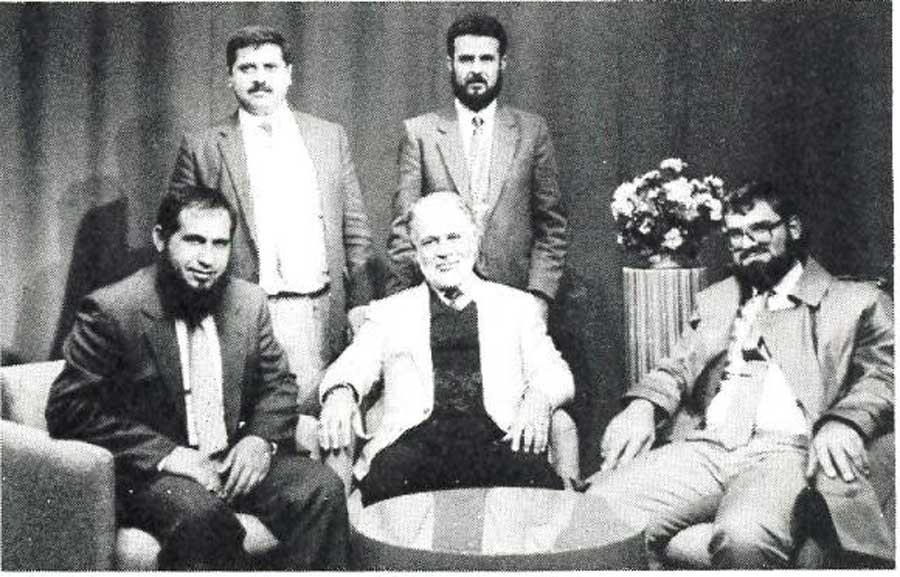
    The story of Ibrahim Abdullah, mayor of an Israeli Arab village called Kfar Qasem, is the story of 800,000 Palestinians living in Israel. The existence and the role of these Palestinians is hardly known to the world, which has seen the Palestinian struggle mainly through the eyes of the PLO and, more recently, in-tifada. Mr. Abdullah, 30, and four other young Muslim mayors from Israel recently came to the United States to tell whoever they could find about the lives, struggles and challenges of Israeli Palestinians. The following story is based on an interview by The Message International with Mr. Abdullah; Jomah Kassasi, mayor of Rahat; Kamel Rayan, mayor of Kfar Bara and Tawfik Khatib, mayor of Jaljulia. Mayor Raid Salah of Umm Fahem, although part of the group, was in Detroit at the time of the interview. Due to his fluency in English, Mr. Abdullah spoke for the group.

    It is a sad irony that in the land of Al-Quds many Muslim Arabs lived a life of Jahiliya for nearly two decades. Indeed, Israel’s policies of cultural annihilation of its Arab subjects could not be more successful. But things are changing, and Palestinian Muslims living within Israel have rediscovered themselves and their mission. They are no longer resigned to their fate, or without a dint in their eyes. Israel’s evil occupation has proved to be a two-edged sword. While Israeli inhumanity and creeping annexation of Palestinian lands have made it the Goliath of our times, they have also brought helpless Palestinians face to face with their natural ally, Islam. The February 1989 elections in Israel were a turning point in the lives of Palestinian Muslims. From a feeling of dejection, frustration and apathy, Muslims of a nameless Islamic movement for the first time contested and won mayoralties in several Arab towns of Israel. And the results were astonishing from any standard.

    In Umm el-Fahem, 75 percent voted for an Islamic candidate. Support for Islamic contestants was also strong in Kfar Bara (70 percent), in Rahat (65 percent) and Kfar Qasem (60 percent). In Nazareth, a stronghold of Communists for 20 years, Islamic candidates won six of the municipality’s 19 seats.

    Their newly found success is seen by some Christians as a hopeful sign for them as well. During the electoral campaign in Umm el-Fahem, a Christian doctor told the audiences: “If you really want to overcome all your problems, you have to support the Islamic movement, because I believe that Islam is the solution.” After Muslims bagged six seats in Nazareth, a place of religious significance for Christians, a priest congratulated Muslims for defeating the atheists. Another Christian, a professor of religious studies in Nazareth, also sent in his commendations.

    “There is a strong cooperation between Muslims and Christians, and those sincere Christians do really believe that Islam is the solution,” Mr. Abdullah said.
    Although their election to power in municipal governments has not affected an Israeli law that bars them from making contacts with out-side Arab governments or movements, it has transformed them into a respected power bloc within Israel. Long committed to a non-political struggle, these Muslims have reversed themselves in order to bring an end to their exploitation, says Mr. Abdullah.

    “We saw that a lot of Israeli parties — whether Communist Party, Arab Progressive Party or Arab Republican Party — did not really penetrate into the hearts of the people or touch the elements of their own faith; they only exploited the Arab masses for elections; they did not remember that there are more than 800,000 Palestinians in Israel, the same number as in the occupied territories. When they spoke of Palestinians’ rights to a homeland, they only spoke about those living in those territories and no one said that the other 800,000 people also have the right to be involved in a future settlement (of the Palestinian problem). So, we came to the conclusion that as an Islamic movement we have to work with the people and help them overcome their difficulties.”

    Although Palestinian Muslims in the country distrust all Israeli parties, they have found an unnatural sympathizer in leftist politicians. Mr. Rayan, mayor of Kfar Bara, said through an interpreter that Palestinians have stopped trusting all Israeli parties because of their role in the massacre of Arabs. On the other hand they see leftist members of Israeli parliament working hard for the Palestinian cause.

    The Islamic movement does not have a political party, nor people in the Knesset, the Israeli parliament. The reason, according to Mr. Abdullah, is simple: Israeli parties, whether Labor or Likud, are united against any resurgence of Arab or Islamic power. He challenged the myth that the Labor Party was favorably disposed towards Palestinians.
    “The Labor Party ruled Israel for 40 years and it was the direct reason for the collapse of the Islamic communities.”

    The Israeli leftists are helping Islamists apparently not because of their views but because of their own sympathy for the left-oriented PLO. But there is more to it. Some Israeli leftists see in these Palestinians a reflection of the Jewish pioneers who settled in Palestine in the early and middle part of the 20th century and exploited all the legal remedies.

    The ultimate aim of the Islamic movement in Israel, which predates intifada, is not just the creation of an Islamic Palestinian state, some-thing that their counterpart in the occupied territories already wants, but the establishment of an Islamic caliphate in the world. But for now, Mr. Abdullah has tempered his hopes with the realities in Israel and wants to address the more urgent problems.

    “Believe me we are not idealists; we are not living in mosques or on the moon. We are struggling for equality and peace.”
    According to Mr. Abdullah the disparities be-tween and Arabs and Jews of Israel are glaring. While Jewish towns and settlements are basking in the glow of modern technology and amenities, those inhabited by Arabs are struggling for Tel Aviv’s attention for some of the basic needs of life. Not only that, they are being gradually deprived of their lands as a result of Israel’s voracious territorial appetite.

    “If I were to compare the situation of Arab cities and villages with that of Jewish cities and villages, I would say that we are living at the beginning of the 20th century and they at the end of it. When I look to the East, I see four Jewish settlements which are more developed than some of the suburbs of Washington, D.C. In Kfar Qasem, Israelis have confiscated more than 70 percent of the land, although people have documents proving their ownership; first those lands were confiscated for military purposes, but afterwards were given to Jewish farmers. In Jaljulia, you cannot find a single centimeter for the future generation, and anyone who wants to guarantee the future of his son or daughter, must buy the land that was once his own. And you can say this about all the lands that belong to the 800,000 people.”

    The ties that bind these Palestinians to their lands are so strong that many of them would not leave their towns and villages even if a Palestinian state were to be founded in the occupied territories. At least Mr. Abdullah won’t.

    “We are not going to move, because we believe we belong to our land and not to the country; countries always change.”

    While the Islamic movement in Israel grows in its unique ways, there are indications that Palestinians in the occupied territories have increasingly looked to Islam for emancipation. A recent poll by the Jerusalem Post showed that 60 percent of West Bank residents sup-ported an Islamic Palestinian state, as opposed to 27 percent who supported a democratic state and 7 percent who said they wanted a socialist state. In Gaza Strip, where Hamas is very strong, the support for a Islamic Palestinian state is believed to be even greater.

    The reports about Islam being the choice of an overwhelming number of Palestinians makes Mr. Abdullah think that the PLO today is not the sole representative of Palestinians, only a formal one. The signs of strains between Islamic elements and PLO members were quite visible until a few months ago. The struggle between two competing forces had even pervaded Israeli jails, where members of Hamas and the PLO clashed with each other.

    “I heard a lot of stories about members of the Islamic movement being severely punished by PLO members in the jails because they were caught reading the Qur’an, or spreading Islamic thought.”
    The clashes had become so frequent and open that Yasir Arafat had to intervene personally and appeal for unity. Although he has succeeded in restoring calm in the name of a common goal, uneasiness still prevails on both sides.

    Mr. Arafat knows the power and dynamism of the Islamic movement in the occupied territories. While he may not like the independent approach of Ikhwan al-Muslemoon, or the Muslim Brotherhood, he knows that their support is crucial for the success of intifada. To garner support for PLO, Mr. Arafat met with Mohammed Abu Nash, a leader of the Ikhwan in Egypt, recently. Mr. Abu Nash is said to have told the PLO chairman that he feared the Islamic movement would be the first to be slaughtered after the establishment of a Palestinian state.

    PLO’s approach, apart from being un-Islamic, is lately seen as harmful to the Palestinian cause. From its recognition of Israel and the United Nations resolution 242 and 338 to the renunciation of its charter as null and void, the PLO has created a credibility problem for it-self in the eyes of many Palestinians. So much so that some influential people with ties to the PLO, such as Edward Said of Columbia University in New York, have publicly ex-pressed their misgivings about some of its actions.

    Although Israel has erected a Berlin Wall of sorts between the Palestinians living under its direct rule and those in the occupied territories, that does not prevent the Islamic movement in Israel from doing its bit for the intifada. For instance, before Mr. Abdullah and his colleagues came to the United States, they distributed 24 truckloads of food, milk and other necessities of life among the Palestinians living on the West Bank and Gaza Strip. The Islamic movement also keeps abreast of the developments in the occupied territories and informs Israeli Palestinians through its two publications Saw ul Haq and AsSimt. The secular publications, according to Mr. Abdullah, ignore the news about Islamic movement and cover mostly PLO-related activities.

    The delegation of Arab mayors left United States impressed, hopeful and evermore determined. It was the first of its kind to visit the United States, and so it met with many surprises. It learned that over six million Muslims lived in this country, and that many American politicians, including the few Congressmen and the Undersecretary of State for Near East and Middle East Affairs it met, didn’t know how Israel treated Palestinians. It also visited Muslim communities in New Jersey, New York, Pennsylvania and Michigan. But strong as it was in its resolve to carry on Islamic work in Israel, the delegation looked to American Muslim community for financial and moral support.

    “We are living at the crossroads; either to be agents of Israel or seek independence. We are members of the Islamic movement, and we will never give up. But we cannot develop anything in our villages and cities because of insufficient funds from Israel. We want them (the American Muslim community) to make up for the deficiency imposed on us by Israel,” Mr. Abdullah said.