بسم الله الرحمن الرحيم

Tag: dawah

  • Brazil: A Dawah Trip of a Lifetime

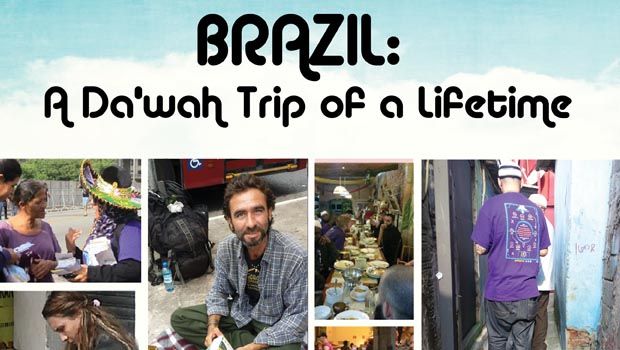
    Brazil: A Dawah Trip of a Lifetime

    Even though I am considered a fifth generation from Guyana, South America, I must confess that I have little to no knowledge of neighboring Brazil except that it is a vast country that borders Guyana and every other country in South America except Chile. Brazil is home to the massive Amazon rainforest, part of which extends into Guyana and which is commonly nicknamed “the lungs of the world” as it covers an area of 2.1 million square miles, a vast tract of forest that sucks up carbon dioxide from global emissions and in turn produces the oxygen we need to breathe. Sixty percent of the rainforest is in Brazil.

    Da’wah is not just words. Oftentimes it is through the way we interact with others

    Questions About Islam and Muslims in Brazil

    I always think of Brazil and other South American countries in terms of their Muslim communities and I wonder if they have masaajid (mosques). Is any Da’wah work going on in these places and if so by whom? What have their populations heard about Islam? Are the people biased against Islam and Muslims? Who are the native Muslims in terms of understanding and practice of their Deen?

    Since most of South America speaks Spanish, and Portuguese in Brazil, I continued to have these questions and few answers as I concentrate on da’wah in the English-speaking environments of Guyana and the U.S. Yet I always hoped that one day I would be able to venture into the Spanish-speaking parts of my own continent and find answers for myself, by the grace of Allah SWT.

    WhyIslam Heading for Brazil

    In May of this year, Br. Farhan from WhyIslam, an ICNA project, reached out to let me know that a da’wah team would be going to Brazil for the 2014 FIFA World Cup; I immediately knew this was my long-awaited opportunity. This was my chance to see first-hand how Islam has advanced into the heart of South America and what, if any, da’wah goes on in this vast country of 202 million people, most of whom are Catholics. So without a second thought I replied that I would like to be part of the WhyIslam team.

    I was pretty excited about the upcoming trip to Brazil but as the time drew near I had many “what ifs” popping up in my mind. Perhaps having second thoughts was because I was going to a strange land, not knowing what lay ahead. Or perhaps it was the Portuguese language and even though my knowledge of Spanish is fairly good, I wondered if it would be sufficient to maintain a dialogue, to give da’wah in an effective way. At the same, the media was covering the large demonstrations preceding the World Cup including strikes, acts of civil disobedience, and the harsh, sometimes brutal, reaction of the police to the protestors. But by the time we got there none of this was evident. Once the match begins, Brazilians are in football frenzy and grooving!

    What is your Goal? ¿Qual é o seu objetivo?

    Brazil, like many of the South American countries, is all about football. For them football is bigger than life itself. Hence, the theme WhyIslam chose for the da’wah campaign in Brazil was “What is your goal?” or as you say in Spanish “¿Cuál es tu meta?” and in Portuguese “Qual é o seu objetivo.” This was so appropriate as it opens up the question for a dialogue, seeing that the main “goal” for many was which player would score a goal for their country. In fact, one day as I was standing on a street corner handing out flyers, a Brazilian journalist approached me and asked me about the place or relevance of religion at the World Cup. So I had the opportunity to explain that beyond the goals on the field is a bigger goal of life that we should also think about, and while the worldly goals of sports and all of life’s activities will end and are short-lived, the real goal of life – to find meaning, purpose, and truth – is everlasting. I explained to her that the first goal is easier, requiring that one kick a ball to score a goal; but the second goal requires a lot more than just kicking a ball! It’s about life! What is the goal of your life? What happens beyond this life? Have you prepared anything for it? And thus my da’wah experience in Brazil began.

    Da’wah at the Games

    Most of our outreach programs were centered around the games. Whenever a match was played in Sao Paulo there would be a huge gathering and there we distributed flyers and had conversations with people. Whenever the Brazilian team was playing, the crowd kept pouring into the “Fan Fest Zone,” a free area not too far from the stadium where fans could watch the match on big screens. While most of the passers-by were Brazilians, we did run into a number of people from different parts of the world. We met several Muslims who had come to see the games. They were very happy to know that we were taking the opportunity to reach out to people with the message of Islam.

    Our first stop was quite a remarkable one. It was Thursday June 19 and we had decided to go to an area where the WhyIslam team had been a few days before to pass out flyers. However there was lots of open drinking in the streets. As we began distributing flyers, one elderly lady came to us and welcomed us, but barely had she done so when she began in an evangelical style to preach that Jesus is the only son of God and that God so loved the world that He sent His only son. So I felt compelled to answer her claims and with my limited Spanish I joined her in the same evangelical style and began to proclaim loud enough for the surrounding people to hear, “El Dios es el más grande. Él no tiene necesidad de un hijo o una hija! Jesús es un profeta. Allah solamente es el Dios!” The meaning is “God is The Greatest. He has no need for a son or a daughter. Jesus is a Prophet. Allah alone is God!”

    At that time Sister Nahela, our Spanish-speaking team member, and Br. Fayed and his wife, Sister Bia, our Portuguese-speaking team members, began a deeper conversation with the woman, gently but confidently refuting her proclamations. In the end she was silent, looking very thoughtful and surprised at what had just taken place. While this was going on, some men who were drinking at a bar began to gather around us. Even though it was a little intimidating, we continued handing out our flyers. It took some time, but I came to realize that people are genuinely interested in knowing about Islam. I expect that the men from the bar have listened to these evangelical speeches countless times and now they were willing to hear what “the newcomers” had to say.

    The Fan Fest Zone

    After a while we went to the Fan Fest Zone on another side of the stadium and there we began handing out flyers at a very fast pace. Every time we gave a flyer we would say “obrigado” meaning thank you or “muito obrigado” thank you very much. With these two phrases and a smile we handed out thousands of booklets and flyers and the da’wah campaign was off and running in Brazil!

    There were a few incidents at the Fan Fest Zone that are worth narrating here. First there was a Brazilian gentleman with whom we were engaging in some discussions. He had a bottle of beer in his left hand and all of a sudden during our conversation with him his beer fell out his hand and the bottle broke. The guy was kind of shocked and bewildered as if some power had just pushed the bottle from his hands, plummeting it to the ground where it broke. It was almost as if Allah SWT’s words and beer could not be with a person at the same time. Another amazing incident that took place within the same hour was praying Salaatul Maghrib and Eshaa at the Fan Fest Zone. It was crowded with thousands of people walking by and lots of drinking was going on. Also the security was very intense. It was time to pray Maghrib and so we decided that we would look for a fairly clean place (which was hard to find) on the pavement and do our Salaah there, even though there was a Masjid nearby. Earlier that day we tried to get into the Masjid to pray Zuhr and Asr Salaah but it was locked and we ended up praying in a nearby parking lot which was far from clean. So right where we were seemed the best choice.

    As we were looking for a possible area to pray, two brothers happened to pass by and gave me salaams. So I told them to join us, that we were about to pray our Maghrib Salaah. Just then I mentioned that we had to pray on this dirty pavement because the nearby Masjid is closed and we did not know who to contact to have it opened. They said that they were the ones in charge of the Masjid and they had the keys. They were very happy to open the Masjid for us and alhamdulillah they did. This was finding an oasis in a desert; the luxury of restrooms, wudhu, a clean place to pray, away from the noise and chaos of a drinking, boisterous crowd. We could only conclude that you make one step to serve Allah SWT and He SWT makes the way easy for you.

    When we engage with the people and listen  to their narratives and the struggles that  they deal with each and every day, we can  offer them words of comfort, hope, and truth

    Da’wah in Liberdade (Little Japan)

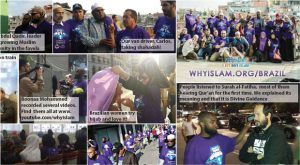
    The next day was Friday and after delivering the Khutbah in Arabic at Sao Paulo’s main Masjid, Abu Bakr Assiddik (translation in Portuguese using the head-phones), we headed for a busy junction called Liberdade in the heart of Sao Paulo. There we were joined by the British da’wah team. This area is known to be home to the largest Japanese community in the world, outside of Japan. There we had a lot more interaction with the crowd. What was noticeable was that the majority of the Japanese people did not accept any flyer from us and the majority of Brazilians took the flyers and booklets and at least interacted with us. One lady said that she heard that The Qur’an is recited like a song. So I had no choice but recite to her Suratul Fatihah in the middle of Liberdade so that she could hear the recitation of The Qur’an.

    After several hours of handing out flyers with the same obrigado and a smile it was time for Maghrib and Eshaa Salaah. This time there was no nearby Masjid so we had no choice but to hit the pavement. One of the brothers called Adhan and the police kind of made sure we prayed undisturbed. So when the Salaah began, a little crowd gathered to see this rare sight: people in a row standing, bowing, prostrating and sitting; all in the same sequence with the sound of Allahu Akbar! I was told that several people took out their phones and took pictures of us and some videoed the prayer. When we were done praying, some more flyers were distributed to the lookers-on. That evening Br. Fayed and Sister Bia invited us for a traditional Brazilian dinner. Needless to say that it was absolutely delicious and a reminder of my own Guyanese cuisine with yuca (we say cassava in the Caribbean) and organic beef in a soup form and the highlight was a passion fruit mousse. Saturday we spent at the center where Sh. Rodrigues, a native Brazilian, had classes for new Muslims. Each one of us introduced ourselves and shared some of our experiences and encouraged them to be firm in their Deen. Most of us spoke in English while sister Bia and Br. Fayed translated.

    Da’wah in the Favelas (Slums)

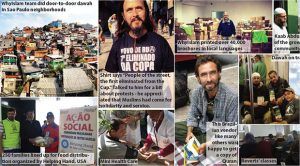
    The next day was an experience in da’wah that was a unique Brazilian experience that. It was da’wah in the favela. Favela is the term for a slum in Brazil and very often one can find these slums near upscale urban areas, in such close proximity that on one side of the street there are multimillion dollar high-rises and on the other side are slums with open sewerage, little or no utilities, poverty evident everywhere, and the potential for crime in every corner. Indeed we were told before entering the favela that we needed to be very vigilant because in some of those areas the police have no presence. Only Br. Boonaa and his camera man, Br. Adnan, were allowed to film and only at particular places and when permission was granted. We met Imam Kaab who by himself established a Musallah just at the entrance to the favela. He informed the “leader” of that particular favela that a group of people wanted to go around and distribute flyers after which they would hand out food boxes to the poor and needy. This was in collaboration with Br. Irfan Khurshid from Helping Hand. So with our trust in Allah SWT and taking our precaution, we went door to door handing out flyers and booklets on Islam and to anyone we met in the street. The favela was set on a hilly region of the city, apparently typical of most of the favelas. The “leader” himself met us and went around with us as if he were part of our team. Wearing a gold chain with a cross around his neck, he took us to the nooks and crannies of the favela. The streets were so narrow that two people of any size would find it difficult to pass. The smell was far from welcoming, but with pleasure our team went from door to door to spread the word of Allah SWT.

    Most people we met had smiles on their faces. SubhanAllah! What a miserable life people are forced to be in while the country prospers! One wonders what government would deprive so many of its citizen from participating in the prosperity. But this is reality, not only in Brazil but so many places around the world. We went higher and higher up the hills until some of us thought it was becoming very hard physically to go on. But with trust in Allah SWT and the motivation from each other we all climbed until we reached the top. Then we finally returned to Imam Kaab’s house and Br. Irfan organized the distribution of the food boxes.

    Our Taxi Driver Takes Shahaadah

    Imam Kaab prepared a humble yet delicious meal for all of us. Just after the meal our taxi driver, Carlos, who had been observing us from day one, decided there and then that it was time for him to take the Shahaadah. He observed how we put aside fear to deliver Allah SWT’s message and how we helped the poor in the favela. He felt that this religion must be true. It was a special moment. You think back at all those stories of the Sahaabah (RA) who prior to their acceptance of Islam were in a state of kufr (disbelief) but just by observing the Muslims they joined the ranks and became the most upright of Believers.

    We prayed Salaatul Maghrib and Eshaa at the Musallah of Br. Kaab after which we engaged in some reflections on Br. Carlos’ Shahaadah and it was very emotional. For many of the brothers and sisters there, it was a humble reminder of their journey from kufr to eman, and the challenges and joys of being Muslim. We were all touched and every one of us cried. Br. Carlos said that he was observing us from the first day and even though he understood very little of what we were saying, just by our behavior and kindness he felt this must be the right way. SubhanAllah! It brings us to another reality check that da’wah is not just words. Oftentimes it is through the way we interact with others. This is such an important lesson for us to learn, especially living amongst non-Muslims.

    Like Carlos, many people in Brazil are ready to listen to the message of Islam and I think that we are somewhat obligated to go and let them know what Islam is. It is Allah SWT who changes the hearts but our job is to deliver the message. Only Allah SWT knows how many of those people to whom we gave flyers and booklets may one day accept Islam and if by His Qadr, they do not, they cannot stand before Him on the Day of Judgment and say that they never heard about Islam.

    Two Incidents – One Uplifting and One Not So Much

    Let me start with the “not-so-much-uplifting” incident, the only down moment in Brazil, and ironically it happened to be with an Imam at one of the first masaajid built in Latin America. We visited this masjid the day after Br. Carlos took Shahaadah. While we were basking in the beauty of the masjid, the Imam appeared and very rudely asked us who gave us permission to enter. We introduced ourselves and I mentioned that Br. Carlos had just taken Shahaadah the day before. The Imam’s next remark was quite disheartening. He asked in a rude way what could Carlos know about Islam to become a Muslim. Then he questioned me as to where I studied about Islam and for how many years. When I told him seven years, he immediately did a “one up” on me, stating that he has studied for 26 years. At that point we realized that we were not welcome there. Ironically, the day before a gang leader graciously and respectfully escorted us around the slums to do da’wah; and the very next day a Shaykh who studied Islam for many years all but kicked us out of Allah’s house of worship. These were teaching moments, reminding us that a man of the streets, without education, might be humble and courteous while a man inhabiting a house of God, one with so-called “knowledge,” might be arrogant and rude.

    Now let me share the uplifting story, one with a happy ending. On my way home I had a layover in Panama for almost eleven hours. So I decided to venture into Panama City for a while. The taxi driver took me to see several important sites including the Panama Canal. During our trip we spoke a lot about religion and I told him about Islam, that Ramadhan would begin the next day and what it meant for Muslims. He explained that he had doubts about some of the tenets of his faith. The last stop we made was to a Masjid. I invited him to come with me into the Masjid. I showed him how to make wudhu and then he stood next to me for prayer. After the prayer he took Shahaadah by Allah’s Grace.

    Conclusion

    I observed in both Brazil and in Panama that the Islamic Centers are built to serve the Muslim community and accommodate their religious and fellowship needs. Alhamdulillah, that is good. But as for da’wah, and Allah SWT knows best, it seems to me that very little is done.

    Muslims cannot take benefits from the society and feel satisfied with just taking. They must give back to society more than what they take. I encourage every Shaykh to take time to leave the minbar (pulpit) and go into the field. When we engage with the people and listen to their narratives and the struggles that they deal with each and every day, we can offer them words of comfort, hope, and truth. In case you want to step out and head down south, Brazil is a good place to go. Just remember a smile, a flyer, and a simple obridgado!
  • Finding Comfort and Countless Other Blessings in Dua

    Finding Comfort and Countless Other Blessings in Dua

    I was listening to National Public Radio a few years ago and the topic of prayer came up. Several random people were asked the question, “When was the last time you prayed?” I was surprised to hear responses like, “I haven’t prayed since my daughter was in the hospital six years ago.” Or “I haven’t prayed since I visited a church two years ago.” The prayer that was being referred to on the radio program could be likened to what Muslims refer to as du’a (supplication), and I remember reflecting on how fortunate Muslims are in their obligation to offer salat (ritual prayer) five times a day—thus maintaining a daily connection with our Creator. The fulfillment of this obligation not only provides the blessings derived from our obedience, but also imparts spiritual benefits enabling us to draw nearer to Allah (swt), thus enjoying peace of mind and spirit. Allah says in the Quran: “Verily in the remembrance of Allah hearts find rest” (Quran 13:28).

    In making du’a, we acknowledge that Allah exists, has imbued the creation with a meaning and purpose, has created us to worship Him, and has the power to answer our supplication and improve our circumstances.

    In addition to salat, however, is du’a and this discussion about prayer begs the question: do we truly recognize the innumerable benefits and blessings of making du’a (supplication) to Allah (swt)? Du’a, supererogatory prayer beyond the obligatory salat, is a humble and earnest entreaty to the Lord which can be made at any time of day or night, for any reason, major or minor, whether for comfort, guidance, relief, or inspiration. Without doubt, there are times in our lives when difficult circumstances are beyond our control. Feelings of helplessness may overcome us due to losing a job, having financial difficulties, a loved one becoming sick, or any of the other countless personal or family challenges humans face. Still at other times we may be frustrated by the lack of peace and justice around the world and the many complex and unsolved global problems like poverty and hunger. It often seems that our ability and power to make change in the world, or even in our own lives, have limits. However, one of our most powerful and useful tools in seeking a better life in this world and in the next comes from making sincere du’a.

    Du’a is an Islamic term which means to call out, to supplicate, to communicate with our Creator, Allah (swt). It is an act which acknowledges our dependence on Him and demonstrates our faith in His power to bring about positive change in our lives. Making du’a is empowering and fulfilling as it provides us a means of hope by which the solutions to our deepest concerns, problems, and hardships will be found and relief granted. As such, the following are some of the many benefits and blessings in making du’a.

    The blessing of recognizing that du’a is a form of worship

    The Prophet (saws) has said, “Du’a is ibadah (worship)” (Tirmidhi). Thus, blessings are derived from the act of worship made through supplication. In addition, in Allah’s infinite Mercy, He has included a du’a for guidance within surah Fatihah which Muslims recite at least 17 times a day during the daily prayers – “Show us the straight path. The path of those on whom You have bestowed Your grace, not the path of those who have earned Your anger or who have gone astray” (Quran 1: 6-7).

    Du’a helps to strengthen our eman (faith)

    In making du’a, we acknowledge that Allah exists, has imbued the creation with a meaning and purpose, has created us to worship Him, and has the power to answer our supplication and improve our circumstances.

    Du’a helps us to grow closer to Allah (swt)

    Allah says, “And when My servants ask you concerning Me, then surely I am very near; I answer the prayer of every supplicant, when he calls on Me… (Quran 2: 186).

    Du’a helps to prevent feelings of isolation and despair

    When we firmly believe in Allah, we realize that Allah (swt) is not only our Creator but also a protecting friend who is always ready to listen to and aid us. Allah says in the Quran, “Allah is the protector of the believers” (Quran 2:257). In addition, Allah says, “…for Allah loves those who turn to Him constantly…” (Quran 2: 222).

    The du’a of repentance provides forgiveness of our sins

    We should never lose hope in Allah’s willingness to forgive our transgressions, and we should also not assume that we are entitled to Allah’s forgiveness without first asking for that forgiveness. Allah (swt) says in Hadith Qudsi: “ …Oh son of Adam, were your sins to reach the clouds of the sky and were you then to ask forgiveness of Me, I would forgive you.”

    Making du’a is a means by which Allah (swt) answers our prayers

    Du’a provides an opportunity for us to have our wishes granted, for blessings to be showered on us, and for protection to be provided to us. The prophet (saws) has said, “Every Muslim who supplicates to Allah with a supplication which is not haram, shall be granted what he asked for in one of three ways – either Allah (swt) answers his supplication quickly, or answers his supplication in the hereafter, or exchanges his supplication for a hardship that was to befall him” (Ahmed).

    It is quite interesting hearing stories from Muslims of how their du’a have been answered. I, myself, have seen my du’a answered, at times, years later with something better than I had initially asked for, and I also have witnessed my du’a being answered immediately, as well. I recall an incident which took place when I was 13-years-old when my younger brother was playing with a child in our neighborhood on a white gravel road in front of our house. My brother showed this young neighbor his new sling shot. The young neighbor then pointed and shot the sling shot directly at my brother’s face. My brother came running into the house crying, with blood all over his face. My mother immediately tried to assess his injuries. She found that his front tooth had been broken in half, and urged me to go to the road where they were playing and find the tooth on the gravel road. I did as she asked and searched for the broken white tooth on the white gravel road. I felt like I needed a miracle so I began making du’a. SubhanAllah about two minutes later my eyes focused and zoomed in on the broken white tooth sitting on the white gravel road. I was amazed and uttered, “alhamdullilah” at the awesome discovery.

    Regardless of how daunting a difficulty is, or seemingly insurmountable a problem or hardship can seem, never underestimate the benefits of making du’a. Remember that Allah (swt) is All-Powerful and promises to answer our call. Allah (swt) says, “… And whoever fears Allah—He will make for him a way out and will provide for him from where he does not expect …” (Qur’an 65:2-3).


  • Dawah Through Caring and Sharing

    Dawah Through Caring and Sharing

    “Have you ever seen a tornado up close? It’s the most awesome thing I’ve seen in my life. It’s like coming face-to-face with God in a bad mood.” That was what a professor of mine said when I was still in college some three years ago and since then Al-humdu lillah, I’m happy to say I’ve still never seen a tornado except on TV or in a movie. But, I did see the aftermath of one in late April in rural Mississippi a few days after a series of tornadoes had barreled through the southern United States, causing extensive damage in four states.

    As a resident of New York City, I had experienced two hurricanes in the past few years – the latter one with a benign-sounding name being particularly ferocious. Sandy flooded my neighborhood but thankfully it didn’t reduce any houses to a pile of planks. So, while I thought I knew what to expect once I landed in Tupelo, Mississippi, the state’s seventh largest city, seeing the damage with my own eyes was surreal.

    Whole sections of restaurants, hotels, and other businesses were obliterated, leaving nothing but a mass of upturned wood and broken furniture scattered nearby, their once towering sign boards now lying flat on the dirt. Many homes had trees fallen through their roofs while the neighboring house was untouched by damage. Seeing one building’s roof blown off and its structure reduced to tragic ruins while the one only a few yards away stood as perfectly charming as a quaint Southern home would be, baffled the mind. You saw an ayah, a sign, of Allah’s Power and Wisdom right in front of you. While one family would be crying out to Him in devastation, the other would be thanking Him as they breathed out sighs of relief. As the Qur’an says, Quran 2:155).

    Across the state of Mississippi 14 people died, mostly in rural areas. Through ICNA Relief USA, a domestic Muslim faith-based agency actively participating in disaster response, I was on the ground in the state to document their work as they began their post-tornado recovery efforts. By the grace of Allah, ICNA Relief has helped many and its work has been recognized at the federal, state, and local levels of government and by their VOAD (Volunteer Organizations Active in Disasters) partners.

    ICNA Relief always makes sure to reach out to the local Muslim community anytime its Disaster Response Team is deployed for recovery work in any particular area. This time it was very difficult to make contact with an Islamic center ahead of time because tornado warnings were in effect in the South in the following days after the tornadoes had first hit. Br. Arif Ali, ICNA Relief’s Disaster Response team Lead, drove all the way from Florida to Masjid Abraham, in Tupelo. When he pulled up to the masjid, a man came rushing out to his car.Br. Arif says that he thought he was perhaps parking in the wrong area. But the man, Br. Abdul Raheem Khan, acting imam of a masjid whose congregants consist of only 20 families, simply said, “Alhumdulillah, you’re here. How did you know we needed help?”

    The masjid was more than happy to let ICNA Relief’s Disaster Response Team, along with volunteers from Florida, set up camp in its facility while they began tornado recovery work in the surrounding towns like Marietta. The team, working alongside NECHAMA, a national Jewish disaster response agency, cleared up debris from damaged houses and used chainsaws to get through thick fallen trees. They also tarped houses whose roofs were damaged. One homeowner was so grateful, telling Imam Rafiq Mahdi, another ICNA Relief Disaster Response Team Lead from Tennessee, “You’ve really changed hearts and minds. You changed my heart and mind.”

    Living in the North you hear many things about the South being ultraconservative and the people being close-minded, wary of outsiders. Though I definitely got more stares due to my hijab, there was barely a person who did not smile at me after I greeted them. After a particularly hot day working on a mobile home that had flipped over on to its topside and crashed into an electric pole, the homeowners provided sandwiches for all 15 of us, including Br. Abdul Raheem Khan and his mother-in-law who had turned out to volunteer. The homeowners’ kids (who were very polite, calling us sir and ma’am) rushed to supply us with paper plates and cups, while their father Robert, who went by “Bubba,” offered us yellow-frosted cupcakes to top off our meal. Southern hospitality is real! The homeowners were so appreciative of the work the volunteers did. “I’ve had a tremendous amount of help. ICNA Relief has done a great job,” Bubba said. “They’re very nice and have done so much work that I can’t explain.”

    So what is the purpose of sharing this story? This isn’t a travelogue on my trip to Mississippi. I want to convey the point that there are plenty of “Bubbas” out there, many people who need help in all sorts of way. As Muslim Americans, as citizens of this nation, we can extend our help  while building bridges of understanding and fellowship. This year, instead of only donating money, please consider donating your time as well, to be of active service to your faith and this country. Sharing your time with those who need it by helping them to clean up after a natural disaster, or providing them with food when they are hungry or clothing when they are cold, offering shelter when they are homeless or solace when they feel lost and alone – this is dawah from the ground up, without even having to utter one ayah of the Qur’an. As Br. Abdul Raheem Khan has said, “I was looking to do dawah through practical work and I found it.”

  • WhyIslam Scores “GOAL”

    WhyIslam Scores “GOAL”

    Organizing a massive dawah effort for the 2014 FIFA World Cup in Brazil, bringing together over 20 Islamic organizations on an international level, and mobilizing dozens of volunteers originating from 6 continents is a task of epic proportions. With the help of Allah and the assistance of the Centro de Divulgação do Islam para a América Latina (CDIAL), an equally dynamic dawah initiative based in Brazil, South America, the Islamic Circle of North America (ICNA)’s WhyIslam Project was able to take on the challenge and as of June 12th a team of daees was already in Sao Paulo kicking off the World Cup by asking soccer fans, “What is your goal?”
    Team members began arriving in Brazil as early as June 10th, from as far as the UK and also the US. After some meetings with local volunteers and logistics coordinating, they began hitting the streets of Sao Paulo on June 12th, which marked the beginning of the World Cup soccer matches. In preparation for the games, they printed 40,000 dawah handouts in Portuguese and Spanish, as well as other languages. As they work, they don the official campaign T-shirt with the slogan, “What is Your Goal?” or “Qual é o seu meta” in Portuguese. The purpose of the slogan is to make people think about what really is the most important goal in life.

    In just one week, there have been three shahadahs facilitated by dawah volunteers

    The crew engaged local residents and fans from all over the world in “street dawah,” a style of outreach in which Muslim men and women approach individuals in the street, local vendors, or fans at stadium-side to provide them with information about Islam and answer questions. In just one week, there have been three shahadahs facilitated by dawah volunteers in Sao Paulo, one of which was the cab driver who was transporting some of the volunteers, alhamdulillah.

    Throughout their days, volunteers take photos and video to post on social media in order to keep WhyIslam’s global audience informed of their progress.
    The many volunteers include Nahela Morales, WhyIslam’s National Spanish Outreach Coordinator, Sheikh Abdool Rahman Khan, Boonaa Muhammad, Cyrus McGoldrick, Andrew Morales, Anwer Arshar and Abu Sumayyah Lebron. Bia Kehdy and Muhammad Martins, both Muslim Brazilian natives, and other local Brazilian volunteers have been instrumental in planning logistics and breaking language barriers. More team members continuously arriving from places such as the US, Canada, Mexico, Colombia, and the UK. Others involved in managing and organizing, taking hotline calls, and media coverage are not physically present in Brazil, but working remotely from the US and Canada to provide assistance to the group.

  • Did ’80s Teach Us Anything?

    Did ’80s Teach Us Anything?

    An Overview of Islam in North America


    As we welcome a new decade, the last of this century, it is important that we review our performance in the ’80s.

    The ’80s witnessed a large influx of immigrant Muslims to the United States and Canada. An overwhelming majority of these immigrants, both old and new, decided to make North America their permanent home. A significant increase in Muslim population also resulted from births in the community, which boasts of 6 million people in the United States and 750,000 in Canada.

    The increase in population also affected the way we live and worship. Disappointed with a life without inter-community communication, proper mosques and a social support system, Muslims in the ’80s joined hands to attack these problems and made impressive gains.

    While figures of the ’70s are not available, today there are an estimated 800 mosques across North America. Organizations which carry out Islamic da’wah, and social and cultural agendas of the community have been founded in every nook and cranny of the continent. While most of these organizations are rooted in the local communities, there are at least four major organizations which work on national and even continental level. The Tableegee Jama’ah, the American Muslim Mission (AMM), The Islamic Society of North America (ISNA) and The Islamic Circle of North America (ICNA), although founded before the ’80s (except ISNA), have broadened their activities and are seen as an important force in the life of the North American Muslim community.

    In 1985 Warith Deen Mohammed, president of AMM, designed for African American Muslims, dismantled the organization, and asked its members to work with the mainstream Muslim community. This was a very important development, as it showed that African American Muslims had come a long way from the racist days of Elijah Muhammad, father of Warith Deen Mohammed and founder of AMM’s race-based predecessor, the Nation of Islam.

    Although Mr. Mohammed and AMM did a highly commendable job in bringing non-Muslims to the fold of Islam in the ’70s, lately they seem to have slowed down. There could be two immediate reasons for this: their emphasis on indoctrinating and training members and internal divisions. Their work was also affected by a lack of rallying point for African Americans, and the Islamic Revolution in Iran. In the ’60s and ’70s, riots in black ghettos and civil rights movement had endeared Islam to many African Americans, who were looking for better alternatives to capitalism. Islam to them epitomized salvation from op­ pression. In the ’80s the civil rights movement, as we knew it in the ’60s, was simply not there.

    In the wake of the Islamic revolution in Iran, hostage taking in the U.S. embassy in Tehran, and a spate of hijackings in the Middle East, the American media portrayed Islam in a negative light. As a result, Muslims of North America, many of whom would have proudly carried out Islamic da’wah, were forced to spend much of their time defending Islam.

    In contrast with slowdown in AMM activities in the ’80s, ICNA made important gains. Founded in 1968 as an Islamic Jama’ah and movement and devoted to Urdu-speaking community until the ’70s, ICNA took its message to the entire Muslim community of North America and to non-Muslims, many of whom accepted Islam in one of its several units. It also published and distributed da’wah literature through its workers in most of the major cities of U.S. and Canada.

    ICNA workers were also active in the propagation of Islam to inmates in different city jails.

    However, we have a long way to go in winning the respect that we as Muslims deserve from others and fulfilling the task that we must. Despite its spiritual hollowness and liberal atmosphere, North America remains a fertile land for the propagation of Islam. And unless we change the society we have chosen to live in, it is possible the society will change us and devour our children.

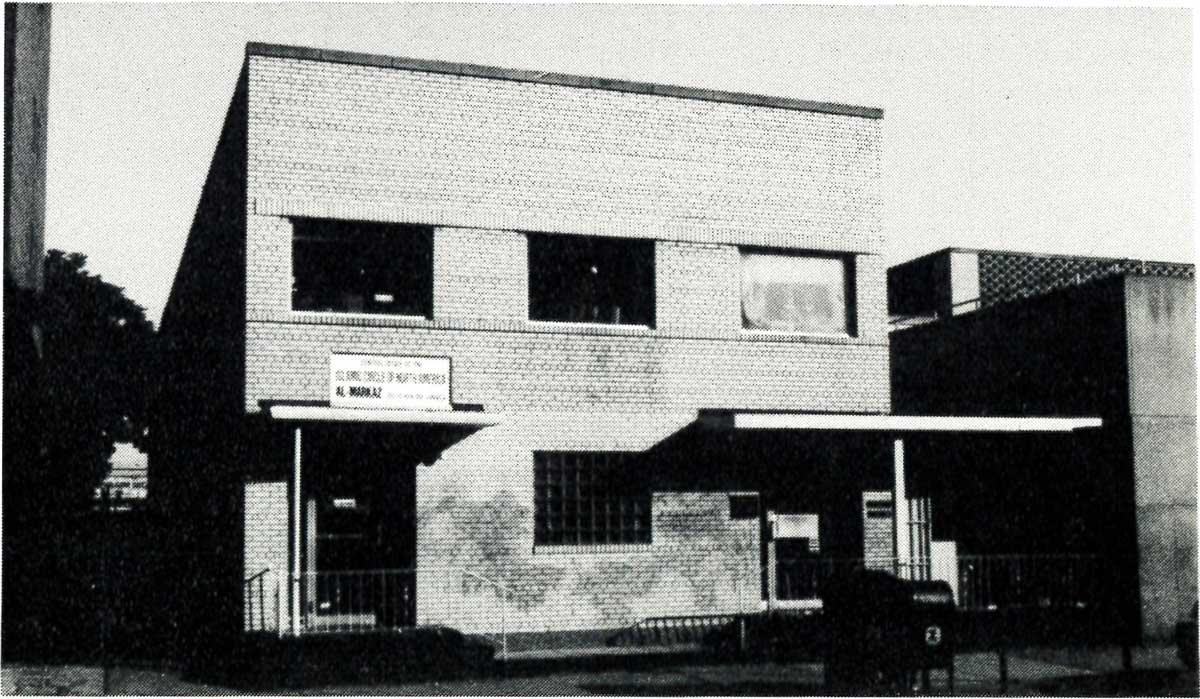
    ICNA Central Office New York
    ICNA Central Office New York

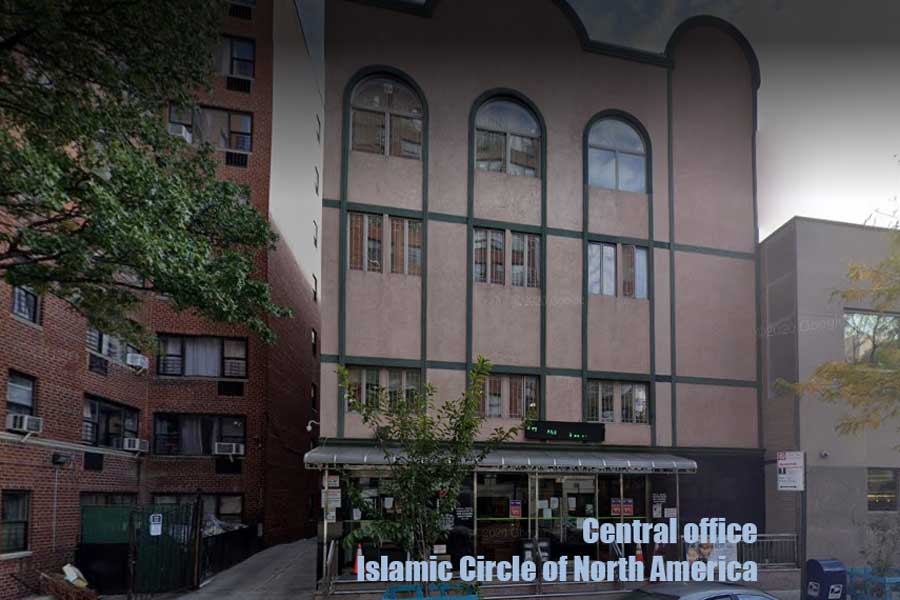
    ICNA central office in Queens, New York

    Besides ICNA, several mosques and Islamic centers also worked towards this end. Masjid At-Taqwa and Malik Shabazz Mosque in New York City, and Masjid Al-Islam in Dallas, worked hard to rid their neighborhoods of drug dealers and invite non-Muslims to Islam. The ’80s were also important for the establishment of mosques, Islamic centers, schools, and businesses. As far as schools are concerned, the African American Muslims led the way by founding a chain of full-time schools called Sister Clara Muhammad School, in several big cities. Immigrant Muslims also made significant gains in this area. By the end of the decade, 60 schools had been established in the United States and Canada, with some of them better than many public schools. New Jersey’s Al-Ghazaly is by far the best Islamic school.

    In the field of education at least three more ventures were launched in the ’80s. Among them were Is-lamia College in Chicago (1983), Nizamia Madrassah at Cornell, Canada (1985), and Darul Uloom Al-Islamiyah of America in California (1988). Unfortunately, the community response has been poor. The Islamia College, where the first batch was graduated in 1988, now has only 60 students. The two madrassahs have also had a disappointing experience. These Islamic educational institutions have to be supported by the community so that they can grow into powerful seats of learning.

    To offer Muslims a chance at interest-free banking, ICNA was able to set up the Muslim Savings and Investments, Ins. (MSI) in 1985. MSI not only offers a chance to invest and earn profits, where possible, it also finances homes for qualified customers.

    It is hoped that in the ’90s MSI will develop into a full-fledged bank.

    There are many financial institutions which were established in ’80s. Some are interest-free like Baitul Maal (BMI) of New Jersey, and some have investment in stocks (according to many `Ulama is not halal) like Amana Mutual Funds.

    In the area of housing Toronto Housing Coop, in Canada, was an important Muslim organization to be founded in the ’80s. Started by a few sincere Muslims, it has been able to buy more than 100 interest-free homes for the community. Other smaller organizations are also working in other cities on these lines. The ’80s also saw a growing unity and sense of Ummah among Muslims of North America, both indigenous and immigrant. The unity was reflected in the community’s work in providing political and monetary support to jihad in Afghanistan and Palestine. A number of Muslims were so dedicated that they actually went to Afghanistan to fight against the Communists.

    Unlike the ’70s, Muslims in the ’80s showed political awareness and began taking active interest in the mainstream political parties of the United States and Canada, with some of them holding political offices. Muslims played an important role in the election of (late) Chicago Mayor Harold Washington, Detroit’s Coleman Young and Virginia’s governor L. Douglas Wilder. It is noteworthy that in Detroit a Muslim, Adam Shakoor, was chosen as the deputy mayor. In the 1988 presidential elections, Muslims got involved in the campaigning and as a result were able to push their weight behind Rev. Jesse Jackson’s debate of the Palestinian problem on the Democratic Party platform. First time in the history of U.S., the Senate has passed a bill (S.794) in 1988 which also includes Muslim and Mosque. This legislation makes it a federal offense to interfere with the exercise of religious freedom, or to damage or desecrate religious property. In the ’80s Muslims learned that American politics was governed by interest and pressure groups. The first significant manifestation of this realization was the founding of the Muslim Political Action Committee (MPAC) in California. Similar efforts have been made in New York and Illinois. ISNA held a conference in 1989 in this context, and it determined to mobilize people towards greater participation in political process of North America.

    pic Major Islamic magazines and newspapers of U.S. and Canada
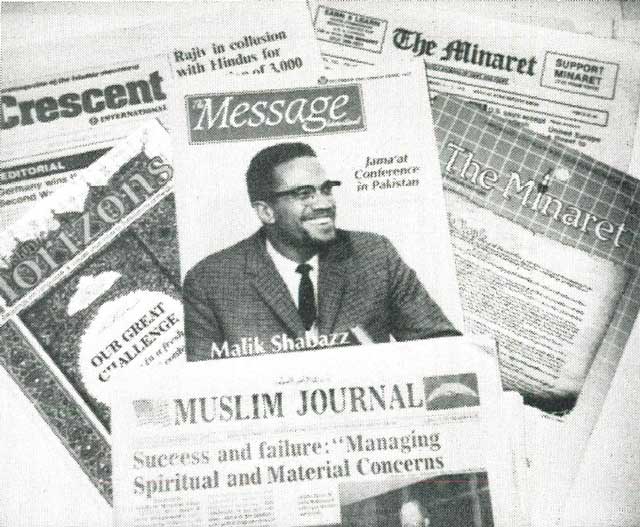
    Major Islamic magazines and newspapers of U.S. and Canada

    The role of the mainstream American media in the ’80s continued to be hostile and nega­tive towards Muslims. However, there was a realization that unless Muslims worked on this area, they would have to be always defensive. The Rushdie affair drove this point home very powerfully and helped galvanize Muslim ac­tivism. At the end of 1988, ICNA took up this matter on a continental basis, and along with different Islamic centers and Muslim or­ganizations, tried to have Salman Rushdie’s book “The Satanic Verses” banned. Although Muslims were not successful in getting the book banned, the outrage over it brought them together and gave them a chance to talk to the media and present their side of the story. It was also the first time that many non-Muslims learned about Muslims and their religion so extensively.

    The Rushdie affair also opened doors of inter-faith dialogues, arranged until the early ’80s mainly by Muslim Students Association, a little wider. Now Christian organizations began to invite Muslims for interfaith dialogues and included Muslims in several committees dealing with interfaith matters. However, much needs to be done. Muslims should try to gain a place on the boards of public television networks where major religions are represented. They should also invite the media to their functions and programs so that Americans can know them better.

    Speaking of the media, Muslims in the ’80s made progress in this direction. Many Islamic centers began to publish a monthly or quarter­ly magazine to air their point of view and publicize community issues. Important among the many are the weekly Muslim Journal (Chicago), bimonthly Islamic Horizons (In­diana), tri-monthly Minaret (California), biweekly Minaret (New York), Crescent (Toronto) and monthly The Message Interna­tional. Among the Islamic publications, The Message is an up-and-coming monthly interna­tional magazine and fills the void created by the closures of the London-based Arabia and Afkar.

    Like the ’70s, Muslims did not have much in­volvement in the electronic media in the ’80s. However, paid Islamic and non-Islamic cul­tural programs continued to be aired on local channels. In this regard the role of the California-based Islamic Information Service (IIS) is important. A major problem with some ITS programs is that they have not portrayed Islam properly. This has to be corrected if we are to save Islam from ridicule and ideological impurities. TV is the most effective news medium and Muslims should increase their presence on it, and also see that Islam is not presented in a twisted manner.

    In the ’80s the Muslim community, reflecting greater maturity, entered hitherto unchartered waters. Although not all its new initiatives succeeded, at least they decreased its insularity. For instance, in the early ’80s ISNA experimented with the Muslim Community Association (MCA), an organization designed to unite the communities. Due to several reasons MCA failed and had to be scrapped. Perhaps the main reason of its failure was that it was not a grassroots organization and had not involved the entire community in decision making.

    Realizing that a whole new generation of Muslims had come of age, both ISNA and ICNA separately founded youth organizations that are called Muslim Youth of North America (MYNA) and Young Muslims for Faith and Action (YMFA). While MYNA is basically concerned with organizing summer camps for youths, YMFA is based in different towns and cities where Muslim youths organize into groups and carry out Islamic and extracurricular activities. Muslim youths are our invaluable asset for the future, and if they are not cultivated Islamically, we would lose them to the American society, just like the early Muslim settlers did. We need to mobilize ourselves and the community, and act now!

    The ’80s also saw the establishment or expansion of several research and publishing organizations. The most notable among them are the Virginia-based International Institute of Islamic Thought and American Trust Publication, and Vermont-based Amana Books. The ATP and Amana, which are basically Muslim publishing houses, have produced some very useful books. But they have not been able to fulfill the needs of the entire community, nor publish much-needed books for youths and Islamic education. In the ’90s we definitely need more books of this kind. We also need more Muslim intellectuals and activists to deal with social, academic and religious problems faced by the community. In this context, ICNA has decided to form an Institute of Leadership Development to train Muslims to handle the responsibilities of imam, directorship of an Islamic center and da’wah work.

    In the area of ibadah, or worship, Muslims were found lacking in the ’80s. Although there has been an impressive increase in Muslim population and mosques in the last decade, no more than 10 percent of Muslims living in the vicinity of a mosque attended Jum’a prayers. This is particularly disheartening to those da’wah groups and activists who worked hard to bring Muslims to the house of Allah. The lack of attendance even in Jum ‘a prayers is not a healthy sign, and the problem must be cor­rected. On the other hand, those who did come to the mosque, were only concerned with of­fering prayers. Most of them made no effort to pass the message of Islam to their neigh­bors. ICNA has started preparing Muslim Data Base to reach to these 90% Muslims who are not involved in any Islamic activity. At the end of ’80s thousands of names and addresses of Muslims have been computerized.

    No one can deny the modern Western civilization’s productivity, comfort and af­fluence but it must be regrettably acknowledged that Western civilization’s shortcomings and weaknesses are no fewer than its advantages. Despite the leisure and ease which American science and technology provide for society and despite the new pages of history turned, human happiness has not in­creased nor have social ills diminished. Living and bringing up of new generation in this non-Islamic society is a great challenge for Muslims.

    Despite many gains and lot of Islamic work, like the ’70s, many Muslims in the ’80s were not successful in meeting this great challenge.

    Indigenous and immigrant Muslims united in a rally in Dallas, against Israeli occupation of Palestine
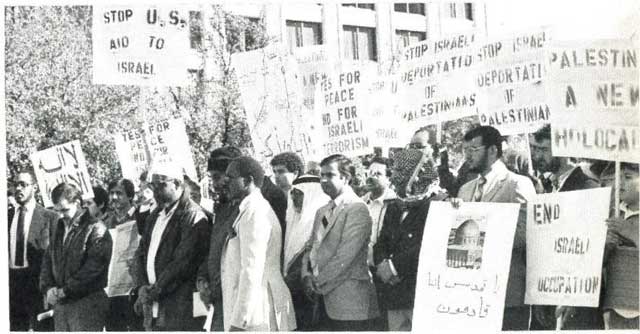
    Indigenous and immigrant Muslims united in a rally in Dallas, against Israeli occupation of Palestine

    In some cases, the whole Muslim family lost the Islamic and Muslim identity and accepted the American and secular norms and ideology and even they changed their names from Muh­ammad to Mo, Sulaiman to Sam and so on. The world has tried all the religions and ideologies whether it was Hinduism or Socialism, Communism or Capitalism, none gave the humanity the peace of heart and mind. But Islam is the only way of life which can cure the mankind from their diseases, can provide the peace of heart and mind in this world and success and falah in the hereafter. The Muslim community will have a bright fu­ture in the ’90s and beyond if it can come into the fold of Islam completely and totally. And show a greater desire for pan-Islamism and pool its resources towards the creation of a United Islamic Movement consisting of workers of Islamic movements and move­ment-oriented indigenous brothers and sisters of the U.S. and Canada. This is the most im­portant requirement if we want to preserve ourselves as Muslims.

    Just preservation is not the guaranty for suc­cess. Therefore, Muslims have to propagate the message of Islam (da’wah) to fellow human beings. Da’wah is a comprehensive program which includes every aspect of Islam. A Muslim as an individual and the ummah as a collective body cannot absolve itself of its responsibility of da’wah if it is not an all-embracing movement. And this da’wah has to be relevant to North American society.

    Then we hope through the ’90s and beyond that the future will belong to Islam and America will belong to Islam, In shaa Allah.