بسم الله الرحمن الرحيم

Tag: dawah

  • Nine Steps of Effective Dawah

    Nine Steps of Effective Dawah

    Allah SWT tells us in the Qur’an, “Invite all to the way of your Lord with wisdom and good instruction, and only discuss with them in the best manner” (16:125). He also says,“There is no compulsion in religion” (Quran 2:256). In these two verses we see that dawah— inviting others to Islam — is a delicate balancing act. On one hand, our Creator commands us to call others to our deen, but He SWT simultaneously reminds us that belief cannot be forced upon anyone. Therefore, dawah must be given gently, diplomatically, and strategically. Wisdom and kindness — not arrogance or attempt to control— must be our driving intention and approach.

    Indeed, calling others to Islam is an art form that should be planned and practiced. Imagine how well we could convey the beauty and message of our faith if we invested some time perfecting our delivery!
    Here are some strategies we can implement when inviting others to Islam:

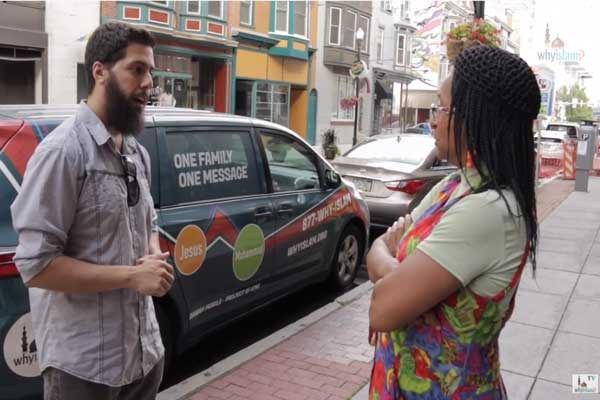
    1. Choose the right time. Not every interaction is appropriate for an impromptu talk about Islam. If a non-Muslim approaches us with a question, however, that is often a good time to give dawah. For instance, if someone asks, “Why do you wear a headscarf” or “Why don’t you drink alcohol?” — it is a great opportunity to say, “I’m glad you asked. To understand that, I would need to tell you a little bit about Islam.Can I share that with you?”

    2. Know your audience. We should try to anticipate the mindset of the person we are talking to and cater our words to them. We can attempt to dispel some of the misconceptions about Islam they might have due to their background, culture, or the media’s portrayal of Muslims. We can also try to identify common ground within our respective religious beliefs. For instance, Christians often appreciate Islam’s reverence for Mary (Mariam), the mother of Jesus (‘Isa). Regardless of their religious beliefs, most people share at least some core values like honesty, charity, and kindness, and these can be a springboard for agreement and discussion.

    3. Speak with passion and sincerity, but don’t sound too eager and or that you need to convince them of anything. Rarely do people embrace Islam after one conversation! Sometimes it takes months or even years of discussion, so take it slowly and follow the lead of the person you are talking to. If they seem eager for more information, keep answering their questions, but if they seem to lose interest, we should end the conversation gracefully. This will give the listener the chance to contemplate what we’ve said and to part ways on a positive note. They will realize we are not pushy and will be more likely to approach us again with questions.

    4. Don’t monopolize the conversation. Dawah is not a debate, and it’s not about proving that you are right and they are wrong. Interrupting, arguing, or dominating the conversation will only come across as rude and overbearing. When the person speaks, we should listen attentively and respectfully, especially if we disagree with their point of view. In fact, the foundation that has to be laid is one of establishing a rapport with them and making it clear that we care about what they are saying and what their viewpoint is. When we do state our opinion, we must do it politely. Remember, Allah SWT says, “…only discuss with them in the best manner.”

    5. Always keep in mind that our actions speak louder than our words.Adaab or good manners are critically important in Islam. In fact, much of our dawah is actually unspoken. When non-Muslims see us engaging in acts of kindness, being honest or generous or self-disciplined, they automatically have insight into our deen. They know what Islam is through our actions, and so while we should always behave as if Allah SWT is watching (because He is), we should also remember that non-Muslims are watching us for clues that illustrate who we are and what we believe.

    6. Describe how Islam benefits them. Give some examples of how our beautiful faith enhances life for people like them. Are they females who express frustration with rampant sexism? Explain how Islam empowers women. Are they men who lament the widespread lack of morals in today’s society? Explain how Islam emphasizes the importance of morality and how it is meant to permeate everything we do on a daily basis.

    7. Talk in a way that is easy to understand. Avoid words your listener would not understand, including commonly-used Arabic words that many of us use spontaneously without conscious thought, but non-Muslims aren’t familiar with.

    8. Practice giving dawah with a Muslim friend and give each other feedback. Role-play different conversations, with one person giving dawah and the other asking questions. This will help polish our technique and think of suitable answers to tough questions.

    9. End with a call to action. Experts always advise ending a pitch with a call to action — an invitation to take a desired next step. If the non-Muslim seems interested in what we have said, we can end the conversation with a specific call to action such as “Why don’t you check out this reputable Islamic website” or “I can tell you where to get a translation of the Quran” or “Maybe you’d like to visit to a local mosque” or “Here’s a great book that explains the basics of Islam.” It might even be useful to keep a list of resources on your phone so you can have them readily available. The WhyIslam website https://www.whyislam.org/ is one excellent resource for non-Muslims.

  • Dawah Through Community Empowerment: A Latino Muslim Perspective

    Dawah Through Community Empowerment: A Latino Muslim Perspective

    Latino Muslims are no longer the novelty they once were in this country. Their number appears to be ris-ing but no extensive studies of Latino Muslims have been done to date, which is why we have no realistic assessment of the numbers of converts nor where, when, or why they converted. What we do know is that they, for the most part, are a disjointed group scattered in pockets across the nation, many, per-haps, yearning for a legitimate Islamic expression of their Latin identity. They have also become a much more diversified group over time, a pan-Latino phenomenon representing practically every Latin Ameri-can nation.

    Historically, as Muslims conquered new lands, they became rulers of large non-Muslim populations, at first Christian and Zoroastrian, and later Hindu and sub-Saharan animist. Due to the Quranic prohibition on forced conversion, these non-Muslims often retained their religious identity for many generations under Muslim minority rule. Yet, in the vast majority of cases, Islam eventually became the dominant religion of the masses. This was not accomplished solely through proselytization because the masses by nature tend to be cautious, distrustful, and wary of the new and unfamiliar. Words may or may not be understood, but actions speak clearly and eloquently.

    Rape, pillage, and murder were the order of the day for conquerors in the world the Muslims inherited. Yet the early Muslims defied all convention by eschewing barbarity and replacing it with a sense of justice and respect for the rights of others. The actions of those early Muslims, embodied in their manners, morals, and the institutions they established to secure societal peace and justice, had a profound effect. They were the impetus for the creation of a new and enduring generation of Muslims, touched by acts that went beyond words. These early Muslims saw justice and the welfare of mankind as the proper outward expression of the Quranic mission Allah and His Prophet (pbuh) had entrusted to them.

    Such was the case with 8th century Visigothic Spain, a land groaning under the weight of oppression and social decay. There, Muslim conquest and rule was transformative. The former injustices were replaced with just laws that empowered the people, most notably in land reform. The emphasis on public welfare was evident in their attention to health, hygiene, education, and urban and rural infrastructure. The Ibe-rian Peninsula became Al Andalus, a beacon of enlightened civilization. By the time Andalusia had reached its caliphal height, 70 percent of the native Iberian population had become Muslim.

    Now, a half-millennium later, the cultural descendants of that Andalusian civilization are returning to
    Allah and the religion that provided its life-altering strength. Yet this time we are not marching into Times Square or San Francisco Bay as conquerors, to display magnanimity from a position of power. We rule nothing, but are among the ruled in a republic whose representatives govern at the behest of
    exploitative, parasitic corporate and financial interests. Misery has spread throughout the country where half of the population is now considered poor, millions have lost their jobs and homes, one in four chil-dren live in abject poverty, and millions, disproportionately African-American and Latino, are behind bars working in legalized slavery for major corporations.

    In this context, what does a Latino Muslim, or for that matter any Muslim, stand for in 21st century America? When non-Muslims look at us now, what do they see? Do they see us standing up for the rights of the oppressed? Do they see us sacrificing our time and money to alleviate the suffering of the afflicted or aiding the needy in our society? Do they see us taking a stand against economic injustice and the brutality of an increasingly authoritarian police force? Or do they see us dispassionately walking by their homes on our way to the mosque, work, or home, seemingly unconcerned with their pain? Yet, the Quran tells us, “O you who believe! Stand out firmly for justice, as witnesses to Allah, even as against yourselves, or your parents, or your kin, and whether it be [against] rich or poor, for Allah can best pro-tect both. Follow not the lusts [of your hearts] lest you swerve, and if you distort or decline to do justice, verily Allah is well- acquainted with all that you do” (4:135).

    This country’s past Islamic movements recognized that the Islamic expression of faith in Allah went be-yond the requisite prayers, fasting, and charity. They saw their efforts to correct injustices and inequity in their society as their way of emulating the great reformers of the past. Latino Muslims are a minority within a minority, yet we have the very real power to impress nuestra gente (our people) with the true essence of Allah’s deen, communicating through our actions what speeches, brochures, videos, and CDs fail to convey. Past groups like the Darul Islam Movement, the Mosque of Islamic Brotherhood, the Is-lamic Party of North America, and Alianza Islamica galvanized their members around two uncompromis-ing propositions: proclaiming the word of Allah and speaking out against any form of injustice and op-pression. Allah says in the Quran, “And what is amiss with you that you fight not in the cause of Allah and of the oppressed among men, women, and children who say, ‘Our Lord, take us out of this city of oppressive people and appoint for us from Yourself a protector and appoint for us from Yourself a help-er?’” (4:74).

    Alianza Islamica was the first Latino Muslim organization to combine an effective dawah program with an equally vigorous social welfare program. On the West Coast, LALMA (Los Angeles Latino Muslim Associa-tion), reportedly inspired by their example, has been very successful with a similar approach, termed indi-rect dawah, by its founder Marta Galedary, for the past 16 years. However, it is important to note that a true Islamic movement faithful to its cause is not a career path. No one in Alianza, from the director on down, ever received a dime for their efforts. Alianza also avoided the temptation of creating self-identified, titled elites: no Shaikh Fulanos or Papo El Mahdis; no attention-seeking or ego-stroking was allowed. Focus was kept on serving the people and the community.

    I believe there is a need for this model to be taken up by a new generation of Latino Muslims who would improve on it, allow it to evolve, and adapt it to new circumstances and environments while remaining true to its revolutionary spirit. Maybe then, if Allah so wills, Islam can become entrenched in communi-ties where people are hurting the most. This society has saddled Latinos with a host of burdens: poor education, economic hardship, police brutality, and the quagmire of immigration. Above that pandemo-nium, we, as Muslims, must proclaim the oneness of Allah and the messengership of Muhammad (pbuh). For those unable to hear us beyond that cacophony, let them see Islam in action. Perhaps, if Al-lah so wills, through a combination of both approaches, the faint echoes of a long-lost Andalucía will be heard again and light will finally return after the long night.

  • Book Review: Manual of Dawah for Islamic Workers

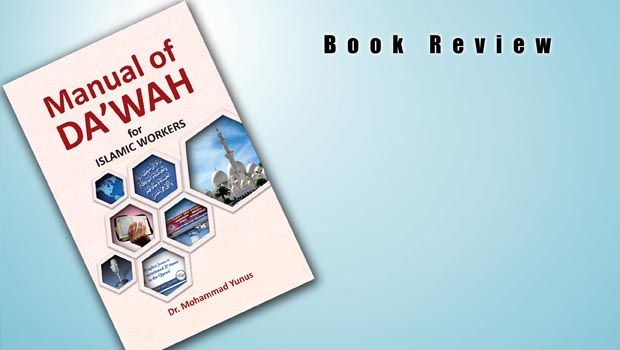
    Book Review: Manual of Dawah for Islamic Workers

    Paperback:  151 pages
    Author:  Dr. Mohammad Yunus (former Ameer of ICNA)
    Publisher: Islamic Circle of North America (ICNA)
    Year Published: 2016 (revision #4)

    Library of Congress Catalog Card #: 83-82068
    International Standard Book #: 0-9691479-1-0

    Review by Dr. Talat Sultan, former Ameer of ICNA

    Dawah, or sharing the true message of Islam, is a fundamental responsibility of every Muslim. It is also a collective obligation of the Muslim ummah. The Quran proclaims: “Thus have we appointed you as a community of the middle way so that you may be witness to mankind and that the Messenger may be a witness to you…” (Baqarah, 2:143). The Quran also tells us: “You are the best community that has been raised up for mankind. You enjoin the doing of what is right and forbid the doing of what is wrong, and you believe in God…” (Ali Imran, 3:110). And Prophet Muhammad (peace be upon him) said, “You should pass it on to others even if you know just one sentence [of Islamic knowledge].”

    Islamic Circle of North America, as an Islamic movement, has been carrying out this task over more than four decades as a leading dawah, educational, and social service organization. The “Manual of Dawah for Islamic Workers,” prepared by Dr. Mohammad Yunus for ICNA’s dawah department, was first published in August, 1983 as a guidebook for Muslims in general, and ICNA workers in particular, to carry out the obligation of dawah in a well-informed and effective manner. Now, ICNA has published its completely revised and updated 4th edition.

    The book starts out by introducing the concept of dawah in the light of Quran and of the sunnah of our beloved Prophet (pbuh) so that the reader understands clearly why it is important to carry out this essential obligation of outreach to people, a legacy of all the prophets of Allah. The book then outlines the contents of the dawah message to fellow Muslims and to non-Muslim audiences, as suitable to each. It then emphasizes that the character and conduct of the daiyah is of paramount importance, as the backbone and embodiment of the words of dawah.

    Various techniques of dawah are presented, geared to individual or collective audiences, from spouse and children in one’s own home, to other relatives and friends, to people in the larger community. Part V provides the reader with information about Christianity, its various doctrines, its scriptures, and the position of Jesus (peace be upon him) in the Quran. Part VI presents the activities and accomplishments of WhyIslam (WhyIslam.org) and Gain Peace (GainPeace.com), two highly successful dawah projects of ICNA. Their various programs are outlined, with statistics showing the encouraging results of the ongoing dawah work. Finally, a list of recommended books is provided for those who are serious and determined to further develop their skills in dawah. There is also a list of books that are recommended for distribution to individuals and groups who are the recipients of one’s dawah activities and efforts.

    The preface of the 1983 manual says, “The act of submitting to Allah requires that every heart beat of a Muslim must carry the message to those around him, that there is no god but Allah and therefore, He alone is the final authority. Concern and unequivocal commitment to Allah’s orders are not the only tools for an Islamic worker. He employs the best available technique of mass communication in a systematic manner for taking Allah’s message to all.” That message is compelling today as it was three decades ago. The “Manual of Dawah” has helped many over the years who thus strive to carry out dawah work, whether on their own or through an organization such as ICNA.

    This valuable manual is recommended reading for every Muslim who realizes that it is his/her obligation to share the truth and the beauty of Islam with fellow citizens.

  • Quran’s Position on Peace, Conflict, and Violence

    Quran’s Position on Peace, Conflict, and Violence

    In recent times some acts of violence have been committed in the name of Islam. Many Muslims have condemned such acts as being contrary to the spirit of their religion. Some non-Muslims as well have supported Muslims in clarifying that Islam is a religion of peace, and that extremists have no right to appeal to the religion to justify their acts of terrorism and violence. A few voices, however, insist that this is really about the religion of Islam; they say that violence is rooted in the life example of Islam’s prophet, and in its sacred scripture, the Quran. If what they say is true, then it must be admitted. If what they say is false, then we ought to urgently voice the necessary correction. Hence we take a closer look here at the Quran and the Prophet to see whether these stand for peace or violence.

    Although non-Muslim scholars do not accept the Quran as the Word of God, they agree with Muslims that it represents the most authentic source for the life and teachings of Prophet Muhammad, on whom be peace. The Quran, as with any book, has to be read inter-textually and contextually. An inter-textual reading is an attempt to understand one Quranic verse in the light of its other verses. Classical Muslim scholars referred to this principle by saying that parts of the Quran explain other parts. A contextual reading is an attempt to understand the Quran in the light of its socio-political historical circumstances. Classical Muslim scholars refer to this principle as the circumstances of revelation.

    The Circumstances of Quran’s Revelation

    The Quran does not describe its own circumstances of revelation in any detail. Hence to establish context we must turn to other sources — the seerah (biography of Prophet Muhammad) and hadeeth (sayings and traditions of the Prophet). The hadeeth were compiled later, and are known to be comprised of authentic as well as inauthentic materials. For our exercise here, however, we may limit ourselves to the materials which non-Muslim scholars generally deem to be authentic. William Montgomery Watt is a recognised scholar who has written much on Islam and its Prophet. In his book, Early Islam: Collected Articles, he argues that regarding the basic outline of major events, the seerah can be accepted as authentic. Here we will depend on that basic outline in understanding the Quran’s attitude to peace and violence.

    It is well known that the Quran was not written all at once, but was proclaimed orally, a portion at a time, by the Prophet over a period of 23 years. The verses comment on events as they arise, offering guidance on the full variety of human concerns, including questions of peace and war. To understand what each revealed portion means, we need to read the Quran, as suggested, inter-textually and contextually. As for context, we need to follow the broad outline of events in the life of the Prophet and chart the verses about peace and war within that chronology.

    Patience During the Early Period of Islam

    The Prophet began his preaching in Makkah following his first experience of revelation in the year 610 CE. For the next decade, he and his few followers were persecuted by fellow tribesmen who were antagonistic to the Prophet’s message. Many passages of the Quran, referred to as the Makkan chapters, were revealed during this period. Some Makkan passages refer to the fact that Muslims were being persecuted, and in some instances even tortured, in an attempt to force their conversion back to paganism. Such passages exhort the Muslims to be patient in the face of such persecution and to remain firm in their faith regardless of what they had to endure.

    Seeking a safe haven to practice their faith, Muslims began migrating to Abyssinia which was then ruled by a Christian king known for his tolerance. Eventually the Prophet himself migrated to Madinah, about 250 miles north of Makkah, and his followers gravitated to that town. What followed was a series of battles with the pagans of Makkah who remained committed to undermining the Prophet’s mission. In the second year after the migration (hence 2 H), he engaged the pagans at Badr; in 3 H at Uhud; and in 5 H at the trench (khandaq) on the northern approach to Madinah. The last of these locations was clearly connected to Madinah, the city of the Prophet. He and his followers had dug a trench to stall the advance of the invading pagan army. The other two locations are also interesting, as they give some indication of who was launching the offensive. Uhud is located just outside Madinah. To this day, when Muslim pilgrims visit Madinah, they often take a short taxi ride to that site to pray for the souls of the Muslims who died in that battle. Badr is also accessible from Madinah, though further away than Uhud. It is already becoming evident, that the Prophet at his new city was being attacked by the Makkans who would travel more than two hundred miles to engage him in battle.

    Defending Themselves Against Aggressors

    It was in this period that the Muslims had to defend themselves, for now a Muslim state had been established, and it is the responsibility of every state to protect its citizens from such attacks. Verses in Madinah chapters that direct Muslims to fight the enemy must be understood in this context; they refer not to just any enemy, but to those pagans at the time who were bent on wiping out the religion and its followers. Even so, the verses (for example 2:190) make it plain that Muslims are only to engage those who were attacking them, and in no case are they to be the aggressors, for God does not like those who engage in aggression. The justification for engaging the enemy was so that the persecution already experienced in the Makkan phase would not be repeated (2:191, 2:217). Moreover, according to the Quran, it was about time that the Muslims defended themselves. They were driven away from their Makkan homes and still the antagonists were intent on killing them. Quranic verses point out that if some people do not rise in defense, invaders might demolish synagogues, churches, monasteries, and mosques (22:39-40). Finally, it was necessary to come to the aid of those elements in society who were most vulnerable such as the elderly, and women and children (4:75). Even this passage is hedged with cautions and limitations of justifiable engagement. The Quran says: “But if they hold aloof from you and wage not war against you and offer you peace, God allows you no way against them” (4:90).

    In 6 H the Prophet and his Companions set out to make a pilgrimage to the sacred mosque, the Kaaba, in Makkah, the Prophet’s hometown. They were stopped short at Hudaybiya near Makkah and prevented from entering the city. According to the recognised rules of the day, they should have had the freedom to perform their devotions. The Muslims wanted to fight their way through as they were wont to do in the old days. But the Prophet instead entered into peace negotiations with the enemy. The treaty drawn up had stipulations that were unfair to the Muslims and favourable to the pagans. This too was difficult for the Muslims to accept. But the Prophet agreed to this, for it included the one condition that was an advantage to everyone: there would be no fighting for ten years. The Quran referred to this as a clear victory for Islam (48:1). The agreement stayed in effect only for eighteen months before the pagans violated it. The Muslims eventually came to understand in what way it was a clear victory. It is noted in the Quranic commentaries that in the eighteen months while the treaty was in effect more people embraced Islam as their new faith than the number of people who did so in the eighteen years prior to that.

    Moreover, many who did not embrace Islam at least developed some appreciation for it. During times of war the people were in their fight-or-flight mode of thinking, and hence they paid little attention to the intellectual call of Islam. But in peacetime they interacted with Muslims and learned about the new faith in friendly dialogue. Soon the public sympathy for Islam had reached a threshold which made it possible for it to ultimately become the religion of Makkah. In 8 H, following the cancellation of the treaty, the Prophet was able to gather enough followers to march into Makkah as an unstoppable and somewhat welcome force and to take it over while declaring a general amnesty to his previous persecutors.

    Pockets of Resistance and Hostility Remained

    The Muslims were now generally safe to practice their religion in Makkah and Madinah, for it was now the official religion in both areas. But there were pockets of resistance, people who would ambush and kill defenseless Muslims. In 9 H the Quran’s 9th chapter declared that the Muslims would have no further ceasefire obligations to such guerrillas (9:1). They were given a grace period of four months (9:2). Within that period they were to either cease their hostilities or clear the area (9:3). The declared warning did not affect those who were willing to abide by their treaty with the Muslims (9:4). At the end of the stipulated period, the Muslims were told to respond in kind to their attempts to ambush and kill Muslims. But even then, if the aggressors repented and established prayer and gave charity, they were to be spared (9:5). And even in this situation of open war, if a non-Muslim were to come to the Muslim area seeking refuge, he was to be given refuge so that he might hear the Word of God. Afterwards, such a non-Muslim was to be transported back to a place where he would be safe (9:6). Hence, it is clear that even here the declaration of war at a most critical time is hedged with cautions and limitations, and a safety net is provided for those who were not hostile to Muslims. In fact, 9:6 makes Muslims responsible for the safety of such individuals. Looking at these verses intertextually and contextually, it is clear that those who extract and use 9:5 above without its surrounding verses, and without paying attention to the social situation, violate the text.

    We may add that these measures, harsh though they were, were necessary at the time to enforce peace and ensure the safety of the general populace. This made it possible near the end of 10 H for the Prophet to perform the Hajj to Makkah and for his followers to join him there from all directions, such that they numbered 120,000. His mission now complete, the Prophet returned home to Madinah where he died peacefully a few months later in 11 H.

    The Quran Promotes Peace, Not Violence

    Having placed the Quranic verses within the basic outline of the Prophet’s life as gleaned from the seerah works, and having connected the dots between verses of the Quran, we are able to reach a firm conclusion. Our contextual and intertextual reading of the Quran shows that the Quran is about peace, not violence. When the Muslims had no state they were told to stay firm in their faith and to bear persecution with patience. When they had a state they were told to rise as a state in the defense of their right to live in peace and security, in defense of their weak citizens and of the places of worship which the pagans were targeting for demolition. The major battles were fought from the defensive proximity of the Prophet’s city. Each time the pagans came back with a larger force than previously, forcing the Muslims eventually to defend their city by digging a trench to hold off the invaders. When the Prophet had the opportunity to sign a treaty he did so. The Quran called this a victory, because Islam is about peace. When the Muslims grew in number and could re-enter Makkah as victors, they did so while forgiving their persecutors.

    Verses which permitted Muslims to fight did so with cautions and limitations. A verse which is nowadays often quoted by itself for shock effect because it declares war does not occur by itself. It has a position within the text and a historical context. Taking it by itself, its meaning is distorted. But it is this kind of distortion that the extremists thrive on. They attempt to justify their killing of civilians with a verse which is about fighting those who were ambushing and killing Muslims. The extremists today who behead workers and journalists ignore 9:6 which instruct Muslims to transport such persons to their places of safety. Those who kill civilians in the name of Islam ignore 2:190 which allows for a war of self-defense but prohibits aggression by Muslims — any unprovoked attacks or violations of rights — even within the context of warfare. Those voices are grossly incorrect which, in recent times, spread the idea that the terrorists are following the Quran and the life example of the Prophet. In fact they distort the Quran and misunderstand the Prophet’s life example. The Quran’s instruction to Muslims is this: “O you who believe! Enter into peace altogether” (2:208).

  • Dawah: The Divine Methodology

    Dawah: The Divine Methodology

    Dawah, calling people to Allah and His religion, is an obligation upon every Muslim man and woman. The Holy Quran tells us dawah is one of the most important acts and is loved by Allah (subhanahu wa ta’ala – glory to Him, the Exalted; SWT). It is the practice of His Prophets (peace be upon them), the chosen servants of Allah who struggled in order to convey Allah’s message to people despite afflictions and hardships. While doing so, they were often insulted and persecuted. But they demonstrated patience and steadfastness. Whenever they faced hostile reaction from their people, they followed the divine methodology in their dawah effort and repelled the animosity in the best possible manner. They demonstrated nothing but the highest moral character.

    Dawah is also the sunnah (practice) of Prophet Muhammad (peace be upon him; pbuh), as enjoined by Allah SWT in the Quran: “O Prophet! Truly We have sent you as a witness, a bearer of glad tidings, and warner. And as one who invites to Allah by His permission, and as a lamp spreading light” (Quran 33:45-46). The Messenger of Allah (pbuh) worked in the most difficult circumstances and gave a practical demonstration of excellence in moral character during his dawah effort. He did everything possible to convey Allah’s message despite the most challenging and antagonistic reactions from the Makkan pagans. He remained firm, patient, and confident of Allah’s help and the ultimate victory in conveying the message.

    Responsibility  of All Muslims

    Allah commands the believers to do whatever they can, according to their circumstance and ability, to spread His message. He made the Muslim ummah (community), both individuals and groups, responsible for this noble cause: “Invite to the Way of your Lord with wisdom and fair preaching, and argue with them in a way that is better. Truly, your Lord knows best who has gone astray from His Path, and He is the best aware of those who are guided” (Quran, 16:125). And in another verse, “Let there arise out of you a group of people inviting to all that is good, enjoining what is right and forbidding what is wrong. And it is they who shall attain to happiness” (Quran 3:104). We see that the Quran instructs us to give dawah with wisdom, to take an approach of kindness and tactfulness, that this is a key to success. Hikmah (wisdom) is a gift from Allah. “He grants wisdom to whomever He wills, and he to whom the wisdom is granted, is indeed granted abundant good. But none bears this in mind except those of understanding” (Quran 2:269). And certainly by following the sunnah of Prophet Muhammad (pbuh), we find excellent examples of moral, wise, and kindly behavior. “Indeed in the Messenger of Allah you have a good example for any whose hope is in Allah and the Last Day, and remembers Allah much” (Quran 33:21).

    Good communication skills and presentation style help make one’s dawah effort successful. Allah commanded Moses (pbuh) to adopt a soft and mild approach when He sent him, along with his brother Aaron, to Pharaoh. “Go both of you, to Pharaoh. Verily he has transgressed. And speak to him mildly, perhaps he may accept admonition or fear Allah” (Quran 20:43-44). Among the most essential qualities required during dawah work is that of patience and steadfastness. “And be patient; verily Allah wastes not the reward of those who do good” (Quran 11:115). And we are told in another verse to practice tolerance in the face of hostile or abusive challenges from those who don’t believe, “And be patient over what they say and avoid them with gracious avoidance” (Quran 73:10). And further, “And endure patiently, for your patience is but from Allah; nor grieve over them, and be not distressed because of their plots” (Quran 16:127).

    If a daa’i follows the divine set of guidelines and applies Quranic manners as demonstrated by the Prophet (pbuh), Allah guarantees success for him for He always helps those who help His cause.

    A daa’i should, therefore, develop necessary skills that help him carry out his work in all circumstances and try to maintain a purely practical approach. In case of a hostile reaction, the daa’i must be well-prepared to face any possible situation including those who mock or insult him. Regardless of how poorly others may act, he must demonstrate the most moral and high-minded behavior at all times. The Prophet (pbuh) said: “The best among you are those who possess the best manners” (Al-Bukhari and Muslim). He also said, “I have been sent to bring good behavior to the highest perfection” (Musnad Ahmad).

    The daa’i must also be able to forgive people and excuse those who treat him badly: “Show forgiveness, enjoin what is good, and turn away from the foolish” (Quran 7:199). While this is not easy, it is essential. “And the servants of the Most Gracious are those who walk on the earth in humility, and when the foolish address them, they say [words of] peace” (Quran 25:63). A daa’i must show kindness and mercy in all his actions and endeavors. The Prophet Muhammad (pbuh) said: “Whoever is devoid of kindness and mercy, is devoid of all goodness” (Abu-Dawoud). And, of course, in order to become a successful daa’i, one must possess sound aqidah (beliefs) and put his faith into practice with sincerity and devotion and discharge all obligations due to Almighty Allah. It is necessary to make his intention only to please Allah. “Actions are governed by intentions. Everyone is rewarded for that which he intended,” the Prophet (pbuh) said. Further, a daa’i has to make sure he abstains from whatever is forbidden. And he must completely stay away from riya (showing off). Development of strong conviction and strength in speaking the truth without fear or hesitation is also needed. The habit of effective control over anger, desires, and temptations will help make the daa’i a a sincere and inspiring example to others. Abu Hurairah narrated the Prophet (pbuh) as having said: “A strong person is not he who can overpower his rival in wrestling, but rather he who controls himself when roused to anger” (Al-Bukhari, Muslim). It is also necessary to practice faith in all sincerity before the daa’i decides to invite others to Islam. Therefore, all those interested in giving dawah must present themselves as outstanding examples of practicing what they preach: Allah SWT says: “O you who believe! Why do you say that which you do not do? Most hateful it is with Allah that you say that which you do not do” (Quran 61:2-3).

    It is extremely important also for the daa’i to obtain necessary knowledge and training in order to plan a logical, well-organized, and mature dawah strategy. Sufficient knowledge of the people and area where he will give dawah is necessary. He should be well prepared and knowledgeable enough to support his points with Quranic verses and hadith of the Prophet (pbuh). Any dawah activity without a mature strategy and careful planning may lead to unproductive debates and unnecessary arguments, and might result in hurting people’s feelings or alienating them. This would be harmful rather than useful and productive.

    Divine Methodology Examples in Dawah

    In order to see the application of this divine methodology in a practical sense, let’s examine a few examples from the Quran. Allah narrates the story of Prophet Noah (pbuh) who with humbleness, patience, and great determination conveyed Allah’s message to his people: “Indeed We sent Noah to his people and he said, ‘O my people, worship Allah. You have no other god but Him. I fear for you the torment of a great Day’” (Quran 7:59). His people mocked and abused him, accusing him of misrepresenting himself as a messenger from God: “The leaders of his people said, ‘Verily we see you in plain error’” (Quran 7:60). Prophet Noah answered them with wisdom and beautiful preaching: “O my people there is no error in me. But I am a Messenger of the Lord of mankind” (Quran 7:61). He explained his mission in simple words and informed them of his responsibility to convey Allah’s message, and did not engage in unnecessary argument: “I convey unto you the messages of my Lord and give sincere advice to you. And I know from Allah what you know not” (Quran 7:62).

    We find another beautiful example in Prophet Hud’s story (pbuh): “And to [the tribe of] ‘Ad [We sent] their brother Hud. He said: ‘O my people, worship Allah. You have no other god other than Him. Will you then not fear [Allah]’”? (Quran 7:65). Hearing this, his people belittled him and called his integrity into question: “The leaders of those who disbelieved among his people said: ‘Verily we see you in foolishness, and verily we think you are one of the liars’” (Quran 7:66). In the face of these denunciations, Hud stood firm and showed himself as a perfect model of patience and self-restraint. He answered them with straightforward and elegant simplicity: “O my people! There is no foolishness in me, but I am a Messenger from the Lord of mankind” (Quran 7:67). Then he explained his mission: “I convey unto you the Messages of my Lord, and I am a trustworthy adviser to you” (Quran 7:68).

    We have another example in Prophet Shuaib’s story (pbuh). When he invited them to listen to Allah’s message, they attacked his character and mocked him, telling him that he was the only one who forbears faults and the only right-minded person, saying this in a sarcastic way. “They said, ‘O! Shuaib! Does your prayer command that we give up what our fathers used to worship, or that we give up doing what we like with our property? Verily, you are the forbearer, right-minded!’” (Qur’an 11:87). Shuaib (pbuh) did not lower himself to their level because he knew his mission and responsibility. He tried to explain the right way to worship Allah and bring them to right path. Here he showed a remarkable amount of patience and highest individual character. He informed them about his motive and method in his dawah work. He also expressed how much he needed Allah’s help and support in carrying out his responsibility. “I only desire reform to the best of my power. And my guidance cannot come except from Allah. In Him I trust and unto him I repent” (Qur’an 11:88).

    In the story of Prophet Abraham (pbuh) we notice that he adopted a mature and logical approach when he talked to his people. He was simple, focused, and to the point. He wanted them to really think about and apply their own wisdom so as to analyze what they worshipped. He explained the true concept of lordship and informed them that the Lord possessing absolute authority and control over the entire universe is the one and only god worthy of being worshipped. Through dawah, he actually challenged their concept of lordship and informed them that Allah is the only and absolute giver of sustenance. He also explained about the life of the Hereafter: “And Abraham – behold, he said to his people, ‘Serve Allah and fear Him: that is better for you if you did but know. You worship beside Allah only idols, and you only invent falsehood. Verily, those whom you worship besides Allah have no power to give you provision. So seek your provision from Allah alone, and worship Him alone, and be grateful to Him. To Him alone you will be brought back’” (Qur’an 29:16-17).

    The Prophet’s (pbuh) Manners in Dawah

    The above verses demonstrate so well the depth of maturity, common sense, and wisdom a daa’i must have. There are countless examples of this in the life of Muhammad (pbuh) but we can take one incident to show his exemplary manner in dealing with others, which oftentimes, is the best, indirect, dawah. The following is an excerpt from “The Sealed Nectar,” a biography of Muhammad (pbuh) by Safiur Rahman Mubarakpuri. The Treaty of Hudaybiah was being signed by Prophet Muhammad (pbuh) and a representative of the Quraish, the people of Makkah: “When the agreement was to be committed to writing, Ali Bin Abi Talib, who acted as a scribe, began with the words: Bismillah-ir-Rahman-ir-Rahim, i.e. ‘in the name of Allah, the most beneficent, the most merciful’ but the Makkan plenipotentiary, Suhail Bin Amr, declared that he knew nothing about Ar-Rahman and insisted upon the customary formula ‘Bismika-Allahumma’, i.e., ‘In your name O Allah!’ The Muslims grumbled with uneasiness but Prophet Muhammad (pbuh) agreed. He then went on to dictate, ‘This is what Muhammad, the Messenger of Allah has agreed to with Suhail Bin Amr.’ Upon this Suhail again protested: ‘Had we acknowledged you as a Prophet, we would not have debarred you from the sacred House, nor fought against you. Write your own name and the name of your father.’ The Muslims grumbled as before and refused to consent to the change. The Prophet (pbuh), however, in the larger interest of Islam, attached no importance to such an insignificant detail, erased the words himself, and dictated instead: ‘Muhammad, the son of Abdullah.’”

    The above incident is a beautiful example to show that as daa’i ila-Allah, (one who calls to Allah), Prophet Muhammad (pbuh) not only possessed, but also demonstrated in a practical sense, all the personal characteristics and skills necessary for successful dawah. Therefore, he was able to resolve a most delicate situation to the satisfaction of all. Here we see him as a daa’i and perfect strategist. He adopted a purely practical approach, full of wisdom. Prophet Muhammad (pbuh) showed time and again the patience, steadfastness, understanding of people, tolerance, and compassion that are required to call people to Allah’s religion. His character, interpersonal skills, and communication abilities were the cornerstones of his success. If a daa’i follows the divine set of guidelines and applies Quranic manners as demonstrated by the Prophet (pbuh), Allah guarantees success for him for He always helps those who help His cause.

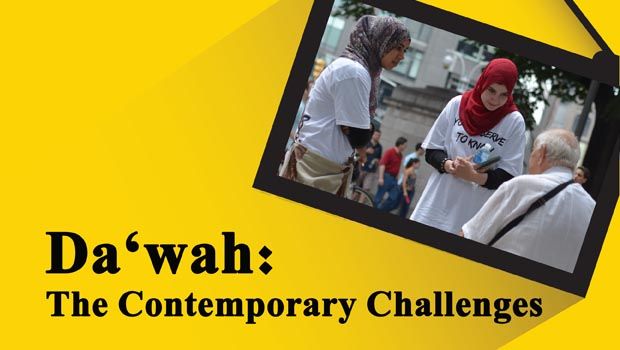
  • Dawah: The Contemporary Challenges

    Dawah: The Contemporary Challenges

    Da‘wah or calling people towards submission to none but the Creator is one of the major themes of the Qur’an. A Muslim, male or female, is visualized by the Qur’an as a da‘iyah whose behavior, speech, and interactions with others convey the Islamic message and invite people towards belief in, submission to, and serving of the Creator. Prophet Muhammad (peace be on him) is designated by the Qur’an as the last messenger, calling people toward all that is good and warning about the consequences of rejecting the truth. The Muslim ummah is commissioned to play a proactive role in creating peace, justice, balance, moderation, and fairness within the Muslim community (ummah) as well as in the human society at large. In fact, the terminology, ummatan wasaat, which the Qur’an uses to describe a distinguishing feature of the Muslim ummah, conveys a characterization of the ummah as one of moderation, balance, and the middle way. The Qur’an, accordingly, strongly condemns an excessive or exaggerated attitude in any aspect of life, and considers extremism of any sort to be misguided.

    This paper seeks to delineate major da‘wah challenges, both internal and external, the ummah faces today and how to respond to these modern challenges from a proper Islamic perspective. This author believes that each challenge comes with huge prospects and opportunities for advancement of the da‘wah work.

    The Internal Challenges

    The internal challenges, for convenience of discussion, can be associated with the following strategic issues.

    Internal Challenge #1: Disunity

    The ummah spans over 57 sovereign Muslim states. Their rulers and elites all face towards the same Ka‘bah in prayer but they fail miserably in establishing a unified policy on strategic goals in regards to social, political, economic, legal, educational, and cultural issues. How to create unity or at least move toward unity remains a core da‘wah issue and challenge. The responsibility for disunity, while in part caused by external forces, must be placed squarely upon our own shoulders. It is only common sense to expect other geopolitical players to use economic, political, and cultural, and even military means to protect their own national interests, and at times this involves intentional or collateral harm to, or exploitation of, Muslims. Ultimately, the campaign to unify Muslims must center on our own internal dynamics, resources, and shared goals.

    Internal Challenge #2: Ghuluw

    The second internal challenge that da‘wah faces is a global rise in ghuluw in the ummah. Ghuluw can be defined as exaggerating any part of Islam beyond its actual specified limits or, likewise, downplaying any part of Islam below its actual specified limits. Unfortunately some da‘wah workers focus on particular aspects of Islam – religious, legal, social, political, or economic – while some equally important teachings of Islam skip their attention. Islam provides necessary instructions in all aspects of human life. Therefore, a call toward Islam implies following Allah’s instructions not only in one or another or some particular aspects of life but in all affairs and all aspects of religious, legal, social, economic, and political matters. It is a call for a holistic and comprehensive change. It is a call to serving Allah alone and becoming His true ‘abd or obedient servant in the totality of one’s existence. In brief, da‘wah is the adoption of, or return to, the straight path, and the righteousness that entails, in all spheres and affairs of life.

    Excessiveness or ghuluw is also manifested in considering one’s maslak or madhhab as the only authentic interpretation of Islamic injunctions, and to look down upon others as if they are misguided. This attitude is totally in contradiction to, and in negation of, the methodology followed in the fiqhi matters by the Prophet’s Companions which was duly approved by the Prophet himself (peace be on him). Some idealists assume that if they succeed in ascending to political power and declare establishment of khilifah, the economic exploitation, political corruption, social decay, and moral decadence will automatically cease and attitudes and behaviors of the people shall spontaneously change. This political idealism is also a form of ghuluw in the sense of overlooking the practical reality of the human condition with its weaknesses and its propensity for self-delusion, and the corresponding challenge of bringing about personal and societal transformation which can only be established through a gradual and progressive process.

    Some spiritualists or mystics, on the other hand, claim to utilize a means of coming closer to Allah through contemplation, dhikr, and strict self-discipline, with some choosing to withdraw entirely from involvement in worldly life. The Prophetic Sunnah on the contrary provides us with a holistic model which takes care of the total needs of a human being. We do not have any evidence in the Prophetic Sunnah for being given to excessive meditation or for living a life of withdrawal from family and society and other worldly affairs; rather we find the Prophet (peace be on him) strongly denouncing such a life of withdrawal.

    Internal Challenge #3:
    The Islamic knowledge deficit

    The third major internal challenge facing da‘wah today is an educational one. The key to progress and excellence lies in a knowledge-based society that engenders a fair and equitable economy and a just and ethical state. A dynamic commitment to and knowledge of Qur’an and sunnah must be deeply embedded in the social fabric but this requires that accurate and authentic Islamic knowledge be disseminated amongst the Muslim masses. This does not exist today and this deficiency is a handicap that must be fixed.

    Internal Challenge #4:
    Methodology

    The fourth internal challenge that da‘wah faces has to do with methodology. Some of those who engage in daw’ah activities do so when afforded time and opportunity outside the constraints of their job or career. This would be fine if those individuals understood that Islam does not bifurcate life into “religious” and “worldly” activities. Therefore, the behavioral and ethical requirements of Muslim life and da’wah in particular are the same whether one is in the workplace, engaged in street da’wah, or part of a professional and organized da’wah effort. The Qur’an and the Sunnah establish a holistic approach to life wherein one’s profession and mission do not belong to different realms.

    Another dimension to this challenge relates to the misunderstanding of da‘wah as an invitation or call to Muslims only. Under the influence of this mindset some very sincere and devout du‘at travel thousands of miles to talk to fellow Muslims, while da‘wah to non-Muslims remains outside the scope of their interest or concern.

    The objective and means of Islamic da‘wah can be summed up in three points:

    Knowledge of the truth (al-haqq) and a proper working knowledge of Islam.

    Preparedness of the da’iyah through the building of his/her own Islamic character, devotion to purification of the heart, and ability to communicate the truth and convey the message of Islam in an effective way (i.e., with confidence, humbleness, conviction, and heartfulness).

    Taking into full account the cultural mindset of the target demographic so as to best address their needs and provide the most relevant information that potentially might open their hearts and minds to the truth.

    The External Challenges

    There are several external challenges facing Islamic da‘wah. The first and foremost of these external challenges is the globalization of economy, education, society, and culture. Not many da‘wah workers are fully aware of the far-reaching effects of globalization on contemporary society. Islamic da‘wah by its very nature is a comprehensive da‘wah. It calls for vision, point of reference, and a paradigm of its own in economic, political, social, educational, and cultural realms. In all human activities it is a matter of inviting towards what is ethically good (khayr) and warning about what is ethically bad or evil (munkar). The impact of global media on the Muslim family and society is becoming visible even in very conservative homes. Untold numbers of Muslim youth are hooked on facebook. Putting a ban on it is no solution. The youth demonstrate a genuine yearning to share their ideas, feelings, and aspirations with others throughout the world. It is the challenge for Muslim scholars, parents, teachers, and activists to draw up and share with our Muslim youth a code of ethics and guidelines for Islamically appropriate behavior and written word expression when engaging in social media.

    The western policy planners in the post cold-war era have put Islam and Muslims in the place which was earlier reserved for the Marxist threat. This scenario is further worsened by the western misperception of Islam as a faith which inherently subscribes to violence, extremism, and anti-democracy tendencies,though history bears witness to the opposite. The fact is that Muslims who are struggling to free their own lands from occupiers, imperialists, and/or corporate-globalist exploiters are labeled “terrorist” by Western policymakers and media.

    The perception of Islam and the Muslims as extremist, fundamentalist, and terrorist needs to be corrected by Muslim scholars and academics who understand the mindset of the West. They must also expose the falsity of the claim that Islam is unfair to women. Issues such as law of inheritance, status of women as legal witness, the political role of women, polygamy, and other gender related issues need to be addressed in a knowledgeable, sincere, and non-apologetic manner. The role of women in the family, economy, education, political life, and da’wah needs to be elaborated and disseminated.

    The strategy of da‘wah has to be proactive and not reactive. Modern challenges to da‘wah are both methodological and phenomenological. The so-called age of globalization and modernity has its own peculiar challenges. A successful da‘wah strategy cannot be developed for our contemporary world and its circumstances, let alone for the future, without taking the internal as well as the external challenges in full consideration in a realistic and comprehensive manner. Finally, serving Allah through serving humanity needs to become the rallying cry of da‘wah movements and their advocates and activists.

    Da‘wah or calling people towards submission to none but the Creator is one of the major themes of the Qur’an. A Muslim, male or female, is visualized by the Qur’an as a da‘iyah whose behavior, speech, and interactions with others convey the Islamic message and invite people towards belief in, submission to, and serving of the Creator. Prophet Muhammad (peace be on him) is designated by the Qur’an as the last messenger, calling people toward all that is good and warning about the consequences of rejecting the truth. The Muslim ummah is commissioned to play a proactive role in creating peace, justice, balance, moderation, and fairness within the Muslim community (ummah) as well as in the human society at large. In fact, the terminology, ummatan wasaat, which the Qur’an uses to describe a distinguishing feature of the Muslim ummah, conveys a characterization of the ummah as one of moderation, balance, and the middle way. The Qur’an, accordingly, strongly condemns an excessive or exaggerated attitude in any aspect of life, and considers extremism of any sort to be misguided.This paper seeks to delineate major da‘wah challenges, both internal and external, the ummah faces today and how to respond to these modern challenges from a proper Islamic perspective. This author believes that each challenge comes with huge prospects and opportunities for advancement of the da‘wah work.The Internal ChallengesThe internal challenges, for convenience of discussion, can be associated with the following strategic issues.
    Internal Challenge #1: DisunityThe ummah spans over 57 sovereign Muslim states. Their rulers and elites all face towards the same Ka‘bah in prayer but they fail miserably in establishing a unified policy on strategic goals in regards to social, political, economic, legal, educational, and cultural issues. How to create unity or at least move toward unity remains a core da‘wah issue and challenge. The responsibility for disunity, while in part caused by external forces, must be placed squarely upon our own shoulders. It is only common sense to expect other geopolitical players to use economic, political, and cultural, and even military  means to protect their own national interests, and at times this involves intentional or collateral harm to, or exploitation of, Muslims. Ultimately, the campaign to unify Muslims must center on our own internal dynamics, resources, and shared goals.
    Internal Challenge #2: GhuluwThe second internal challenge that da‘wah faces is a global rise in ghuluw in the ummah. Ghuluw can be defined as exaggerating any part of Islam beyond its actual specified limits or, likewise, downplaying any part of Islam below its actual specified limits. Unfortunately some da‘wah workers focus on particular aspects of Islam – religious, legal, social, political, or economic – while some equally important teachings of Islam skip their attention. Islam provides necessary instructions in all aspects of human life. Therefore, a call toward Islam implies following Allah’s instructions not only in one or another or some particular aspects of life but in all affairs and all aspects of religious, legal, social, economic, and political matters. It is a call for a holistic and comprehensive change. It is a call to serving Allah alone and becoming His true ‘abd or obedient servant in the totality of one’s existence. In brief, da‘wah is the adoption of, or return to, the straight path, and the righteousness that entails, in all spheres and affairs of life.Excessiveness or ghuluw is also manifested in considering one’s maslak or madhhab as the only authentic interpretation of Islamic injunctions, and to look down upon others as if they are misguided. This attitude is totally in contradiction to, and in negation of, the methodology followed in the fiqhi matters by the Prophet’s Companions which was duly approved by the Prophet himself (peace be on him).  Some idealists assume that if they succeed in ascending to political power and declare establishment of khilifah, the economic exploitation, political corruption, social decay, and moral decadence will automatically cease and attitudes and behaviors of the people shall spontaneously change. This political idealism is also a form of ghuluw in the sense of overlooking the practical reality of the human condition with its weaknesses and its propensity for self-delusion, and the corresponding  challenge of bringing about personal and societal transformation which can only be established through a gradual and  progressive process. Some spiritualists or mystics, on the other hand, claim to utilize a means of coming closer to Allah through contemplation, dhikr, and strict self-discipline, with some choosing to withdraw entirely from involvement in worldly life. The Prophetic Sunnah on the contrary provides us with a holistic model which takes care of the total needs of a human being. We do not have any evidence in the Prophetic Sunnah for being given to excessive meditation or for living a life of withdrawal from family and society and other worldly affairs; rather we find the Prophet (peace be on him) strongly denouncing such a life of withdrawal.
    Internal Challenge #3:  The Islamic knowledge deficitThe third major internal challenge facing da‘wah today is an educational one. The key to progress and excellence lies in a knowledge-based society that engenders a fair and equitable economy and a just and ethical state. A dynamic commitment to and knowledge of Qur’an and sunnah must be deeply embedded in the social fabric but this requires that accurate and authentic Islamic knowledge be disseminated amongst the Muslim masses. This does not exist today and this deficiency is a handicap that must be fixed.Internal Challenge #4:  MethodologyThe fourth internal challenge that da‘wah faces has to do with methodology. Some of those who engage in daw’ah activities do so when afforded time and opportunity outside the constraints of their job or career. This would be fine if those individuals understood that Islam does not bifurcate life into “religious” and “worldly” activities. Therefore, the behavioral and ethical requirements of Muslim life and da’wah in particular are the same whether one is in the workplace, engaged in street da’wah, or part of a professional and organized da’wah effort. The Qur’an and the Sunnah establish  a holistic approach to life wherein one’s profession and mission do not belong to different realms.Another dimension to this challenge relates to the misunderstanding of da‘wah as an invitation or call to Muslims only. Under the influence of this mindset some very sincere and devout du‘at travel thousands of miles to talk to fellow Muslims, while da‘wah to non-Muslims remains outside the scope of their interest or concern. The objective and means of Islamic da‘wah can be summed up in three points: Knowledge of the truth (al-haqq) and a proper working knowledge of Islam.Preparedness of the da’iyah through the building of his/her own Islamic character, devotion to purification of the heart, and ability to communicate the truth and convey the message of Islam in an effective way (i.e., with confidence, humbleness, conviction, and heartfulness). Taking into full account the cultural mindset of the target demographic so as to best address their needs and provide the most relevant information that potentially might open their hearts and minds to the truth.
    The External Challenges There are several external challenges facing Islamic da‘wah. The first and foremost of these external challenges is the globalization of economy, education, society, and culture. Not many da‘wah workers are fully aware of the far-reaching effects of globalization on contemporary society. Islamic da‘wah by its very nature is a comprehensive da‘wah. It calls for vision, point of reference, and a paradigm of its own in economic, political, social, educational, and cultural realms. In all human activities it is a matter of  inviting towards what is ethically good (khayr) and warning about what is ethically bad or evil (munkar). The impact of global media on the Muslim family and society is becoming visible even in very conservative homes. Untold numbers of Muslim youth are hooked on facebook. Putting a ban on it is no solution. The youth demonstrate a genuine yearning to share their ideas, feelings, and aspirations with others throughout the world. It is the challenge for Muslim scholars, parents, teachers, and activists to draw up and share with our Muslim youth a code of ethics and guidelines for Islamically appropriate behavior and written word expression when engaging in social media. The western policy planners in the post cold-war era have put Islam and Muslims in the place which was earlier reserved for the Marxist threat. This scenario is further worsened by the western misperception of Islam as a faith which inherently subscribes to violence, extremism, and anti-democracy tendencies,though history bears witness to the opposite. The fact is that Muslims who are struggling to free their own lands from occupiers, imperialists, and/or corporate-globalist exploiters are labeled “terrorist” by Western policymakers and media.The perception of Islam and the Muslims as extremist, fundamentalist, and terrorist needs to be corrected by Muslim scholars and academics who understand the mindset of the West. They must also expose the falsity of the claim that Islam is unfair to women. Issues such as law of inheritance, status of women as legal witness, the political role of women, polygamy, and other gender related issues need to be addressed in a knowledgeable, sincere, and non-apologetic manner. The role of women in the family, economy, education, political life, and da’wah needs to be elaborated and disseminated. The strategy of da‘wah has to be proactive and not reactive. Modern challenges to da‘wah are both methodological and phenomenological. The so-called age of globalization and modernity has its own peculiar challenges. A successful da‘wah strategy cannot be developed for our contemporary world and its circumstances, let alone for the future, without taking the internal as well as the external challenges in full consideration in a realistic and comprehensive manner. Finally, serving Allah through serving humanity needs to become the rallying cry of da‘wah movements and their advocates and activists.

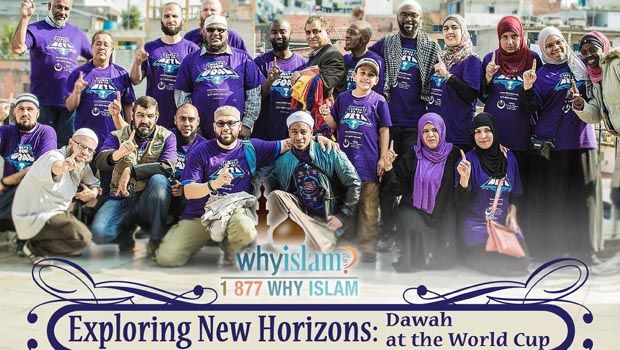
  • Exploring New Horizons: Dawah at the World Cup

    Exploring New Horizons: Dawah at the World Cup

    According to a Muslim historian, Khashkhash ibn Said ibn Aswad from Islamic Spain sailed across the Atlantic Ocean and made contact with the inhabitants of a distant land. He then returned safely to Andalusia with treasures and tales of his adventures. If this story is true, this would mean that he reached the New World over 600 years before Christopher Columbus. Historian Abu al-Hasan ‘Al? al-Mas’?d? (871-957), in “The Book of Golden Meadows,” speaks of this story: “In the ocean of fogs [the Atlantic] there are many curiosities which we have mentioned in detail in our Akhbar az-Zaman, on the basis of what we saw there, adventurers who penetrated it on the risk of their lives, some returning back safely, others perishing in the attempt. Thus a certain inhabitant of Cordoba, Khashkhash by name, assembled a group of young men, his co-citizens, and went on a voyage on this ocean. After a long time he returned back with booty. Every Spaniard knows this story.”

    It is important to learn different languages and cultures to better answer the questions that others have about Islam. That will have a significant impact on dawah work

    Similarly, in 1311, a naval fleet of 400 ships with Muslim passengers from Mali was swept off course and crossed the Atlantic Ocean, discovering a new world in the west and engaging in trade with its natives. Of the fleet, only one ship returned and its captain told the Mali ruler at the time, Prince Abu Bakr II, about their remarkable journey. Cited in an article by Joan Baxter, “Africa’s greatest explorer,” on BBC news online, a Malian scholar, Gaoussou Diawara, in his book, “The Saga of Abubakari II,” writes that Abu Bakr was Intrigued by this story and decided to follow in their footsteps, preparing an expedition of his own to sail the Atlantic. These contacts between Muslim travelers and the indigenous people of the Americas began to shape the history of the lands that were soon to be “discovered,” conquered, and colonized, by a once Muslim-dominated Spain. The trading that allegedly took place between the two cultures would have facilitated the introduction of Islam, much like Islam spread to Indonesia through commercial contact between Muslims and islanders. There are a number of historical narratives that suggest that some native inhabitants of the Americas practiced Islam and even spoke Arabic due to continuous interactions with Muslim traders.

    Even during the colonization period, immigration from both the Iberian Peninsula and Africa shaped the cultures, traditions, and languages of countries and territories in Latin America. With waves of immigration from Muslim countries to Latin America and the voluntary conversion of natives to Islam, the number of Muslims from Mexico to Argentina continues to rise. Currently, the estimated Muslim population in Latin American countries combined is anywhere from 4 to 7 million, the largest concentration being in Brazil with an estimated 1.5 million.

    Certainly, Islam has played a colossal role in the history of Latin America, a land which some are calling the “final frontier” of Islam. Muslim organizations engaging in Islamic propagation have realized this fact, and turned a vigilant eye towards these lands. Unlike the brave navigators and explorers of the past who spent months or even years on their journeys, those making dawah today have the advantage of technology which facilitates contact and information-sharing between the two cultures, making Latin America a fertile ground for outreach and education. It is no wonder that Muslims in Latin America’s closest neighbor, the United States, with a sizable Latino population of its own, have taken on the task of paving the way for dawah missions to their southern neighbors. One such effort took place recently with the FIFA 2014 World Cup as the venue. What began as an over-ambitious idea in the imagination of an associate of the Islamic Circle of North America’s WhyIslam project, surged into an unprecedented tidal wave of dawah efforts in Latin America, particularly in Brazil. The FIFA World Cup 2014 soccer tournament was the second hosted by Sao Paulo, Brazil, the first being held in 1950. It was the perfect opportunity for outreach, given the global popularity of futbol, or soccer, and the proximity to the US, where WhyIslam’s headquarters is located.

    WhyIslam directors and coordinators began the massive undertaking months in advance, networking with organizations and individuals to put together teams, assign tasks, and develop a strategic plan. It was determined that the propagation efforts in Brazil would culminate with a global day of outreach, termed “Global Dawah Day” (GDD) to be held on July 5. In order to promote and fund the project, WhyIslam elaborated a successful marketing campaign, using advertising in photos, videos, email blasts, and posting to social media outlets like YouTube, FaceBook, Instagram, and Twitter. Well-known Muslim lecturers, personalities, and imams such as Nouman Ali Khan, Omar Suleiman, Yasmin Mogahed, Hamza Tzortsis, Abdurraheem Green, Boona Mohammed, and Isa Garcia, provided video clips endorsing the campaign and calling for support and participation.

    The resonating theme for WhyIslam’s bold endeavor was “What is Your Goal?”, a play on soccer lingo intended to make one reflect on the true goal or purpose in life. There was a webpage (www.whatisyourgoal.org) set up for teams, organizations, and individuals to register their dawah event and to follow the endeavors and accomplishments of the crew in Brazil. The official flyer for GDD was printed on cards, banners, and posters and plastered over purple T-shirts that were provided to eager volunteers on six continents who vowed to participate in the World Cup street dawah and/or GDD. Many organizations came on board, one of which was the Centro de Divulgação do Islam para América Latina or CDIAL. CDIAL is one of the most prominent dawah-driven organizations in South America based in Brazil. They helped to facilitate housing and itinerary logistics, translations and printing of materials for distribution during the World Cup, as well as providing their own volunteers on the ground. WhyIslam printed and distributed thousands of brochures in English, Spanish, French, and Portuguese, as well as translations of the meaning of the Qur’an to World Cup spectators and locals in Brazil.

    Another group which contributed volunteers was the Islamic Education and Research Academy (iERA), headquartered in the UK, and its Mission Dawah team traveled across the Atlantic to partake in the outreach efforts. Another group was led by Imran ibn Mansur, widely known as Dawah Man, a YouTuber who has gained attention through his videos. They joined a group of 18 organizers, scholars, youths, and professionals from the US and Canada including Nahela Morales, the National Spanish Outreach Coordinator for WhyIslam, Shaykh Abdool Rahman Khan, a graduate of the Islamic University of Madinah, KSA, Abu Sumayyah Lebron, an Islamic Studies teacher and senior student at Mishkat University, Boona Mohammed, a famous poet and Islamic lecturer, and Cyrus McGoldrick, a writer and political activist.

    Native Brazilian volunteers offered their language and cultural expertise to aid their visiting brothers and sisters during their stay in Sao Paulo, and arranged housing and meal accommodations. Although the World Cup attracts people from all over the world, including many English-speaking countries, one of the challenges team members faced was the language barrier. Volunteers represented various regions, some being of South Asian descent, others from Spanish backgrounds, and many from Europe and Canada. One volunteer, Moihudeen Syed, originally from Pakistan and now residing in Orlando, Florida, describes his experience: “The way I thought was that dawah could be given to anyone in the English language only. I realized after I landed in Sao Paulo that it is not the case. I had to face the language barrier on every step I made. So I think it is important to learn different languages and cultures to better answer the questions that others have about Islam. That will have a significant impact on dawah work Insha’Allah.” Syed is currently in the process of learning Spanish after being inspired by his trip to South America.

    Others such as Morales, Lebron, and McGoldrick used their knowledge of Spanish to facilitate the dawah efforts since the Portuguese-speaking Brazilians understand it due to the similarities. Brazil is the only country in Latin America which recognizes Portuguese as its official language. Spanish is the official language of the overwhelming majority of countries in Central and South America, including a few which border Brazil. Brazilian convert and WhyIslam volunteer Muhammad S. Abdallah-Martins, who resides in Dallas, Texas, was one of the US team’s interpreters. A frequent traveler to his homeland, Martins emphasizes the need for these types of campaigns as he understands very well the challenges faced by local Muslims. Some of these challenges include a lack of adequate resources such as classes and activities for new converts, feelings of exclusion due to a language barrier between Brazilians and Muslim Arab immigrants, and the compelling need to establish cultural awareness between the two groups. Martins notes, “I don’t see a problem of being proud of your heritage, however, if we don’t identify with the local culture and do not make connections with the local convert Muslim community, then how are we supposed to spread the message of Islam?”

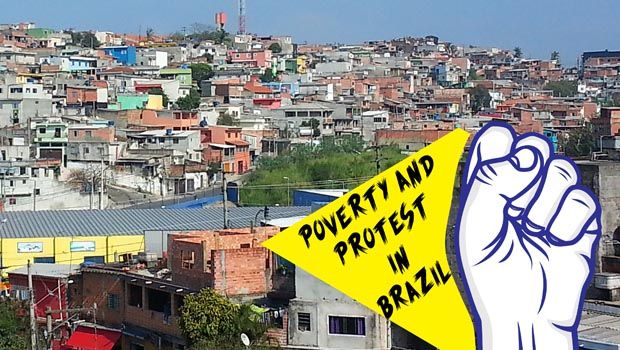
    During the World Cup, volunteer groups did their best to distribute flyers, speak with both spectators and locals about Islam, and engage vendors, taxi drivers, and anyone they came in contact with in conversations about Muslims and their religion. The regular driver for the American crew, a man by the name of Carlos, accepted Islam during their stay citing his reason as being their generosity and respect towards the people of Brazil. He witnessed how they distributed food and toiletries to poor families in the slums of Sao Paulo and made regular visits to the area’s small musalla, or Islamic prayer space. There were many lessons learned during the trip, the greatest lesson being that these type of efforts need to continue, and as Morales stated, “This is just the beginning.” Martins suggested that organizations in the US continue to work with those in Brazil and other Latin American countries, as well as reach out to their Islamic centers to establish special programs. “We should assist them with organizing national and regional conferences, similar to the ICNA conventions, in order to unite Muslims from all over (South America) to learn about their Deen, address issues that they are facing, and to create opportunities for networking.” He also commended the efforts in Brazil thus far, stating, “I think that this is a great start and will have a great impact on strengthening the bonds between the Muslims living in Brazil and the native Brazilians that have embraced Islam.”

    Muslim explorers, traders, immigrants, and converts of the past faced great challenges of distance and limited communication opportunities. They share, however, with the dawah journeyers, immigrants, and converts of today their passion for Islam. Many of our forebears’ dawah challenges have been resolved by the modern tools and technologies of today. However, it is up to the current and subsequent generations to step out of the comfort of their everyday lives to journey to other lands and explore new horizons, seeking the pleasure of the Lord by sharing with the local inhabitants the faith in One Creator and Sustainer of all.

  • From Ireland to Brazil

    From Ireland to Brazil

    All praise and grace are due to God, without whose help nothing is possible. That knowledge was made so real and vivid to me in June of 2014 when I was asked by a friend of mine if I would like to accompany him to Brazil. I have no interest in football and the World Cup was something that was completely out of my frame of reference and so I asked “What’s in Brazil?” He laughed and told me the World Cup was being held there and that he had heard of some daw’ah organizations inside Brazil who were starting big daw’ah drives due to the influx of people for the World Cup. I said I would love to go but I had a lot of projects in the works and I was very busy and so I regretfully declined.

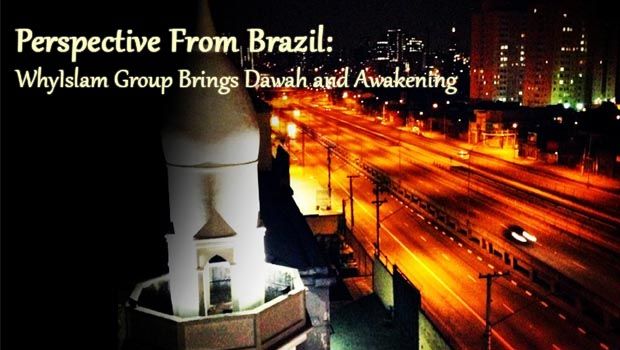
    In Brazil, I met a man who will be in my heart until the day I die. Ka’ab Abdul Qadar is a Brazilian brother who established a masjid on his roof. I ask Allah to give him the highest level in Jannah. When we entered his masjid we prayed with him and some others from the area, fifteen of us in total. He later told me that this was the greatest number of people to ever pray in his masjid.

    A few weeks prior to this some of the brothers in our office were watching a man I had never heard of before, Boonaa Mohamed, give a TedX talk. So one day after the call from my friend I had a few minutes to spare and decided to look him up on YouTube. When I searched his name the first video I saw was “Mission Daw’ah” and I was definitely intrigued! Once I started to watch the video I knew I’d made a huge mistake. He was inviting people to come and join the WhyIslam team in Brazil for daw’ah! I then made a sincere intention to travel to Brazil solely to invite the people there to Islam and to benefit them in any way that I could. I booked a ticket and made dua to Allah that if this decision was good for me then to make it easy for me to arrange all of my work and personal affairs so that I could travel peacefully to Brazil and with focus only on making daw’ah.

    My friend said he was in touch with an imam in Brazil who was the head of a daw’ah organization and that we would meet him there. However, when we arrived in Sao Paulo, we found out that the imam had to travel to Brasilia and so was unable to host us. We travelled to a masjid and the imam there told us there was no problem with us staying in the apartment above the masjid and he was a brilliant host for us, may Allah reward him. Two days later we were amazingly blessed. It shows that once you make a pure intention to work for Allah, Allah will make it easier and easier for you. The imam of the masjid told us there was a group in Sao Paulo who were working in daw’ah and he drove us to their office where we were given blessing after blessing, and I thank Allah, subhanahu wa ta’ala, every day.

    At the office, we met a group of individuals who from that day until now have inspired and re-inspired me. The WhyIslam team we met there was completely dedicated to the task at hand. They were serious about their duties and demonstrated time and again something that is lacking in a lot of daw’ah organizations today – they genuinely care about the people they interact with. One of the hardest working members of the WhyIslam team was sister Nahela. She is very skilled at what she does and is perfect for the role she is in. She has a passion for daw’ah that is infectious, and a deep affection for people that attracts them automatically and builds compassion on both sides instantly. Brother Crus, another volunteer, and I clicked instantly. We are the same age and are very similar in our thinking and our world-view. He is another shining example of the quality of people who volunteer for Dawah. Again the compassion for his fellow human beings is felt instantly by everyone around him. I ask Allah to bless them and to reward them abundantly for their sincerity and dedication.

    This group of wonderful individuals welcomed us with open arms, literally! Our uncle Farooq
    hugged me straight away like I was a beloved family member he hadn’t seen in a while.

    This group of wonderful individuals welcomed us with open arms, literally! Our uncle Farooq hugged me straight away like I was a beloved family member he hadn’t seen in a while. Without doubt, the team of WhyIslam volunteers was the best and most dedicated group of individuals I have ever had the blessing to work with. Their efforts and sincerity in their daw’ah was moving. For me personally, not speaking Portuguese, the leaflet distribution and street dawah was a serious learning curve. Ireland is a very different place than Brazil and street daw’ah like this would never work in Ireland. Without my brothers and sisters in WhyIslam, I never would have been able to experience this. So many wonderful things happened. The first few days were spent on the streets in different areas of Sao Paulo, distributing WhyIslam literature and copies of the Qur’an in Portuguese. This was an amazing experience for me. Irish people are very introverted when it comes to matters of faith and so they will rarely accept literature if its handed to them. Brazilians, however, are so open-minded. They really are a beautiful people who are so soft and genuinely good-natured that they rarely refused a leaflet. What’s more, as they walked down the street you could see them reading it, may Allah guide them all.

    We then took a trip to a favela, Embu des Artes, outside of San Bernardo where we were staying. Even thinking about it makes me choke up. It is sometimes very easy to forget the people we meet, yet I will never forget the brothers and sisters I met in Embu des Artes. The people live in makeshift homes that are constructed on top of other makeshift homes. It creates alleys that twist and turn in a haphazard way that is obviously born from necessity. There are no civic facilities, no waste management, no sewage system; just a beautiful people living in a situation they shouldn’t have to live in but have no alternative. May Allah make it an expiation for them. We took a walk through this favela (the favelas are talked about in the media in Brazil as hives of drug trafficking, prostitution, and vice of every other sort) and were greeted with a bright smile from every single person we met. We were invited in for tea or coffee so many times I lost count! The people were so open to us and welcomed us so beautifully I can’t make dua for them enough.

    In this favela I met a man who will be in my heart until the day I die. Ka’ab Abdul Qadar is a Brazilian brother who established a masjid on his roof. I ask Allah to give him the highest level in Jannah. When we entered his masjid we prayed with him and some others from the area, fifteen of us in total. He later told me that this was the greatest number of people to ever pray in his masjid. Then, with tears in his eyes, he thanked us for coming to visit him and, with tears steadily falling from my eyes, I thanked him for welcoming us and being such an inspiration. While in this favela we were blessed to put into practice, and see the instantaneous results, the words of Prophet Muhammad, sal Allahu alaihi wa salaam, when he said “Your greatest daw’ah is in your actions…” We were blessed to be able to help the poorest members of that community with food packages. To see how grateful they were, to see the worry of trying to feed their children for another week wash away, was an extraordinary experience. In this action alone is blessings above and beyond what anyone can imagine, the reward is from Allah, subhanahu wa ta’ala, and I ask for a reward only from Him.

    We were then blessed even further. We had a driver, a wonderful Brazilian man named Carlos, who was so patient and helpful to us. Every day he helped us deliver our daw’ah to his people, while he himself was non-Muslim. When we travelled to the favela and we followed the sunnah of Muhammad, sal Allahu alaihi wa salaam, and helped the neediest people in his society, Carlos took his shahadah on the same day, in that rooftop masjid, surrounded by people who I know all still remember him with a smile on their faces and such happiness in their hearts. He took his shahadah and may Allah guide him and his family and keep them safe from the evil of this world, ameen.

    It truly was a blessing to take part in this amazing venture. I make dua every day for the brothers and sisters of WhyIslam because they truly are devoted to their mission. My hope and dua is that more and more individuals and groups support WhyIslam in any way possible. There is so much in the media that misrepresents Islam and makes Muslims look bad, and organizations like WhyIslam counter and correct the misinformation that is out there. If you hear of any work WhyIslam is doing in your city, volunteer and help out. If you can’t volunteer, then donate to support their important projects and outreach efforts. And no matter what, always keep them in your dua. They do their work tirelessly for the sake of Allah SWT and I pray to be able to volunteer for them again in the future. May Allah bless them all, guide and keep them safe, and elevate them in the ranks of the people of paradise, ameen.


  • Perspective from Brazil

    Perspective from Brazil

    I would like to share with the reader the wonderful experience I had with the WhyIslam dawah group who came to Brazil during the 2014 World Cup. I am Brazilian and have been a revert for about 12 years. I lived in the US more than ten years and that is where I took my shahada, but I’ve been back in Brazil for a couple years now. Then one day not too long ago I received a Facebook message from a sister (she and I have a common friend), letting me know that she would be coming to Brazil with a dawah group during the World Cup. At that moment I was pretty excited to know that a group of Muslims would be coming to my country. However I really didn’t know anything about them, their mission, theirs plans, or the individuals who would be part of the group. And I never could have imagined how their visit would so deeply impact my life and my reality here in Brazil.

    The most inspiring of it all was to see the dedication of the group,  so willing to give of their time and resources,  willing to travel to another part of the world to make dawah,  simply blessed with pure intention, effective printed material, and a nice smile.

    My husband and I try to be pretty active with the Brazilian revert community, attending weekly classes which are open to reverts or anyone interested to know about the deen of Islam. In addition, we try to provide support and followup to the newcomers to facilitate their transition into a wonderful new way of life as Muslims. A whole new phase in this blessed journey of discovery in Islam began with the arrival of the first individuals from the WhyIslam group, a sister and her son, at the airport. I was very excited to meet them; in fact, it felt like I was going to see family members that I hadn’t seen for years. Alhamdulillah, because of hijab it was easy to recognize each other. From the very first moment I met this sister and the other WhyIslam brothers and sisters, I instantly felt a tremendous bond of love and great respect among us. It was amazing to see that although we come from different parts of the worlds, with different languages and cultures, we had all come together for a singular purpose – to invite others to the deen of Islam; and with one common intention – to do so for the sake of Allah SWT.

    The dawah itinerary consisted of daily visits to various parts of São Paulo including suburbs and slums, as well as designated spots at World Cup venues where large numbers of locals and tourists and World Cup attendees were concentrated. We made dawah by distributing Islamic material and through these blessed activities I found, amazingly, that language wasn’t a barrier even though most of the dawah group didn’t speak Portuguese. Communication took place between hearts as we handed brochures to people, offering them a nice smile and a kind and open demeanor. When someone had a question or comment, the native speakers among our group would engage with them.

    I was surprised to see the response of the people. Most of the time they were very open, curious, and very receptive to the message of Islam. Due to a bit of prejudice I have faced with the wearing of hijab, I realized that I had some preconceived notions about Brazilians not being open to hearing about Islam. In the beginning of my time with the WhyIslam group, I was actually a bit nervous to talk to the people, not knowing how to approach them and thinking that it would be challenging to convey the message to them, to total strangers. But slowly I realized that it becomes natural with time and practice. It was so rewarding to be talking to people and sharing with them what I have found to be the most sacred thing in my life. Allah SWT is the best facilitator of all things and capable of transforming us in the most unexpected ways!

    Talking to people about Islam was not just rewarding in the sense of inviting them to the truth, but it also strengthened my eman

    My experience was that talking to people about Islam was not just rewarding in the sense of inviting them to the truth, but it also strengthened my eman. This dawah experience caused me, in addition, to seek greater knowledge about, and reflect on, points brought up through questions or conversation. Usually some other individual(s) in our group would know the answer to any question that I lacked knowledge about, and each instance of this helped to prepare me more for further dawah interactions and conversations.

    I realized through this experience that the use of technology and social media is so effective and you don’t have to be a professional to make a video and upload it to Facebook or YouTube. Whether intending to convey a dawah message or report what is happening on the ground, one can use a smartphone to spread the word. Also I came to appreciate the importance of the group having a good visual identification and we wore very catchy and memorable T-shirts. People in my own community immediately bring to mind Islam when they see the T-shirt.

    The most inspiring of it all was to see the dedication of the group, so willing to give of their time and resources, willing to travel to another part of the world to make dawah, simply armed with pure intention, effective printed material, and a nice smile. I actually felt ashamed the moment I realized that I had to wait for others to come across the continent to teach me the importance of dawah and that the most essential tools needed to make dawah are within me. Now I can only thank Allah SWT for giving me this blessed opportunity and the capacity to see how much I can still do here in Brazil, even with the most simple resources. For my husband and me, this visit by WhyIslam was an awakening moment, not only to realize how much we can do here, but to see how much Brazilian people are receptive and in need of the message of Islam.

    This awakening is a milestone in our lives. Now we are organizing ourselves to hold at least monthly street dawah events, and if Allah wills, we will make brief videos and post regularly such reports of our events in a variety of media. We hope that slowly we can encourage other Brazilians to join us so that they too can experience the wonderful fulfillment of sharing the blessings of our deen. I ask Allah SWT to continue to bless the amazing work WhyIslam has been doing, and to reward all their efforts for the sake of Allah only. Ameen.

  • Poverty and Protest in Brazil

    Poverty and Protest in Brazil

    The Maracana Stadium, which hosted the final match in the 2014 FIFA World Cup, can be seen from the hills of a close-by shantytown or “favela,” in Rio de Janeiro, Brazil. The favelas are notorious for their extreme poverty and the violence and turmoil that result when drug gangs are left to dominate their neighborhoods. In preparation for the World Cup, Rio established the Police Pacification Unit (UPP) to bring order and security to particular favelas. The UPP program was initiated in 2008 and thousands of military police officers were hired. Critics charge that the UPPs do not function as normal police officers – enforcing the law, protecting public safety, providing assistance to victims of crime and investigating crime. The UPP appear to function to make sure that gang members do not carry guns or other weapons and to ensure safe passage for utility company workers to read meters. No attention was paid to the security needs of the favelados before the city authorities and real estate developers decided the slums needed law and order and as much gentrification as possible so as to present a glorious image of Brazil to the world for the World Cup and the 2016 Olympics. UPPs patrol all the favelas that are located near the Maracana Stadium, the tourist hotels, and the international airport.

    Brazil’s impoverished majority are disgusted and deeply frustrated with inadequate public services, political corruption, and the vast amount of money spent to host the World Cup

    To make sure that the squalid and neglected blight of the favelas did not ruin the visual splendor of the FIFA event, Brazil built walls between the stadium and some of the surrounding slums. As to Favela de Metro, one shantytown near the stadium, the decision was made to force a hundred families from their homes in order to bulldoze the dilapidated shacks out of view of FIFA fans and tourists. Those families were relocated to a slum across town.

    For another favela, Vila Autodromo, close to the site of the 2016 Rio Olympic Village, a different tactic was used to force residents out. Finding resistance to the relocation plans from pesky residents, the city of Rio uprooted many of the trees that beautified the otherwise unsightliness of slum environs, full foliage trees that provided shade as gathering places of residents, to watch their children playing or simply socialize with neighbors. To date, 150 of the 500 families who called Via Autodromo home have left. Remaining residents complain that the city also cut down on garbage collection in their neighborhoods and turn off streetlights at intervals throughout the night, all in an effort to make life in the favela inhospitable. “It’s a psychological attack…a perverse strategy to weaken community and weaken our resolve,” said Jane Nascimiento from the Vila Autodromo Neighborhood Association.

    In the months leading up to the World Cup, there were demonstrations in more than one hundred of Brazil’s cities, with estimates of up to one million protestors. Brazil’s impoverished majority are disgusted and deeply frustrated with inadequate public services, political corruption, and the vast amount of money spent to host the World Cup. With a total cost of an estimated $11.3 billion, and of that, $3.6 billion for 12 new and refurbished stadiums, it is no wonder that many Brazilians are outraged.

    The research literature shows, in fact, that the construction of stadiums and arenas for large events such as the World Cup offer the host country little to no long-term economic benefit. Protesters argued that for the money spent in refurbishing the Maracana Stadium alone, the city could have upgraded a number of schools and increased much needed social services for the poor. In Rio de Janeiro an estimated 300,000 protestors were met with tear gas, pepper spray, and rubber bullets.

    From Elite Rule to Populism

    In 2002, after 500 years of being governed by elites with immense power and wealth, the voters of Brazil elected Luiz Inacio Lula da Silva as president. Lula had little formal education, quitting school after the fourth grade to work and help his family. As president, he increased the minimum wage more than 150% and, along with other reforms, this raised 26 million Brazilians out of poverty. Lula’s Chief of Staff and handpicked successor, Dilma Rousseff, took office in January 2011 and is expected to win re-election in October of this year.

    Following Sao Paul, Rio de Janeiro is the second largest city in Brazil, the third largest metro area in South America, and the sixth largest city in the Americas. Of its 6.35 million population, 1.3 million live in favelas. Once the UPPs were instituted in certain favelas to prepare for the World Cup, investors began buying up houses in the newly secured areas and real estate prices and rentals soared; many residents were unable to pay increasing rents. They were forced to move, typically finding their way to further outlying locations where drug gangs and militias continue to hold sway. That investors are eying prime locations of certain favelas is underscored by real estate developer Eike Batista’s donation of $80 million Brazilian reals (roughly $36 million USD) to the UPP program.

    While Lula’s and Rousseff’s administrations have made many reforms that benefit workers and the poor, activists chronicle the ongoing needs that must be addressed regarding housing, sanitation, healthcare, and education. With regard to income distribution, Brazil is one of the most unequal nations in the world. Pedro Alvares Cabral of Portugal landed in Brazil in April of 1500 and in 1532 a permanent trading post, Sao Vicente, was founded. Sugar cane cultivation followed which required much labor and this demand was met with the slave labor of the indigenous people and later African slaves brought to the Americas. Eventually, the Portuguese Crown divided Brazil into fifteen large tracts of land. The unequal distribution of land continues to be a source of conflict and protest. Land concentration in the hands of a powerful few and the crushing poverty in rural areas gave rise to the Movimento dos Trabalhadores Rurais Sem Terra (Landless Workers’ Movement – MST) in 1979. The MST today has 1.5 million members and is one of many other indigenous movements in Latin America. According to educator, linguist, and activist Noam Chomsky, these movements point to “the vibrancy and vitality of democracy in much of Latin America today — denounced in the West as ‘populism,’ a term that translates as ‘threat to elite rule with marginalization of the public in systems with democratic forms but with only limited substance.’”

    Friends of the MST is a network of people and groups who support the MST in the wider struggle for social justice and economic fairness. One of its volunteers, Charlotte Casey, writes “Motivated by their slogan ‘Occupy, Resist, Produce,’ families in the encampments and settlements have found, however, that the legal battle is just a small part of the struggle for land. Violence carried out by forces opposed to agrarian reform has resulted in thousands of assassinations, death threats, and imprisonments. Political education is key to their organizing efforts, helping rural workers understand Brazilian reality and see that land in itself does not free them from exploitation. The MST organizes settlement families to pressure the government for schooling, health care, access to credit to support farm production, and other necessities. Rural workers also learn to oppose agricultural policies like genetically modified crops and patenting of seeds that benefit the bottom line for giant agribusinesses like Monsanto, but are ruinous to small farmers and do nothing to eliminate hunger in Brazil.” She also lists the MST principles:

    To love and preserve the land and the creatures of nature.

    To improve our understanding of nature and agriculture.

    To produce food and wipe out hunger. To avoid monocultures and the use of agricultural poisons.

    To preserve living plants and to reforest new areas.

    To care for springs, rivers, ponds, and lakes. To struggle against the privatization of water.

    To beautify the settlements and communities, planting flowers, medicinal plants, vegetables, and trees.

    To adequately handle waste and combat any practice that will contaminate or abuse the environment.

    To practice solidarity and fight injustices and aggression toward people, communities, or nature.

    To struggle against land concentration so that all may have land, bread, education, and freedom.

    To never sell the land that we have attained. Land is an absolute good for future generations.

    These are not the principles of agribusiness, neoliberal policies, or elite exploiters of the earth and its masses!

    Ordinary People Protest and Speak Out

    It is understandable that many citizens of Brazil see the enormous sums of money spent to host the World Cup as appalling and immoral when so many are hungry and without employment, and hospital’s and schools and basic social services are neglected. While the Ministry of Sports official figure is $11.6 billion for cost of the World Cup, it has been suggested that it is closer to $15-20 billion. In addition, the government has spent $1 billion on security, including 170,000 law enforcement, military, and private security personnel. These were backed up by 10,000 members of the Shock Riot Police. During one of the many protests, Gizele Martins, a journalist and activist from one of the favelas spoke to the people: “We have the right to housing, the right to a life. The World Cup destroyed and ended many lives with policies that target poor, black favela residents. Amarildo [a bricklayer from one of the favelas who was killed by UPP forces in 2013] was just one case, but innumerable others are exterminated in the favelas. We are tired of tears of blood. We are tired of wiping up the bloodied ground.” Some have noted that the protests in 2014 were small in comparison to those in 2013. The answer from those on the ground is that the heavy-handed response of the police to peaceful protests in 2013, as well as the media portraying the protestors as criminals, deterred many from joining in ongoing protests. Those who did brave the punitive police responses were faced with greater police brutality.

    Many observers look to Rousseff to continue to bring about reforms that address the income inequality in Brazil, reforms that were started by Lula. During Lula’s term in office, the number of citizens living in poverty, according to the World Bank, dropped from 21 percent in 2003 to 11 percent in 2009. Interestingly, it is reported that over a period of the last ten years, the top 20 percent of Brazilians saw their share of wealth decrease while the poorest 20 percent saw a 2.6 to 3.5 percent increase. President Rousseff, in June of 2011, initiated a social welfare program called Brazil Sem Miséria (Brazil Without Misery) to address the extreme poverty still rampant in the country. It will include many programs to bolster aid in health, education, and infrastructure. It will also expand the Bolsa Familia program, a cash transfer program for the most needy, which was launched by Lula. The Economist has called the Bolsa Familia initiative an “anti-poverty scheme invented in Latin America which is winning converts worldwide.”

    Nicholas Lemann, a journalist, interviewed Lula and in an article in The New Yorker in 2011 he quotes the then-still-president: “We have to distribute wealth in order to grow. The economists were always agonizing over this. We proved that it was possible to grow, to distribute income, and to do so with social inclusion without inflation. Today, Brazil has three hundred and fifty billion dollars in reserves. We don’t owe a cent to the I.M.F., and the I.M.F. owes us fourteen billion.” Lemann also quotes an email response he got from Rousseff after sending her some interview questions: “The main aim of economic development must always be the improvement of living conditions. You cannot separate the two concepts. The creation and distribution of wealth increases living standards; likewise, increases in living conditions lead to economic prosperity.”

    Re-emergence of Elite Power

    Some see gains made by Rousseff’s opponent in polls as they move toward the October election and wonder if she still has a powerful draw for the Brazilian people. They point to the current slowdown in economic growth and the possibility of recession. Yet Brazil still has low unemployment and real income remains stable. And Rouseff will undoubtedly point to the gains made by her party and administration in moving millions into the middle class. In February of this year, however, MST activists took to the state palace, accusing Rousseff of capitulating to the interests of Big Agro. “Dilma’s government has taken a step back on agrarian reform because she is in an alliance with conservatives,” said national co-coordinator Marina dos Santos. “Industrial capital has appropriated the countryside and brought agrarian reform to a standstill.”

    In an article in Al Jazeera America by Donna Bowater, “Whatever happened to Brazil’s World Cup protests?”, Bowater talks of the petering out of the 2013 protests that shook Brazil. Yet the mood and view of the man and woman on the street remains determined to continue the reforms that Brazilians have come to expect since Lula was in office. The author quotes a biologist, Iuri Souze, who describes the lives of people who are overlooked and disregarded by those in power: “We don’t have health or education, we have corrupt police. It’s always been like this: people were always treated like rubbish while the rich had everything.” He continued, “People are dying in favelas. People are living in sewage. It’s a chaotic state. It’s going to continue after the World Cup. We can’t put up with this life.”

    The anger is understandable, despite the gains made, given that half the available farmland in Brazil remains uncultivated while four million landless peasant farmers are homeless and unable to make even a substandard living. The reality is that less than three percent of the population owns two-thirds of the land. There is no justification for this inequity. People everywhere are tired of the institutionalized, systemic inequalities that afflict societies worldwide.

    We must be willing to critically call out a system of international finance that is unjust and immoral, that, “with the IMF at its centre, works to reward the international commercial banks and the elites in developing countries, at the expense of the common people in the debtor countries.”

    Debt and the Monetary Foundations of Inequality

    Richard Robbins, a professor at SUNY at Plattsburgh in New York, in an article on anthropologynews.org, the site of the American Anthropological Society, finds the core problem to lie in the the type of monetary system that revolves around debt and interest. He writes about an “institutionalized…debtor-creditor relationship” that inevitably creates the economic inequality that we see in the U.S. and other countries around the world. In our monetary system, money is “lent into existence by privately-owned banks.” Since all money is debt, and since not only the principal but also the interest must be repayed, “the economy must perpetually grow at an exponential rate to generate the interest on the debt and/or the dividend on investments.”

    For the privately-owned banks, these debts created by the creation/lending of money are their assets. For the banks’ assets to grow, debt held by “federal, state and local governments, businesses, households, students and financial institutions” must also grow. It is no wonder that the $11 trillion worth of government, business, and public debt in 1990 in the U.S. has ballooned to almost $59.4 trillion as of March of this year. That debt is owed to the wealthiest Americans, those who are the “net-creditors.” Robbins writes, “Interest is paid out in virtually all economic transactions, since prices and rents include interest that sellers and entrepreneurs must pay as a price of money. Interest and or dividends are realized from bank deposits, loans, and investments. Based on studies done in Germany and Norway, some 90% or more of the population count as net debtors, while 10% or less are net creditors.” He also notes that as the debt has spiraled to massive amounts, the “the gap between rich and poor is greater than any time in almost 100 years and that the bottom 30% of US families have seen their median income fall by 29% since 1979.” The institutionalized debtor-creditor relationship afflicts all nations which participate in the international banking system.

    Robbins sums up the sad reality: “Clearly, in the present state of things, creditors control the system. They do so by control of financial and multilateral institutions and central banks charged with protecting money as a store of value, and by ensuring that creditors receive their return on capital (eg, by bank bailouts, structural adjustment programs and ad hoc actions such as seizing portions of Cypriot bank accounts to repay debts owed to European banks). And creditors control nation-states whose legislatures are pressured to reduce taxes on creditors (eg, capital gains taxes) and support programs that force people (eg, students) to accept more debt… In sum, our monetary system is constructed in a way that ensures a growing division of wealth and income; a division that, like the economy, must grow exponentially.”

    The current U.S. national (government) debt is $17+ trillion. The interest expense for fiscal year 2014 is $354,863,251,628.78 (that’s nearly $355 billion!) The debt of federal and state governments, businesses nationwide, and all people is nearly $60 trillion, as stated above, according to the latest economic data from the St. Louis Federal Reserve. The situation for developing countries clearly shows the same out-of-control black hole of exponentially growing debt. According to the World Bank’s Global Development Finance report of 2012, “The combined stock of developing countries’ external debt rose $437 billion to $4 trillion at end in 2010…” When numbers are so large, they seem to lose meaning, until we look at the real-world repercussions of such massive debt and the toll on ordinary lives: “According to UNICEF, over 500,000 children under the age of five died each year in Africa and Latin America in the late 1980s as a direct result of the debt crisis and its management under the International Monetary Fund’s structural adjustment programs. These programs required the abolition of price supports on essential food-stuffs, steep reductions in spending on health, education, and other social services, and increases in taxes. The debt crisis has never been resolved for much of sub-Saharan Africa. Extrapolating from the UNICEF data, as many as 5,000,000 children and vulnerable adults may have lost their lives in this blighted continent as a result of the debt crunch” [“The Rich Borrow and the Poor Repay: The Fatal Flaw in International Finance,” by Ross P. Buckley, professor of international finance regulation and law at UNSW Australia (The University of New South Wales)].

    Current Monetary System Alternatives

    The Institute of Islamic Banking and Insurance is a not-for-profit organization that “brings together people of all faiths, and those with no faith, to create the awareness of a viable alternative financial system that that aspires to realize fairness, justice and equity in dealings for the public good that must be accompanied by righteous behaviour and moral conduct . The important message of Islamic banking and insurance is that all financial dealings whether in the form of commercial transactions, financial products and services, must always produce a benefit and lead to goodness for the welfare of society.” The IIBI delineates the basics of Islamic banking that throw a revealing light on the monetary systems that are based on an institutionalized debtor-creditor relationship. It is beneficial here to quote them at length:

    “In order to be Islamic, the banking system has to avoid interest. Consequently, much of the literature on the theory of Islamic banking has grown out of a concern as to how the monetary and banking system would function if interest were abolished by law.

    Another Islamic principle is that there should be no reward without risk-bearing. This principle is applicable to both labour and capital. As no payment is allowed to labour unless it is applied to work, so no reward for capital should be allowed unless it is exposed to business risks.

    Consider two persons, one of whom has capital but no special skills in business, while the other has managerial skills but possesses no capital. They can co-operate in either of two ways:

    1) Debt-financing (the western loan system). The businessman borrows the capital from the capital-owner and invests it in his trade. The capital-owner is to get back his principal and an additional amount on the basis of a fixed rate, called the interest rate, as his compensation for parting with liquidity for a fixed period. The claim of the lender for repayment of the principal plus the payment of the interest becomes viable only after the expiry of this period. This payment is due irrespective of whether the businessman has made a profit using the borrowed money. In the event of a loss, the borrower has to repay the principal amount of the loan, as well as the accrued interest, from his own resources, while the capital-owner loses nothing. Islam views this as an unjust transaction.

    2. Mudarabah (the Islamic way). The two persons co-operate with each other on the basis of partnership, where the capital-owner provides the capital and the other party puts his management skills into the business. The capital-owner is not involved in the actual day-to-day operation of the business, but is free to stipulate certain conditions that he may deem necessary to ensure the best use of his funds. After the expiry of the period, which may be the termination of the contract or such time that returns are obtained from the business, the capital-owner gets back his principal amount together with a pre-agreed share of the profit.

    The ratio in which the total profits of the enterprise are distributed between the capital-owner and the manager of the enterprise is determined and mutually agreed at the time of entering the contract, before the beginning of the project. In the event of loss, the capital-owner bears all the loss and the principal is reduced by the amount of the loss. It is the risk of loss that entitles the capital-owner to a share in the profits. The manager bears no financial loss, because he has lost his time and his work has been wasted. This is, in essence, the principle of mudarabah.

    There are at least three reasons for considering the mudarabah relationship to be more just than the creditor-debtor relationship:

    Both parties agree on the ratio in which profits will be shared between them.

    The treatment of both parties is uniform in the event of loss, since if the provider of the capital suffers a reduction of his principal, the manager is deprived of a reward for his labour, time and effort.

    Both parties are treated equally if there is any violation of the agreement. If the manager violates anyone of the stipulated conditions, or if he does not work, or is instrumental in causing loss to the business by negligence or bad management, he will have to bear the responsibility for the safe return of the whole amount in question. If, on the other hand, the provider of the capital violates any of the stipulated conditions, for example, by withdrawing his funds before the stipulated time, or by not providing part or full funds at the promised time, etc., he will have to pay the manager a reward equivalent to what he would have earned in similar work.

    Mudarabah is the basis of modern Islamic banking on a two-tier basis.

    1st tier: The depositors put their money into the bank’s investment account and agree to share profits with it. In this case, the depositors are the providers of the capital and the bank functions as the manager of funds.

    2nd tier: Entrepreneurs seek finance from the bank for their businesses on the condition that profits accruing from their business will be shared between them and the bank in a mutually agreed proportion, but that any loss will be borne by the bank only. In this case, the bank functions as the provider of capital and the entrepreneur functions as the manager.

    Islam argues that there is no justifiable reason why a person should enjoy an increase in wealth from the use of his money by another, unless he is prepared to expose his wealth to the risk of loss also. Islam views true profit as a return for entrepreneurial effort and objects to money being placed on a pedestal above labour, the other factor in production. As long as the owner of money is willing to become a shareholder in the enterprise and expose his money to the risk of loss, he is entitled to receive a just proportion of the profits and not merely a merely nominal share based on the prevailing interest rate.

    Thus, under an Islamic banking system, the cost of capital is not analogous to a zero interest rate, as some people wrongly assume it to be. The only difference between Islamic banking and interest-based banking in this respect is that the cost of capital in interest-based banking is a predetermined fixed rate, while in Islamic banking; it is expressed as a ratio of profit.”

    Toward a Decent and Hopeful Life for All

    Pundits in Brazil, the U.S., or any country which has a monetary system in which money is “lent into existence by privately-owned banks” can debate endlessly about which policies will bring about greater economic equity and narrow the gap between rich and poor. But no long-lasting change of any value will take place until we, ordinary citizens, educate ourselves about the inevitable contemptible outcomes of a system which is purposely structured in such way that, as Robbins says, “debt represents a regressive tax in which money trickles up rather than down.” We must be willing to critically call out a system of international finance that is unjust and immoral, that, “with the IMF at its centre, works to reward the international commercial banks and the elites in developing countries, at the expense of the common people in the debtor countries,” as described by Professor Buckley. “It does this by only selectively applying market principles and disciplines, that is the market is allowed to operate unimpeded when it is delivering profits to the international banks and the elites in the developing countries, and its operation is interfered with, grossly, when market forces would impose massive losses on the banks and/or the developing country elites.”

    The change can only come when enough individuals insist upon – as described by the Institute of Islamic Banking and Insurance – “a viable alternative financial system that aspires to realize fairness, justice and equity in dealings for the public good that must be accompanied by righteous behaviour and moral conduct.” Then those in the favelas, slums, shantytowns, and ghettos of the world might be afforded a decent and hopeful life.

    It was narrated from A’ishah (may Allah be pleased with her) that the Prophet (pbuh) used to say in his prayer, “O Allah, I seek refuge with You from sin and heavy debt.”