
For a quarter-century, American politics trained itself to see Muslims as a problem, then Americans started electing them.
That was not how the script was supposed to end.
After 9/11, the Muslim became a permanent suspect in the national imagination. We were American enough to pay taxes, perhaps, but forever required to produce supplementary evidence of belonging. Campaigns trafficked in Muslim panic, legislatures hunted imaginary Sharia takeovers, and cable television discovered that a beard, a hijab and ominous music could apparently substitute for political analysis.
And yet, here we are.
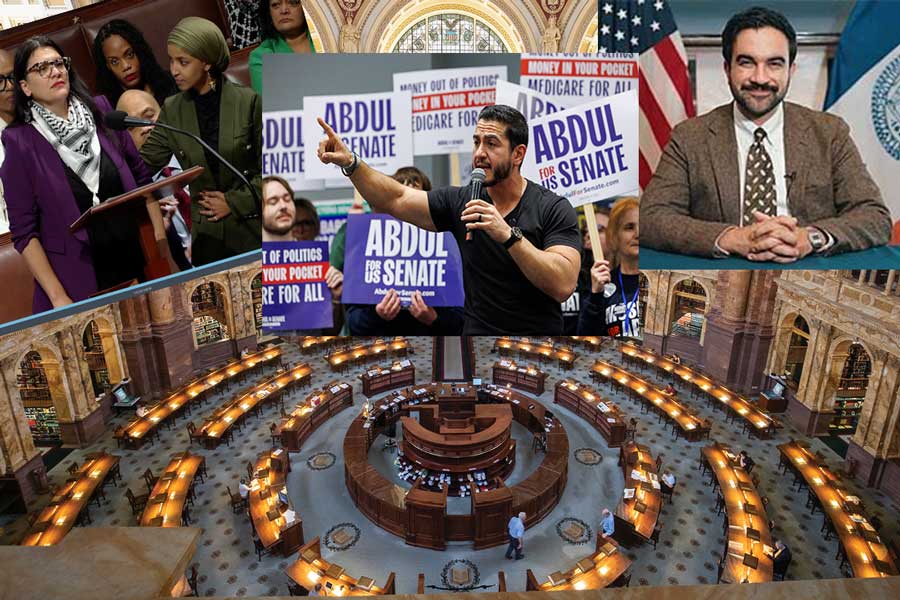
Since 2019, Rashida Tlaib and Ilhan Omar have served as U.S. Representatives. In 2026, Zohran Mamdani was sworn in as the mayor of New York City after a stint in the State Assembly. Most recently, Abdul El-Sayed became the Democratic U.S. Senator-elect in Michigan. What’s more, Aisha Wahab – Afghan American, former foster child, first Muslim woman elected to California’s legislature – won a congressional special election despite an avalanche of outside spending against her.
It seems America keeps complicating its own prejudices.
The easy explanation is these politicians succeeded despite being Muslim. The more interesting possibility is that, for some voters, they succeed partly because being Muslim reveals something else – conviction. Not theology as campaign platform, not sectarian loyalty or some exotic Islamic electoral formula, but moral seriousness.
In an age of politicians focus-grouped into ideological oatmeal, merely appearing to believe something has become almost radical, and the candidate with an identifiable moral center can look positively insurgent.
That is where Muslim-ness becomes politically significant.
For politicians such as Mamdani, El-Sayed, Wahab, Omar, and Tlaib, Islam is not simply a demographic label attached to an otherwise secular political project, it can be part of the moral architecture of the project itself.
Justice. Dignity. Obligation. Poverty. Inequality. War. The stranger. The vulnerable. The duties of power toward those without it.
These are not uniquely Islamic concerns. Of course not.
But neither is Islam incidental to them.
The Islamic ethical tradition places justice near the center of moral life. Wealth carries obligations. Power carries obligations. Community carries obligations. The vulnerable possess claims upon us. The Qur’anic command to stand firmly for justice — even against oneself — is not exactly the operating philosophy of contemporary Washington.
K Street would probably classify it as a workplace hazard.
And therein lies the paradox.
American politics has become so professionally cynical that ordinary moral consistency can now look revolutionary. Voters have watched politicians discover principles after reading polls and misplace them after meeting donors. They have watched “public service” become a curious profession in which people enter promising sacrifice and leave remarkably well-networked.
Against that landscape, Muslim identity can do something unexpected.
It can make a politics of obligation look rooted rather than manufactured.
Consider Mamdani. His political strength did not come from hiding his religion or sanding down his worldview. He remained visibly, unapologetically Muslim while translating moral commitments into the least abstract language imaginable:
Rent. Buses. Groceries. Childcare. Wages.
That is the political alchemy. Social justice becomes formidable when it stops sounding like a graduate seminar and starts sounding like somebody’s electricity bill.
The important point is not merely that Mamdani is Muslim and also talks about affordability; it is that the two need not be morally disconnected.
A worldview shaped, in part, by Islamic ideas of justice, dignity and social obligation can find civic expression in housing, transportation, healthcare and wages. Faith need not enter politics as a demand for privilege. It can enter as a source of duty.
El-Sayed offers another version. His politics of healthcare and economic security is resolutely civic, but civic politics does not require amnesia about its moral sources. A Muslim politician can translate religious conviction into obligation toward people who do not share his religion.
That is not alien to the American tradition. In fact, it is one of its oldest political forms.
Wahab’s story sharpens the point. An Afghan American, orphaned young, raised partly in foster care, then elected on a politics centered on workers, discrimination and marginalized communities, her Muslim identity matters not because voters yearn for theology in government, but because it can make that politics feel anchored in something deeper than messaging.
There is a difference between a politician trained to say she cares about inequality and one who appears to possess an internally coherent reason for caring about it.
Omar and Tlaib established an earlier template. Both endured extraordinary vilification and responded not by becoming less Muslim, less visible or less themselves, but by remaining unmistakably so.
That matters.
Their Muslim identity is not merely representational scenery. It is intertwined, however differently in each case, with the moral questions they insist politics confront: war, Palestine, immigration, poverty, discrimination, civil liberties, racial injustice, and the treatment of people rendered disposable by power.
One may disagree sharply with their answers. But the intensity of the questions is difficult to separate entirely from a moral formation in which justice is not merely administrative preference.
It is obligation.
That authenticity carries risks. Conviction can harden into rigidity. Moral certainty can flatten complexity. Muslim politicians are as capable of ego, opportunism and bad judgment as Christian, Jewish, Hindu or atheist ones. Islam does not issue ethical immunity cards at birth.
But the variable is not Muslim identity alone.
It is Muslim identity as moral formation.
For some Muslim politicians, Islam is not merely what opponents attack and supporters tolerate. It helps animate the political project itself. It supplies a language of duty. It places justice inside a framework larger than electoral advantage. It can transform concern for the poor, the immigrant, the worker, the victim of war or discrimination from a policy preference into something closer to a moral claim.
And voters may recognize the difference.
Perhaps Americans are not searching for Muslim politicians at all.
Perhaps they are searching for politicians who appear to possess something American politics has spent decades systematically exterminating:
a moral center.
That is the great irony.
The identity once presented as evidence that Muslims were incompatible with American democracy may, in some cases, be supplying precisely the ethical grammar that disillusioned voters find missing from it.
For 25 years, Muslim Americans were asked to prove that Islam would not interfere with their Americanness. Now some voters may be discovering the opposite possibility,
that Muslim-ness can be part of what makes a politics of justice coherent, disciplined and morally intelligible.
For a generation, America demanded Muslims prove they were American enough for its politics. Now a stranger question is emerging: Is American politics principled enough for the Muslims its voters keep electing?