Upon my arrival in the United States in 1987, I soon became involved with an Illinois pro-life organization. When I encouraged fellow Muslims to participate, the response I often heard was, “It’s their problem.” Not surprisingly, more than two Muslims were rarely involved. Nearly four decades later, that sentence still echoes in my mind. If America is our home, which problem is “their problem”?
For decades, American Muslims have tried to combat anti-Muslim sentiment by explaining Islam. We opened our mosques, distributed literature, corrected misconceptions, defended our civil rights, and, gradually became politically active – all of which have value – but after watching my community grow and mature in America, I wonder whether we overlooked something more fundamental: simply becoming part of the everyday civic life of the country we call home.
Upon arrival in America, many Muslim immigrants naturally sought out one another. We built mosques, schools, and organizations to preserve our faith and raise our children within it. There was nothing wrong with that, as we were immigrants building our community.
However, our relationships with our neighbors and the wider community developed much more slowly, and, even when they did, they often revolved around religion, explaining our faith, or inviting people to our mosques rather than simply getting to know one another as neighbors and working together on shared community concerns. As a result, we knew Muslims across town better than the family a few doors away. We were indeed building our community, but in the wider civic picture, we were often missing.
Then attitudes toward Muslims changed, and we responded by explaining ourselves.
We explained the status of women, jihad, and Shariah. We assured Americans that Muslims were not terrorists and that our faith did not teach us to kill others. But there was an imbalance. We repeatedly invited others to understand us, while relatively few of us visited their places of worship simply to understand them and their faith and to build relationships despite the theological differences. We wanted to be understood more than we sought to understand.
However, our outreach remained within a religious framework, with one faith community reaching out to another. Valuable as that is, we were still less present in the ordinary civic spaces where Americans meet and work together without a faith label.
We also tend to bring our religious identity to the front of almost every public interaction, either out of enthusiasm for our faith or because we feel others should know about it. Faith may shape our values, but not every civic relationship has to begin with it. When we consistently first approach society as Muslims explaining Islam, rather than as neighbors, parents, professionals, and fellow citizens, we may unintentionally reinforce the impression that we stand apart from the society around us. The issue is not whether we bring our faith with us. The issue is whether we can translate the values it gives us into a civic language and civic presence that does not always require a religious label.
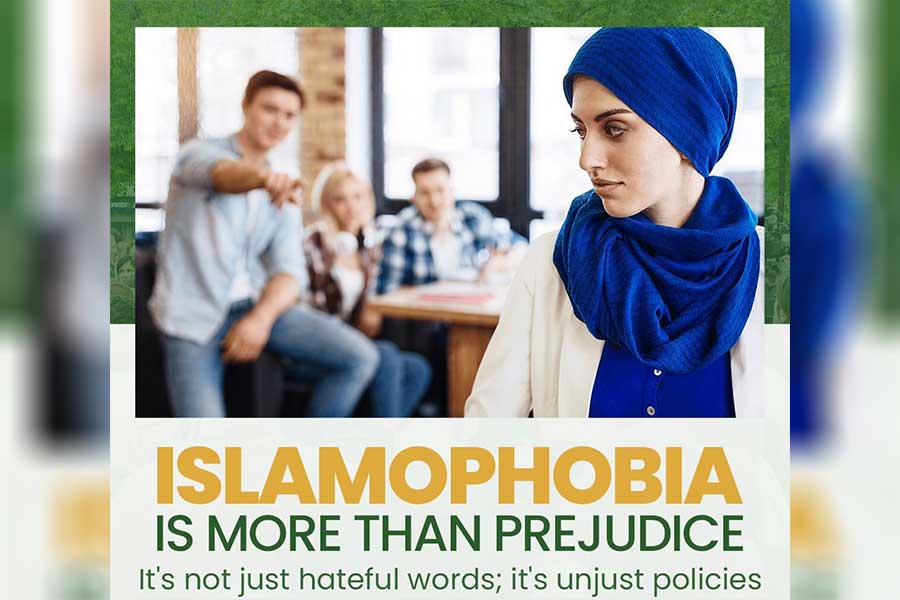
We have not been alone in this framing. Much of the wider conversation about Muslims also approaches us primarily through religion rather than as neighbors, coworkers, and members of American society. When nearly every interaction involving Muslims is framed through faith, Islam itself can become the target of every disagreement involving Muslims.
As Islamophobia intensified, we became even more willing to reach across differences. I remember welcoming into a mosque members of a liberal organization wearing T-shirts proclaiming, “We promote consensual sex,” a message whose blunt focus on sexuality was starkly out of place in our sanctuary. There was nothing wrong with welcoming them, but it made me think: Why did our differences become so manageable when we needed others to stand with us, yet seem so difficult to overcome when common social problems called on us to stand and work together?
Living in a pluralistic society does not require theological agreement. Muslims, Christians, Jews, atheists, and others will never agree on everything, and we don’t need to. Our motivations may differ as well. A Christian may fight poverty because of Jesus; I may do so because of the Quran, while an atheist may act from human solidarity. We do not have to settle our disagreement about God before agreeing that a family should not sleep under a bridge.
Civic belonging does not require us to dilute our faith; it requires us to see the society around us as our society. What matters is whether we can move beyond our theological differences and work together on the problems we share. A visit to a mosque can be a wonderful introduction, but it is no substitute for sustained civic engagement. In fact, working together could build the very mutual understanding we so dearly seek.
None of this means Muslims created the prejudice directed against them. It means we should ask whether explaining ourselves is enough to overcome it. Once again, we were making efforts, but in the broader civic picture, we were still missing.
American Muslims have gradually discovered their political voice. We organize voters, support candidates, and run for office. That is a healthy part of citizenship, but politics can create another trap. When an election becomes “our candidate” against “their lobby,” we risk turning an American political disagreement into a contest between communities. The broader American public has little reason to see itself in a political fight framed that way.
A Muslim candidate should be able to stand before voters simply as an American candidate who happens to be Muslim – judged on schools, healthcare, housing, taxes, civil liberties, foreign policy, and the other issues affecting Americans.
Our public identity cannot be built primarily around whom we oppose. It should be demonstrated by what we stand for and what we want for this country, namely that American resources and policies serve American interests and communities, and that we work with our fellow citizens for better schools, affordable housing, strong families, accountable government, justice, and peace.
Politics gave us a voice. But a political voice is not the same as civic roots. We entered the political picture, but in everyday civic life, we were still missing.
Looking back, I see three broad stages in the Muslim American experience: We built our community. We explained and defended our faith. We developed some political influence. Civic belonging should have been developing alongside all three.
We should know the neighbor before someone vandalizes the mosque. Join the PTA before a religious controversy brings us to the school board. Work with churches before we need their pastors to defend us. Work on homelessness, addiction, education, and family problems, not because they are “Muslim issues,” but because they are problems in our society.
Perhaps American Muslims have spent too much time trying to be understood and not enough time becoming known through serving, volunteering, raising our children, and solving problems together. Civic engagement allows us to know one another through the shared experience of fixing what is broken and building our society together, and that takes me back to the words I heard in 1987. To that I say, if America is our home, no problem is “their problem.”