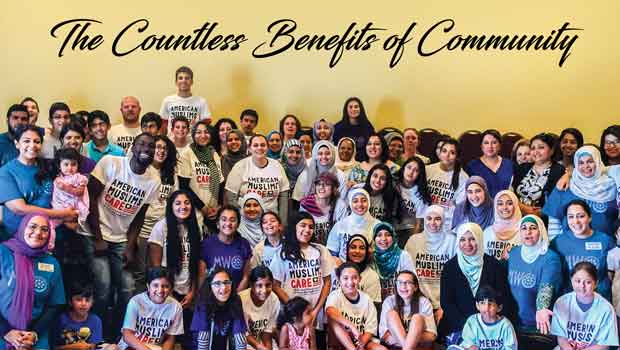
Growing up in a tiny town called Bonifay in the northwest panhandle of Florida, I was a part of a close-knit community. We were a small group of Muslim families who would get together each Wednesday for a meeting and potluck dinner at the local masjid my father had built on a huge stretch of land just off the highway. Even though there weren’t many of us, being a part of this affiliation of people who held similar beliefs and dealt with many of the same challenges somehow felt homey and reassuring. There was a sense of belonging, a comfort within, that I could feel as I iced my bundt cake (that all the aunties raved about) in preparation for the Wednesday meeting. There were aunties and uncles looking after me just as they did their own children, and there were a number of friends and cousins to lean on.
Bonifay, a town most people have never heard of, was my home, and because of the community who gathered regularly for a shared belief and cause, it was a place where I felt I belonged. That sense of belonging helped me in overcoming the many difficulties of living in a place in which most people did not understand Islam, Muslims, or Pakistanis, and too often made prejudiced remarks to my seven siblings and me. Belonging to a masjid and being part of a group of people who cared about me saved me from falling into despair countless times.
The Importance of Community to Well-being
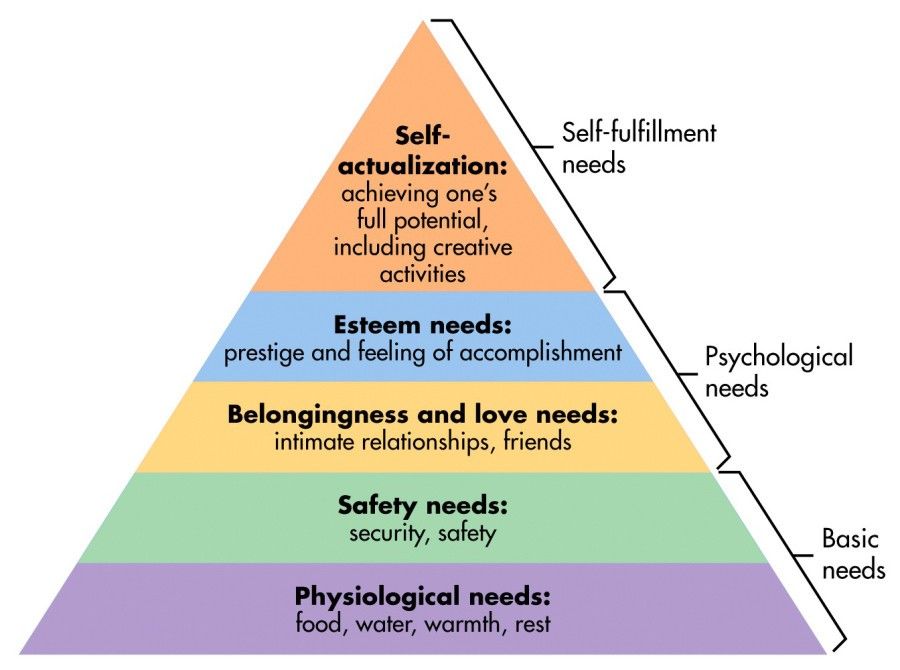
The powerful bonds of community I experienced and the beneficial effect it had on me is not surprising. In 1943, psychologist Abraham Maslow described a five-tier hierarchy of human needs. Maslow designated the need for belonging and love, in its importance to human well-being, right after physiological needs and safety needs. In his 1943 paper, A Theory of Human Motivation, he describes belongingness and love needs as including intimate relationships, family, and friends. Maslow wrote that an individual “will hunger for affectionate relations with people in general, namely, for a place in his group, and he will strive with great intensity to achieve this goal. He will want to attain such a place more than anything else in the world…”
In 1986, a theory on community, titled “Sense of Community,” was developed by social psychologists McMillan and Chavis. They stated, “The sense of community is a feeling that members have of belonging, a feeling that members matter to one another and to the group, and a shared faith that members’ needs will be met through their commitment to be together.” In this beautiful description, they provide us with an image of togetherness, mutual caring and support, and the shared experience of belonging and feeling fully accepted. With this sense that individuals matter to one another, a strong and palpable bond is formed, providing security and safety in the hearts of its members.
The importance of belonging to a community as a requisite for overall well-being was further described by Frances Moore Lappe, author of “You Have the Power: Choosing Courage in a Culture of Fear” and “Democracy’s Edge: Choosing to Save Our Country by Bringing Democracy to Life.” When asked about the significance of community, he said, “Community – meaning for me ‘nurturing human connection’ — is our survival. We humans wither outside of community. It isn’t a luxury, a nice thing; community is essential to our well-being.” This statement underscores just how crucial community is, that it is a means to nurture human connection. The reality is that humans are social beings. We find meaningfulness in our relationships; we give and receive affirmation, we provide feedback to one another, and we mature, growing emotionally and spiritually through our connections.
Benefits of Community
Belonging to a community has enormous positive effects on a person’s mental, emotional, and physical well-being. In a TED talk on this topic, Susan Pinker mentions researcher Julianne Holt-Lunstad of Brigham Young University who did a meta-analysis of 148 studies in the literature on the influence of lifestyle and other factors on lifespan. The multiple studies involved 308,849 middle-aged participants over a period of seven years. The top two predictors of longevity had to do with relationships. The second most important predictor was the existence and quality of close relationships. The highest predictor of extended lifespan was social integration. This is not just having social circles like belonging to a book club or social action group; it also refers to how much an individual interacts with others as they move through their day. This engagement includes both strong and weak bonds, so it includes casual interactions like talking to the store clerk or postal carrier or chatting with a co-worker. The take-away is that being a part of a community and communicating and connecting with people is essential to the quality and length of our lives.
No matter how large or small, a community creates a safe haven for individuals and families to turn to in good times and bad. My community, for example, provided me with a place to turn to when the outside world was too cruel — when my hijab was ripped off in fifth grade, when I was called all kinds of racial slurs, and when I felt alone on the elementary school playground. I knew I had my community, my people, to open up to about my experiences because they had faced similar cruelty, or simply because they cared. Belonging to my community allowed me to express the hurt that was inside, and had I not been able to express it, if I had no one to share my thoughts and feelings with, I would have suppressed the hurt. Suppression of emotions and difficult experiences contributes to a host of mental health problems and sometimes increases aggressive behavior.
The Social Media Community
A question often arises regarding social media and if it serves as a community with the same benefits as face-to-face community involvement. Brene Brown, a research professor at the University of Houston, explains that, “Social media are great for developing community, but for true belonging, real connection and real empathy require meeting real people in a real space in real time.” Social media can be a great tool to find opportunities for “real space” and “real time” connections, such as being a part of a local business owners’ group or participating in a political, social, or religious network. When I moved to Long Island in New York, I knew there were so many Muslim women residing on Long Island, but they were all scattered. After searching online for Long Island communities that I could be a part of, I came across the page “Muslimahs of Long Island.” However, there were not many sisters signed up as members and the page appeared to be inactive. After reaching out to the admin to let her know that I had a vision for the group, I set my plan into motion. My mission was to utilize the online platform to connect all the Muslim women on Long Island so that we could connect, network, support one another, and have a place to turn to whenever we needed it.
Currently, in less than two years, our group has grown into an amazing online community of over 2,500 Muslim women in the same geographic area who are there for one another. It has become a platform for exchanging ideas, informing one another of upcoming events in the area, and as a referral and recommendation source. There have been numerous spinoffs from the group including a ladies’ night planning group, a moms-with-toddlers group, and a planning group for children’s playdates. These groups often meet in person and, as a result, bonds have been formed and close friendships have been created. The Muslimahs of Long Island is a beautiful example of how an online community can provide an avenue for people to connect, not just online but also face-to-face to experience a closer and deeper connection of human hearts.
The Detriment of Isolation
What happens when there is no connection to community? A person who is not connected to a larger group and remains isolated is at risk for physical and mental health related problems. Social isolation is the state of being alone, without meaningful relationships or a healthy support system. A related concept to social isolation is loneliness, which differs in that social isolation is the external state of not having social connections, while loneliness is the perception of not feeling connected to others. A person can have many friends yet still have a sense of loneliness. In March of 2018, Psychology Today’s monthly magazine displayed the cover story, “The Loneliness Cure,” exploring the issue of loneliness and how to counteract it. The research indicates that loneliness in the older population is strongly correlated with dementia and cognitive decline. A lonely individual, according to the research, is more susceptible to catching a cold and is more likely to suffer the illness longer. Loneliness can lead to generalized stress, depression, anxiety, and anger. The lead article states, “…lonely people are more likely than the nonlonely to die from cardiovascular disease, cancer, respiratory illness, and gastrointestinal causes—essentially, everything.”
Finding Your Community
Now that it is certain as to the importance of community immersion, having a social connection with others, and steering clear of loneliness and isolation, how does one go about finding a community and becoming a part of it? The first step is the courage to move out of your comfort zone and be determined to find a place that will be a beneficial and positive environment for you. Of course, the most obvious and relevant place for a Muslim to get involved is at his/her masjid. There are usually many opportunities to volunteer and engage. In addition, broadening your social circles might involve making a phone call that you’ve been wanting to make but have been putting off. It could be exploring with a therapist as to what type of community you want to be involved in, or discovering what your hobbies and likes are so that you can search for like-minded people. A common interest, a mutual belief, a shared life experience can all be different ways of connecting with others.
Another way to find your community is to engage in research on events and community groups in your area. You may discover a domestic violence organization, a cancer walk, or a food bank that you would be interested in getting involved in. Oftentimes, service in the community is an excellent doorway to making connections with others. Participating in making your community a better place can not only lead you to find others to connect with, but also can facilitate mutual support and service, empowerment, and/or enlightenment in expanding circles of human interaction.
The Prophet, peace be upon him, indicated the supreme importance of community. He said, “’A believer to another believer is like a building whose different parts support each other.’ The Prophet then clasped his hands with the fingers interlaced while saying that” (Bukhari). He (pbuh) also said, “The parable of the believers in their affection, mercy, and compassion for one another is that of a body. When any limb aches, the whole body reacts with sleeplessness and fever” (Bukhari and Muslim).
The Quran, in the most beautiful and succinct way, lets us know that we are meant to interact and form bonds of association: “O humankind! We created you from a single [pair] of a male and a female, and made you into nations and tribes, that you may know one another…” (Quran 49:13).
Let’s get involved in our local communities and the larger American community — our lives depend on it!