
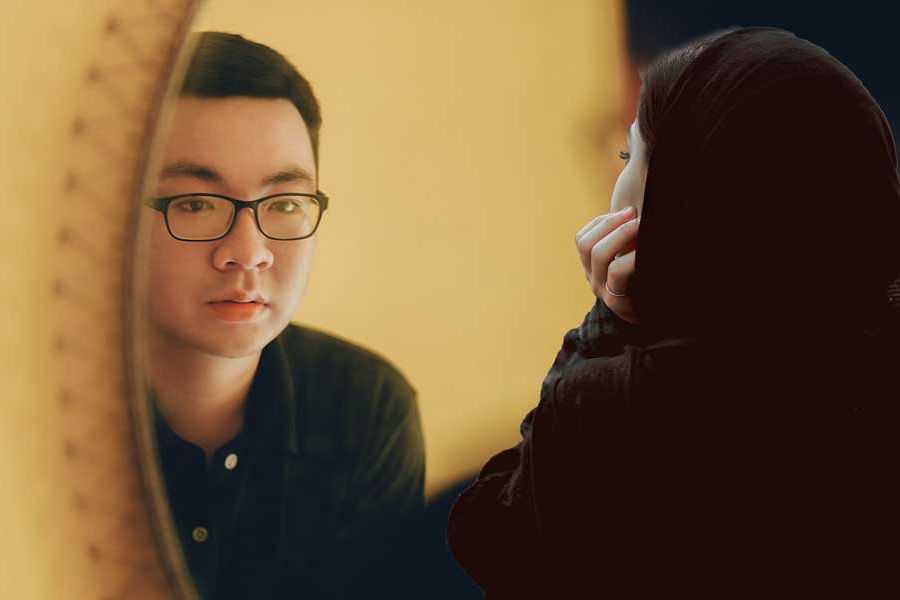
A marriage brings together two souls. Two families. Two worlds. It’s often portrayed in film and popular culture that these two individuals are opposites, yet they are brought together under the (naive) belief of “opposites attract.” Sometimes the differences are depicted as having opposite career paths, diverging personalities, or even differing belief systems. In those storylines, we see a battle in which one spouse attempts to assert his or her principles and lifestyle choices over the other. Maybe the outcome results in harmony, or maybe it ends in dysfunction. In either scenario, we are taught the message that it’s okay if your spouse doesn’t mirror you.
As a Muslim, the question I aim to answer when thinking about compatibility in a spouse is this: to what degree does my potential spouse need to be at the same level of religious practice as me? If Allah is pleased with my actions and efforts to fulfill my deen, do I absolutely need to find a spouse who is also doing so? Can they be a good person, but not be as devoted to daily practice as I am? In answering this question, I hope to guide single Muslims who are seeking a spouse and trying to determine what to search for in terms of a potential’s religiosity.
What If They’re Not as Religious as Me?
When I was on my search for a husband, I often got stumped with this question. I would meet an eligible Muslim bachelor, someone around my age who had a solid career, similar education background, and similar interests as me. We would have conversations that were easy, fun, and fulfilling. I would often step away from those initial phone calls, or meetings, thinking, “wow, I would love to get to know this person better.” However, the very next meeting or two, when we were comfortable enough to get into serious questions about religion, I would discover that we were at very different levels of practice. Usually, the men I met were still trying to get all five prayers in during the day. They didn’t make reading the Qur’an part of their daily or weekly habit, and they often missed out on Jummah when it didn’t fit into their work schedule. One guy, in particular, told me he was too afraid to pray at work, and so he would make up two or three of his salats in the comfort of his home. I on the other hand, was busy trying to attend as many halaqas a week as possible, take classes to work on my tajweed, and was bold enough to pray at work or even in other public spots like the library or the park.
When I assessed my religious practice, I realized I just wasn’t at the same level as many of my suitors. I would go back to them and ask questions about how they intended to improve, or if they even wanted to. Sometimes the answer would be yes, absolutely, and I want my spouse to inspire me to do better, and sometimes it would be I’m happy where I’m at and I don’t want anyone to change me. Either response just wasn’t good enough. I realized we weren’t at the same level of religiosity. Admitting that made me feel icky, because I feared that I was unfairly judging someone and that such a judgment was only to be done by the Almighty, Himself.
In trying to find some support for my decision to move on, I relied on Islamic principles that taught me about the importance of establishing relationships where you can grow your Islam. Understanding the concept of suhba was part of my enlightenment. Suhba, understood to mean companionship, or the development of relationships, forming good company, is what all Muslims should strive to foster. Although the principle of isolation can be a tool used to reflect on the greatness of God and His beautiful religion, suhba, or righteous company can also have the same, if not stronger, effect.
Your Spouse Should Be Your Mirror
Evidence for this concept is found in the hadith “A believer is the mirror of his brother” (al-Tirmidhi). The more time you spend with a fellow Muslim, the more likely you are to pick up their religious habits. That’s why Islam encourages us to surround ourselves with righteous companions so that we may increase our chances of having good religious practices. That hadith has its literal meaning by mentioning “his brother [in faith],” but the meaning extends of course to any believer, including our spouse.
As Muslims, the most important factor that we aim to find when seeking a spouse, is good deen. Although we are given lessons from the Sunnah that tell us we may use wealth, beauty, or lineage as a starting point for selecting a spouse, it is attraction to a person’s religion that is unequivocally the most important. This is the ultimate litmus test for compatibility.
A marriage, if done properly, involves two people that connect with their mind, body, and soul. In the Qur’an, in Surah Baqarah, verse 187, Allah describes the spouse as “a garment” to emphasize the comfort, protection, and multiple layers of closeness you will obtain with your spouse. If it is understood that our spouse is meant to be so closely connected to us, it can only be that their spirituality and attention to their deen is also intended to be closely related. If one spouse wakes for Fajr, the other should do the same. If one spouse is mindful of using foul language, the other should be mindful of doing so too. The day-to- day religious practices we engage in should be something we can bond with our spouse over. It should never be a point of contention or dissention. Agreement, or mirroring of religion between spouses becomes especially important when there are children involved. So many times, when there are parents who have different levels of practice, the children are left confused about who they should follow. One parent is seen as strict and the other as easy-going. This can create division in the home if not addressed at the outset of the relationship.
Ultimately, I answered that question for myself by searching for a spouse who not only would mirror my devotion and level of practice of Islam but would also inspire me to improve, because he, himself, was committed to improving his own devotion and practice. I strongly believe anyone searching for a spouse should focus on finding someone that strives to gain closeness to Allah and is actively doing so. I do not believe people should search for someone that is lightyears ahead of them in practice. I think having an uneven match of religiosity could create unrealistic expectations for both parties. Instead, if two individuals come together, for the purpose of marriage, and see good deen in each other, then that should be sufficient. Otherwise, the reflection in the mirror becomes opaque. We need to be mindful of selecting spouses who will help us to continue to improve our connection to Allah and who will help us achieve the ultimate goal of getting into jannah.