بسم الله الرحمن الرحيم

Tag: trump

  • After Trump: Exemplifying the True Nature of Islam

    After Trump: Exemplifying the True Nature of Islam

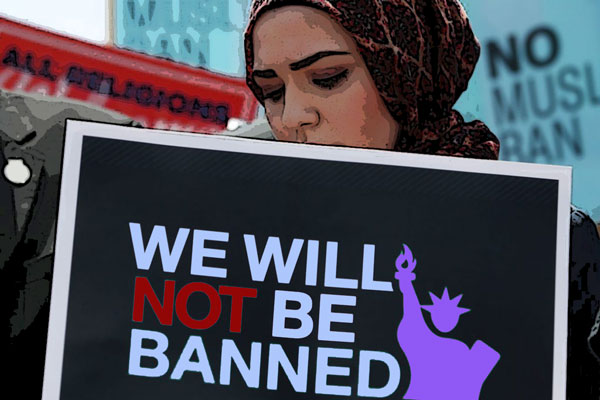
    When Donald Trump announced his intention to have a “Muslim Ban,” stating that early on as a presidential candidate, many were unsure of its effects and what it meant for the future of American Muslims. President Trump signed an executive order on January 27th, 2017 that banned foreign nationals from seven Muslim-majority countries from entering the United States. Protests took place and lawsuits immediately initiated in the attempt to repeal the order. However, four years on, as Trump prepares to leave office, the effects of his anti-Muslim policies and rhetoric on American Muslims have largely been ignored. In fact, however, Trump’s tenure has seen a dramatic decline in Muslim refugees, as well as a rise in hate crimes against Muslim citizens.

    According to a CATO Institute report, after the United States welcomed a record 38,555 Muslim refugees in the fiscal year of 2016, that number was cut to a mere 3,321 in the fiscal year 2018 — a 91 percent decrease. The Pew Research Center also found that Christians comprised 79 percent of refugees in 2019, despite Muslims outnumbering Christian refugees just three years earlier. Trump’s Muslim Ban has had a devastating effect on Muslims who seek to escape war, poverty, and/or hunger, especially in countries such as Yemen, Syria, and Iraq. Syrian refugees who would have sought to escape the chaotic civil war that left their country in ruins had their hopes diminished when Trump’s executive order suspended Syrian refugee immigration indefinitely. That is despite the fact that in 2017, a Pew survey found that almost half of Americans believed that the United States had a responsibility to accept refugees from Syria. This is likely due to America’s long-term involvement in the war that has devastated the Middle Eastern nation. Yemeni refugees were also blocked by the initial executive order; and despite the United Nations warning that Yemen has become the largest humanitarian catastrophe in the world, Trump saw fit to forbid the entry of the three million displaced persons from Yemen. The United States also has a significant hand in the Yemen war, providing a multitude of arms to Saudi Arabia, one of the main players in the war, under the 2017 United States-Saudi Arabia arms deal.

    Ongoing Negative Effects of the Muslim Ban

    Trump’s insistence on a Muslim ban may end up hurting the United States economically. Studies have shown that over time, refugees have high labor force participation rates and rely less on social welfare programs. Therefore, most refugees represent a net positive to the U.S economy in the long run. A 2017 New York Times report detailed that the Trump administration rejected a report which found that refugees generated over $60 billion to the U.S economy over a decade, a glaring detail that was overlooked or ignored when Trump imposed the travel ban.

    Trump’s travel ban has likely also had a hand in decreasing international student enrollment in the United States. According to a recent U.S. News & World report, 2019 was the first year that international student enrollment into American universities dropped, with many students citing the U.S political climate as an area of concern when considering the U.S. for studies. Moreover, the U.S Department of Commerce stated that international students contributed $45 billion and nearly half a million jobs to the U.S economy in 2018; losing these students will undoubtedly deprive the U.S of an important source innovation and expertise in STEM (science, technology, engineering, and mathematics) in the years to come.

    It is evident that Trump has largely fulfilled his promise to halt Muslim immigration to the United States. However, this may have caused increased resentment toward Muslims in America and there is little evidence that it has made America much safer. A Pew Research survey conducted in 2017 found that 75 percent of Muslims believed that there was a lot of anti-Muslim discrimination, and half of all Muslims expressed that it has become harder to be Muslim in America in recent years. It also seems that the 68 percent of U.S Muslims who claimed that Trump “worried them” may have been justified considering an uptick in hate crimes against Muslims since Trump took office. A study published by the Council on American-Islamic Relations (CAIR) documented 300 cases of hate crimes against Muslims in 2017, a 15 percent increase from 2016, a year which also saw an increase in hate crimes. CAIR stated that this increase was at least partly a result of Trump’s policies and inflammatory rhetoric regarding Muslims.

    A Powerful Lesson for American Muslims

    In light of the undeniable correlation between Trump’s Muslim ban and public attitudes toward Muslims, we have a responsibility to debunk all stereotypes about Muslims and fabrications about Islam. In order to achieve this objective, Muslims must be good ambassadors of Islam and let their character speak louder than the words of anti-Muslim politicians and ordinary hatemongers. In the early years of Islam, the Prophet was relentlessly tormented by disbelievers in every manner possible. There is a well-known story of a woman who used to throw garbage at the Prophet as he walked by her house to go for prayer every day. One day she did not appear. He inquired about her and was told she was sick and so he visited her. He extended to her many kindnesses to help her recover her health. She then accepted the truth of Islam (while this story is not found in the authentic hadith, it is repeated in many biographies of the Prophet; while its authenticity cannot be verified, its message of the Prophet’s patience, tolerance, and kindness even toward those who hated him, and acted upon that hatred, is verified by a multitude of reliable accounts in the life of the Prophet).

    A similar lesson is found in the contemporary true story of Richard McKinney, an American veteran returning from the Middle East. He planned to bomb a mosque in Indiana due to his hatred of Muslims. However, after receiving a warm welcome to the mosque he had planned to bomb, Mr. McKinney instead took home a Quran and eight weeks later he converted to Islam. He later became president of the that same Islamic Center.

    These two examples contain a powerful lesson for American Muslims — we need to show others the true nature of Islam. Non-Muslims do not go to mosques, they do not read the Quran, and many of them do not know anything about Islam beyond what they hear on the news. The only exposure to Islam is through Muslims in America, through the agency of Islamic personality and character. It is, therefore, imperative to be a good ambassador of Islam so as to change any negative perceptions that people may have about Islam and Muslims. In today’s tumultuous political climate, in order to combat hate-mongering sentiments and Islamophobic policies, Muslims must be distinguished exemplars of Islam and its teachings, and that starts with purifying the heart and doing good deeds. The Prophet, peace be upon him, said, “Verily, Allah does not look at your appearance or wealth, but rather he looks at your hearts and actions” (Sahih Muslim).
  • Beyond the 2020 Elections: What’s Next for Muslim Americans

    Beyond the 2020 Elections: What’s Next for Muslim Americans

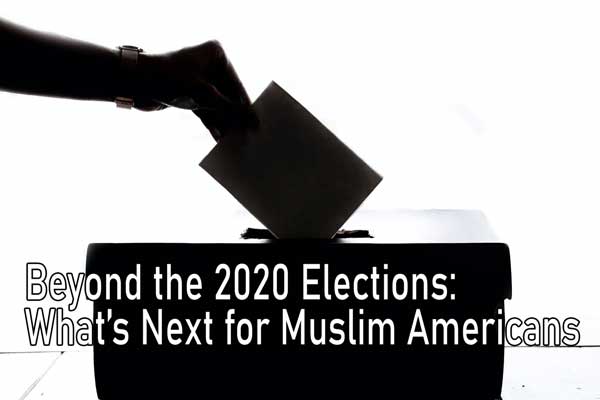
    The 2020 U.S. presidential election has often been described in hyperbolic terms by journalists, political hacks, and social commentators as being the “most important election in the history of the republic.” While the truth of this observation may be questioned by some, it is credible to say that only in the period leading up to and during the Civil War, in the 1850s and 1860s, do we find a comparable era when the American people were so socially and politically polarized. A sense of racial superiority and support of the institution of chattel slavery fueled 11 Southern states to secede from the Union in 1861 and set up an independent government called Confederate States of America. What followed was the deadliest war in the history of this country, resulting in over 618,000 combatants being killed.

    The historic election of Barack Hussein Obama in 2008 as the country’s first Black president was interpreted by a significant number of Americans as signaling a post-racial America. This perspective was soon debunked by subsequent events. In the immediate aftermath of Obama’s election, hundreds of cases of racially inspired hate crimes and other acts of intimidation against Blacks and ethnic minorities skyrocketed to levels unseen since at least the middle of the last century. The FBI and other intelligence agencies reported more credible death threats against Obama than any of his predecessors in the White House. Beyond the racist epithets and crude characterizations of Barak and Michelle Obama as apes or monkeys, and accusations that he was not born in the U.S., Obama was doggedly accused of being a Muslim, a claim that he repeatedly denied. The fact that his being labeled a Muslim was intended to be a denunciation is a testament to the climate of Islamophobia that existed in the United States at that time.

    Donald Trump’s election in 2016 was to a large degree a racist backlash against Obama. Trump’s unapologetically equivocal attitude toward White supremacist and neo-Nazi groups, and his refusal to condemn the extrajudicial killing of unarmed Black men and women by police officers across the country, have emboldened these groups. In addition, Trump’s draconian immigration policies for Latin America are unparalleled in the modern era. His patently Islamophobic statements and travel bans on citizens from seven Muslim-majority countries to the United States have militated against Muslim Americans being accepted as full citizens, regardless of historical and present contributions to society.

    Muslims in Early America

    Muslims in America represent the most ethnically diverse population in the world. Enslaved African Muslims were forcibly brought by the Spanish to the area in and around present-day Florida as early as the 1560s. Prior to becoming the third president of the United States, Thomas Jefferson was the governor of Virginia and he significantly influenced the Virginia state legislature to insert clauses in the state constitution that prohibited the establishment of a state-sponsored religion. He also persuaded the same of the framers of the U.S. Constitution.

    Those who wanted an official religion presumed that it would, of course, be Christianity. Most early 18th century Protestant Christians believed that the Islamic religion was outside the realm of an acceptable faith while others, like Jefferson, opined that the new nation should offer full citizenship to those outside the mainstream religion of Protestant Christianity. While Jefferson espoused concepts of freedom and equality for all men, he held hundreds of enslaved Africans on his Monticello plantation. The probability is great that at least a few of these were Muslim based on their West African origins and census data from the 1790 census. Jefferson had a fascination with the various religions and their teachings and, as a young lawyer, he purchased in 1765 an English translation of the Qur’an, a 1734 edition. But his advocacy for full citizenship rights for Muslims was presented hypothetically, as most Americans, including Jefferson most probably, were not aware at that time that many of the African slaves were Muslim. But even in the hypothetical, Muslims were not looked upon favorably. So, for Jefferson, they served as an indicator of whether a universal tolerance and guarantee of constitutional rights for all people would be enshrined in the Constitution.

    In 1807, Jefferson got definitive proof that Muslims, literate no less, were among the enslaved Africans. He received two hand-delivered manuscripts from Muslim fugitive slaves, written entirely in Arabic, appealing for their release from slavery. The Arabic verses were passages from the Qur’an addressing bondage and freedom. When Louisiana native Ira Nash delivered the manuscripts to the president, the two Muslims were moving eastward along the Cumberland River in Kentucky and Tennessee, hoping to return to Africa. The president was unsuccessful in locating the fugitives to free them.

    During the colonial period, there were many Christian denominations, including Anglicans, Baptists, and Presbyterians, and there were conflicts and persecutions by one Christian group against another. Later, in the 1800s, there were tensions between Protestants and Catholics, and violent attacks were aimed at Irish Catholic immigrants. In the early 1800s, Mormons were chased out of a number of Northeast states until they finally settled in Utah. The town where they settled was burned to the ground in 1844 by anti-Mormon agitators. The first occurrence of anti-Jewish sentiment was in the late 1800s. Considering this backdrop of religious conflict among various denominations and religions, it is not surprising that there was antipathy toward Muslims. But, again, because most Americans at that time didn’t personally know Muslims, it was a theoretical antipathy, with a perception of Islam as a foreign, violent religion. The animus toward Islam and Muslims by White Protestant Christians in 17th and 18th century America had been inherited primarily from European Catholic church doctrine and the general public attitude toward a faith they knew little about.

    Prince Among Slaves

    Even though the relatively few Muslim immigrants and the thousands of enslaved African Muslims were forced to operate on the margins of Colonial American society, often practicing their religion clandestinely, the existence of a Muslim presence was at times dramatically thrust into the national spotlight. One such example is that of Ibrahima Abdul Rahman Sori. Born in 1762 into a royal family in what is modern-day Guinea, he was captured in a tribal battle and sold into slavery at the age of 24. After Abdul Rahman’s chance encounter in Natchez, Mississippi with John Cox, a British doctor who had met Ibrahima decades before in his home village of Futa Jallon, Cox and his son tried for years, unsuccessfully, to purchase Abdul Rahman’s freedom. They were able, though, to publicize the story of the prince among slaves, making it known in Natchez and even beyond the state of Mississippi. In 1828, after Ibrahima had spent 40 years in captivity, President John Quincy Adams and his Secretary of State, Henry Clay, received a request from the Sultan of Morocco to release Abdul Rahman. After his emancipation, Abdul Rahman embarked on a high-profile national campaign to try to raise funds for the freedom of his wife Isabella and their nine children. He and Isabella returned to West Africa, but Abdul Rahman died before making it back to his village.

    Canaries in the Coal Mine

    Since the inception of the nation, Muslims and African-Americans have been the proverbial canaries in the coal mine, signaling whether true and full citizenship rights will be granted to all Americans. Despite fighting bravely in every war that the United States has fought and contributing much to the success and betterment of this nation, the loyalty of African Americans and Muslim Americans is again and again challenged by elected officials and opinion poll respondents after every incidence of foreign or domestic terror, even though according to the Center for Strategic & International Studies, “Right-wing attacks and plots account for the majority of all terrorist incidents in the United States since 1994, and the total number of right-wing attacks and plots has grown significantly during the past six years. Right-wing extremists perpetrated two thirds of the attacks and plots in the United States in 2019 and over 90 percent between January 1 and May 8, 2020.”

    During the decades of the 1950s and 1960s, millions of African Americans were influenced in their understanding of structural racism by the brilliant oratory and searing analysis of American society by Malcolm X. For 12 years, Malcolm X was the national spokesman for Elijah Muhammad and the Nation of Islam. He announced his departure from the organization on March 8, 1964, becoming one of the most prolific da’ees (callers to orthodox Islam) in the history of this country. Millions of African Americans have been influenced by his example to embrace Islam and actively engage in civil society. The Nation of Islam was a Black separatist, heterodox Muslim organization that served as a counterpoint to the integrationist efforts of the Civil Rights Movement. The message of Malcolm and the NOI held wide appeal to African Americans, particularly those trapped in cycles of poverty, drugs, and general disadvantage and hardship due to systems of oppression imposed on their communities. Prior to the 1970s, many “orthodox” African American Muslims were disengaged from the political system in the U.S. Thousands of African American Muslims started to vote and otherwise participate in “mainstream” American pursuits due the influence of Imam Warith Deen Mohammed. Imam Mohammed took over the leadership of the NOI after the death of his father, Elijah Muhammad.

    The circumstances surrounding the path to citizenship of immigrant Muslims coming to the U.S. could not have been more glaringly different from that of African Americans. After being kidnapped and forcibly brought in the bowels of slave ships to this country, African people were enslaved for roughly 250 years and denied de facto citizenship until the passage of the 14th Amendment to the Constitution in 1868. In contrast is the experience of immigrant Muslims. Since the passage of the Immigration and Naturalization Act of 1965, Muslims from Muslim-majority countries were allowed entry to the United States if immigration authorities classified them as having potential benefit to the country. This process of selective immigration essentially allowed only the brightest and most educated Muslims to enter. These new Muslim arrivals were almost uniformly classified as White for immigration purposes. Upon arrival, many of these immigrants were afforded amenities and perks that had been denied people of African descent due to structural racism. Hence, over the succeeding decades, the civic engagement of immigrant Muslims generally exceeded that of African American Muslims, especially in relationship to the electoral arena.

    The rise of Islamophobia in the U.S. since 9/11 has arguably created the greatest challenge to American Muslims. Hate crimes against Muslims have exponentially increased over the years as some elected officials ramp up negative rhetoric against the Muslim presence in this country. Still, Muslim immigrants to the U.S. have had a rather seamless transition into professional careers and business ownership, affording the Muslim community here the distinction of being the most educated and highest-earning Muslim population in the world.

    Active Participants in Civic Engagement

    Muslims in America must make critical decisions about our individual and collective actions moving forward. Our rights, privileges, and social opportunities are no longer discussed in abstract terms like during the formative days of the republic. We are no longer living on the margins of society but rather are increasingly active participants in civic engagement and social justice areas that are so important to our existence as Muslims. It is critical that we be clear about our Islamic identities and not immerse ourselves in pursuits, no matter how well intentioned, that take us away from our Islamic duties to Allah SWT, to ourselves, and to others. To a large degree, our actions are predicated on our knowledge and experiences. It is imperative that our Muslim leaders know and understand the history of this land. Otherwise, as so succinctly stated by Dr. Martin Luther King, Jr., we risk “leading our people into a burning house.” There is an expression that many Christians ruminate about when deciding a course of action: “What would Jesus do?” — (peace be upon him). Maybe, as Muslims, we should ask ourselves and one another as we chart our political and social collective paths, “What would Prophet Muhammad (peace be upon him) do?”

  • Can America Survive Four More Years of Donald Trump?

    Can America Survive Four More Years of Donald Trump?

    A relatively late entrant as a candidate for the Republican Party’s 2016 nominee for president, Donald Trump officially announced his candidacy on June 15, 2015, joining a field that eventually included 16 other GOP candidates. Texas Senator Ted Cruz, the first Republican to file, announced his intention to run 596 days before the election. By contrast, Canada’s campaign season for prime minister lasts eleven weeks, while Mexico’s presidential run lasts 90 days, concluding three days before election day. Over the last few decades, presidential aspirants in the U.S. have often expressed their “interest” in running for the office two to three years in advance while formally filing as a candidate an average of 400 days prior to the actual election. Unlike other industrialized nations, the United States has no fixed time limit for campaigning or limitations on campaign spending. As a result, America has the longest and most expensive campaign season in the world.

    Trump is a useful tool of the deep-pocketed ruling elite of which he is a part. But he is a replaceable cog in the American political machine. There are thousands like him waiting to assume the mantel of leadership while ignoring the common good and defying the Ultimate Lawgiver.

    The inordinate amount of money that is raised and spent during every presidential election cycle in the U.S. has the practical effect of limiting potential candidates to millionaires and billionaires, or individuals who have a political organization capable of raising enormous amounts of money from corporations and other wealthy donors. During the 2016 presidential campaign, candidate Trump spent $66 million of his own money and $280 million of funds raised from Super PACs and small donors. His opponent, former first lady and secretary of state Hillary Clinton, raised an eye-popping $1.2 billion in her unsuccessful presidential bid.

    A significant portion of the American electorate, as well as leaders and citizens of other countries, were dumbfounded by the election of Donald Trump. His extreme narcissism, blatant expressions of racist, xenophobic, and misogynistic views, as well as his hedonistic lifestyle, were not seen as inclining him to become a salaried public servant. Trump was the ultimate Washington outsider and political novice, a reality show tv star, a self-proclaimed billionaire with six bankruptcies in his portfolio. As a rental property owner, he had multiple racially motivated housing discrimination lawsuits filed against him. Trump was an extremely atypical candidate for the presidency.

    A President Should Ideally Possess Certain Traits

    While the office of the president has no stated requirements beyond being a natural-born U.S. citizen, 35 years or older, and resident in the U.S. for at least 14 years, it is generally expected by voters that the office bearer should ideally possess certain traits such as believability, decorum, a strong commitment to universal justice, and patriotism. In less than four years in office, the current president, in his official capacity, has been cited by multiple fact-checking operations to have lied to the American people, media outlets, and government officials more than 20,000 times. Over 100 licensed psychiatrists released a signed document questioning his fitness to serve as president based on him exhibiting signs of mental instability. He has publicly denigrated developing nations by characterizing them in vulgar and derogatory terms, referred to asylum-seeking Latin American refugees as rapists and drug dealers, and ordered immigrant children at the U.S./Mexico border to be separated from their parents and caged like animals in unsanitary, traumatizing conditions. Additionally, in the history of the American republic, no American president has shown such a flagrant disregard or ignorance of the constitutional parameters of presidential power. None has flaunted an overreach of executive authority toward the judicial and legislative branches of government as demonstrated by Trump.

    Trump’s Disconcerting Policy Decisions

    Yet, while Trump’s crudeness and lack of social graces may be unsettling to individuals across the political spectrums, it has been his policy decisions as head of state that are most disconcerting to American citizens and members of the global community. He has appointed 194 of 792 sitting federal judges who are appointed for life and significantly influence public policy, law, and legislation. Trump, with Congressional approval, has stacked the federal benches with ultra-conservative activist judges who are able to reverse or modify established progressive social legislation. The Affordable Care Act, commonly known as Obamacare, has been unrelentingly attacked as the Trump administration tries again and again to dismantle it. Environmental protection legislation, regulations governing worker safety, automobile emission standards, protection from drilling in federal preserves, and social safety nets like food stamps and welfare payments — all have been gutted to varying degrees by the current administration. To further enrich the one percent, Trump has engineered significant tax cuts for corporations and the wealthiest individuals. He has attempted to privatize the public-school system and the United States Postal Service. His mismanagement of the economy mirrors his past business failures as some of the nation’s economic indicators have spiraled into a downward cycle under his watch, even before the onset of the pandemic. He continues the practice of his predecessors of privatizing virtually all aspects of the military, including combat and intelligence missions, to the degree that private contractors serve side-by-side with their military counterparts, doing the same jobs at a substantially higher rate of pay.

    Trump has weakened strategic relationships with long-term allies of the United States by making insulting and disrespectful comments about the leaders of other countries. He has unilaterally pulled out of the 2015 Joint Comprehensive Plan of Action, commonly known as the Iran Nuclear Deal, and unilaterally withdrawn from treaties like the Paris Climate Agreement, signed in 2016 by 196 countries, that addresses greenhouse gas emissions and other critical environmental issues. The withdrawal will not be completed until after the November election.

    No Coherent Plan to Navigate the Pandemic

    One of this President’s most apparent deficiencies has been his inability to provide a coherent plan for the nation to navigate the deadly ravages of the Covid-19 pandemic. With a reported death toll of over 190,000 men, women, and children as of September 2020, Trump has demonstrated such incompetence and lack of compassion at this critical moment in history that the United States will likely suffer unnecessary pain and suffering for years to come. Leadership is a serious responsibility at any time, but the failures of inept leaders during extraordinarily challenging moments are magnified, to the continuing detriment of the nation. Trump’s leadership failures are exacerbated by his deliberate attempts to polarize racial, ethnic, and religious differences for what he thinks benefits him politically, caring not about how it harms the country. It can be reasonably argued that in the 20th and 21st centuries, no president since Woodrow Wilson has been as openly supportive of White supremacists and violence against non-White people as Donald Trump. How ironic that he is the immediate successor to the nation’s first African American president, Barack Obama.

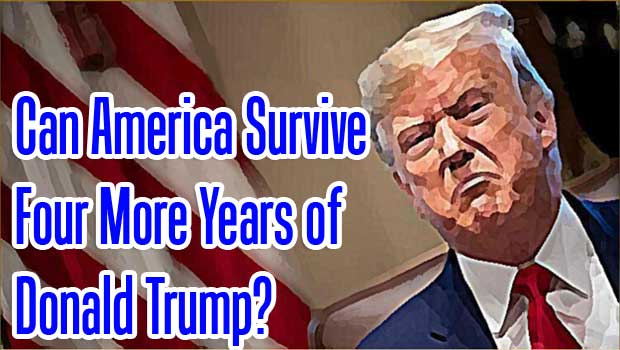
    At this critical juncture in United States and world history, the question must be asked, “Can America survive four more years of Donald J. Trump?” The reflex response to this question by millions of Americans is an emphatic “No!” But, if we fail to understand, as expressed by Dr. Martin Luther King, Jr., “the urgency of now,” then we will have to endure four more agonizing years of a dangerous decline in American society. We must vote and make sure our family members and friends vote so that our voices are heard, loud and clear.

    Trump Is a Useful Tool for the Exploiters

    We are living in a time in which social justice warriors want to cancel anyone in the past who didn’t live up to the standards of today. Taking into account that history is moment after moment and era after era of humans as “products of their times,” we don’t need to go around canceling America’s history. Having said that, we must acknowledge that it is way past due to reckon with its flaws, and to realize that the U.S. is a mixed bag of good and bad like most nations and individuals. It remains the case that in many ways, the American core failure rests on the two pillars of exploitation and racism. From the beginning of American history (and human history), the poor have been exploited by the rich. The U.S. was built upon the back of chattel slavery while land and natural resources of Native Americans were expropriated by White settler colonists. America tolerated racially based convict leasing until 1908, and even today, those who are incarcerated are forced to work for virtually nothing in prison industries that are contracted with major corporations. Our American history includes exploitation of poor White coal miners by coal barons…Chinese railroad workers, migrant farm workers, “essential workers” today during a deadly pandemic, all have been exploited by the “owners,” the super-rich. The perpetuation of this system of exploitation by the moneyed elite is supported by both sides of the aisle even though their political theater wants us to believe otherwise.

    Trump is a useful tool of the deep-pocketed ruling elite of which he is a part. But he is a replaceable cog in the American political machine. There are thousands like him waiting to assume the mantel of leadership while ignoring the common good and defying the Ultimate Lawgiver.

    Turning the Mirror Toward Ourselves

    The responsibility to stand for justice is a divinely mandated responsibility for the head of every political, economic, and social organization and group, as well as the responsibility of every individual in his or her own life. We must enjoin right conduct and forbid wrong conduct consistently and with conviction. Four more years of Donald Trump as president will be disastrous for everyone except the exploiters among us. However, a good practice is to also turn the mirror toward ourselves and search our own hearts. The great scholar Ibn Qayyim wrote in Miftah Dar As-Sa’adah: “Ponder upon the wisdom of Allah where He has made people’s kings, leaders, and those of authority over them of the same kind as their own deeds. It is as if the people’s deeds appeared in the forms of their kings and leaders.”

    The point is that we must be the change that we wish to see in the world. “Indeed, Allah will not change the condition of a people until they change what is in themselves” (Qur’an – 13:11).

  • Unity and Activism under a Trump Presidency: The Need of Our Times

    Unity and Activism under a Trump Presidency: The Need of Our Times

    On a rainy January 20, 2017 Donald J. Trump became the president of the United States after winning the Electoral College and losing the popular vote by over three million. The pomp and ceremony, military and police presence, even the somberness of the day lacked the celebration of at least the previous two inaugurations. The twitter-verse remarked that the “sky was crying” and dissent filled the air blocks away amid a wide range of socially disparate individuals from Muslims, immigrants, blacks, Latinos, and gays, to whites who blocked roads and held bold signs demanding impeachment and likening Trump to Hitler. With a nation politically divided along many fissures that have been growing over the past several decades, Muslims also found themselves separated along similar lines. Muslim Republicans, Democrats, and Independents voted their conscience and helped usher in one of the most divisive administrations America has ever seen. Economic concerns and social issues like illegal immigration, abortion, and gay marriage were uppermost in the minds of conservative Muslim voters. Most Muslim voters were concerned about eroding civil liberties, continued wars, and America’s foreign policies.

    Unity is a necessary goal, but not easy to achieve. Muslim-led organizations need to work with other groups on a grassroots level. There is certainly strength in numbers and the many diverse organizations working toward the same over-arching goals can achieve much more than singular, non-allied groups.

    The inauguration was a historic moment in many ways, the least of which was the visibly low turnout of spectators which Trump, in narcissistic fashion, continued to rail against in his early morning twitter rants. Nothing could stop the juggernaut ascension of Trump to the highest office in the land. The fervent wishes and voting choice of the majority of Americans got swallowed up by the Electoral College system, and the prayers of believers did not change the course that America has been set upon, for good or ill. What then is left in the repertoire of activists as they prepare for the coming years of a presidency run by an ill-equipped, self-obsessed, money-hungry, politically clumsy elitist, along with his chief strategist, Steve Bannon, a white nationalist, White House Chief of Staff Reince Preibus and Vice President Mike Pence, both right-wing powerhouses. Rule by oligarchs, corporate corruption, criminal war-making, oppression and occupation, and layers of disinformation — these all exist in the world today, but it can get so much worse. However dire the future looks, fear and hopelessness must be displaced by courage and conviction in hearts and minds of those aligned against this new world order.

    The Role Muslims Can Play

    For Muslims, particularly, it is a matter of faith. We should fear only Allah since we know that all things happen according to His will and plan. So we make our choices day to day, and determine to the best of our ability the course we are going to follow. We then leave the rest up to Allah (SWT). What remains then is how Muslims participate in this new political reality. Representation in government at the local, state, and federal levels, of Muslims and their concerns, is still limited but slowly increasing. In the fledgling Somali voting block of Minneapolis, Minnesota they elected the first Somali woman to state office. As more Muslim American state representatives continue to be elected, some of them will find themselves in national positions within the next ten years. The primary concern now is how to represent Islam in its totality, from its politics to its social ideals, and to advocate for Muslims. Imam Omar Suleiman, President of the Yaqeen Institute for Islamic Research, summed up in a speech at the ICNA/MAS convention in December, 2016 what the Muslim activist position should be: “If we allow fear to drive us to continue to do away with notions of our faith that others find problematic because of their ignorance and because of their racism and their bigotry, rather than standing boldly and explaining and defining those concepts and showing them in motion and in action and how they contribute to the betterment of society then we will slowly see our identity disappear.” He went on to say that Islam “should be in motion” as an active religion that betters all societies. Sometimes that means dissent within the confines of a unified front.

    Never has there been a more urgent time to stand tall and firm in speaking about Islam and countering all misrepresentations of the faith. Steve Bannon is an avowed Islamophobe with a belief in a coming apocalyptic battle between the Judeo-Christian world and Islam. And Jared Kushner, Trump’s son-in-law, is now senior advisor to the president. He is also purportedly being considered for the role of peace broker between Israel and the Palestinians, while his family has donated tens of thousands of dollars to illegal West Bank settlements, according to their tax forms. A negative perception of Islam is at the heart of this administration’s immigration and foreign policy agendas. It matters little to these ideologues in power how high American flags fly at Islamic centers, how often Muslims leaders and organizations condemn terror, or how often public officials are welcomed to address Muslim community and masjid events.
    ‘Get Up, Stand Up, Don’t Give Up the Fight’

    It is understandable that many Americans are worried, but we must maintain a long view and broad perspective. Allah (SWT) tells us in the Quran, “And obey Allah and His Messenger, and do not dispute and [thus] lose courage and [then] your strength would depart; and be patient. Indeed, Allah is with the patient” (Quran 8:46). Already there is some light shining in the politically divisive gloom — an unintended consequence of the new future with Trump is that a robust and growing opposition has risen against him and his absolutist, autocratic inner circle. Uniting to push back against hate, against division, is a myriad of groups who are protesting, filing legal actions, and vowing to keep America the land of diversity and tolerance.

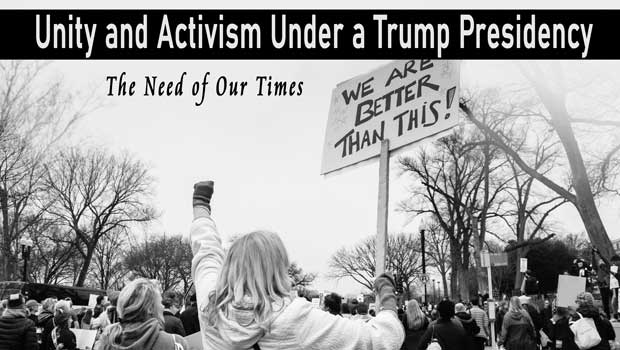
    Trump has become the symbol of both ultra-right zealotry and crass, profit-driven opportunism. Organizations and individuals working towards social and racial justice, immigration and migrant rights, national universal health care, women’s reproductive rights, and environmental protections have naturally and spontaneously united against the threat to our civil liberties and even our survival. The “Stop Trump” mantra speaks of a fragile unity, organic, without structure. It is reactive rather than a deeply entrenched, planned revolt. Yet, it took hold. The tiny spark of unified dissent was launched the day after the inauguration as the Women’s March took place across major cities in America and in several countries abroad as well, collectively numbering in the millions. An estimated 650,000 to over one million women and men took to the streets of Washington D.C. The signs held aloft on that day spoke eloquently of the fervor protestors felt: Get up, stand up, don’t give up the fight; We are better than this; Another world is possible; Babies against bigots; No white supremacists in the White House; Senate, have a spine, block Trump’s cabinet of horrors; Billionaires in the swamp; Muslim rights are human rights; Jews & Muslims stronger together; Refugees welcome; United we stand, divided we fall; No human being is illegal; Hate is un-American; Hatred’s greatest weapon is complacency.

    The march in Washington was co-organized by a young Palestinian-American Muslim woman, Linda Sarsour. You may be a social conservative and have an issue with Sarsour aligning herself with Planned Parenthood and various LGBTQ groups for the march, but we cannot deny the political impact that such an historic event had and will continue to have. Protests are the matchstick that sets a movement on fire. “It’s more than just a release for anger – taking to the streets is a necessary way to participate in democracy” notes Sarah Jaffe, a writer for Rolling Stone magazine. But without direction, a movement can fizzle out and disappear from the front pages or evening news as new distractions emerge, or it can organize and grow so as to significantly impact the political reality. So what comes after the euphoria of speeches, the camaraderie of protest, the zeal and fervor for change?

    For now, the motivation to continue standing up and being counted is strong, as Trump has been busy signing controversial executive orders and pushing through divisive cabinet appointments. In his first week he signed orders to gut major provisions of the Affordable Care Act, expedite infrastructure projects through environmental and business-related deregulations, build a 1,900-mile long wall, deport undocumented immigrants, and impose a travel ban against seven Muslim-majority countries. He also green-lighted the Keystone and Dakota Access Pipelines, the latter being close to Standing Rock Sioux tribal lands in North Dakota, threatening their sources of water.

    Jeremi Suri, in The Atlantic, warns, “With his barrage of executive orders, Trump is taking America back to the historical nightmares of the world before December 1941: closed borders, limited trade, intolerance to diversity, arms races, and a go-it-alone national race to the bottom. His executive order on ‘rebuilding the U.S. armed forces’ calls for ‘peace through strength,’ but this document and the others he signed offer nothing but unilateralism and militarization: more military spending, more nuclear weapons, more use of torture (which is illegal), and more promises to destroy ISIS and other terrorist threats. The executive orders promise to curtail American participation in international organizations, prohibit whole categories of foreigners from entering our country, and limit exchanges of ideas and goods.” David Leonhardt, writing in the New York Times, points out that countering Trump initiatives will demand a sustained effort. “If progressives want to have an effect — if they want to defend civil rights, protect the environment and keep millions of people from losing health insurance, among other things — the hard work hasn’t even begun.”

    Protests as Well as Political Participation

    People spontaneously took to the streets and airports to protest the most immediately executed of the executive orders — a ban on refugees and travelers on the basis of protecting American borders. Muslims were not at the forefront of those protests, but at the heart of it. Ordinary Americans, from all walks of life, came out to protest the discriminatory action against Muslims. When protests are needed for Mexicans facing deportation, native Americans protecting the land and vital resources, blacks losing more voting rights and facing increased police brutality, will Muslims stand and march and protest with them?

    Protests are imperative, but so is political participation. As David Brooks of the NYT put it, “Change happens when people run for office, amass coalitions of interest groups, engage in the messy practice of politics.” Organizations and even cities have filed lawsuits, including the Council for American-Islamic Affairs (CAIR) and the ACLU. In a February, 2017 article in Glamour magazine, Linda Sarsour summed up the immediate needs of activists at least until the midterm elections in 2018: “We need to translate the emotions and the frustrations right now, and the fear that people have right now, into massive polls numbers to win back the House of Representatives. Right now there are no checks and balances. We need to get control back of at least one branch of government.”

    Unity is a necessary goal, but not easy to achieve. Muslim-led organizations need to work with other groups on a grassroots level. There is certainly strength in numbers and the many diverse organizations working toward the same over-arching goals can achieve much more than singular, non-allied groups. Together, individuals and groups can support and inspire one another. Just remember the messages of the grass-roots demonstrators, holding high their heads and their ideals…and their signs, declaring that we must not give up; that as Americans we are better than this, and that another world, a better world, is possible. They said it, and it is true, that united we stand, divided we fall. As to hatred, bigotry, discrimination, and worship of profits over people — the greatest weapon of demagogues and vulgar profiteers is the complacency of people. To quote Omar Suleiman once again, “Now is the time dear brothers and sisters, now more than ever to stand up and to define ourselves, to show our Islam in motion, to stand with the oppressed and the vulnerable.”