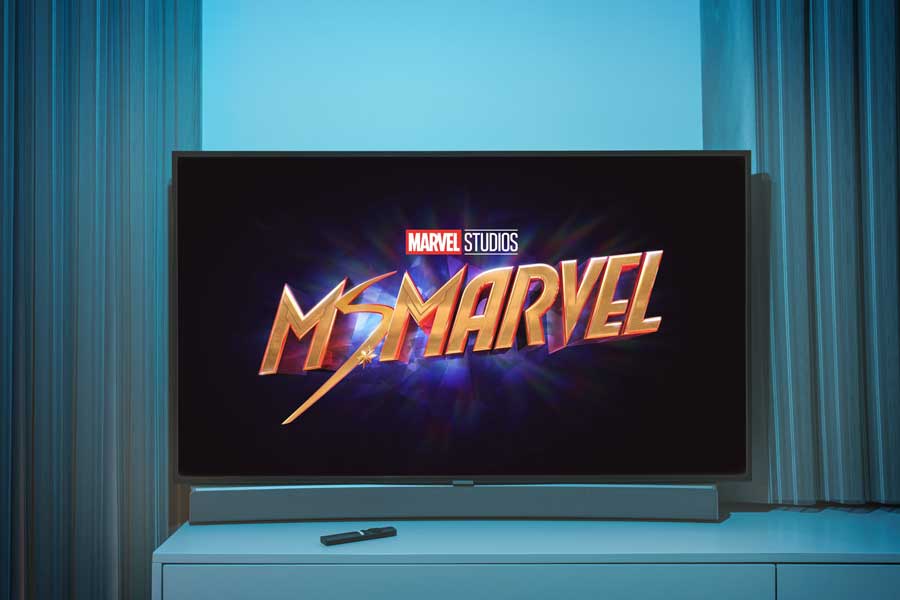
Credit: Marvel and Disney+
In recent years, The Walt Disney Corporation has been under scrutiny for their policies on diversity and inclusion. According to their new initiative, “Reimagine Tomorrow,” Disney is doing everything in its power to fight back against what they call systemic racism by “amplifying underrepresented voices and untold stories as well as championing the importance of accurate representation in media and entertainment.” Since they acquired Marvel Entertainment in 2009, this vision has extended into the Marvel Cinematic Universe (MCU), which generates billions of dollars from their superhero comic-inspired films. Disney and Marvel’s latest venture into its multiverse of inclusivity is the Muslim superhero, Ms. Marvel, also known as Kamala Khan. With a hit series on the streaming service Disney+ and a starring role in the upcoming movie, The Marvels, diehard MCU fans will be seeing much more of this Muslim character.
From June 8 – July 13, 2022, the six-episode miniseries, Ms. Marvel, created by Bisha K. Ali, was released on Disney+. The story is about a Pakistani-American Muslim teen from New Jersey named Kamala Khan, who gains unusual superpowers from a mysterious bangle she receives as a gift from back home. The story is set in the MCU, where supervillains and superheroes like the Avengers, who have prevented countless human catastrophes, collide. Kamala, a diehard fan of the Avengers, especially cosmic super woman Captain Marvel, is thrilled to gain powers of her own, because as she says, “Let’s be honest, it’s not really the brown girls from Jersey City who save the world.” As young Kamala struggles to adapt to her new abilities, a series of accidents transpire, and a group of shadowy strangers appear. Eventually, she faces off with her new adversaries and gains allies in her transition to becoming Ms. Marvel.
In many ways, Ms. Marvel represents Muslim women’s empowerment, but as the famous quote from Marvel Comic’s Spiderman says, “with great power comes great responsibility.” Did the entertainment giants, Disney and Marvel, succeed in representing what it really means to be a Muslim in the U.S. while staying true to Islamic values and authenticity? Does Kamala Khan live up to the expectations of Muslims eager to finally see themselves on the big screen in a positive light – as the hero instead of the villain?
Answers to those questions may vary depending on who is speaking on the issue – the general audience, the producers and show writers, the actors, and groups within the Islamic community. Many Muslims were involved in all the aspects of creating Ms. Marvel. Azhar Usman, a comedian, devout Muslim, and actor, who starred in the show, said to Aljazeera, “Whatever authenticity people are able to feel in the show really has its origin in the authenticity of the writers, producers, and the original creative team that took incredible pains to make sure that every detail was indeed authentic. (They) were indeed attempting to do justice to what is ultimately a very nuanced experience – being a Muslim in the United States.” What is certain is that Ms. Marvel is unlike anything anyone has ever seen and the first Muslim superhero in a major series or film.
Watching Ms. Marvel from a Muslim’s perspective is one thing but being on set while the show was being filmed is another. That was the experience of Siri M. Carrion, an Afro Latina Muslim fashion designer and founder of ALMA – the Asociación Latina Musulmana de Atlanta or the Atlanta Latino Muslim Association. As a fashion consultant on the Ms. Marvel set, she had firsthand experience about what it takes to bring Muslim authenticity to television.
Here is what Siri M. Carrion had to say about her role in Ms. Marvel:
Q. What is your background and what do you do?
A. I am a fashion designer – I have a modest-wear fashion company, Siri2Siri (www.siri2siri.com), and I design and manufacture my own clothing line. I also run an alteration service for medical grade compression garments for post op clients. I am also COO and freight broker for a Muslim broker company called Halal Freight, LLC.
I was born and raised in Sacramento, CA. My father’s side of the family is from Puerto Rico and my mother’s side of the family is from Texas and Oklahoma. I am the oldest of four siblings. I am a single mom and I have five children, three are adults and two are in high school. I also have two grandchildren.
Q. What role does Islam play in your life?
A. Alhamdulillah, I was born and raised as a Muslim. My family converted to Islam before I was born, around the 1960s through the Nation of Islam. Later, after Elijah Muhammad’s death, we migrated over to Sunni Islam. Even though I was born Muslim, I really did not start practicing Islam until I was in my 20s. Up until then Islam was just a religion and not a way of life. I was going through the motions because my abuela (grandmother) said this is what we need to do. I really did not understand the purpose of praying and the purpose of wearing a hijab. As I grew up, I began reading the Qur’an and participating in sisters-only halaqa circles. I began to establish my connection to Allah. When I got married and became pregnant with my first born, I covered full time and had a whole life shift. My connection to Allah became stronger and now Islam guides me on my daily journey in life and business. It is definitely the center of my moral compass.
Q. How and when did you first hear about Ms. Marvel?
A. I heard of Ms. Marvel about 2 years ago, during the Covid-19 pandemic. A friend of mine within the Muslim community reached out and told me a consulting firm was looking for a local Muslim woman to help on set. She could not do it and passed on the opportunity to me. Earlier in the year. I had told myself that this was the year of YES – I had to say yes to everything, so I said yes, not realizing what I was saying YES to.
The consulting firm reached out to me and gave me a quick synopsis of what was needed, and I had to sign an NDA before they could give me any more details. Once I signed the NDA and they disclosed the name of the series, I was just amazed that this opportunity landed in my lap.
I quickly got on the internet and started to do some research. I am not a huge comic book fan, so I had no idea who Ms. Marvel was. However, that all changed very quickly! As I conducted my research, I quickly learned that Ms. Marvel is the first Muslimah superhero and that there was a recent relaunch of the title. I was super excited to be a part of this series.
Q. What has been your involvement in the production of Ms. Marvel?
A. I was brought on as a Hijab Consultant. My job was to assist the hair and makeup team on how to properly wrap hijab and to make sure the hijab was culturally appropriate. As I prepared myself to arrive on set, I made my intention to be as open and honest as possible when presented with questions about hijab and Islam.
When I came on board, the hijab styles were already in place according to each scene. The team had some difficulties in wrapping certain styles and how to pin the hijab correctly. I was there to assist the team in navigating this process. As we spoke about the various styles and how to recreate them, I tried to make the team feel comfortable and tell them stories on how I began wearing hijab and how I create and personalize my style. It was all surreal and an awesome opportunity to give dawah.
I remember one time on set, the hair team was preparing the character, Nakia, played by actress Yasmeen Fletcher, for a reshoot of a scene and they had to recreate the original hijab style. It was a simple style -—the hijab pin is placed under the neck and then the scarf is wrapped over the head. The hairstylist was very anxious about wrapping, and I told her, “Girl, just wrap it! You know, like this.” She was so nervous that I wrapped it for her so she could see how it is done. That night I realized that I take wearing my hijab for granted, never thinking about how complicated it can be for someone who does not wear it, even to wrap a simple style. It also made me think of those new converts coming to Islam and choosing to wear hijab and how very difficult it must be to stand in front of the mirror and don a hijab for the first time.
It was a very humbling experience and a great educational opportunity. I encouraged everyone on set to ask me questions about Islam and hijab, realizing that most of them had probably never met a Muslim in their entire lives. I had someone actually tell me that, and I was honored and grateful. Hopefully I was able to also shatter some myths they may have had about Islam. For instance, a lot of people just assumed that Muslim women wear the hijab inside our homes, as well. They think we never take it off. My response to them was, “The hijab is the first thing that comes off when we walk into our homes!” It felt great to have these open, unapologetic conversations about hijab and Islam.
Q. Have you seen Ms. Marvel?
A. Since I like to binge watch my tv shows, I waited for a couple of weeks until all episodes were streaming on Disney+. I have to say the whole series was fantastic. The cinematography was great. Ms. Marvel’s powers were awesome. (The creators) touched upon the history of Islam in India and Pakistan and the Partition, which is something most Americans did not learn in history class. I really appreciated how they gave the audience a glimpse of how Muslims live their daily lives within their homes and outside of their homes.
Q. What was your favorite part of the series?
A. I was impressed with the whole series – the music, the costumes, the art. I was most impressed with the wedding scene. It was exciting to see a man from a Desi background [those from the Indian subcontinent and their diaspora] marry an African American Muslim sister. It was as if the scene was created to show the Muslim ummah that the racism part of Muslim culture is dead. This is what true Islam looks like, embracing and thriving within each other’s culture, all the while worshiping Allah and giving thanks for finding a wonderful spouse.
Q. Do you think Islam was well represented?
A. I think Islam was well represented both from a cultural point of view and an Islamic point of view. As Muslims, we are all on different levels of our spiritual journey. The characters touched upon struggles we have encountered in our lives. Wearing hijab is a major struggle for many Muslimahs and having two main characters discuss this struggle on a major tv show is huge.
I would love to have seen more character development for Black Indigenous People of Color (BIPOC) characters. I believe in imagery. It is powerful to see black and brown superheroes on tv and in the movies. Characters that look like me and talk like me. Even though I felt like the series was relatable. As an Afro-Latina, I was looking for that Muslimah who spoke Spanish. I was looking for some hint of me, mi gente (my people) within the series.
Q. Do you think Ms. Marvel is a good role model for Muslim girls?
A. I think Ms. Marvel is a relatable role model for Muslim girls. Kids nowadays have to navigate through so many obstacles that they may not have the opportunity to explore their identity as Muslims. At times, society has already told them who they are supposed to be. I hope that young Muslimahs will look at Ms. Marvel as a source of inspiration and believe that they do not have to give up their Islamic identity to be successful. I feel Ms. Marvel has opened the door for more representation.
Q. What character did you relate to most in the series?
A. The character I related to most was Nakia. She is a young lady navigating life as a full time hijabi. Growing up, I was her; it was a struggle for me to find my identity as a hijabi and to feel good about myself when covered. It is a lifelong struggle. As we get older and work through life’s challenges, we tend to question who we are as a person and what is our purpose in life. Depending on the challenges, many women decide not to wear hijab. So, I could totally relate to Nakia’s struggle of wearing hijab and to be seen as someone who is more than just a covered pretty face.
Read more about Siri Carrion on social media: IG: @Siri2Siri; @MusulmanaYAfrolatina