

بسم الله الرحمن الرحيم

Tag: Muslim American

  • Black History Month:  Redlining and Public-School Segregation

    Black History Month: Redlining and Public-School Segregation

    It’s February, and that means it’s Black history month in the U.S. While big and small businesses alike attempt to turn this important month into a marketing campaign to attract new customers, the month remains an important one for all those in America who recognize the injustices that have befallen Black Americans.

    Since the death of George Floyd, there has been an increased effort within the Muslim community to pay attention to the current oppression against Black communities. However, more can and must be done to further develop a consciousness about their struggles. By diving deep into the history of policies and laws that have hindered Black Americans, we can be better prepared to prevent further injustices.

    Two such important topics are redlining and segregation in public schools. The first hindered Black Americans’ ability to own homes and the second to receive a good education. Why are these significant? Because the ability to own property and have a quality education are fundamental to ensuring generational wealth.

    Redlining

    In 1933, the federal government created the Home Owners’ Loan Corporation (HOLC) as part of the New Deal. Under the leadership of President Franklin D. Roosevelt, the HOLC was intended to refinance home mortgages under default to prevent foreclosure and to expand home buying opportunities for Americans. The HOLC placed neighborhoods into categories based on a number of factors such as age and quality of construction of the homes, availability of infrastructure such as transportation, amenities such as parks, and especially based on their racial makeup. The different categories were color coded on maps for every metropolitan area in the country. The areas marked in red (hence redlining) were considered high risk for mortgage lenders. These areas were anywhere that African Americans lived or lived nearby.

    The logic of the Federal Housing Administration, which was founded on zero research, was premised on the idea that if African Americans and other communities of color bought homes in those suburbs, or even near those suburbs, the value of homes owned by Whites would decline, and therefore those loans would be at risk. Richard Rothstein’s book, The Color of Law, according to an NPR article, educates the public about specific segregationist policies outlined in federal handbooks like the Underwriting Manual of the Federal Housing Administration. The article notes that Rothstein points out that regulations that are written policy and published in government publications like the Underwriting Manual “are as much a de jure [e.g., legally recognized] ( . . . ) expression of government policy,” even if it is unconstitutional, “as something written in law.”

    The U.S. government today acknowledges the harm done to Black communities by such policies. The Federal Register, a federal government journal, notes that “The creation of the Interstate Highway System, funded and constructed by the Federal Government and State governments in the 20th century, disproportionately burdened many historically Black and low-income neighborhoods in many American cities. Many urban interstate highways were deliberately built to pass through Black neighborhoods, often requiring the destruction of housing and other local institutions. To this day, many Black neighborhoods are disconnected from access to high-quality housing, jobs, public transit, and other resources.” In some cases, highways were designed to separate Black neighborhoods from White neighborhoods.

    The 1968 Civil Rights Act included Title VIII and Title IX, known as the Fair Housing Act, which prohibited discrimination in the selling, renting, or financing of housing because of race, color, national origin, religion, sex, (and later amended to include) family status, or disability. While the Fair Housing Act of 1968 modestly addressed future discriminatory practices, it could not undo decades of discrimination that resulted in vast disparities of home ownership and the building of wealth by Blacks, as compared to Whites.

    In October 2021, the Department of Justice announced a new initiative to combat redlining. In their press release, they not only admitted that it was their previous policy to deny credit to communities of color, but that they were going to engage in new initiatives to “ensure that federal fair lending laws are vigorously enforced and that financial institutions provide equal opportunity for every American to obtain credit.”

    Public School Segregation

    The effects of redlining not only prevented many African American families from owning homes, building wealth through home equity, and passing that ownership and wealth on to their children, but it also impacted where their children were able to go to school.

    Due to Jim Crow segregation laws, Black children attended Black schools and White children attended White schools. With the Civil Rights era came a wave of Supreme court cases that cut against segregationist laws. One such monumental case was Brown v. Board of Education of Topeka (1954). There, the U.S Supreme Court ruled that racial segregation in public schools violated the Fourteenth Amendment. While this was a massive success in the battle for racial equality, it was resisted by the South which wanted to maintain school segregation. In instances like the famous case of the Little Rock Nine, where nine Black high school students attempted to enroll in an all-White high school, they faced mobs and death threats. Most Southern schools developed plans to delay or deny implementation of desegregation even though it was federally mandated.

    Although, there were subsequent orders from the Supreme Court in Brown II that directed states to take “deliberate speed” when implementing desegregation policies, most children still attended segregated schools in 1964. The federal government used funding incentives to get schools to move quickly on desegregation. However, the biggest obstacle was in moving children in urban areas to the suburbs where the White schools were. The majority of Black children had to be bused to attend those schools. This often meant leaving their home very early in the morning to attend school sometimes twenty or more miles from home. In those new schools, children often faced racism from both their fellow students and teachers. It wasn’t only the Southern states that protested integration. Northern cities like Boston and Detroit had historic protests from White parents who didn’t want busing to occur.

    Today, we continue to see public school segregation. In a recent study released by the U.S Government Accountability Office (GAO), more than a third of students (about 18.5 million) attended a predominantly same-race/ethnicity school during the 2020-21 year. Furthermore, 14% of students attended schools where almost all of the student body was of a single race/ethnicity. The studies also show that the lack of diversity means the Black and Brown children are more likely to attend under-funded schools.

    We can see the intersection of redlining and school segregation, and the resulting wealth gap and educational achievement gap between Black and White students. Yet, there are ways to address underfunded schools and some states are doing so.

    Funding for public schools in a district come from property taxes, as well as state and federal contributions. Since more affluent school districts receive more funding from property taxes than do lower income districts, the only way to level the playing field is to allocate more state and federal monies to low-income districts than to those with greater funding from property taxes. A number of states have already implemented this strategy including Utah, Ohio, South Dakota, Georgia, and others, and they have seen increases in students’ academic achievement. These reforms target not just greater funding for economically disadvantaged students, it also invests in the ongoing acquisition of knowledge and development of skills of the teachers, and greater funding for early childhood education. Other states such as Massachusetts, Minnesota, and New Jersey “have undertaken reforms based on these practices and, in turn, have narrowed achievement gaps.”

    Conclusion

    Redlining and school segregation have had lasting impacts on how Black people were and are able to succeed in this country. The systematic tactics to prevent them from owning their own home in the suburbs not only contributed to ongoing segregation, but they also impacted their children’s ability to get a good education in properly funded schools.

    I believe it’s important to learn more about these and other discriminatory policies so that we can better support Black communities. In addition, we must understand the past injustices, so we don’t allow the same types of wrongs to repeat themselves in the future. Muslims should look towards the well-known hadith for inspiration on what to do when they see an injustice: The Messenger of Allah said, “Whosoever of you sees an evil, let him change it with his hand; and if he is not able to do so, then with his tongue; and if he is not able to do so, then with his heart — and that is the weakest of faith” (Muslim). Following the footsteps of our beloved Prophet (s), we must do our best to take action by arming ourselves with knowledge on important history. This is how we can begin to effect change.
  • Political Evolution of Muslim Americans: An Historical Perspective

    Political Evolution of Muslim Americans: An Historical Perspective

    Sustained European contact with Muslims goes back at least to the late 7th and early 8th centuries when in 711 CE, Tarik ibn Ziyad, the Berber-appointed governor of Morocco, led a Muslim army across the Straits of Gibraltar (Jabal al Tarik) and defeated the Visigoth forces in Spain, liberating the persecuted Jewish and Christian populations under their rule. Muslims then ruled southern Spain, Al Andalus, for approximately 800 years, establishing a period of enlightenment often referred to as the Golden Age of Islam. A reign of terror against Muslims and Jews started in 1492 after King Ferdinand II of Aragon and Queen Isabella I of Castille, the Catholic monarchs of Spain, conquered Granada, the last Muslim stronghold in Al-Andalus. Jews were forcibly expelled from Spain and many North African Muslim countries accepted these religious refugees. Jews and Muslims remaining in Spain were forced to accept Christianity or be killed. Muslims were ultimately expelled from Spain in 1608.

    The Ottoman Empire conquered the Balkans consisting of Bulgaria, Greece, Hungary, and Macedonia, during a process that started in 1362 and continued for approximately the next 100 years. The four North African countries of Morocco, Algiers, Tunis, and Tripoli were also a part of the Ottoman empire and constituted what was known as the Barbary States. Under the unofficial protection of the heads of respective territories, the Barbary States would enrich their coffers through pirating commercial ships from other countries, often kidnapping foreign sailors and passengers for ransom. These seafaring marauders were infamously referred to as the Barbary Pirates. The maritime trade and travel of European nations were severely hampered by the threat of being robbed of their goods and their crew being ransomed or sold into slavery in North Africa or other parts of the Ottoman Empire. This slave trade resulted in many hundreds of thousands of Europeans being enslaved in North Africa. This phenomenon was a motivating factor in the late 15th century for Spanish monarchs Ferdinand and Isabella to finance the voyages of Christopher Columbus to identify other sources of wealth and to find new, more secure, trade routes to the lucrative markets of India and the Far East so as to avoid the threat of pirates. In 1492, Columbus set foot in the Americas.

    Thirteen Colonies and Its Immigrants

    The first British colony was established in the “New World” in 1607. By the late 1700s, thirteen colonies had been established. They declared their independence from Britain in 1776 and fought the British in the American Revolutionary War. The American colonies won the war and a treaty was signed in 1783. The first head of state to recognize the newly-established government of the United States was Muhammad III, the Sultan of Muslim Morocco. Muhammad III signed the Moroccan-American Treaty of Friendship in 1777, recognizing the sovereignty of the United States and affording safe passage and open ports to American ships. Yet, the first overseas war fought by the young nation was fought from 1801 to 1805 against Muslims in the country of Tripoli. Tripoli had demanded that the U.S. pay a tribute for any ship sailing with the American flag. Thomas Jefferson, before being elected president in 1800, adamantly stated that he would refuse to pay a tribute to Tripoli. His position changed when the U.S.S. Philadelphia, carrying a number of then-current and former U.S. diplomats and valuable cargo was captured and $60,000 demanded as ransom for the seized vessel. Jefferson relented and the government paid the ransom for the release of its citizens.

    Today, Muslims in the United States continue to navigate a complicated relationship with the people and government of this country. Some of the earliest Muslims to arrive here were Africans who were sold into slavery and transported to early America. This is different from the Europeans who came here as immigrants fleeing grinding poverty or religious and political persecution, or the tens of thousands of British prisoners, for example, who were sent here as a way for England to get rid of their undesirable citizens. These convicts were sold as indentured servants in the colonies, with a specific number of years they were required to work before being granted their freedom. In contrast, those from the African continent were trapped in a mostly inescapable system of brutal generations-long chattel slavery. Although recent research has established that 30 percent or more of enslaved Africans in the United States were Muslims, the exact number is presently unquantifiable and may never be known.

    Demographics of Muslim American Citizens

    In Edward Curtis’ searing political analysis in his book “Muslim American Politics and the Future of US Democracy,” the author states, “From that time until the present, war-making in Muslim lands has been frequently interpreted by US policymakers and citizens alike as a struggle for liberty and freedom over and against what are said, in blatantly racist terms, to be Islam’s and Muslims’ tendencies towards despotism, ignorance, and fanaticism… US liberalism’s supposedly benevolent military intervention abroad, including in places where Muslims live, is essential to explaining why Muslim Americans are not offered full political and social citizenship in the United States.”

    From the inception of the United States to the present time, the population of Muslim Americans has been comprised of a significant number of immigrants and refugees, as is the case in other Western countries. Accurate census data about the number of Muslims in the United States is challenging to obtain, primarily because questions about religious preference are not included in the decennial (every ten years) U.S. census. Muslim American population estimates range from 3.45 million according to the latest Pew Research findings to 6-8 million, estimates from research institutions and other Muslim-sponsored surveys. The likelihood is that the more accurate figure lies somewhere in between.

    According to a 2017 Pew Research Study, U.S. Muslims concerned About Their Place in Society, But Continue to Believe in the American Dream, “Nearly six-in-ten U.S. Muslims are first-generation Americans, having been born in another country. Three-quarters of the U.S. Muslims are immigrants or the children of immigrants…the vast majority of Muslims living in the U.S. (82%) are American citizens, including 42% who were born in the U.S. and 40% who were born abroad but who have been naturalized.” African American Muslims are routinely estimated to make up 20-25 percent of the U.S. Muslim population.

    Fulfilling Citizenship Requirements

    The diverse racial, ethnic, geographical, and socio-economic profiles of U.S. Muslims preclude the simplistic stereotyping that, intentionally or not, serves to marginalize or typecast all members of this particular group. The third president, Thomas Jefferson, famously argued for the future citizenship and full participation in the electoral process of even “despised groups like Muslims,” a group whose existence in the U.S. at the time he failed to acknowledge or was unaware of. Former president Eisenhower, who cut the ribbon in 1957 to inaugurate what was then the largest mosque in the Western hemisphere — the Islamic Center in Washington, D.C. — like Obama, George W. Bush, and others in between, have, according to Curtis, “articulated the idea that Muslims, like other religious minorities, can become genuine Americans, especially if they serve in the US military and fight its ideological enemies.” From the Revolutionary War to the longest war in U.S. history in Afghanistan, Muslim Americans have fulfilled their citizenship requirements and more. American Muslims are arguably the most assimilated Muslims in all of the Western countries. Resistance to Muslim assimilation into American society is, to a large extent, the function of religious and racially-based prejudice on the part of the larger society rather than any legitimate reasons, any perceived deficiency or estrangement from American society on the part of the Muslim American community. A similar false notion was set forward after the end of chattel slavery in the U.S. when some asserted that Black culture was the cause for anti-Black racism and the failure of the newly emancipated population to be accepted in mainstream society. The similar phenomenon taking place today is that some people in the larger American community refuse to accept Muslims as equal citizens and insist on seeing Islam and Muslims as alien and a destructive force. Despite the fact that the majority of Muslims in the U.S. support and embrace the good that American society has to offer, a well-financed Islamophobic network flourishes in the U.S.

    The geographical diversity of Muslim Americans, hailing from numerous other countries, is unparalleled in any other nation’s population. Consequently, the mere fact that Muslim Americans may have family members in nations that the U.S. and its allies are at war with has provided justification for them to become targets of extrajudicial surveillance, arrest, and rendition. Additionally, when violent illegal acts are committed on American soil by Muslim foreign nationals, Muslims as an entire group come under suspicion. Acts of institutionalized discrimination and false labeling of Muslim Americans have erected additional barriers for Muslims to overcome in our longstanding efforts to become citizen partners in this land.

    The Opportunity to Serve

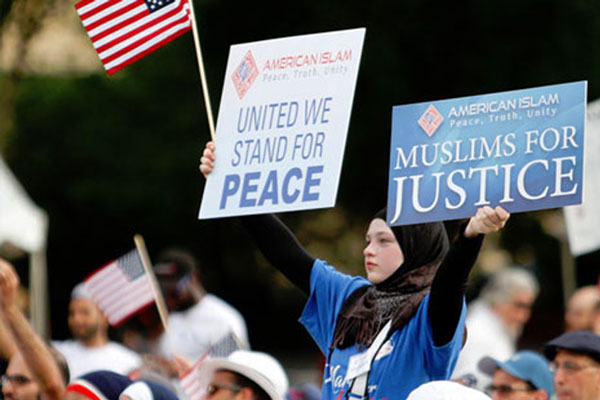
    However, the Muslim American community has, for the most part, rejected attempts by some within our ranks to self-identify as hapless victims rendered marginalized and hopeless because of Islamophobia. Within the last 13 years, the United States has seen the election of its first Muslim member of Congress, Keith Ellison, subsequently three other Muslims, Andre Carson, Ilhan Omer, and Rashida Tlaib, and a host of Muslim city council members, county commissioners, school board members, and other elected officials across the nation. While electing Muslims to public office should not be the ultimate achievement goal for Muslim Americans, it is a barometer of the capacity of the Muslim community to overcome Islamophobic discrimination and organized resistance to Muslims achieving full citizen rights and privileges and having the opportunity to serve the greater American society. Muslim Americans have embraced the divinely mandated responsibility to serve humanity through the efforts of multi-area social service operations, social justice initiatives, dawah (Islamic propagation efforts), and the display of exemplary moral character and conduct. Muslim Americans are a significant and valuable thread in this country’s diverse and beautiful social and political fabric. We pray that those who oppose or even detest that reality will come to realize that we are here to stay and to serve the common good.