
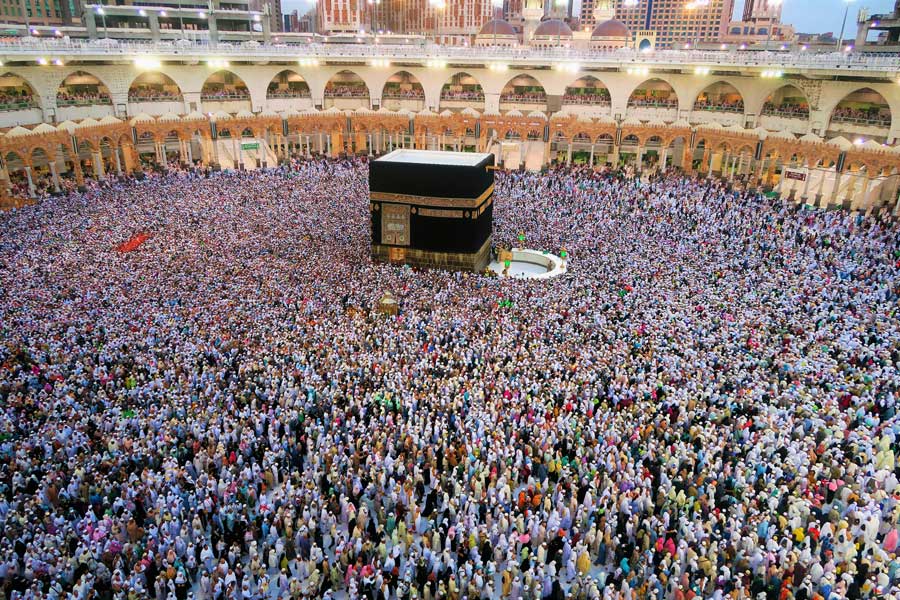
It is said you can never know what it feels like until you experience it for yourself. No number of words nor detailed descriptions can adequately portray the encounter. Likewise, no pictures, as professional and emotionally moving as they may be, can do justice to the actual human spectacle and religious landscape as witnessed by the eye. Nothing captures the literal likeness of what your senses feel, and it is said that the feeling is like no other. Every culture and era has written poignant poetry and transcribed hymns down generations, attempting to visualize a snapshot of what it is to visit this land.
Could it be anything other than this? For this land is most beloved to Him, Azza wa Jal (Mighty and Majestic) whom we love more than any other — it holds Baytu Allah, the House of Allah, for whom we would lay down our lives. Rasool Allah (sallallahu ‘alayhi wa sallam), the man whom we love more than ourselves and everything we hold dear, shed blessed tears of longing for the land when he looked towards it, even after having been persecuted there.
There is no city dearer to Allah and to Rasool Allah than this city. How could it be anything less than magnificent to us, His servants? The splendid sacredness of the land of the House of Allah transcends our earthly attempts at praise and honor.
It is so blessed, that the fragrance can be felt even from afar, yes felt, not just smelled. And all the senses weave together and heighten one another here, so your heart may skip a beat or your eye may shed a tear, just from a trace of the aroma. The mesmerizing chant of the adhan (call to prayer) reverberates through hills and mountains, through the bustling markets and grand hotel lobbies, and through the chambers of your heart and soul. You don’t just hear it; you feel its profound meaning, and you are motivated to establish salah and hurry to do so. You long to hear it between salah times, and that longing begins to ache when you leave the land. You then realize that this is the essence of prayer: This is actually how salah is to be established and treated. It should make us ponder deeply — do our rushed few minutes spent on salah, in between stressful meetings, performed while we’re out of breath because the time is almost gone, with our buzzing cell phones in our pockets, do justice to this most essential form of worship in the lives of Muslims? Does it have the effect it should on us and our lives when performed in that way? And yet, the Prophet told us, “The first action for which a servant of Allah will be held accountable on the Day of Resurrection will be his prayers…” (al-Tirmidhi).
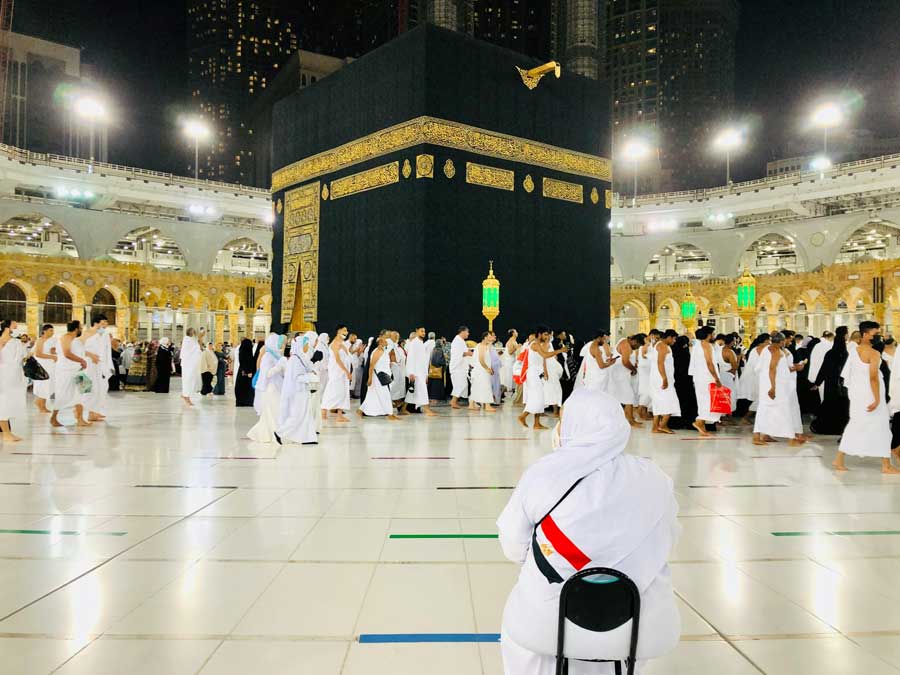 The city is so honorable that even glorifying it becomes an act of worship. The honor one gives it, and the sincerity in performing the rites and rituals within it, are tied to the level of piety in one’s heart. Could anything else explain how and why there is a consistent circling around the magnificent cube, the House of Allah, as if it were the heartbeat of the ummah, past, present and future. In the constant bustling Tawaf, the encircling round and round, how is it that one feels utter peace, and even with multitudes of other souls circling around with you, you feel completely alone with Him. It is as if you are the only one there. Why else would so many, more than two million souls last year, travel from across all the corners of the earth, leaving behind their lives, work, and families, some with great financial or health difficulty, to perform religious rituals and be a guest in His House? The pull to travel to this land and perform the rituals — the desire of each and every Muslim to do so— has not diminished in 1400-plus years and never will.
It is miraculous that nothing in the past one and half millennia lessened this great, burning desire of every single Muslim from every corner of every continent to glorify this city. He SWT has made glorifying this city one of the most honorable acts of worship, one by which a person draws close to Him. He says: “…And whoever honors the symbols of Allah — indeed, it is from the piety of hearts” (Qur’an 22:32).
There exists a piece of heaven in this land, an actual piece of the place we all dream about. The Black Stone is from that place we all aspire to ultimately attain through worship, goodness, and du’a. “A piece of heaven” is an endearing term used to evoke feelings of one’s intense love for a place, time, or object. This literally has it, the Black Stone given to Prophet Ibrahim, alaihi salam, from Jannah (Paradise). There is a rush to be in its presence more than any other spot in this Masjid al-Haram. The circumambulating intensifies at the corner where The Black Stone is set in the Ka’aba. There the prayers heighten in yearning.
Makkah, this land of the House of Allah, is the birthplace of the most beloved man throughout all history, the most revered and the most followed, the most studied and the one for whom we all, every one of the 1.8 billion of us, make durood (salutations) multiple times a day, every day. The one to whom we send peace and blessings upon every single time we hear his name. This city is the place where “the world’s most influential person” was raised. It neighbors the other beloved city, Madinah, the one which accepted our beloved in its comforting borders when he was emigrating there, away from persecution in Makkah. He came to love the city so much that whenever he approached it he would spur his horse to a gallop because of his love for the city (Bukhari). It holds the most revered spot after the Ka’aba: our beloved’s home and final resting place. These two cities, Makkah and Madinah, are so hallowed as they are the places where the Qur’an was revealed, a holy Book that is the most widely read, memorized, and studied book in the world.
Pivotal milestones — great numbers of individuals accepting Islam, battles, treaties, and final triumph — took place and taught us invaluable lessons in the two cities that shaped what Islam has become today. This is a land of hallowed grounds such as Mount Uhud, described by the Prophet as “… a mountain which loves us and which we love, it is upon the Gate of Heaven” (Bukhari).
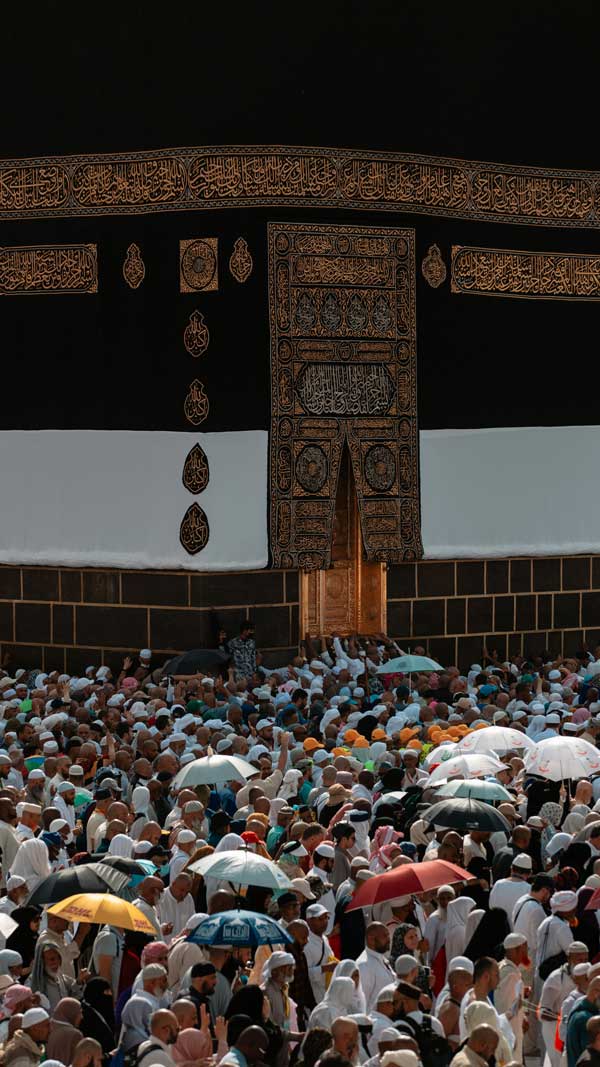 It is said when you arrive in the land of these two cities, you are transported in time and space to another spiritual realm. A transforming of your mindset occurs as it feels drawn to a higher power and feels the soul gravitating to its natural state. You find your life, and everything within it, playing like a film in your mind, the good and the bad, until you find meaning and purpose in it all. You depart this place of transformation secured to a new focal point, feeling spiritually charged. It is said when you leave this land, you leave a piece of your heart behind, each time, no matter how many times you may come. You receive what you didn’t even know you needed. You are comforted, connected to the realm of goodness, and uplifted. This is the land where you come because you love it and all that it signifies, only to realize you were invited here because you are, in fact, the one loved. Indeed, this is a place with a divine aura, so full yet so silent at the same time, where you can fully communicate with others without speaking a word of their languages. This land is blanketed in an indescribable peace. All this being said and much, much more…and you can only comprehend fully when you go.