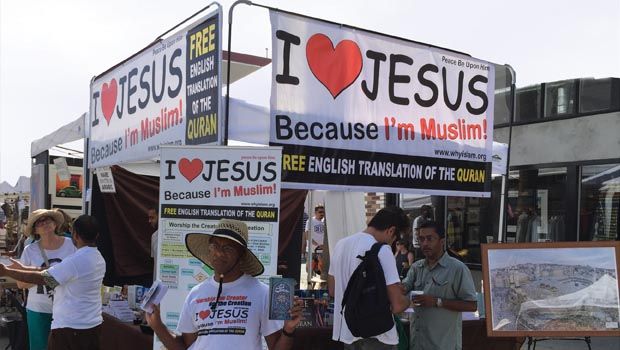
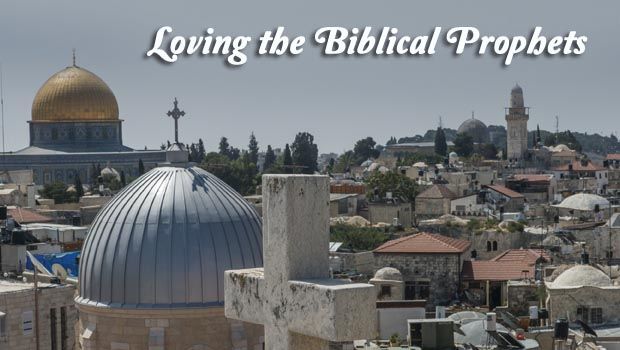
Loving the Biblical Prophets: Extending an Olive Branch to the People of the Book
Throughout time, religion and politics have fueled conflicts.The Crusades, the ethnic cleansing during the Bosnian War, and the decades-longPalestinian-Israeli crisis have shown how deep rooted the tensions can beamong Muslims, Christians, and Jews. Such strife,recurrent in history, leads one to wonder whether our three religious groups are fated to be at odds, or if thereis some common ground that can be the basis for reconciliation and understanding.
Establishing common ground is arguably not only possible but perhaps easier than we may realize, and begins with opening our eyes and first recognizing our common humanity. Being human unites us, yet also makes us fallible and, thus, prone to competitiveness and potential conflict. Even the angels anticipated future strife when God informed them of the creation of humankind in the Quran: “Behold, thy Lord said to the angels: ‘I will create a vicegerent on earth.’ They said,‘Wilt Thou place therein one who will make mischief and shed blood, whilst we do celebrate Thy praises and glorify Thy holy (name)?’ He said: ‘I know what ye know not.’” (Quran 2:30). Allah(SWT) had a divine plan in which human beings, given free will,could choose to live a life of worship and righteousness, as stated in the Quran: “I have created Jinn and humankind to worship me” (Quran 51:56 ).
Our Common Heritage—Beginning with the Prophet Adam
Prophet Adam was not only the first man created, he was also the first vicegerent of the earth and a prophet, and we are all the “children of Adam,” regardless of our race, religion or language. Adam was the first in a long line of prophets and messengers sent to specific peoples at specific times throughout history. The essence of their message – to worship God and live a pious life – is available in all of God’s holy books, in the Torah, the Gospels, and the Quran.
Allah says in the Quran, “Say:We believe in God, and in what has been revealed to us, and in what has been sent down to Abraham and Ismail and Isaac and Jacob and their offspring, and what has been revealed to Moses and Jesus and to all the prophets of our Lord. We make no distinction between them and we submit to Him and obey”(Quran 3:84).Loving the biblical prophets means also loving fellow man and recognizing that our commonalities far outweigh our differences. The goal here is to highlight and celebrate our common ties through our prophets, and to show how understanding the lessons and life examples of the prophets helps to build our love and admiration for them.
Love for All of God’s Prophets
Islam teaches Muslims to honor and respect all of God’s holy books and His prophets and messengers. In fact, out of love and respect, it is customary for Muslims to say, “peace and blessings be upon him” when mentioning or referring to any of God’s prophets. Muslims love and hold all of Allah’s prophets and messengers in high esteem because they were the best examples of human character,successfully enduring great trials, teaching unity, generosity, and justice. The Quran mentions 25 prophets—most of whom are also in the bible, though it is believed that there were thousands more prophets throughout time, each sent with the same mission: to bring humankind back to the path of monotheism and the worship of the one true God and Creator of the universe.
Monotheism:One God Despite the Differences
By definition, the three monotheistic religions of Islam, Judaism, and Christianity believe that there is one true God, the Creator of the universe. I am amazed, then, to hear some non-Muslim leaders proclaim, “I don’t worship the God of the Muslims.” Their implication is that Muslims worship a false god. The Islamic explanation of the differences among the religions is more tenable, and in point of fact, more respectful, suggesting that all prophets taught the same essential message (while taking into account the historical and cultural differences), but that over time each prophetic message was changed, by error or deliberate action. Thus, while there are differences today among the doctrines of the three monotheistic religions, Islam sees no room for declaring that either the Jews or the Christians worship a false god, but indeed that all three religions worship the same God and Creator of the universe.
One Creator withMany Names, Providing Universal Guidance
Cultures around the world refer to the Creator of the universe by various names. This does notchange the fact that He is the one true God. For example, in English He is called God, in French He is called Dieu, in Greek Theos, in Italian Dio, in German Gott, in Hebrew Elohim, in Spanish Dios, and in Arabic He is called Allah. It is important to note that even Christian Arabs refer to God as Allah. These various names are a necessary product of culturesand their varying languages. Through God’s books, messengers, and prophets, He conveyed His guidance to the various communities in their own languages. The records of the lives of the prophets, beginning with Prophet Adam, provide us wonderful life lessons, from which we can benefit immensely.
The story of Prophet Adam teaches usmuch about the universal meaning of human life and the weakness of human nature. It is through his story that we learn that life is a test, as God has endowed us with free will, but also that there arerewards for obedience and punishing consequences fordisobedience.Allah said to Adam,”O Adam! Dwell thou and thy wife in the Garden, and enjoy [its good things] as ye wish; but approach not this tree, or ye run into harm and transgression” (Quran 7:19).
It is also important to note, that through the trials of Adam and Eve, we learn the importance of repentance.Although they disobeyed God in the garden and were sent to earth to struggle and be further tested, they asked for and received forgiveness. Allah(SWT) says in the Quran,“Thereupon Adam received words [of guidance] from his Sustainer, and He accepted his repentance; for, verily, He alone is the Oft-Returning, the Dispenser of Grace” (2:37).
The Trials of Prophet Abraham—Acknowledging our Common Origins
Prophet Abraham is widely regarded as the father of Judaism, Christianity, and Islam. While we should not construe this statement as suggesting greater theological commonality among the three faiths than actually exits today, it is helpful to interfaith engagement and cooperation, and helps us peel back the layers of our common origin to find that we have more in common than we have differences. Prophet Abraham(pbuh) was a man who exhibited great obedience to the Creator. There are times in our own lives when we are tested with great trials and distress, but perhaps not to the degree of Prophet Abraham; he was not only told by God to sacrifice his son, but also to leave his wife and baby alone in a barren desert. The stories in the life of the Prophet Abraham (Ibrahim) teach us lessons of trust in our Creator, obedience, and patience.One of the significant events in the life of Prophet Abraham (pbuh) had to do with making the tough decision regarding his wife Hagar (Hajar), and their son. One day Prophet Abraham instructed his wife Hagar to bring their baby Ishmael (Ismail) and embark with him on a long journey to the middle of a barren valley in the Arabian Peninsula. After they arrived, Abraham prepared to leave his wife and baby alone in the desert with little food or water and began to walk away. Hagar was very alarmed by his actions and asked him if Allah(SWT) had instructed him to leave her, to which he answered“yes” and then he left.
Once Hagar’s food and drink ran out, shelaid down baby Ishmael and desperately ran between the two mountains of Safa and Marwa seven times searching for food or help. Prophet Muhammad (pbuh) said,”When she reached al-Marwa [for the last time]…she saw an angel at the place of Zamzam, digging the earth with his heel till water flowed from that place. She started to make something like a basin around it, using her hand in this way, and started filling her water skin with water with her hands and the water was flowing out.”Prophet Muhammad continued, “Then she drank water and suckled her child. The angel said to her, ‘Don’t be afraid of being neglected, for this is the House of Allah which will be built by this boy and his father, and Allah never neglects His people’” (Bukhari).The House of Allah referred to in the hadith is the Ka’bah, which is in Makkah, the holiest city for Muslims.
The Miracles of the Prophet Jesus
Jesus Christ was born to the Virgin Mary, and thus had no father. This was difficult for some people to believe and thus some began to think that perhaps Christ was the son of God, or a divine being himself. However, Prophet Adam had no mother or father, and yet he is considered a human being created by God, rather than a son of God. Allah(SWT) says in the Quran, The likeness of Jesus before Allah is that of Adam; He created him from dust, and then said to him,‘Be,’ and he was. (Quran 3:59)In addition, while still a baby, he defended his mother’s honor, as some of her people began calling her an unchaste woman. She pointed to her baby son, Jesus,in the cradle, and let him speak on her behalf–as Jesus is quoted in the Quran: “I am indeed a servant of Allah. He hath given me revelation and made me a prophet.And He hath made me blessed wherever I be, and hath enjoined on me prayer and charity as long as I live.[He] hath made me kind to my mother, and not overbearing or miserable.So peace is on me the day I was born, the day that I die, and the day that I shall be raised up to life [again]!” (Quran19: 30-33).
In addition, when Prophet Jesus was older, he could perform miracles like healing the sick, and raising the dead.According to the Quran, however, Jesus clearly stated that he was able to perform miracles only by Allah’s permission.The Quran states,”And Allah will teach him the Book and Wisdom, the Law and the Gospel; and [appoint him]a Messenger to the Children of Israel,[with this message]:‘I have come to you with a sign from your Lord, that I design for you out of clay, as it were, the figure of a bird, and breathe into it, and it becomes a bird by Allah’s permission.And I heal him who was born blind, and the leper, and I bring the dead to life by Allah’s Leave. And I inform you of what you eat, and what you store in your houses. Surely, therein is a sign for you, if you believe” (Quran 3-49).Prophet Jesus led a pious and God-conscious life. His devotion to God and his compassion for people make it easy for students of his life to feellove and respect for him.Then, 600 years later Prophet Muhammad was born. He clearly confirmed that Jesus and the other prophets were indeed messengers from God, and he brought the final universal guidance, the Quran, to humanity.
If You Don’t know Prophet Muhammad, You Don’t Know Islam
As part of the effort to engage in sincere dialogue among our three faiths, it would be helpful for our Jewish and Christian counterparts to read Prophet Muhammad’s biographyso as to better understand the final prophet. Coming to know Prophet Muhammad holds the key to understanding the religion of Islam, and realizing that he too is a descendent of Prophet Abraham. As Muslims, we love and respect all of God’s prophets, as they were all great teachers, mentors, and motivators, and the best human exemplars of how to gain spiritual success in this world and the next. For this and many other reasons, Muslims do love and honor Prophet Muhammad as well as all the biblical prophets, and it is through understanding the history of each of these prophets that the three monotheistic religions can take a fresh look at our common history and tradition.
Paving the Way to Friendship and Understanding
Delving deeper into our common monotheistic heritage, we find that we are like estranged relatives that need to reconcile and reconnect. Many interfaith activists and groups have been engaging in sincere dialogue and collaborative actions for some time. But individual Muslims can do their part by reaching out to their neighbors, co-workers, and community members more broadly.
Although we may not agree on all issues of theology, we are not foreign to one another. We stem from the same Creator, we are people of faith, and we have a distinctive common ground upon which to pave the way toward friendship and understanding. We are,after all, the children of Adam, with God as our common source and destiny; together we can better face the challenge to bring righteousness and peace to a world of turmoil and unrest.Allah(SWT) says in the Quran: “O ye Children of Adam! We have bestowed raiment upon you to cover your shame, as well as to be an adornment to you. But the raiment of righteousness- that is the best. Such are among the Signs of Allah, that they may receive admonition!”
Ambara Abdi is an educator and a media professional and one of the founders of the Muslim Youth of North America (MYNA).