In late December of last year, six female students belonging to the Government Pre-University college in a small town in the state of Karnataka, India, were not allowed to attend classes wearing hijab. Photos showing them sitting on a staircase outside the classroom started gaining attention once it was reported by several national and international media sources. The students claimed the college was not allowing them to attend classes with their hijab, even though they had been doing so since they joined the college.
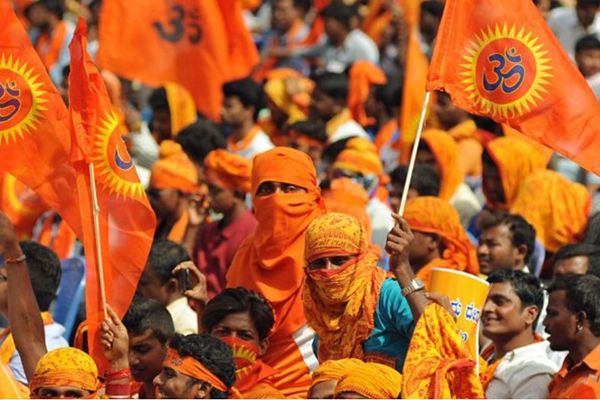
Following this incident, a group of Hindutva male students at a college in Kundapur went to class wearing saffron shawls in protest of Muslim students attending classes wearing hijab. Then Hindutva-aligned students, both males and females, started coming to class in saffron shawls, and demanding a ban on hijab. Several elected members of the ruling BJP (Bharatiya Janata Party) started getting involved in this controversy. Then the government passed an executive order asking colleges and universities to enforce a dress code, though it left each college to define the code.
The Muslims students filed for relief in the Karnataka High Court (HC). While this case was under review in the HC, a new video went viral of an incident of Hindutva young men harassing a Muslim girl in hijab. The girl, Muskan Khan, stood her ground when faced by the mob. This incident thrust the hijab controversy into national and international media and political discourse.
The Case Before the Court and International Reactions
The HC considered the case on the legal grounds of freedom of religion. The defendants were demanding the right to wear hijab as they claim that the Indian Constitution guarantees freedom of conscience and free profession, practice, and propagation of religion. The government, on the other hand, invoked public order to justify a ban on hijab. The Indian Express reports that the state issued a directive “validating decisions of state education institutions prohibiting Muslim girl students from wearing the hijab (headscarf).” The Karnataka government stated that “clothes which disturb equality, integrity and public law and order should not be worn.”
On February 10, the full bench of Karnataka High Court adjourned the hearing until February 14 and issued the following observations: “…till the matter is pending consideration before the court, these students and all the stakeholders, they do not insist on wearing religious garments, may be headdress or saffron shawl. We will restrain everyone. Because we want peace and tranquility in the state. We are seized with the matter; we can continue the matter on the day-to-day basis.” Unfortunately, the judge’s interim order amounted to a suspension of the fundamental rights of the Muslim students until the court passes a final judgment. A higher bench in Karnataka was expected to take up the case. If Muslim students don’t get a favorable ruling, they might approach the Supreme Court of India. But it is a drawn-out legal process.
Following that ruling, the Karnataka High Court in mid-March ruled that “There is absolutely no material placed on record to prima facie show that wearing of hijab is a part of an essential religious practice in Islam.” Heraa Hashmi is a writer and activist known as the American Muslim sister who created a 712-page list of Muslim individuals, scholars, organizations, and governments who have consistently condemned violence and terrorism in response to a non-Muslim classmate who asked why Muslims don’t condemn terrorism. Now, Hashmi wrote an article in March about the hijab situation in India, noting that the order from the court “cites certain passages from the Qur’an to establish – in their view as judges of a secular court with dubious levels of Islamic literacy and credentials to make theological prescriptions – Hijab as not obligatory, claiming that it ‘therefore cannot be made a quintessential aspect of the religion through public agitations or by the passionate arguments in court.’” She adds, “Consequently, the court found that the ban does not violate the constitutional rights of Muslim women. This startling verdict has widespread implications for similar cases across the country.” She further writes, “The three-judge bench declared that the Hijab is a ‘cultural practice’ and that it ‘is not a part of essential religious practices of Islam and thus, is not protected under Article 25 of the Constitution.’ They also introduced the verdict by quoting a US-based academic’s article that interprets the practice of veiling as one to distinguish social status and goes on to engage in poor attempts at tafsir (Qur’anic exegesis), hadith interpretation, and usul (methodology), stepping far beyond its bounds as a court. It is clear that the court was already assuming an ideological corruption of Muslims and their practices prior to this judgement.”
Rashad Hussein, ambassador-at-large for the U.S. Office of International Religious Freedom, tweeted after the ruling, “Religious freedom includes the ability to choose one’s religious attire. The Indian state of Karnataka should not determine permissibility of religious clothing. Hijab bans in schools violate religious freedom and stigmatize and marginalize women and girls.”
Nobel Laureate Malala Yusufzai tweeted, “College is forcing us to choose between studies and the hijab.” And Noam Chomsky, one of the West’s most eminent intellectuals, has recently said about the rise of Islamophobia, that it is “taking its most lethal form in India where the Modi government is systematically dismantling Indian secular democracy and turning the country into a Hindu ethnocracy. It is not just hijab that is under threat in India; the very existence of Muslims in that nation is in peril. After the ruling about hijab in Karnataka, Muslim vendors were prevented from doing business at Hindu religious premises. Then there was a call to boycott halal meat and, further, a controversy was raised on the use of loudspeakers for calling the adhan (the Muslim call to prayer). The apparent intent of the ruling party is to continue to demonize and dehumanize Muslims — the end result can be ethnic cleansing or even genocide.
The Way Forward for Indian Muslims
Systematic hate of Islam and Muslims has been spreading in India. A large section of the Hindu society has been radicalized. There are things that are beyond the control of Muslims in the Indian nation, but there are things they can and must do, including the following:
- The Muslim community should be educated and reminded about the meaning and purpose of their existence. Qur’an and Sunnah make it clear that Muslims are to be witnesses of truth and therefore willing to stand up and enjoin the right and forbid the wrong. The lives of Muslims —individuals, families, and communities— have to reflect these values.
- Muslims have masajid all across the country. But these masajid mostly function as a place for daily prayers. They should be used for social gatherings, religious advice and admonitions, education, administration of community affairs and challenges, and other functions and services to support the community.
- Indian Muslims should inform neighbors, co-workers, and society at large that Islam and Muslims have no intention to harm Hindus or their interests. On the contrary, the religion teaches Muslims to support the common good and to support justice for all.
- There are many marginalized groups in India. Working to support their rights is an Islamic obligation. This will demonstrate that Muslims stand for the human and civil rights of all people.
- The media, be it broadcast or social media, is the major source of spreading Islamophobia in Indian society. Muslims need to produce and distribute sound and accurate information to counter the misinformation and propaganda.
- Muslims should build alliances with people and organizations of conscience, both religious and secular, for the common goal of civility, equality, and justice in society.