
بسم الله الرحمن الرحيم

Tag: injustice

  • Ferguson Tragedy: Lessons Learned About Race in America

    Ferguson Tragedy: Lessons Learned About Race in America

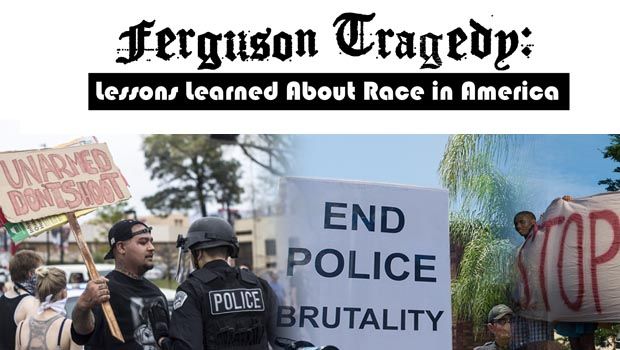
    Ferguson, a small suburban town in Missouri, has recently been the focus of global media attention for The August 9 shooting death of a black teenager, Michael Brown, by a Darren Wilson, a white police officer. The mostly peaceful protests that followed night after night turned violent at times, resulting in Missouri Governor Jay Nixon calling in the National Guard and imposing a midnight curfew. A vigorous debate on the intractable issue of race in America has been ignited once again by media outlets and in public policy forums, and on social media sites where the conversation becomes very intense and divisive at times. The Ferguson tragedy has raised several questions about the social fabric of American society.

    Laws and social norms attempt to regulate, always imperfectly, human behavior. Minds and hearts, though, can only be cleansed and elevated through divine guidance and spiritual practice

    The first issue is the social impact of changing demography. Ferguson, a suburban town of 21,000 people and a part of metropolitan St. Louis, is administratively included in St. Louis County. While most of the county population is white, Ferguson and neighboring towns are predominantly black. Blacks were once a minority in Ferguson, but the city’s demography has shifted in recent decades after white families moved out to surrounding suburbs. In 1970, whites were 99 percent of the Ferguson population. However, in 2010, 67 percent of the population was black and, according to Richard Rosenfeld, a professor of criminology and criminal justice at the University of Missouri-St. Louis, Ferguson has “a relatively stable, working and middle-income community but it does have its pockets of disadvantage.” Yet, the town’s executive leadership and its police force are predominantly white, almost 94 percent in 2014. This disparity can negatively impact the community as shown in a racial profiling study indicating that while blacks make up 67 percent of the city’s population, they account for 86 percent of traffic stops by the police, and 92 percent of all arrests in Ferguson. The Ferguson Annual Operating Budget Report states, “Municipal Court Fines are a product of the penal system. It is not the City’s policy to maximize its government finances through the use of the judicial process.” Yet, the sad irony is that one fourth of the town budget is collected through court fines, as in other small towns in Missouri, and mainly come from black citizens and other minority groups.

    Another sad fact is that, unfortunately, the shooting and killing of a black teenager was not an isolated event in American policing. It is a pattern. According to the latest available homicide data of the FBI, during the seven year period ending in 2012, nearly two times a week in the United States a white police officer killed a black person. Compared to white teenagers, black teenagers are twice as likely to be killed by a white police officer. The unjust American prison-industrial complex also presents the racial divide in a vivid manner. The prison population in the U.S. is larger than that in any other country in the world. Of the total 2.3 million, one million prisoners are black. Hispanics and African-Americans are 25 percent of the U.S. population. However, among the prison population, they account for 60 percent.

    The second issue raised by the killing of Michael Brown is the severe ethnic and political polarization on race issues in American society. According to the latest Pew Research poll, 80 percent of black people believe that the Ferguson case raises important issues about race. Thirty-seven percent of white people surveyed agreed. However, 47 percent of white people also said that race has been getting too much attention in America. The responses broke along political affiliation as well as racial lines, with 68 percent of Democrats thinking the shooting raises important racial issues but only 22 percent of Republicans think so. Some media commentators on Fox News even declared that talking about race issues is itself racism. Conservative pundits generally do not consider that there is a race problem in America and do not seem unduly concerned that young black males are too often subject to racial profiling and presumed suspicious just because of the color of their skin.

    The third issue raised by the killing of an unarmed black teen in Ferguson is that historically racial prejudices are deeply rooted in American society. There is no question that the U.S. has made great strides toward the achievement of racial equality, especially since the 1950s. Having an African-American president in the White House is the greatest testimony to this progress. Still, bigotry remains in the minds and hearts of too many Americans. In 1999, The American Assembly, a public policy forum established by President Eisenhower at Columbia University in New York City, presented a report suggesting that American society has not resolved four divisive issues despite tremendous technological and economic progress. These are economic disparity, racial inequality, family disintegration, and the role of religion in public life.

    Racism is an explosive issue and with increasing political polarization, especially after Obama was elected, it needs to be addressed at all levels. The Assembly in its report on race in America offered several measures to improve the situation. Dialogue, education, economic opportunities, better housing, reforming the prison system, and volunteerism are included in its list of recommendations. Let me also offer two suggestions, one practical and the other philosophical. On a practical level, it would facilitate trust and positive community relations if the racial makeup of law enforcement on the local level was reflective of the racial makeup of the community it serves. This can go far in precluding the deep distrust that exists in Ferguson and the festering tensions that arise out of that. On a more philosophical level, we would do well to consider the limitation of the human intellect in resolving human problems and miseries. Liberal western civilization, after rejecting any role of divine guidance in solving human problems, depends solely on man-made solutions to the big issues that societies face. Race in America is only one of the many gripping issues we are grappling with.

    Laws and social norms attempt to regulate, always imperfectly, human behavior. Minds and hearts, though, can only be cleansed and elevated through divine guidance and spiritual practice. Muslims are well aware of the last sermon of Prophet Muhammad (pbuh) during his last Hajj, when he profoundly declared, “All mankind is from Adam and Eve; an Arab has no superiority over a non-Arab nor a non-Arab any superiority over an Arab; also a white has no superiority over a black nor a black any superiority over a white – except by piety and good action.” The challenge is how such abiding wisdom can be embedded in the hearts and minds of all American citizens and, especially, in our younger generation so they can be liberated from the scourge of racism and realize a future of greater peace and harmony.
  • Islam and the African American Experience

    Islam and the African American Experience

    Much has been written on the impact of 9/11 on American Muslims. The experience of African-American Muslims in dealing with the anti-Muslim feeling that followed in the aftermath of the tragedy mirrors in most ways the experience of the larger American Muslim community. The history of Islam in this country, though, has a conspicuous trajectory visible through its unfolding — that of Islam as it developed in the African-American community. That development was very much influenced by the ongoing struggle of blacks as they grappled with issues of identity in a white-dominated society. After 9/11, those issues were magnified and brought to the fore as anti-Muslim rhetoric and animosity shook the larger Muslim community and caused greater focus on the issues of social integration of Muslims and their engagement within the American experience.

    African-Americans, like human beings everywhere and in all times, have struggled with profound questions such as who am I, where do I belong; they have also had to contend like many others throughout history with the difficult question why must I suffer such oppression and indignity? These are strident questions, however, in a culture that used the African-American’s forced, indentured, then low-paid labor to build prosperity for others, all the while proclaiming against his humanity, intelligence, moral character, and loyalty. Exploring the ontological questions of identity and the nature of existence when one belongs to an oppressed group, we find in the literature two related but distinct narratives of self-definition. Between 1900 and the interwar period in the last century, the black community was adjusting to the challenges of the post Civil War period and the ramifications of migration from the South to the North for better employment and greater engagement with society as free men and women. Unsure about their status and acceptability in the North, African-Americans looked with hope at the many religious organizations emerging in the black community.

    These principles spoke to the peculiar challenge of being black in America, what W.E.B. DuBois referred to as “double consciousness.”

    Among these were the Nation of Islam and other proto-nationalist black groups. These have been studied and classified by the late Eric C. Lincoln and Essien Udom.  Lincoln coined the now widely-known name Black Muslims; and Udom, from Nigeria, wrote a dissertation on Islam and the Black experience while at the University of Chicago. Navigating between religious and ethnic folkways, many African-Americans came to rally behind the banner of the late Elijah Muhammad and the Nation of Islam. In doing so, the black community experienced a change of direction, with a new generation of African-Americans seeking a meaningful and secure-enough place for themselves in American society. What was most significant about the NOI was its advocacy of self-definition and self-discipline.

    There was, in fact, a convergence between the sectarian and heterodox ideas of Elijah Muhammad and the political and social activism of Malcolm X (Elhaj Malik Shabazz). The synergy resulted in the NOI becoming a major force in the black community’s endeavoring for social reform; the organization demonstrated a dynamism that emerged from its opposition to racist and colonialist control over the subordinated and disenfranchised black community. The NOI was, not surprisingly, rejected by orthodox Muslims who repudiated the secular and nationalist tendencies of the organization.

    Yet orthodox Islam has a quintessential utility as a politico-religious apparatus for shaping the individual and social psychology of its religionists as they view the challenges of daily living through the lens of its theological dogma and metaphysical precepts.  The Nation of Islam, admixing selected Islamic doctrine with its own nationalist creed, was very successful in reforming the lives of its followers, instilling in them the inseparable nature of their “blackness” from the foundation of their self-definition. The NOI also indoctrinated their members with an enduring sense of being American, belonging to and claiming this country as their own, a right borne from the endurance of chattel slavery to the ongoing struggles following emancipation.
    These principles spoke to the peculiar challenge of being black in America, what W.E.B. DuBois referred to as “double consciousness.” He wrote that the African-American was caught in “a world which yields him no true self-consciousness, but only lets him see himself through the revelation of the other world. It is a peculiar sensation, this double-consciousness, this sense of always looking at one’s self through the eyes of others, of measuring one’s soul by the tape of a world that looks on in amused contempt and pity. One ever feels his two-ness — an American, a Negro, two warring souls, two thoughts, two unreconciled strivings; two warring ideals in one dark body, whose dogged strength alone keeps it from being torn asunder.”

    In this ongoing struggle, one cannot, and should not, overlook the contributions made by the Nation of Islam to the advancement and well-being of African-Americans.

    This “double-consciousness” still afflicts African-Americans, to varying degrees, despite the passing of time and significant social changes. In fact, it is not so long since the American Colonization Society, founded in 1816 by three prominent white men, sought the “return” of African-Americans to Africa. The ACS helped to constitute the colony of Liberia in 1821. While purportedly aiming to provide blacks with a chance for a better life, the society was handily supported by slave-holders who wanted to “repatriate” free blacks as they were looked upon as an incitement to slave rebellions.

    Frederick Douglass, the great abolitionist, statesman, and orator reminded racist and segregationist whites of the 19th century that blacks were here to stay. Douglass and other African-Americans leaders in the fight against slavery saw abolition as an inevitable step toward justice and equality as American citizens. The idea, to them, was outrageous that blacks should be sent back to Africa after their tremendous contributions, extracted through their suffering in chattel slavery, to the building of a prosperous America, as well as the patriotic serving of the country by nearly 200,000 African-American men in the Union army during the Civil War.

    It is interesting that African-Americans who convert to Islam are in a very real way embracing a new “double-consciousness.” Especially since 9/11 and the increasing tendency among average Americans to look at Muslims through the lens of Islamophobia, African-American Muslims have to contend with a newly challenging “two-ness.” However, this “two-ness” of being African-American and being Muslim is an identity not thrust upon them by those who aimed to dehumanize and exploit; it is an identity elected in the free searching of the soul. This double-consciousness is a phenomenon that all Muslims living in America experience today. However, by voluntarily choosing to practice the religion of Islam, it becomes an experience of great honor, a demonstration of dedication to Qur’anic principles such as worshipping God and not ascribing any partner to Him, enjoining the right and forbidding the wrong, being witnesses to fair dealing, helping the needy and feeding the hungry, showing kindness and compassion, fulfilling all promises, striving to make peace, living life as a sincere lover of Truth. But the experience is an especially poignant one for the African-American, given the history of slavery, the challenges of defining one’s life within an often hostile cultural environment, and the ongoing struggle for social justice.

    The late Imam is gone but his activism has infused a cadre of highly educated, intellectually and politically astute followers who will continue to make forward strides in helping to bring about a just society for all citizens.

    In this ongoing struggle, one cannot, and should not, overlook the contributions made by the Nation of Islam to the advancement and well-being of African-Americans. Heterodox tendencies aside, the organization began addressing the horrendous and daunting conditions faced by blacks in their communities. Any Muslim who is a true student of history will look at the doctrinal distortions of the NOI within the larger context of what they accomplished in bringing a sense of dignity to the marginalized, dispossessed African-American community; providing a narrative of honor and pride when their own country denied them that most basic human birthright; actively engaging in community work such as helping drug addicts get clean, feeding the poor and helping the needy; in advocating individual and family responsibility and self-discipline; promoting entrepreneurship and small business ownership, and more. It should also be noted that after the death of Elijah Muhammad, his son W.D. Mohammad disavowed the sectarian and ultra-nationalist doctrine and directed the organization toward a more orthodox Islam. In 1978 Louis Farrakhan split with that organization and revived the original template of the Nation of Islam.

    Imam W.D. Mohammad, who died in 2008, spent his later years working with his nonprofit ministry, the Mosque Cares. He was also a vital force in promoting interfaith relations. Many young leaders have followed in his footsteps and are continuing his work, promising individuals such as Imam Talib Sheriff of Masjid Muhammad in Washington D.C.  Among these leaders are graduates from Howard, Spellman, Harvard, Columbia, and Yale.  The late Imam is gone but his activism has infused a cadre of highly educated, intellectually and politically astute followers who will continue to make forward strides in helping to bring about a just society for all citizens.

    Americans have matured since the days of slavery, and many have shown the capacity to look beyond race in electing Barak Obama as president.  African-Americans have made great strides in their search for full inclusion in the American experience and narrative. And African-American Muslims have demonstrated their spiritual mettle in re-claiming the Islamic faith which was so often opposed by their slave-masters because the Muslim who was forced into enslavement notably refused easy acquiescence to the subjugation, to submission to any other than God. African-American Muslims, along with their other American Muslim brothers and sisters, will continue to work vigorously against religious bigotry and political violation whether here or elsewhere in the world.

  • Editorial: Race Against Racism and Injustice

    Editorial: Race Against Racism and Injustice

    Speaking out against racism and injustice is easy, but keeping oneself free from their poisons is not as simple.  Too often people denounce racism not because they abhor it as personal belief, state policy, or humankind’s pathology of hate and thus want to eliminate its scourges from society once and for all. Rather, a public stance against racism is often dictated by utilitarian consideration and calculation. After all, the social, political and even financial cost for being exposed as “racially insensitive” is steep in America today, as evident in many downfalls from political office. Our politicians therefore are keen to craft their language with anti-racist rhetoric, seeking always to maximize their political gains and support. The worst case is an ethos in which people speak the language that is politically correct, but they continue to feel and act otherwise. Their formula is very simple, as described by K. Taylor in Civil rights and civil wrongs: Racism in America today: “…(they) Acknowledge that the problem exists, while actively undermining any effort to deal with the problem.” Such dissembling is often concealed by high-minded sentiments. Former president George W. Bush while visiting Africa in 2003, said in one of his speeches: “My nation’s journey toward justice has not been easy and it is not over. The racial bigotry fed by slavery did not end with slavery or with segregation. And many of the issues that still trouble America have roots in the bitter experience of other times.” Yet, Bush and his party stalwarts continued dismantling affirmative action and legislating discriminatory policies that put   minorities at ongoing disadvantage and caused great despair in so many aspects of their lives.

    Racism is primarily a psycho-moral and spiritual problem. Therefore, the pathology of racism requires a spiritual remedy at both the individual and collective levels

    Racism has many forms and faces. We know it can be blatant or subtle and disguised. Thus it’s no wonder that the ascendancy of an African American man to the highest office of the United States didn’t dismantle the racist structure of the society. While Barak Obama’s election is certainly an historic achievement and milestone, we have to face the ugly reality that racism still manifests in treacherous ways and at all levels of our society.  As a position paper on racism put out by the Australian Psychological Society describes, “Modern racism still involves a rejection of minority groups and discrimination, but is now framed in terms of values and ideology rather than a straightforward dislike. Research has demonstrated that the modern variant of racism is more insidious, entrenched, resilient and difficult to counteract.”
    So, how does humanity climb out of this xenophobic hell-hole? The answer begins to emerge when we consider that despite all the historic legislation and policy changes put in place to address racial injustice, our society continues to suffer from the disease. Indeed, racism is primarily a psycho-moral and spiritual problem, so “while man’s actions can be legislated, their hearts and fears cannot.” Therefore, the pathology of racism requires a spiritual remedy at both the individual and the collective levels.

    We pray that our fellow citizens and the whole of humanity come to recognize that a spiritual approach is needed. Then we might all open our minds and hearts to the spiritual cure Islam freely offers. The Qur’an declares: “O Mankind, We created you from a single (pair) of a male and a female and made you into nations and tribes, that you may know each other. Verily the most honored of you in the sight of God is he who is the most righteous of you” (Qur’an 49:13). This is divine declaration that no individual or group is superior to any other, except by way of virtue and rectitude of action.
    Prophet Muhammad (peace be upon him) emphasized this principle: “O people, remember that your Lord is One. An Arab has no superiority over a non-Arab nor a non-Arab any superiority over an Arab; also a black has no superiority over a white, nor a white any superiority over a black, except by piety and good action (taqwa). Indeed the best among you is the one with the best character (taqwa)” [excerpted from the Prophet’s Last Sermon].

    This is not a glib slogan; it’s a genuine reminder and warning, for its rejection is tantamount to abandoning Islam and its non-compliance a return to jahiliyyah (darkness, ignorance). In any case, the consequence is the sin of vain glory and ultimate destiny in the hellfire. The Prophet (pbuh) thus warned: “Whoever has pride in his heart equal to the weight of an atom shall not enter Paradise.” A companion asked: “What about a person who likes to wear beautiful clothes and fine shoes,” and the Prophet said: “God is beautiful and likes beauty, while pride is rejecting the truth because of self-esteem and looking down on other people” (Muslim). The Prophet also said: “Let people stop boasting about their ancestors. One is only a pious believer or a miserable sinner. All men are sons of Adam, and Adam came from dust” (Abu Dawud, Tirmidhi).

    With such clear and coherent wisdom the Prophet (pbuh) purified his society from racism with its attendant injustices. To likewise cleanse the soul of our nation, we must embrace and fulfill the divine teachings, unifying hearts and minds against the infernal menace of racial supremacism. May God Almighty enable us to do this!

    Ameen.

  • Injustice in Syria

     
    The Prophet Muhammad (peace be upon him) said:

    O My servants! I have forbidden injustice to Myself and I have made it unlawful for you, so do not oppress one another.

    [Sah?h Muslim 6524]

    Today Syria burns. Syria. The center of historical Sham, vibrant heart of the Islamic world for over a millennium.

    Since the dawn of the Islamic era, the faithful have flocked to this ancient land. Many made it their home. Others came seeking knowledge, wisdom or simply a better life. The first Muslim empire made it their capital for nearly a century. In turn, the region produced over time some of our brightest minds. After all, it was the Prophet himself who had advised, Go to Sham, for it is the chosen among God’s lands, and the destination of His chosen ones. [Abu Dawud, authenticated by al-Albani] And so it was naturally the Companions of the Prophet who were first to settle in Damascus, heart of Greater Syria, bringing with them the Prophetic legacy.

    The Quintessential Damascene Tradition

    Among these was Abu Dharr al-Ghifari, and among the Prophetic traditions he passed on was the hadith cited above on the subject of justice. It was taught from generation to generation until another great scholar of Damascus, Imam Nawawi, immortalized it for posterity. Consequently, it became a sort of quintessential Damascene tradition and was celebrated as such. In fact, Nawawi remarks, “The people in the chain of transmitters of this Hadith from myself to Abu Dharr are all from Damascus.” And Imam Ahmad before him made the claim, “There is no tradition that the people of Sham possess that is nobler than this one.”

    Justice is God’s Own Value

    This is a qudsi hadith, which means “sacred tradition” and refers to the statements of God as related by the Prophet Muhammad. The above hadith represents the initial words of a lengthier tradition instructing humanity on one of the most important values in Islam, a value that permeates all Islamic laws and teachings: justice.

    Its opening words are, at the same time, universal and intimate. My servants speaks to humanity in the broadest terms possible and addresses them in a warm and close manner that suggests the great care the Creator has for His creation. Only after such an introduction does God deliver the point—justice is His own value, His guiding principle.

    He declares that He forbade injustice—its exact opposite—upon Himself. Two of His Names have to do with justice: al-’Adl (“The Just One”) and al-Muqsit (“The Dispenser of Justice”). God created the world with justice, and it is self-evident all around us:  And the heavens He has raised up and established the scale of justice, so do not transgress the scale of justice. [Quran 55:7-8]

    Justice is an Islamic teaching which has its roots in God Himself. God is Just, created the world with justice, and enjoined the same standard on humanity. Unfortunately, far too few heed this call. Perhaps that is why the instruction given was to avoid injustice rather than to implement justice. Even the angels had recognized earlier that humans would bring injustice to the world:

    Are you going to place in the earth those who will inevitably sow corruption therein and shed blood? [Quran 2:30]

    Hence the reminders throughout our history, through Messengers, whose central message was to establish justice:

    Verily, we sent Our Messengers with clear proofs, and we revealed unto them the Scripture and the Balance in order that they lead people with justice. [Quran 57:25]

    Two Sides to Injustice

    So God made injustice unlawful and instructed us to avoid it. The term used (tazalamu) is in the reflexive form, which does not simply mean Do not commit injustice, as is commonly translated, but includes the involvement of two sides. That is because for every act of injustice there is a perpetrator and a victim. Oppression requires the oppressed. And institutionalized tyranny can only operate with a steady supply of victims, willing or unwilling. When victims refuse to be victims, then the system crumbles as the Arab Spring continues to demonstrate.

    With this same insight, the Prophet advised his followers, Help your brother whether he is an oppressor or oppressed. In response to how an oppressor could be helped, he replied, Stop him from his oppression!  So the meaning of these words is much deeper than they would appear: avoid injustice in all its forms, whether it is direct involvement or by becoming accessories, or whether it is by being perpetrators or becoming victims.

    It is ironic that Syria of all places has become a tragic stage for the most egregious injustices being played out in the world today—the same region that disseminated this lesson on justice! Both the perpetrators and victims are Muslim, which makes these violations all the more egregious.

    The justice maxim is quite clear in the Quran and in the life mission of the Holy Prophet. It was also clear in the minds of the early Muslims, such as the Muslim emissary to Persia who famously told the Emperor:

    We came to rescue God’s servants from being slaves to other men to serving the Creator of all men, from the constraints of this life to the vastness of the next life, and from the tyranny of other religions to the justice of Islam.

    The world needs this offer once more.