بسم الله الرحمن الرحيم

Tag: hispanic

  • Finding God and a Purpose in Islam

    Finding God and a Purpose in Islam

    My name is Martha Guadalupe; I am originally from Ecuador, but live in New Jersey, and I have been Muslim since 2003, alhamdulillah (all praise is due to Allah).Why did I embrace Islam? Interestingly, every time I have been asked this question, I have a different story to tell. There is never enough time to say it all. I recently saw a post on Facebook which drew my attention. It stated: “Searching for happiness, I found Islam.” What I can say is, “While searching for God, I found Him in Islam,” alhamdulillah!

    At first I was not the one who was searching for this beautiful religion. My family and I had distanced ourselves from the Catholic religion, but I never stopped worshipping God, praying to Him, asking him to guide my children by whatever means would permit them to reach Him, and to never abandon them. I was sure that God always protected us and that He was the only one who provided us with everything we need.

    It so happened that on September 11, 2001, my son Hernan (the eldest and a university student at the time) visited us in the evening and told my husband and me that he had accepted the Islamic religion. In my ignorance, I responded, “What is that?” He explained to me that it was the true religion of Allah, and I remember saying to him, “If this is the path that will take you to God, blessed be His Name, then may He continue guiding you,” and I hugged him.

    It was my eldest son who brought the religion of Islam to our home but a month after he became a Muslim, my second son did so as well, alhamdulillah. Then I began to learn for myself about the basics of this religion. Hernan would tell me about the life of Prophet Muhammad (may peace and blessings be upon him), that he was the last and seal of all the Prophets. At first I found it strange because for me, the last prophet had been Jesus (may peace be upon him).

    Whenever he could, Hernan would teach me about Islam. I began to worry because during one of our conversations, he told me about the punishments in the hereafter for those who did not obey the laws of God. That filled my heart with terror, and I feared God more than ever. “What will happen if I don’t follow what God wants? What will happen if I don’t have any time left? What will happen if I don’t wake up?,” I would ask myself. This is one of the reasons why I began to reflect deeply about what was better for me. I wanted to be a good servant so that God would not punish me.

    Two years later I accepted this wonderful religion. Now I am a proud Muslim, alhamdulillah. I won’t say that the change was easy. At first, it was very difficult, but Allah eased the way and I have been able to persevere, breaking through barriers and overcoming all obstacles in my path. I know that Allah has always guided me, but I had been blind for a portion of my life. Today everything is clear and I am very happy knowing that I am a humble servant of Allah; to Him we belong, and to Him we will return.

    In my daily living, my faith imbues all aspects of my outlook on life with hope and trust in God. When I left my job, I said to myself, “If Allah has taken me away from this job which has been very good, it is because He has something better for me.”I have always loved sewing and I used to make clothes for girls, but had stopped doing so 11 years previously. Then during a conversation, I heard some sisters speaking about how they would like to buy Islamic clothing online but it was too expensive. I suggested, “If you want, I can make the clothing for you at a much lower price, insha’Allah.” With the help of Allah, and my sons, I decided to start my own business, which we called, “Modasty Designs,” alhamdulillah. The business has been successful at a national level due to internet sales and Islamic conferences, and above all, Muslim women in my locality who ask me to make their clothes. It is always a pleasure for me and I am here to serve my Muslim community, insha’Allah.

    Since I have been Muslim, I dedicate myself to prayer and following the Sunnah, or the teachings of Prophet Muhammad (may peace and blessings be upon him). May Allah bless us, protect us, and guide us always. Ameen.

  • My Conversion Story

    My Conversion Story

    It’s hard to believe how different my life was just three years ago. Alhamdulilah, Allah (SWT) blessed me by guiding me to the straight path. My story was written by Allah (SWT) and happened solely by His will. In early 2009, I attended a wedding at a Catholic church, and subhan’Allah, I don’t know what it was about the wedding ceremony, but I walked out of that church knowing that I no longer wanted to be Christian. I didn’t know what I wanted to be, but I knew I didn’t want to be Jewish because I knew the conversion process was very lengthy and involved.

    I had an Egyptian Muslim friend during that period who I spent a lot of time with. I witnessed the unity of the their family during Ramadan and it was something that really stood out and appealed to me. I sat at my computer one day and I googled “what does it take to become Muslim,” and to my surprise, all it took was saying a few words!

    I told my Muslim friend and family that I wanted to be Muslim and they were very excited. I was given a Quran, but truth be told I didn’t really read it much. I did know, however, that I wanted to take my shahada before Ramadan of 2009.

    It happened one June day. I was on my way home from a trip to Los Angeles and I was walking to my car, and at that moment I was overwhelmed with a feeling of absolute, one hundred percent certainty, that I was ready to take my shahada. I really didn’t know much about Islam at that point, but it was implanted into my heart at that moment that I was ready to become Muslim. The next Friday I took my shahada. I didn’t know how to pray until my first day of Ramadan 2009. Fortunately, after that Ramadan, at the end of October, I found the M.E.C.C.A. Center and their New Muslims Program. It has been an amazing journey ever since.

    I have been blessed to be able to use my professional expertise to help Muslims. I am a movement therapist and nutrition coach and have been in the health and fitness industry for over 20 years. I operate a training and nutrition business in Manhattan and my students have nicknamed me “the hijabi drill sergeant.” In addition, I run Fit For Allah, a group strength-training class held weekly at the MECCA center in Manhattan, and work as director for the non-profit, health and fitness organization, Nadoona.

    Through this organization and their Nadoona Body Makeover, I am able to create and design individualized programs for weight loss. It is very fulfilling to bring an entirely new perspective to the fitness industry, utilizing the teachings of the Quran and Sunnah. I begin each class with a du’a, striving for the pure intention to spread health and fitness for the sake of Allah SWT.

  • Gift of Islam

    Gift of Islam

    There was a wooden shelf in the corner of my parents’ bedroom with a statue of Our Lady of Guadalupe, and every Sunday my father replaced the flowers in a vase that was set by the statue. I remember him so clearly as he stood in front of the shelf which also had many other statues and he prayed with such strong belief. When I was nine years old, before his passing, he taught me many prayers, and I was taught to perform a spiritual cleansing of the evil eye (in Spanish “mal ojo”).

    Soon after my father passed, I started catechism (principles of the Christian religion) classes, and I spent most nights and Sundays at church. I received the communion as a Catholic and also the sacrament of confirmation, but I never felt close to God. During most of my younger years I had the Catholic religion forced upon me by my family; it wasn’t a choice to attend classes or mass, it was just obligatory in my home.

    As I got older, my mother distanced herself from the church as she became busy with her full-time job and we weren’t practicing our religion much anymore. In my mother’s bedroom was still that homemade shelf my father had built and all the statues he prayed to. But no one placed any flowers in the vase or prayed as my father had done.

    By my high school years my life had changed tremendously. I had become a very rebellious teenager. I was definitely lost. I experienced so many unwholesome things during my teenage life and I had lost my faith and didn’t believe in God.

    Alhamdulillah, after my daughter’s birth when I was 27 years old, I realized it was time to change the way I was living. I was introduced to Islam by a few friends online and I will never forget the first time I heard the Qur’an recited—I felt a connection with God! I felt something that I had not felt before in my life. Even though I had no idea what was said during the recitation, I fell in love with the Qur’an.

    I was blessed to be in contact with many wonderful brothers and sisters who provided me with the information I was looking for. It wasn’t long after that I decided to become Muslim. I took shahada in 2006, alhamdulillah. Today I know why I fell in love with the Qur’an; I know why I felt an instant connection with Allah SWT. Allah the Almighty Says: “This day have I perfected your religion for you and completed My favor upon you and have chosen for you Islam as your religion” (Qur’an 5:3).Islam is beautiful and Allah SWT has granted us the greatest gift possible and that is the gift of guidance to His religion, the complete and final religion.

    My life as a Muslim woman is amazing. My days are filled with so much peace and contentment — my family, home, and daily efforts are continuously blessed and it only gets better alhamdulillah. Muslims are bound together in heart and this unity is the means of strength for the Muslim ummah. In fact, it’s a divine gift that we Muslims must make use of. “And the believers, men and women, are protecting friends one of another; they enjoin the right and forbid the wrong, and they establish worship and they pay the poor-due, and they obey Allah and His messenger. As for these, Allah will have mercy on them. Lo! Allah is Mighty, Wise (Qur’an 9:71).

    That we are meant to be supporters of one another means so much to me. I want for my brothers and sisters what I want for myself, and after contemplating for months I finally decided to launch an effort that would be of benefit to my sisters in Islam. In May 2011 I established Muslimahs Covered With Care (MCWC). This initiative is designed to provide hijabs and abayas to Muslim women. I personally understand the difficulty in adopting the Islamic attire and I understand the number of reason why some Muslim women do not cover.

    Presently the MCWC team consists of seven wonderful women and others are always encouraged to join us. We have coordinators in the US, Europe, Canada, Australia, and the UK. Join our team in helping Muslimahs around the world to dress modestly, one hijab and one abaya at a time. Visit www.muslimahscoveredwithcare.org for more information.

  • Sh. Al-Husary – Spotlight on Islamic Traditions

    Sh. Al-Husary – Spotlight on Islamic Traditions

    In the narrative that chronicles the preservation of the Qur’an, Shaykh Mahmud Khalil al-Husari occupies a unique position. He was born in 1917 in the center of Tanta, Egypt, with an excelling aptitude for learning the Qur’an. He began his journey at the age of four with local Qur’an teachers and finished memorizing the Qur’an by the age of eight. Too young for admission to any of the Qur’an schools, he began to recite in the village mosques and quickly became a local sensation. As his voice matured, he was invited to gatherings and events to recite the Qur’an. When he reached the age of 12, he entered formal studies at the renowned al-Azhar University schools and completed formal degrees as well as attaining proficiency in the Ten Readings of the Qur’an.

    In 1944, Shaykh al-Husari became nationally known when he won first place in a radio competition, and thereafter became a familiar voice in Egypt. He held various positions in the region’s mosques and religious institutions, as well as serving on several academic and government councils to advance the cause of the Qur’an.

    His passion turned global as he became one of the first Qur’an scholars to travel widely throughout the world as an informal “Ambassador of the Qur’an.” He travelled to India in 1960 to recite at a conference in the presence of Egypt’s president Gamal Abdul Nasir and India’s Nehru, and went to Kuwait in Ramadan of 1963. He frequently visited the major Muslim nations, including Saudi Arabia and Pakistan where he was chosen as the head of an International Reciters Forum at a conference in Karachi in 1966.

    His passion to spread the voice of the Qur’an did not exclude the West. He visited France in 1965 where ten individuals embraced Islam upon hearing his recitation. He visited the U.S. on multiple occasions in the 1970s, met President Jimmy Carter, and visited some of the oldest Islamic centers in the country. On one occasion, it is said that 18 men and one woman embraced Islam after hearing him. He was the first individual ever to recite the Qur’an in the U.S. Congress, the first to recite at the United Nations, in 1977, and in London’s Buckingham Palace in 1978.

    A Rich Legacy

    In addition to being a reciter, Shaykh al-Husari left behind a dozen written works on the Qur’an and its sciences, including a textbook on the science of Tajweed. His greatest legacy, however, is one that placed his name squarely on the historical roadmap of pioneers in preserving the Qur’an and advancing its status in the world. Shaykh al-Husari has the distinction of being the first person in history to record the entire Qur’an in audio media and preserve it for posterity. Although there were others who did partial recordings before his time, and many who did recordings after him, his work became preeminent for a number of reasons.

    To begin with, he was simply the first to record the entire Qur’an. The story behind this project reveals a glimpse into his visionary spirit as well as the workings of destiny. Shaykh al-Husari was greatly concerned about the efforts of Christian missionaries, particularly in Africa, to spread confusion and doubts about the Qur’an. Moreover, this was the dawn of the age of electronic communication and the world was just beginning to take shape as a global village. Shaykh al-Husari used his influence and position to raise awareness of the need to preserve the Qur’an, in the spirit of its early pioneers, this time in an audio format.

    The project had initially been presented to a number of reciters but never came to fruition due to disputes about monetary compensation and related issues. After exhausting these avenues, the matter returned to Shaykh al-Husari, who reluctantly agreed to do it. But he did it as a service to the ummah, without any monetary compensation. He did the same for all his written works, preferring charitable distribution rather than selling for profit.

    Most importantly, his complete mastery and precision in articulating the letters and words of the Qur’an were undeniable. After the project’s completion, the recordings were presented to numerous scholarly experts, and it was only after all of them testified to its precision that the project was allowed to proceed. And to this day, with the unanimous and universal approval of the leading experts of Tajweed, Shaykh al-Husari’s crystal clear voice continues to resonate with divine beauty and power from schools, cars, audio players, and computer software throughout the world.

    Finally, the ambitious nature of the project was also a key factor in its success. After recording the entire Qur’an in the rendition of Hafs in 1961, Shaykh al-Husari’s work was not over. He proceeded to do another entire recording in the Reading of Warsh in 1964 and additional ones in Qalun and Duri in 1968. He also produced another recording in Mujawwad form, a slower style of recitation, as well as one in a teaching style (Muzallam). These recordings have all been widely available since, and continue to our times.

    In 1980, Shaykh al-Husari began suffering from a heart condition and ultimately passed away on November 24, 1980 after completing the last prayer of the day. Upon his death, he left a third of his wealth for charitable works for advancing the cause of the Qur’an.

  • Charity and Service to Others

    Charity and Service to Others

    The Prophet stated: “Every Muslim should give charity.” He was asked, “What if one cannot?” He replied, “Then he should go find work and help himself and others.” He was asked, “What if one cannot?” The Prophet replied,“Then he should help someone in need.” He was asked, “What if one cannot?” He replied, “Then he should command what is right or good.” The Prophet was asked, “What if one cannot?”He replied, “Then at least he should refrain from evil, and that would be charity for him” (Bukhari, Muslim).

    The spirit of charity, volunteerism, and service to others is a hallmark of Islam and among its greatest teachings. The Prophet never lost an opportunity to convey this message to others, and on this foundation he built a prosperous and charitable society oriented to public service.

    Prophet Muhammad exhibited this generosity of character in his own life in a marvelous way. Before he became a Prophet, he earned the greatest respect and regard from his contemporaries by being al-Sidiq (the truthful) and al-Amin (the trustworthy). People confided in him, went to him to arbitrate differences, sought his advice, and even entrusted their valuables to his safekeeping. It was these ethical qualities in his early life that enabled him to be a successful Messenger later on. And so, when the first revelations came down to anoint him as a Messenger of the Divine and he rushed home fearful and full of great distress, his wife Khadijah, beloved supporter and confidante, consoled him and gave him confidence by reminding him of his impeccable character and service to others: “No, rejoice! By God, He would never disgrace you! For you uphold the ties of kinship, always speak the truth, bear the people’s burdens, help the destitute, honor guests, and serve those whose rights are due.”

    This tradition of service continued throughout his prophet-hood and became an integral part of his mission and message. When he arrived in his adopted home of Madinah to establish the first Islamic society, his very first words to the people summed up that message: “People, spread peace among yourselves, uphold family ties, feed each other, and pray during the night while the rest of the people sleep, and you shall enter Paradise in peace!” The formula was simple. Build a peaceful society which consists of service to others (your families and those who are needy) and service to God (in the form of prayers). That, in essence, is the road to salvation. The balance between the body and spirit, between personal and civic responsibilities, and between spirituality and the mundane affairs of life is wonderful guidance bequeathed by Islam to humanity.

    As part of this prophetic lesson, Prophet Muhammad emphasized the need for financial independence so that one can be in a position to help others. Charity, primarily in the form of donations, is a responsibility of every believer. This can be monetary donation or other type of material provision, depending upon the need. And for those unable to afford such, the Prophet strongly urged them to find work to earn something with their own hands so that they could help themselves and then others. In other words, tangible donations are among the greatest forms of charity and financial independence is, therefore, a desirable value in Islam.

    Yet, for those who truly are not in a position to give material assistanceto others, then the Prophet recommended they find some other means to help someone in need. Financial assistance takes precedence but if that is simply not possible, then service to others is a priority. The principle of charity is so important that no single person is exempt from practicing it, even those who cannot afford it.For those who are neither in the position to give nor in a position to help, then they were urged to at least enjoin something that is good or virtuous. That could entail, for example, teaching someone something beneficial, speaking out for social justice, or promoting some worthy cause. Finally, those not in a position to practice any of these approaches must, at the very least, stay away from wrongdoing of any sort which indirectly protects people from that potential harm.

    So charity and public service should involve everyone in a sound and healthy society. There are no exceptions because there are many forms of giving and helping. In our current political atmosphere where public assistance and providing for those in need have been assailed by some in the public discourse, these lessons on charity are very timely. There are, indeed, hopeful signs as the majority has rejected a selfish and self-serving political agenda—as the recent elections have shown. And in the aftermath of Hurricane Sandy, we recognize once again that we live in difficult times; and that the tenuousness of this life is best dealt with by engaging and cooperating with those whose spirit of charitableness is ever ready to provide support and relief to those in need.

  • Editorial: Our Collective Role  in Spanish Dawah

    Editorial: Our Collective Role in Spanish Dawah

    More than 1,400 years ago, Prophet Muhammad, peace be upon him, said: “Surely, this religion will reach the boundaries of the day and night and Allah will not spare a rural or an urban dwelling except that He would cause Islam to enter it…”(Ahmad and Ibn Hibban, classified as authentic). We are witnessing the realization of this prophecy today, as Islam continues to spread from the East to the West, including North and South America, where the number of Muslims will more than double by the year 2030, according to statistical projections.

    Many of the new Muslims are Latinos who are living in the US and in Latin America. Recent studies such as the The American Mosque 2011 Report reveal that the number of Latino converts in the US has been steadily increasing since the year 2000, more so than any other racial or ethnic group. Similar trends are occurring in neighboring Mexico and further south in Central and South America, where the primary language is Spanish.

    Spanish is the second most widely spoken language in the world, and the official language of 21 countries. With over 50 million native speakers and second-language speakers, the United States has the second largest Spanish-speaking population in the world, after Mexico. Spanish is the most studied foreign language in the US.

    In the Qur’an, God says, “And We sent not a Messenger except with the language of his people, in order that he might make (the Message) clear for them. Then Allah misleads whom He wills and guides whom He wills. And He is the All-Mighty, the All-Wise”(Qur’an, 14:4). This points to the importance of providing educational materials about Islam in all languages. And due to the dramatically rising number of Spanish-speaking Muslim converts in the US, the need for resources in Spanish cannot be ignored.

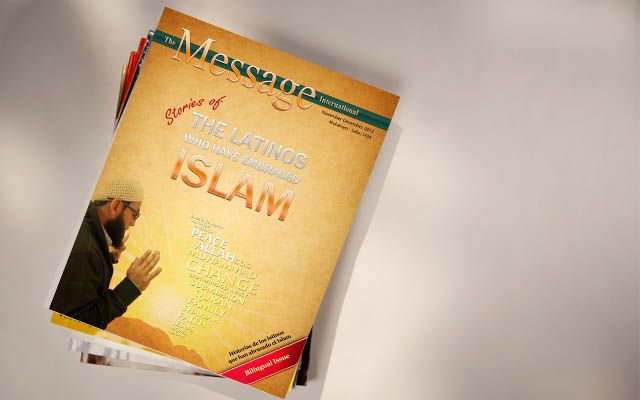
    ICNA and its WhyIslam project are among the few organizations providing services for this demographic, with Spanish-speaking operators on the 1-877-WhyIslam hotline, educational material in Spanish, Spanish sessions during the annual ICNA-MAS convention, and The Message International magazine now featuring articles in the Spanish language.

    Islam is an integral part of Latino history and culture and as such, Hispanics who choose to become Muslim are merely rediscovering and embracing their past. Through our efforts, with God’s help, we can share the message with our brothers and sisters in humanity and facilitate the success of their transition.

  • From Juan to Shafiq

    From Juan to Shafiq

    Ever since childhood, I have felt in some way like a “spiritual” person, and found myself unlike other children. Because of this, I sometimes felt alienated. I was different, and it remained to be seen whether this was a good thing or not.

    My family members all know that I am a Muslim and and that it is a permanent choice. Initially, it was a little difficult. My family
    has come to accept that I am Muslim

    I am of Latin American descent. My parents came to NY from the Dominican Republic in the late 60s. Unlike the current depression (yes, I think it’s a depression), it was a time of industry and prosperity— lots of work and possibilities for success. Like other Latinos, I was born into the Catholic faith. I went through the motions of what it means to be Catholic: I was baptized, did my communion and confirmation. I was even an altar boy at one point. But by the time I was a teen, I was growing impatient with Catholicism. Part of it was that I was not getting the answers that I sought. I started exploring different religions and other forms of spirituality. I had already read the New Testament cover to cover — not an easy thing for a young person to do. One thing that annoyed me a lot and I found difficult to understand was the cult of saints. Another issue that troubled me is that there is so much written in the Bible that is not followed by the church.

    By age 16, I can confidently say that I had renounced Catholicism. I still considered myself “Christian,” however. I visited churches of differing denominations and watched lots of televangelists but just could not feel a sense of belonging. One of the biggest things that I did not like about Christianity was the inter-denominational bickering. There was a complexity to Christianity, or so it seemed to me, that just kept me wondering and doubting. In my search for understanding, I looked into Judaism, Buddhism, Hinduism, Santeria, and various New Age and occult movements. As for Judaism, I recognized some “truth” in it.It seemed “truer” to me than Christianity. I just could not deal with a life without Jesus. This was a big sticking point for me (later, when I found Islam, it was very compelling to me that I would not lose Jesus, peace be upon him).

    Buddhism seemed too esoteric, a little complicated, and to some degree too bland. The kicker for me was when I went to a Buddhist temple in Manhattan. When I knocked, someone quietly came to the door, almost like they were sneaking up to the door, peeked through the peering hole, and quietly left, hoping I wouldn’t discern their presence. I knocked again and politely stood there for a few more minutes, hoping someone would acknowledge me but no one came back. Hinduism’s caste system and grandiose number of gods and goddesses just repelled me. That religion was interesting sociologically and it even had teachings that influenced me such as vegetarianism; but I could not find it in me to bow down to numerous and varied gods. Santería’s gods also repelled me. And it is a secretive religion and to me this was problematic— if you have the truth, there is nothing to be kept secret. The many New Age movements just seemed too complex and at times even silly.

    By the time I was 19, I had renounced Christianity once and for all. I continued my search, though. This led me to read on a continuous basis, something that I still do. When I was 20, a friend of mine gave me a book published by the Ansaaru Allah Community, a Black Muslim cultish group that was founded in the 60s (which by the 80s had abandoned its “Muslim” creed; they now call themselves the Nuwaubian Nation).Still, after reading their publications for about 2½ years, I decided to become “Muslim” at age23. In retrospect, I cannot say that I really was Muslim as the Ansar teachings were quite deviant from pure Islam. And the leader of this movement changed his beliefs and doctrines ever so often. This I found to be strange and it nagged me inside. I lasted two years in this movement.

    At the time, I did not know any orthodox Muslims who could guide me. Only God could guide me and this He did. One day, while attending Jumu’ah (Friday prayer service) at the central mosque in Manhattan, a Hispanic brother noticed that my jalabiya (Islamic dress) had an insignia sewn on that revealed my affiliation with the Ansars. This brother was kind enough to take time out and talk to me. He did not speak English well but he attempted to tell me the errors of the Ansar beliefs. This brother introduced me to some other brothers and gave me a book that set me straight. It was “The Ansar Cult” by Bilal Phillips. After reading it, I knew I was wrong to affiliate myself with the group.

    After this episode, I took shahada again with Alianza Islámica (Islamic Alliance), a Sunni organization in Manhattan. I was then 25 and had been guided to the truth by Allah SWT. I still love to read and I am constantly learning; but I am no longer searching for the truth – I have found Islam.

    Since then, I have co-sponsored the formation of LADO (Latino American Dawah Organization), a group dedicated to spreading Islam, with special focus on Hispanics. LADO strives to reach out to Latinos and provide information about Islam as a way of life, and to promote a greater appreciation of the legacy of Islam in Spain and Latin America.

    My family members all know that I am a Muslim and that it is a permanent choice. Initially, it was a little difficult. My dad thought I had been brainwashed. My mom was worried for my safety. It’s been many years since my conversion now, and my family has come to accept that I am Muslim and I have no problems with any of them. Yes, I have taken a different course than most people I have known. I have felt alienated from the faith of my birth. But now I know that it was all for the good.

  • Peace & Piety

    Peace & Piety

    My name is Nylka Vargas, and I live in New Jersey. My parents are from Peru and Ecuador. I converted to Islam when I was 20 years old. There are multiple reasons why I converted, the first of which was the salat (prayer). I saw some classmates at school perform the salat in public and I was immediately drawn to its peaceful and disciplined nature.

    When I was young, I was hesitant about following certain practices of Christianity, in particular, the belief in salvation through the blood of Jesus Christ. It just did not make sense to me. Once I learned about Islam, I felt a deep curiosity and asked many, many questions. My prayers to God to guide me in filling the spiritual void I felt were being answered. After reading some introductory material and various passages of the Quran, I was convinced. In just a few months time, I declared my testimony of faith.

    My family slowly accepted my conversion. They came to understood that the decision was mine to make and that the change was a positive one. It is so important to be a good example — true representatives of Islam in our speech, attitudes, and behavior. Alhamdullilah (all praise is to God) for the guidance. I can never be a servant thankful enough for the gift of hidaya (guidance) that lighted my path right when I needed it.

    In my journey since, I have found many supportive Muslims and met others with similar stories. At the North Hudson Islamic Educational Center (NHIEC) in Union City I found a proactive community of Muslims. The open-door policy and programs there facilitated my learning about Islam. I then used my own experience in learning and growing as a Muslim to give back by way of helping others. I met Sister Khadijah Rivera, may Allah shower upon her His Mercy and fill her grave with noor (light), who invited me to join P.I.E.D.A.D (Propagación Islámica para la Educación de Devoción a Alá el Divino), a women’s dawah (outreach) organization. Sr. Khadijah, a great community activist, passed away in 2009 during the blessed days of the month of Dhul Hijjah.

    However, Piedad lives on. Sr. Khadijah was a co-founder of this organization that started in the late 1980s as a vehicle to give dawah to Latino Muslims. Later it would expand to include other services. A little while before she passed away, we talked a lot about the direction of Piedad and I am glad to share this story, as it is an honor to continue the legacy of this wonderful organization that was built with little resources more than sincerity. The acronym of the organization, P.I.E.D.A.D., spells out the Spanish word “piedad” which means piety. It reminds us always to strive for piety, God-consciousness, and sincerity in performing charitable acts.

    Alhamdullilah, this year was marked by a number of exciting projects: Informational Dawah Tables, Hijab (headcovering) Workshop, Co-Sponsorship of Ladies Spa Day, Purple Hijab Day, Local Eid Toy Drive with Baitul Salaam Network, our new Stay-fit and Healthy Initiative, the NJ Walk/Jog Chapter of Nadoona, and continued Latino Muslim collaboration with the Latino American Dawah Organization (LADO) (www.latinodawah.com).

    We’ve also helped many newly converted sisters with the very basics of Islam such as learning how to properly pray. Insha’Allah (God willing), we plan to develop our women’s network, the Latino dawah focused projects, and be at the forefront of community services —all with a heartfelt vision of success for our Muslim ummah (community). May Allah accept our efforts. Ameen.

  • Allah Rescues a “Boricua” through Islam

    Allah Rescues a “Boricua” through Islam

    In the name of Allah, the most Compassionate, the most Merciful — may the peace and blessings of Allah be upon His last and final messenger, the seal of all the prophets, Muhammad. And may peace be upon those who follow in his footsteps until the Day of Judgment.

    I felt empowered each time I completed an act of obedience to Allah

    My Dear Family

    I was blessed with parents of Puerto Rican origin, which is what makes me a “Boricua” — a person of Puerto Rican heritage. I am the youngest of three sons, born in New York, and raised in both Puerto Rico and New Jersey. My mother, who was a nun before she married my dear father, taught more than fifty girls in a convent in New York. She had studied psychology at Fordham University and later during her years as a nun had many unanswered questions that led her to leave the convent. She later married my father. She taught us to always pray to God upon awakening and before going to sleep, and to thank Him for our food. In Puerto Rico, she established catechism classes in our home for the children in our neighborhood.

    I continued reading the Qur’an for nine consecutive months and through my reading and application I realized that I was gradually curing myself from the vices of smoking and drinking alcohol

    My father was hard-working and he would take us to work with him so we could learn a good work ethic and basic skills for survival. From a young age, I learned how to make pizza, scrambled eggs, and sandwiches. My father loved to be with his children and would play videogames and sports with us on his days off. My older brothers would always play with me or take me to the movies, and we had a great sense of camaraderie and a lot of fun together.

    Islam and Basketball

    During my growing-up years, I was a fan of Michael Jordan and the Chicago Bulls team. The Bulls won three championships, and then in 1993 Jordan retired. I felt like a boy without a favorite sports hero. I began to search for a new favorite player and chose Chris Jackson from the Denver Nuggets, who later accepted Islam and changed his name to Mahmoud Abdul Rauf.

    During those days, there was not much access to watching games of out-of-state teams unless they were playing against the local team. The way I kept up with everything was through collecting trading cards. Once I was reading Mahmoud Abdul Rauf’s cards and I found information about Islam including what his Arabic name meant and about the pilgrimage to Mecca. Since I didn’t have a chance to watch many of Denver’s games, I had to pick another player from one of the two local teams, the New York Knicks or the New Jersey Nets. I chose the Knicks because I was born in New York; and as a favorite player, I picked John Starks.

    That year, the NY Knicks made it to the playoffs against the Houston Rockets. The Rockets had at that time the legendary Hakeem Olajuwon who was fasting during the championship games. Many of the Knicks players would trash-talk him, but he always responded with patience and grace. The Knicks had the opportunity to win the game with a shot from Starks, but it was blocked by Olajuwon and Houston won the NBA Championship. Here again, I was being exposed indirectly to Islam, but during this time period I was not interested in religion.

    The Challenges and Hardships of Youth

    While I was in Union Hill High School, in Union City, New Jersey, I began smoking cigarettes because all my friends were doing it. After school we would go play basketball and sometimes those who were waiting their turn to play would drink beer or smoke marijuana. So my teenage years were spent playing basketball, singing reggaeton (urban music rooted in Latin and Caribbean music with a fusion of Latin and reggae rhythms) in the clubs, drinking alcohol, and hanging out with friends. It is not surprising, given my lifestyle, but still a big loss, that a friend of mine drowned while he was drunk, at the age of 18. I was also involved with a gang and became friends with Carlos Hernandez, from Colombia, who lived in my house for a few weeks. Carlos loved to read a lot and one day we visited the public library and, given my lack of moral principles at that time, I stole a copy of the Qur’an. At one point, some members of my gang killed two of my friends with whom I had been the day before. That tragedy affected me tremendously. Day after day I thought of three things —death, illness, and my family’s well-being. During that time I lost trust in all human beings except my parents, but they lacked the experience to guide me and help me see beyond my narrow perspective. I decided to search for God.

    My Spiritual Journey

    My quest to find answers began in the year 1998 when I felt like I had no direction and lacked the ability or the willingness to confide in any other human being. I visited the churches in my area and acquired six different bibles. I began to read through all of them, comparing passages, and then I remembered the Qur’an that my friend Carlos had left at my house. I looked for it and began reading it daily, along with the bibles. Interestingly, I found that there was an assertion in the introduction of the New Revised Standard Version that the King James Bible contained grave errors. I began to think that if there are different versions of “the Word of God” then we can’t trust that the Bible has been kept intact and uncontaminated by man. Later I read in the introduction of the translation of the Qur’an by Abdullah Yusuf Ali that, “This Qur’an is a confirmation of the message of Moses, Jesus, Muhammad, and all the prophets of God.” The introduction also stated that the Qur’an remain available in the original Arabic language, in its original form without having been changed for more than 1400 years; and that countless people have memorized the entire text. These things impressed me.

    Reading the Qur’an

    I continued my search and I became attached to reading the Qur’an. I wanted to apply everything I was reading. When I read a verse that said: “Establish regular prayers – at the sun’s decline till the darkness of the night, and the morning prayer and reading: for the prayer and reading in the morning carry their testimony” (Qur’an 17:78). After reading this verse, I would wake up in the middle of the night secretly, to read the Qur’an while my family slept. I felt empowered each time I completed an act of obedience to Allah. Some time later I read a verse related to speaking well: “O ye who believe! Fear Allah, and (always) say a word directed to the Right: That He may make your conduct whole and sound and forgive you your sins: He that obeys Allah and His Messenger, has already attained the highest achievement” (Qur’an 33:70-71). Immediately after I read that verse, I began to put forth a lot of effort to control my speech. I would push myself to only speak well or maintain silence.

    I continued reading the Qur’an for nine consecutive months and through my reading and application I realized that I was gradually curing myself from the vices of smoking and drinking alcohol. That internal turning toward Allah made me trust the Holy Qur’an more and more. Finally, after those nine months of reading and applying what I learned, I decided on September 24, 1999 to accept Islam. I did so at the North Hudson Islamic Educational Center (NHIEC) in Union City with Sheikh Mohammed Al Hayek, who offered regular classes in English for new Muslim converts. Two years later, my dear mother and father also accepted Islam. All praise is to Allah.

    Efforts to Teach Islam

    In 2002, I established a Spanish class at NHIEC called, “Understanding Islam.” Later, during a Dawah Committee meeting, Imam Al Hayek asked me if I had any ideas for a dawah event directed at the Latino community. I suggested holding a Hispanic Muslim Day. Through the wonderful efforts of the Dawah Committee, the first event took place in 2002. I continued offering the weekly classes from 2002 to 2004.

    Path Towards Arabic and Islamic Studies

    In 2004, I was offered a scholarship to study in Egypt; Arabic language at Eqraa Institute and Islamic Studies at Al-Azhar University. I studied in Egypt form 2004 until 2007, completing five years of course material in three years at Al-Azhar. All praise is to Allah. I met many wonderful Latino brothers and sisters in Egypt who helped me to settle into my new life. Among them were Abdul Rahman Khairo from Colombia, Sheikh Uzman from Argentina, Dr. Juan Yahya Suquillo who visited and gave us good advice, and also a dear brother, Mujahid Fletcher, founder of IslamInSpanish. We spent nights talking about how we could serve our Latino/Hispanic community.

    IslamInSpanish: My New Family

    In the year 2010, my family and I relocated from New Jersey to Houston. It was my aim to work as a teacher for Iman Academy Islamic School and also work with IslamInSpanish. I joined IslamInSpanish because of their extraordinary mission of producing multimedia to educate Latinos about Islam. It has been a marvelous experience working with them to serve the Latino community, recording IslamInSpanish programs in the Andalucia Center Studios with “The Voice of IslamInSpanish” narrator Abu Mujahid Fletcher.

    Show: Entendiendo el Corán (Understanding the Qur’an)
    All praise is to Allah. IslamInSpanish has a lot to offer the Latino community:
    educational Islamic material at www.islaminspanish.org
    networking with the Latino community through Facebook on their page www.facebook.com/IslamEnSpanish
    material available for purchase at www.dar-us-salam.com
    national and international presentations; for more information, contact them through info@islaminspanish.org or www.facebook.com/IslamEnSpanish

    Opportunity to Become an Imam

    At the end of 2011, I received an offer to become an Imam in Beaumont, Texas. My first impulse was to refuse the offer as my family and I were happy living in Houston and I was very satisfied with my work at Iman Academy and IslamInSpanish. Yet, in my current circumstances, I was extremely busy and did not have much time for my family. My wonderful wife said to me: “We’ll go wherever we need to go.” I made the Istikhara prayer (for consultation), analyzed the offer, and said to myself, “With this offer, I could balance my family life and manage my time better. I could make dawah, continue my Islamic studies, spend more time with my family, and be a good example to them.” After praying Istikhara, I also consulted with my mother and trusted friends and advisors. I then made the decision to accept the offer as Imam of the Islamic Society of Triplex.

    On January of 2012, the Islamic Society of Triplex founded Al Hidaya School, a weekend school with the mission to “Develop in our youth a love for Allah as their God, Islam as their way of life, Muhammad (peace be upon him) as the seal of the prophets, and the Qur’an as the guide for humanity.” At Al Hidaya, students learn Arabic, Islamic Studies, Qur’an reading, basketball, and martial arts. Al Hidaya is comprised of wonderful students, teachers, and volunteers.

    Looking back on my journey, I never could have imagined the wonderful blessings I would receive as I took step after step in my determination to find truth. All praise is to Allah that I have found much more than I could ever have hoped for. Indeed, Allah rescued a young, lost soul — a “Boricua” — through Islam.

  • Finding Islam in Mexico

    Finding Islam in Mexico

    My name is Martha Patricia Garcia and I am 27 years old, a graduate of the Faculty of Political and Social Sciences from the National Autonomous University of Mexico (UNAM). I am currently working as a reporter for the entertainment section of a national newspaper in Mexico. I was born into a Catholic family and never had the intention of changing my religion, but alhamdulillah (all praise is due to Allah), today I am very happy to be a Muslim.

    Any lingering doubts about Islam did not last very long. I searched on the internet for the answer to the question: what must one do to become a Muslim?

    The first impression I had about Islam was not good because it was based on two movies that made me want to never set foot in any Islamic country, particularly Turkey where one of the stories was set. I used to make many friends on the internet and the social network, Hi5, was very popular. I became friends with a guy and after a while I realized two things: he was a Muslim and he also lived in Turkey; that did away with my misconceptions.

    Before I met him, Muslims seemed to me to be backward, fanatical people. But he was not anything like that. On the contrary, he was the friendliest and most polite 19 year-old I had ever met, and he was very intelligent. But as every rule has an exception, I wanted to be sure that he was not just an anomaly. I did not want to believe that the films, newsreels, and even print media were lying. So I began searching for Muslims from other parts of the world: Algeria, Egypt, Morocco, and Saudi Arabia, and all had the common denominator of good manners, kindness, and intelligence.

    The Turkish guy and I started a long-distance relationship. He talked a lot about Islam and I liked learning, but always warned him that I would never change my religion because I was convinced about my faith. Four months later, our “courtship” ended, but I remained friends with many Muslims, who continued to explain to me their religion.
    Everything was going well until in 2010, I was told that in Islam, Jesus (peace and blessings be upon him) was a prophet. That offended me so much that I became obsessed with finding something that could prove that idea wrong. I went to fellow followers of Catholicism and they ignored me; then I went to a Christian forum where they spoke ill of other religions and I happened to share that Muslims were good people. The forum administrator told me: “This is a Christian forum, if you do not like it, then leave.” So I left.

    By then I had been communicating with an Egyptian who offered to send me books in Spanish to better understand Islam. I accepted because I did not know at the time that there were Muslims in Mexico. I received several packages and one of the booklets seemed to be the perfect tool to “sink” the arguments of the Muslims with regards to Jesus. It was called “The True Message of Jesus.” I took the book and, since it quoted the Bible, I decided to compare the verses mentioned one by one. My Catholic faith faded a bit more with each page I read. When I finished the book I did not know if I was a Muslim, but I knew I was no longer Catholic.

    Any lingering doubts about Islam did not last very long. I searched on the internet for the answer to the question: what must one do to become a Muslim? I found the shahada, the testimony of faith: “Ash hadu anna laa il?ha illa All?h, wa Ashadu anna Mu?ammadan ras?l All?h” (I bear witness that there is nothing worthy of worship, except Allah and that Muhammad is His servant and Messenger). My heart was stirred by the idea of pronouncing it and so I did; I did it so many times that I memorized it. From that moment onward, I would repeat it, and as a Catholic would make the sign of the cross upon himself, I would say the Islamic declaration of faith whenever something frightened me.

    Shortly after I was pleasantly surprised to find a Mexican Muslim on Facebook who took me to the Educational Center of the Muslim Community in Polanco, Mexico City, and a week later I declared my shahada to the community. At first my family did not accept it, but gradually they realized that I had made a very serious decision and I would not change my mind.

    An Ordinary Muslimah

    One of the biggest obstacles I faced was the clothing. I tried to adjust my wardrobe to keep using clothes that were Islamically acceptable to my eyes, but not strange enough for people to consider me “weird”. The battles were tougher in the beginning when I would leave the house without hijab (the Islamic head-covering) and try to “play super hero” by looking for somewhere to cover myself before going to the mosque, or to remove the hijab before returning home. I disliked the idea of being questioned, especially by my neighbor across the street, who was also my “godmother” for my first communion.

    One day on a work assignment, I visited the hotel where the musical band, U2, was staying while on tour in Mexico City. As a journalist, I write for the entertainment section of the paper and often cover such stories. That day I dared to wear the hijab and when I asked a police officer for information about the fans surrounding the hotel, he looked at me in a derogatory manner because of the hijab and said “I cannot give that information.” This situation made my heart uneasy, but politely and firmly I asked “Am I being discriminated against?” while I pointed to my hijab. Another policeman who witnessed the scene from afar came and answered my questions politely.

    That incident put doubts on my intention to wear the hijab regularly; I was terrified of being discriminated against. Little by little I started inventing more excuses not to cover my hair despite having the desire to do so. During this period, my clothing began to transform into long shirts and blouses, and pants a little less tight. At last, this Ramadan, alhamdulillah, I began to wear the hijab every day and nothing negative has happened. People glance at me with a bit of curiosity, but no one has been rude.

    There are still days when I feel so strange that the thought of taking off my hijab crosses my mind, but then I remember that no matter how weird or unappealing my attire may seem to others, I have decided to do what pleases God. I will never give up my hijab! Another major battle I faced was the reaction of my family and friends. It took a while for them to get used to the idea that I do not drink and that I am no longer interested in partying. I cannot say I lost my friends because I know they are still there, although I do not see them as often. I would much rather say that I have found many new brothers and sisters.