بسم الله الرحمن الرحيم

Tag: hajj

  • Embrace: A Life-changing Umrah Trip for American Muslim Converts

    Embrace: A Life-changing Umrah Trip for American Muslim Converts

    Umrah, also known as the lesser pilgrimage, is a religious journey with a variety of benefits for Muslims who are blessed by their Lord to perform it. It was reported by Abu Hurairah that Prophet Muhammad, may Allah’s peace and blessings be upon him, said that the performance of Umrah expiates the sins between the Umrah performed and the next one. Additionally, Umrah gives Muslims the opportunity to visit and pray in the House of Allah where, according to hadeeth, each obligatory prayer is worth 100,000 prayers. Many who perform Umrah also visit Medina, the second holiest city in our religion, a place that is full of blessings and history. For many, an Umrah trip is a transformational experience that will always be a beloved memory in one’s heart. For many converts to Islam, taking this transformative journey can also seem like a fleeting dream.

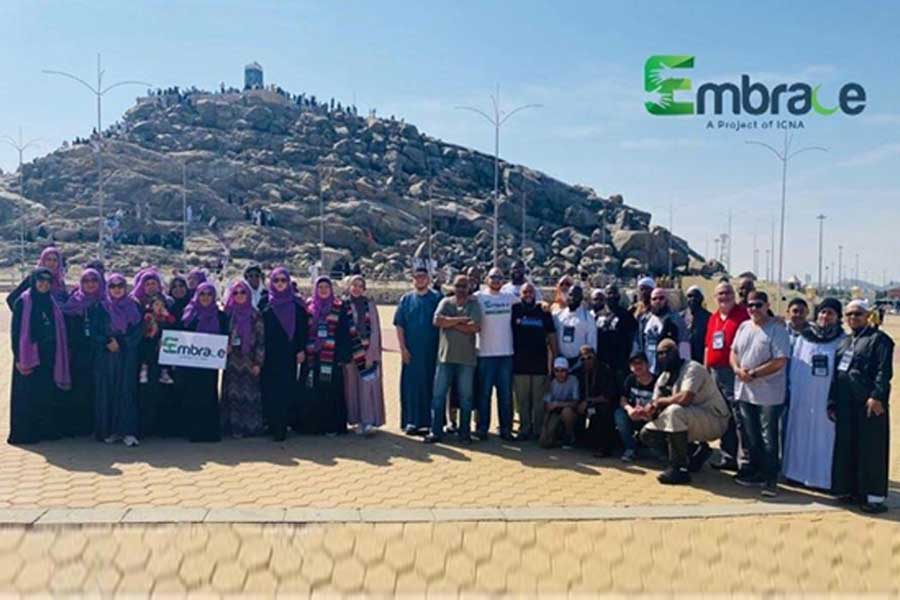
    Embrace: A Project of ICNA

    Embrace is a convert-led organization that focuses on supporting converts to Islam. Their mission is to empower, integrate, and serve our American Muslim convert community by providing social and educational spaces that encourage growth, shape their Islamic identity, and provide them with the tools they need for their lifelong journey. This organization was founded in response to the challenges and difficulties facing American Muslim converts. Studies show that 7 out of 10 converts eventually end up leaving Islam, returning to their previous religion. A primary factor for this alarmingly high turnover rate is the lack of belonging and support many American Muslim converts feel from the larger Muslim community.

    Umrah, a Transformational Journey for Converts

    Embrace partnered with “3 Puerto Rican Imams,” another convert-led organization, and Amax Travel to provide a life-changing Umrah trip specifically for American Muslim converts. This trip was conducted towards the end of February, 2020. Embrace wanted to provide an Umrah trip catering to converts during which they can grow spiritually and experience it with other converts who have similar backgrounds. This Umrah trip could serve not only as a spiritual experience but also as a community-building opportunity to develop friendships and connections that would last a lifetime. This is especially important as many converts develop feelings of loneliness and isolation as they try to navigate the many changes to their lives and lifestyles once they have converted. Additionally, Embrace wants to help converts become active members in their own communities, and even embrace leadership roles. As American-born Muslims, they can do much to help change the negative perspective of Islam in America. Through this Umrah trip, Embrace hoped to help converts learn the history and religious significance of the many venerable sites in Mecca and Medina. From there, converts could use their experiences and growth to further benefit their own local communities.

    The Umrah trip had over 40 participants, the vast majority of whom were converts to Islam. The group was diverse, some being Muslim for decades while others having converted more recently. It was an especially emotional journey for the more experienced converts who have been waiting nearly a decade or more for this opportunity. Sr. Karysa Gurwell, a Puerto Rican convert of 8 years, said that the connection to her Lord that she has been desperately craving had been so beautifully fulfilled through this trip. Br. Jeffrey Sykes, an African American convert of three years, explained that being able to share this journey with other converts who have been Muslim for one or two decades and might have been waiting long to experience Umrah, highlighted for him the value of the trip itself and how fortunate he was to experience it so early in his own journey of Islam.

    The trip was led by two American convert imams, Shaykh Gyasi McKinzie and Imam Wesley Lebron. These two imams were able to easily identify with the other converts and teach them from personal experience and from a perspective that converts can easily relate to. The two imams led discussions as the group visited multiple historical sites in both Medina and Mecca. Shaykh McKinzie pointed out to the participants that all of the companions at the time of the Prophet were converts to Islam like themselves. Participants really appreciated this point as it highlighted their own value in the contemporary Muslim community, as well as their connection to the earliest followers of Islam.
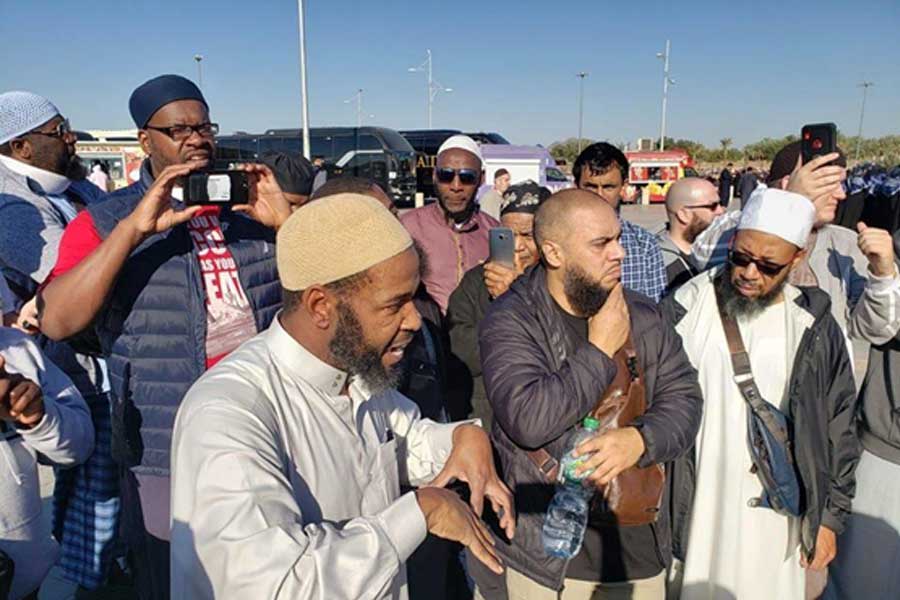
    Embrace-Umrah-2
    Shaykh Gyasi McKinzie (left) and Imam Wesley Lebron (middle) leading a discussion near Mount Uhud.

    Brother Malik Shaw, a longtime American Muslim convert, explained that converts do not typically get the opportunity to go to Umrah or Hajj with individuals of the same ilk. He expressed that it can be very difficult for converts to connect with other Muslims who may not completely understand the experiences and challenges that come with converting to Islam. Being able to share the experience of Umrah with those who can understand you, and can easily relate to you, makes the experience all the more impactful.
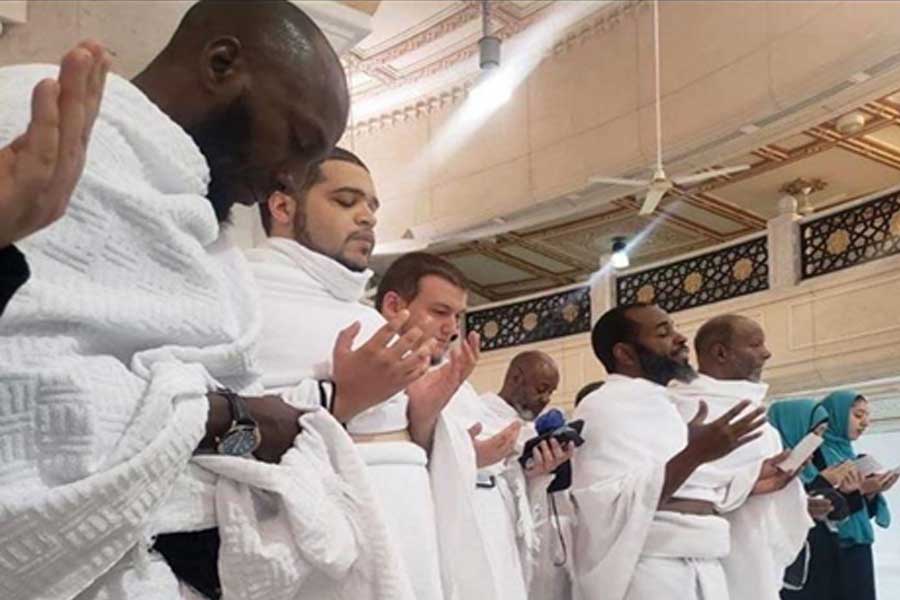

    The convert pilgrims making du’a at Mount Safa’ and Marwah

    The last day of the trip was very bittersweet for the participants. Before even leaving, everyone’s heart was yearning for an eventual return to Mecca and Medina. The participants felt extremely grateful and blessed for the unforgettable experiences they had and the powerful relationships they built. Heading back home after such a life-changing journey, everyone knew they were truly not alone, but connected in deep ways to those with whom they had shared their experience.

    Little did the participants know at the time of their departure that the Kingdom of Saudi Arabia would implement a temporary ban on all foreign Umrah trips due to the COVD-19 pandemic just a couple days after the Embrace Umrah trip ended. While unfortunate, this fact served to further increase everyone’s gratefulness for being able to experience this wonderful and revitalizing trip when they did.

    Kenneth Misurella is a co-founder of Embrace and its National Secretary General.
  • Hajj — The Journey of Preparation

    Hajj — The Journey of Preparation

    “For Hajj are the months well known. If anyone undertakes that duty therein, let there be no obscenity or wickedness nor wrangling in the Hajj. And whatever good you do — Allah knows it. And take a provision for the journey,but, indeed, the best provision is fear of Allah. And fear Me, O you of understanding” (Al-Baqarah:197).

    Hajj is full of many important messages but perhaps one of the most important messages of Hajj is“prepare for the hereafter!” Hajj begins with the pilgrims entering the state of ihram in which they are prohibited from having sexual relations, marrying, wearing perfume,and other worldly pleasures. Hence, from the time the pilgrims begin Hajj, the yare directed to minimize the distraction of their worldly concerns and focus intensely on preparing for the hereafter.

    Additionally, the standing on Arafah during Hajj reminds the pilgrims to prepare for the day when all of mankind will have to stand before Allah to be judged.The two pieces of white cloth worn by the male pilgrims remind them to prepare for the day when they will be shrouded in similar clothing after their inevitable demise.The timing of the Hajj reminds the pilgrims of the importance of preparing for the hereafter. The Hajj begins at a time of a heightened awareness of preparation. The Hajj takes place in the last month of the Islamic calendar and,naturally, as the year draws to a close, one instinctively begins preparing for the coming year and evaluating the previous years.

    During the performance of the rites of Hajj, the pilgrims are directed to reflect upon the obedience and submission(the core meaning of Islam) of Prophet Ibrahim (peace be upon him) and his family.This signals to the pilgrims that proper preparation for the hereafter is simply done by obeying Allah and adhering to Islam.Those who frequently think about preparation for the hereafter are blessed with swift repentance, satisfaction with Allah’s provisions, and active worship. Alternatively,those who don’t think about preparation are often at risk of delaying their repentance,dissatisfaction with Allah’s provisions, and laziness in worship.

    Unquestionably,preparing for the hereafter should be a believer’s greatest concern in life. Hence, the last pillar of Islam stresses preparation for it. Furthermore, the last verse of the Quran, the last message for mankind,according to Ibn Abbas (or one of the last verses according to others) tells us to be prepared for the hereafter.Allah says, “And be aware of the day when you shall return to Allah. Then every person shall be compensated for what they earned, and they shall not be dealt with unjustly” (Al-Baqarah:281).

    Gyasi Mckenzie is the Associate Director of ICNA Relief—South Central Region. He has a bachelor’s degree in Islamic theology from the University of Madinah and a master’s in theology from Vanderbilt University.

  • Hajj — A Journey of Faith Toward the Ultimate Truth

    Hajj — A Journey of Faith Toward the Ultimate Truth

    The journey of Hajj (Islamic pilgrimage) begins with niyah (intention), by cleansing the body and, for the man, wearing the ihram, two pieces of cloth without any stitchingordecoration on it. A woman wears additional garments in order to cover her awrah (the intimate parts of the body), as prescribed in the Quran. As the journey begins, the pilgrim declares the Talbiyah, the prayer of intention to perform the Hajj and doing so only for the glory of Allah: “Here I am at Your service, O Lord, here I am. Here I am at Your service and You have no partners. Verily all praise and all bounty and the sovereignty are Yours. You have no partners.”

    The obligatory rituals of Hajj commence on the 9th day of Dhul-Hijjah (the twelfth and final month in the Islamic calendar) by arriving at any point within the boundaries of the plain of Arafah in Makkah Al-Mukarramah (the holy city of Makkah) before sunset. Even if it is only for a moment, standing in Arafah on that day before sunset is the beginning of one’s Hajj. The next obligatory part of the journey continues immediately after sunset, the journey towards Muzdalifah, a large level area southeast of Makkah. At least one third of the night needs to be spent under the open sky at Muzdalifah. Then the pilgrim chooses the next part of the journey, either to go to Mina or to the Al-Masjid-al- Haram. Those who choose to go to Mina first will eventually have to go to Al-Masjid-al- Haram and continue the journey by tawaf (circumambulation) seven times around the Ka’ba,the House of Allah and the first masjid on the earth,built by Prophet Ibrahim. Upon completion of tawaf, the pilgrims continue the journey with a ritual named Saii, marching seven times between Safa and Marwa, two mountains near the Ka’ba. Part of the journey includes throwing stones at the jamarat, three pillars where Satan is said to be tied. In addition to these, at least three nights can be spent at Mina and a qurban,sacrifice, can be offered (not obligatory).

    In Hajj, each and every ritual is a reminder of a Muslim’s relationship with Allah. The ihram is a reminder of the return to the Rabb (Lord and Creator), as it is similar to the shroud that will be worn after death, for burial in the kubur (grave). Standing on Arafah is a reminder of Allah forgiving Prophet Adam and his wife Hawa, and where mankind began their journey on earth. Saii is the remembrance of the event when Hājar, the second wife of Prophet Ibrahim, accepted to stay in the middle of desert with her baby without any apparent supply of food or shelter, following the command of Allah. Spending a night in the desert of Muzdalifah under the open sky is a reminder of the minuscule existence of a human entity in the universe. Throwing stones at Jamarat is reminder of Prophet Ibrahim’s encounter of Satan and throwing stones to get rid of the Satanic influence so that he can obey Allah. The event of qurban is linked to Prophet Ibrahim’s intention to sacrifice his most beloved son for the sake of Allah.

    Thus, the journey of Hajj is a reminder of the concept of tawhid (oneness of Allah) in every dimension. The journey reminds us that Allah is the Creator of the heavens and the earth and everything in between, that only Him we worship and obey, and that to Him we all are bound to return. And a pilgrim declares that by reciting the Talbiyah as a testimony of surrender to Him at the beginning of Hajj.

    While performing Hajj, a pilgrim has utmost faith that Allah, the most Merciful and the Most Kind, will forgive all his past sins and will grant His blessings for success in the life hereafter. Those who are yet to perform Hajj, also have similar faith about receiving His forgiveness and blessings if they would have the chance to perform Hajj. Hence, while performing the rituals, every pilgrim dedicates their utmost and sincere effort to complete the journey without any mistakes,and an unintentional mistake is corrected by offering various forms ofkafarah(expiation).

    Faith and Dedication During Hajj Reflected in Daily Life

    Is the level of faith and dedication of a pilgrim during Hajj reflected in the daily life of a Muslim? Regardless of the pledge and effort we all make, we are bound to have shortcomings or sins in the ongoing journey of our daily lives. Besides, many of us might not have the opportunity to perform Hajj before we return to our Rabb. Therefore, the faith and dedication that a Muslim demonstrates while performing Hajj, i.e., having the journey to Arafah, Muzdalifah, Mina, Tawaf, Saii, and throwing stones at Jamarat, are meant to be observed every moment in the everyday life.

    To evaluate our level of faith in our daily life, compared to the level of faith that we have during the Hajj, let us exemplify saii, an important ritual of Hajj. Saii reminds us how Nabi (Prophet) Ibrahim and his second wife Hājar submitted themselves to the command of Allah (Quran, 14: 37). Based on human understanding or rationality, both Nabi Ibrahim and Hājar knew the absurdity of finding water, food, and shelter in the middle of that desert. Such facts, which are based on human calculation — observation or rationality — would force them to believe that the mother and the baby would not survive in the desert. However, their submission was guided by their faith in the oneness of Allah who creates everything out of nothing and that only He controls everything on earth and in the heavens and everything in between (Quran, 39: 62). Thus, their obedience to the command of Allah based on their faith in the ultimate truth demonstrates how Allah can contravene natural law, according to His will and pleasure, for He transcends the very laws of nature that He put in place in the universe. The obedience of Ibrahim and Hājar to His command also provides a lesson for all time about the beauty and power found in the depth of faith that a true believer possesses. That is the level of faith we should strive for in our daily lives.

    At various times throughout history, Allah sent a prophet and messenger to a particular ummah (nation, race, or tribe). All the prophets called their respective ummah toward tawhid, oneness of Allah (Quran 51:56). Thus, every prophet called for his people to accept and declare the same testimony of tawhid: “There is no god but Allah.” To live life on the right path, mankind has been reminded of the same ultimate truth again and again. A Muslim today must embark on the journey of life towards the ultimate truth. The reality of tawhid,oneness of Allah, is true in every aspect of the universe including human life. The testimony to that reality expresses that Allah is the Creator and sole master of everything in the heavens and earth and everything in between.
    Prophet Mohammad, like every other prophet before him, taught his ummah the ultimate truth,that there is no god but Allah. By accepting Mohammad as the last prophet and messenger of Allah, the people of his time accepted the oneness of Allah.Since then, those who have accepted this ultimate truth have been guided in their journey of life on the straight path; and those who denied this truth have remained astray (Quran 48:29). Those who accept the ultimate truth enter the sanctuary of Islam and become Muslim (Figure 1).Indeed, Allah asks every human being to become a Muslim before they die (Quran 3:102). Upon accepting the ultimate truth, a Muslim starts his journey toward full conviction as a believer (Mu’min), one who not only accepts and declares the ultimate truth but also acts accordingly.

    There are more than 80 verses in the Quran that command the Mu’min to lead their life according to the precepts of truth and goodness. In reality, not every Muslim can follow all of Allah’s commands in his lifetime. Despite the differences in the paths taken by Muslims for their journey toward the ultimate truth, everyone must remain determined to follow the command of Allah (Figure 1). At the same time, he or she must aim for excellence in performing their obligations and become a successful Mu’min (Quran 23:1-10). For example, such a successful Mu’min not only establishes salat, but also offers salat with due solemnity and full submissiveness, turns away from al-laghw (dirty, false, or evil vain talk, falsehood, and all that Allah has forbidden), and guards their chastity.

    Conclusion

    Hajj is a journey of faith toward the ultimate truth. It has its requirements, its rituals, and its rewards. It also has many important reminders for the believer that can be utilized to deepen iman, strengthen conviction, and imbue the Muslim’s devotion with meaning and purpose. Standing on the path toward the ultimate truth, with the faith and dedication of a pilgrim, an individual takes great care in determining what is right or what is wrong,what is good or bad, useful or useless, beneficial or harmful. Deep in his or her heart is the meaning and purpose of both the shahadah and the talbiyah —that we have full conviction that Allah is one, with no partners, that we are here to serve Him, and that any bounty we enjoy in our lives is from Him, and Him alone. And, finally, in His sovereignty, He alone is worthy of all praise.

    Acknowledgement: I gratefully acknowledge invaluable suggestions from Associate Prof. Dr. Raihanah Binti Hj Azahari (Academy of Islamic Studies, University of Malaya), Dr. Mohammad Bahawi (University of Jeddah), and Hatim Abdullah Natto (Umm-al-Qura University) in writing this article.

  • Hajj in the Bible

    Hajj in the Bible

    When many Jews and Christians view Islam from the outside, they find parallels to their own faiths that usually inspire a great deal of curiosity. These parallels are often doctrinal, sometimes regarding the biographies of Prophets shared between the three Abrahamic faiths like Moses and Jesus (peace be upon them). Yet, sometimes striking parallels are found by the more discerning eye. Deep inquests often reveal textual and lexical similarities that are difficult, if not impossible, to explain by mere theories of one tradition borrowing from another.

    The book of Exodus contains the following verse in reference to a Hajj in the time of Moses: “And this day shall be unto you for a memorial; and ye shall keep it a feast to the LORD throughout your generations; ye shall keep it a feast by an ordinance forever” (Exodus 12:14).

    As millions upon millions of Muslim devotees engage in the rites of the Hajj pilgrimage, one of the five pillars of Islam, we can peer into the terms used in this age-old practice that lead us to a time long before the Prophet Muhammad (pbuh) was even born. Let us look at the word al-Hajj itself. Typically, the entire Arabic vocabulary, like its sisters in the Semitic linguistic group, consists of words structured from trilateral tri-consonantal roots. In this case the root is hajaj. According to the classical Arabic lexicon Lisan al-Arab it is defined as follows: “Purpose. As in, ‘So-and-so did hajj unto us,’ which means he presented himself before us.”

    So the general lexical meaning of the word is “intended purpose.” In the context of the Hajj, the Ka`bah within the Meccan Sanctuary is the intended destination and purpose. To list usages of this word in an Islamic context would be, for most Muslims, an appeal to the very obvious as stories of its wonder and splendor that have been related to them since childhood. However, if we peer beyond the context of Islamic rites and deep into the past, do we find this word used in the previous traditions of the Old Testament? The answer is in the affirmative. The book of Exodus contains the following verse in reference to a Hajj in the time of Moses: “And this day shall be unto you for a memorial; and ye shall keep it a feast to the LORD throughout your generations; ye shall keep it a feast by an ordinance forever” (Exodus 12:14).

    In this verse, the King James translators rendered the uninflected noun Khag as “feast.” This word Khag is wholly cognate to the Arabic Hajj. Elsewhere in the verse the word Khag is inflected as khagotem and takhaguhu. One must pay attention to the fact that the Hebrew phonetic “kh” is the pharyngeal fricative “h” in Arabic. Also, one must note that the phonetic “g” is cognate to the Arabic “j.” So for analytical purposes in this context the verse would be rendered: “And this day shall be unto you for a memorial; and ye shall keep it a Hajj to the LORD throughout your generations; ye shall keep it a Hajj by an ordinance forever.” Another verse using this root is the following: “And afterward Moses and Aaron went in, and told Pharaoh, ‘Thus saith the LORD God of Israel, Let my people go that they may hold a feast unto me in the wilderness” (Exodus 5:1).

    “This Qur’an could not have been authored by any other than God, as it rectifies what came before it and elucidates what was in the previous scriptures. Let there be no doubt that this is, indeed, from the Lord of all Worlds” (Qur’an 10:37).

    The inflected word that the King James translators rendered “feast” is yakhugg? which is cognate to the Arabic “yuhajju,” so for analytical purposes the verse would be rendered in this context as: “And afterward Moses and Aaron went in, and told Pharaoh, Thus saith the LORD God of Israel, Let my people go, that they may hold a Hajj unto me in the wilderness.” This is not to suggest that Moses and Aaron went to Mecca and performed Hajj as Muslims know it today. It is merely to exemplify that a consecrated journey and pilgrimage unto God at His Temple did, indeed, precede the rise of Islam in the 7th Century CE. An additional and astonishing dimension to this that makes the concept of lexical borrowing between the Old Testament and the Qur’an improbable, if not outright impossible, is found in an alternate form of the root in Hebrew, Khug. Friedrich Wilhelm Gesenius (1846) defines this word: “To describe a circle, to draw a circle, as with compasses. Job 26:10…m. a circle, sphere, used of the arch or vault of the sky, Pro. 8:27; Job 22:14; of the world, Isa. 40:22.” Let us look at the verses he has cited:

    “When he prepared the heavens, I was there: when he set a compass upon the face of the depth” (Proverbs 8:27).

    “Thick clouds are a covering to him, that he seeth not; and he walketh in the circuit of heaven” (Job 22:14).

    “It is he that sitteth upon the circle of the earth, and the inhabitants thereof are as grasshoppers; that stretcheth out the heavens as a curtain, and spreadeth them out as a tent to dwell in” (Isaiah 40:22).

    Thus, this word not only means sacred pilgrimage and feast unto God in the Bible, it also means to encircle. To any Muslim this will be a striking discovery.

    Semitic languages have been, since time immemorial, broad and deep systems of expression where one word’s many variant, but supplementary, meanings all coalesce to a greater understanding of that lexeme. So in this case we have a root which has a form meaning a feast, also meaning a pilgrimage, and in one form meaning to encircle! The Hajj pilgrimage, which is at its core an encircling of the Ka`bah, called Tawaf, is concluded with none other than the Feast of the Sacrifice, Eid al-Adha, to commemorate Abraham’s willingness to sacrifice his son at God’s command. Borrowing all these meanings buried in lexica that did not even exist until hundreds of years after the life of the Prophet Muhammad (pbuh) would require nothing short of a Semitic linguist and Biblical scholar. It should be noted that the Bible itself would not be available until 200-300 years after the passing of the Prophet Muhammad (The International Standard Bible Encyclopedia, vol. 4, Geoffrey W. Bromiley, p. 982). Such lexical depth and lucidity is consistently found throughout the Qur’an as God has stated therein:

    “This Qur’an could not have been authored by any other than God, as it rectifies what came before it and elucidates what was in the previous scriptures. Let there be no doubt that this is, indeed, from the Lord of all Worlds” (Qur’an 10:37).

    —–Shibli Zaman—-

    Did Jesus (pbuh) personally claim divinity?

    The response to this question could be found in the following Qur’anic verses: “At length she brought the (babe) to her people, carrying him (in her arms). They said: ‘O Mary! Truly an amazing thing hast thou brought! O sister of Aaron! Thy father was not a man of evil, nor thy mother a woman unchaste!’ But she pointed to the babe. They said: ‘How can we talk to one who is a child in the cradle?’ He said: ‘I am indeed a servant of Allah. He hath given me revelation and made me a prophet; And He hath made me blessed wherever I be, and hath enjoined on me Prayer and Charity as long as I live; (He) hath made me kind to my mother, and not overbearing or miserable; So peace is on me the day I was born, the day that I die, and the day that I shall be raised up to life (again)!’ Such (was) Jesus the son of Mary: (it is) a statement of truth, about which they (vainly) dispute. It is not befitting to (the majesty of) Allah that He should beget a son. Glory be to Him! When He determines a matter, He only says to it, ‘be’, and it is. Verily Allah is my Lord and your Lord; therefore serve Him: this is a Way that is straight. But the sects differ among themselves: and woe to the unbelievers because of the (coming) Judgment of a Momentous Day! How plainly will they see and hear, the Day that they will appear before Us! But the unjust today are in error manifest! Warn them of the Day of Distress, when the matter will be determined: for (behold,) they are negligent and they do not believe! It is We Who will inherit the earth, and all beings thereon; to Us will they all be returned” (19:27-40).

    Actually, the Quranic verses cited above point out that Jesus, himself, proclaimed his humanity and that he was a servant of Allah and a prophet, clearly not divine. He actually rebuked the people who would develop those philosophical ideas after he is gone. An example is when Satan came to Prophet Jesus and tried to tempt him as it appears in the book of Matthew (4:1-11). Now the question is how can Satan tempt God? This is only conceivable if the person who is subjected to temptation is a human being and that is what Jesus spoke of. Also, on many occasions Jesus had gone to the wilderness or mountains to pray. Now what does it mean that Jesus is praying? He is praying to someone who is greater than himself. He is praying to his God and Lord, and in accordance to the definition of the Trinity this doesn’t make sense. Nobody prays to himself; so why would Jesus pray to himself if he was God?

    In the book of Matthew, Jesus denies any knowledge of the unseen or the last hour (24:36). Again the knowledge of the unseen is definitely one of the divine attributes and if somebody doesn’t know the future then he is not God – he is a human being. He may be pious, he may be a messenger, but he is not God. Additionally, the Gospel of Mark says that when someone ran after Jesus and said ‘Good Master’ Jesus would reply, “Why do you call me good? No one is good—except God alone” (10:17-18). Here this doesn’t mean that Jesus is not good but that goodness, in the absolute sense, is a divine attribute and that is not to be used as a description of him. In the Gospel of John, Jesus admits and says that “father is greater than I” (14:28), which is very clear evidence he never meant that he is divine and even denied it and clarified that he is simply a human and messenger of God. That is exactly what the Qur’an, 600 years later, confirms.