بسم الله الرحمن الرحيم

Tag: Fiqh

  • The Case for the  “Fiqh of Muslim Minorities”

    The Case for the “Fiqh of Muslim Minorities”

    Can a Muslim live a pious or just life in a society where Muslims are a minority? Some Muslims wonder. Some non-Muslims (especially some agenda-driven pundits and Islamophobes) also raise a question: Can Muslims be loyal citizens in the West? These questions may not be burning issues or the reflections of widely held views, but these are certainly present in our contemporary debates and discourses, and therefore, they deserve adequate attention and answer. Since the “Fiqh al-Aqalliyyat” or “Fiqh for the Muslim Minorities” deals with these issues, we have decided to make this subject the “cover story” for the current issue of The Message.
    It’s true that many medieval jurists viewed the world from a binary perspective—“Dar-ul-Islam” (Abode of Peace) and “Dar-ul-Harb” (Abode of War) and advised Muslims not to live in a non-Muslim land permanently. Their argument was that where Muslims are a minority, they live not only under non-Muslim political authority, but their environment also becomes surrounded by moral laxity and all sorts of transgressions. Therefore, Muslims have no choice, according to these jurists, but to migrate from a non-Muslim land to a Muslim land. Many scholars (both medieval and contemporary), however, contested and refuted this “fatwa” on the ground that in Islamic religious texts (i.e., the Quran and Sunnah), no clear divine prohibition on residence in non-Muslim land exists. As a matter of fact, sometimes the situation in the so-called “Muslim land” could be more hostile to the Islamic lifestyle than the “non-Muslim land.” The majority scholars thus view that if certain conditions are met, especially if the freedom to “manifest one’s religion” is present, residence anywhere is permissible.

    Fiqh Al-Aqalliyyat deals with the
    daily problems that arise for millions of Muslim individuals living in the West or in similar minority situations

    Sheikh Taha Jaber Al-Alwani has rightly pointed out that “the classical and medieval jurists ignored the need for a systematic formulation of the status of Muslims as minorities”. Today, among the 1.57 billion Muslims worldwide, at least one third of them—if not more—live as minorities, and many of them reside in the west. Among these western Muslims, many are actually native born and, therefore, there is no such place for them that they can “return” to. The challenge these Western Muslims (and the Muslim minorities elsewhere) are confronting today is how to ensure their integration in these societies without the loss of their religious identity. The good news is that Fiqh of Muslim Minorities seeks to provide that answer (or solution).

    Fiqh al-Aqalliyyat, to put it simply, deals with the daily problems that arise for millions of Muslim individuals living in the west or in similar minority situations. It tries to resolve conflicts with the culture and values of the host/native societies from within the framework of Islamic jurisprudence. According to Alwani, “It is not meant to give minorities’ privileges or concessions not available to Muslim majorities; on the contrary, it aims to project minorities as representative models or examples of Muslim society in the countries in which they live. It is the fiqh of model communities, elites, and a rigorous, rather than frivolous or concessionary, approach. Based on the rules and fundamentals of this fiqh, a number of parameters have been identified which may define our method in responding to questions from minority members” (Towards a Fiqh for Minorities: Some basic Reflections, IIIT: 2003, pp.3-4).
    This, however, is not to suggest that the ruling in two different situations will always remain the same. Since the ‘fiqh for the minorities’ as a discipline takes into account the relationship between the religious ruling and the conditions of the community and the location where it exists, obviously, the fuqaha take into consideration a ‘sensitive’ appreciation of the social context. While answering a question, the jurists carefully examine the wider social context in which this question arises, as well as the social implications of implementing the fatwa. Furthermore, “the fatwas should be guided not by a literalist reading of the sources of law, but, instead, should be shaped by the broader aims of the shariah (maqasid al-shariah), Islam’s missionary imperative as well as by the recognition of the fact that the shariah ‘permits all that is clean and wholesome and forbids what is harmful,’ and hence is ‘aimed at making life easier and more convenient.” After all, ‘the fulfillment of religious obligations is concomitant upon human ability’.

    At a time when the Muslim community (ummah) is passing through many challenges that require creative, sensitive, and sound answers, it’s a matter of great relief and hope that the Fiqh Al-Aqalliyyat is being applied to address some of those challenges. Fiqh of Minorities, therefore, could be considered not only as a legitimate and timely ijtihad for Muslims, but it’s indeed a window through which the rest of the world would be able to see the beauty of Islam as well.

  • Fiqh of the Muslim Minorities

    Fiqh of the Muslim Minorities

    “Fiqh of the minorities” (Fiqh al-Aqalliyyat) is a specific discipline that takes into account the relationship between the religious ruling and the conditions of the community, including the location where it exists. It is a fiqh that applies to a specific group of people living under particular conditions with special needs that may not be appropriate for other communities. The jurist in such a situation must not only have a strong background in Islamic sciences, but must also be well versed in sociology, economics, politics, and international relations relating to that community. The purpose of Fiqh al-Aqalliyyat is not to recreate Islam; rather it is a set of methodologies that govern how a jurist would work within the flexibility of the religion to best apply it to particular circumstances. Some of the methodologies include:

    Redefining the Question

    A wrong question can lead to a wrong answer. Before answering a question, the jurist must know the problem that caused the question and redefine the question to deal with the core issue involved. When the people asked the Prophet how the moon worked, their core issue was to understand its purpose. The answer came, “They ask you concerning the new moons. Say: they are but signs to mark fixed periods of time for people and pilgrimage” (Al-Quran, 2:189). The Quran reworked the question and answered regarding the purpose of the cycle of new moons, not regarding the scientific mechanism that runs it.

    Example #1: A questioner asks, “Is it forbidden (haram) for a Muslim woman to be married to a non Muslim, and what should one do?”

    The standard answer based on the Quran is that it is forbidden for a Muslim woman to be married to a non-Muslim, so she should be divorced immediately. However, in this particular case, the circumstances are as follows:

    The woman has just converted to Islam, and she has a husband and two young kids. The husband is very supportive, but is not at this time interested in converting. The woman was told immediately after converting that she had to divorce her husband of 20 years.
    Within these circumstances, the question should have been, “Is it worse for a Muslim woman to be married to a non-Muslim husband or for her to leave the religion?”

    The answer is that leaving the religion is much worse, so it is acceptable for her to continue with her marriage, and she is responsible before Allah on Judgment Day.

    Example #2: A questioner asks: “Is it forbidden to be involved in an un-Islamic government or institution?”

    The standard Fiqh answer would be that yes, it is forbidden, because you do not want to be corrupted by the system or be seen as supporting a corrupt system in front of other weaker Muslims who might be negatively influenced. However, in this particular case the circumstances are as follows:

    The government’s actions can be influenced by being involved in the system. The government has secular authority over the Muslims in that country and gives them the right to freely practice their religion. The Muslims are awarded by the government the right to hold public office. The government currently exerts laws and policies that are not in the best interest of the global or local Muslim community. The Muslims have the obligation of spreading their religion.

    With this information, the question must be redefined to reflect the totality of the situation: Is it permissible for Muslims to participate in the political arena of a democratic government in order to affect policy in favor of the Muslims, or is it better to not get involved for fear of being corrupted by the system?

    Under these circumstances the answer is that it is permissible and an obligation on the part of the Muslim community to get involved as long as they are not forced to sacrifice their integrity. For the community, it would be considered a type of jihad. If a particular member of the community feels himself/herself to be too weak in religion, then there is no harm if that person does not directly participate, but supports financially or in other ways instead.

    Learning from Prior Rulings

    The golden rule of Fiqh is “changes of Al-‘Ahkam (judgments) are permissible with the change in times.” The schools of fiqh and the past judgments were different because they were generated for different times and different people. For this reason, a jurist should not apply prior historical rulings to modern situations without a careful analysis of the circumstances and reasoning that generated the prior ruling.

    For example, the Prophet (pbuh) first forbade visiting cemeteries; then he allowed it later saying, “Formerly, I forbade you from visiting cemeteries. You may visit them for they remind you of Al Akhira (i.e. the next life). The reason is that there were some bad pagan customs surrounding cemeteries, and he wanted to distance his people from that. After a time when the Muslims were stronger in their belief, the restriction was no longer necessary, so it was removed. Indeed, there are many documented cases of the four enlightened caliphs making changes to the established rulings. Occasionally, minor or major changes were even made to the rulings of the Prophet (pbuh), because the circumstances had changed.


    Things to keep in mind regarding the early Jurists rulings:

    Many early scholars did not thoroughly document how they arrived at rulings.

    Many mistakes are found in historical books on fiqh because the jurists did not always have access to all of the relevant material. It has been only recently that jurists have been able to make computer searches to speed up research on issues.

    The Muslims were not under conditions such that they had to escape to non-Islamic countries seeking lost rights or escaping from persecution.

    The concept of citizenship, duties of a citizen, international law, and diplomatic relations did not exist in the form that they are today.

    In ancient times, the language of military power was supreme. A country’s borders were only established because the military found it difficult to move forwards.

    Globalization did not exist. People in ancient times lived on a planet of islands.

    Therefore, we should not fight each other over the literal rulings of the past. Rather, we should study the methodology, wisdom, and intent of the prior rulings to best understand how they should apply to the modern world. The mere stress on minor issues of rulings without understanding intent will inevitably cause us to become like the people of “Al-Baqarah”.

    Understanding the Purpose and Intent

    The central theme of fiqh is: the performance of man as inheritor of the earth particularly from the point of view of man’s compliance or resistance to the divine purpose of the creation and how he falls short of that purpose. The debate regarding the realties of man’s mind and our abilities to evaluate ourselves independent of revaluation has gone on for centuries. Islam recognizes the role of the human intellect as part of the decision-making process. Also, we are provided with two books to help guide us in our decisions, the revelation (Quran) and the moving cosmos, which is the sum total of all aspects of life. The study of each book leads to a better understanding of the other. Some of the criteria for the method of study that emerge to facilitate a better understanding of ultimate purposes are:

    Realize the unity of message and structure within the Quran and studying its application by the Prophet (pbuh) in specific practical everyday matters. We should hold everything to the benchmark of the Quran. If a saying does not appear to be in keeping with the Quran, we should follow the Quran in such circumstances and simply acknowledge that we might not have all the information surrounding that Sunnah (i.e. the circumstances that generated it).

    Be in line with the concept that the Quran and the Prophethood in general are a completion of the legacy of past prophets. The message and purpose have always remained the same but the form has changed as human society has matured.
    Grasp the delicate differences between humanity and the individual and how the Quran relates to each.

    Be alert to the inherit logic of the Quran and the parallel nature of that logic for both capturing the divine purpose and the spiritual logic of the All Knowing, and yet speaking to and being logical to the unlettered human mind.

    Adopt the Quranic concept of geography on the basis that the world is completely for Allah, and so the Quran is inherently a global message and should be treated and understood as such.

    Contemplate the facts of life, so that when a question is formulated, it is done while taking into consideration all aspects involved.
    Understand the aims and purposes of the Shari’ah as well as the resulting outcomes.

    Test the fiqh verdicts to evaluate their validity by seeing if they provoke the desired outcome of bringing people closer to the pure path of Allah.

    A Fundamental Rule in Relations with Others

    The following two Quranic verses express the golden rule defining the relationship between Muslims and others:

    “God does not forbid you to be kind and equitable to those who have neither fought you on account of your religion nor driven you from your homes. God loves the equitable. But God only forbids you to be allies with those who have fought you because of your religion and driven you from your homes and abetted others to do so. Those that make friends with them are wrongdoers” (Al-Quran, al-Mumtahanah: 8-9).

    These two verses set out the moral and legal foundation principle with which the Muslims must comply in their dealings with people of other faiths: kindness and justice towards all non-belligerent communities. All developments and new situations must be judged according to this principle. The relationship between Muslims and non-Muslims cannot deviate from the main framework.

    Forbearance

    Even if the Muslim minority’s proactive participation with the majority should entail certain courtesies that may blur or dilute some aspects of the minority’s behavior or qualities, other than the fundamentals of its faith, it would be acceptable and pardonable because without such participation a greater good would be forfeited. This is not a new situation for Islamic fiqh. It was something that Muslim scholars have tolerated ever since the end of the era of the first four caliphs. Muslims were facing two choices: affirmative participation with certain concessions demanded by the reality of the prevailing tyranny or passive association and withdrawal, leaving the Ummah easy prey for tyrants. They opted for the former because of what they knew of Islam’s positive and flexible attitude.

    The Example of Abyssinia

    The example we have of Muslims taking refuge in another country to protect themselves and their religion is the emigration to Abyssinia. Like today, the Muslims at that time were being persecuted in their homeland, and the Prophet (pbuh) sent them to Abyssinia because their rights would be protected there.

    The Quraish (the leading tribe of Makkah) sent two emissaries to make a plea before the Abyssinia king Negus to return the refugees back to Quraish. Negus, however, was not about to make a judgment on people in absentia. So after hearing the arguments of the emissaries (Amr, and Abdullah), he asked to hear the defense of the Muslims. When Negus’s messenger informed the Muslims of Negus’s decision to hear them, they had a discussion amongst themselves and decided to stick to the truth no matter what. They also agreed upon Ja’far ibnu ‘Abi Talib as a spokesperson.

    When they came before the King, the Muslims didn’t bow to the king, and when asked, they explained that they only bowed to Allah. Then Jafar said, “O King! We were a people in ignorance, we worshipped idols, rejected kin, abused our neighbors, and the strong among us oppressed the weak. We continued so until Allah sent us a prophet from among us. He invited us to worship the one God, leaving the idols of wood and stone, and to tell the truth, guard the trust, to keep good relations with both family and neighbors, to give charity. We have come to your country, chosen you and not anybody else, and desire being near you, and hope that we would not be treated unfairly in your audience, O king.”

    The king was impressed with the Muslims argument and granted them “political asylum”. During their stay, they developed very strong relations with the Negus and his people, and when his throne was challenged, they prayed for him. Umm Salamah said, “We prayed to God to help the Negus prevail over his rivals and confirm his rule in his country.” The logical consequence of that relationship was that the Negus eventually embraced the religion of Islam.

    Some lessons to learn

    We should drop concepts like Darul-Islam and Darul-Kufr and consider all land to be for God as the Quran says:

    “Moses said to his people: “Seek support from God and be patient, surly the earth is God’s to grant to the servants of his choice, and the best is for righteous” (Al-Quran, 7:128).

    Existence of Muslims in any country should be planned on the basis of being permanent, not temporary or accidental. They (Muslims) must be a contributing factor to the society, should work together within the established system to better their position as long as they do not get so carried away that they sacrifice the core pillar of their religion.

    We must present Islam in our words and deeds in the best possible way so that we gain the interest and respect of those around us.

    Concluding Remarks

    Fiqh relating to Muslim minorities is essentially derived from the general fiqh of Islam as a whole. It is in a similar category to the fiqh of fundamentals, priorities (al-awlawiyyat), contrasts (al-muwazanah), or realities, or to comparative fiqh, or the fiqh of ethics, etc. Accordingly, although this branch of fiqh includes several aspects of the general fiqh, it focuses specifically on issues affecting Muslim minorities living among non-Muslim majorities and endeavoring to preserve their identities under somewhat different customs, legislation, and laws.

    “Fiqh for Minorities” is a collective discipline and should not be practiced on an individual basis. It is multifaceted, with differing aspects that render any individualistic approach potentially perilous. It comprises political, economic, cultural, social, and legal elements. The fiqh side of it requires appropriate treatment of facts and issues. No treatment can be correct without consideration of all aspects of the matter in question, a task that cannot be completely fulfilled by a single individual. It requires the collective input of several scientists and specialists from different social and religious disciplines. These people need to scrutinize and study the issue from all angles, especially those of a general nature, that affect the future of Muslim minorities in order to articulate the problems accurately and seek their solutions in fiqh. Indeed, the fiqh derived for these cases should not be based on partial evidence or facts commonly approved by jurists, but should be broadly based on the universal fundamentals of the Quran and Sunnah, as well as the established values and objectives (maqasid) of the Shariah.

    Finally, what we have said so far regarding the fiqh of Muslim minorities is a mere introduction—it is intended to provoke interest in issues peculiar to Muslim minorities. Since this fiqh is open to debate and discussion, so should be its development, the documentation of its literature, and the elaboration of its means, methods, and tools. The author will be happy to receive from readers any suggestions or comments that may assist in further research and analysis.


  • Fiqh of Minorities: What Does It Deal With?

    Fiqh (jurisprudential understanding) of Minorities is a contemporary terminology for issues that were discussed and presented by earlier fiqh scholars in a widely scattered form. The breadth of this term spans across intrapersonal issues as well as ibaadah (worship) matters. The following is a list of examples of topics covered by the Fiqh of Minorities:

    Intrapersonal Issues: family matters, marriage, divorce, inheritance, wills, rights and duties of husband and wife, childcare related issues, extended families, convert Muslims, interfaith marriages, etc.

    Ibaadah Issues: prayer timings, Jumu’ah midday prayer timing, combining prayers, praying in a vehicle, Qiblah (praying direction), Zakah (alms-giving) distribution, nisaab (Zakah threshold), tax evasion, insurance, compensation and wages, social welfare, traveling without a mahram (unmarriageable kin), halal zabeehah (animal slaughtering), interfaith dialogues, joining the military, participation in civic and political activism, janaazah (Islamic burial and funeral) matters, traditional and cultural norms and conflicts, citizenship, legal disputes, moon sighting, co-ed education, difference of opinions, schools and sects, etc.

    The general details of these issues are not new, though specific circumstances may vary, but many contemporary scholars saw to it that the Masaa’il and Ahkaam (fiqh questions and their decrees) be extracted from the older text of fiqh and be compiled under one heading. Thus, this would allow for easier understanding, study, analysis, and synthesis of the many challenges faced by the practicing Muslims living as minorities. It would also allow for easier focus on their specific circumstances and their special needs within their cultural subtexts. In addition to recompiling previous decrees, the new Fiqh of Minorities would allow for developing and establishing new relevant decrees while fulfilling the following conditions:

  • Extracting decrees from the sacred texts within established and existing frameworks;
    Remaining mindful of the conditions and capabilities of the subjects of the decrees and establishing suitability;
    Understanding the context time and locale to address the challenges, and as such, the hukm (singular of ahkaam: decree) may vary from one context to another.
  • It is worthy of noting that in Usool-ul-Fiqh (jurisprudence), takleef (duty or imposition) is the implementation of hukm on a subject; however, there are numerous causes for exception or forgoing of enforcement, such as nisyaan (forgetfulness or mindlessness), jahl (ignorance), al-aafaat as-samawiyyah (the natural disasters), daroorah (necessity), ikraah (compulsion) as well as the expected outcome of living in non-Muslim countries, such as new acceptance of Islam, living where Islamic knowledge is not readily available.
    Additionally, urf (norms or culture) plays a major role in shaping the context of the enforcement subject as well as the application of text, which varies from one time, place, and people to another. For example, certain traditions have established a set of objects or things as Islamic symbols; i.e. green color or the crescent. The term musallaa (place of prayer) meant the one place where all people of a locality gathered for an Eid prayer congregation, yet musallaa now refers to a to a smaller, rented or otherwise impermanent place or hall for daily prayers, while a Masjid refers to a permanent entity. As per varying urf practice, a Masjid may only be used for just praying or it may be a hub of numerous activities and services.

    Fiqh is the science of deriving and extracting practical application and rules from the authentic sources for the implementation by the masses of Muslims

    Reality on the ground and local needs of every place are also incorporated in shaping of the Fiqh of Minority jurisprudence and developing the applicable ahkaam from it. The fundamentals and sources of derivation remain agreeable and firm while the application and the details vary. For example, it is allowed to miss a jama’ah (congregation) for the prayers in poor weather conditions, but what counts as bad weather will differ with different locales, and as such, the ahkaam defined and derived will vary as well.

    An important and more controversial issue is related to the division of different countries, states, and areas in different categories and zones by our earlier fiqh scholars; e.g. Dar-ul-Kufr (a non-Muslim or disbelieving state) and Dar-ul-Islam (an Islamic state). This is a fiqh-related issue as well an ijtihaadi (Islamic exegesis) matter. It is important to consider the following points with respect to the categorization of world zones: a. it was introduced in Madinah while the Prophet (pbuh) did not establish it in Makkah; b. the classification cannot exist independently from an existence of a Dar-ul-Islam, which itself has a strict definition and it differs from Dar-ul-Muslimeen (a Muslim state, exclusive or predominant); c. in the present time, this division is not existent and unsuitable, especially in the sense of a Dar-ul-Harb (a warring state). In fact, other categories may be more applicable, such as Dar-ul-Amaan or Dar-as-Sulh and Dar-ad-Da’wah; d. presently, numerous non-Muslim countries have opened up doors for all for citizenship, and they provide equal rights, freedom of faith and association for Muslims and others. The development and advancement of the Fiqh of Minorities will continue to lead towards more relevant and refined classifications and more suitable ahkaam will be derived therein.
    Some scholars have disagreed with the new terminology given to the Fiqh of Minorities because that term has not been used in the past, but differing about terminology is no cause to overlook the necessity and applicability of this embranchment. As the Usool-ul-Fiqh scholars have stated: “No Quarrelling over Terminology”.

    Fiqh of Minority is a step in the right direction and it can help the Muslims deal with the ever-growing challenges faced by Muslims living as minority communities

    Fiqh is the science of deriving and extracting practical application and rules from the authentic sources for the implementation by the masses of Muslims. It seeks yusr (ease) while maintaining balance and keeping extremism away, which leads to fanaticism and disorder. Fiqh is a tool for attaining wihda (unity) as well when understood and applied correctly. It establishes the framework of prioritization, major issues ahead of minor ones, as well as a logical classification level of application, such as wajib (obligatory), sunnah (recommended), mubaah (allowed), makrooh (distasteful) and haraam (prohibited). It also provides guidelines for coexisting and maintaining amicable relations with each other while differing on details. Conflict emerges with faulty understanding of fiqh, mixing of fiqh’s practical rules with aqeedah (creed and belief) matters and with not establishing the priorities correctly.

    Fiqh of Minority is a step in the right direction and it can help the Muslims deal with the ever-growing challenges faced by Muslims living as minority communities while remaining faithful to the practice of Islamic teachings along with a better appreciation and acceptance of accepted differences of opinion amongst themselves.

    Fiqh of Minority may also serve as a great dawah (calling to Islam) tool, develop characters of individuals to cope with societal needs and challenges, and to organize the collective lifestyle and focus towards moral excellence. It is one way to show humanity that Islamic framework adapts to the challenges of all times and places and it provides a remarkable solution for all.

  • Fiqh of Muslim Minorities: Necessity or Innovation?

    Q: There is a scholarly difference nowadays as to fiqh al-aqalliyyat or the fiqh of Muslim minorities. Some scholars regard it as an innovation that manipulates Allah’s religion, and some others consider it a lawful necessity. What is your point of view on that issue with special reference to the concept of fiqh al-aqalliyyat itself? What is the nature of the scholarly difference in that regard?

    A: In the first place, we’d like to note that any person with a sound intellect agrees that the Shari`ah aims at removing hardship from people and giving them solutions to their problems regardless of their places and locations. In countries where Muslims represent the minority and are, therefore, not under the rule of an Islamic government, they may face lots of problems that they have to solve in order for their life to go smoothly. These things they face are totally unlike those that are in the Muslim countries. Here comes the role of the Shari`ah to provide solutions for their problems and to answer their needs. Fiqh, in its very nature, is mainly concerned with finding solutions to people’s problems and making their life easy in the shade of the Shari`ah. In no way does this mean transforming the basics of religion or changing its pillars. We cannot say, for example, that people living in a country where they represent a minority do not have to perform a certain Prayer. Rather, they are required to observe their religious duties. However, the nature of the place, the surrounding environment, and the system may require some solutions to be produced under the general objectives of Shari`ah, which is mainly concerned with maintaining the five basic things: life, religion, reason, lineage, and property.

    Thus, in quest of achieving these general objectives of the Shari`ah, the role of ijtihad appears to produce new solutions, which culminate in the new but not new fiqh of Muslim minorities. Thus, the fiqh of Muslim minorities cannot be regarded as an innovation.

    The fiqh of Muslim minorities is not an innovation. The earlier books of jurisprudence have tackled many rulings peculiar to the Muslims who live in countries that do not adopt Islam.

    It is a necessity that Muslims [in non-Muslim countries] are in need of. Its rulings are in conformity with the criteria that scholars consider as to jurisprudence in general. Responding to the question, Sheikh Muhammad Al-Mukhtar Al-Shinqiti, Director of the Islamic Center of South Plains, Lubbock, Texas, states the following: “Jurisprudence is different from Shari`ah in that sense: Shari`ah refers to the revealed religion as a whole, while jurisprudence refers to how the rules of Shari`ah are to be applied from the points of view of the jurists. Hence, there is nothing wrong in having jurisprudence that deals with the issues and conditions peculiar to the Muslim minorities in non-Muslim countries. There are many aspects of difference between the conditions of the Muslims who live as minorities in non-Muslim countries and those representing the majority of the population of the Muslim world. With this in mind, we are to take into account also that jurisprudence always takes into consideration the difference in the elements of time and place when it comes to prescribing rulings. Thus, the fiqh of Muslim minorities is not an innovation. The earlier books of jurisprudence have tackled many rulings peculiar to the Muslims who live in countries that do not adopt Islam. It is only the term given to such rulings, i.e. “Fiqh of Muslim minorities” that is innovated, and there is nothing wrong in changing terms. The scholarly difference referred to in the question in hand may be, rather, considering mixing up jurisprudence with Shari`ah in people’s minds. There is no Muslim scholar who can agree to having a Shari`ah or Islam peculiar to minorities. So, jurisprudence is not involved in the difference.” Moreover, Sheikh Taha Jabir Al-`Alawani, former chairman of the Fiqh Council of North America, adds: “Fiqh of minorities is not to be regarded, as it is common nowadays, as dealing with minor juristic issues. It is, rather, to be handled within the comprehensive outlook of jurisprudence that tackles all aspects of religion in the sense which the Prophet (peace and blessings be upon him) referred to when he (peace and blessings be upon him) said: “If Allah wants to do good to a person, He makes him comprehend the religion.” Hence, it is important to consider the fiqh of minorities as a considerable branch of jurisprudence in general in order to put it in its suitable framework, and in order to deal with the issues peculiar to the Muslims living in non-Muslim countries that have not been given certain rulings in Shari`ah. To sum up, the fiqh of minorities is concerned with the legal rulings regarding the issues that concern the Muslim communities living in non-Muslim societies. Considering the different conditions of these communities, we are to bear in mind that the legal rulings applying to them are not applicable to the Muslims living in the Muslim world. Furthermore, he who deals with such branch of jurisprudence is also to have knowledge about the sciences of sociology, economics, politics, and international relations.” Finally, Sheikh Muhammad Nur Abdullah, former President of ISNA and Member of the Fiqh Council of North America, concludes: “Fiqh al-aqalliyyat has arisen in request of Muslims’ state of affairs as a minority in a non-Muslim country and not as a majority living in a Muslim country. The needs of Muslims living in a non-Muslim country, as well as their conditions and circumstances, may differ from other countries where Muslims live as a majority. In this case, the rules of Shari`ah that are not decisive can be adjusted in a way that suits them and never puts hardship on them. For example, voting for political parties in Muslim countries is completely different from non-Muslim countries, because in the former case Muslims have Islamic parties as an option, whereas in the latter case they do not exist. In this case, some Muslims might get confused that this can go under the category of taking non-Muslims as patrons in a way that is not sanctioned by Islam. However, under fiqh al-aqalliyyat, this is understood in another sense that Muslims should vote for the party that serves their issues the best. Globalization has played an important role in bridging the gap between people and has facilitated the means of communication. However, the daily conditions of Muslims differ from one country to another. That is why Muslims in non-Muslim countries need this kind of fiqh.”

    Allah knows the best.
    [This question was asked by Ameen from U.K. and was answered by the scholars at Islamonline.net].

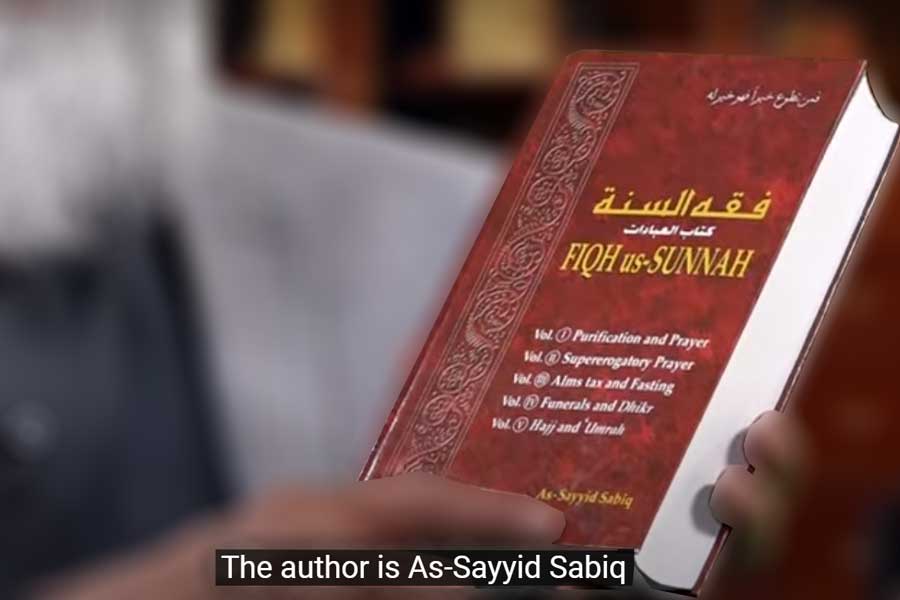
  • Sh. Sayyid Sabiq: A Living Encyclopedia of Fiqh

    Sh. Sayyid Sabiq: A Living Encyclopedia of Fiqh

    The Scholar

    Shaykh Sayyid Sabiq was a great Egyptian Muslim scholar who left a profound legacy to the world in the field of fiqh studies, having written one of the most popular and widely used Islamic books in the world today.

    He was born in 1915 in the Egyptian Nile Delta region, where he memorized the Holy Qur’an by the age of nine and pursued a formal education in Islamic studies that culminated in his attendance at the prestigious al-Azhar University. He spent his early years under the tutelage of Shaykh Mahmud Khitab al-Subki (died 1352/1933), who was his greatest teacher, and he, in turn, was his most distinguished student. He graduated from the Faculty of Shari‘ah of al-Azhar in 1947 and continued higher studies thereafter.  He then served in various capacities at al-Azhar-affiliated institutions before moving to Saudi Arabia to teach at Abdul Aziz University in Jeddah and Umm al-Qura University in Makkah. During his broad academic career, he taught and trained generations of scholars in various countries and oversaw the publication and dissemination of hundreds of articles and scholarly dissertations.

    But Shaykh Sabiq was more than just a scholar. He was described as one devoted to worship, especially prayer and fasting, and possessed a sharp and witty mind along with a strong memory and exceptional intelligence. It is said that when he spoke, even dignitaries and scholars listened attentively without interruption. He also had a keen interest in, and deep knowledge of, the affairs of the Muslim world, adding a dimension of relevance to his lectures and written works that is often missing from the works of more traditional scholars.
    He touched the lives of many over the years, and his more famous students included Shaykh Yusuf al-Qaradawa, Dr. Ahmad al-‘Assil, Dr. ‘Abdul-Satt?r Fathallah, the Imam of the Haram in Makkah Dr. Salih b. Humayd, and countless others. Among his contemporaries who relied on him for reference and support were the likes of the late Grand Imam of Azhar, Shaykh Mahmud Shaltut (died 1963), the popular author and scholar Muhammad al-Ghazali (died 1996) and the author Muhammad Ab? Zahr? (died 1974).

    His work did not go unnoticed on the world stage. He received a Medal of Honor in Egypt in 1992 and the King Faisal Prize for Islamic Studies in 1994. His works have been translated into most languages and disseminated widely throughout the Muslim world.

    He spent the last three years of his life in his native Egypt, where he continued to teach and lecture in various mas?jid until his death at the age of 85, in Dhul Qa‘dah 1420/ February 2000.
    It is said that fiqh was a closed door for the masses that was opened by him in our times. He was described by a contemporary scholar as a “living encyclopedia of fiqh.”

    The Text

    Since its publication more than half century ago, this simple textbook of fiqh entitled Fiqh al-Sunnah, has enjoyed a remarkable popularity and acceptance in the contemporary Muslim world that appears to be unrivalled. Though several works exist with this title, its name evokes only one author. This popularity stems partly from the nature of the work and its intended purpose: to serve as a comprehensive manual of fiqh, written for the common person in modern times, and written in a comprehensible style. It is equally useful for the average person with little background in fiqh and for the more advanced students of the Islamic sciences. It has been the subject of numerous commentaries and discussions.

    The book presents the practical fiqh rulings, organized topically and in a comprehensible format, along with the evidences for the rulings. Exhibiting an independent mind, he is yet free of fanaticism. He presents the strongest opinions based upon the evidences on many issues. Because it is based so heavily on Qur’an and Hadith texts, it reads at times more like a work of Had?th in the tradition of the Muwatta’ than a traditional fiqh work.

    The work represents a part of the rich tradition of comparative fiqh works, and draws heavily on the works of Ibn Qudamah al-Maqdisi, Ibn al-Qayyim, al-Shawkani and al-Sanani. His contribution to the field has been in making fiqh both relevant and accessible to the modern world.

    The Era

    The author was born at a time which could be characterized politically as the post-colonial era in the Middle East.  Many divergent ideas and movements were emerging to reassert the newly independent Muslim nations and societies, including Arab nationalism, socialism and communism. More importantly, from the perspective of the Muslim ummah, this period also represented the height of the Islamic revival period, a time of renewed intellectual vigor and interest in turning to the traditions and teachings of Islam for solutions to the world’s problems. Shaykh Sayyid, who died in 1420AH/2000CE, represents one of the premier fruits of the Islamic revival and the Islamic movement, and his work has left a mark on us all.