بسم الله الرحمن الرحيم

Tag: family

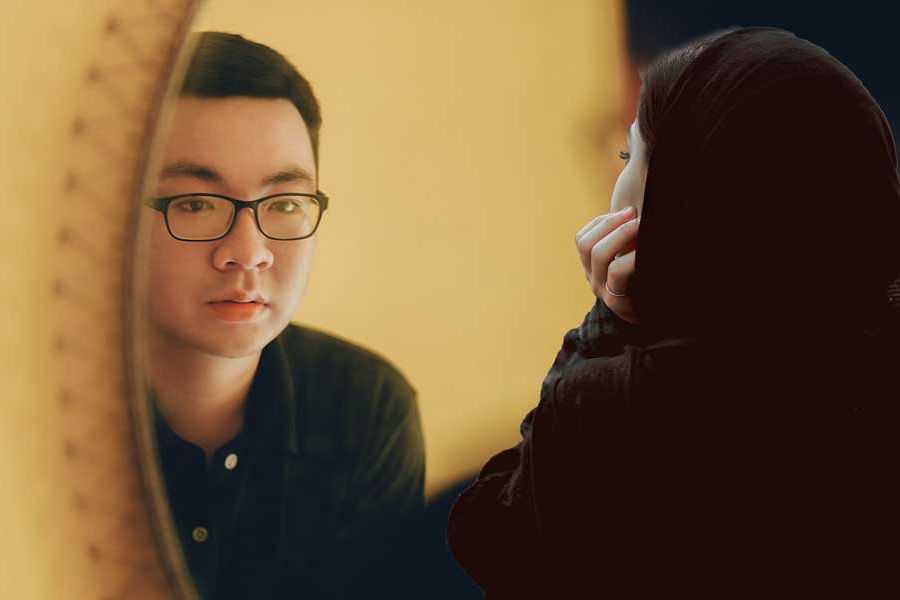
  • The Ultimate Human Mirror: Your Spouse

    The Ultimate Human Mirror: Your Spouse

    A marriage brings together two souls. Two families. Two worlds. It’s often portrayed in film and popular culture that these two individuals are opposites, yet they are brought together under the (naive) belief of “opposites attract.” Sometimes the differences are depicted as having opposite career paths, diverging personalities, or even differing belief systems. In those storylines, we see a battle in which one spouse attempts to assert his or her principles and lifestyle choices over the other. Maybe the outcome results in harmony, or maybe it ends in dysfunction. In either scenario, we are taught the message that it’s okay if your spouse doesn’t mirror you.

    As a Muslim, the question I aim to answer when thinking about compatibility in a spouse is this: to what degree does my potential spouse need to be at the same level of religious practice as me? If Allah is pleased with my actions and efforts to fulfill my deen, do I absolutely need to find a spouse who is also doing so? Can they be a good person, but not be as devoted to daily practice as I am? In answering this question, I hope to guide single Muslims who are seeking a spouse and trying to determine what to search for in terms of a potential’s religiosity.

    What If They’re Not as Religious as Me?

    When I was on my search for a husband, I often got stumped with this question. I would meet an eligible Muslim bachelor, someone around my age who had a solid career, similar education background, and similar interests as me. We would have conversations that were easy, fun, and fulfilling. I would often step away from those initial phone calls, or meetings, thinking, “wow, I would love to get to know this person better.” However, the very next meeting or two, when we were comfortable enough to get into serious questions about religion, I would discover that we were at very different levels of practice. Usually, the men I met were still trying to get all five prayers in during the day. They didn’t make reading the Qur’an part of their daily or weekly habit, and they often missed out on Jummah when it didn’t fit into their work schedule. One guy, in particular, told me he was too afraid to pray at work, and so he would make up two or three of his salats in the comfort of his home. I on the other hand, was busy trying to attend as many halaqas a week as possible, take classes to work on my tajweed, and was bold enough to pray at work or even in other public spots like the library or the park.

    When I assessed my religious practice, I realized I just wasn’t at the same level as many of my suitors. I would go back to them and ask questions about how they intended to improve, or if they even wanted to. Sometimes the answer would be yes, absolutely, and I want my spouse to inspire me to do better, and sometimes it would be I’m happy where I’m at and I don’t want anyone to change me. Either response just wasn’t good enough. I realized we weren’t at the same level of religiosity. Admitting that made me feel icky, because I feared that I was unfairly judging someone and that such a judgment was only to be done by the Almighty, Himself.

    In trying to find some support for my decision to move on, I relied on Islamic principles that taught me about the importance of establishing relationships where you can grow your Islam. Understanding the concept of suhba was part of my enlightenment. Suhba, understood to mean companionship, or the development of relationships, forming good company, is what all Muslims should strive to foster. Although the principle of isolation can be a tool used to reflect on the greatness of God and His beautiful religion, suhba, or righteous company can also have the same, if not stronger, effect.

    Your Spouse Should Be Your Mirror

    Evidence for this concept is found in the hadith “A believer is the mirror of his brother” (al-Tirmidhi). The more time you spend with a fellow Muslim, the more likely you are to pick up their religious habits. That’s why Islam encourages us to surround ourselves with righteous companions so that we may increase our chances of having good religious practices. That hadith has its literal meaning by mentioning “his brother [in faith],” but the meaning extends of course to any believer, including our spouse.

    As Muslims, the most important factor that we aim to find when seeking a spouse, is good deen. Although we are given lessons from the Sunnah that tell us we may use wealth, beauty, or lineage as a starting point for selecting a spouse, it is attraction to a person’s religion that is unequivocally the most important. This is the ultimate litmus test for compatibility.

    A marriage, if done properly, involves two people that connect with their mind, body, and soul. In the Qur’an, in Surah Baqarah, verse 187, Allah describes the spouse as “a garment” to emphasize the comfort, protection, and multiple layers of closeness you will obtain with your spouse. If it is understood that our spouse is meant to be so closely connected to us, it can only be that their spirituality and attention to their deen is also intended to be closely related. If one spouse wakes for Fajr, the other should do the same. If one spouse is mindful of using foul language, the other should be mindful of doing so too. The day-to- day religious practices we engage in should be something we can bond with our spouse over. It should never be a point of contention or dissention. Agreement, or mirroring of religion between spouses becomes especially important when there are children involved. So many times, when there are parents who have different levels of practice, the children are left confused about who they should follow. One parent is seen as strict and the other as easy-going. This can create division in the home if not addressed at the outset of the relationship.

    Ultimately, I answered that question for myself by searching for a spouse who not only would mirror my devotion and level of practice of Islam but would also inspire me to improve, because he, himself, was committed to improving his own devotion and practice. I strongly believe anyone searching for a spouse should focus on finding someone that strives to gain closeness to Allah and is actively doing so. I do not believe people should search for someone that is lightyears ahead of them in practice. I think having an uneven match of religiosity could create unrealistic expectations for both parties. Instead, if two individuals come together, for the purpose of marriage, and see good deen in each other, then that should be sufficient. Otherwise, the reflection in the mirror becomes opaque. We need to be mindful of selecting spouses who will help us to continue to improve our connection to Allah and who will help us achieve the ultimate goal of getting into jannah.

  • Quran as a Psychological Healing

    Quran as a Psychological Healing

    As he gathered his thoughts, he wondered if he could ever recover from his sense of loss. The death of a close friend so unexpectedly had left him feeling so devastated that he could not muster up the strength to stand up straight. This was his friend who had been there for him, caring and supportive, through graduation, through the death of his father, through his marriage and the birth of his beloved child. And now this wonderful friend had left this world. How could he get through all of the pain and become whole again? He somehow rose to his feet and began walking down the hallway to his study. Books were something he turned to when he needed some kind of inspiration or solace. This was one of those times. He searched the shelves until his eyes fell on the Holy Quran, a copy his friend had given him when his father had passed. It served as a comfort then and must serve as one now. He picked it up and sank into his armchair, allowing the tears to flow even before he opened to the first chapter, “The Opening.” He trusted that the Quran would open his heart, sooth his emotions, and bring a light unto his mind. He would sit and read and reflect, soaking in all the wisdom the Lord from on high had to offer that would heal his broken heart.

    When an individual is undergoing a harsh trial, one suggestion psychologists give to him/her is to focus on gratitude. This does not mean dismissing or denying the feelings of sadness, anger, etc., but to experience gratitude as shelter in a violent storm.

    As humans, we will all endure difficulties in life for this is the nature of the life of this world. Allah (SWT) has created us to test us, and some of those tests that we encounter may be extremely painful. There are many resources for us to turn to in these times of sadness, loss, hardship, and struggle such as family members, friends, imams, therapists, support groups, etc. But one essential resource is the Holy Quran itself. Allah (SWT) says about the Quran, “And We send down of the Quran that which is a healing and a mercy to those who believe…” (Surah Al-Israa, 17:82). He (SWT) describes the Quran as a healing, something that soothes hearts and souls. We must believe in its ability to heal us when we are going through trials, particularly the psychological anguish that comes along with these tribulations. The sadness, anger, guilt, regret, and other negative emotions that arise within us can be soothed by the recitation of, and reflection on, the words of Allah (SWT).

    When an individual is undergoing a harsh trial, one suggestion psychologists give to him/her is to focus on gratitude. This does not mean dismissing or denying the feelings of sadness, anger, etc., but to experience gratitude as shelter in a violent storm. The storm is still there and the wind is howling, but gratitude provides a safe haven, a place to momentarily rest and breathe deeply and endure with patience. The Quran contains numerous passages on gratitude as Allah (SWT) reminds the believers of what they have been given from Him: “And whatever of blessings and good things you have, it is from Allah” (Surah al-Nahl, 16:53). This verse, among many, reminds us of how blessed we are even in the darkest of times. It is a reminder of the One who has given us all that we have, a reminder to thank Him and turn to Him for solace.

    Another characteristic we learn from the Quran that can help heal hurting hearts is sabr, which is patience and perseverance. When one is going through a trial, the practice of sabr ensures that the one who is suffering is able to endure the trial and remain firm throughout. Sabr is a beautiful quality that Allah (SWT) describes in the Quran as a feature of the people who earn Jannah. If one struggles through a hardship and endures patiently, he/she will be rewarded greatly. Even knowing this fact brings comfort to the heart in harsh times. The promise of Allah (SWT) is true, and trusting in, and depending on that promise is often the strength that pushes a person forward despite being in distress. The Quran says, “Be sure we shall test you with something of fear and hunger, some loss in goods or lives or the fruits [of your toil], but give good news to those with sabr who, when afflicted with calamity, say, ‘Truly, to Allah we belong and truly, to Him we shall return.’ Those are the ones upon whom are blessings from their Lord, and mercy. And it is they who are the guided ones” (Surah al-Baqarah, 2:157). This promise of the blessings and mercy of Allah (SWT) is a beautiful one that can be remembered in challenging times for support and consolation. The Messenger of Allah (pbuh) said, “Strange is the affair of the believer; verily, all his affairs are good for him. If something pleasing befalls him, he thanks [Allah] and it becomes better for him. And if something harmful befalls him, he is patient and it becomes better for him. And this is only for the believer.”

    Recitation and reflection on the words of Allah bring solace and healing. Gratitude is a safe haven because even in difficult times there are moments in which to focus on the many blessings to be grateful for. Sabr (patience and perseverance) is a virtue to practice at all times but especially when we are struggling with the tests of this life because the promise of Allah (SWT) is true: that the one who practices sabr in hard times surely deserves Paradise. The very thought of Paradise can be a solace for us in difficulty. We can close our eyes, imagine a place in Jannah that we are longing for, a place of complete ease and comfort and joy, and strive to earn that reward. Allah (SWT) tells us, “Now no person knows what delights of the eye await them [in the life to come] – as a reward for all that they did” (Surah as-Sajdah, 32:17). In harsh circumstances, if we remind ourselves of this beautiful place, it will provide a comfort to our hearts that will carry us through the pain towards a place of contentment.

  • Stop Ignoring the Issue of Sexual Abuse

    Stop Ignoring the Issue of Sexual Abuse

    She looked at herself in the mirror with tears streaming down her face. She could no longer keep it inside and felt that she had to tell her mother today. But, would her mother even believe her that her uncle had been touching her in places that no one should be touching? This was her mother’s brother. How would her mother react when she hears that it had been going on for a few weeks, ever since her uncle had moved in with them? He had warned her not to say a word, and that it was all her fault anyway that this was happening. She was 13 and afraid, but knew she had to tell her mother or it would never stop. If it didn’t stop, she didn’t know what she was going to do. The thought of it was unbearable. She wiped her tears and opened the door, ready to talk to her mother, but who did she find waiting for her when she opened the door? Her uncle…

    According to the National Institute of Justice Report, three out of four adolescents who have been sexually assaulted were victimized by someone they knew well

    Sexual abuse is a more common phenomenon in the Muslim community than we would ever care to believe, yet we do not face it head on as we should. It is a topic that people ignore and when it is brought up, heads begin shaking, as if to say “Shh! There’s no need to talk about that…Muslims don’t do that.” Yes, it is considered taboo, but the very fact that we won’t talk about this dire issue allows abuse to persist. Young girls and boys are afraid to tell anyone when it happens to them, and parents are reluctant to teach their children about boundaries, gently yet directly letting their children know that no one has the right to touch their private parts, or touch them in any way that makes them uncomfortable. If a child is not equipped with that knowledge, when an incident occurs, he or she suffers in the agony of silence and shame. And if the abuse is suspected or found out, it is too often ignored or hushed up, particularly if the abuser is considered religious or is a respected family member. This is a terrible betrayal of the child.

    Victimized by Someone They Knew

    According to statistics by the Crimes Against Children Research Center, 1 in 5 girls and 1 in 20 boys are victims of sexual abuse. These numbers are believed to be lower than the actual number of cases since most sexual abuse of children goes unreported. And when we think of sexual abuse, we may automatically think of a stranger as being the perpetrator of these acts, but this is not usually the case. According to the National Institute of Justice Report, three out of four adolescents who have been sexually assaulted were victimized by someone they knew well. The same is the case for younger children.

    It is just not enough to teach children about “stranger danger” since the person more likely to sexually abuse a child is one who has easy access to him or her and earns the child’s trust, like a family member, teacher, religious figure, or family friend. The emotional and psychological consequences of this betrayal, from both the abuser and those who cover it up, are catastrophic. If we don’t do something as a community to tackle this issue, we are responsible for acquiescing to, and enabling, this abuse and betrayal.

    A Campaign to Raise Awareness About Sexual Abuse

    We, as community members, must raise awareness about this shattering issue. Families and communities are broken apart when sexual abuse occurs. But our children are precious, and shame and fear must not win out over doing what is right. The worry about life being disrupted, or the ruinous consequences for the perpetrator, if he or she is within the family or community circle, must not be stronger than the fear of a child being set up for lifelong pain and misery.

    We must clearly convey this message about sexual abuse in workshops, Islamic schools, and masaajid so that people are informed and equipped with the tools on how to appropriately handle such a situation. Community leaders and imams must be at the forefront of this campaign to raise awareness by organizing or supporting workshops and events on this topic. The community can invite Muslim mental health professionals to provide informative lectures on sexual abuse. The future of the ummah depends on our willingness to face all issues, however challenging or ugly. We must show ourselves to be among those who stand up for justice, even if against ourselves or our inner circle, and especially for the protection and defense of our children. We must be silent no more.

  • The Marital Relationships: Its Impact on Children

    The Marital Relationships: Its Impact on Children

    He let out a huge sigh as he looked at himself in the mirror. He wondered how things had gotten this bad. The past few months had been difficult in the house. He and his wife had been arguing and although they did so quietly in the bedroom, the kids had been acting strangely. There’s no doubt they had been affected by this mess. He couldn’t wait around anymore for things to get better. It was time to do something about it…

    The quality of our marriage relationship profoundly impacts our children

    Allah (SWT) describes the relationship between husband and wife in the Quran: “Your spouses are a garment for you, and you are a garment for them” (2:187). This is the most beautiful description of the closeness, warmth, and security that a marital relationship is supposed to provide. And in another verse, He says, “It is He who created you from a single soul, and made its mate of like nature in order that he might incline towards her…”(7:189).This is a mutual inclining of man and woman that revolves around love and compassion. Unfortunately compassion is an ingredient that is missing in so many marriages today. Instead of understanding and accepting one’s partner and his/her experience, there is judgment, blame, and dissatisfaction. This contradicts the intended relationship in which the male and female not only incline toward each other, they complete each other. They are two parts of a larger whole, striving in their lives together with a spirit of interdependence, collaboration, and harmony.

    The couple must be a cohesive unit as the marital relationship is the foundation of the edifice called family— the very base and infrastructure of the family system. When this marital underpinning is firm, the family structure stands elevated and strong against all challenges. Keeping this analogy in mind, let us look at what makes the family structure enduring and what causes it to crumble.

    A Good Divorce vs. a Bad Marriage

    Empirical evidence suggests that children are harmed less by the difficult circumstances of a divorce than the discord present in a dysfunctional family dynamic. There is the well-known hadith that “the lawful thing which Allah hates most is divorce,” but scholars point out that this refers to divorcing without a sound reason. Sometimes in anger a spouse will threaten divorce; but the hadith makes it clear that offhand, impulsive, or malicious bandying of the issue of divorce is unacceptable. Divorce is serious and displeasing to Allah SWT unless the discord is so grievous that maintaining the marriage would cause greater harm than ending it. Unfortunately though, cultural views in Muslim communities have so stigmatized divorce that unhappy spouses too often hide in shame their martial problems and thus are reluctant to seek help. But parents who are hostile to one another yet stay married only for the sake of the children may not be doing them any favors. A stable, mature, and peaceful environment is crucial to the healthy growth of a child. His or her mental and physical health is at risk when conflict predominates in the family dynamic. Studies performed by the University of Notre Dame have shown that a child’s apprehension and worry about his or her parents’ conflictual relationship directly correlates to negative mental health outcomes such as anxiety, depression, low self-esteem, and behavioral problems. In addition, parent marital conflict is related to digestive problems, fatigue, and chronic illness in children. Marital conflict can be exhibited in many ways, but the effects are similar. The slightest hint of aggression or hostility of a spouse towards the other sparks a sharp increase in cortisol levels and elevated heart rate in children. Children exhibit the same stress reaction when one or both parents yell, are contemptuous, insult, roll eyes, give out an exasperated sigh, avoid the partner, or use intimidation such as pointing a finger in a threatening way. Both the research on the effects of marital discord on children as well as the clinical experience of counselors show just how vulnerable children are to all types of marital conflict.

    Teaching by Example

    Children who witness unhealthy communication and other relational patterns between their parents grow up with inadequate understanding of what a healthy relationship is and what it encompasses. They have experienced the unhappiness resulting from parents trying to address conflicts without effective tools that maintain marriage unity and respect even in the midst of disagreement. Thus, the children themselves will more likely not possess the tools necessary to make their own relationships work in the future. Interestingly, witnessing marital conflict that is resolved with respect, warmth, and empathy has shown to have a very positive effect on children. By example, they learn how to manage the stress, frustration, and differences of opinion that can lead to conflict, and importantly, how to resolve conflicts, when they do occur, in a healthy manner. Parents are role models for their children and are responsible for providing to the best of their abilities a healthy, stable environment for the entire family to grow and succeed.

    Healthy Couples, Healthy Families

    According to Dr. John Gottman, successful marriages have a higher ratio of positivity versus negativity. Unfavorable factors exist in a good marriage but the spouses acknowledge that and then consciously choose to focus on the positive aspects of their relationship and their partners. In his book, The Seven Principles for Making Marriage Work, Dr. Gottman provides a roadmap for couples to work on their issues and become better partners. The seven principles discussed in the book include the following: enhance your love maps [knowing your partner in deep ways including his/her hopes and aspirations, stresses, emotional wounds, important life events, etc.], nurture fondness and admiration, turn toward each other instead of away, let your partner influence you, solve your solvable problems, overcome gridlock, and create shared meaning. For more details on what these principles are and how to live by them, refer to Dr. Gottman’s book.

    Another pioneer on successful relationships is Salvador Minuchin, who has published numerous books on the subject of family structure. He stresses that the hierarchy of the family is very important, with husband and wife in charge, a team working together for the betterment of the family. Co-parenting is key, with both parents on the same page when it comes to discipline, reward, punishment, etc. Family roles are also focused upon, with each person playing a role such as scapegoat or dreamer or peacemaker, and whether that role is actually helpful or harmful to the family’s overall functioning. For more information on family structure including triangles, coalitions, and boundaries (all very significant when it comes to family functioning), refer to Minuchin’s published works.

    Getting Help When Needed

    The average couple waits six years —during which time problems worsen — before they seek help, according to extensive research done by Gottman. This means that the average couple lives with discord and unhappiness for far too long. Despite the stigma that exists against therapy, we as Muslims must understand that Islam encourages seeking help when it is needed. Prophet Muhammad (s) was the ultimate advice-giver and counselor. He listened actively and empathically to any individual seeking his counsel, considered their personal and spiritual maturity, and articulated his advice in a way that addressed their particular needs. The companions of the Prophet did not try to hide their weaknesses at all cost, but sought help when needed in order to improve themselves and elevate their characters.

    This is a facet of personal courage that we must strive to emulate. Knowing that the quality of our marriage relationship profoundly impacts our children, we must find that courage within ourselves to better our own lives and that of our spouses, and contribute to a better future for our children.

    May Allah (SWT) guide us all to the right path, ameen.


  • Save Family, Save Society

    Allah (SWT) puts a heavy emphasis on family as a unit because it is the core of a thriving society. If the family unit consists of weak links, then society is always vulnerable to the exploitation of the evil elements that exist within. However, if the family unit is strong, comprising of bolstering bonds within, then the society transforms into an Ummah, one nation under Allah, indivisible by anything.

    “O! You who believe, save yourself and your families from Hell-fire, whose fuel are humans and stones (idols)…” (Al-Quran, 66:5).

    The important thing to notice in the above verse is that Allah (SWT) first asks each one of us to protect ourselves from activities that would lead to Hellfire, and then we should also worry about our loved ones who are linked to us through blood. No wonder when we travel in airplanes and the crew demonstrates safety measures before taking off, they always stress putting the mask on ourselves first and then on our loved ones. How ironic is the fact that if we do not save ourselves first, then we will not be able to save our loved ones either? Hence, being selfish here is justified for the collective good of the society, whereas in all other things we are encouraged to be generous and think of others before ourselves, but that would be disastrous here.

    Therefore, we are obliged by Allah (SWT) to be responsible for our children as they are the prime fruit of a family, and Allah (SWT) has entrusted us with nurturing them according to His teachings. If we pass this test of responsibility from Allah (SWT), then Paradise is the highest reward for it; otherwise, it is a straight route to Hellfire.

    “Verily your wealth and children are only a test, whereas Allah! With Him is a great reward (Paradise)” (Al-Quran, 64:15). Passing this test is not an easy task, as Allah (SWT) has forewarned us that our own family can be our enemies if they become an obstacle in our quest for Paradise by stopping us from implementing Allah’s rule in our lives.

    “O you who believe! Verily, among your wives and your children there are enemies for you; therefore beware of them” (Al-Quran: 64:14).

    On the contrary, if we groom and nurture our spouses and offspring in the shade of Quranic teachings and the sunnah of the Prophet (pbuh), then they become the most prized asset for us in this world and the next. This is the fulfillment of the trust of children bestowed upon us by the Creator who wants our legacy of good parenting to continue for generations to come. This can be done via optimal utilization of money and children, two of the most precious resources entrusted upon us by Allah (SWT).

    “Wealth and children are the adornment of the life of this world. But the good righteous deeds, that last, are better with your Lord for rewards and better in respect of hope” (Al-Quran, 18:46).

    How to convert our wealth and children into lasting good deeds for the next life is the real task of parenting and a challenge that we have to meet by utilizing them for the sake of this deen. The Quran is replete with incidences between Prophets of Allah and their children, which enlighten us on how to meet this challenge of parenting.

    First and foremost is the skill of communication between parents and children so that both are on the same mental wavelength and share the same vision, as we see in the example of Prophet Ibraheem and his young son Prophet Ismail.

    “And, when he (his son) was old enough to walk with him, he said: “O my son! I have seen in a dream that I am slaughtering you (offering you in sacrifice to Allah). So look what you think!” He said: “O my father! Do that which you are commanded, Insha’ Allah (if Allah wills), you shall find me of As-Sabirun (the patient)” (Al-Quran, 37:102).

    Even though Prophet Ibraheem was not obligated to ask his son before fulfilling the command of his Lord, he valued the opinion of his son and also strengthened their relationship by giving respect and honor to his son. Thus, Prophet Ibraheem taught all humanity a moral lesson of parenting that we ought to have a strong bond with our progeny, such that they will never let down their parents’ expectations. Prophet Ismail not only lived up to the expectations of his father here, but even went one step ahead in bolstering the will of Prophet Ibraheem in this severe test.

    The same is the case with the great grandson of Prophet Ibraheem when Prophet Yusuf confided in his father Prophet Yaqoob about his dream, and the father informed his son not to tell about it to other siblings because they might plot against him. Prophet Yaqoob strengthened his son’s will by reassuring him that Allah (SWT) has chosen Prophet Yusuf for a big task and test, as He did with his forefathers before, and that he will support every step of the way in his endeavors ahead.

    Strong communication within family members gels the unit into an unbreakable network, which can wither every storm of catastrophe headed in their direction, as we see in the example of Prophet Ibraheem and his wife Hagar. When Prophet Ibraheem left her and their newborn baby Ismail in the desert of Makkah by the Kaaba without any reason, the only thing she asked was that did Allah (SWT) order him to do this? The Prophet replied in the affirmative and Hagar relaxed saying if that is the case, then Allah (SWT) will never waste us, for He is the Master who will not let down His Slaves.

    This was the fruit of the tarbiyaah (nurturing) of Prophet Ibraheem with his wife Hagar that she did not argue with her husband even though she was being deserted with a newborn baby where there was no vegetation. Hence, the wife and son reaped the rewards of patience such that Allah (SWT) flowed pure zamzam water beneath the feet of baby Ismail and made the trekking of Safa and Marwah a lifelong ritual for Muslims until the Day of Judgment. Such are the dividends from the Creator when the family, as a unit, is in sync with its Master and His Commandments upon this earth.

    Thus, Allah (SWT) showers upon those families who remain steadfast and firm in their commitment to Him collectively as a unit and not individually, because baraka resides in collectiveness and not in individualism. For this, the family members have to sacrifice a lot as we observed in the above examples of the family of Prophet Ibraheem. He was tested by Allah (SWT) for his spouse, his sons, and even his father Azar, as Allah (SWT) informs us in the Quran.

    Truly, Prophet Ibraheem was tested the most from every aspect of family, such as a husband, father, and a son, but he never wavered in his loyalty and dedication to Allah’s path whatever came in his way. He addressed his father with utmost respect each time trying to persuade him to believe in Allah (SWT), whilst the father was adamant upon his disbelief and even threatened to punish Prophet Ibraheem. Yet, the forbearance of Prophet Ibraheem wins when he seeks the forgiveness for his father in spite of all this.

    Such is the legacy of the father of prophets, Prophet Ibraheem, as he has set the benchmarks in every dimension of grooming a tawheed-oriented family so that we look towards him as a role model when steering our society from all perils of its evils today.

  • Family Life in Islam

    The late Imam Apha-Him Jobe served on the ICNA National Shura. He was widely known across Muslim communities in North America for his taqwa, humility, knowledge, and wisdom. Born in Gambia, he was educated at Ummul Qura University in Makkah, Saudi Arabia. He passed away in a car accident in 1997 on his way to an ICNA Educational Retreat in Atlanta, GA.
    Actively aiding Muslim communities and Islamic organizations across the continent, his works will continue to inspire generations of Muslims and non-Muslims alike, InshaAllah. May Allah grant him Paradise. Ameen.

    The topic of this article is Nizam-ul-Qusra-fil-Islam, which means “family life in Islam”. Let us picture a triangle with the husband at the highest point of the triangle, the wife and children on the other two points. This triangle is a very important triangle in life that consists of three members in one home. The origin of the family goes back to the beginning of the creation of Adam (pbuh). Adam, the father of the human family, and his wife Howa were the first family. Allah (SWT) says in Surah Al-Nisa, “O mankind, be mindful of your duty to your Lord, who created you from a single soul and from that soul, he created its companion and from the tooth he created countless men and women” (Al-Quran, 4:1). Allah is explaining to us the process of creation with Himself being the only one who supervises that process.

    We as Muslims have to be careful of how to maintain family life because, without the family, we cannot establish our social life. Family is the fundamental unit of our social life, which is founded on principals drawn by Shariah.

    Family has many functions to perform in the life of individuals and in society. Family is not only for the purpose of procreation, but has objectives for preservation and continuation of the human race as well. Procreation must have an established structure to come into operation, but if we do not establish the structure, we are going to have chaos in the operation. To operate the family, men and women and children are all in need of a permanent and lasting institution in order to fulfill their duties. To fulfill these duties, we need an institution called a home, or manzil, where one can dwell in relaxation, calmness, and security, and with this home, we need a leader to help establish family life.

    The Husband

    The leader of the household is the man in the family. A man has to be a husband before he introduces himself as the leader of the house. At the top of the triangle, he must have a companion, so in search for a companion, he must descend the hill. His coming down is a noted gesture or signal of harmlessness, because he has reached out to look for his mate. He cannot live life up there in isolation and arrogance.

    A man also must be a husband before he can become a father. He is the father who is appointed by Allah (SWT) to be the protector and maintainer of the family. Allah (SWT) says in Al-Quran in Surah 2, ayah 24 that men are the protectors and maintainers of women. However, a man must have high character to be the protector, security guard, and maintainer of the family. He has to acquire the characteristics of a “Qauwaam”, which signifies a person who takes the responsibility of safeguarding the interest of all people. “Qauwaam” is not just being the husband, but it is taking responsibility for safeguarding the entire family.

    Man, who is at the top of the triangle, has a duty to build the house that will be the center of family life. Men have to build the institution, which includes not just the physical structure, but the relationships and psycho-emotional stability of the family. Other important parts of the building are kindness and love. If there is no love, there is no family, because love is the root of sincerity. It is not enough to just love oneself, but a person has to share love by loving Allah and loving everyone for Allah. The Prophet (pbuh) said if you love, love for Allah; if you hate, hate for Allah. Then hate, love, kindness, and psycho-emotional stability must be established for Allah in the family as a firm, stable family building. An issue with stability is that we are living in a period of cultural crisis where one can see community life today founded on race, birth, tribe, and geography. But, if we check Al-Islam, community life is based on the unity of purpose, not based on color or race. These are three fundamental bases: Unity of Purpose, Love, and Faith. So, it is important to love faith, because race, language, and place of birth are rational in nature, but not a fundamental base for the building of a family.

    The Wife

    The role of the woman in the family is extremely important, because a good wife is considered to be the best blessing one can ever achieve in this life. Allah (SWT) is the only one who can stand by Himself; all of us, however, are in need of a companion. If the man and woman stay in their corners of the triangle, then they remain incomplete. But to complete the self, they have to come together in marriage where one half has a connection with the other half.

    The Prophet (pbuh) made women integral to his plan for Islamic education. He declared that seeking knowledge is an important duty of every Muslim male and female. Ayesha (R) used to praise the women of the Ansaar for not shying away from learning and comprehending the deen. Women need to take on that position to learn the deen because they are the mothers of the Ummah.
    Women at the time of the Prophet (pbuh) had become so keen to acquire more knowledge that they came to him and said, “O Messenger of Allah, you are always surrounded by men, and we cannot reach you.” They asked the Prophet (pbuh) to appoint a day for them to learn from him. Not only did he do that, but he sent some representatives to go to the women to teach them like Umar Ibn Al-Khattab and Ubaid-ul-Muqam (R).

    Women must realize that they are the root of the family. If they have educational and social skills, then they are the strongest root and have prepared themselves well to impart this knowledge to their children. They will be able to see the fruits of their striving reflecting in their children and in the entire family. Calmness, love, tenderness is in their hands, yet it is their responsibility to be the managers of the home. When the management is in their hands, they have to learn more about how to build the family. If you have a manager who cannot manage, the whole operation can fail. This is why it is important for women to continue to learn how to manage and build the family with their partners.

    Why is Marriage Important?

    A good and sound community can only grow if a man and woman are bonded in a soul relationship through the sacred contract called marriage. Marriage is a social institution as old as the human race itself. Allah (SWT) is the founder of the family, and Adam and Howa were members of the first family structured by Allah (SWT). He created Howa from Adam, which indicates that there is no superiority or inferiority in the family. As soon as a man comes into marriage, his entire life depends on that decision to step down to take responsibility. Some men do not assume responsibility after marriage and continue to live their lives in isolation at the top. This non-family-oriented behavior results in abuse in families. Therefore, taking on the role of a husband with a companion is vital to the success of the human race.

    The Prophet (pbuh) warned us and said that a man can marry a woman for her wealth, novelty, family, or religious quality. The Prophet (pbuh) said, “Blessed and fortunate is he who chooses his wife for religious qualities.” Religion—piety and God-consciousness—is the jewel to look for in a potential spouse. The reason that this is so is because religion is the focus of the marriage. Husband and wife must observe the cardinal purpose of their union, which is “Ibadathulla-hi-Subhanathullah”—marriage is an “Ibadah”, and the love and enjoyment in marriage is an “Ibadah”.

    Besides Ibadah, what is marriage? Marriage is righteousness, kindness, consideration, good manners, and generosity. Generosity means spending on family members. It is important to give, but not to count how much one gives. Marriage is also about dignity, honor, and respect, which includes self-respect as well as respecting others. There is no superiority or inferiority in marriage, but, instead, there is equality, justice, love, integrity, patience, courage, and modesty.

    Marriage is not about individuals, but it is about the entire home. It even goes beyond the home, by being an important social institution. Marriage perfects the human personality for the individual as well as society, and it secures happiness with prosperity for the individual as well as the society as a whole.

    Foundations of a Marriage

    Marriage is a very serious commitment based on the first quality we will discuss, honorable intention. One cannot marry periodically or temporarily, but must have the intention of marrying forever. Marrying someone for a short time, which is called “Mutah”, is not acceptable in Islam. When the parties enter into a marital contract, the intention must be clear to make the union permanent.
    Now, the second quality that a marriage is based on is fair knowledge of each other. It is important to have a basic understanding of one another and not to marry based on a picture or through the telephone. We cannot trust the voice or expressions, but must sit with this sister or brother to get to know him/her (obviously through Islamic means with appropriate chaperones present). This will allow the person to demonstrate his/her internal self, and of course all of this must be done within the Islamic context.

    The third quality a marriage is based on is compatibility. A husband and wife have to make sure that they have some kind of closeness in attitudes, and being flexible for each other is important. Compatibility on major things is necessary. This will become easier when they have love for each other, and then they will be able to adjust themselves to live together in tranquility. If you put the husband and wife together, but they do not have compatibility, then it will cause damage in the family; therefore, it is vital to find a companion with that compatibility.

    The fourth basis for a marriage is a reasonable dowry. There is no marriage without a dowry. There are many situations about dowry during the time of the Prophet (pbuh). One situation that is brought up often is when a woman came to the Prophet (pbuh) and wanted to get married. She asked Rasulallah to marry her, and he was quiet. Then a man said, “Yaa Rasulallah, if you don’t to want to marry her, I want to marry her.” The Prophet asked the woman if she would marry him, and she said yes. Then, the Prophet asked the man what he had to give to her. He had nothing. Prophet (pbuh) asked him to recite a portion from Quran, and then married them based on ilm, and the recitation was her dowry. This Hadith is Sahih, but the Hadith is not a standard. We should examine the dowries of Aisha, Fatimah and others around the Prophet (pbuh) and use those as standards. If the sisters believe in Allah (SWT) and follow Him, then they deserve to have the highest dowry in the world. But, it must be a reasonable dowry.

    The last basis for a marriage is good will. Every man and woman must marry with good will, ability, capability, and strength. So, these are the five fundamental basics to a marriage commitment that must be established for the marriage to be successful.

    Rights and Obligations Parents

    Now, let us move on to the rights and obligations of each member of a family. Allah addresses the rights of parents in the Quran. Allah says, “Your Lord has decreed that you worship no one but him and that you be kind to parents” (Al-Quran, 17:23). Here, Allah (SWT) says to be considerate, kind, and loving to one’s parents.

    Then, He says “whether one or both of them attain old age in your life, say not to them a word of contempt.” Allah says to be kind to them, and, in addition to this, to not use harshness by using words of contempt, which includes body language. Sometimes people do not talk, but their body language is communicating a particular message. For example, when a mother requests something from her son or daughter, it is important for the child not to roll his/her eyes or to refuse to get up, but to be prompt in fulfilling this request.

    “And address them in terms of honor…” This means that we have to address our parents in terms of respect. We cannot address our father and mother by raising our voices even if we are upset or if they are wrong about something. We must address them in terms of kindness and to use very pleasant language as well.

    “Lower to them the wings of humility” means to be humble towards them. Lowering the wings of humility can be humbleness and help as well, just like the birds lowering their wings to cover their babies. We have to do the same thing and demonstrate like the birds that are lowering their wings to cover the babies when the weather is cold. When the situation is difficult, it is important for us to cover our parents, support them with kindness, and not to feel proud of supporting them. Lowering the wings means to listen to them when they are talking and to lower our voices.

    Making dua for our parents is, no doubt, a duty that we have, and the best dua is to say “My Lord, give my parents mercy as they cherished me in childhood.” This is the dua Allah (SWT) has chosen for children to say for their parents. When the parent was strong and the child was helpless, parents were giving up a lot of time, energy, and money. All of their life is about their children and how to raise them. Therefore, as children, we must constantly make dua for them.

    The Prophet (pbuh) said that you and your wealth belong to your parents. It is not about if we want to help them, but we have to. Even if they have the money, we still must be there for them. The Prophet (pbuh) said to one companion who asked him, “Who deserves my companionship more than anyone else?” The Prophet replied, “Your mother deserves your companionship more than anyone else.” In addition, we must remember the famous hadith of the Prophet (pbuh) when he said, “Your mother” and was asked, “Who else?” He said, “Your mother” and was asked, “Then who?” He said, “Your mother”. When he was asked the same question again, he said, “Then your father.” Even with the father, he said “then”, and did not say “and” your father. The conjunction is different. The conjunction of “and” is parallel, but “then” is after the effect: then your father. This places the mother before the father three times.

    The Prophet (pbuh) was asked, “What are the greatest sins in life?” He said, “To associate anything or anyone with Allah is one of the greatest sins in the world. The second one is to boycott your mother.” It is important to respect one’s mother whether she is kafir or Muslim. A part of respect is sitting with her and listening to her stories, because a person’s mother is the one who can tell him/her of the first moments of his/her life.

    Children

    Now, let us discuss the rights of children. The first right of a child is to have a good mother. So, for men, it is important to remember that marriage is not just to obtain a companion, but to earn a mother for their children. Choosing a good person as a wife will benefit the child. The second right is for the child to live life, which makes abortion haram. In the stage of procreation, no matter if it is within 40 days, it is abortion because it is cutting the process of life. Allah says in the Quran that when Allah seals the egg in the womb with the sperm to fertilize it, that is the beginning of the process of life.

    Another right that children have is the right to be given a meaningful, beautiful name. Also, circumcision is the right of the male child, because it is part of cleanliness. Companionship is among the rights of children as well—it is important not to isolate children, but to play with them instead and to answer any questions that they may ask. The next right that a child has is to an education, which is the most important aspect of human society.

    The last right of the child to be discussed is their right to be disciplined. The children may not want to be disciplined, but it is their right. It is essential not to confuse punishing and disciplining. Punishment is the attitude of mothers long ago when humans could not talk, so they would beat their children. That is why, when a mother abuses her children, she has failed because she has not expressed herself properly. This kind of punishment is not part of the Islamic raising of children. Discipline, the correct form of rearing children, is part of education; to discipline is to educate and to tell the child what is right and what is wrong.

    Reminder

    Recall in mind that marriage is a decent human companionship authorized by Allah (SWT), so we must turn to Him for guidance. Allah (SWT) says, “O you humankind, fear your Lord, and be mindful for your duty towards your Lord” (Al-Quran, 4:1). Allah (SWT) says “Itaqullah”, meaning “Fear Allah”. This is the main fundamental principle in marriage and family life—to fear Allah alone and live life based on this beautiful quality of taqwa.

  • Counseling for a Healthy Family

    Counseling for a Healthy Family

    How does counseling help people make their families better, safer, secure and loving? To understand this, we have to be familiar with the goals and objectives of counseling, family counseling, and Islamic family counseling. The goal of clinical counseling is to help people continually help themselves. Taking this to a family level, family counseling focuses on helping family members deal appropriately with their immediate problems, and learn better ways of relating overall. Family counseling can be broken down into the categories of spousal or couples counseling, parental counseling, and teen counseling.

    We can list the goals of Islamic family counseling as follows:

    • To help the person come to the realization that his relationship with Allah is the primary relationship in his life, to which all other relationships are secondary.
    • To help the person strengthen her relationship with Allah to the degree that it becomes her source of strength, courage, and guidance for all of life’s challenges (all experiences that she goes through).
    • To help the person have a larger goal in life, that of being pious, which is his own choice; and to be assured that he is looked after and cared for (internalizing the concept of tawakul, which means putting our trust in Allah for everything).
    • To help the person analyze her actions and interactions objectively in light of Islamic values.
    • To help the person identify and deal with his negative thoughts and emotions in a healthy way so that these thoughts and emotions don’t push him into unhealthy patterns of behavior.
    • To help the person recognize the choices she has made in life and take responsibility for these choices and actions and their consequences.
    • To help the person identify his own destructive, negative, or hurtful behaviors   and replace them with healthy and positive behaviors.

    Common Problems

    Ask any family counselor, and he/she will tell you that there are certain common problems that are seen over and over, no matter the family member’s background, socioeconomic status, culture, or age.  These typical problems are the ones most counselors spend their time addressing, and the ones most family members find themselves suffering from.

    • Repetitive arguments: no matter how small the actual subject being argued, repetitive arguments can drive family members apart and blow up into seemingly much larger issues.
    • Feeling of emptiness or distance in the relationship: one or both spouses often complain of feeling ‘distant from’ or misunderstood by the other. It can be worse when the other spouse is oblivious to this problem.
    • Pervasive feelings of anger:  this can become extremely destructive and lead to negative behavior toward other family members.
    • Resentment: a common problem when a family member feels unsupported or misunderstood. Resentment will often manifest without any outward signs, making it hard for other family members to spot.
    • Lack of support system: one of the leading causes of resentment.
    • Lack of interest in affection or in physical relationship with one another: an underlying problem that often leads to many more day-to-day problems. This can easily drive a couple apart even if all other aspects of the relationship seem to be fine.
    • Financial issues: Couples need to be able to discuss their financial situation openly and feel that they are on the same page when it comes to spending decisions. Financial problems or feeling a lack of financial control can manifest in decisions both big and small, from whether or not to take a trip overseas to visit family all the way down to grocery shopping decisions.
    • In-law related problems: A marriage is the combining of two people from two different families, and as a result, couples will always face differences in the way they do things big and small. While they may be able to negotiate these differences at a spousal level, it is often much more complicated to resolve issues when members from one or both families are involved.

    Reminders to the Couples

    As many of the problems faced by our families come down to a misunderstanding of gender relationships in Islam, studying the verses and hadeeths dealing with gender interactions is key. One such verse’s translation is as follows:

    “The Believers, men and women, are protectors one of another: they enjoin what is just, and forbid what is evil: they observe regular prayers, practice regular charity, and obey Allah and His Messenger. On them will Allah pour His mercy: for Allah is Exalted in power, Wise.” (Q9: 71)
    Other important verses related to gender relations are as follows:  “Repel (evil) with what is best.” (Q41: 34)
    “Say to My servants that they should (only) say those things that are best: for Satan doth sow dissensions among them: For Satan is to man an avowed enemy.” (Q17: 53)

    These verses stress the importance of always behaving in the best way and using the best language. Allah swt tells us not only to say those things which are good, but to “say those things which are best”. Couples who follow this advice will avoid situations in which a hurtful comment made carelessly can scar the relationship and do serious damage.

    Allah swt also advises us what to do when the inevitable disagreements do occur:

    “Do you not wish that Allah should forgive you? For Allah is Oft-Forgiving, Most Merciful.” (Q24: 22)

    “And forget not kindness among yourselves: verily, God sees all that you do.” (Q2: 237)

    Perhaps the verse that best illustrates the ideal spousal relationship is as follows:

    “They (your wives) are your garment and you are their garment.” (Q2: 187)

    This simple but beautiful simile conveys succinctly several aspects of the spousal relationship.  First of all, a garment is not a part of the human being wearing it; it is something external.  Be that as it may, it is the closest thing to a human being.  A garment describes its wearer; it gives him or her a personality.   Like a garment, a husband and wife are closest to each other and should reflect each other’s personality.     In addition, a garment covers, conceals, and protects.  It covers our nakedness and it conceals our blemishes.  It protects us from our external surroundings.   Like a garment, a husband and wife provide this covering, concealment, and protection for each other.

    A garment also provides comfort and meets the needs of the person wearing it. Like a garment, a husband and wife in their interactions should try to adapt to various situations to make their life successful, happy, and harmonious. A garment is also a source of pleasure and beauty.  It not only gives the wearer a unique personality, it also enhances and beautifies that personality.  Like a garment, a husband and wife become each other’s adornments.  They enhance each other’s personality so that it is seen in the best possible light.

    Finally, a garment does not destroy what it covers; rather, it adorns, protects and complements.  In a similar manner, the husband and wife do not suffocate each other by their closeness and togetherness; rather they strengthen and support each other, complement and enrich each other, help to bring out the best in each other in all spheres of life and interactions.

    Along with the Quranic verses listed above, the prophet’s sunnah provides many examples of important concepts we can apply to family and spousal relations.  There are prophetic sayings (ahadeeth) targeted at both men and women, urging them and encouraging them to be good to the opposite gender and treat each other with respect and kindness.

    Some ahadeeth targeted at men are as follows:

    Be kind to ladies. (At-Termezy)

    The best of you is the best to his family and wife. (Ibn Majah and others)

    A person who is kind to women is an honorable person. A person who is mean to them is a non-dignified one.(Al-Jame’ Al-Sagheer)

    Some ahadeeth targeted at women are as follows:

    If a woman prays her five prayers, fasts her month (Ramadan), preserves her chastity, and obeys her husband, she will be rewarded with Jannah. (Al-Bazzar)

    If a woman dies while her husband is satisfied with her, Allah will admit her to paradise. (Ibn Majah and others)

    As you can see, when the prophet pbuh addressed men, he encouraged them and urged them to be good to women, and when he addressed women, he encouraged and urged them to be good to men. This shows the importance of focusing on one’s own behavior, rather than focusing on how others behave. This is another concept we can apply to all our interactions.

    Parental Counseling

    While the concepts above are primarily relevant for couples counseling, parental counseling has a slightly different focus. The dynamic in a parent-child relationship is such that the parent has the majority of power and authority. As such, it is critical that parental counseling empowers parents with the right knowledge to allow them to parent as effectively as possible. Parental counseling gives parents knowledge of child development, its stages, and the characteristics of each stage. This alone helps parents understand that what might seem strange is a normal stage that their child is passing through, and this knowledge helps alleviate possible stress and problems.

    Counseling also gives parents knowledge of the basic Islamic principles of parenting, and looks to the Prophet’s (pbuh) example as a parent for helpful tips on how to behave with children. Finally, counseling gives parents insight about the environment in which we now live, and in which their child is growing up. In many cases, Muslim parents have emigrated from a different country with a drastically different culture. If they expect to be able to raise their children the way they were raised, despite the change in times and in culture, they will be in for a huge shock. Understanding how their children are being acculturated through their experience in school, with friends, and through the media is extremely important in giving them the right tools with which to parent.

    Once parents have been empowered with this knowledge, the next step of counseling is to motivate them to put the knowledge into practice. Counseling helps parents, through self-examining and self-scrutiny, to identify their negative and positive behaviors toward their children, which create and inform their relationships. It also helps them identify the sources of the negative behaviors, whether it be bad habits, old cultural baggage, or their own emotional issues. Counselors will give parents tools to help them overcome negative behaviors and learn new, positive ways of dealing with their children, as well as additional parenting tools such as story telling and positive and negative reinforcement for children’s behavior. Finally, counseling is a very hands-on process, and counselors will provide parents with tools for implementation and monitoring of their progress as they move forward.

    Counseling Skills

    We’ve now seen the benefits that can be gained from going to an Islamic family counselor. What is the best way, however, to go about choosing a counselor who will be able to guide you to all these benefits? It’s important to look for someone with the specific skills that are critical for counseling success. A good counselor must have the right kind of knowledge: Islamic knowledge, yes, but also knowledge of human psychology, particularly as it applies to those he/she is counseling. For example, a marriage counselor would need to have strong knowledge and be well-read on the psychology of both men and women, while a children’s counselor or a parenting counselor would need to have a strong knowledge of child developmental stages and child psychology. It’s critical that counselors also have knowledge of the environment. Many families assume that asking an imam in the Middle East or the Far East about issues they are facing in the West is an effective way to find solutions. We would suggest that while an imam will be well versed on the Islamic texts needed to come to a solution, applying that knowledge to the issue without understanding the context or environment of the issue, will not result in an ideal resolution.

    Counselors must also have strong communication skills. This includes active listening and a mastery of the art of dialogue. A counselor must be able to get to the root of the problem, even though family members may not always be able to spell it out, due to shyness, embarrassment, or sometimes not even knowing what the problem is themselves. Thus, a counselor needs to know how to question without offending. A counselor should be impartial to all parties involved, and finally, a counselor must show wisdom, the ability to apply knowledge properly to resolve issues. Wisdom is not just an innate quality, although Allah swt has blessed some people with this gift. Wisdom can be developed through the consistent following and application of Allah swt’s rules. As the Prophet pbuh told us in a hadeeth, “Wisdom is the property of the believer. Wherever he finds it, he should claim it”.  This shows us that wisdom can be learned and cultivated, and that wisdom includes the application of new knowledge and
    innovation.

    By Dr. Rida Beshir and Noha Beshir

  • Balancing the Blocks of Family

    Balancing the Blocks of Family

    … by Building the Blocks of Faith

    It’s the day after Eid Ul-Adha and my three children are gathered in the center of the playroom with their Eid gifts scattered around them.  After a busy day spent with friends and family, they seem to be enjoying the settled calm of the second day of Eid.  Peering quietly over their shoulders, I’m surprised to find that the game holding their attention is not one of the fancy electronic objects that the grandparents believed would captivate them.  Instead, the three of them are focused intently on a set of wooden blocks, trying hard to balance a precariously teetering tower.

    Watching the look of intense concentration on my children’s faces, it dawns on me that their simple block building is really a microcosmic view of what we, as parents, grandparents, siblings, cousins, sons, daughters, nieces, and nephews do on a daily basis.  That wobbly balancing act of managing our kinship roles and giving the best of each of us to our families can sometimes feel like a cautious exercise that we just barely manage to keep from crumbling. Yet, we keep striving towards that balance because we know that the Noble Prophet (SAS) advised us that “The best of you is the best to his family.” (Tirmidhi, Ibn Maajah)

    Regardless of the stage of life we are currently in, we all work consistently at balancing the multitude of blocks in our lives.  No one can deny that we live in a time where being “busy” is the catch phrase of the century.  Whether speaking to a stay-at-home mother of two, a corporate working father, a third year college student, a newly married couple, or even a retired grandparent, we often hear “I’d love to do XYZ or to help with ABC, but I’m soooooo busy.”  Although one person’s purported busyness may be seen as another’s leisure, the reality is that what we deem as important in our lives often shifts the blocks of balance and winds up severely cutting into the time that should be spent on family and faith building.

    Balancing Our Perceived Burdens

    When the hectic nature of life tends to overwhelm us, an important point to remember is beautifully expressed in this ayah of Surat Al-Baqarah:  “On no soul doth Allah place a burden greater than it can bear. It gets every good that it earns, and it suffers every ill that it earns. (Pray 🙂 “Our Lord! Condemn us not if we forget or fall into error; our Lord! Lay not on us a burden like that which Thou didst lay on those before us; Our Lord! Lay not on us a burden greater than we have strength to bear. Blot out our sins, and grant us forgiveness. Have mercy on us. Thou art our Protector; Help us against those who stand against faith.” (2:286)

    The beauty of this prayer is often forgotten as we struggle in our era of “busyness” to balance what we perceive as priorities.  While every person carries specific burdens and defines his or her burden differently, in the end, it is important to remember that Allah (swt) will never weigh us down with something we cannot handle. However, we must remain strong in our iman and in our conscious belief that Allah (swt) is The All-Merciful and will always provides us with what is best.  Perhaps the truth of this ayah is most evident when we think we’ve been stretched to the limit and then find that there is more we can handle by the grace of Allah (swt).

    A simple comparison of the era of the Prophet (SAS) to our current lives of ease and technology makes it abundantly evident that what we complain about as “having no time” to spend with family or on matters of faith is really just a case of a misappropriation of time.  The hours of the day have not been shortened in the years that have passed, but the barakah in the way we use that time has greatly decreased.  Unfortunately, in attempting to fulfill our work, leisure, and family roles and our desires to self-gratify and self-entertain, the major sacrifice that is often made is in the deduction of time given to our children, our parents, our siblings, our communities and most of all to our deen.

    Balancing Our Blocks of Time

    As the Eid takbeerat rang out melodically in the crowded prayer space on the day of Eid Ul-Adha, I looked around at the family and friends gathered together.  This was a day that we would celebrate by visiting with the many community members, obscure relatives, and distant kin that usually materialized twice a year to join in the Eid congregations.  As my cleanly scrubbed and newly-attired children played happily with distant cousins, I thought about how we had set aside this time—this mere 24 hours—to do nothing but to praise and remember the blessings of Allah (swt) and to try to bring joy to our children, our parents, and our family members.  Sadly, though, on every other day of the year, finding 24 minutes of quality time to spend with the family in praise and worship seems like a struggle.

    Breaking into my thoughts, the khateeb spoke eloquently about the story of “The Most Successful Parent in History”—Prophet Ibrahim (AS) and his many prayers for righteous children rather than for wealthy, healthy, or successful children because all these blessings would follow if the basis of iman and righteous action existed.

    The Prophet Ibrahim prayed “O my Lord, make this city one of peace and security and preserve me and my children from idol worship.” (14:35) The khateeb pointed out that what we must pray for today is an avoidance of idle worship for our children.  The wasting of time in our technology-infested world on the Internet, on our smart-phones, and on watching TV is an ever growing plague that threatens the bonds of family as our lives are consumed with idleness and laziness masked as productivity and busyness.

    There are an abundance of ahadeeth that remind us of the importance of not wasting the precious gifts of time, faith, and family such as the hadith narrated by Abdullah Bin Mas`ud where Allah’s Messenger (SAS) said: “A man shall be asked concerning five things on the day of resurrection: concerning his life, how he spent it; concerning his youth, how he grew old; concerning his wealth, whence he acquired it, and in what way he spent it; and what was it that he did with the knowledge that he had.” Likewise, the hadith narrated by Mu’adz ibn Jabal (RA) reported that Rasulullah (SAS) said: “Those who are admitted into paradise will not regret over anything of this world, except the time spent without Zikr in their life.”

    Although we may be familiar with these Prophetic sayings, we can often get wrapped up in worldly distractions and forget to apply them. As the khateeb pointed out, we may express more anger about a child neglecting a homework assignment or a spouse forgetting to record a favorite TV show than if we neglect or forget a salah.  This decline of priorities creates a metaphoric and a literal block of faith that can only interfere in our building of strong families.

    Balancing Our Family Roles

    Following the Eid prayer and khutbah, snippets of conversation floated around the prayer area as salams and felicitations were exchanged.  One of the most interesting strands of conversation that seemed to recur as an oft-repeated lament was “Are you going to your in-laws or to your family first?”  Depending on the answer, the response was either a barely stifled groan or a practically exuberant whoop.

    As familiar as we may be with the seven ayahs in the Qur’an that stress the importance of being kind and good to our parents, the remembrance of these ayahs is often lost in the marital distinction of my parents versus his parents.

    “And we have enjoined on man the doing of good to his parents; with trouble did his mother bear him and with trouble did she bring him forth; and the bearing of him and the weaning of him was thirty months; until when he attains his maturity and reaches forty years, he says: My Lord! grant me that I may give thanks for thy favor which thou hast bestowed on me and on my parents, and that I may do good which pleases thee and do good to me in respect of my offspring; surely I turn to thee, and surely I am of those who submit.” (46:15)

    Another familiar verse states “And your Lord has commanded that you shall not serve (any) but him, and goodness to your parents.  If either or both of them reach old age with you, say not to them (so much as) “ugh” nor chide them, and speak to them a generous word.” (17:23)
    The application of these ayahs extends to both sides of the equation.  After all, the union of a couple is much greater than just two individuals joining together; it is the joining of two families and two lives.  Allah (swt) describes this important relationship as “They are your garments, and you are their garments.” (2:187)

    Imagine the vulnerability one would experience facing the world alone and unclothed.  One can then understand and appreciate the importance and the interdependence of the husband and wife relationship.  The importance of balancing the roles of husband and wife can also be seen in the ayah that states:  “And among His Signs is this that He created for you mates from among yourselves, that ye may dwell in tranquility with them, and He has put love and mercy between your (hearts): verily in that are Signs for those who reflect.” (30: 21)

    Just from these ayahs alone one can grasp the importance of fulfilling and respecting the roles of mother and father (both natural and in-laws), husband and wife, daughter and son, and the magnitude of maintaining bonds of kin.  Thus, the true foundation of family lies in our adherence to faith.  Without building these bonds and restructuring our use of time through a strengthened iman, the ultimate demise of the family could be inevitable.

    Building and Balancing

    As I continue to watch the children building their block tower, I know that the teetering structure can only bear so much height until the forces of gravity will likely pull it downwards.  Just as I predicted, the wooden blocks tumble down with a resounding clatter.  Rather than expressing anger or frustration at the scattered pieces, the children simply laugh and begin the process of building again.

    There’s a lesson here for all of us who struggle to “find the time” to be with our families on a daily basis.  The blocks are bound to fall eventually when you stack them too high and on a narrow base.  By building our faith first and integrating that faith into our family life, we will create a much stronger foundation upon which to continue the upwards stacking.

    Begin with yourself, your iman, and your own concept of time and then move outwardly to influence your family, your friends, and your community.  The resulting ripple that will emanate is bound to help support other towers from crumbling as well.  And even if a few blocks do fall, don’t be afraid to pick them back up and start building again.

    Drawn in by my children’s laughter, I glance over at the soup boiling on the stove, the open textbook on the counter, the phone chiming an email notification, and the laptop screen blinking with a half-written chapter.  Leaving the chaos of the kitchen, I consciously sit down to help them build another block tower.  After all, an added 24 minutes spent with my children seems to be a much more productive use of time.

    By Suzy Ismail

  • Muslim Families: Challenges and Moral Dilemmas

    Muslim Families: Challenges and Moral Dilemmas

    The challenges and moral dilemmas facing Muslim families requires an understanding of the shifts in ideological, social, religious, and political forces that are shaping the structure and function of families in North America. Families are not static or monolithic; each family is unique, yet it is a microcosm of the society at large and is reflective of religious, social, and political values. The challenge facing the Muslim family is to not only maintain its Islamic identity, but to initiate change in the social and political spheres in light of the principles of the noble Qur’an. To achieve these goals requires active participation of Muslims in the political, social, economic, and religious aspects of society. Failing this, Muslims will either be segregated or assimilated. Both processes are undesirable since they lead to the loss of self-identity, which is built on religious and social values acquired from one’s family and strengthened through constant interaction with the larger society.

    Over the past three decades, the North American society has undergone a rapid social, political, and religious transformation, resulting in high divorce rates, spouse separation, single parent families and common-law relationships. There are same sex couples, childless couples, and increasing numbers of women are choosing to work outside the house. These changes are reflected in the parameters of the society’s functioning on the psychological and emotional planes. The rate of depression has been doubling in some industrial countries roughly every ten years. Suicide is the third most common cause of death among young adults in North America, after car wrecks and homicides. Fifteen percent of Americans have had a clinical anxiety disorder. And, pathological, even murderous alienation is a hallmark of our time, reported Time magazine on August 28, 1995 (p.38).

    Muslim Families Are Experiencing Social and Personal Problems

    The paucity of research on the health of Muslim families makes it difficult to provide specific statistical evidence. However, data collected from different sources including this writer’s personal practice as a family counselor over the last 18 years, indicates that Muslim families are also experiencing social and personal problems like the rest of the North American society. There is marked increase in divorce rates, separation, domestic violence, child abuse, elder abuse, intergenerational conflict, and teenage pregnancies.

    The tendency among young married couples is to opt for separation and divorce, rather than work through differences and disagreements when there is tension or conflict in marriage. Barring violence or psychological abuse in the family, seeking solutions through negotiations is the Islamic norm. Marriage requires collaboration, commitment, and above all a sense of responsibility towards oneself, one’s partner, the family, and the society. In addition, a significant number of young Muslims are marrying outside the community. One of the major hurdles for young Muslims to find someone to marry from within the diverse Muslim community is the question of ethnicity and culture. Cultural and racial diversity, instead of being a positive factor, as the Qur’an tells us (49:13), is becoming a dividing factor, since every Muslim group wants to preserve its own ethnic and culture purity. This limits the pool of young males and females for any individual to choose from.

    Also, increasing numbers of young Muslim parents, both the father and the mother, are choosing to work outside the house, primarily for economic reasons, and are relegating the care and nurturing of their children to daycare centers and elderly parents. Both arrangements are inherently insufficient because daycare by its very nature lacks individualized emotional, spiritual, and intellectual care the child needs. Also, the social environment of daycare is predisposed to producing conformity through the process of socialization and leaves very little room for developing an independent religious or social identity.

    Although more equipped to provide emotional, spiritual, and nurturing environment, grandparents lack the physical vigor to cope with the demands of growing children. In numerous instances, language is also a barrier putting both under undue stress. The above social trends in Muslim families point to various degrees of assimilation, or adaptation to existing societal values. This has serious implications for the future of the Muslim family. In Islam, family is central to creating a stable society and ultimately civilization itself. Therefore, if family as a social system fails to provide sound religious and social values for the total physical and psychological growth of a human being, then society will suffer greatly as is evident from the malaise afflicting western society.

    Disturbing Trends in North America

    North America has made much progress in science, technology, psychology, medicine, human sciences, as well as in the standard of living. It insists its social, political, and economic values are the only viable option to achieve human equality, financial prosperity, and peace and justice. Yet it finds it exceedingly difficult to provide its own citizens the peace of mind and a healthy social environment in which parents can raise their children without the fear of random violence in schools, homes or in the streets.

    According to social scientists, the American society is becoming increasingly violent, aggressive, self-destructive, narcissistic, and uncaring towards those who are less fortunate, including members of the immediate family. The Qur’an tells us that the Book was revealed to the Prophet (s) “…in order that you might lead mankind out of the depth of darkness into light…” (14:1). The Qur’an provides numerous examples of what happens to nations, peoples, and individuals who exceed the limits prescribed by Allah. “Have they not traveled on the earth and seen how what was the end of those who were before them? And they were stronger than they in power…” (40:21).

    Muslims make up a sizable minority in North America so the question is: should they not
    be concerned about the state of the family and society, and the rest of humanity; or they feel they have no responsibility beyond themselves?

    Malek Bennabi in his book, “Islam in History and Society,” says that corruption and colonization of people can only take place when human beings are in a state of moral and psychological decay. “Moral paralysis results in intellectual paralysis: when one ceases to perfect oneself morally, one also ceases to modify the conditions of one’s life and is reinforced by moral, social and political paralysis.”

    Unfortunately, Muslims in North America and the Ummah in general seem to fit Bennabi’s description, since their apathy and inactivity indicates that they may be suffering from political, social and moral paralyses. It is easy to blame others for the present predicament of Muslims worldwide, but to hold others responsible for one’s own weaknesses and shortcomings contradicts the Qur’anic injunction of personal responsibility. “God does not change the condition of a people until they change that which is in their souls” (13:11).

    If Muslim families are to survive the current social and structural changes in North America, they must actively initiate social changes in the society in which they live. Humanity is told that as a vicegerent of Allah (2:30), it is under moral obligation to reform its own thinking and behavior in order to create a just and morally balanced self and society.

    The challenge in the next millennium for Muslim families is not from the external environment; it is from within. Islam has a lot to offer to the ongoing debate on the future and status of the family. The practical implications of the answers found in the Qur’an for those who advocate stability of the family and society are immense.