
بسم الله الرحمن الرحيم

Tag: Eid in America

  • The Beauty of Eid al-Fitr in America

    The Beauty of Eid al-Fitr in America

    I’ve never spent Eid al-Fitr — the celebration that ends the holy month of Ramadan — in a Muslim country, but I have heard stories. It is remarkable that more than 2 billion Muslims around the world celebrate Eid al-Fitr and friends have shared with me wonderful memories of Eids abroad where people celebrated in the streets, sometimes with parades, playing drums, and singing nasheeds. They describe the mountains of food they share with family members and neighbors. They talk about how the children are on a long holiday break and receive their Eid money in between getting hugs and kisses from elders. Many people say that there is no place like Eid in a Muslim country because as soon as you leave your home, you feel the radiance of the people’s joy at every corner.

    In the U.S, where I’ve spent all my Eids since childhood, I have found that Americans have a harder time trying to find unique and creative ways to mark the ending of Ramadan. Although Muslims in America, being a minority, have to create their own experience of celebratory joy and fun, different from their Muslim counterparts abroad, the day still manages to be beautiful in so many ways. So how do American Muslims generally celebrate the blessed holiday?

    First, because it’s not a holiday recognized by the federal government, we don’t all automatically have the day off. We must communicate with employers in advance of the holiday to request it off. Depending on the moon sighting, it is even sometimes challenging to know which date to request off from work or school due to the uncertainty of the sighting. However, you can use an official letter from the local mosque announcing the holiday and potential days for Eid to provide you with some support. In the case of a day off from school, the school should mark it as an excused absence and allow the child extra time to turn in assignments. In some school districts where Muslim students are high in number, there has been success in petitioning the school district to recognize Eid al-Fitr and mark it as an official school holiday.

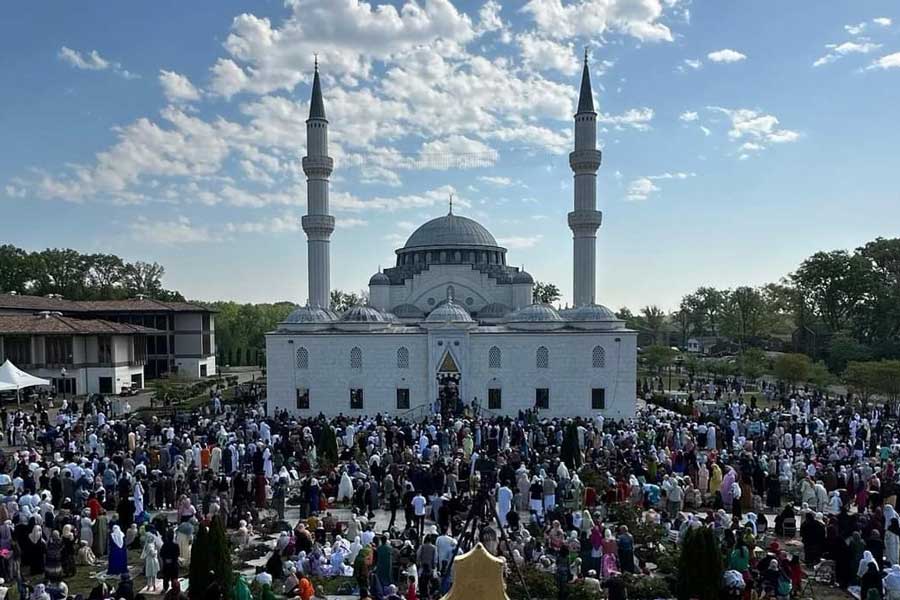
    If the day off is secured, most individuals and families will pray in congregation, the special Eid salat at the local mosque. Some mosques even rent out big venues like convention halls or football stadiums, or parks to pray in large numbers. Before leaving the house, people put in effort buying new clothes, planning their outfits, and putting on new scents. After the salat, Muslims take time to greet one another and take photos with their families. Depending on the mosque, there are various activities, pastries and tea, toys, and maybe even a mini carnival for the kids.

    After festivities at the mosque, my family usually goes out to eat for breakfast. Some years it was as simple as IHOP, other years it turned into a hunt for the best brunch in the city. We would keep our fancy clothes on and sit together happy to be eating pancakes during daylight hours, as this was a day of celebration, not fasting. With breakfast finished, we sometimes go home for a quick “Eid nap.” Based on social media mentioning, the instituting of an Eid nap seems to be a quintessential part of the American Eid tradition: fill your stomachs in the morning and then take a pause in celebrations for a quick nap. This allows your body to catch up on sleep since you probably stayed up after Fajr to prepare for festivities.

    If there are small children in the house, it also may be the time when gifts are opened. My parents always wanted us to feel the joy of Ramadan even if we weren’t old enough to understand it’s significance or could partake in fasting. So, from a very young age we would open our gifts that would be stacked in the middle of the living room with our names written on the wrapping paper. I know many of my friends growing up would instead receive “eidies” which were envelopes of money that they could use on whatever toys or gadgets they wanted.

    The post Eid activities vary from household to household. If people live close to relatives, they’ll spend the evening hopping from one home to the other to share a meal or give Eid greetings. If they don’t have family around, maybe they’ll choose to gather in a big community group and go for fun activities like miniature golf or bowling. I’ve seen some masajid organize groups specifically for singles or new Muslims who may not have anyone to spend the day with. I think organizing within the community to figure out how people are spending the day and encourage people to invite community members to their homes, is necessary to ensure no one feels alone on a joyous occasion.

    Regardless of which way you choose to celebrate Eid al-Fitr, it’s important to take stock of all the great habits you cultivated during Ramadan. It’s often said that the mosque is most empty the days following Eid because people are no longer entranced in the practice of praying daily salats at the masjid. It’s important that we not only celebrate on Eid al-Fitr, but we think about all the good we busied our time with during Ramadan and what of those newly formed good habits we can continue. We must not just go back to our old habits, allowing our eyes and ears to get thrown quickly back into dunya affairs. We should take time to do things like fasting the six days of Shawwal in the days following Eid al-Fitr. If we can extend and reinforce the blessings from Ramadan, we are demonstrating our devotion and gratitude to Allah SWT. And we can pass on good traditions and practices to future generations.

  • Eid on Two Days: Muslims Need To Agree On ’Their Calendar

    Eid on Two Days: Muslims Need To Agree On ’Their Calendar

    Our young people are furious about our absurd behavior, and non-Muslims laugh at us. It is twenty-first century, and yet Muslims still cannot determine the correct dates for their most important celebrations.

    Year after year, Muslims face the same confusion over when to begin and end Ramadan and the Eidain, for all attempts to solve a simple calendar issue have failed. In North America and Europe especially, Muslims have fistfights every year over this issue. Each group claims that its fixed date was correct, and that those who did not follow that date were wrong and misguided. As usual, each group claims to posses the sole perfect secret formula for date determination. Why is it impossible for Muslims to agree on such things?

    Let’s start with some basic facts.

    1. Earth has only one moon, the rotation of which is fixed and known: a synodic month of 29 days, 12 hours, 42 minutes, and 2.8 seconds. Its exact position, angle from the sun, and altitude above the horizon, whether it sets before or after sunset, and all other relevant data can be exactly calculated.

    2. Its conjunction (the new moon) date, time, and location can be calculated for more than 2,000 years in advance. But the new moon is not visible, and hence is not the hilal mentioned in the Qur’an and the Sunnah. On calendars, its date is marked as a black circle.

    3. The moon’s earliest visibility (hilal) can be approximately calculated. Every month, the hilal becomes visible in a different location on the globe. For example, it may appear first in the northern hemisphere as far north as Nova Scotia (Canada) in the summer, or as far south as New Zealand in the winter. It never first appears at the same place twice, even in 1,000 months. (There is no reason to accept the continuous claims from Makkah or the Middle East that the crescent moon was seen there first.)

    Without going into finer details, we also know that:

    * Each lunar month is never more than 30 days and never less than 29 days.

    * A crescent moon (hilal) is always seen on the 30th evening. If the horizon is clear, it will be visible to every observer without binoculars or a telescope. If it is not visible, it is not the 30th day.

    * A hilal is not visible at or before sunset. On the 29th day, if it appears, it will be very low on the horizon and usually can be seen 20-25 minutes after sunset, when the western horizon is dark enough for our eyes to notice the contrast of a dim silver crescent moon against the bright lower sky. On the 30th day, it will be visible some 8-15 minutes after sunset.

    * Once a 29-day hilal is visible, you can see it for a few minutes. It will not disappear in seconds, as many witnesses claim. A 30th-day hilal is usually visible for much longer, until almost 3-4 minutes before the moon sets.

    *If the hilal is first visible at point A, then all places of A (in the visibility parabola) will see it after sunset. If it is not visible in a clear sky, then it can be safely assumed that the hilal was not seen at point A.

    Most of the problems over fixing the calendar arise because Muslims use different criteria, such as:

    a. The new moon (conjunction) date is used as the first date of the month.

    b. Moonset is considered to occur with or after sunset in Makka, Cairo, or some other location.

    c. Witnesses testify that they saw a moon.

    d. The 30 days of the lunar month have been completed.

    We know that the new moon date cannot be used to fix the first day of a lunar month, for it occurs at all times of the day and night, whereas the Islamic month starts from sunset. Thus, the new moon cannot be the hilal.

    If moonset occurs with sunset or 15 minutes after sunset, this does not necessarily mean that the synodic lunar month has been completed. The new month cannot begin while the previous synodic month is incomplete. A new lunar month starts 15-35 hours after the synodic month is over, as indicated by the new moon represented on all calendars. The hilal is usually seen when the new moon moves approximately 12° away from the sun and attains an altitude of 10° above the horizon at sunset.

    Saudi Sightings

    Most Muslims could have had Eid al-Fitr on Sunday, November 14, 2004, and Eid al-Adha on Friday, January 21, 2005. Instead, we celebrated Eid al-Fitr on four different days (from Friday to Monday, November 12-15, 2004) and Eid al-Adha on two (January 20-21, 2005).

    Saudi authorities (Majlis al-Qada al-A`’la) asserted that many witnesses in the kingdom testified before the relevant authorities that they saw a Shawwal 1425 hilal on November 12, 2004, and a Dhu al-Hijja hilal on January 10, 2005. Saudi authorities are fully aware that a witness’ testimony is nothing but zann (whim), whereas the moon’s calculations are yaqeen (exact). It was their Islamic duty to disregard these reports, as they contradicted an established fact.

    On November 12, 2004 (the calculated, but invisible) moon had set 10 or more minutes before sunset in Saudi Arabia and most Middle Eastern countries. How could anyone see a visible crescent moon after sunset? Moreover, seeing a crescent moon before sunset is simply not possible. The same is true for January 10, 2005. The moon set before sunset in Saudi Arabia and many other Middle Eastern countries.

    Now, if all Saudis had testified about these miraculous sightings, the Majlis should still have rejected their claims, for the rules of testimony about a crescent moon cannot be quoted to disprove a fact (moonset before sunset) or prove a falsehood (seeing a hilal above the horizon when the new moon never rose above the horizon).

    Local or Global Sighting

    Many Muslims follow Saudi dates because they believe in a global (as opposed to local) sighting of the new moon. This is just another fallacy. The moon, like the sun, becomes visible over the globe during the same 24 hours. If the moon is visible in Saudi Arabia, it will certainly be seen in North America on the same day in the evening, for the moon reaches here 8-11 hours later. It will be brighter and higher on the horizon. If the moon seen in Saudi Arabia is not seen in North America the same evening, then the claim of its sighting is incorrect.

    On the other hand, it is quite probable that Muslims in North America, even in western Africa, can see a hilal a full day before it is visible in Saudi Arabia. Do you ever wonder why the claim of first visibility always comes from Saudi Arabia and the Middle East, even though this is against the very rule of the moon’s rotation, as explained by Allah and confirmed by modern lunar calculations?

    Saudis also argue that “the 30 days of the month have been completed” to declare the beginning of a new month. This is against the basic facts of the moon’s visibility. The Messenger told us that a lunar month cannot be longer than 30 days. If a crescent moon is not visible on the 30th day on a clear horizon, then it is not the 30th day. If it was the 30th day, then the hilal would have been visible. Kuraib’s hadith confirmed this fact long ago. If it were cloudy all over Saudi Arabia on 30th evening (an impossibility), then a moon will be seen everywhere west of Saudi Arabia, where the horizon’ is clear.

    For the beginning of Ramadan 1425 in North America, confusion was created because a lone couple claimed to have seen a crescent moon for 2-3 minutes immediately after sunset. The shape of the hilal was described as 10 to 12 to 2 or 9 to 12 to 3 on a clock. There was no reason to accept this testimony, for a hilal of this shape cannot appear anywhere in the world. The crescent moon is never visible during the first 5 minutes after sunset. Moreover, if it is really visible, then every town and village west of the initial sighting will also see it. If it is not seen anywhere on a clear horizon at places to the west of the claimed point, then the witnesses were mistaken.

    The relevant authorities must know the basics of moonsighting to determine the dates correctly. Their disputes among themselves are creating difficulties for millions of Muslims around the globe.