
بسم الله الرحمن الرحيم

Tag: down syndrome

  • Neurodivergent Muslims: A Warm Welcome Is Due

    Neurodivergent Muslims: A Warm Welcome Is Due

    Part one of this series discussed the definitions of neurodivergence, autism, and ADHD and highlighted some of the challenges neurodivergent Muslims face. In this article we will explore how our Islamic centers, gatherings, and communities can become more supportive and accommodating of our neurodivergent brothers and sisters in faith.

    I interviewed three families with neurodivergent children. They kindly shared their experiences and suggestions in the hopes that this will raise awareness and help our ummah improve its outreach and attitude towards neurodivergent Muslims.

    Note: some names below have been changed to protect identities.

    Parents’ Wish Lists

    Rosena, the mother of two neurodivergent children who found out in 2023 that she herself has ADHD, has some specific requests of the Muslim community. “Please be inclusive and allow children to be children,” she says. “Allow them to regulate in their preferred way and stim.”

    Stimming is when a person repeatedly makes certain movements or sounds, often for self-regulation. Stimming can be a way to handle overwhelming emotions or sensory overstimulation.

    Rosena continued, “Allow them to express and make noise as children should. Prophet Muhammad (peace and blessings be upon him) would allow his grandchildren to climb on his back as he led the prayer. Who are we to hold children to a level of account beyond their comprehension? Remember to be merciful and embrace diversity.”

    Some people find it difficult to be tolerant of behaviors that they interpret to be rambunctious or disrespectful in the masjid. It might help to keep in mind that oftentimes, children are moving and making noise because their bodies and brains are compelling them, not because they are undisciplined or naughty. Also, remember that many disabilities are invisible. Neurodivergent people do not necessarily look different from neurotypical people. You will not be able to look at a child and know his/her neurotype, challenges, abilities, or disabilities.  It is best to give children and their caretakers the benefit of the doubt.

    If you need to talk to a child or his parents about behavior that you find disruptive, ask yourself first, “How would the Prophet (peace be upon him) handle this?” Would he talk harshly? Would he make them feel unwelcome at the masjid? Would he act annoyed and inconvenienced?” As we all know, our beloved Prophet (peace be upon him) always handled people with gentleness, patience, and kindness. We should strive to uphold his noble example, regardless of whether a child is neurodivergent or not.

    Fatima, the mother of two autistic children, explains, “My daughter does not have an understanding of prayer and other forms of worship, and therefore her attention and focus are limited.  Many of the forms of worship require her to sit still and focus, as well as be mindful of verbalization. For example, Jumah khutbah and Eid khutbah are two instances that can require attention and silence.  My daughter’s vocal and body stereotypy can be somewhat disruptive.  She makes vocal sounds and rocks back and forth. At the Islamic center we attend, the space is extremely limited, making the ambiance very upsetting for her.  She prefers to walk and stretch her legs.  This can be seen as disruptive since other worshippers may be praying.”

    Louise A., the mother of an autistic seven-year-old son, hopes for greater awareness, acceptance, and support. She says, “I wish the Muslim community knew more about neurodivergence and that it is part of Allah’s creation and not something to look down upon. Nor is it a source of shame. I also wish there were more Muslim support groups for families with neurodivergent members.”

    “Muslim communities should engage with neurodivergent individuals,” says Fatima. “They too have a right to participate in their own ways and engage in ibadat (worship). These children with disabilities are Muslim, too. Accommodations for children (and even adults) with disabilities at their respective places of worship should be made,” Fatima suggests offering ASL [American Sign Language] and braille classes, and sensory limiting activities in both the men and women’s areas. Also supervision of the children by trained individuals during times of prayer can be provided.

    The Importance of a Warm Welcome

    “If a trained Muslim in this community approaches one of our children to make them welcome, bring a smile to our children’s face, teach them one thing —that would be ibadat itself,” says Fatima. “Neurotypical children would then also realize that all unique/different children should be attending our Islamic center.”

    “As my daughter matures, her [autistic] behaviors have decreased considerably, but her diagnosis is quite apparent when she is amongst neurotypical peers,” continues Fatima. “If she has accommodations at the Islamic center, or any place of worship, she will become accustomed to attending this space.  And in turn, more children and adults with disabilities will have that same opportunity.”

    Less Judgment, More Understanding

    With greater understanding of neurological differences, many Muslims will be less judgmental of others. So often, we label people negatively, criticize them, or ostracize them without knowing the genuine struggles behind their behaviors.

    Rosena gives some examples: “Those who are neurodiverse, whether diagnosed or not, may have difficulty with executive functioning and as a result may have trouble with skills such as planning, staying organized, sequencing information, and self-regulating emotions.”

    “Communities can assist,” she says, “by taking responsibility to educate themselves on neurodiversity to better support community members. It would be wise for those who are educators in the Muslim community to tailor their teaching so those with neurodiversity can fully benefit and achieve their full potential.”

    “It can be perceived that those who are neurodiverse are lazy or obstructive,” adds Rosena. “This harmful terminology has a long-term, deep impact on a group who already experiences difficulty with daily tasks and routine. The routine of neurodivergent individuals may be at odds with what communities would want (such as sleep patterns, keeping their homes organized, etc). Better understanding and support of how each neurodivergent individual operates and showing actual support rather than judgment would assist them greatly. Also, we should all acknowledge that seeking support is not bad.”

    Co-occurring Conditions

    “Many neurodivergent individuals also have co-occurring conditions, such as anxiety or depression,” explains Rosena. “Mental health conditions can increase the risk of addiction, as you may use substances or engage in addictive behaviors to cope with your symptoms.”

    While not promoting harmful substances or encouraging addictions, the Muslim community can still compassionately support their brothers and sisters who are struggling with mental health problems.

    “As a community, we need to be aware and offer support and encouragement rather than shaming, which can lead to isolation,” says Rosena.  “The Prophet’s (peace be upon him) example is the best one and demonstrates how society can foster social connections that are strong, wholesome, and nurturing — connections that can serve to dissuade people from falling into sin but also lead to an ummah who are the best examples of Islam, living a life of complete submission to Allah and contributing in remarkable ways to their communities.”

    Inclusion Is the Islamic Way

    If we are going to be true ambassadors of our faith and sincere followers of our Prophet (peace be upon him), then we must do more to educate ourselves about neurodivergent people and accommodate their needs. Otherwise, we are excluding many of our brothers and sisters from congregational worship, celebrations, and ties to their ummah.

    Fatima says, “We understand the Islamic center is a shared space and everyone has a right to be there. Everyone is reaping blessings by their attendance.  Unfortunately, the neurodivergent community and children/adults with disabilities are not factored into this equation.  Until the Muslim community begins to make such accommodations, children with disabilities and their families will continue to miss out on important events.”

    Rosena sums up our community’s Islamic obligation by quoting an article by Hazwan Hilmi: “Incorporating children into the mosque environment aligns with the teachings of the Quran and the practices of the Prophet Muhammad (peace be upon him). The Quranic emphasis on children, coupled with the Prophet’s love and compassion for them, reinforces the value of their presence in the mosque. Furthermore, involving children in the mosque community aligns with the responsibility of parents and the community to educate and guide them on the path of righteousness. Embracing the teachings of Islam regarding children in mosques not only benefits the younger generation but also contributes to the formation of a united and compassionate community that embodies the true essence of Islam.”

    Let us all work to ensure that all children can feel welcome and comfortable in our Islamic centers and gatherings. The future of our ummah depends upon the way we nurture and support young people now, and neurodivergent individuals have as much of a right to kind treatment and access to Islamic spaces as neurotypical ones. To read more about this subject, go to https://muhsen.org/who-we-are/.
  • Down Syndrome Awareness Month: Hamza, the Joy of Our Family

    Down Syndrome Awareness Month: Hamza, the Joy of Our Family

    I stared at her in utter shock trying to make sense of what I’d just heard her say. The words reverberated in my head like some distant thumping, bringing a lump to my throat that I couldn’t swallow. Was this really happening to me! I felt her soft touch on my shoulder as she gently reiterated for the third time, “It is a difficult decision, you don’t have to decide now. Think about it and I’m available to answer your questions.” I looked up at her in disbelief. How could a doctor be suggesting such a thing when my life was not in any danger? I took a deep breath and sighed as Dr. Anette gently rubbed my shoulder, and then I looked at her and crisply replied, “I’m keeping my baby no matter what.” “Think about it,” she went on, “it’s not that simple. There are a lot of challenges…heart defects, hearing problems, digestion issues, childhood cancer, early onset of Alzheimer’s….and she went on and on, not once mentioning that my baby would still just be a baby, a child who loves and cries, who wants to snuggle and play, who is oblivious to his or her challenging diagnosis and just wants to be loved!

    Her voice faded away as I made my way out of her office, walking in a trance. “So, what did the doctor say?” I heard my husband ask excitedly. “Everything okay?” I took a deep breath, looked into his eager eyes, held his hands and gently whispered, “I am a high-risk candidate for carrying a baby with Down Syndrome. The doctor presented an option.” Confused, my husband repeated what I said. “Presented an option?” I replied, “She said we can terminate the pregnancy and be free of numerous challenges and hardships.” As I spoke, my voice quivered, and the color of my husband’s face changed. Only Allah knows how much we had yearned for this baby, what we had endured to get here and now when we were just months away from holding him in our arms, we were being told that it may be better to abort him! All because he may be born with Down Syndrome.

    Over the next few months, every time I walked into Dr. Anette’s office for my regular checkup, I was offered the option, until finally Dr. Anette suggested I should talk to a psychologist about it! I had kept my cool every time she suggested “the option,” politely informing her that we are happy and content with our decision to welcome our baby. But that day, I exploded. “The diagnosis of Down Syndrome is not the worst thing that can happen to an expectant parent,” I vehemently retorted. “Are you a parent?” I asked Dr. Anette, “Don’t people with Down Syndrome deserve a right to live and be included in this life? Aren’t there solutions for all the medical challenges they have? How could terminating life be the only solution and that too, one that relieves the parent of a ‘burden’ — the unborn baby!” I was 24 weeks now and Dr. Anette, ignoring my imploring questions, calmly went on to say that this was the last week that we could undergo the procedure to terminate my baby with Down Syndrome. I rushed out of her office and asked to talk to her supervisor. Upon listening to my sense of frustration that the doctor had over and over asked if I wanted to terminate my pregnancy, “terminate” my baby, he professionally informed me that she was doing her job and it was her duty to inform me about the option to terminate my pregnancy after finding out that my baby would be born with Down Syndrome! That was the moment I realized that not only would I have to deal with medical challenges facing my baby, but also immense social and emotional challenges. But I was determined to be his advocate and voice.

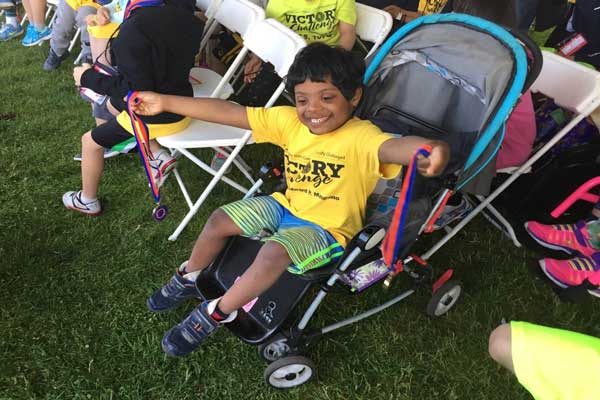
    Fast forward 10 years and Hamza is the joy of our family. He is the best gift that Allah could have given us. His smiles, hugs, and kisses can cheer the saddest person and his overall presence is energizing. He has his fair share of challenges, which he struggles with. But the best part is he never gives up and perseveres through the most difficult tasks, just at his own pace. He is my teacher in life, and I wouldn’t change one chromosome in him!

    Down Syndrome Awareness Month

    October is Down Syndrome Awareness Month and a time to celebrate people with Down Syndrome and make others aware of their abilities and accomplishments. Down Syndrome is named after the English doctor John Langdon Down who was the first to categorize the common characteristics of people with the condition. The colors for Down Syndrome awareness are blue and yellow.

    Down Syndrome is the most common genetic disorder. While there are three types of Down Syndrome, one type, Trisomy 21, accounts for 95 percent of people with Down Syndrome. In this type, the individual has three copies of chromosome 21 rather than the usual two. There is about 1 in 700 babies with Down Syndrome born each year in the U.S. The chances of having a baby with Down Syndrome are higher in older women.

    Some common physical characteristics include almond-shaped eyes slanting upwards, poor muscle tone, short stature, a flat nasal bridge, a protruding tongue, and a single deep crease across the center of the palms. People with Down Syndrome may have some or all of these physical characteristics, as well as a number of others. The presence of part or whole of the extra chromosome also affects a person’s cognitive ability, causing intellectual disability. Yet, studies have shown that children with Down Syndrome learn best alongside their typically developing peers and so need to be included in such settings or least-restrictive learning environments. They have mild to moderate developmental delays and reach milestones later than their typically developing peers. Early Intervention techniques and therapies in the first five years are critical to the optimal development and progress of children with Down Syndrome. Medical issues can vary from mild to severe. Around half of all people with Down Syndrome have congenital heart defects and there may be a higher risk of respiratory problems, hearing issues, thyroid conditions, early onset of Alzheimer’s, and childhood Leukemia. Fortunately, medical advancements have made it possible to address these issues. In the 1960s, the life expectancy of a person with Down Syndrome was 25 years, but with medical advancements, the life expectancy has expanded to 60 years.

    Sadly, however, even with all the medical advancements, inclusion with peers in academic settings, and early intervention techniques — all improving the lives of people with Down Syndrome —the number of abortions of Down Syndrome fetuses is increasing around the world. In the U.S., the rate of terminating a Down Syndrome fetus is over 70 percent and in Europe the numbers are even more staggering. Iceland claims to have “cured” Down Syndrome, the “cure” being almost 100 percent termination of Down Syndrome fetuses. The push to eliminate these beautiful souls is on the increase every decade.

    Back to Hamza’s Story

    The journey of raising a child with Down Syndrome can be daunting and intimidating. The challenges can vary from mild to extreme, but with far better guidance and resources easily accessible now, all of these can be overcome. Hamza is the purest soul I have ever met in my 50 years of life. He is extremely sociable and loves people. His smiles are contagious, and his hugs are healing. He is a willing learner, mostly, and though he struggles hard to achieve basic tasks, he never gives up. His resilience to keep on trying his best to participate and interact is admirable. He is pure joy and the sunshine in one’s darkest hour. He can put a smile on the saddest face with his charming personality. Yet, he has his moments too. He has the full spectrum of human feelings and desires to be loved and included.

    Unfortunately, our communities are not fully aware of, and comfortable with, Down Syndrome. Although research verifies that inclusion benefits children with Down Syndrome, schools are still reluctant to implement this. Sadly, many parents of typically developing children fear that their children will regress if they are around children with cognitive and developmental delays. In fact, being with children with Down Syndrome can increase understanding and compassion. Yet, many children with Down Syndrome are rejected and denied their right to participate in various social and athletic programs. It does require additional effort and planning to include children with Down Syndrome in all activities, but that is the way forward. They can learn and participate, just at a different pace.

    There are many ways to support greater awareness of Down Syndrome and to participate in, and advocate for, inclusion. You and your child can befriend a child with Down Syndrome and his or her family; you can participate in the annual Buddy Walks (held in about 40 states across the country); you can join and volunteer in groups that provide information and resources such as the National Down Syndrome Society (NDSS), Down Syndrome Advocacy Foundation (DSAF), and Gigi’s Playhouse (across the country). There are numerous books available for children and adults about Down Syndrome. You can follow Facebook and Instagram pages such as Parents of Children with Down Syndrome or Noah’s Dad for valuable and informative resources and latest developments. Hope Story, of which I am a Hope Advocate, is a non-profit group aiming to educate and support parents who have received prenatal diagnosis of Down Syndrome. We are open and happy to talk to the expectant parent(s), offering hope, information, and support as we share our own family’s story of living with and loving a child with Down Syndrome.

    In conclusion, as a parent of a child with Down Syndrome, I encourage people to learn more about Down Syndrome and open their minds and hearts to such individuals. They have a beauty all their own and can teach many things about life, adversity, and joy. Without exaggeration, knowing and interacting with a person with Down Syndrome can greatly enrich your life!