بسم الله الرحمن الرحيم

Tag: Dawah in the west

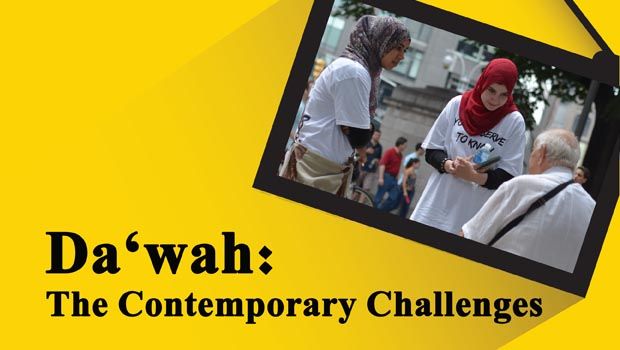
  • Dawah: The Contemporary Challenges

    Dawah: The Contemporary Challenges

    Da‘wah or calling people towards submission to none but the Creator is one of the major themes of the Qur’an. A Muslim, male or female, is visualized by the Qur’an as a da‘iyah whose behavior, speech, and interactions with others convey the Islamic message and invite people towards belief in, submission to, and serving of the Creator. Prophet Muhammad (peace be on him) is designated by the Qur’an as the last messenger, calling people toward all that is good and warning about the consequences of rejecting the truth. The Muslim ummah is commissioned to play a proactive role in creating peace, justice, balance, moderation, and fairness within the Muslim community (ummah) as well as in the human society at large. In fact, the terminology, ummatan wasaat, which the Qur’an uses to describe a distinguishing feature of the Muslim ummah, conveys a characterization of the ummah as one of moderation, balance, and the middle way. The Qur’an, accordingly, strongly condemns an excessive or exaggerated attitude in any aspect of life, and considers extremism of any sort to be misguided.

    This paper seeks to delineate major da‘wah challenges, both internal and external, the ummah faces today and how to respond to these modern challenges from a proper Islamic perspective. This author believes that each challenge comes with huge prospects and opportunities for advancement of the da‘wah work.

    The Internal Challenges

    The internal challenges, for convenience of discussion, can be associated with the following strategic issues.

    Internal Challenge #1: Disunity

    The ummah spans over 57 sovereign Muslim states. Their rulers and elites all face towards the same Ka‘bah in prayer but they fail miserably in establishing a unified policy on strategic goals in regards to social, political, economic, legal, educational, and cultural issues. How to create unity or at least move toward unity remains a core da‘wah issue and challenge. The responsibility for disunity, while in part caused by external forces, must be placed squarely upon our own shoulders. It is only common sense to expect other geopolitical players to use economic, political, and cultural, and even military means to protect their own national interests, and at times this involves intentional or collateral harm to, or exploitation of, Muslims. Ultimately, the campaign to unify Muslims must center on our own internal dynamics, resources, and shared goals.

    Internal Challenge #2: Ghuluw

    The second internal challenge that da‘wah faces is a global rise in ghuluw in the ummah. Ghuluw can be defined as exaggerating any part of Islam beyond its actual specified limits or, likewise, downplaying any part of Islam below its actual specified limits. Unfortunately some da‘wah workers focus on particular aspects of Islam – religious, legal, social, political, or economic – while some equally important teachings of Islam skip their attention. Islam provides necessary instructions in all aspects of human life. Therefore, a call toward Islam implies following Allah’s instructions not only in one or another or some particular aspects of life but in all affairs and all aspects of religious, legal, social, economic, and political matters. It is a call for a holistic and comprehensive change. It is a call to serving Allah alone and becoming His true ‘abd or obedient servant in the totality of one’s existence. In brief, da‘wah is the adoption of, or return to, the straight path, and the righteousness that entails, in all spheres and affairs of life.

    Excessiveness or ghuluw is also manifested in considering one’s maslak or madhhab as the only authentic interpretation of Islamic injunctions, and to look down upon others as if they are misguided. This attitude is totally in contradiction to, and in negation of, the methodology followed in the fiqhi matters by the Prophet’s Companions which was duly approved by the Prophet himself (peace be on him). Some idealists assume that if they succeed in ascending to political power and declare establishment of khilifah, the economic exploitation, political corruption, social decay, and moral decadence will automatically cease and attitudes and behaviors of the people shall spontaneously change. This political idealism is also a form of ghuluw in the sense of overlooking the practical reality of the human condition with its weaknesses and its propensity for self-delusion, and the corresponding challenge of bringing about personal and societal transformation which can only be established through a gradual and progressive process.

    Some spiritualists or mystics, on the other hand, claim to utilize a means of coming closer to Allah through contemplation, dhikr, and strict self-discipline, with some choosing to withdraw entirely from involvement in worldly life. The Prophetic Sunnah on the contrary provides us with a holistic model which takes care of the total needs of a human being. We do not have any evidence in the Prophetic Sunnah for being given to excessive meditation or for living a life of withdrawal from family and society and other worldly affairs; rather we find the Prophet (peace be on him) strongly denouncing such a life of withdrawal.

    Internal Challenge #3:
    The Islamic knowledge deficit

    The third major internal challenge facing da‘wah today is an educational one. The key to progress and excellence lies in a knowledge-based society that engenders a fair and equitable economy and a just and ethical state. A dynamic commitment to and knowledge of Qur’an and sunnah must be deeply embedded in the social fabric but this requires that accurate and authentic Islamic knowledge be disseminated amongst the Muslim masses. This does not exist today and this deficiency is a handicap that must be fixed.

    Internal Challenge #4:
    Methodology

    The fourth internal challenge that da‘wah faces has to do with methodology. Some of those who engage in daw’ah activities do so when afforded time and opportunity outside the constraints of their job or career. This would be fine if those individuals understood that Islam does not bifurcate life into “religious” and “worldly” activities. Therefore, the behavioral and ethical requirements of Muslim life and da’wah in particular are the same whether one is in the workplace, engaged in street da’wah, or part of a professional and organized da’wah effort. The Qur’an and the Sunnah establish a holistic approach to life wherein one’s profession and mission do not belong to different realms.

    Another dimension to this challenge relates to the misunderstanding of da‘wah as an invitation or call to Muslims only. Under the influence of this mindset some very sincere and devout du‘at travel thousands of miles to talk to fellow Muslims, while da‘wah to non-Muslims remains outside the scope of their interest or concern.

    The objective and means of Islamic da‘wah can be summed up in three points:

    Knowledge of the truth (al-haqq) and a proper working knowledge of Islam.

    Preparedness of the da’iyah through the building of his/her own Islamic character, devotion to purification of the heart, and ability to communicate the truth and convey the message of Islam in an effective way (i.e., with confidence, humbleness, conviction, and heartfulness).

    Taking into full account the cultural mindset of the target demographic so as to best address their needs and provide the most relevant information that potentially might open their hearts and minds to the truth.

    The External Challenges

    There are several external challenges facing Islamic da‘wah. The first and foremost of these external challenges is the globalization of economy, education, society, and culture. Not many da‘wah workers are fully aware of the far-reaching effects of globalization on contemporary society. Islamic da‘wah by its very nature is a comprehensive da‘wah. It calls for vision, point of reference, and a paradigm of its own in economic, political, social, educational, and cultural realms. In all human activities it is a matter of inviting towards what is ethically good (khayr) and warning about what is ethically bad or evil (munkar). The impact of global media on the Muslim family and society is becoming visible even in very conservative homes. Untold numbers of Muslim youth are hooked on facebook. Putting a ban on it is no solution. The youth demonstrate a genuine yearning to share their ideas, feelings, and aspirations with others throughout the world. It is the challenge for Muslim scholars, parents, teachers, and activists to draw up and share with our Muslim youth a code of ethics and guidelines for Islamically appropriate behavior and written word expression when engaging in social media.

    The western policy planners in the post cold-war era have put Islam and Muslims in the place which was earlier reserved for the Marxist threat. This scenario is further worsened by the western misperception of Islam as a faith which inherently subscribes to violence, extremism, and anti-democracy tendencies,though history bears witness to the opposite. The fact is that Muslims who are struggling to free their own lands from occupiers, imperialists, and/or corporate-globalist exploiters are labeled “terrorist” by Western policymakers and media.

    The perception of Islam and the Muslims as extremist, fundamentalist, and terrorist needs to be corrected by Muslim scholars and academics who understand the mindset of the West. They must also expose the falsity of the claim that Islam is unfair to women. Issues such as law of inheritance, status of women as legal witness, the political role of women, polygamy, and other gender related issues need to be addressed in a knowledgeable, sincere, and non-apologetic manner. The role of women in the family, economy, education, political life, and da’wah needs to be elaborated and disseminated.

    The strategy of da‘wah has to be proactive and not reactive. Modern challenges to da‘wah are both methodological and phenomenological. The so-called age of globalization and modernity has its own peculiar challenges. A successful da‘wah strategy cannot be developed for our contemporary world and its circumstances, let alone for the future, without taking the internal as well as the external challenges in full consideration in a realistic and comprehensive manner. Finally, serving Allah through serving humanity needs to become the rallying cry of da‘wah movements and their advocates and activists.
    Da‘wah or calling people towards submission to none but the Creator is one of the major themes of the Qur’an. A Muslim, male or female, is visualized by the Qur’an as a da‘iyah whose behavior, speech, and interactions with others convey the Islamic message and invite people towards belief in, submission to, and serving of the Creator. Prophet Muhammad (peace be on him) is designated by the Qur’an as the last messenger, calling people toward all that is good and warning about the consequences of rejecting the truth. The Muslim ummah is commissioned to play a proactive role in creating peace, justice, balance, moderation, and fairness within the Muslim community (ummah) as well as in the human society at large. In fact, the terminology, ummatan wasaat, which the Qur’an uses to describe a distinguishing feature of the Muslim ummah, conveys a characterization of the ummah as one of moderation, balance, and the middle way. The Qur’an, accordingly, strongly condemns an excessive or exaggerated attitude in any aspect of life, and considers extremism of any sort to be misguided.This paper seeks to delineate major da‘wah challenges, both internal and external, the ummah faces today and how to respond to these modern challenges from a proper Islamic perspective. This author believes that each challenge comes with huge prospects and opportunities for advancement of the da‘wah work.The Internal ChallengesThe internal challenges, for convenience of discussion, can be associated with the following strategic issues.
    Internal Challenge #1: DisunityThe ummah spans over 57 sovereign Muslim states. Their rulers and elites all face towards the same Ka‘bah in prayer but they fail miserably in establishing a unified policy on strategic goals in regards to social, political, economic, legal, educational, and cultural issues. How to create unity or at least move toward unity remains a core da‘wah issue and challenge. The responsibility for disunity, while in part caused by external forces, must be placed squarely upon our own shoulders. It is only common sense to expect other geopolitical players to use economic, political, and cultural, and even military  means to protect their own national interests, and at times this involves intentional or collateral harm to, or exploitation of, Muslims. Ultimately, the campaign to unify Muslims must center on our own internal dynamics, resources, and shared goals.
    Internal Challenge #2: GhuluwThe second internal challenge that da‘wah faces is a global rise in ghuluw in the ummah. Ghuluw can be defined as exaggerating any part of Islam beyond its actual specified limits or, likewise, downplaying any part of Islam below its actual specified limits. Unfortunately some da‘wah workers focus on particular aspects of Islam – religious, legal, social, political, or economic – while some equally important teachings of Islam skip their attention. Islam provides necessary instructions in all aspects of human life. Therefore, a call toward Islam implies following Allah’s instructions not only in one or another or some particular aspects of life but in all affairs and all aspects of religious, legal, social, economic, and political matters. It is a call for a holistic and comprehensive change. It is a call to serving Allah alone and becoming His true ‘abd or obedient servant in the totality of one’s existence. In brief, da‘wah is the adoption of, or return to, the straight path, and the righteousness that entails, in all spheres and affairs of life.Excessiveness or ghuluw is also manifested in considering one’s maslak or madhhab as the only authentic interpretation of Islamic injunctions, and to look down upon others as if they are misguided. This attitude is totally in contradiction to, and in negation of, the methodology followed in the fiqhi matters by the Prophet’s Companions which was duly approved by the Prophet himself (peace be on him).  Some idealists assume that if they succeed in ascending to political power and declare establishment of khilifah, the economic exploitation, political corruption, social decay, and moral decadence will automatically cease and attitudes and behaviors of the people shall spontaneously change. This political idealism is also a form of ghuluw in the sense of overlooking the practical reality of the human condition with its weaknesses and its propensity for self-delusion, and the corresponding  challenge of bringing about personal and societal transformation which can only be established through a gradual and  progressive process. Some spiritualists or mystics, on the other hand, claim to utilize a means of coming closer to Allah through contemplation, dhikr, and strict self-discipline, with some choosing to withdraw entirely from involvement in worldly life. The Prophetic Sunnah on the contrary provides us with a holistic model which takes care of the total needs of a human being. We do not have any evidence in the Prophetic Sunnah for being given to excessive meditation or for living a life of withdrawal from family and society and other worldly affairs; rather we find the Prophet (peace be on him) strongly denouncing such a life of withdrawal.
    Internal Challenge #3:  The Islamic knowledge deficitThe third major internal challenge facing da‘wah today is an educational one. The key to progress and excellence lies in a knowledge-based society that engenders a fair and equitable economy and a just and ethical state. A dynamic commitment to and knowledge of Qur’an and sunnah must be deeply embedded in the social fabric but this requires that accurate and authentic Islamic knowledge be disseminated amongst the Muslim masses. This does not exist today and this deficiency is a handicap that must be fixed.Internal Challenge #4:  MethodologyThe fourth internal challenge that da‘wah faces has to do with methodology. Some of those who engage in daw’ah activities do so when afforded time and opportunity outside the constraints of their job or career. This would be fine if those individuals understood that Islam does not bifurcate life into “religious” and “worldly” activities. Therefore, the behavioral and ethical requirements of Muslim life and da’wah in particular are the same whether one is in the workplace, engaged in street da’wah, or part of a professional and organized da’wah effort. The Qur’an and the Sunnah establish  a holistic approach to life wherein one’s profession and mission do not belong to different realms.Another dimension to this challenge relates to the misunderstanding of da‘wah as an invitation or call to Muslims only. Under the influence of this mindset some very sincere and devout du‘at travel thousands of miles to talk to fellow Muslims, while da‘wah to non-Muslims remains outside the scope of their interest or concern. The objective and means of Islamic da‘wah can be summed up in three points: Knowledge of the truth (al-haqq) and a proper working knowledge of Islam.Preparedness of the da’iyah through the building of his/her own Islamic character, devotion to purification of the heart, and ability to communicate the truth and convey the message of Islam in an effective way (i.e., with confidence, humbleness, conviction, and heartfulness). Taking into full account the cultural mindset of the target demographic so as to best address their needs and provide the most relevant information that potentially might open their hearts and minds to the truth.
    The External Challenges There are several external challenges facing Islamic da‘wah. The first and foremost of these external challenges is the globalization of economy, education, society, and culture. Not many da‘wah workers are fully aware of the far-reaching effects of globalization on contemporary society. Islamic da‘wah by its very nature is a comprehensive da‘wah. It calls for vision, point of reference, and a paradigm of its own in economic, political, social, educational, and cultural realms. In all human activities it is a matter of  inviting towards what is ethically good (khayr) and warning about what is ethically bad or evil (munkar). The impact of global media on the Muslim family and society is becoming visible even in very conservative homes. Untold numbers of Muslim youth are hooked on facebook. Putting a ban on it is no solution. The youth demonstrate a genuine yearning to share their ideas, feelings, and aspirations with others throughout the world. It is the challenge for Muslim scholars, parents, teachers, and activists to draw up and share with our Muslim youth a code of ethics and guidelines for Islamically appropriate behavior and written word expression when engaging in social media. The western policy planners in the post cold-war era have put Islam and Muslims in the place which was earlier reserved for the Marxist threat. This scenario is further worsened by the western misperception of Islam as a faith which inherently subscribes to violence, extremism, and anti-democracy tendencies,though history bears witness to the opposite. The fact is that Muslims who are struggling to free their own lands from occupiers, imperialists, and/or corporate-globalist exploiters are labeled “terrorist” by Western policymakers and media.The perception of Islam and the Muslims as extremist, fundamentalist, and terrorist needs to be corrected by Muslim scholars and academics who understand the mindset of the West. They must also expose the falsity of the claim that Islam is unfair to women. Issues such as law of inheritance, status of women as legal witness, the political role of women, polygamy, and other gender related issues need to be addressed in a knowledgeable, sincere, and non-apologetic manner. The role of women in the family, economy, education, political life, and da’wah needs to be elaborated and disseminated. The strategy of da‘wah has to be proactive and not reactive. Modern challenges to da‘wah are both methodological and phenomenological. The so-called age of globalization and modernity has its own peculiar challenges. A successful da‘wah strategy cannot be developed for our contemporary world and its circumstances, let alone for the future, without taking the internal as well as the external challenges in full consideration in a realistic and comprehensive manner. Finally, serving Allah through serving humanity needs to become the rallying cry of da‘wah movements and their advocates and activists.
  • Exploring New Horizons: Dawah at the World Cup

    Exploring New Horizons: Dawah at the World Cup

    According to a Muslim historian, Khashkhash ibn Said ibn Aswad from Islamic Spain sailed across the Atlantic Ocean and made contact with the inhabitants of a distant land. He then returned safely to Andalusia with treasures and tales of his adventures. If this story is true, this would mean that he reached the New World over 600 years before Christopher Columbus. Historian Abu al-Hasan ‘Al? al-Mas’?d? (871-957), in “The Book of Golden Meadows,” speaks of this story: “In the ocean of fogs [the Atlantic] there are many curiosities which we have mentioned in detail in our Akhbar az-Zaman, on the basis of what we saw there, adventurers who penetrated it on the risk of their lives, some returning back safely, others perishing in the attempt. Thus a certain inhabitant of Cordoba, Khashkhash by name, assembled a group of young men, his co-citizens, and went on a voyage on this ocean. After a long time he returned back with booty. Every Spaniard knows this story.”

    It is important to learn different languages and cultures to better answer the questions that others have about Islam. That will have a significant impact on dawah work

    Similarly, in 1311, a naval fleet of 400 ships with Muslim passengers from Mali was swept off course and crossed the Atlantic Ocean, discovering a new world in the west and engaging in trade with its natives. Of the fleet, only one ship returned and its captain told the Mali ruler at the time, Prince Abu Bakr II, about their remarkable journey. Cited in an article by Joan Baxter, “Africa’s greatest explorer,” on BBC news online, a Malian scholar, Gaoussou Diawara, in his book, “The Saga of Abubakari II,” writes that Abu Bakr was Intrigued by this story and decided to follow in their footsteps, preparing an expedition of his own to sail the Atlantic. These contacts between Muslim travelers and the indigenous people of the Americas began to shape the history of the lands that were soon to be “discovered,” conquered, and colonized, by a once Muslim-dominated Spain. The trading that allegedly took place between the two cultures would have facilitated the introduction of Islam, much like Islam spread to Indonesia through commercial contact between Muslims and islanders. There are a number of historical narratives that suggest that some native inhabitants of the Americas practiced Islam and even spoke Arabic due to continuous interactions with Muslim traders.

    Even during the colonization period, immigration from both the Iberian Peninsula and Africa shaped the cultures, traditions, and languages of countries and territories in Latin America. With waves of immigration from Muslim countries to Latin America and the voluntary conversion of natives to Islam, the number of Muslims from Mexico to Argentina continues to rise. Currently, the estimated Muslim population in Latin American countries combined is anywhere from 4 to 7 million, the largest concentration being in Brazil with an estimated 1.5 million.

    Certainly, Islam has played a colossal role in the history of Latin America, a land which some are calling the “final frontier” of Islam. Muslim organizations engaging in Islamic propagation have realized this fact, and turned a vigilant eye towards these lands. Unlike the brave navigators and explorers of the past who spent months or even years on their journeys, those making dawah today have the advantage of technology which facilitates contact and information-sharing between the two cultures, making Latin America a fertile ground for outreach and education. It is no wonder that Muslims in Latin America’s closest neighbor, the United States, with a sizable Latino population of its own, have taken on the task of paving the way for dawah missions to their southern neighbors. One such effort took place recently with the FIFA 2014 World Cup as the venue. What began as an over-ambitious idea in the imagination of an associate of the Islamic Circle of North America’s WhyIslam project, surged into an unprecedented tidal wave of dawah efforts in Latin America, particularly in Brazil. The FIFA World Cup 2014 soccer tournament was the second hosted by Sao Paulo, Brazil, the first being held in 1950. It was the perfect opportunity for outreach, given the global popularity of futbol, or soccer, and the proximity to the US, where WhyIslam’s headquarters is located.

    WhyIslam directors and coordinators began the massive undertaking months in advance, networking with organizations and individuals to put together teams, assign tasks, and develop a strategic plan. It was determined that the propagation efforts in Brazil would culminate with a global day of outreach, termed “Global Dawah Day” (GDD) to be held on July 5. In order to promote and fund the project, WhyIslam elaborated a successful marketing campaign, using advertising in photos, videos, email blasts, and posting to social media outlets like YouTube, FaceBook, Instagram, and Twitter. Well-known Muslim lecturers, personalities, and imams such as Nouman Ali Khan, Omar Suleiman, Yasmin Mogahed, Hamza Tzortsis, Abdurraheem Green, Boona Mohammed, and Isa Garcia, provided video clips endorsing the campaign and calling for support and participation.

    The resonating theme for WhyIslam’s bold endeavor was “What is Your Goal?”, a play on soccer lingo intended to make one reflect on the true goal or purpose in life. There was a webpage (www.whatisyourgoal.org) set up for teams, organizations, and individuals to register their dawah event and to follow the endeavors and accomplishments of the crew in Brazil. The official flyer for GDD was printed on cards, banners, and posters and plastered over purple T-shirts that were provided to eager volunteers on six continents who vowed to participate in the World Cup street dawah and/or GDD. Many organizations came on board, one of which was the Centro de Divulgação do Islam para América Latina or CDIAL. CDIAL is one of the most prominent dawah-driven organizations in South America based in Brazil. They helped to facilitate housing and itinerary logistics, translations and printing of materials for distribution during the World Cup, as well as providing their own volunteers on the ground. WhyIslam printed and distributed thousands of brochures in English, Spanish, French, and Portuguese, as well as translations of the meaning of the Qur’an to World Cup spectators and locals in Brazil.

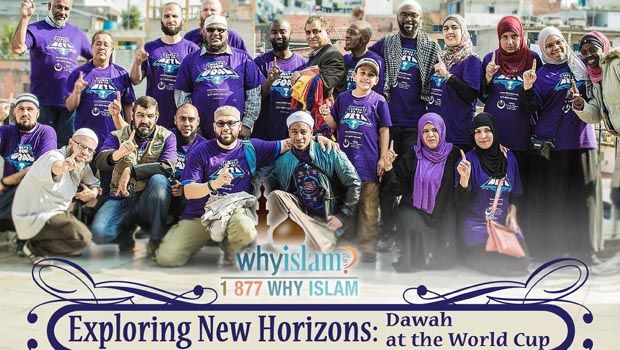
    Another group which contributed volunteers was the Islamic Education and Research Academy (iERA), headquartered in the UK, and its Mission Dawah team traveled across the Atlantic to partake in the outreach efforts. Another group was led by Imran ibn Mansur, widely known as Dawah Man, a YouTuber who has gained attention through his videos. They joined a group of 18 organizers, scholars, youths, and professionals from the US and Canada including Nahela Morales, the National Spanish Outreach Coordinator for WhyIslam, Shaykh Abdool Rahman Khan, a graduate of the Islamic University of Madinah, KSA, Abu Sumayyah Lebron, an Islamic Studies teacher and senior student at Mishkat University, Boona Mohammed, a famous poet and Islamic lecturer, and Cyrus McGoldrick, a writer and political activist.

    Native Brazilian volunteers offered their language and cultural expertise to aid their visiting brothers and sisters during their stay in Sao Paulo, and arranged housing and meal accommodations. Although the World Cup attracts people from all over the world, including many English-speaking countries, one of the challenges team members faced was the language barrier. Volunteers represented various regions, some being of South Asian descent, others from Spanish backgrounds, and many from Europe and Canada. One volunteer, Moihudeen Syed, originally from Pakistan and now residing in Orlando, Florida, describes his experience: “The way I thought was that dawah could be given to anyone in the English language only. I realized after I landed in Sao Paulo that it is not the case. I had to face the language barrier on every step I made. So I think it is important to learn different languages and cultures to better answer the questions that others have about Islam. That will have a significant impact on dawah work Insha’Allah.” Syed is currently in the process of learning Spanish after being inspired by his trip to South America.

    Others such as Morales, Lebron, and McGoldrick used their knowledge of Spanish to facilitate the dawah efforts since the Portuguese-speaking Brazilians understand it due to the similarities. Brazil is the only country in Latin America which recognizes Portuguese as its official language. Spanish is the official language of the overwhelming majority of countries in Central and South America, including a few which border Brazil. Brazilian convert and WhyIslam volunteer Muhammad S. Abdallah-Martins, who resides in Dallas, Texas, was one of the US team’s interpreters. A frequent traveler to his homeland, Martins emphasizes the need for these types of campaigns as he understands very well the challenges faced by local Muslims. Some of these challenges include a lack of adequate resources such as classes and activities for new converts, feelings of exclusion due to a language barrier between Brazilians and Muslim Arab immigrants, and the compelling need to establish cultural awareness between the two groups. Martins notes, “I don’t see a problem of being proud of your heritage, however, if we don’t identify with the local culture and do not make connections with the local convert Muslim community, then how are we supposed to spread the message of Islam?”

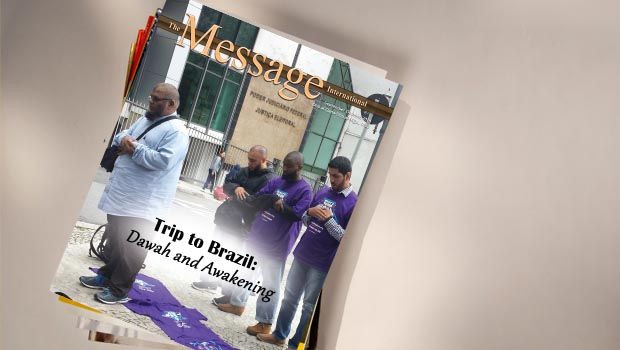
    During the World Cup, volunteer groups did their best to distribute flyers, speak with both spectators and locals about Islam, and engage vendors, taxi drivers, and anyone they came in contact with in conversations about Muslims and their religion. The regular driver for the American crew, a man by the name of Carlos, accepted Islam during their stay citing his reason as being their generosity and respect towards the people of Brazil. He witnessed how they distributed food and toiletries to poor families in the slums of Sao Paulo and made regular visits to the area’s small musalla, or Islamic prayer space. There were many lessons learned during the trip, the greatest lesson being that these type of efforts need to continue, and as Morales stated, “This is just the beginning.” Martins suggested that organizations in the US continue to work with those in Brazil and other Latin American countries, as well as reach out to their Islamic centers to establish special programs. “We should assist them with organizing national and regional conferences, similar to the ICNA conventions, in order to unite Muslims from all over (South America) to learn about their Deen, address issues that they are facing, and to create opportunities for networking.” He also commended the efforts in Brazil thus far, stating, “I think that this is a great start and will have a great impact on strengthening the bonds between the Muslims living in Brazil and the native Brazilians that have embraced Islam.”

    Muslim explorers, traders, immigrants, and converts of the past faced great challenges of distance and limited communication opportunities. They share, however, with the dawah journeyers, immigrants, and converts of today their passion for Islam. Many of our forebears’ dawah challenges have been resolved by the modern tools and technologies of today. However, it is up to the current and subsequent generations to step out of the comfort of their everyday lives to journey to other lands and explore new horizons, seeking the pleasure of the Lord by sharing with the local inhabitants the faith in One Creator and Sustainer of all.

  • From Ireland to Brazil

    From Ireland to Brazil

    All praise and grace are due to God, without whose help nothing is possible. That knowledge was made so real and vivid to me in June of 2014 when I was asked by a friend of mine if I would like to accompany him to Brazil. I have no interest in football and the World Cup was something that was completely out of my frame of reference and so I asked “What’s in Brazil?” He laughed and told me the World Cup was being held there and that he had heard of some daw’ah organizations inside Brazil who were starting big daw’ah drives due to the influx of people for the World Cup. I said I would love to go but I had a lot of projects in the works and I was very busy and so I regretfully declined.

    In Brazil, I met a man who will be in my heart until the day I die. Ka’ab Abdul Qadar is a Brazilian brother who established a masjid on his roof. I ask Allah to give him the highest level in Jannah. When we entered his masjid we prayed with him and some others from the area, fifteen of us in total. He later told me that this was the greatest number of people to ever pray in his masjid.

    A few weeks prior to this some of the brothers in our office were watching a man I had never heard of before, Boonaa Mohamed, give a TedX talk. So one day after the call from my friend I had a few minutes to spare and decided to look him up on YouTube. When I searched his name the first video I saw was “Mission Daw’ah” and I was definitely intrigued! Once I started to watch the video I knew I’d made a huge mistake. He was inviting people to come and join the WhyIslam team in Brazil for daw’ah! I then made a sincere intention to travel to Brazil solely to invite the people there to Islam and to benefit them in any way that I could. I booked a ticket and made dua to Allah that if this decision was good for me then to make it easy for me to arrange all of my work and personal affairs so that I could travel peacefully to Brazil and with focus only on making daw’ah.

    My friend said he was in touch with an imam in Brazil who was the head of a daw’ah organization and that we would meet him there. However, when we arrived in Sao Paulo, we found out that the imam had to travel to Brasilia and so was unable to host us. We travelled to a masjid and the imam there told us there was no problem with us staying in the apartment above the masjid and he was a brilliant host for us, may Allah reward him. Two days later we were amazingly blessed. It shows that once you make a pure intention to work for Allah, Allah will make it easier and easier for you. The imam of the masjid told us there was a group in Sao Paulo who were working in daw’ah and he drove us to their office where we were given blessing after blessing, and I thank Allah, subhanahu wa ta’ala, every day.

    At the office, we met a group of individuals who from that day until now have inspired and re-inspired me. The WhyIslam team we met there was completely dedicated to the task at hand. They were serious about their duties and demonstrated time and again something that is lacking in a lot of daw’ah organizations today – they genuinely care about the people they interact with. One of the hardest working members of the WhyIslam team was sister Nahela. She is very skilled at what she does and is perfect for the role she is in. She has a passion for daw’ah that is infectious, and a deep affection for people that attracts them automatically and builds compassion on both sides instantly. Brother Crus, another volunteer, and I clicked instantly. We are the same age and are very similar in our thinking and our world-view. He is another shining example of the quality of people who volunteer for Dawah. Again the compassion for his fellow human beings is felt instantly by everyone around him. I ask Allah to bless them and to reward them abundantly for their sincerity and dedication.

    This group of wonderful individuals welcomed us with open arms, literally! Our uncle Farooq
    hugged me straight away like I was a beloved family member he hadn’t seen in a while.

    This group of wonderful individuals welcomed us with open arms, literally! Our uncle Farooq hugged me straight away like I was a beloved family member he hadn’t seen in a while. Without doubt, the team of WhyIslam volunteers was the best and most dedicated group of individuals I have ever had the blessing to work with. Their efforts and sincerity in their daw’ah was moving. For me personally, not speaking Portuguese, the leaflet distribution and street dawah was a serious learning curve. Ireland is a very different place than Brazil and street daw’ah like this would never work in Ireland. Without my brothers and sisters in WhyIslam, I never would have been able to experience this. So many wonderful things happened. The first few days were spent on the streets in different areas of Sao Paulo, distributing WhyIslam literature and copies of the Qur’an in Portuguese. This was an amazing experience for me. Irish people are very introverted when it comes to matters of faith and so they will rarely accept literature if its handed to them. Brazilians, however, are so open-minded. They really are a beautiful people who are so soft and genuinely good-natured that they rarely refused a leaflet. What’s more, as they walked down the street you could see them reading it, may Allah guide them all.

    We then took a trip to a favela, Embu des Artes, outside of San Bernardo where we were staying. Even thinking about it makes me choke up. It is sometimes very easy to forget the people we meet, yet I will never forget the brothers and sisters I met in Embu des Artes. The people live in makeshift homes that are constructed on top of other makeshift homes. It creates alleys that twist and turn in a haphazard way that is obviously born from necessity. There are no civic facilities, no waste management, no sewage system; just a beautiful people living in a situation they shouldn’t have to live in but have no alternative. May Allah make it an expiation for them. We took a walk through this favela (the favelas are talked about in the media in Brazil as hives of drug trafficking, prostitution, and vice of every other sort) and were greeted with a bright smile from every single person we met. We were invited in for tea or coffee so many times I lost count! The people were so open to us and welcomed us so beautifully I can’t make dua for them enough.

    In this favela I met a man who will be in my heart until the day I die. Ka’ab Abdul Qadar is a Brazilian brother who established a masjid on his roof. I ask Allah to give him the highest level in Jannah. When we entered his masjid we prayed with him and some others from the area, fifteen of us in total. He later told me that this was the greatest number of people to ever pray in his masjid. Then, with tears in his eyes, he thanked us for coming to visit him and, with tears steadily falling from my eyes, I thanked him for welcoming us and being such an inspiration. While in this favela we were blessed to put into practice, and see the instantaneous results, the words of Prophet Muhammad, sal Allahu alaihi wa salaam, when he said “Your greatest daw’ah is in your actions…” We were blessed to be able to help the poorest members of that community with food packages. To see how grateful they were, to see the worry of trying to feed their children for another week wash away, was an extraordinary experience. In this action alone is blessings above and beyond what anyone can imagine, the reward is from Allah, subhanahu wa ta’ala, and I ask for a reward only from Him.

    We were then blessed even further. We had a driver, a wonderful Brazilian man named Carlos, who was so patient and helpful to us. Every day he helped us deliver our daw’ah to his people, while he himself was non-Muslim. When we travelled to the favela and we followed the sunnah of Muhammad, sal Allahu alaihi wa salaam, and helped the neediest people in his society, Carlos took his shahadah on the same day, in that rooftop masjid, surrounded by people who I know all still remember him with a smile on their faces and such happiness in their hearts. He took his shahadah and may Allah guide him and his family and keep them safe from the evil of this world, ameen.

    It truly was a blessing to take part in this amazing venture. I make dua every day for the brothers and sisters of WhyIslam because they truly are devoted to their mission. My hope and dua is that more and more individuals and groups support WhyIslam in any way possible. There is so much in the media that misrepresents Islam and makes Muslims look bad, and organizations like WhyIslam counter and correct the misinformation that is out there. If you hear of any work WhyIslam is doing in your city, volunteer and help out. If you can’t volunteer, then donate to support their important projects and outreach efforts. And no matter what, always keep them in your dua. They do their work tirelessly for the sake of Allah SWT and I pray to be able to volunteer for them again in the future. May Allah bless them all, guide and keep them safe, and elevate them in the ranks of the people of paradise, ameen.


  • Perspective from Brazil

    Perspective from Brazil

    I would like to share with the reader the wonderful experience I had with the WhyIslam dawah group who came to Brazil during the 2014 World Cup. I am Brazilian and have been a revert for about 12 years. I lived in the US more than ten years and that is where I took my shahada, but I’ve been back in Brazil for a couple years now. Then one day not too long ago I received a Facebook message from a sister (she and I have a common friend), letting me know that she would be coming to Brazil with a dawah group during the World Cup. At that moment I was pretty excited to know that a group of Muslims would be coming to my country. However I really didn’t know anything about them, their mission, theirs plans, or the individuals who would be part of the group. And I never could have imagined how their visit would so deeply impact my life and my reality here in Brazil.

    The most inspiring of it all was to see the dedication of the group,  so willing to give of their time and resources,  willing to travel to another part of the world to make dawah,  simply blessed with pure intention, effective printed material, and a nice smile.

    My husband and I try to be pretty active with the Brazilian revert community, attending weekly classes which are open to reverts or anyone interested to know about the deen of Islam. In addition, we try to provide support and followup to the newcomers to facilitate their transition into a wonderful new way of life as Muslims. A whole new phase in this blessed journey of discovery in Islam began with the arrival of the first individuals from the WhyIslam group, a sister and her son, at the airport. I was very excited to meet them; in fact, it felt like I was going to see family members that I hadn’t seen for years. Alhamdulillah, because of hijab it was easy to recognize each other. From the very first moment I met this sister and the other WhyIslam brothers and sisters, I instantly felt a tremendous bond of love and great respect among us. It was amazing to see that although we come from different parts of the worlds, with different languages and cultures, we had all come together for a singular purpose – to invite others to the deen of Islam; and with one common intention – to do so for the sake of Allah SWT.

    The dawah itinerary consisted of daily visits to various parts of São Paulo including suburbs and slums, as well as designated spots at World Cup venues where large numbers of locals and tourists and World Cup attendees were concentrated. We made dawah by distributing Islamic material and through these blessed activities I found, amazingly, that language wasn’t a barrier even though most of the dawah group didn’t speak Portuguese. Communication took place between hearts as we handed brochures to people, offering them a nice smile and a kind and open demeanor. When someone had a question or comment, the native speakers among our group would engage with them.

    I was surprised to see the response of the people. Most of the time they were very open, curious, and very receptive to the message of Islam. Due to a bit of prejudice I have faced with the wearing of hijab, I realized that I had some preconceived notions about Brazilians not being open to hearing about Islam. In the beginning of my time with the WhyIslam group, I was actually a bit nervous to talk to the people, not knowing how to approach them and thinking that it would be challenging to convey the message to them, to total strangers. But slowly I realized that it becomes natural with time and practice. It was so rewarding to be talking to people and sharing with them what I have found to be the most sacred thing in my life. Allah SWT is the best facilitator of all things and capable of transforming us in the most unexpected ways!

    Talking to people about Islam was not just rewarding in the sense of inviting them to the truth, but it also strengthened my eman

    My experience was that talking to people about Islam was not just rewarding in the sense of inviting them to the truth, but it also strengthened my eman. This dawah experience caused me, in addition, to seek greater knowledge about, and reflect on, points brought up through questions or conversation. Usually some other individual(s) in our group would know the answer to any question that I lacked knowledge about, and each instance of this helped to prepare me more for further dawah interactions and conversations.

    I realized through this experience that the use of technology and social media is so effective and you don’t have to be a professional to make a video and upload it to Facebook or YouTube. Whether intending to convey a dawah message or report what is happening on the ground, one can use a smartphone to spread the word. Also I came to appreciate the importance of the group having a good visual identification and we wore very catchy and memorable T-shirts. People in my own community immediately bring to mind Islam when they see the T-shirt.

    The most inspiring of it all was to see the dedication of the group, so willing to give of their time and resources, willing to travel to another part of the world to make dawah, simply armed with pure intention, effective printed material, and a nice smile. I actually felt ashamed the moment I realized that I had to wait for others to come across the continent to teach me the importance of dawah and that the most essential tools needed to make dawah are within me. Now I can only thank Allah SWT for giving me this blessed opportunity and the capacity to see how much I can still do here in Brazil, even with the most simple resources. For my husband and me, this visit by WhyIslam was an awakening moment, not only to realize how much we can do here, but to see how much Brazilian people are receptive and in need of the message of Islam.

    This awakening is a milestone in our lives. Now we are organizing ourselves to hold at least monthly street dawah events, and if Allah wills, we will make brief videos and post regularly such reports of our events in a variety of media. We hope that slowly we can encourage other Brazilians to join us so that they too can experience the wonderful fulfillment of sharing the blessings of our deen. I ask Allah SWT to continue to bless the amazing work WhyIslam has been doing, and to reward all their efforts for the sake of Allah only. Ameen.

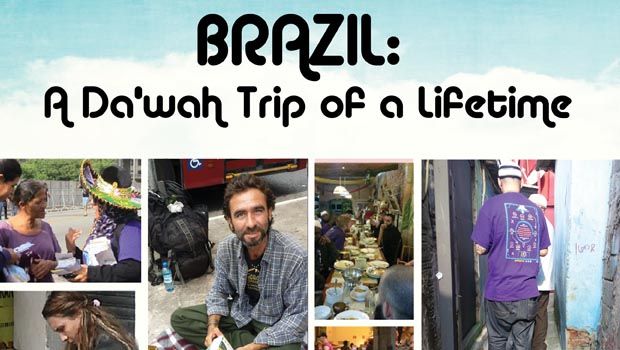
  • Brazil: A Dawah Trip of a Lifetime

    Brazil: A Dawah Trip of a Lifetime

    Even though I am considered a fifth generation from Guyana, South America, I must confess that I have little to no knowledge of neighboring Brazil except that it is a vast country that borders Guyana and every other country in South America except Chile. Brazil is home to the massive Amazon rainforest, part of which extends into Guyana and which is commonly nicknamed “the lungs of the world” as it covers an area of 2.1 million square miles, a vast tract of forest that sucks up carbon dioxide from global emissions and in turn produces the oxygen we need to breathe. Sixty percent of the rainforest is in Brazil.

    Da’wah is not just words. Oftentimes it is through the way we interact with others

    Questions About Islam and Muslims in Brazil

    I always think of Brazil and other South American countries in terms of their Muslim communities and I wonder if they have masaajid (mosques). Is any Da’wah work going on in these places and if so by whom? What have their populations heard about Islam? Are the people biased against Islam and Muslims? Who are the native Muslims in terms of understanding and practice of their Deen?

    Since most of South America speaks Spanish, and Portuguese in Brazil, I continued to have these questions and few answers as I concentrate on da’wah in the English-speaking environments of Guyana and the U.S. Yet I always hoped that one day I would be able to venture into the Spanish-speaking parts of my own continent and find answers for myself, by the grace of Allah SWT.

    WhyIslam Heading for Brazil

    In May of this year, Br. Farhan from WhyIslam, an ICNA project, reached out to let me know that a da’wah team would be going to Brazil for the 2014 FIFA World Cup; I immediately knew this was my long-awaited opportunity. This was my chance to see first-hand how Islam has advanced into the heart of South America and what, if any, da’wah goes on in this vast country of 202 million people, most of whom are Catholics. So without a second thought I replied that I would like to be part of the WhyIslam team.

    I was pretty excited about the upcoming trip to Brazil but as the time drew near I had many “what ifs” popping up in my mind. Perhaps having second thoughts was because I was going to a strange land, not knowing what lay ahead. Or perhaps it was the Portuguese language and even though my knowledge of Spanish is fairly good, I wondered if it would be sufficient to maintain a dialogue, to give da’wah in an effective way. At the same, the media was covering the large demonstrations preceding the World Cup including strikes, acts of civil disobedience, and the harsh, sometimes brutal, reaction of the police to the protestors. But by the time we got there none of this was evident. Once the match begins, Brazilians are in football frenzy and grooving!

    What is your Goal? ¿Qual é o seu objetivo?

    Brazil, like many of the South American countries, is all about football. For them football is bigger than life itself. Hence, the theme WhyIslam chose for the da’wah campaign in Brazil was “What is your goal?” or as you say in Spanish “¿Cuál es tu meta?” and in Portuguese “Qual é o seu objetivo.” This was so appropriate as it opens up the question for a dialogue, seeing that the main “goal” for many was which player would score a goal for their country. In fact, one day as I was standing on a street corner handing out flyers, a Brazilian journalist approached me and asked me about the place or relevance of religion at the World Cup. So I had the opportunity to explain that beyond the goals on the field is a bigger goal of life that we should also think about, and while the worldly goals of sports and all of life’s activities will end and are short-lived, the real goal of life – to find meaning, purpose, and truth – is everlasting. I explained to her that the first goal is easier, requiring that one kick a ball to score a goal; but the second goal requires a lot more than just kicking a ball! It’s about life! What is the goal of your life? What happens beyond this life? Have you prepared anything for it? And thus my da’wah experience in Brazil began.

    Da’wah at the Games

    Most of our outreach programs were centered around the games. Whenever a match was played in Sao Paulo there would be a huge gathering and there we distributed flyers and had conversations with people. Whenever the Brazilian team was playing, the crowd kept pouring into the “Fan Fest Zone,” a free area not too far from the stadium where fans could watch the match on big screens. While most of the passers-by were Brazilians, we did run into a number of people from different parts of the world. We met several Muslims who had come to see the games. They were very happy to know that we were taking the opportunity to reach out to people with the message of Islam.

    Our first stop was quite a remarkable one. It was Thursday June 19 and we had decided to go to an area where the WhyIslam team had been a few days before to pass out flyers. However there was lots of open drinking in the streets. As we began distributing flyers, one elderly lady came to us and welcomed us, but barely had she done so when she began in an evangelical style to preach that Jesus is the only son of God and that God so loved the world that He sent His only son. So I felt compelled to answer her claims and with my limited Spanish I joined her in the same evangelical style and began to proclaim loud enough for the surrounding people to hear, “El Dios es el más grande. Él no tiene necesidad de un hijo o una hija! Jesús es un profeta. Allah solamente es el Dios!” The meaning is “God is The Greatest. He has no need for a son or a daughter. Jesus is a Prophet. Allah alone is God!”

    At that time Sister Nahela, our Spanish-speaking team member, and Br. Fayed and his wife, Sister Bia, our Portuguese-speaking team members, began a deeper conversation with the woman, gently but confidently refuting her proclamations. In the end she was silent, looking very thoughtful and surprised at what had just taken place. While this was going on, some men who were drinking at a bar began to gather around us. Even though it was a little intimidating, we continued handing out our flyers. It took some time, but I came to realize that people are genuinely interested in knowing about Islam. I expect that the men from the bar have listened to these evangelical speeches countless times and now they were willing to hear what “the newcomers” had to say.

    The Fan Fest Zone

    After a while we went to the Fan Fest Zone on another side of the stadium and there we began handing out flyers at a very fast pace. Every time we gave a flyer we would say “obrigado” meaning thank you or “muito obrigado” thank you very much. With these two phrases and a smile we handed out thousands of booklets and flyers and the da’wah campaign was off and running in Brazil!

    There were a few incidents at the Fan Fest Zone that are worth narrating here. First there was a Brazilian gentleman with whom we were engaging in some discussions. He had a bottle of beer in his left hand and all of a sudden during our conversation with him his beer fell out his hand and the bottle broke. The guy was kind of shocked and bewildered as if some power had just pushed the bottle from his hands, plummeting it to the ground where it broke. It was almost as if Allah SWT’s words and beer could not be with a person at the same time. Another amazing incident that took place within the same hour was praying Salaatul Maghrib and Eshaa at the Fan Fest Zone. It was crowded with thousands of people walking by and lots of drinking was going on. Also the security was very intense. It was time to pray Maghrib and so we decided that we would look for a fairly clean place (which was hard to find) on the pavement and do our Salaah there, even though there was a Masjid nearby. Earlier that day we tried to get into the Masjid to pray Zuhr and Asr Salaah but it was locked and we ended up praying in a nearby parking lot which was far from clean. So right where we were seemed the best choice.

    As we were looking for a possible area to pray, two brothers happened to pass by and gave me salaams. So I told them to join us, that we were about to pray our Maghrib Salaah. Just then I mentioned that we had to pray on this dirty pavement because the nearby Masjid is closed and we did not know who to contact to have it opened. They said that they were the ones in charge of the Masjid and they had the keys. They were very happy to open the Masjid for us and alhamdulillah they did. This was finding an oasis in a desert; the luxury of restrooms, wudhu, a clean place to pray, away from the noise and chaos of a drinking, boisterous crowd. We could only conclude that you make one step to serve Allah SWT and He SWT makes the way easy for you.

    When we engage with the people and listen  to their narratives and the struggles that  they deal with each and every day, we can  offer them words of comfort, hope, and truth

    Da’wah in Liberdade (Little Japan)

    The next day was Friday and after delivering the Khutbah in Arabic at Sao Paulo’s main Masjid, Abu Bakr Assiddik (translation in Portuguese using the head-phones), we headed for a busy junction called Liberdade in the heart of Sao Paulo. There we were joined by the British da’wah team. This area is known to be home to the largest Japanese community in the world, outside of Japan. There we had a lot more interaction with the crowd. What was noticeable was that the majority of the Japanese people did not accept any flyer from us and the majority of Brazilians took the flyers and booklets and at least interacted with us. One lady said that she heard that The Qur’an is recited like a song. So I had no choice but recite to her Suratul Fatihah in the middle of Liberdade so that she could hear the recitation of The Qur’an.

    After several hours of handing out flyers with the same obrigado and a smile it was time for Maghrib and Eshaa Salaah. This time there was no nearby Masjid so we had no choice but to hit the pavement. One of the brothers called Adhan and the police kind of made sure we prayed undisturbed. So when the Salaah began, a little crowd gathered to see this rare sight: people in a row standing, bowing, prostrating and sitting; all in the same sequence with the sound of Allahu Akbar! I was told that several people took out their phones and took pictures of us and some videoed the prayer. When we were done praying, some more flyers were distributed to the lookers-on. That evening Br. Fayed and Sister Bia invited us for a traditional Brazilian dinner. Needless to say that it was absolutely delicious and a reminder of my own Guyanese cuisine with yuca (we say cassava in the Caribbean) and organic beef in a soup form and the highlight was a passion fruit mousse. Saturday we spent at the center where Sh. Rodrigues, a native Brazilian, had classes for new Muslims. Each one of us introduced ourselves and shared some of our experiences and encouraged them to be firm in their Deen. Most of us spoke in English while sister Bia and Br. Fayed translated.

    Da’wah in the Favelas (Slums)

    The next day was an experience in da’wah that was a unique Brazilian experience that. It was da’wah in the favela. Favela is the term for a slum in Brazil and very often one can find these slums near upscale urban areas, in such close proximity that on one side of the street there are multimillion dollar high-rises and on the other side are slums with open sewerage, little or no utilities, poverty evident everywhere, and the potential for crime in every corner. Indeed we were told before entering the favela that we needed to be very vigilant because in some of those areas the police have no presence. Only Br. Boonaa and his camera man, Br. Adnan, were allowed to film and only at particular places and when permission was granted. We met Imam Kaab who by himself established a Musallah just at the entrance to the favela. He informed the “leader” of that particular favela that a group of people wanted to go around and distribute flyers after which they would hand out food boxes to the poor and needy. This was in collaboration with Br. Irfan Khurshid from Helping Hand. So with our trust in Allah SWT and taking our precaution, we went door to door handing out flyers and booklets on Islam and to anyone we met in the street. The favela was set on a hilly region of the city, apparently typical of most of the favelas. The “leader” himself met us and went around with us as if he were part of our team. Wearing a gold chain with a cross around his neck, he took us to the nooks and crannies of the favela. The streets were so narrow that two people of any size would find it difficult to pass. The smell was far from welcoming, but with pleasure our team went from door to door to spread the word of Allah SWT.

    Most people we met had smiles on their faces. SubhanAllah! What a miserable life people are forced to be in while the country prospers! One wonders what government would deprive so many of its citizen from participating in the prosperity. But this is reality, not only in Brazil but so many places around the world. We went higher and higher up the hills until some of us thought it was becoming very hard physically to go on. But with trust in Allah SWT and the motivation from each other we all climbed until we reached the top. Then we finally returned to Imam Kaab’s house and Br. Irfan organized the distribution of the food boxes.

    Our Taxi Driver Takes Shahaadah

    Imam Kaab prepared a humble yet delicious meal for all of us. Just after the meal our taxi driver, Carlos, who had been observing us from day one, decided there and then that it was time for him to take the Shahaadah. He observed how we put aside fear to deliver Allah SWT’s message and how we helped the poor in the favela. He felt that this religion must be true. It was a special moment. You think back at all those stories of the Sahaabah (RA) who prior to their acceptance of Islam were in a state of kufr (disbelief) but just by observing the Muslims they joined the ranks and became the most upright of Believers.

    We prayed Salaatul Maghrib and Eshaa at the Musallah of Br. Kaab after which we engaged in some reflections on Br. Carlos’ Shahaadah and it was very emotional. For many of the brothers and sisters there, it was a humble reminder of their journey from kufr to eman, and the challenges and joys of being Muslim. We were all touched and every one of us cried. Br. Carlos said that he was observing us from the first day and even though he understood very little of what we were saying, just by our behavior and kindness he felt this must be the right way. SubhanAllah! It brings us to another reality check that da’wah is not just words. Oftentimes it is through the way we interact with others. This is such an important lesson for us to learn, especially living amongst non-Muslims.

    Like Carlos, many people in Brazil are ready to listen to the message of Islam and I think that we are somewhat obligated to go and let them know what Islam is. It is Allah SWT who changes the hearts but our job is to deliver the message. Only Allah SWT knows how many of those people to whom we gave flyers and booklets may one day accept Islam and if by His Qadr, they do not, they cannot stand before Him on the Day of Judgment and say that they never heard about Islam.

    Two Incidents – One Uplifting and One Not So Much

    Let me start with the “not-so-much-uplifting” incident, the only down moment in Brazil, and ironically it happened to be with an Imam at one of the first masaajid built in Latin America. We visited this masjid the day after Br. Carlos took Shahaadah. While we were basking in the beauty of the masjid, the Imam appeared and very rudely asked us who gave us permission to enter. We introduced ourselves and I mentioned that Br. Carlos had just taken Shahaadah the day before. The Imam’s next remark was quite disheartening. He asked in a rude way what could Carlos know about Islam to become a Muslim. Then he questioned me as to where I studied about Islam and for how many years. When I told him seven years, he immediately did a “one up” on me, stating that he has studied for 26 years. At that point we realized that we were not welcome there. Ironically, the day before a gang leader graciously and respectfully escorted us around the slums to do da’wah; and the very next day a Shaykh who studied Islam for many years all but kicked us out of Allah’s house of worship. These were teaching moments, reminding us that a man of the streets, without education, might be humble and courteous while a man inhabiting a house of God, one with so-called “knowledge,” might be arrogant and rude.

    Now let me share the uplifting story, one with a happy ending. On my way home I had a layover in Panama for almost eleven hours. So I decided to venture into Panama City for a while. The taxi driver took me to see several important sites including the Panama Canal. During our trip we spoke a lot about religion and I told him about Islam, that Ramadhan would begin the next day and what it meant for Muslims. He explained that he had doubts about some of the tenets of his faith. The last stop we made was to a Masjid. I invited him to come with me into the Masjid. I showed him how to make wudhu and then he stood next to me for prayer. After the prayer he took Shahaadah by Allah’s Grace.

    Conclusion

    I observed in both Brazil and in Panama that the Islamic Centers are built to serve the Muslim community and accommodate their religious and fellowship needs. Alhamdulillah, that is good. But as for da’wah, and Allah SWT knows best, it seems to me that very little is done.

    Muslims cannot take benefits from the society and feel satisfied with just taking. They must give back to society more than what they take. I encourage every Shaykh to take time to leave the minbar (pulpit) and go into the field. When we engage with the people and listen to their narratives and the struggles that they deal with each and every day, we can offer them words of comfort, hope, and truth. In case you want to step out and head down south, Brazil is a good place to go. Just remember a smile, a flyer, and a simple obridgado!

  • Finding Comfort and Countless Other Blessings in Dua

    Finding Comfort and Countless Other Blessings in Dua

    I was listening to National Public Radio a few years ago and the topic of prayer came up. Several random people were asked the question, “When was the last time you prayed?” I was surprised to hear responses like, “I haven’t prayed since my daughter was in the hospital six years ago.” Or “I haven’t prayed since I visited a church two years ago.” The prayer that was being referred to on the radio program could be likened to what Muslims refer to as du’a (supplication), and I remember reflecting on how fortunate Muslims are in their obligation to offer salat (ritual prayer) five times a day—thus maintaining a daily connection with our Creator. The fulfillment of this obligation not only provides the blessings derived from our obedience, but also imparts spiritual benefits enabling us to draw nearer to Allah (swt), thus enjoying peace of mind and spirit. Allah says in the Quran: “Verily in the remembrance of Allah hearts find rest” (Quran 13:28).

    In making du’a, we acknowledge that Allah exists, has imbued the creation with a meaning and purpose, has created us to worship Him, and has the power to answer our supplication and improve our circumstances.

    In addition to salat, however, is du’a and this discussion about prayer begs the question: do we truly recognize the innumerable benefits and blessings of making du’a (supplication) to Allah (swt)? Du’a, supererogatory prayer beyond the obligatory salat, is a humble and earnest entreaty to the Lord which can be made at any time of day or night, for any reason, major or minor, whether for comfort, guidance, relief, or inspiration. Without doubt, there are times in our lives when difficult circumstances are beyond our control. Feelings of helplessness may overcome us due to losing a job, having financial difficulties, a loved one becoming sick, or any of the other countless personal or family challenges humans face. Still at other times we may be frustrated by the lack of peace and justice around the world and the many complex and unsolved global problems like poverty and hunger. It often seems that our ability and power to make change in the world, or even in our own lives, have limits. However, one of our most powerful and useful tools in seeking a better life in this world and in the next comes from making sincere du’a.

    Du’a is an Islamic term which means to call out, to supplicate, to communicate with our Creator, Allah (swt). It is an act which acknowledges our dependence on Him and demonstrates our faith in His power to bring about positive change in our lives. Making du’a is empowering and fulfilling as it provides us a means of hope by which the solutions to our deepest concerns, problems, and hardships will be found and relief granted. As such, the following are some of the many benefits and blessings in making du’a.

    The blessing of recognizing that du’a is a form of worship

    The Prophet (saws) has said, “Du’a is ibadah (worship)” (Tirmidhi). Thus, blessings are derived from the act of worship made through supplication. In addition, in Allah’s infinite Mercy, He has included a du’a for guidance within surah Fatihah which Muslims recite at least 17 times a day during the daily prayers – “Show us the straight path. The path of those on whom You have bestowed Your grace, not the path of those who have earned Your anger or who have gone astray” (Quran 1: 6-7).

    Du’a helps to strengthen our eman (faith)

    In making du’a, we acknowledge that Allah exists, has imbued the creation with a meaning and purpose, has created us to worship Him, and has the power to answer our supplication and improve our circumstances.

    Du’a helps us to grow closer to Allah (swt)

    Allah says, “And when My servants ask you concerning Me, then surely I am very near; I answer the prayer of every supplicant, when he calls on Me… (Quran 2: 186).

    Du’a helps to prevent feelings of isolation and despair

    When we firmly believe in Allah, we realize that Allah (swt) is not only our Creator but also a protecting friend who is always ready to listen to and aid us. Allah says in the Quran, “Allah is the protector of the believers” (Quran 2:257). In addition, Allah says, “…for Allah loves those who turn to Him constantly…” (Quran 2: 222).

    The du’a of repentance provides forgiveness of our sins

    We should never lose hope in Allah’s willingness to forgive our transgressions, and we should also not assume that we are entitled to Allah’s forgiveness without first asking for that forgiveness. Allah (swt) says in Hadith Qudsi: “ …Oh son of Adam, were your sins to reach the clouds of the sky and were you then to ask forgiveness of Me, I would forgive you.”

    Making du’a is a means by which Allah (swt) answers our prayers

    Du’a provides an opportunity for us to have our wishes granted, for blessings to be showered on us, and for protection to be provided to us. The prophet (saws) has said, “Every Muslim who supplicates to Allah with a supplication which is not haram, shall be granted what he asked for in one of three ways – either Allah (swt) answers his supplication quickly, or answers his supplication in the hereafter, or exchanges his supplication for a hardship that was to befall him” (Ahmed).

    It is quite interesting hearing stories from Muslims of how their du’a have been answered. I, myself, have seen my du’a answered, at times, years later with something better than I had initially asked for, and I also have witnessed my du’a being answered immediately, as well. I recall an incident which took place when I was 13-years-old when my younger brother was playing with a child in our neighborhood on a white gravel road in front of our house. My brother showed this young neighbor his new sling shot. The young neighbor then pointed and shot the sling shot directly at my brother’s face. My brother came running into the house crying, with blood all over his face. My mother immediately tried to assess his injuries. She found that his front tooth had been broken in half, and urged me to go to the road where they were playing and find the tooth on the gravel road. I did as she asked and searched for the broken white tooth on the white gravel road. I felt like I needed a miracle so I began making du’a. SubhanAllah about two minutes later my eyes focused and zoomed in on the broken white tooth sitting on the white gravel road. I was amazed and uttered, “alhamdullilah” at the awesome discovery.

    Regardless of how daunting a difficulty is, or seemingly insurmountable a problem or hardship can seem, never underestimate the benefits of making du’a. Remember that Allah (swt) is All-Powerful and promises to answer our call. Allah (swt) says, “… And whoever fears Allah—He will make for him a way out and will provide for him from where he does not expect …” (Qur’an 65:2-3).


  • Dawah Campaign in Brazil:  Important Lessons

    Dawah Campaign in Brazil: Important Lessons

    “Who is better in speech than he who invites people to Allah and does righteous deeds, and says ‘I am of those who have submitted [to Allah]’” (Qur’an 41:33).

    “Invite to the way of your Lord with wisdom and beautiful preaching; and argue with them in ways that are best and most gracious…” (Qur’an 16:125).

    The baseline of effective dawah is good conduct and the best moral behavior

    Many of us are familiar with the above divine exhortations, but how many of us act upon them? If we are honest with ourselves, we will acknowledge that the answer is very few. Beside the fact that Allah swt exhorts us to disseminate the religion and we are not sufficiently living up to that obligation, is the dreadful reality that those extremists who engage in appalling, inhumane, and un-Islamic behaviors present themselves as true followers of the deen, and the non-Muslim world is confused, not knowing what to think about Muslims and Islam. Misconceptions about Islam and Muslims abound in today’s world and the need for dawah – conveying the true message of Islam to the non-Muslims – is more pressing than ever before. And so, during the FIFA World Cup 2014 soccer tournament, hosted by Brazil, WhyIslam, the largest dawah network in America, found the perfect opportunity for propagating Islam. More than five million people from all over the world attended the event, and of course the locals were out en masse and WhyIslam was able to offer dawah to the Brazilian residents of the host cities as well. The outcome was a grand success, for it set an important milestone for dawah work among Brazilians as well as creating a template for dawah campaigns at similar large events in the future.

    Sr. Wendy, one of the volunteers, says that the WhyIslam volunteers “prepared well before they launched this campaign. They began their massive undertaking months in advance, networking with organizations and individuals in the development of a strategic plan. It was decided that the propagation efforts in Brazil would culminate with a global day of outreach, termed ‘Global Dawah Day’ to be held on July 5. In order to promote and fund the project, WhyIslam elaborated a successful marketing campaign, using advertising in photos, videos, email blasts, and posting to social media outlets like YouTube, Facebook, and Twitter.”

    The resonating theme for WhyIslam’s endeavor was “What is Your Goal? (in Spanish “¿Cuál es tu meta?” and in Portuguese “Qual é o seu objetivo?”) The slogan aimed at raising questions in people’s minds and initiating conversations about the meaning of life, how to find one’s purpose, what happens when you die, and similar concerns about existence. A website (www.whatisyourgoal.org) was set up for individuals, groups, and organizations to register their dawah event and to follow the endeavors and accomplishments of the crew in Brazil. The official flyer for Global Dawah Day was printed on cards, banners, posters, and purple T-shirts that were provided to eager volunteers on six continents who were inspired to participate in the World Cup street dawah and/or Global Dawah Day. Many organizations came forward. WhyIslam printed and distributed thousands of brochures in English, Spanish, French, and Portuguese, as well as translations of the meaning of the Qur’an to World Cup spectators and locals in Brazil.

    During the World Cup, Sr. Wendy says that “volunteer groups distributed flyers and engaged passersby, vendors, taxi drivers, and anyone with whom they came in contact in conversations about Muslims and Islam. The regular driver for the American team, a man named Carlos, accepted Islam during their stay, stating that the team’s generosity and respect toward the people of Brazil profoundly moved him. He witnessed the WhyIslam volunteers distributing food and toiletries to poor families in the slums of Sao Paulo and he was intrigued by the regular visits to the musalla, or Islamic prayer space.” There were several other incidents of “Shahadah pronouncements” that moved the dawah volunteers deeply.

    What lessons can be drawn from this trip? The first and foremost lesson is that similar efforts should take place with increasing frequency. Second, the baseline of effective dawah is good conduct and the best moral behavior. The third lesson we can learn from the WhyIslam dawah campaign is that when engaging in dawah one needs some solid basic knowledge about Islam and good communication skills. One effective approach when doing street dawah is to ask what the person knows about Islam as this opens a conversation during which any misconceptions can be addressed and information beyond whatever they already know can be offered. The fourth lesson we can learn is that inviting people to Islam, especially when doing street dawah, is a very challenging task. One must be ready and able to hear negative comments, even insults. In all situations, patience is a must. Allah swt has commanded, “And bear patiently the vain things they utter, and part from them graciously” (Qur’an 73:10).

    The best lesson, however, is that dawah is an endeavor that brings great fulfillment, greater than the satisfaction from worldly success of any sort -“If Allah would guide one person, through you, to Islam, it is better than the whole world and whatever is in it” (Al-Bukhari).