
بسم الله الرحمن الرحيم

Tag: bosnia

  • Srebrenica: Forgotten by the Ummah

    Srebrenica: Forgotten by the Ummah

    Srebrenica. The site of one of the worst atrocities to occur on European soil since World War II. This July will mark the 27th anniversary of the genocide. The Bosnian town is situated in the easternmost part of the country, sharing a border with Serbia. Before the war, Bosniak Muslims and ethnic Serbians lived side by side in Bosnia. They lived in what we falsely believed to be unity and mutual respect. In reality, suppressed ethnic tensions in Bosnia manifested into a bloody four-year war. During the years leading up to the war, Bosnia was still part of a nation known as the Socialist Republic of Yugoslavia. In Yugoslavia, ethnocentrism was highly discouraged as we were all part of a collective Yugoslav nationalist identity. Which sounds like a good thing, except that what was constituted by Yugoslavia as “nationalism” was biased against Bosniaks.

    As Bosniaks, we could not talk about the history of our region. My mother remembers her time at school in Yugoslavia. They were taught about Serbian and Croatian historical figures and stories, and left out the stories about Bosniak Muslim figures, and Bosniak figures predating Islam. Talking about pre-Ottoman Bosnia and Bosniaks was considered ethnocentric. Academics such as Alija Izetbegovic were jailed for speaking about the history of Bosnia. The Yugoslav mainstream erased parts of our history to perpetuate the notion that the Bosniak ethnicity doesn’t exist, that we were just Serbian or Croatian people who converted to Islam when the Ottomans took over region. Ethnic Serbs resented Bosniaks for following Islam and “abandoning” the religion of our ancestors. Serbian school children would call their Muslim classmates “Turks” in a denigrating way.

    Resentments and Hatreds Manifested Through Genocide

    I remember my aunt taking me to her village one summer. We passed by a bus stop that she used to take every day to go to school. She told me how she remembered the day she got on the bus and all her Serbian classmates started looking at her differently, treating her differently. Like she was no longer their classmate, she was now their enemy. That was the day she knew that war was going to happen, and that it would change their lives forever. Despite Yugoslavia masking the resentment Serbian extremists had for Bosniak Muslims, these resentments and hatred ultimately manifested themselves through genocide.

    Throughout the duration of the Bosnian war, there was a struggle to take over control of the town of Srebrenica which was home to both ethnic Serbs and Bosniak Muslims. The town was under the control of the Bosnian-Serb army for several weeks during the start of the war.They are officially referred to as the “Bosnian-Serb” army because the soldiers were Bosnian nationals and ethnic Serbs. During those weeks, Serbian forces expelled and killed Bosniak civilians in an attempt to ethnically cleanse the town of Bosnian Muslims. In May 1992, the town was recaptured by Bosnian Muslim forces. After Srebrenica was declared a “Safe Area” in April 1992 by the UN, there was an agreement reached to demilitarize the town. Under this agreement, Bosniaks had to surrender their weapons and ammunition. Despite the fact that Srebrenica was now declared a demilitarized zone, Serbian forces were still attacking Bosniaks. In 1993, the UN condemned Serbian forces for starting a “slow motion process of genocide.” However, the UN did little to stop Serbian forces from advancing on Srebrenica besides condemning their actions and calling for a cessation of the hostile advance. By early 1995, Serbian forces had taken control over most of the territory surrounding Srebrenica and the situation in the city was disastrous. Humanitarian aid was being withheld from the town, leaving its citizens to die from starvation. Serb forces continued their advances on the town, and in July, Srebrenica fell into the hands of the Bosnian-Serb Army.

    The process of genocide began. Men and women were separated. The women and children were gathered and put on buses headed toward refugee camps in the northern town of Tuzla. The men and boys were taken to schools, community buildings, and fields where they were gathered in groups to be systematically killed by the Bosnian-Serb forces. Over the course of several days, 8,372 Bosnian men and boys were slaughtered. Many of them tried to flee Srebrenica through the forest to reunite with their families in Tuzla. Most were captured by Serbian soldiers and tortured and killed. Many of them died of wounds, exhaustion, and starvation. Nedzad Avdic was only 17 years old when he and his male family members were taken to a killing field. He was shot three times by Serbian soldiers and left for dead in a pile of corpses, men and boys who had been shot and killed. With the help of another wounded survivor, he managed to escape to Bosnian-Muslim controlled territory. They are some of the few male survivors from Srebrenica.

    The family of Hatidza Mehmedovic were not as fortunate. Hatidza lived in Srebrenica with her husband and two sons, Almir and Azmir. On July 11th, 1995, Hatidza would see her sons and husband for the last time. Her youngest son held on to her while begging her to go. He begged her to leave but couldn’t bring himself to let go of her. Her husband and sons took the forested route to Tuzla to try and avoid being captured by the Bosnian Serb soldiers. She boarded a bus with other women and young children and when she arrived, she waited for her sons and husband. After a few days, she realized they did not make it. Bosnian Serb soldiers pretending to be UN soldiers captured the men trying to escape Srebrenica on foot. A year after the war ended, Hatidza received a phone call informing her that remains of her husband and son Azmir were found, but they did not find her son Almir. It took her three years to find out what happened to the rest of her family. Only a few bones of her husband and sons were found. She also lost her brothers, her nephews, her cousins, and their children. Their entire bloodline was wiped out in a matter of days.

    While the men were the main targets of this genocidal campaign, women and girls were not spared. Bosniak Muslim women were repeatedly assaulted by Serbian soldiers. They taunted them, assaulted them in front of family members, and left them alive only so that they would have to live with the trauma. Children were killed in front of their parents and grandparents. Women and children who weren’t able to flee on buses had to flee through the forest on foot. Pregnant women, women with infants in their arms that they couldn’t feed, and women with children so young that they could not understand they needed to be quiet in order for the Serbs to not be able to locate them — many of these people died on their way to safety, their bodies yet to be found. Hundreds of victims are still declared missing because of how the Bosnian-Serb soldiers strategically hid mass graves, and how they randomly distributed the bodies and even body parts. When some victims are found, only parts of their bodies are recovered, while the other parts are still missing in different mass graves.

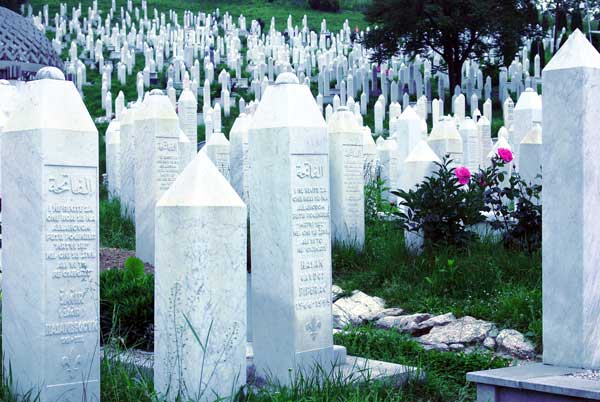
    Every year on July 11th, the bodies of victims found in mass graves are laid to rest in the Memorial Center Potocari. Last year, 19 victims were laid to rest. This year, there will be 18 more victims laid to rest. The funerals never end. Every year, someone receives a phone call that their husband, son, father, brother, uncle, or other male relative has been found. Every year, many mothers of Srebrenica pass away without ever having buried their sons and other loved ones. The pain and suffering are unimaginable. This is a war, one of many wars, that ravaged the Balkans in the 1990s. Bosniak Muslims were not the only victims of Serbian aggression, and Srebrenica is not the only town where genocide occurred. However, as the descendant of a Bosnian genocide survivor, I rarely hear about the Bosnian war being discussed in Muslim communities. I rarely hear about the suffering my people still endure in Bosnia and the political turmoil that makes another war and another genocide a real threat to the country.

    We Cannot Forget Bosnia’s Suffering

    I find it sad, and shameful. No one, besides Bosnians and a few supporters, have advocated against genocide denial, or for the international recognition of the genocide. Several UN officials such as Phillip Corwin and Lew MacKeznie still engage in genocide denial. Academics such as Noam Chomsky and Michael Parenti who are highly respected have continuously denied the horrific events that took place in Bosnia. In a 2006 interview, Noam Chomsky claimed that concentration and death camps were just “refugee camps” where people were free to leave any time they wanted too. My uncle was starved and tortured in one of these camps. He barely survived the beatings in the concentration camp that Chomsky describes as a camp for refugees. Michael Parenti, author of “To Kill a Nation: The Attack on Yugoslavia,” has written that the mass killings of Bosnian Muslims never took place.

    When one part of the ummah hurts, we all hurt. But Bosnia has become a forgotten part of the ummah. Bosnia’s suffering, my family’s suffering, have been forgotten. I write this article not only to educate people on what happened in Srebrenica, but also to call on people to teach others and to advocate for Bosnia. Advocate for peace in Bosnia against aggressors who threaten another war. Most importantly, I ask you to pray for Bosnia. Pray for those who lost their lives, those who are still living with the pain and trauma of war, and for the future generations of Bosniak Muslims who carry the burden and sadness our parents carry. Pray that one day, Bosniaks will truly be able to find peace and healing.

  • Bosnia: A Country With or Without Future

    Bosnia and Herzegovina (referred to in the West as Bosnia), a country with three ethnic groups—Serbs, Croats and Bosniaks— went through a devastating war coupled with ethnic cleansing in the 1990s. Finally after a US led intervention, the Dayton Peace Accord was signed and peace was restored. The three ethnicities that were at war were brought to live together as members of one nation. Since Dayton, the country has been busy establishing institutions and democracy but these efforts have encountered stumbling blocks erected by extremist ethnic politicians. Given the ethnicity-based government structure, the only way for Bosnia to implement reforms and have cooperation between various communities is through a coalition government. Such efforts regularly fall prey to ethnic extremists and threaten the future prospects of the Bosnian state.

    Since presidential and parliamentary elections in Bosnia and Herzegovina, held on October 3,  2010, things were progressing very slowly towards forming a ruling coalition on the state level. The reason for the faltering progress is as simple as it is devastating—the participating parties, coming from three different ethnic groups that live in Bosnia, differ so much in their views of a future internal organization of Bosnia. Their goals and demands appear very much mutually exclusive and their positions are so entrenched that any compromise looks nearly impossible. Bosnian Serbs and some Bosnian Croats are primarily pushing for further decentralization of state institutions; while Bosniaks (Bosnian Muslims) are in favor of a more centralized state. This situation, however, is not much different from past elections and pundits generally expect that at the end a few of the strongest parties will come together to form some kind of “mathematical coalition.” That coalition would be just enough to claim power but it will continue to wrestle with contentious issues throughout the four years of rule. For ordinary Bosnians of all the ethnic groups, it means four years more of wasted time and inefficiency, mutual vetoing of necessary legislation and ethnic demagoguery that ignores national interest and renders state institutions powerless. It also means four years more of virtual economic stagnation and slow implementation of reforms needed for EU accession that in turn gives rise to separatist tendencies.

    It is necessary for the Peace Implementation Council, as guardian of the Dayton Peace Accord, to take a firm stance against those who openly agitate against the constitution (a byproduct of the Dayton Peace Accord itself)

    The fundamental question is whether Bosnia and Herzegovina, given this state of affairs, can survive in the long term. Some Western diplomats like Henry Kissinger and  William Montgomery (former US ambassador to Bulgaria, Croatia and Serbia-Montenegro and former advisor to President Clinton on Bosnia) think that it cannot. In their view, some ethnic groups that live in Bosnia, such as Bosnian Serbs and Croats, cannot be forced to stay in a country of which they don’t want to be part. Since they do not see Bosnia as one entity, and rather regard themselves primarily as citizens of neighboring Serbia or Croatia, they  doubt the legitimacy of the Bosnian government itself. Given this fundamental reality, there is a strong feeling among many that Bosnia exists only on paper and as a result of international pressure; and that Bosnian Serbs and Bosnian Croats will walk away as soon as that pressure wanes.

    This view is attested to by the results of war in the 1990s that profoundly altered the ethnic structure of Bosnia. Most of the territory and the cities were “ethnically mixed” before the war and after were dominated exclusively by one ethnic group or another. After the Dayton Peace Accord that ended the war in 1995, two entities within Bosnia and Herzegovina were formed: Republika Srpska, which was almost exclusively inhabited by Bosnian Serbs; and the Federation of Bosniaks and Croats,  which was deeply divided between Bosniaks and Bosnian Croats.  The war left deep emotional scars and sectarian animosities. And children born after the war have grown up in ethnically homogenous environments without the chance to mix with members of other ethnic groups. As a result, Bosnian society is becoming even more divided, with palpable fear of “others,” and no countervailing factors to offset this disastrous trend. 

    It is important to note that Bosnia and Herzegovina has not always been an ethnically divided society

    Recently, the government in the Federation of Bosniak and Croats was formed by coalition of two major Bosniak parties and several fringe Croatian parties. Forming of this coalition was precipitated by announcement of a common platform built around social democratic values with a proposed list of legislative aims. The newly formed government received blessings from Western allies and encouragement for swift action. However, this resulted in major Croatian parties being pushed into opposition, an unprecedented event in Bosnian history. Averse to acknowledging defeat, these Croatian parties used the common demagogic methods of appealing to ethnic sentiment and proclaiming themselves the only true representatives of the Croatian constituency in Bosnia; and they went further and accused the Bosniak representatives of trying to marginalize Croats in Bosnia. While it is true that Bosniak political parties have at times selfishly pursued their own ethnic interest, this only shows how the most effective arguments used by politicians of any party or faction in Bosnia are those that arouse ethnic fear and suspicion.

    The political discord and ethnic strife in Bosnia have only been contained with extensive intervention by the international community. For that purpose, the Office of the High Representative (OHR) was created as part of the 1995 Dayton Peace Agreement. Some have said that the OHR “renders Bosnia a protectorate and the High Representative a viceroy.” The Office of High Representative is the institution that represents countries of  the Peace Implementation Council and has the duty to oversee implementation of  the Dayton Peace Accord. It also has power to impose legislation and sack democratically elected officials. OHR, especially right after the war, played a significant role in removing ethnically extremist politicians and pushing for reforms that made Bosnia more governable by centralizing state institutions. However, in the last few years, and especially after departure of the energetic British diplomat Paddy Ashdown, the OHR has minimized its activities to mostly an advisory role. This was partly because the US started losing interest in the situation in Bosnia as they became preoccupied with wars in Iraq and Afghanistan;  and more importantly, the EU came to the conclusion that if Bosnia wants to work its way to EU membership, then it has to start making independent decisions that should not be imposed from the outside.

    However, this led to the re-emergence of unbridled ethnic extremism that has pushed Bosnia back into political stalemate and festering sectarianism. Politicians of all three ethnicities know very well that the easiest way to win an election is to ride on the wave of ethnic extremism and dogmatic finger-pointing at the other ethnic groups. Elections in 2006 confirmed this by the election of Milorad Dodik as Prime Minister of the Republika Srpska. Mr. Dodik,  a Bosnian Serb, promised secession of Republika Srpska from Bosnia; and the election of Haris Silajdzic,  a Bosniak politician who got Bosniak support for the presidency with slogans of a centralized state. Since their elections, any kind of meaningful compromise was impossible and Bosnia  stagnated both politically and economically. Sectarian politics prevented any debate on important issues such as corruption, unemployment which has skyrocketed to 27 percent, and slow EU asccession reforms—problems recognized as extremely pressing issues by all three ethnic groups. It is hard to project a bright future for Bosnia when politicians have diametrically opposed political goals, use ethnic rhetoric to gain ascendancy, and are not willing to put the national interest above sectarian expediency, which is the only way to find common ground on core issues.

    Throughout history Bosnia was one of the rare examples of different ethnic groups living peacefully together 2010 presidential elections in Bosnia which brought victory to Bakir Izetbegovic, the son of a wartime Bosniak leader and moderate Bosniak politician, over Haris Silajdzic, a hardliner

    However, we need to look at the root causes of ethnic problems in Bosnia and the domination of ethnic extremists over moderates  since the country gained independence in 1992. Bosnia, part of former socialist Yugoslavia, has had a hard time transitioning into a democratic state with a free market economy. The war itself had disasterous economic consequences on the people, and the post-war free market reforms and privatization of formerly state-owned enterprises led to further impoverishment of the majority while creating a small wealthy elite. In this polarized political environment, with an almost nonexistent middle class, moderate voices were drowned out by rabble-rousing opportunists. Ethnic extremists were able to frame every issue as “a matter of ethnic survival,” playing the ethnic card in order to gain and/or remain in power.

    The only way for Bosnia to solve this entrenched problem is to develop moderate forces formidable enough to challenge and dissempower the ethnic extremists. Until now they have not had  much success since voters are still cling to fear of the other ethnic groups and choose those politicians who appeal to their basest ethnic sentiments.

    We have to look beyond the everyday political quagmires and analyze the implications of potential dissolution of Bosnia and the current trends in the Balkan region. It is important to note that Bosnia and Herzegovina has not always been an ethnically divided society. In fact, throughout history it was one of the rare examples of different ethnic groups living peacefully together.  Bosnia never had ethnically exclusive areas where certain parts of the country were inhabited only by one ethnic group. Most of the cities had large populations of all three ethnic groups. Only after the war and its campaigns of ethnic cleansing, did it became possible to draw the map with ethnically exclusive geographical areas where one ethnical group represented the majority with two other minority groups.  Even today, however, it wouldn’t be entirely possible in cities like Tuzla, Mostar, and midwest Bosnia in general.

    Thus dissolution of Bosnia along ethnic lines would not be a product of organic historical forces but rather a result of violent ethnic cleansing. As a result of that “cleansing,” Bosniaks and Croats were forced to leave areas that encompass Republika Srpska; and Bosnian Serbs fled parts of the Federation of Bosnia and Herzegovina. That is why the general consensus in the international community today is that sovereignty of Bosnia and Herzegovina has to be preserved so that the prevailing conditions that resulted from war crimes, ethnic cleansing, and genocide are not legitimized.

    It is somewhat understandable that Bosniaks and some Bosnian Croats are opposed to dissolution because they stand to lose the most;  49% percent of Bosnian territory is now part of Republika Srpska and the independence of Republika Srpska means that Bosniaks and Croats would effectively lose the land that belonged to them before the war and from where they were forced out. However, it is less clear why Bosnian Serb leaders are so eager for dissolution. Even though they got the biggest territorial gains as a result of the war, many Bosnian Serbs, in the event of dissolution, would lose a lot too. It is estimated that in Sarajevo alone, today’s capital of Bosnia and Herzegovina and city where the majority are Bosniaks, approximately 180,000 Serbs left the city during the war. It is hard to understand that in the city where there was a vibrant Serbian community for centuries that greatly contributed towards multicultural life, that today’s Bosnian Serbian politicians are willing to forgo and give up the right of many ordinary Serbian people to their previous habitats throughout Bosnia and Herzegovina.

    In fact, those who advocate secession should not be overly optimistic about the prospects of those newly formed states to gain recognition of their independence. The UN has already recognized Bosnia as an independent state and the EU, together with the US, has put massive resources behind state-building efforts in Bosnia. Any secession attempts are then likely to be unsuccessful because such a project wouldn’t gain recognition from other nations and it would go directly against efforts of the international community to build a self-sustaining Bosnian state. Other EU members such as Belgium and Spain also have the problem of provinces aspiring to independence (but they are unlikely to go to full extent of declaring secession because such projects would fail on feasibility grounds.) More importantly, Germany and Turkey, premier rising economic powers in Europe, have recently showed significant interest in sorting out the problems in the Balkans and finding solutions that protect the rights of all three ethnic groups and preserve the integrity of the Bosnian state.

    As soon as people are willing to look beyond the ethnic extremist rhetoric, it will be easier for them to understand that for all three ethnic groups it is better to return to their previous towns and cities; and if all of them want to be part of European Union, eventually they will have to co-exist peacefully anyway. Unfortunately, common sense and rationality are hard to find in ethnically charged Bosnian politics today.

    There have been, however, some recent overtures that might signal positive changes. Firstly, newly elected Croatian president, Ivo Josipovic, has initiated mutual reconciliation amongst Balkan countries by offering apologies for war crimes and other offenses committed by Croatia during the Balkan wars. In this he was joined by Serbian president, Boris Tadic, who helped pass a declaration in the Serbian parliament that for the first time acknowledged war crimes committed by the Serbian army. But more importantly, the new Croatian government, firmly on its path towards EU membership and a resolve to put the past behind, sent a clear message to Bosnian Croats that their future is in Bosnia and they have to work on solving their issues through Bosnian institutions instead of expecting to become part of Croatia someday. This offered a good example of how situations can change for the better —the Croatian government during the 1990s strongly supported the secession movement of Bosnian Croats. Now, however, it is willing to  support the integrity of the Bosnian state. This fact significantly lessened ambitions toward secession among Bosnian Croats. However, a similar step was notably lacking from the Serbian government—they formally support the integrity of Bosnia but fail to distance themselves from Bosnian Serbian politicians that openly call for secession of Republika Srpska. Nonetheless, it is likely that the Serbian government will follow in the steps of Croatia in the near future as they are enrolling in the EU accession process and they will be pressured by EU authorities to do more to support the integrity of Bosnia and Herzegovina. EU, as the ultimate authority in Balkans, has a vested interest in calming down the situation there because it doesn’t want problems in its backyard; and at the same time it wants to help the Balkan countries in becoming members of the European Union.

    The second recent positive political event is the presidential elections in Bosnia which brought victory to Bakir Izetbegovic, the son of a wartime Bosniak leader and moderate Bosniak politician, over Haris Silajdzic, a hardliner. This might serve as a sign that Bosniaks are also inclining to more moderate options. It is a positive sign that Bosniaks, the largest ethnic group in the country,  endorsed the moderate option that will extend an open hand to the other two ethnic groups. The problem that has been plaguing Bosniak leaders, described by some Western officials, is that” they were living in the past” and expecting that because they were victims of war atrocities that someone else will solve their problems for them. This was the result of backward looking politics that was exploited by many Bosniak politicians in order to get votes but never resulted in any meaningful progress. Mr. Izetbegovic, on the other hand, seems to understand that internal Bosnian problems have to be solved through negotiations with the other two ethnic groups and that appealing to international community to solve Bosnian problems will not work.

    Unfortunately, irresponsible extremist rhetoric still remains ingrained in the Bosnian political scene and works against the compromises some are willing to engage in. Openly defying the constitution in Bosnia still goes without political or legal consequences. In such a climate, opportunistic politicians thrive and have no incentive to forgo short term interest in order to build a better future. Those who do are often derided as traitors of “vital ethnic interests.”

    It is necessary for the Peace Implementation Council, as guardian of the Dayton Peace Accord, to take a firm stance against those who openly agitate against the constitution (a byproduct of the Dayton Peace Accord itself). Sovereignty, the current political structure, and laws of state have been established through negotiations prior to the Dayton Peace Agreement, and can be renegotiated only through agreement of all three ethnic groups. The international community must make it abundantly clear that it is still the guarantor of the peace agreement and that it will protect it if necessary. Only in a climate where ethnic extremists understand that there is no sectarian circumvention of, or unilateral solutions to, the issues, and that change is only possible through mutual effort and negotiations, will it be possible for meaningful dialogue to take place.

    We must hope for that to happen as the current situation threatens to undermine all progress and possibly lead to violent outcomes that can only bring misery and suffering to all.

    In the final analysis, only when openly challenging the constitution or state institutions is afforded zero tolerance, will politicians in Bosnia and Herzegovina have enough incentive to sit down at the table and make hard compromises in order to find common ground. Therein lies the hope for all ethnic groups, for all the citizens of Bosnia and Herzegovina.