
بسم الله الرحمن الرحيم

Tag: american politics

  • Political Evolution of Muslim Americans: An Historical Perspective

    Political Evolution of Muslim Americans: An Historical Perspective

    Sustained European contact with Muslims goes back at least to the late 7th and early 8th centuries when in 711 CE, Tarik ibn Ziyad, the Berber-appointed governor of Morocco, led a Muslim army across the Straits of Gibraltar (Jabal al Tarik) and defeated the Visigoth forces in Spain, liberating the persecuted Jewish and Christian populations under their rule. Muslims then ruled southern Spain, Al Andalus, for approximately 800 years, establishing a period of enlightenment often referred to as the Golden Age of Islam. A reign of terror against Muslims and Jews started in 1492 after King Ferdinand II of Aragon and Queen Isabella I of Castille, the Catholic monarchs of Spain, conquered Granada, the last Muslim stronghold in Al-Andalus. Jews were forcibly expelled from Spain and many North African Muslim countries accepted these religious refugees. Jews and Muslims remaining in Spain were forced to accept Christianity or be killed. Muslims were ultimately expelled from Spain in 1608.

    The Ottoman Empire conquered the Balkans consisting of Bulgaria, Greece, Hungary, and Macedonia, during a process that started in 1362 and continued for approximately the next 100 years. The four North African countries of Morocco, Algiers, Tunis, and Tripoli were also a part of the Ottoman empire and constituted what was known as the Barbary States. Under the unofficial protection of the heads of respective territories, the Barbary States would enrich their coffers through pirating commercial ships from other countries, often kidnapping foreign sailors and passengers for ransom. These seafaring marauders were infamously referred to as the Barbary Pirates. The maritime trade and travel of European nations were severely hampered by the threat of being robbed of their goods and their crew being ransomed or sold into slavery in North Africa or other parts of the Ottoman Empire. This slave trade resulted in many hundreds of thousands of Europeans being enslaved in North Africa. This phenomenon was a motivating factor in the late 15th century for Spanish monarchs Ferdinand and Isabella to finance the voyages of Christopher Columbus to identify other sources of wealth and to find new, more secure, trade routes to the lucrative markets of India and the Far East so as to avoid the threat of pirates. In 1492, Columbus set foot in the Americas.

    Thirteen Colonies and Its Immigrants

    The first British colony was established in the “New World” in 1607. By the late 1700s, thirteen colonies had been established. They declared their independence from Britain in 1776 and fought the British in the American Revolutionary War. The American colonies won the war and a treaty was signed in 1783. The first head of state to recognize the newly-established government of the United States was Muhammad III, the Sultan of Muslim Morocco. Muhammad III signed the Moroccan-American Treaty of Friendship in 1777, recognizing the sovereignty of the United States and affording safe passage and open ports to American ships. Yet, the first overseas war fought by the young nation was fought from 1801 to 1805 against Muslims in the country of Tripoli. Tripoli had demanded that the U.S. pay a tribute for any ship sailing with the American flag. Thomas Jefferson, before being elected president in 1800, adamantly stated that he would refuse to pay a tribute to Tripoli. His position changed when the U.S.S. Philadelphia, carrying a number of then-current and former U.S. diplomats and valuable cargo was captured and $60,000 demanded as ransom for the seized vessel. Jefferson relented and the government paid the ransom for the release of its citizens.

    Today, Muslims in the United States continue to navigate a complicated relationship with the people and government of this country. Some of the earliest Muslims to arrive here were Africans who were sold into slavery and transported to early America. This is different from the Europeans who came here as immigrants fleeing grinding poverty or religious and political persecution, or the tens of thousands of British prisoners, for example, who were sent here as a way for England to get rid of their undesirable citizens. These convicts were sold as indentured servants in the colonies, with a specific number of years they were required to work before being granted their freedom. In contrast, those from the African continent were trapped in a mostly inescapable system of brutal generations-long chattel slavery. Although recent research has established that 30 percent or more of enslaved Africans in the United States were Muslims, the exact number is presently unquantifiable and may never be known.

    Demographics of Muslim American Citizens

    In Edward Curtis’ searing political analysis in his book “Muslim American Politics and the Future of US Democracy,” the author states, “From that time until the present, war-making in Muslim lands has been frequently interpreted by US policymakers and citizens alike as a struggle for liberty and freedom over and against what are said, in blatantly racist terms, to be Islam’s and Muslims’ tendencies towards despotism, ignorance, and fanaticism… US liberalism’s supposedly benevolent military intervention abroad, including in places where Muslims live, is essential to explaining why Muslim Americans are not offered full political and social citizenship in the United States.”

    From the inception of the United States to the present time, the population of Muslim Americans has been comprised of a significant number of immigrants and refugees, as is the case in other Western countries. Accurate census data about the number of Muslims in the United States is challenging to obtain, primarily because questions about religious preference are not included in the decennial (every ten years) U.S. census. Muslim American population estimates range from 3.45 million according to the latest Pew Research findings to 6-8 million, estimates from research institutions and other Muslim-sponsored surveys. The likelihood is that the more accurate figure lies somewhere in between.

    According to a 2017 Pew Research Study, U.S. Muslims concerned About Their Place in Society, But Continue to Believe in the American Dream, “Nearly six-in-ten U.S. Muslims are first-generation Americans, having been born in another country. Three-quarters of the U.S. Muslims are immigrants or the children of immigrants…the vast majority of Muslims living in the U.S. (82%) are American citizens, including 42% who were born in the U.S. and 40% who were born abroad but who have been naturalized.” African American Muslims are routinely estimated to make up 20-25 percent of the U.S. Muslim population.

    Fulfilling Citizenship Requirements

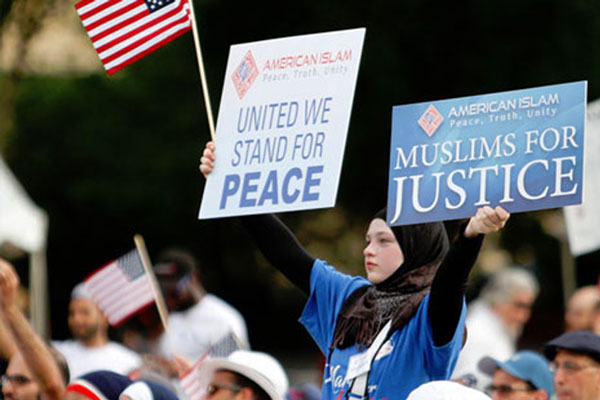
    The diverse racial, ethnic, geographical, and socio-economic profiles of U.S. Muslims preclude the simplistic stereotyping that, intentionally or not, serves to marginalize or typecast all members of this particular group. The third president, Thomas Jefferson, famously argued for the future citizenship and full participation in the electoral process of even “despised groups like Muslims,” a group whose existence in the U.S. at the time he failed to acknowledge or was unaware of. Former president Eisenhower, who cut the ribbon in 1957 to inaugurate what was then the largest mosque in the Western hemisphere — the Islamic Center in Washington, D.C. — like Obama, George W. Bush, and others in between, have, according to Curtis, “articulated the idea that Muslims, like other religious minorities, can become genuine Americans, especially if they serve in the US military and fight its ideological enemies.” From the Revolutionary War to the longest war in U.S. history in Afghanistan, Muslim Americans have fulfilled their citizenship requirements and more. American Muslims are arguably the most assimilated Muslims in all of the Western countries. Resistance to Muslim assimilation into American society is, to a large extent, the function of religious and racially-based prejudice on the part of the larger society rather than any legitimate reasons, any perceived deficiency or estrangement from American society on the part of the Muslim American community. A similar false notion was set forward after the end of chattel slavery in the U.S. when some asserted that Black culture was the cause for anti-Black racism and the failure of the newly emancipated population to be accepted in mainstream society. The similar phenomenon taking place today is that some people in the larger American community refuse to accept Muslims as equal citizens and insist on seeing Islam and Muslims as alien and a destructive force. Despite the fact that the majority of Muslims in the U.S. support and embrace the good that American society has to offer, a well-financed Islamophobic network flourishes in the U.S.

    The geographical diversity of Muslim Americans, hailing from numerous other countries, is unparalleled in any other nation’s population. Consequently, the mere fact that Muslim Americans may have family members in nations that the U.S. and its allies are at war with has provided justification for them to become targets of extrajudicial surveillance, arrest, and rendition. Additionally, when violent illegal acts are committed on American soil by Muslim foreign nationals, Muslims as an entire group come under suspicion. Acts of institutionalized discrimination and false labeling of Muslim Americans have erected additional barriers for Muslims to overcome in our longstanding efforts to become citizen partners in this land.

    The Opportunity to Serve

    However, the Muslim American community has, for the most part, rejected attempts by some within our ranks to self-identify as hapless victims rendered marginalized and hopeless because of Islamophobia. Within the last 13 years, the United States has seen the election of its first Muslim member of Congress, Keith Ellison, subsequently three other Muslims, Andre Carson, Ilhan Omer, and Rashida Tlaib, and a host of Muslim city council members, county commissioners, school board members, and other elected officials across the nation. While electing Muslims to public office should not be the ultimate achievement goal for Muslim Americans, it is a barometer of the capacity of the Muslim community to overcome Islamophobic discrimination and organized resistance to Muslims achieving full citizen rights and privileges and having the opportunity to serve the greater American society. Muslim Americans have embraced the divinely mandated responsibility to serve humanity through the efforts of multi-area social service operations, social justice initiatives, dawah (Islamic propagation efforts), and the display of exemplary moral character and conduct. Muslim Americans are a significant and valuable thread in this country’s diverse and beautiful social and political fabric. We pray that those who oppose or even detest that reality will come to realize that we are here to stay and to serve the common good.
  • Brett Kavanaugh and the Politics of White Privilege

    Brett Kavanaugh and the Politics of White Privilege

    In 1787, delegates to the Constitutional Convention gathered in what was to become known as Independence Hall in Philadelphia to discuss the division of power between the executive and legislative branches of the United States government. From the spirited debates of the Constitutional Convention, the importance of a federal judiciary emerged, laying the groundwork for a third branch of the federal government. Article III of the U.S. Constitution in 1789 established the Supreme Court of the United States while the First United States Congress, meeting in Federal Hall in New York City, passed the Judiciary Act of 1789 that detailed the role, meeting place, and operational procedure of the newly created Federal Court. On February 2 through 10, 1790, the inaugural session of the Supreme Court convened in New York City’s Royal Exchange Building. The building doubled at the time as a covered marketplace. When the capital of the country was permanently moved from Philadelphia to Washington, DC in December 1800, the Supreme Court and the rest of the federal government found a permanent home in the newly-created national capital.
    Unlike members of the executive and legislative branches of the federal government, Supreme Court justices are nominated by the president and serve for life. The idea was that if the justices were not required to run for office, partisan influences and considerations would not affect their judicial rulings. The reality of this moral decision proved hollow almost from the very beginning of the Supreme Court. Associate Justice Samuel Chase, nominated by President George Washington, served on the Supreme Court from 1796 until his death in 1811. Chase was a member of America’s first political party, the Federalist Party. This party existed from the 1790s to 1816 and was considered pro-administration, socially conservative, and favored national over state governments. President Thomas Jefferson and his Republican allies targeted Chase for removal from the Supreme Court in 1804 for “acting in a partisan manner.” Jefferson and the Republicans in Congress wanted to minimize the influence of the Federalist Party, particularly in the judicial arena, but their thinly-veiled assault on Associate Justice Chase resulted in his impeachment by the United States House of Representatives in 1804. The U.S. Senate acquitted Chase, and he continued as an associate justice until his death.
    Partisan Politics and the Court
    Partisan politics have tainted the presidential nomination and congressional approval of future Supreme Court justices since the inception of the institution. To date, there have been 114 Supreme Court justices in our nation’s history and few, if any, have reached the bench untouched by considerations by presidents and Congress of their future impact on major social policy issues confronting the nation. Supreme Court justices are nominated and approved primarily based on the projection by the president and the majority party in Congress that the nominee will provide judicial reinforcement of their partisan agendas. A case in point is Associate Justice James Clark McReynolds. McReynolds was nominated to the Court by President Woodrow Wilson and served from 1914 until he retired in 1941. McReynolds was known as a bigot who spewed toxic vitriol mostly against Jews but also against Blacks. President Wilson was fundamentally an academic, an efficient administrator, and a racist. During his two terms as president, 1913-1921, Wilson transformed Washington, D.C. into one of the most segregated, racist cities in the country. In the racist McReynolds, Wilson found a kindred spirit. But unlike Wilson, McReynolds did nothing to disguise his animosity towards Jews and Blacks. During his 27 years as an associate justice on the Supreme Court, McReynolds refused to stand beside Associate Justice Lewis Brandeis who was Jewish, or to listen to a woman present a legal case. McReynolds relished his self-appointed role as the Court’s chief adversary against the jobs creation programs of the New Deal of Wilson’s predecessor, Franklin Delano Roosevelt.
    The fifth Chief Justice of the Supreme Court was Roger Taney, a former Federalist who switched to the Democratic Party. After supporting the successful presidential bids of Andrew Jackson in 1824 and 1828, Taney was appointed in 1831 by President Jackson as U.S. Attorney General and as Chief Justice of the Supreme Court in 1835. Jackson is recognized for his slaughter and persecution of Native Americans and as a slave owner who brutally beat his slaves, owning at least 150 slaves and co-owning with his son an additional 51. Taney’s accomplished judicial career was overshadowed by his leading role in the 1857 Dred Scott decision. He wanted to resolve the issue of slavery according to his own views, that the government was obligated to uphold and defend the institution of slavery. Dred Scott was an enslaved Missouri Black who made the legal claim in 1856 that he had attained his emancipation in the 1830s by living with another enslaver in the free state of Illinois and in a section of the Louisiana Territory that was exempt from slavery due to the Missouri Compromise. The Missouri Supreme Court overturned the lower court’s ruling that Scott was a free man. The Supreme Court of the United States accepted the case on appeal and ruled against Scott, that having lived in a free state and territory did not accord him his freedom, and that as an African slave, he was not a citizen and could not sue in federal court. The majority opinion, written by Chief Justice Taney stipulated that African Americans could never become citizens, and that “They had for more than a century been regarded as beings of an inferior order, and altogether unfit to associate with the white race either in social or political relations, and so far inferior that they had no rights which the white man was bound to respect, and that the negro might justly and lawfully be reduced to slavery for his benefit. He was bought and sold and treated as an ordinary article of merchandise and traffic whenever a profit could be made by it.” This was the overtly racist view of both Jackson and Taney.
    Past opinions and attitudes have never been exact predictors of how Supreme Court justice nominees will rule in the future, but all presidents have attempted to replace vacancies on the high court with men and women who are most likely to reflect their core values and views on topical issues of the day. For 180 years, only white male Protestants served on the Supreme Court of the United States. In the 229-year history of the Supreme Court, only four women have served on this august body— Sandra Day O’Connor, appointed by President Ronald Reagan in 1981; Ruth Bader Ginsburg, appointed by President Bill Clinton in 1993; Sonia Sotomayor, the first Supreme Court Justice of Latina descent, appointed by President Barak Obama in 2009; and Elena Kagan, also nominated by President Obama in 2010. It was not until 1967 that President Lyndon Johnson appointed the first African American Supreme Court Justice, Thurgood Marshall. Marshall, a distinguished and tireless civil rights attorney before his serving on the highest court in the land, was an associate justice of the Supreme Court from 1967 until 1991. The only other African American to serve as a Supreme Court Justice is Clarence Thomas, appointed by President H.W. Bush in 1991 after the retirement of Thurgood Marshall. Thomas is a conservative who rarely asks questions or otherwise speaks during sessions. He is the longest-serving current associate justice with over 27 years on the bench.
    The Nomination and Confirmation of Brett Kavanaugh
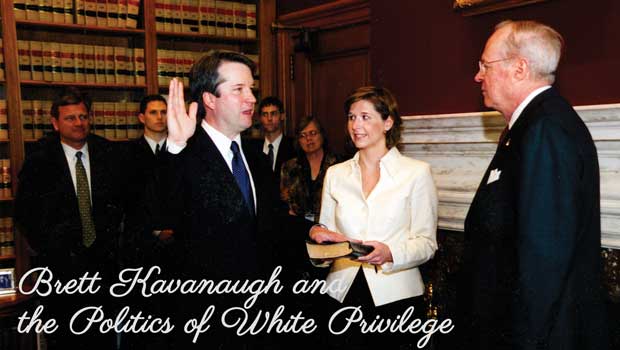
    In July 2018, Donald Trump nominated Brett Kavanaugh to become an associate justice of the Supreme Court. Kavanaugh, a well-respected conservative lawyer served from 2006 as a U.S. court of appeals judge for the District of Columbia circuit. The senate confirmed Kavanaugh in October of 2018 to become an associate justice of the Supreme Court. Kavanaugh is a member of the Federalist Society for Law and Public Policy Studies. The Federalist Society was formed in 1982 at University of Chicago Law School, Harvard Law School, and Yale Law School, to challenge what its members claimed to be American liberal ideology prevailing in law schools. The Federalist Society vets potential conservative candidates for federal judicial appointments and submits its approved list to the president. The list of Supreme Court justices whose names the group submitted for presidential consideration includes Supreme Court Chief Justice John Roberts, Supreme Court Justice Samuel Alito, Supreme Court Justice Clarence Thomas, and Supreme Court Justice Brett Kavanaugh. Kavanaugh and Trump share more than a penchant for an unregulated free enterprise system of economics. At least 13 women have accused President Trump of sexual harassment or sexual assault, all alleged to have taken place before his presidency. He is also known to have engaged in extramarital sexual encounters, and to have paid hundreds of thousands in hush money to at least two women to conceal these affairs, with allegations of hush money paid to additional women. Regarding Kavanaugh, Dr. Christine Blasey Ford called a Justice Department tip line to accuse Kavanaugh of attempted rape and sexual assault approximately 30 years ago when they were teenagers.
    Although two other women allege sexual misconduct by a drunken teenage Kavanaugh, only Dr. Christine Blasey Ford was permitted to testify before the Senate committee. Kavanaugh vehemently denied any sexual misconduct, claiming, “This whole two-week effort has been a calculated and orchestrated political hit, fueled with apparent pent-up anger about President Trump and the 2016 election, fear that has been unfairly stoked about my judicial record, revenge on behalf of the Clintons, and millions of dollars in money from outside left-wing opposition groups.” Of the four candidates interviewed by Trump for the Supreme Court nomination, Kavanaugh has in the past expressed the broadest interpretation concerning the scope and limits of presidential pardons, raising the question of whether a president can pardon himself or be subpoenaed to testify in a criminal case. This is certainly an issue of interest to a president who is, himself, being criminally investigated, and has already seen six of his inner circle members pleading guilty or being convicted of crimes including financial fraud, conspiracy against the United States, and lying to the FBI.
    The strident tone of Kavanaugh’s denial of the charges leveled against him by Ford and the two other women garnered considerable opposition to his approval. John Paul Stevens, who formerly served as a Supreme Court justice for 35 years, questioned whether Kavanaugh had the requisite temperament to perform on the highest court in the land. About Kavanaugh being confirmed, Stevens said, “I feel his performance in the hearings ultimately changed my mind.” Stevens noted that critics of Kavanaugh “suggest that he has demonstrated a potential bias involving enough potential litigants before the court that he would not be able to perform his full responsibilities.” Stevens went on to say, “And I think there is merit in that criticism and that the senators should really pay attention to it.” Over 2,400 law professors signed a letter opposing his ascension to the Supreme Court based on his performance during the hearings.
    Both Trump and Kavanaugh exude a sense of superiority and entitlement, especially with regard to women. When accused of sexual misconduct, Trump waves it off as if it didn’t happen, is nothing of consequence, or was, in fact, part of his privilege as a celebrity and a wealthy man. Kavanaugh, on the other hand, reacts to accusation of sexual misconduct with indignation, as if it were impossible that someone of his social standing, hard competitive drive, and accomplishments could be accused of anything. He spoke in his confirmation hearing testimony about his prestigious prep school education, his two Yale University degrees, and numerous other self-styled accolades including his time as captain of the football team. His words and indignant attitude conveyed that his prestigious life precluded belief that he was guilty of the accusations against him. Whether Kavanaugh possesses the capacity to render impartial judgments as a member of the Supreme Court is a moot point since he ultimately prevailed in the confirmation process.
    White Privilege Must No Longer Hold Sway
    Exaggerated, if not cartoonish, public displays of white male privilege have sadly become commonplace since the advent of the Trump Administration. White privilege, particularly for white males, is not an invention of Trump, Kavanaugh, or even the modern era. The U.S. Constitution is predicated on white male privilege. The framers of the U.S. Constitution were mostly British aristocrats or their descendants who fashioned a system of economic and political power distribution that was to be the near-exclusive domain of white males, much as it had been in Britain. Voting was restricted to white male property owners.
    White females were not given the ballot in the United States until the Women’s Suffrage Movement pressured Congress to pass the 19th amendment to the U.S. Constitution that granted women the right to vote. The Snyder Act of 1924 granted Native Americans citizenship and the presumptive right to vote. As late as 1948, however, Native Americans could not vote in New Mexico and Arizona. The passage of the Voting Rights Act of 1965 prohibited racial discrimination in voting. Millions of African Americans, Native Americans, and other non-white citizens finally had the legal barriers removed that had blocked them from casting their ballots in municipal, state, and national elections. However, Southern states devised devious requirements to prohibit African Americans from voting such as poll taxes and onsite exams on the U.S. Constitution. The Ku Klux Klan and other racists used intimidation and violence to obstruct voting. For most of American history, voting, running for public office, and petitioning the court for judicial relief has been the near-exclusive privilege of white males. Currently, in the United States, women earn on average eighty cents to every one dollar earned by her male counterpart. According to a recent report in USA Today, this gender pay disparity accounts for $513 billion in lost wages for female workers every year.
    The United States has reached a pivotal moment in its relatively young existence as a nation. The clarion call for a moral revolution, after 242 years, must resonate in hearts across this nation as championed by the Poor Peoples Campaign lead by Dr. William Barber, III if the country is to ever achieve its place as leader of the free world. Every nation/empire reaches a point of diminishing returns whenever fear and brute force is needed to guarantee a compliant citizenry. America is no longer a nation of European immigrants wielding some self-proclaimed superiority and privilege over Native Americans, Mexicans, and enslaved Africans as it was during the establishment of the country. The destructive disposition of white privilege can no longer hold sway if this multi-racial, multi-ethnic, multi-faith mosaic of American people is to realize its full potential as a land of justice and opportunity.