بسم الله الرحمن الرحيم

Tag: America

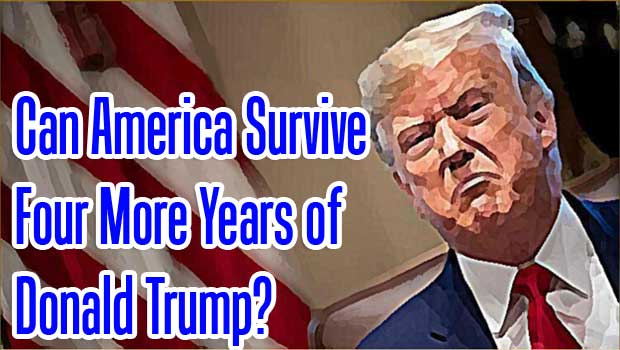
  • Can America Survive Four More Years of Donald Trump?

    Can America Survive Four More Years of Donald Trump?

    A relatively late entrant as a candidate for the Republican Party’s 2016 nominee for president, Donald Trump officially announced his candidacy on June 15, 2015, joining a field that eventually included 16 other GOP candidates. Texas Senator Ted Cruz, the first Republican to file, announced his intention to run 596 days before the election. By contrast, Canada’s campaign season for prime minister lasts eleven weeks, while Mexico’s presidential run lasts 90 days, concluding three days before election day. Over the last few decades, presidential aspirants in the U.S. have often expressed their “interest” in running for the office two to three years in advance while formally filing as a candidate an average of 400 days prior to the actual election. Unlike other industrialized nations, the United States has no fixed time limit for campaigning or limitations on campaign spending. As a result, America has the longest and most expensive campaign season in the world.

    Trump is a useful tool of the deep-pocketed ruling elite of which he is a part. But he is a replaceable cog in the American political machine. There are thousands like him waiting to assume the mantel of leadership while ignoring the common good and defying the Ultimate Lawgiver.

    The inordinate amount of money that is raised and spent during every presidential election cycle in the U.S. has the practical effect of limiting potential candidates to millionaires and billionaires, or individuals who have a political organization capable of raising enormous amounts of money from corporations and other wealthy donors. During the 2016 presidential campaign, candidate Trump spent $66 million of his own money and $280 million of funds raised from Super PACs and small donors. His opponent, former first lady and secretary of state Hillary Clinton, raised an eye-popping $1.2 billion in her unsuccessful presidential bid.

    A significant portion of the American electorate, as well as leaders and citizens of other countries, were dumbfounded by the election of Donald Trump. His extreme narcissism, blatant expressions of racist, xenophobic, and misogynistic views, as well as his hedonistic lifestyle, were not seen as inclining him to become a salaried public servant. Trump was the ultimate Washington outsider and political novice, a reality show tv star, a self-proclaimed billionaire with six bankruptcies in his portfolio. As a rental property owner, he had multiple racially motivated housing discrimination lawsuits filed against him. Trump was an extremely atypical candidate for the presidency.

    A President Should Ideally Possess Certain Traits

    While the office of the president has no stated requirements beyond being a natural-born U.S. citizen, 35 years or older, and resident in the U.S. for at least 14 years, it is generally expected by voters that the office bearer should ideally possess certain traits such as believability, decorum, a strong commitment to universal justice, and patriotism. In less than four years in office, the current president, in his official capacity, has been cited by multiple fact-checking operations to have lied to the American people, media outlets, and government officials more than 20,000 times. Over 100 licensed psychiatrists released a signed document questioning his fitness to serve as president based on him exhibiting signs of mental instability. He has publicly denigrated developing nations by characterizing them in vulgar and derogatory terms, referred to asylum-seeking Latin American refugees as rapists and drug dealers, and ordered immigrant children at the U.S./Mexico border to be separated from their parents and caged like animals in unsanitary, traumatizing conditions. Additionally, in the history of the American republic, no American president has shown such a flagrant disregard or ignorance of the constitutional parameters of presidential power. None has flaunted an overreach of executive authority toward the judicial and legislative branches of government as demonstrated by Trump.

    Trump’s Disconcerting Policy Decisions

    Yet, while Trump’s crudeness and lack of social graces may be unsettling to individuals across the political spectrums, it has been his policy decisions as head of state that are most disconcerting to American citizens and members of the global community. He has appointed 194 of 792 sitting federal judges who are appointed for life and significantly influence public policy, law, and legislation. Trump, with Congressional approval, has stacked the federal benches with ultra-conservative activist judges who are able to reverse or modify established progressive social legislation. The Affordable Care Act, commonly known as Obamacare, has been unrelentingly attacked as the Trump administration tries again and again to dismantle it. Environmental protection legislation, regulations governing worker safety, automobile emission standards, protection from drilling in federal preserves, and social safety nets like food stamps and welfare payments — all have been gutted to varying degrees by the current administration. To further enrich the one percent, Trump has engineered significant tax cuts for corporations and the wealthiest individuals. He has attempted to privatize the public-school system and the United States Postal Service. His mismanagement of the economy mirrors his past business failures as some of the nation’s economic indicators have spiraled into a downward cycle under his watch, even before the onset of the pandemic. He continues the practice of his predecessors of privatizing virtually all aspects of the military, including combat and intelligence missions, to the degree that private contractors serve side-by-side with their military counterparts, doing the same jobs at a substantially higher rate of pay.

    Trump has weakened strategic relationships with long-term allies of the United States by making insulting and disrespectful comments about the leaders of other countries. He has unilaterally pulled out of the 2015 Joint Comprehensive Plan of Action, commonly known as the Iran Nuclear Deal, and unilaterally withdrawn from treaties like the Paris Climate Agreement, signed in 2016 by 196 countries, that addresses greenhouse gas emissions and other critical environmental issues. The withdrawal will not be completed until after the November election.

    No Coherent Plan to Navigate the Pandemic

    One of this President’s most apparent deficiencies has been his inability to provide a coherent plan for the nation to navigate the deadly ravages of the Covid-19 pandemic. With a reported death toll of over 190,000 men, women, and children as of September 2020, Trump has demonstrated such incompetence and lack of compassion at this critical moment in history that the United States will likely suffer unnecessary pain and suffering for years to come. Leadership is a serious responsibility at any time, but the failures of inept leaders during extraordinarily challenging moments are magnified, to the continuing detriment of the nation. Trump’s leadership failures are exacerbated by his deliberate attempts to polarize racial, ethnic, and religious differences for what he thinks benefits him politically, caring not about how it harms the country. It can be reasonably argued that in the 20th and 21st centuries, no president since Woodrow Wilson has been as openly supportive of White supremacists and violence against non-White people as Donald Trump. How ironic that he is the immediate successor to the nation’s first African American president, Barack Obama.

    At this critical juncture in United States and world history, the question must be asked, “Can America survive four more years of Donald J. Trump?” The reflex response to this question by millions of Americans is an emphatic “No!” But, if we fail to understand, as expressed by Dr. Martin Luther King, Jr., “the urgency of now,” then we will have to endure four more agonizing years of a dangerous decline in American society. We must vote and make sure our family members and friends vote so that our voices are heard, loud and clear.

    Trump Is a Useful Tool for the Exploiters

    We are living in a time in which social justice warriors want to cancel anyone in the past who didn’t live up to the standards of today. Taking into account that history is moment after moment and era after era of humans as “products of their times,” we don’t need to go around canceling America’s history. Having said that, we must acknowledge that it is way past due to reckon with its flaws, and to realize that the U.S. is a mixed bag of good and bad like most nations and individuals. It remains the case that in many ways, the American core failure rests on the two pillars of exploitation and racism. From the beginning of American history (and human history), the poor have been exploited by the rich. The U.S. was built upon the back of chattel slavery while land and natural resources of Native Americans were expropriated by White settler colonists. America tolerated racially based convict leasing until 1908, and even today, those who are incarcerated are forced to work for virtually nothing in prison industries that are contracted with major corporations. Our American history includes exploitation of poor White coal miners by coal barons…Chinese railroad workers, migrant farm workers, “essential workers” today during a deadly pandemic, all have been exploited by the “owners,” the super-rich. The perpetuation of this system of exploitation by the moneyed elite is supported by both sides of the aisle even though their political theater wants us to believe otherwise.

    Trump is a useful tool of the deep-pocketed ruling elite of which he is a part. But he is a replaceable cog in the American political machine. There are thousands like him waiting to assume the mantel of leadership while ignoring the common good and defying the Ultimate Lawgiver.

    Turning the Mirror Toward Ourselves

    The responsibility to stand for justice is a divinely mandated responsibility for the head of every political, economic, and social organization and group, as well as the responsibility of every individual in his or her own life. We must enjoin right conduct and forbid wrong conduct consistently and with conviction. Four more years of Donald Trump as president will be disastrous for everyone except the exploiters among us. However, a good practice is to also turn the mirror toward ourselves and search our own hearts. The great scholar Ibn Qayyim wrote in Miftah Dar As-Sa’adah: “Ponder upon the wisdom of Allah where He has made people’s kings, leaders, and those of authority over them of the same kind as their own deeds. It is as if the people’s deeds appeared in the forms of their kings and leaders.”

    The point is that we must be the change that we wish to see in the world. “Indeed, Allah will not change the condition of a people until they change what is in themselves” (Qur’an – 13:11).


  • America’s Secret Colony: The Shame in America’s Backyard

    America’s Secret Colony: The Shame in America’s Backyard

    On November 19, 1493, Christopher Columbus stumbled onto an island named, by its Taino inhabitants, Borikén, one of three large islands comprising the Greater Antilles in the Caribbean Sea. For the next 400 years, it remained a neglected backwater in the far-flung Spanish empire until 1898 when it was invaded and annexed, along with Guam, the Philippines, and Cuba, by the United States as a result of the Spanish-American War.

    The United States was completing a century of continental expansion, but this was its first foray into colonial empire. In a series of opinions by the U.S. Supreme Court in 1901, called the Insular Cases, it was determined that full constitutional protection of rights does not apply to Puerto Rico or other territories or places under U.S. control. And people of such territories were to be considered “alien races differing from us in religion, customs, laws, methods of taxation and modes of thought,” so that “the administration of government and justice, according to Anglo-Saxon principles, may for a time be impossible.”

    The man who wrote the majority opinion in the Insular Cases was Justice Henry Billings Brown, who also wrote the majority opinion in the “separate but equal” case Plessy v. Ferguson which upheld racial segregation laws for public facilities. Thus the tone was set for over a century of dysfunctional relations between Puerto Rico and the United States.

    Though officially a commonwealth with some local legislative control, it remains “subject to the full plenary powers of Congress under Article IV, Section 3 of the United States Constitution.” Puerto Ricans were granted American citizenship with the Jones Act in 1917, just in time for its young men to be eligible for the draft of World War I. Despite fighting in all of America’s wars ever since, Puerto Ricans are forbidden from voting for President. The U.S. Supreme Court made it official in 1922, declaring Puerto Rico a territory, not a state. The U.S. Constitution’s protections, especially those which relate to labor protections, collective bargaining, and the minimum wage, would not be available to the residents of Puerto Rico. As we shall see shortly, this was a formula for egregious exploitation that American corporations and bank syndicates wouldn’t pass up.

    Disaster Relief, American Style

    A year after the American invasion, San Ciriaco, the longest-lived Atlantic hurricane in recorded history, wreaked havoc on Puerto Rico. It left over 3,000 dead, 250,000 homeless and without food, and thousands of farms and crops destroyed. It was the worst hurricane in Puerto Rican history and an epic disaster. Curiously, the United States offered no aid whatsoever.

    The following year the United States outlawed the Spanish peso and devalued it by 40 percent so that when Puerto Ricans exchanged their pesos for U.S. dollars, they instantly lost 40 percent of their wealth. Still desperately trying to recover from the previous year’s devastation, they lost almost half their wealth and saw their debts increase proportionately. The next year the U.S. began enforcement of the Hollander Act, which imposed a land tax on already desperate farmers who were now in danger of losing their farms.

    Farmers rushed to mortgage their farms in a last-ditch attempt to save them, but their only recourse was the American Colonial Bank. Unencumbered by usury laws, the bank charged interest rates so high that defaults and foreclosures were legion. The result was an enormous land and wealth transfer to American interests and the impoverishment of the Puerto Rican masses. A major transformation would also take place as the previously diversified agricultural economy of coffee, tobacco, fruits and sugar would give way to one crop. Sugar was now king. By 1930, 45 percent of all arable land in Puerto Rico was transformed into sugar plantations. By 1934, U.S.-owned Central Guánica, Central Aguirre, Fajardo Sugar, and United Porto Rico Sugar comprised over half the island’s arable land. Their possessions included cane fields refining mills, warehouses, railroads, and the post office.

    One particular criminal bears special mention here: Charles Herbert Allen. The first civilian governor of Puerto Rico, he used his brief, nearly 17-month tenure to take control of the island’s entire economy. On his return to the United States, he became president of the American Sugar Refining Company, the largest sugar refining company in the world. You know it today by the name Domino Sugar.

    Natural disaster, currency devaluation, land taxes, and usurious banking syndicates by now had reduced the Puerto Rican population to a landless, crushing poverty. Many went to work at the major sugar cane Centrales, but the highly mechanized operation could not absorb the workforce who then sought work in the cities. Wages were less than half those paid under the Spanish. When the Puerto Rican legislature, created by the Jones Act in 1917, tried to give some relief with a minimum wage law, it was struck down as unconstitutional by the U.S. Supreme Court. This pattern of total domination by American branches of government characterizes the colonial relationship which persists to this day.

    Resistance and Repression

    With wages at a mere 12.5 cents an hour, half of what they were under the Spanish, and many families on the brink of starvation, workers embarked on a series of island-wide strikes. They were led by a man who was to become the iconic symbol of Puerto Rican patriotism and resistance— Don Pedro Albizu Campos. He was the first Puerto Rican ever to graduate from Harvard Law School. A brilliant intellectual and orator who spoke six languages, he was ever the freedom fighter, even helping Eamon de Valera draft the constitution for the new Irish republic. He turned down many lucrative offers to return to his hometown of Ponce to practice poverty law.

    He was asked to lead the strike after it was evident that some of the leaders had sold out. The syndicates finally caved in, with a resounding victory for the agricultural workers who saw their wages doubled, staving off starvation for hundreds of thousands. Albizu Campos, now leader of the Puerto Rican Nationalist Party, emerged as the undisputed leader of the island’s resistance movement. In 1934, President Roosevelt appointed General Blanton Winship governor of Puerto Rico with the express mission of crushing the Puerto Rican Nationalist Party. He began by militarizing the police, issuing them Tommy-guns, tear gas, and riot gear, and instituting intense police training modeled after military boot-camp.

    Winship appointed E. Francis Riggs Chief of the Insular Police. Riggs was a Yale graduate and military intelligence officer fresh from duties as advisor to Nicaraguan dictator Anastasio Somoza. He became notorious for the murder of four Nationalists and a bystander in broad daylight in what infamously became known as the Rio Piedras Massacre. Afterward, he called a press conference declaring that if Albizu Campos did not cease his organizing of the agricultural workers, there would be “war to the death against all Puerto Ricans.” After two Nationalists retaliated by assassinating Riggs the following year, Don Pedro Albizu Campos along with six other Nationalists were sent to prison for ten years.

    The Ponce Massacre

    In 1937, a peaceful Palm Sunday demonstration took place in the southern Puerto Rican city of Ponce. Hundreds, many of them Nationalists armed only with palm fronds, were marching in commemoration of the abolition of slavery on the island. Abruptly, Governor Winship rescinded their permit to march. While the march’s organizers were arguing with police officials, the heavily armed security force positioned themselves along the route, blocking escape and forming a killing zone. On Governor Winship’s orders, the slaughter commenced, and after a 13-minute fusillade with carbines, rifles, and Thompson submachine guns, 17 were dead and over 200 wounded. Among the dead was seven-year-old Georgina Maldonado. There was outrage throughout the island, and Roosevelt was forced to recall Winship. Despite condemnations from the press and members of Congress, he remained unrepentant and never offered an apology.

    The Struggle Continues

    Don Pedro was held in prison ten years. On his release in 1948, Law 53 was enacted. Dubbed La Ley de la Mordaza (The Gag Law), the law made any expression of sympathy for the resistance movement, singing of La Borinqueña (the Puerto Rican national anthem), or even ownership of the Puerto Rican flag punishable with up to ten years in prison. Undeterred, Albizu Campos and the Nationalists launched in 1950 an uprising that came to be known as the October Revolution. It was put down with the overwhelming might of the U.S. military. Ten P47 Thunderbolt planes indiscriminately bombed the towns of Utuado and Jayuya, marking the only time in history that the United States has dropped bombs on its own citizens on American soil.

    Don Pedro Albizu Campos, after ten more years in prison and four more under house arrest with round-the-clock FBI surveillance, died in 1965. He remains an inspiration and a powerful symbol of resistance, patriotism, unflinching determination, and courage.

    A Legacy of Colonialism

    Puerto Rico has endured indignities for being the United States’ “secret colony.” A perverted application of Law 113, which made sterilization legal on the island, resulted in one-third of all Puerto Rican women of childbearing age, from 20-49, being sterilized, the highest rate in the world. A 1968 study determined that thousands were unaware that the procedure would lead to permanent sterilization.

    The U.S. established up to 25 bases on the island, using the outlying island of Vieques as a bombing range and testing ground by the U.S. Navy, with devastating ecological impact to residents and the fishing industry upon which they depend. And now, hedge fund vultures are taking advantage of the island’s economic crisis to force the sale of public institutions and utilities to private hands, all with the complicity of the U.S. government. This has increased the cost of living for a population earning only half that of the poorest state in America.

    The United Nations Special Committee on Decolonization has repeatedly called on the United States to provide for Puerto Rican self-determination, but it has repeatedly been ignored. This situation is no longer sustainable or justifiable.

    Que viva Puerto Rico libre— May Puerto Rico live free!

  • Marriage of Muslim Girls (and Boys) in America

    Marriage of Muslim Girls (and Boys) in America

    The marriage of Muslim girls in America is becoming a problem.  Recently, a Muslim father wrote a letter in a national magazine complaining that despite all his efforts to teach his children Islam, his college-going daughter announced that she would marry a non-Muslim boy whom she met in college. As I was wondering why a Muslim girl would prefer a non-Muslim boy over a Muslim, the following issues came to my mind:

    1. Might be she is opposed to and scared of arranged marriages. However, she should know that not all arranged marriages are bad ones, and about 50% of all love marriages end up in a divorce in this country.  Arranged marriages should be “arranged” with the approval of both boy and the girl.  I am personally opposed to the blind arranged marriages, for that is not Islamic.
    2. It is possible that the Muslim boys she or her family knows may not care for marrying Muslim girls.  In this white supremacy cult of our society, many of us are living with an inferiority complex.  Thus, Muslim boys in pretext of  dawah, get involved with non-Muslim girls because of their easy availability.  Muslim parents who also live with an inferiority complex do not mind their son marrying a white American girl, but they would object if he marries a Muslim girl of a different school of thought (Shia/Sunni) or different tribe, like Punjabi, Sindhi, Pathan, Arab vs. non-Arab, Afro-American vs. Immigrant.  Both the parents and the boy should remember that the criterion for choosing a spouse that was placed by the Prophet Muhammad (P) was not wealth or color, but Islamic piety.
    3. She may have been told that early marriage, that is, age 18 or less, is a taboo, and she should wait for later age. According to statistics, 80% of American girls, while waiting to get settled in life with marriage, engage freely in sex with multiple boyfriends.  However, this freedom is not and it should not be available to Muslim girl (as well as boys).  Every year, huge number of teenage girls in this country who think that they are not ready for marriage  get pregnant.  By the age of 24, when a Muslim girl decides that she is ready for marriage, it may be too late for her.  If she reviews the matrimonial ad section in Islamic magazine, she will quickly notice that boys of the age group of 25 to 30 are looking for girls from the 18 to 20 year age group.  They wrongfully assume that an older girl may not be chaste.
    4. She may also carry a wrong notion not proven scientifically that marrying healthy cousins may cause congenital deformities in her offspring.

    Let us discuss some other issues.

    1. Marriage with People of the Book. The Quran permits Muslim men to marry women from the People of the Book (Chapter 5, verse 5).  Whatever Quran makes permissible remains permissible, and we cannot make it non-permissible. At the same time, Quran discourages Muslim men and women from marrying an idolater (mushrik), saying that a believing man or a believing woman, even as slaves, is better than idolaters (Ch. 2, verse 221).Thus, Muslim reformists in the past, including Caliph Umer (RA) discouraged Muslim men from marrying women from People of the Book. My personal opinion is that a Jewish or Christian girl who wants to marry a Muslim boy should preferably become Muslim for at least six months before marriage, with the conviction that even if the marriage does not take place, she will remain a Muslim.
    2. Wrong expectations. If you review the matrimonial ads in the Islamic magazines, the wish list for Mr. Right or the Perfect Wife is very similar.  All fathers and brothers want to marry their daughters or sisters to a professional such as a physician, engineer or lawyer, as if other modes of living such as in the case of teachers, mechanics, taxi drivers or carpenters, have no right to marry.
    3. Importing brides or grooms from overseas (green card marriages). There is nothing wrong with marrying someone from overseas, preferably a relative who has visited the USA.  It would be easier for him or her to adapt to the lifestyle in the USA than it would be for a total stranger from overseas, who marries a girl with a green card.  Such marriages are usually disastrous.
    4. Marriage with a widow or older woman. This does not take place anymore in our society because of the culture.  To the contrary, Islam came to abolish such customs, and the Prophet Mohammed (P) himself set an example.
    5. Role of parents and community elders in introducing prospective brides or grooms. There is nothing wrong with doing so.  Again, it is the culture that stipulates that the girl and her parents do not initiate a proposal but wait for the offer.  To the contrary, Khadija sent a proposal to her business manager through her friend and the father of Fatima (RA) sent a message to Ali, his cousin that suggested that he marry his daughter because he (PBUH) thought that both of them were suitable for each other.  Therefore, the introduction of eligible bachelors to each other is the duty of the parents and community elders, regardless of their sex or relationship.

    By Shahid Athar

  • Did ’80s Teach Us Anything?

    Did ’80s Teach Us Anything?

    An Overview of Islam in North America


    As we welcome a new decade, the last of this century, it is important that we review our performance in the ’80s.

    The ’80s witnessed a large influx of immigrant Muslims to the United States and Canada. An overwhelming majority of these immigrants, both old and new, decided to make North America their permanent home. A significant increase in Muslim population also resulted from births in the community, which boasts of 6 million people in the United States and 750,000 in Canada.

    The increase in population also affected the way we live and worship. Disappointed with a life without inter-community communication, proper mosques and a social support system, Muslims in the ’80s joined hands to attack these problems and made impressive gains.

    While figures of the ’70s are not available, today there are an estimated 800 mosques across North America. Organizations which carry out Islamic da’wah, and social and cultural agendas of the community have been founded in every nook and cranny of the continent. While most of these organizations are rooted in the local communities, there are at least four major organizations which work on national and even continental level. The Tableegee Jama’ah, the American Muslim Mission (AMM), The Islamic Society of North America (ISNA) and The Islamic Circle of North America (ICNA), although founded before the ’80s (except ISNA), have broadened their activities and are seen as an important force in the life of the North American Muslim community.

    In 1985 Warith Deen Mohammed, president of AMM, designed for African American Muslims, dismantled the organization, and asked its members to work with the mainstream Muslim community. This was a very important development, as it showed that African American Muslims had come a long way from the racist days of Elijah Muhammad, father of Warith Deen Mohammed and founder of AMM’s race-based predecessor, the Nation of Islam.

    Although Mr. Mohammed and AMM did a highly commendable job in bringing non-Muslims to the fold of Islam in the ’70s, lately they seem to have slowed down. There could be two immediate reasons for this: their emphasis on indoctrinating and training members and internal divisions. Their work was also affected by a lack of rallying point for African Americans, and the Islamic Revolution in Iran. In the ’60s and ’70s, riots in black ghettos and civil rights movement had endeared Islam to many African Americans, who were looking for better alternatives to capitalism. Islam to them epitomized salvation from op­ pression. In the ’80s the civil rights movement, as we knew it in the ’60s, was simply not there.

    In the wake of the Islamic revolution in Iran, hostage taking in the U.S. embassy in Tehran, and a spate of hijackings in the Middle East, the American media portrayed Islam in a negative light. As a result, Muslims of North America, many of whom would have proudly carried out Islamic da’wah, were forced to spend much of their time defending Islam.

    In contrast with slowdown in AMM activities in the ’80s, ICNA made important gains. Founded in 1968 as an Islamic Jama’ah and movement and devoted to Urdu-speaking community until the ’70s, ICNA took its message to the entire Muslim community of North America and to non-Muslims, many of whom accepted Islam in one of its several units. It also published and distributed da’wah literature through its workers in most of the major cities of U.S. and Canada.

    ICNA workers were also active in the propagation of Islam to inmates in different city jails.

    However, we have a long way to go in winning the respect that we as Muslims deserve from others and fulfilling the task that we must. Despite its spiritual hollowness and liberal atmosphere, North America remains a fertile land for the propagation of Islam. And unless we change the society we have chosen to live in, it is possible the society will change us and devour our children.

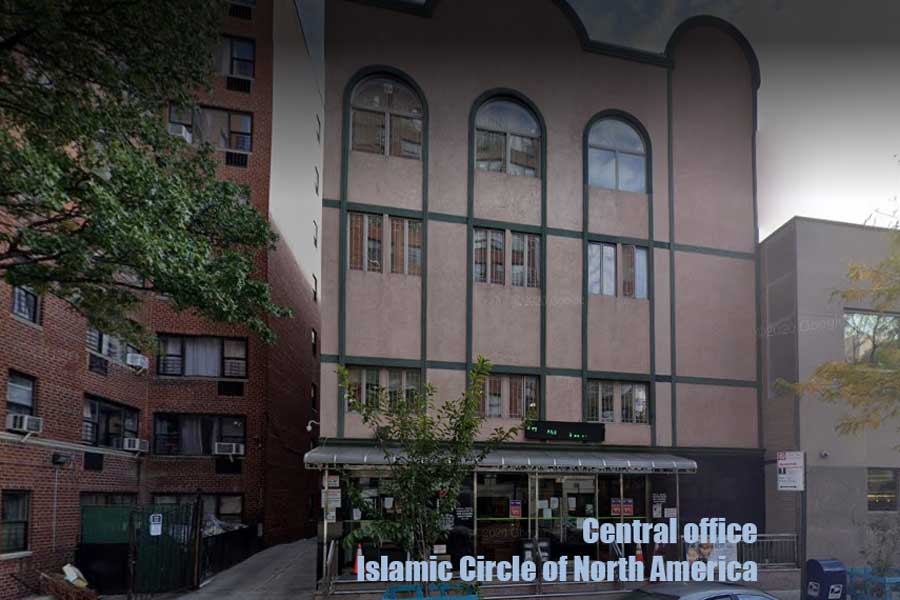
    ICNA Central Office New York
    ICNA Central Office New York

    ICNA central office in Queens, New York

    Besides ICNA, several mosques and Islamic centers also worked towards this end. Masjid At-Taqwa and Malik Shabazz Mosque in New York City, and Masjid Al-Islam in Dallas, worked hard to rid their neighborhoods of drug dealers and invite non-Muslims to Islam. The ’80s were also important for the establishment of mosques, Islamic centers, schools, and businesses. As far as schools are concerned, the African American Muslims led the way by founding a chain of full-time schools called Sister Clara Muhammad School, in several big cities. Immigrant Muslims also made significant gains in this area. By the end of the decade, 60 schools had been established in the United States and Canada, with some of them better than many public schools. New Jersey’s Al-Ghazaly is by far the best Islamic school.

    In the field of education at least three more ventures were launched in the ’80s. Among them were Is-lamia College in Chicago (1983), Nizamia Madrassah at Cornell, Canada (1985), and Darul Uloom Al-Islamiyah of America in California (1988). Unfortunately, the community response has been poor. The Islamia College, where the first batch was graduated in 1988, now has only 60 students. The two madrassahs have also had a disappointing experience. These Islamic educational institutions have to be supported by the community so that they can grow into powerful seats of learning.

    To offer Muslims a chance at interest-free banking, ICNA was able to set up the Muslim Savings and Investments, Ins. (MSI) in 1985. MSI not only offers a chance to invest and earn profits, where possible, it also finances homes for qualified customers.

    It is hoped that in the ’90s MSI will develop into a full-fledged bank.

    There are many financial institutions which were established in ’80s. Some are interest-free like Baitul Maal (BMI) of New Jersey, and some have investment in stocks (according to many `Ulama is not halal) like Amana Mutual Funds.

    In the area of housing Toronto Housing Coop, in Canada, was an important Muslim organization to be founded in the ’80s. Started by a few sincere Muslims, it has been able to buy more than 100 interest-free homes for the community. Other smaller organizations are also working in other cities on these lines. The ’80s also saw a growing unity and sense of Ummah among Muslims of North America, both indigenous and immigrant. The unity was reflected in the community’s work in providing political and monetary support to jihad in Afghanistan and Palestine. A number of Muslims were so dedicated that they actually went to Afghanistan to fight against the Communists.

    Unlike the ’70s, Muslims in the ’80s showed political awareness and began taking active interest in the mainstream political parties of the United States and Canada, with some of them holding political offices. Muslims played an important role in the election of (late) Chicago Mayor Harold Washington, Detroit’s Coleman Young and Virginia’s governor L. Douglas Wilder. It is noteworthy that in Detroit a Muslim, Adam Shakoor, was chosen as the deputy mayor. In the 1988 presidential elections, Muslims got involved in the campaigning and as a result were able to push their weight behind Rev. Jesse Jackson’s debate of the Palestinian problem on the Democratic Party platform. First time in the history of U.S., the Senate has passed a bill (S.794) in 1988 which also includes Muslim and Mosque. This legislation makes it a federal offense to interfere with the exercise of religious freedom, or to damage or desecrate religious property. In the ’80s Muslims learned that American politics was governed by interest and pressure groups. The first significant manifestation of this realization was the founding of the Muslim Political Action Committee (MPAC) in California. Similar efforts have been made in New York and Illinois. ISNA held a conference in 1989 in this context, and it determined to mobilize people towards greater participation in political process of North America.

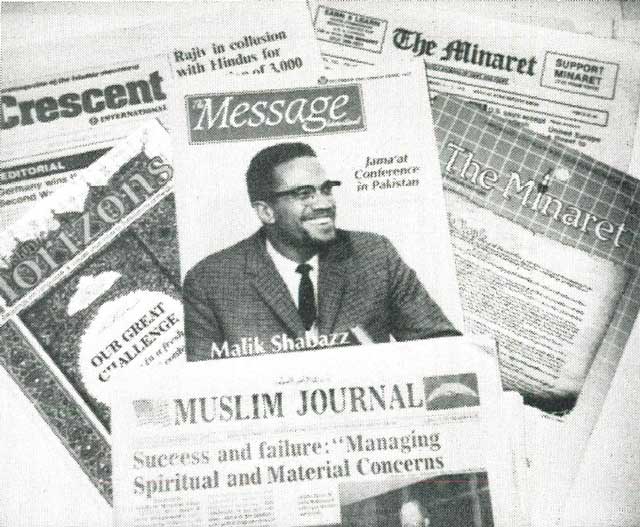
    pic Major Islamic magazines and newspapers of U.S. and Canada
    Major Islamic magazines and newspapers of U.S. and Canada

    The role of the mainstream American media in the ’80s continued to be hostile and nega­tive towards Muslims. However, there was a realization that unless Muslims worked on this area, they would have to be always defensive. The Rushdie affair drove this point home very powerfully and helped galvanize Muslim ac­tivism. At the end of 1988, ICNA took up this matter on a continental basis, and along with different Islamic centers and Muslim or­ganizations, tried to have Salman Rushdie’s book “The Satanic Verses” banned. Although Muslims were not successful in getting the book banned, the outrage over it brought them together and gave them a chance to talk to the media and present their side of the story. It was also the first time that many non-Muslims learned about Muslims and their religion so extensively.

    The Rushdie affair also opened doors of inter-faith dialogues, arranged until the early ’80s mainly by Muslim Students Association, a little wider. Now Christian organizations began to invite Muslims for interfaith dialogues and included Muslims in several committees dealing with interfaith matters. However, much needs to be done. Muslims should try to gain a place on the boards of public television networks where major religions are represented. They should also invite the media to their functions and programs so that Americans can know them better.

    Speaking of the media, Muslims in the ’80s made progress in this direction. Many Islamic centers began to publish a monthly or quarter­ly magazine to air their point of view and publicize community issues. Important among the many are the weekly Muslim Journal (Chicago), bimonthly Islamic Horizons (In­diana), tri-monthly Minaret (California), biweekly Minaret (New York), Crescent (Toronto) and monthly The Message Interna­tional. Among the Islamic publications, The Message is an up-and-coming monthly interna­tional magazine and fills the void created by the closures of the London-based Arabia and Afkar.

    Like the ’70s, Muslims did not have much in­volvement in the electronic media in the ’80s. However, paid Islamic and non-Islamic cul­tural programs continued to be aired on local channels. In this regard the role of the California-based Islamic Information Service (IIS) is important. A major problem with some ITS programs is that they have not portrayed Islam properly. This has to be corrected if we are to save Islam from ridicule and ideological impurities. TV is the most effective news medium and Muslims should increase their presence on it, and also see that Islam is not presented in a twisted manner.

    In the ’80s the Muslim community, reflecting greater maturity, entered hitherto unchartered waters. Although not all its new initiatives succeeded, at least they decreased its insularity. For instance, in the early ’80s ISNA experimented with the Muslim Community Association (MCA), an organization designed to unite the communities. Due to several reasons MCA failed and had to be scrapped. Perhaps the main reason of its failure was that it was not a grassroots organization and had not involved the entire community in decision making.

    Realizing that a whole new generation of Muslims had come of age, both ISNA and ICNA separately founded youth organizations that are called Muslim Youth of North America (MYNA) and Young Muslims for Faith and Action (YMFA). While MYNA is basically concerned with organizing summer camps for youths, YMFA is based in different towns and cities where Muslim youths organize into groups and carry out Islamic and extracurricular activities. Muslim youths are our invaluable asset for the future, and if they are not cultivated Islamically, we would lose them to the American society, just like the early Muslim settlers did. We need to mobilize ourselves and the community, and act now!

    The ’80s also saw the establishment or expansion of several research and publishing organizations. The most notable among them are the Virginia-based International Institute of Islamic Thought and American Trust Publication, and Vermont-based Amana Books. The ATP and Amana, which are basically Muslim publishing houses, have produced some very useful books. But they have not been able to fulfill the needs of the entire community, nor publish much-needed books for youths and Islamic education. In the ’90s we definitely need more books of this kind. We also need more Muslim intellectuals and activists to deal with social, academic and religious problems faced by the community. In this context, ICNA has decided to form an Institute of Leadership Development to train Muslims to handle the responsibilities of imam, directorship of an Islamic center and da’wah work.

    In the area of ibadah, or worship, Muslims were found lacking in the ’80s. Although there has been an impressive increase in Muslim population and mosques in the last decade, no more than 10 percent of Muslims living in the vicinity of a mosque attended Jum’a prayers. This is particularly disheartening to those da’wah groups and activists who worked hard to bring Muslims to the house of Allah. The lack of attendance even in Jum ‘a prayers is not a healthy sign, and the problem must be cor­rected. On the other hand, those who did come to the mosque, were only concerned with of­fering prayers. Most of them made no effort to pass the message of Islam to their neigh­bors. ICNA has started preparing Muslim Data Base to reach to these 90% Muslims who are not involved in any Islamic activity. At the end of ’80s thousands of names and addresses of Muslims have been computerized.

    No one can deny the modern Western civilization’s productivity, comfort and af­fluence but it must be regrettably acknowledged that Western civilization’s shortcomings and weaknesses are no fewer than its advantages. Despite the leisure and ease which American science and technology provide for society and despite the new pages of history turned, human happiness has not in­creased nor have social ills diminished. Living and bringing up of new generation in this non-Islamic society is a great challenge for Muslims.

    Despite many gains and lot of Islamic work, like the ’70s, many Muslims in the ’80s were not successful in meeting this great challenge.

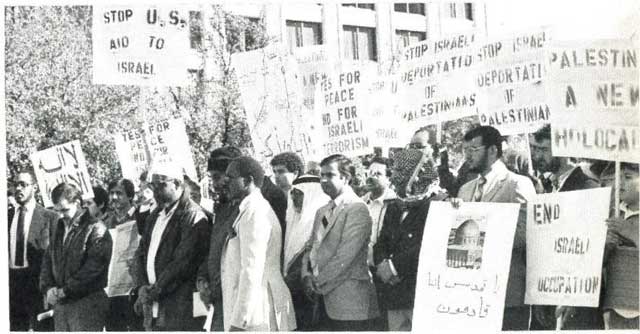
    Indigenous and immigrant Muslims united in a rally in Dallas, against Israeli occupation of Palestine
    Indigenous and immigrant Muslims united in a rally in Dallas, against Israeli occupation of Palestine

    In some cases, the whole Muslim family lost the Islamic and Muslim identity and accepted the American and secular norms and ideology and even they changed their names from Muh­ammad to Mo, Sulaiman to Sam and so on. The world has tried all the religions and ideologies whether it was Hinduism or Socialism, Communism or Capitalism, none gave the humanity the peace of heart and mind. But Islam is the only way of life which can cure the mankind from their diseases, can provide the peace of heart and mind in this world and success and falah in the hereafter. The Muslim community will have a bright fu­ture in the ’90s and beyond if it can come into the fold of Islam completely and totally. And show a greater desire for pan-Islamism and pool its resources towards the creation of a United Islamic Movement consisting of workers of Islamic movements and move­ment-oriented indigenous brothers and sisters of the U.S. and Canada. This is the most im­portant requirement if we want to preserve ourselves as Muslims.

    Just preservation is not the guaranty for suc­cess. Therefore, Muslims have to propagate the message of Islam (da’wah) to fellow human beings. Da’wah is a comprehensive program which includes every aspect of Islam. A Muslim as an individual and the ummah as a collective body cannot absolve itself of its responsibility of da’wah if it is not an all-embracing movement. And this da’wah has to be relevant to North American society.

    Then we hope through the ’90s and beyond that the future will belong to Islam and America will belong to Islam, In shaa Allah.