
بسم الله الرحمن الرحيم

Tag: Activism

  • Unity and Activism under a Trump Presidency: The Need of Our Times

    Unity and Activism under a Trump Presidency: The Need of Our Times

    On a rainy January 20, 2017 Donald J. Trump became the president of the United States after winning the Electoral College and losing the popular vote by over three million. The pomp and ceremony, military and police presence, even the somberness of the day lacked the celebration of at least the previous two inaugurations. The twitter-verse remarked that the “sky was crying” and dissent filled the air blocks away amid a wide range of socially disparate individuals from Muslims, immigrants, blacks, Latinos, and gays, to whites who blocked roads and held bold signs demanding impeachment and likening Trump to Hitler. With a nation politically divided along many fissures that have been growing over the past several decades, Muslims also found themselves separated along similar lines. Muslim Republicans, Democrats, and Independents voted their conscience and helped usher in one of the most divisive administrations America has ever seen. Economic concerns and social issues like illegal immigration, abortion, and gay marriage were uppermost in the minds of conservative Muslim voters. Most Muslim voters were concerned about eroding civil liberties, continued wars, and America’s foreign policies.

    Unity is a necessary goal, but not easy to achieve. Muslim-led organizations need to work with other groups on a grassroots level. There is certainly strength in numbers and the many diverse organizations working toward the same over-arching goals can achieve much more than singular, non-allied groups.

    The inauguration was a historic moment in many ways, the least of which was the visibly low turnout of spectators which Trump, in narcissistic fashion, continued to rail against in his early morning twitter rants. Nothing could stop the juggernaut ascension of Trump to the highest office in the land. The fervent wishes and voting choice of the majority of Americans got swallowed up by the Electoral College system, and the prayers of believers did not change the course that America has been set upon, for good or ill. What then is left in the repertoire of activists as they prepare for the coming years of a presidency run by an ill-equipped, self-obsessed, money-hungry, politically clumsy elitist, along with his chief strategist, Steve Bannon, a white nationalist, White House Chief of Staff Reince Preibus and Vice President Mike Pence, both right-wing powerhouses. Rule by oligarchs, corporate corruption, criminal war-making, oppression and occupation, and layers of disinformation — these all exist in the world today, but it can get so much worse. However dire the future looks, fear and hopelessness must be displaced by courage and conviction in hearts and minds of those aligned against this new world order.

    The Role Muslims Can Play

    For Muslims, particularly, it is a matter of faith. We should fear only Allah since we know that all things happen according to His will and plan. So we make our choices day to day, and determine to the best of our ability the course we are going to follow. We then leave the rest up to Allah (SWT). What remains then is how Muslims participate in this new political reality. Representation in government at the local, state, and federal levels, of Muslims and their concerns, is still limited but slowly increasing. In the fledgling Somali voting block of Minneapolis, Minnesota they elected the first Somali woman to state office. As more Muslim American state representatives continue to be elected, some of them will find themselves in national positions within the next ten years. The primary concern now is how to represent Islam in its totality, from its politics to its social ideals, and to advocate for Muslims. Imam Omar Suleiman, President of the Yaqeen Institute for Islamic Research, summed up in a speech at the ICNA/MAS convention in December, 2016 what the Muslim activist position should be: “If we allow fear to drive us to continue to do away with notions of our faith that others find problematic because of their ignorance and because of their racism and their bigotry, rather than standing boldly and explaining and defining those concepts and showing them in motion and in action and how they contribute to the betterment of society then we will slowly see our identity disappear.” He went on to say that Islam “should be in motion” as an active religion that betters all societies. Sometimes that means dissent within the confines of a unified front.

    Never has there been a more urgent time to stand tall and firm in speaking about Islam and countering all misrepresentations of the faith. Steve Bannon is an avowed Islamophobe with a belief in a coming apocalyptic battle between the Judeo-Christian world and Islam. And Jared Kushner, Trump’s son-in-law, is now senior advisor to the president. He is also purportedly being considered for the role of peace broker between Israel and the Palestinians, while his family has donated tens of thousands of dollars to illegal West Bank settlements, according to their tax forms. A negative perception of Islam is at the heart of this administration’s immigration and foreign policy agendas. It matters little to these ideologues in power how high American flags fly at Islamic centers, how often Muslims leaders and organizations condemn terror, or how often public officials are welcomed to address Muslim community and masjid events.
    ‘Get Up, Stand Up, Don’t Give Up the Fight’

    It is understandable that many Americans are worried, but we must maintain a long view and broad perspective. Allah (SWT) tells us in the Quran, “And obey Allah and His Messenger, and do not dispute and [thus] lose courage and [then] your strength would depart; and be patient. Indeed, Allah is with the patient” (Quran 8:46). Already there is some light shining in the politically divisive gloom — an unintended consequence of the new future with Trump is that a robust and growing opposition has risen against him and his absolutist, autocratic inner circle. Uniting to push back against hate, against division, is a myriad of groups who are protesting, filing legal actions, and vowing to keep America the land of diversity and tolerance.

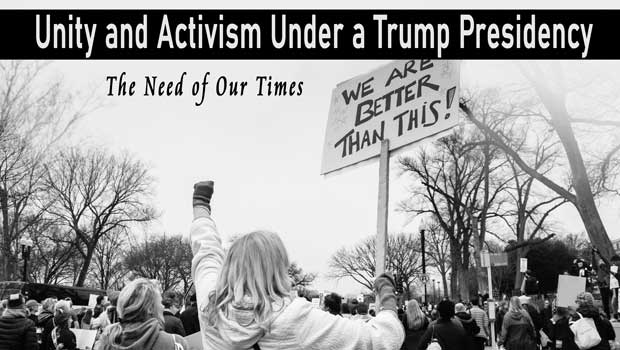
    Trump has become the symbol of both ultra-right zealotry and crass, profit-driven opportunism. Organizations and individuals working towards social and racial justice, immigration and migrant rights, national universal health care, women’s reproductive rights, and environmental protections have naturally and spontaneously united against the threat to our civil liberties and even our survival. The “Stop Trump” mantra speaks of a fragile unity, organic, without structure. It is reactive rather than a deeply entrenched, planned revolt. Yet, it took hold. The tiny spark of unified dissent was launched the day after the inauguration as the Women’s March took place across major cities in America and in several countries abroad as well, collectively numbering in the millions. An estimated 650,000 to over one million women and men took to the streets of Washington D.C. The signs held aloft on that day spoke eloquently of the fervor protestors felt: Get up, stand up, don’t give up the fight; We are better than this; Another world is possible; Babies against bigots; No white supremacists in the White House; Senate, have a spine, block Trump’s cabinet of horrors; Billionaires in the swamp; Muslim rights are human rights; Jews & Muslims stronger together; Refugees welcome; United we stand, divided we fall; No human being is illegal; Hate is un-American; Hatred’s greatest weapon is complacency.

    The march in Washington was co-organized by a young Palestinian-American Muslim woman, Linda Sarsour. You may be a social conservative and have an issue with Sarsour aligning herself with Planned Parenthood and various LGBTQ groups for the march, but we cannot deny the political impact that such an historic event had and will continue to have. Protests are the matchstick that sets a movement on fire. “It’s more than just a release for anger – taking to the streets is a necessary way to participate in democracy” notes Sarah Jaffe, a writer for Rolling Stone magazine. But without direction, a movement can fizzle out and disappear from the front pages or evening news as new distractions emerge, or it can organize and grow so as to significantly impact the political reality. So what comes after the euphoria of speeches, the camaraderie of protest, the zeal and fervor for change?

    For now, the motivation to continue standing up and being counted is strong, as Trump has been busy signing controversial executive orders and pushing through divisive cabinet appointments. In his first week he signed orders to gut major provisions of the Affordable Care Act, expedite infrastructure projects through environmental and business-related deregulations, build a 1,900-mile long wall, deport undocumented immigrants, and impose a travel ban against seven Muslim-majority countries. He also green-lighted the Keystone and Dakota Access Pipelines, the latter being close to Standing Rock Sioux tribal lands in North Dakota, threatening their sources of water.

    Jeremi Suri, in The Atlantic, warns, “With his barrage of executive orders, Trump is taking America back to the historical nightmares of the world before December 1941: closed borders, limited trade, intolerance to diversity, arms races, and a go-it-alone national race to the bottom. His executive order on ‘rebuilding the U.S. armed forces’ calls for ‘peace through strength,’ but this document and the others he signed offer nothing but unilateralism and militarization: more military spending, more nuclear weapons, more use of torture (which is illegal), and more promises to destroy ISIS and other terrorist threats. The executive orders promise to curtail American participation in international organizations, prohibit whole categories of foreigners from entering our country, and limit exchanges of ideas and goods.” David Leonhardt, writing in the New York Times, points out that countering Trump initiatives will demand a sustained effort. “If progressives want to have an effect — if they want to defend civil rights, protect the environment and keep millions of people from losing health insurance, among other things — the hard work hasn’t even begun.”

    Protests as Well as Political Participation

    People spontaneously took to the streets and airports to protest the most immediately executed of the executive orders — a ban on refugees and travelers on the basis of protecting American borders. Muslims were not at the forefront of those protests, but at the heart of it. Ordinary Americans, from all walks of life, came out to protest the discriminatory action against Muslims. When protests are needed for Mexicans facing deportation, native Americans protecting the land and vital resources, blacks losing more voting rights and facing increased police brutality, will Muslims stand and march and protest with them?

    Protests are imperative, but so is political participation. As David Brooks of the NYT put it, “Change happens when people run for office, amass coalitions of interest groups, engage in the messy practice of politics.” Organizations and even cities have filed lawsuits, including the Council for American-Islamic Affairs (CAIR) and the ACLU. In a February, 2017 article in Glamour magazine, Linda Sarsour summed up the immediate needs of activists at least until the midterm elections in 2018: “We need to translate the emotions and the frustrations right now, and the fear that people have right now, into massive polls numbers to win back the House of Representatives. Right now there are no checks and balances. We need to get control back of at least one branch of government.”

    Unity is a necessary goal, but not easy to achieve. Muslim-led organizations need to work with other groups on a grassroots level. There is certainly strength in numbers and the many diverse organizations working toward the same over-arching goals can achieve much more than singular, non-allied groups. Together, individuals and groups can support and inspire one another. Just remember the messages of the grass-roots demonstrators, holding high their heads and their ideals…and their signs, declaring that we must not give up; that as Americans we are better than this, and that another world, a better world, is possible. They said it, and it is true, that united we stand, divided we fall. As to hatred, bigotry, discrimination, and worship of profits over people — the greatest weapon of demagogues and vulgar profiteers is the complacency of people. To quote Omar Suleiman once again, “Now is the time dear brothers and sisters, now more than ever to stand up and to define ourselves, to show our Islam in motion, to stand with the oppressed and the vulnerable.”
  • Activism in the Light of Surah Al-Asr

    Activism in the Light of Surah Al-Asr

    Remember the individual (there’s usually at least one in every community) who used to be really active in your local Islamic center but you don’t see him or her around anymore? This individual was someone who was always there, passionate about the causes, eager to spend hours to serve the community. What happened to that individual? Why have they taken a back seat or even, in some cases, disappeared from the masjid? Thankfully there are many others who continue to be vibrant volunteers year after year, always looking for opportunities to give back, and adapting to new conditions by learning new skills. They do not vanish but, rather, remain shining examples for the new generations. They serve the cause as it should be served. We call these individuals activists, those volunteers who found it within themselves to devote their lives to Islamic and charitable work.

    I was curious to know how some kept moving forward and others lost their passion along the way. I always wondered how one transforms himself from a volunteer to an activist. Then I was sitting at my local masjid, attending a seminar presented by Nasser Karimian, and right then and there, I felt the mystery was solved for me. As is so often the case, the answer came from the Quran, from the oft-recited verses of Surat Al-Asr. This short chapter, a brief three verses, starts by declaring that all of us, all human beings, are losers: “By time as it passes, verily man is in loss…” (Quran 103:1). But wait, we want to be successful – we do not want to be losers! Alhamdulillah, Allah SWT in the next two verses informs us that there are exceptions, that we can avoid the loser tag. Yes, all people are in a state of loss “…except those who believe and do righteous deeds and enjoin one another to truth, and enjoin one another to patience and constancy” (Quran 103:1-3).
    These verses outline the four essential ingredients for success in the Hereafter:

    1. Believe
    2. Live by it
    3. Inspire others
    4. Never lose hope

    See, it all makes sense. Maybe it is us or someone we know who lacks one of the above four qualities and, therefore, is not reaching his or her full potential. Just as those successful people who keep plugging away longer than others, in all seasons, we too have to believe in a “dream,” and then do whatever it takes to make it a “reality.” We cannot do this alone, we need to build effective alliances. During this entire process, we will face setbacks and obstacles, potentially preventing us from converting our dream into a reality, but we must keep moving forward and not give up. May Allah (SWT) make us of those people who are actively working for His cause with sincerity and dedication, ameen.

    Belief is not enough

    As Muslims, we all believe in the divine knowledge sent to us through our beloved Prophet Muhammad (peace be upon him). We believe in the Hereafter, and we also believe that we have to earn our place in Paradise. In fact, belief is futile if it does not result in righteous action, just as action without knowledge is so often misguided and ultimately useless. Imam Ash-Shafiee (may Allah be pleased with him) is reported to have said, “Knowledge is that which benefits, not that which is memorized.” If knowledge is the tree, then actions are the fruits.

    In every prayer we recite Surat Al-Fatihah, the opening chapter of Quran, which in the sixth verse provides a supplication to Allah (SWT), asking Him to guide us to the right path. So the very reason the knowledge was bestowed on us is so we act upon it once we believe in it. In fact, in other verses Allah SWT mentions the right path, and calls it a steep path, one which we have to be willing to ascend. It is a path that requires action. It is “freeing the bondman; or the giving of food in a day of privation to the orphan with claims of relationship, or to the indigent lying in the dust. Then will he be of those who believe and enjoin patience and perseverance, and enjoin deeds of kindness and compassion” (Quran 90:13-17). Clearly, the people who don’t act upon their belief and knowledge have gone astray and, therefore, are losers.

    I am a good person, individually – isn’t that enough?

    Many people fall into this trap of Shaytan. They feel that they are doing good deeds on the individual level, and they no longer want to deal with the complications and interpersonal struggles of working with others collectively. Every volunteer engaged in the collective effort goes through this internal debate. In such vulnerable moments, we should remember what Malik ibn Dinar is reported to have said (he was one of the tabieen, successors after the companions of the Prophet): “Allah (SWT) revealed to an angel to destroy one of the villages. So the angel wondered, ‘O my God, there is this slave of yours who has not disobeyed you for a single moment and he lives there.’ Allah (SWT) said to the angel, ‘Start with him, for he has never acted upon seeing other people violating my prohibitions.’”

    As Muslims, we are required to engage actively and positively in our local communities. It has been said, “No man is an island, entire of itself; every man is a piece of the continent, a part of the main.” This is so true. History proves that individuals cannot fight corruption and bring about positive change without organizing and acting in concert with other like-minded individuals.

    Inspire others to join you

    Those who have made a positive difference throughout history have envisioned change for the better and they inspire others to collaborate in realizing that vision. Everyone wants to believe in something of significance and wants to make a contribution. We must realize this basic human need and effectively link this individual desire to the imperative of taking action and serving a noble and divinely-mandated purpose. As activists for Islamic causes, we must not only provide leadership that inspires, but also empower our fellow volunteers to strive to fulfill their best potential. So our goal should be to inspire and collaborate with others, not just as empty slogans, but rather with a clear and compelling vision to move us from indifference, mediocrity, or pessimism to the highest excellence, a mastery of self and a devoted service to others, by the Mercy of Allah (SWT).

    Persevere and enjoin others to do the same

    The person who doesn’t stick it out when things get difficult is a quitter. Isn’t an individual who quits the race midway a loser? Remember, our goal on the day of Judgement is to not be a loser but a clear winner, insha’Allah. Allah (SWT) reminds us in Quran repeatedly that we will be tested in this life. There will be many obstacles and hardships that challenge our faith and impede our efforts. We therefore must develop sabr – patience and perseverance. The Quran instructs us, “So [O Believers] endure hardship with beautiful sabr” (al-Ma’arij 70: 5). Not only should we persevere, we should do it with resilience and optimism. We must see an opportunity in every difficulty, an opportunity to turn to Allah (SWT) in remembrance and prayer. We can remind ourselves whenever necessary that Allah (SWT) will grant ease after hardship (at-Talaq 65: 7), and that on no soul does He place a burden greater than it can bear (al-Araf 7: 42). Remember that He has all the power. He gives everything. No harm can come to any one of us except by His will, and no benefit can come to us except through His beneficence. Everything that is happening in life is because of Him and comes from Him, for there is no power other than Allah, the Most High, the Great. Those of us who remain steadfast during times of challenge and adversity will be the ones rewarded for reaching the finish line, by the Mercy of Allah (SWT).

    We are a dawah nation

    As we gain clarity about these essential ingredients for success, it is imperative that we refresh our grasp of the job description assigned to us by our Creator. We must remind ourselves as to why we volunteer in the first place. Allah (SWT) states, “You are the best nation produced [as an example] for mankind. You enjoin what is right and forbid what is wrong and believe in Allah” (Al-Imran, 3:110). Our task is to be “the best,” and we are raised up to provide light for all humanity. Notice how the verse says that we are raised up “for” not “from” humanity. The use of “for” means that we should be in service of humanity. Not a single day should pass by without us providing this service – the service to help our fellow humans find guidance to the straight path. The ultimate objective is to be “witness unto mankind.” Our struggle in this prophetic mission of volunteerism is to be witness to the Truth by facilitating what is righteous, and eradicating what is wrong. That is the purpose and obligation of Islamic activism. May Allah (SWT) help us to fulfill this duty. Ameen.

    Consequences of Failure

    The Prophet (pbuh) has provided us with a metaphor about the collective and interdependent well-being of humanity, and that those with resources, whether natural resources or spiritual knowledge, must be willing to guide and assist those who are seeking access. He (pbuh) mentions a boat having two decks. Whenever the people in the lower deck needed water, they had to go to the upper deck to get access to the water. Eventually they said to themselves, “Let us make a hole in our part of the ship and get water without bothering the people above.” The water in this example represents knowledge. The people on the upper deck are the “practicing” Muslims, those who, according to the hadith, abide by Allah’s orders and limits. The people from the lower deck are seeking knowledge from the people above. So if we, as Islamic activists, get annoyed when those without knowledge choose a misguided solution or path of action, we should remember that it is our responsibility to share the knowledge, understanding, and experience we have been blessed with. Otherwise, the people will go astray and resort to ignorant solutions such as making a hole in the ship. Ignorance on the one hand, conjoined with dereliction of duty on the other, can take us all down with the ship!

    The bottom line

    Our life journeys will have both successes and failures. But neither success nor failure will be by accident. They are direct result of our actions or inactions. We are not answerable for our circumstances, but we are responsible for the actions in response to those circumstances. We must learn from our past mistakes, and at the same time, not live in the past by relishing “old” successes. As we graduate from occasional volunteer to lifetime activist, we must transition from “Why me?” to “Ask me!” whenever opportunities to contribute arise. That lays the foundation for a win-win situation!

  • Activism for Change

    As we know, the Glorious Quran contains many stories related to the Messengers that were sent by Allah (SWT). These stories about the great men are not bedtime stories, nor should we take them as entertainment. Rather, the stories serve as great lessons and reminders for all of us. A striking thing about the stories of the Messengers of Allah is that the Messengers mainly spoke about two things: spiritual awakening and social reform.

    The fountainhead of Islamic belief is that there is none worthy of worship except Allah (SWT). So this was the aim of all the Messengers of Allah: to rejuvenate the spirituality of the people, to come and redirect humanity to the right path, i.e. to the light of Islam. To show people the way to develop an appropriate relationship with the Creator was the central mission of all of the Prophets (pbut).

    However, equally as important as the spiritual awakening that the Messengers of Allah brought into people that were spiritually bankrupt is the idea of social reform. The Messengers of Allah taught and preached, but their preaching and their thoughts and their education did not stop at “Lailaha illallah”.

    For instance, Prophet Musa (pbuh) invited people to worship none but Allah. However, besides the spiritual bankruptcy among people, there was something else that was going on. There was political tyranny, a group of people was downtrodden, marginalized, and exploited. Musa (pbuh) could not solely invite people to have a proper relationship with their Creator and say nothing about the rotten condition many people were living in. People would not listen. So, Musa (pbuh) not only taught them “Lailaha illallah” but also spoke on behalf of the masses. Musa (pbuh) addressed Firoun directly. Following Allah’s command, he spoke softly to Firoun. He did it with sincere hope that maybe Firoun would have a change of heart and become a better person, because if Firoun became a better person, then you could count on improvement in the entire state of Egypt.

    Musa (pbuh) started by inviting Firoun, “We are the Messengers (Haroon and Musa) of your Lord.” They made it a personal invitation and invited him to worship Allah (swt) alone. So Musa (pbuh) saw the oppression taking place and he confronted the oppressor in a gentle and civil manner.

    All the Messengers of Allah were engaged in the reality of their time. They directly confronted the challenges and problems of their time. Another great example is Prophet Lut (pbuh). He came to his people with a clear message: “Worship none but Allah”, and this was the aspect aimed at the spiritual awakening of the people. However, during the time of Lut (pbuh), there was also another problem rampant in society. Not only were people spiritually bankrupt, but they were morally bankrupt, indulging in the fulfillment of improper sexual desires. What did Lut (pbuh) do? In addition to inviting them to “Lailaha illallah”, he worked for social reform. He spoke against their behavior and their wicked ways of life.

    Similarly, the Prophet (pbuh) invited people to “Lailaha illallah”. However, along with a return to monotheism, social reform was imperative. People were being wrongly enslaved, women were oppressed, and the weak were marginalized. Nobody stood up for their rights and spoke out for them. It was the Prophet (pbuh) who took a stand on their behalf. He spoke against alcoholism and against the exploitation of the poor and needy. In fact, in the fourth year of prophethood, he and his companions were prosecuted and tortured.

    Quran asks us a very simple question: “Have you seen the one who denies the religion?” Our first instinct would be to say one who doesn’t pray or doesn’t believe in the Day of Judgment is the one who denies the religion. But the Quran gives us a totally different account. “It is he or she who repels the orphan with harshness; and he does not encourage the feeding of the poor and the needy.” Unbelievable! This is the Deen from Allah (SWT). These are the teachings of the Prophet (pbuh).

    Prophet Shuaib (pbuh) presents another great example. The Quran tells us, “And to the people of Madian, we sent them their brother Shuaib.” (Surah Al-Araf) Madian was very important geographically as it was strategically located where caravans met and business transactions happened. So Shuaib (pbuh) not only reminded them to worship Allah (SWT), but told them, “I fear for you the chastisement of an encompassing day! O my people, be just in your measurements and weight. And do not torture people, do not deprive of people that which belongs to them. And do not go around the earth intending mischief. That which you earn in a proper way, the way that Allah (SWT) approves, is what is best for you. If you the people believe Me.” How did the people respond? They started mocking him! Shuaib (pbuh) did not give up or resort to harsh methods to stop people. He simply reiterated, “I wish not to do that for which I am forbidding you of doing. You will not find me guilty of double standards or hypocrisy.” He then went on to prove his sincerity, an essential ingredient of social reform by saying, “I only wish for your betterment to the best of my ability.”

    It’s our moral obligation that when we see the social ills around us, we raise awareness and call people away from them.Whether people respond to the call for social reform or not is almost irrelevant. These ills are not for us to curse; these ills are for us to address and try to fix as much as we can. Nowadays, you cannot help but admire these young activists in the West who are marching in the streets, protesting the wars, the WTO, the GH Summit. These young activists who live in a comfortable life in their own countries are feeling the pain of other people. Why aren’t we Muslims realizing that this is part of our Deen? Isn’t this the Sunnah of the Prophet (pbuh)?

    It is remarkable how in the farewell sermon, the Prophet (pbuh) addressed the people. He said “O People”, not “O Muslims” or “O Believers”. He said “O People” because his message is a universal message. He was the leading activist of all times. He took up issues that really mattered. The Quran tells us that we have been appointed as people who are constantly engaged in the eradication of evil and in the progressing and facilitating good. We are supposed to be the ones who do not live for ourselves but rather live to make sure that other people also have human dignity and integrity. This is the message of Islam.

    For us as Muslims, being an activist is an essential element of our faith. Didn’t the Prophet (pbuh) say that if you see something wrong, you must do something about it? He advised us to either speak against it, eradicate it physically, or at least denounce it in our hearts. And then He (pbuh) said the last option is the weakest level of faith. The point is that we must learn from these teachings, we should not take these stories for entertainment. Rather these stories and the Ahadith of the Prophet (pbuh) are mapping for us a way of life, a path to success.

    Some Reminders

    1 We must be engaged in reality. We have to get engaged and involved. This is not a suggestion or a recommendation; this is an obligation. Unfortunately, too often we hear our elders cursing social ills around us, and then taking the attitude that our children will fix them. Do we simply sit around and watch? Act as if we don’t count?

    2 As we listen to these stories, there is a sense of care among the Messengers that you can sense. They constantly reminded people, that “I am one of you”, or “you are my people”. They addressed people out of sincere concern and love in a way saying “I fear for you”. We are not following these great models when we think of problems as other people’s problems. The world is becoming so small nowadays that any social ill will creep into any community, and no community is immune from this. So do not think that because these are someone else’s problems today, they cannot become yours tomorrow! They very well could; it’s just a matter of time.

    3 When there are so many social ills that we need to be engaged in, we need to choose our battles wisely. We have to be mature as to which ones we choose to fight. We must carefully decide which social ill we are going to confront first and which one to speak about. We, the Muslim Ummah, sometimes are so easily offended and so easily provoked and instigated. Yes, we should appreciate the passion, but our responses are not mature. For example, people who write against the Prophet (pbuh), or Quran, or Islam (and some may even be Muslim), it might be wise to just ignore them. Even if somehow they are made to stop, is our situation any better? Would we have less poverty? More freedom? No, the situations of the masses will not improve because we decided to fight this battle. So what did we win? What was in it for us? We actually made someone more famous, seen as heroes, and we definitely made them rich! What did we gain? So we must carefully choose which causes we are going to take a stand on.

    Upon closer look, we realize that the Prophet (pbuh) didn’t address every issue immediately. At times, he remained silent. His silence was not an approval of the social ill that was taking place. It’s all about timing. Always remember that the teachings of Islam are not one horizontal line, but rather it’s a slope where some things are more important than others. The Prophet (pbuh) said, “Faith has 77 branches where the highest branch is ‘Lailaha illallah’ and the lowest part is to remove harm from the path of the people.” This implies that to remain occupied at the lowest level at the expense of the highest is not acceptable. The Prophet (pbuh) demonstrated this principle by emphasizing on Tawheed (oneness of God) in the early years of Prophethood and other issues, such as the prohibition of alcohol, were addressed much later. The point is that we must learn to choose our causes wisely. That’s why scholars speak of the “Fiqh” of determining priority of various matters.

    What do we want? We want to be engaged in reality. Many social ills are out there by which we can tell people about Islam and by which we can aid and help in the betterment of our fellow human beings. We need to engage ourselves in grassroots campaigns such as the campaigns against drugs and poverty. Drugs are consuming our children, boys and girls, be they Muslim or Non-Muslim; they are being wasted. This is a situation where we, as the Muslim community, can speak about the teachings of Islam and the wisdom behind the prohibition of all intoxicants. It is an opportunity for us to say that the teachings of Islam are so good that we wish them for you as well.

    We need to have an “Aids Awareness Day”. As the Muslim community, we can explain that we understand the reasons behind the rapid spread of AIDS. Islam provides a deterrent for the spread of AIDS by prohibiting sex outside of marriage. We need to engage in a campaign against domestic violence. It is appalling how many of our sisters are being abused day and night and the Muslim community remains silent. At times, it may even be happening in our own community, and we do not address it. Child abuse is another major social evil on which the Muslim community is silent. We cannot afford to be.

    We need to put our Masajid to further use. Our centers are virtually empty from Fajr to Dhuhr: how about running health clinics? Or starting an educational institution where people can come and learn? We can make the Masjid a place of refuge for people. Our centers can serve with lots more than just five times prayers.

    The bottom line is that we must be engaged in the reality and our response should be mature by choosing our causes wisely. Keep in mind though, that to bring change is mandatory, but to eradicate evil, we cannot use evil means. You cannot replace evil with evil. You can only eradicate evil with good and righteous initiatives.

    I hope that, InshaAllah, with this short reminder I have provoked my fellow Muslims to be more proactive. Let us analyze: are we really doing what Islam asked us to, or are we just talking about it?

    A brother was once visiting France and in the hotel he inquired if there was any Muslim around. A young individual came to him and said, “I am a Muslim. I am a Sunni, and I follow Maliki.” The brother looked at him and said, “Masha Allah, could you show me the direction of the the Qibla so I can pray?” The boy looked puzzled and said, “I don’t know. I never pray.” So he claimed he was a Muslim, he was a Sunni, and a Maliki, yet he did not pray.

    If what you believe in does not impact how you behave, then what you believe in is not important. We can say all the nice things we want to say about Islam, but unless we put it into practice, nice words remain just that, words without any practical relevance.
    Nobody is interested in just nice words. People want to see results. In current times, as a Muslim community, we have a lot to show for, but let us begin by this “Care for Humanity” grassroots effort. When we say this, we are not pretending to be anything that we are not, we are not pretending to be like anybody else, but we are just trying to be what the Prophet (pbuh) was to humanity.