بسم الله الرحمن الرحيم

Author: Aisha Asif

  • Dawah Through Caring and Sharing

    Dawah Through Caring and Sharing

    “Have you ever seen a tornado up close? It’s the most awesome thing I’ve seen in my life. It’s like coming face-to-face with God in a bad mood.” That was what a professor of mine said when I was still in college some three years ago and since then Al-humdu lillah, I’m happy to say I’ve still never seen a tornado except on TV or in a movie. But, I did see the aftermath of one in late April in rural Mississippi a few days after a series of tornadoes had barreled through the southern United States, causing extensive damage in four states.

    As a resident of New York City, I had experienced two hurricanes in the past few years – the latter one with a benign-sounding name being particularly ferocious. Sandy flooded my neighborhood but thankfully it didn’t reduce any houses to a pile of planks. So, while I thought I knew what to expect once I landed in Tupelo, Mississippi, the state’s seventh largest city, seeing the damage with my own eyes was surreal.

    Whole sections of restaurants, hotels, and other businesses were obliterated, leaving nothing but a mass of upturned wood and broken furniture scattered nearby, their once towering sign boards now lying flat on the dirt. Many homes had trees fallen through their roofs while the neighboring house was untouched by damage. Seeing one building’s roof blown off and its structure reduced to tragic ruins while the one only a few yards away stood as perfectly charming as a quaint Southern home would be, baffled the mind. You saw an ayah, a sign, of Allah’s Power and Wisdom right in front of you. While one family would be crying out to Him in devastation, the other would be thanking Him as they breathed out sighs of relief. As the Qur’an says, Quran 2:155).

    Across the state of Mississippi 14 people died, mostly in rural areas. Through ICNA Relief USA, a domestic Muslim faith-based agency actively participating in disaster response, I was on the ground in the state to document their work as they began their post-tornado recovery efforts. By the grace of Allah, ICNA Relief has helped many and its work has been recognized at the federal, state, and local levels of government and by their VOAD (Volunteer Organizations Active in Disasters) partners.

    ICNA Relief always makes sure to reach out to the local Muslim community anytime its Disaster Response Team is deployed for recovery work in any particular area. This time it was very difficult to make contact with an Islamic center ahead of time because tornado warnings were in effect in the South in the following days after the tornadoes had first hit. Br. Arif Ali, ICNA Relief’s Disaster Response team Lead, drove all the way from Florida to Masjid Abraham, in Tupelo. When he pulled up to the masjid, a man came rushing out to his car.Br. Arif says that he thought he was perhaps parking in the wrong area. But the man, Br. Abdul Raheem Khan, acting imam of a masjid whose congregants consist of only 20 families, simply said, “Alhumdulillah, you’re here. How did you know we needed help?”

    The masjid was more than happy to let ICNA Relief’s Disaster Response Team, along with volunteers from Florida, set up camp in its facility while they began tornado recovery work in the surrounding towns like Marietta. The team, working alongside NECHAMA, a national Jewish disaster response agency, cleared up debris from damaged houses and used chainsaws to get through thick fallen trees. They also tarped houses whose roofs were damaged. One homeowner was so grateful, telling Imam Rafiq Mahdi, another ICNA Relief Disaster Response Team Lead from Tennessee, “You’ve really changed hearts and minds. You changed my heart and mind.”

    Living in the North you hear many things about the South being ultraconservative and the people being close-minded, wary of outsiders. Though I definitely got more stares due to my hijab, there was barely a person who did not smile at me after I greeted them. After a particularly hot day working on a mobile home that had flipped over on to its topside and crashed into an electric pole, the homeowners provided sandwiches for all 15 of us, including Br. Abdul Raheem Khan and his mother-in-law who had turned out to volunteer. The homeowners’ kids (who were very polite, calling us sir and ma’am) rushed to supply us with paper plates and cups, while their father Robert, who went by “Bubba,” offered us yellow-frosted cupcakes to top off our meal. Southern hospitality is real! The homeowners were so appreciative of the work the volunteers did. “I’ve had a tremendous amount of help. ICNA Relief has done a great job,” Bubba said. “They’re very nice and have done so much work that I can’t explain.”

    So what is the purpose of sharing this story? This isn’t a travelogue on my trip to Mississippi. I want to convey the point that there are plenty of “Bubbas” out there, many people who need help in all sorts of way. As Muslim Americans, as citizens of this nation, we can extend our help  while building bridges of understanding and fellowship. This year, instead of only donating money, please consider donating your time as well, to be of active service to your faith and this country. Sharing your time with those who need it by helping them to clean up after a natural disaster, or providing them with food when they are hungry or clothing when they are cold, offering shelter when they are homeless or solace when they feel lost and alone – this is dawah from the ground up, without even having to utter one ayah of the Qur’an. As Br. Abdul Raheem Khan has said, “I was looking to do dawah through practical work and I found it.”

  • Serving Others: A Beautiful Loan to Allah SWT

    Serving Others: A Beautiful Loan to Allah SWT

    Prophetic wisdom: “The highest level of the intellect, after eman, is to be of service to the creation.”

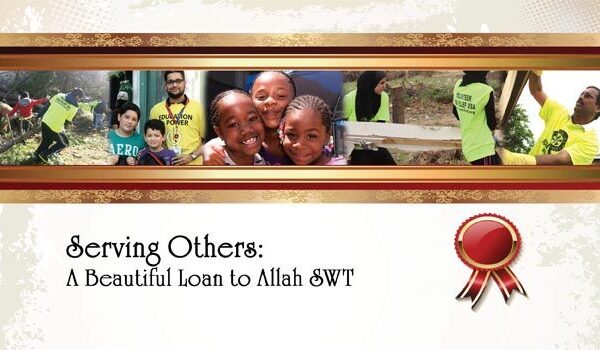
    On a Sunday morning in March, a group of Muslim volunteers gathered at the Haley House soup kitchen in Boston’s South End neighborhood where they served breakfast and then lunch to the hungry. They helped prepare the food and rather than having the people who came for a meal stand in a line to receive their food, the Muslims waited on them at their own tables as a server would at a restaurant. The volunteers also distributed 150 “blessing bags” which contained personal-sized hygiene products, warm winter socks, and granola bars and crackers. Touched by the gesture, a man named George said, “I’ve never seen a Muslim doing things like this.”

    We have believed in Allah and we can optimally use our intellect and our resources to serve others – that is a beautiful loan
    to Allah SWT

    But Muslims have the best example to follow in doing such things — a man who took the very shirt off his back to give to another who had asked him for it. This man would give food and drink to a guest even though he and his family had so little that they “did not eat their fill for three successive days…” according to his wife. He once expressed that one of his greatest delights would be to have a mountain turned into gold so that he could give away every single gold coin except for what he needed to pay off his debts. This man’s name is Muhammad (peace is upon him).

    We claim to know the Prophet very well but rarely take too seriously his behavior as a model in our own lives except what comes naturally and easily for us. We declare our love for him but listen to his teachings with a sincere respect while at the same time harboring half-hearted intentions of applying them in our lives. In similar way, the Qur’an is often placed on the top shelf of the bookcase in our homes out of respect and reverence while we too often forget to place the same topmost priority to apply its wisdom in our daily lives.

    Alhamdulillah, we are Muslim and we have submitted to the One and Only God. But what is the natural outcome once eman has entered the heart? It’s serving the Almighty’s creation. That’s something Muhammad (peace be upon him) had been doing even before he became a prophet. Remember his wife Khadijah comforting him after his first encounter with Jibril? Her words are so revealing: “By Allah, Allah will never disgrace you. You keep good relations with your kith and kin, help the poor and the destitute, serve your guests generously and assist those who are in distress.”

    The Prophet’s example inspired great sahabah like Uthman ibn Affan, Jafar ibn AbiTalib, and Abdulrahman ibn Awf to demonstrate again and again generosity of epic proportions. Many others were galvanized to assist their fellow human beings in need. Once a man came to the Prophet asking for food, but he (peace be upon him) had nothing to give him. Abu Huraira narrates what then transpired: “The Prophet then said, ‘Allah would show mercy to him who will entertain this guest tonight.’ A person from the Ansar stood up and said, ‘Messenger of Allah, I am ready to entertain him.’ He took him to his house and said to his wife, ‘Is there anything with you (to serve the guest)?’ She said, ‘No, but only sustenance for our children.’ He said, ‘Distract their attention with something and when the guest enters extinguish the lamp and give him the impression that we are eating.’ So they sat down, and the guest had his meal. When it was morning he went to Allah’s Messenger (peace be upon him) who said, ‘Allah was well pleased with what you both did for your guest last night.’”

    Where are people today like this selfless Ansari man? We all need to step up to the plate and strive to follow our righteous predecessors’ footsteps. The volunteers present as Haley House in Boston that Sunday in March were not some uniquely kind-hearted people. They are everyday American Muslims volunteering for an organization called ICNA Relief USA, striving to put their faith into action. ICNA Relief USA is an American Muslim relief organization working in the U.S. to help the most vulnerable in our communities regardless of race, religion, color, national origin, socioeconomic status, or any other demographic factor. ICNA Relief USA has eight major programs providing services in everything from disaster response to women’s shelters and family counseling to burial assistance.

    As the only Muslim disaster response organization in the U.S., ICNA Relief USA has responded to 25 disasters since 2001, including hurricanes Katrina and Sandy. It has thirteen food pantries in major cities throughout the country, and through their hunger prevention program fed 36,000 people in 2012 alone. In that same year, ICNA Relief’s financial assistance program helped more than one thousand low-income families pay for their rent and utilities. The organization operates women’s shelters in twelve cities across the U.S., providing a safe haven to homeless and/or abused women, both Muslim and non-Muslim. ICNA Relief distributed 20,000 free school bags with school supplies to low-income students to give them the necessary tools to succeed in school. ICNA Relief USA received a gold star rating from GuideStar, an organization that gathers and disseminates information about nonprofits with regard to their legitimacy, finances, transparency, and other aspects of their organization, governance, and performance.

    Alhamdulillah ICNA Relief has been changing perceptions about the deen of Allah one person at a time. A non-Muslim female veteran, who stayed in ICNA Relief’s women’s shelter in NY, stated, “After returning from active duty in Iraq, I found myself on the street, emotionally distressed. ICNA Relief gave me a place to live and put myself together in order to become an IT professional today.” Another woman described the support she received from an ICNA Relief case manager after her town was hit by a natural disaster: “Now this man — I know nothing about and he is a Muslim. You hear things. I was a little skeptical and afraid… He has done nothing but help me. He was here for my good.”

    Every day ICNA Relief USA uses its resources to serve fellow Americans in whatever way the organization can. Their staff and volunteers are striving to follow the prophetic example of uplifting the less fortunate and providing for the needy. They are making a difference in this world and we can too. Allah says in the Qur’an, “If you loan to Allah a beautiful loan, He will double it for you and will forgive you. And Allah is most ready to appreciate and reward, forbearing….” (64:17). We have believed in Allah and we can optimally use our intellect and our resources to serve others – that is a beautiful loan to Allah SWT. For that He promises appreciation and reward for our good deeds, and forbearance and forgiveness for our sins and shortcomings. Will you take Him up on His offer?

  • Strictness and Leniency in Teaching: Finding the Balance

    Strictness and Leniency in Teaching: Finding the Balance

    Leniency does not mean giving someone a pass from their responsibilities, but that you excuse them when there’s a valid reason without holding it against them, and that you believe in them and give them an appropriate chance to succeed even if they’ve failed you multiple times

    “Don’t crack a smile till March.” This was the advice given to our class by our education professor while I was in college. He was referring to how we, as prospective teachers, should behave with our students, especially during our first year. Some of us laughed while others smiled – as student teachers we knew all too well how difficult class management was. Getting your students to get to class on time, to keep them in their seats, and to arrange them in such a way as to keep all the friends and enemies away from each other so they wouldn’t cause a ruckus in your class was no easy feat. Then of course, there were the smart-alecky kids who preyed on new teachers. They talked back to you constantly, questioned your instructions only to then ignore them, and were able to mobilize their classmates against you. Not to mention the knack some of the smart ones had for comparing you to other teachers they had had in order to point out your incompetence. If people think a rocket scientist has a tough job, try teaching a room full of 6-year-olds, or 12-year-olds, or even 17-year-olds.

    So despite the harsh-seeming advice from our professor, I knew the logic behind his words was sound. When it comes to teaching students at a school, a masjid, or at home, you must adopt a strict personality if you want to be taken seriously. That is because you have to show your students who’s the boss; you have to let them know that they will be held to certain standards and decorum because you are not, in this particular role, trying to be their friend. A couple of days into my student teaching a sixth grade class two years ago, I told my students that although I was not their permanent teacher, they had to treat me like one and that I was not their friend who they could take lightly. I still remember an adorable 12-year-old asking me, “Why can’t you be our friend?” and it broke my heart. But then when you overhear another 12-year-old calling your co-teacher the b-word and another trying to cheat on your test that strengthens your resolve.

    Getting your students’ respect is a lot like joining a gang where most everyone views you with suspicion. Unfortunately, that is how being a teacher can be on a psychological level in today’s schools, especially a new teacher. I apologize for the lack of a better analogy, but perhaps this is just another sign of the times. As a newly minted gangster, you are the least trusted member of the group, and a lot of your fellow gangsters who have been together for a long time will not accept you, and they’ll play tricks on you to assert their dominance over you. But you have to beat them at their own tricks, work harder than they do, have their backs, catch them when they fall and get them back up. They need to know that you are on their side and whatever you are doing is for their benefit. That is how you work your way up the food chain and become gang leader or, in this case a respected teacher. You have to earn their respect in order to establish your authority. Gone are the days when a teacher’s mere title was enough to elicit reverence from the students. We see this kind of attitude in classical cultures of medieval Islam or Japan, for example, when the teacher-student relationship followed a master-apprentice model of mutual respect and love. Those were the good old days for teachers.

    I might have painted a bleak picture of the state of the teacher-student relationship today and talked about strictness, but this does not at all mean that teachers shouldn’t love their students. The Prophet (peace be upon him) was the best teacher ever sent to humanity and he said, “I am but holding the rank of a father who is teaching you.” How much do our fathers love us? How many chances do they give us even when we fail? They might complain about us, but aren’t they the first to show off our accomplishments? It is important then that as Muslim teachers we tell our students that we are like mothers and fathers to them. But with the condition that we hold them to standards higher than even their mothers and fathers might.

    The Qur’an says,” So by mercy from Allah, [O Muhammad], you were lenient with them. And if you had been rude [in speech] and harsh in heart, they would have disbanded from about you (3:159).” When you love someone, being lenient comes naturally. Every child comes into your classroom with baggage and is shaped by a background different from your own; even your own child living in your house will have certain tendencies as part of his/her personality, some productive and some counterproductive, that are intrinsic to their nature. That is why is it important to give students chances over and over again to show that you believe in their success. Even if a deadline for an assignment passes and a student hasn’t turned it in, you have to push that student to hand in the next one and have good expectations of him or her. Leniency does not mean giving someone a pass from their responsibilities, but that you excuse them when there’s a valid reason without holding it against them, and that you believe in them and give them an appropriate chance to succeed even if they’ve failed you multiple times.

    I remember supervising a fourth-grade class one time which was very well-behaved under their homeroom teacher. The teacher had asked me to give the 9-year-olds some work, and I did. Things looked fine until the phone rang and she went to answer it. The moment the teacher turned her back, an avalanche of voices filled the classroom. Being timid, I tried to quiet individual students, which didn’t work. I then tried to yell at them to stop talking but in a manner that clearly showed I was unsure of myself. A little girl who was helping me to silence the kids said, “You have to be a little mean, too. You have to be nice and mean like Ms. Lau. ”Out of the mouths of babes, as they say!

    Yes, as teachers, we have to find a balance between strictness and leniency, between authoritativeness and nurture. There are times when each is appropriate and necessary. But even when the teacher is being strict with the students, even when she is reprimanding them or correcting them, the students have to know that at the base of the teacher’s actions and words is a profound caring for them and their well-being. The students have to believe without any doubt that the teacher will be fair and balanced in her dealings with them. They have to feel absolutely respected and appreciated as human beings, albeit young ones, who are struggling to know themselves, to learn to the best of their abilities, and to grow and mature — all under the watch of a teacher who strives to understand and support them in every way possible on their journey toward adulthood.

  • Nature of Suffering

    Nature of Suffering

    Too often when we face some difficulties or experience some sort of loss, we feel sorry for ourselves. We wonder why we are suffering, and what we did to deserve this particular hardship. Some of us who are more self-examining might retrace our steps in an attempt to understand where exactly we went wrong. We might think: “I pray five times a day (okay, so maybe I miss fajr sometimes), I fast in Ramadan and I give sadaqah when I can. I might have a slight backbiting problem and somewhat of an addiction to a mind-blowing fantasy action show I watch. But, I am honestly trying to improve; I am sincere in my quest to become a better Muslim. Heck, I even make my parents take me to the ICNA convention every year because there are people there to help me along my way. So, why does it seem like Allah is striking me down with one difficulty or another?”

    Next time, whether you have a common cold or a serious health condition, in the face of simple inconvenience or heartrending misfortune… find a moment to be thankful and know that Allah loves you

    And people might tell us that it’s because Allah is testing us, or it might just be the consequence of some unjust act we had committed so we kind of deserve what we’re getting if we’re really honest with ourselves. Considering the first possibility, that Allah is testing us, we might ask why He would do that. And Allah answers this question in this verse: “Do people think that they will be left alone because they say: ‘We have faith’, and will not be tested? And We indeed tested those who were before them. And Allah will certainly make known those who are true and will certainly make known those who are liars” (Qur’an 29:1-3). And we should take into consideration that when the verse was revealed, Allah was addressing, in the first case, the greatest generation of Muslims – the sahabah at the time of the Prophet, peace be upon him, who were physically and mentally persecuted in such atrocious ways just because they believed in the tawheed of Allah.

    While we are suffering, we should remember that Allah is merely testing our sincerity and resolve, which He has every right to do

    It’s just like in those epic fantasy action shows we watch. In order to become a part of an exclusive elite group who champion justice and protect the public, the protagonist has to prove his sincerity, his worth, and his dedication. This weeds out the coward or the blowhard who makes bold claims but shrinks at the first moment his conviction and endurance are required. So while we are suffering, we should remember that Allah is merely testing our sincerity and resolve, which He has every right to do. Muslims are to be people of their words and Islam is a practical religion. A Muslim is enjoined to testify to his belief and to act upon that belief.

    Allah says in a hadeeth qudsi, “I was a Treasure unknown, then I desired to be known so I created a creation to which I made Myself known; then they knew Me.” Living in the dunya with its numerous distractions, sometimes Allah causes us to suffer to remind us of Him, so that we remember in the midst of all of our activities what truly is important and why we are here on this earth. The Prophet, peace be upon him, said “When Allah desires the redemption of His people, He causes them to suffer in this world. But when He is averse, He leaves them to transgress until death overtakes.”

    So our suffering is merely a calling from Al-Basit, The Reliever. The pain we are feeling is a reminder to turn to Him. And if we stray from the path, we are reminded by our difficulties to call upon Al-Haadi, The Guide. We must understand that Allah doesn’t want anything bad for us. What we’re experiencing as a test from Allah or as a consequence of some wrong doing on our part, is a reminder from Allah for His servants that, in the words of Yasmin Mogahed, a freelance writer and international speaker, “no matter how far they’ve fallen or strayed, He always awaits their return.”

    Finally, let us contemplate the truly inspiring words of Imam Al-Ghazali which illustrate Allah’s immense love for us:

    “[I]f a man ceases to take any concern in worldly matters, conceives a distaste for common pleasures, and appears sick in depression, the doctor will say, ‘This is a case of melancholy and requires such and such prescription.’ The physicist will say, ‘This is dehydration of the brain caused by hot weather and cannot be relieved till the air becomes moist.’ The astrologer will attribute it to some particular conjunction or opposition of planets. ‘Thus far their wisdom reaches,’ says the Qur’an. It does not occur to them that what has really happened is this: that the Almighty has a concern for the welfare of that man, and has therefore commanded His servants, the planets or the elements, to produce such a condition in him that he may turn away from the world to his Maker. The knowledge of this fact is a lustrous pearl from the ocean of inspirational knowledge, to which all other forms of knowledge are as islands in the sea.”

    Next time, whether you have a common cold or a serious health condition, in the face of simple inconvenience or heartrending misfortune — whatever the difficulty or loss — find a moment to be thankful and know that Allah loves you.


  • The Rohingya Muslims: A Tale of Tears

    Thirty-four year old Jafar and his family fled to Bangladesh in 1991. He laments his situation, saying “Myanmar is my home and that is where I want to go back to. ..because we don’t have citizenship we are like a fish out of water, flapping and unable to breathe…and when a fish is out of water, he suffocates to death.”

    The Rohingya are the only ethnic group in Burma
    subject to severe restrictions on the right to marry
    and a two-child policy

    Jafar is from the ethnic group Rohingya, and it’s not hard to understand why he and his family fled. Facing years of discrimination and abuse, the Rohingya, a Muslim minority in Burma (also called Myanmar), are a people who are prevented from calling the place in which they were born, and where their families have resided for generations, as their homeland. The Burmese government does not give the Rohingya citizenship status as a result of the Citizenship Act passed in 1982. Further, the Rohingya are the only ethnic group in Burma subject to severe restrictions on the right to marry and a two-child policy. They face forced labor, expropriation of property, and severe travel limitations. There are well-documented reports of beatings, torture, and killings including being burned alive, and some individuals are arrested by the military never to be seen again by their families. The United Nations calls them one of the world’s most persecuted minorities. They are the Rohingya– “the forgotten people.”

    In light of recent circumstances, it is important to understand that conflict between the Buddhist majority and the Muslim minority population in Burma is nothing new. In 2001, a number of riots broke out between the two groups. In May of that year, tensions flared in the city of Taungooas. Buddhists demanded that the ancient Hantha Mosque be destroyed to avenge the destruction of the Buddhas of Bamayian, carried out by the Taliban in Afghanistan. According to the U.S. State Department’s Annual Report for International Religious Freedom issued in October of that year, ten Muslims and ten Buddhists perished in the violence after Buddhists attacked Muslim businesses and homes, followed by Muslim retaliation. In addition, it stated there were credible reports of military personnel disguising themselves as Buddhist monks to incite the violence.

    In another incident in 2001, according to the State Department report, 50 Muslim homes were burned to the ground. Additionally, an unknown number of Muslim and Buddhist fatalities occurred, as reported by Human Rights Watch, after several Buddhist monks refused to pay a Muslim vendor who sold them some cakes. The Muslim vendor and her husband then beat the monks and an all-out riot ensued.

    Muslims make up roughly four percent of the population of Burma according to official statistics. Although there are numerous examples of Buddhist-Muslim conflict in Burma’s history, the main issue plaguing the country today involving the Rohingya ethnic/religious minority does not seem to be based on religious differences. The 800,000 Rohingya reside in the Arakan state of Burma, bordering Bangladesh, and trace their lineage back to shipwrecked Arab merchants from the 8th century A.D. Their presence in the region as far back as the 18th century is confirmed in the writings of Scottish physician Francis Buchanan-Hamilton in his “A Comparative Vocabulary of Some of the Languages Spoken in the Burma Empire.”

    One would imagine that even a presence extending back two or three centuries would warrant citizenship status, but the Burmese government vehemently rejects this. They believe the Rohingya are Bengali immigrants who do not have any ancestral claim to the land. While there is sufficient evidence to establish the Rohingya presence in Arakan (“The Advent of Islam in Arakan and the Rohingya” – a scholarly work by Dr. Mohammad Ali Chowdhury uses a wealth of sources to make some excellent points in this regard), it is also true that during British colonial times there was an effort by the British to push Bengalis living in Chittagong, Bangladesh to settle in Arakan for cheap labor. The first British Commissioner of Burma, Arthur Pharyre, in his “Account of Arakan,” stated that hundreds, maybe thousands, of migrants made their way to Arakan from Chittagong for work and high wages. However, it has also been documented that thousands of Rakhine (the Buddhist ethnic group belonging to Arakan) also moved into Bengal during this borderless era. Conditions were set up in this way to allow for easy movement between British-ruled India and Burma in the mid 1800s. Even if the Rohingya are the descendants of Bengali immigrants, they have now been in Arakan for three generations or so. It would only be natural for them to be granted citizenship status under modern Burmese law.

    A bone of contention between the two groups is that the Muslims of Arakan sought to join with Pakistan at the time of the Partition of India in 1947. The ethnic Burmese people are, therefore, wary of any separatist tendencies the Rohingya might hold. The Rohingya are thus viewed suspiciously by the Rakhine Buddhists as a group just waiting for a chance to seek independence.

    The current violence started in June when three Rohingya men allegedly raped and killed a Buddhist woman. In retaliation, Buddhist villagers stopped a bus and brutally killed ten Muslim passengers. Human Rights Watch personnel confirmed that local police officials witnessed the massacre and did nothing to stop it. The Rohingya, in the aftermath of those murders, protested by destroying Buddhist property which was then met with Buddhist and police collaboration in killing of Muslims and burning of Muslim property. Violence spun out of control on both sides.

    According to human rights organizations, nearly 80 Rohingya have died as a result of the turbulence, while the Turkish charity Humanitarian Aid Foundation (IHH) reports that one thousand have perished. Meanwhile, thousands of others have been detained, displaced, or removed from their homes. In a report entitled “The Government Could Have Stopped This,” Human Rights Watch related the following: “In Sittwe[Capital of Arakan state], where the population was about half Arakan [Buddhist] and half Muslim, most Muslims have fled the city or were forcibly relocated, raising questions about whether the government will respect their right to return home. Human Rights Watch found the center of the once diverse capital now largely segregated and devoid of Muslims.”

    As the title of the Human Rights Watch’s release indicates, the rioting and violence from both sides could have been stopped, as reported to them by both Muslim and Buddhist sources in Arakan state. The authorities, however, were silent spectators to the bloodbath, or worse, at times helping the Buddhists in their attacks on Muslims and their property.

    National hero Aung Suu Kyi, awarded the Nobel Peace Prize for her efforts to bring about Burma’s transition to democracy after half century of a brutal military dictatorship, is now being criticized for staying silent about the Rohingyas’ plight. And Burmese President Thein Sein stated in a meeting with a U.N. High Commissioner for Refugees delegation that the only solution to the problem would be mass deportation or moving all of the Rohingya Muslims to refugee camps.

    It is sad to report that while this ethnic cleansing takes place, corporations such as Coca Cola and Master Card were fast to enter the Burmese market after U.S. trade sanctions were eased in July. “If the atrocities in Arakan had happened before the government’s reform process started, the international reaction would have been swift and strong,” said director of Human Rights Watch Asia, Brad Adams, in their report. “But the international community appears to be blinded by a romantic narrative of sweeping change in Burma, signing new trade deals and lifting sanctions even while the abuses continue.”

    Thousands of Rohingya Muslims have tried to flee to Bangladesh to escape this nightmarish situation only to be forced back with meager supplies of food and water in rickety old wooden boats. Some have been fired upon by Bangladeshi authorities who can only ignore the refugees’ pleas in compliance with government orders. Under international law,the country is obligated to provide Rohingya refugees temporary shelter, but the Bangladeshi government refuses to get involved in an issue they say has nothing to do with them. Some Rohingya refugees manage to sneak in but have no access to basic survival necessities. The Organization of Islamic Countries (OIC) unfortunately has not done anything of substance to help out their fellow brothers and sisters in need. They have issued a statement or two urging the international community to come together to find a solution.

    Recently, Turkey took a bold step and visited refugee camps in Arakan. Emine Erdogan, the prime minister’s wife, who could be seen in pictures weeping as she hugs Rohingya women, along with Foreign Minister Ahmet Davutoglu, personally delivered aid to the Rohingya in need. The Turkish newspaper Today’s Zaman reports that they delivered aid to the Buddhist camps as well. What can better exemplify the beauty of Islam than such a humane gesture?

    It is now high time for Muslims from all over the world to do something substantive for their Rohingya brothers and sisters as well.

  • Struggle for Freedom

    It started the very last days of 2010 and continues till today, almost two years later. It began in Tunisia when the poor and frustrated street vendor Mohamed Bouazizi set himself on fire after being harassed by the police; and then protest spread like wildfire to the surrounding countries. The dictatorial governments of Egypt, Libya, Yemen, and Saudi Arabia, along with more than a dozen other Muslim countries, faced historic backlash from their citizens. “The people want to bring down the regime” was chanted throughout the nations as the people led massive protests against corrupt rulers and their profligate lifestyles.

    The usually volatile Middle East is at present even more unsettled. There has been regime change in Tunisia, Egypt, Libya, and Yemen. The first two can be classified as success stories after their people underwent tremendous struggle to achieve their objectives, while the latter two are open questions since the media has been eerily quiet about them after the ouster of their presidents. Some movements have been quelled by governmental reforms and others have led to brutal crackdowns of protestors. The uprising in Syria has degenerated into a bloody civil war claiming more than 20,000 lives according to Syrian sources.

    Allah says, “Let there be a community among you who call to the good, and enjoin the right, and forbid the wrong. They are the ones who have success (3:104).” This verse of the Qur’an succinctly outlines the duty of Muslims. And who better to call on to enjoin good and forbid evil than the head of state himself? Unfortunately, in today’s world it has become almost impossible for the average person to be given access to the ruler, whether president, governor, or mayor, to advise him in the most serious of matters — “Stop killing your own people, Allah will hold you accountable for this.” In light of such circumstances, it then becomes Muslims’ responsibility to get the message across using other peaceful methods.

    In such a case, the Prophet’s (SAW) words come to mind: “Whoever of you sees something wrong should change it with his hand; if he cannot, then with his tongue; if he cannot, then with his heart, and that is the weakest form of faith (Muslim).” Sitting at home and murmuring criticism or screaming diatribes at the TV news will not inform the government of the people’s discontent. It is because many in the Muslim world had been silent in the face of government injustices for so long that they suffered increasing torment until they could no longer endure it. Demonstrations, massive sit-ins, and other forms of protest have become necessary to call out those wrongdoers in power who are indifferent to fulfilling huquq-ul-ibaad, the duties toward humankind.

    However, a word of caution needs to be mentioned here. Protesting must not devolve into lawlessness. Looting, wanton violence, sexual assault, and other anarchic behavior moves the demonstration from the realm of permissible to that of prohibited.

    Unfortunately, such haram acts have been documented in some of the protests in the Muslim world. It is disheartening when people pour into the streets in the name of justice and the common good and some among them steal from or harass others. If anything, the very government they are protesting against will exploit the lawless behavior as justification to crack down on the protestors.

    SubhanAllah, the patient struggle of ordinary Muslims in the Middle East against their brutal leaders has inspired people around the globe, Muslims and non-Muslims, to unite and rally against harsh or unjust laws upheld by their own governments. The Occupy movements are a case in point where ordinary people have united in cities across the Western world and beyond to protest injustice, particularly the corruption of the banking sector which, with government complicity, has wreaked havoc with people’s lives and livelihoods. Insha’Allah, this struggle will not be in vain and an increase in the common good will be the result.

    The Prophet (SAW) said, “The best jihad (struggle) is the speaking of truth in the presence of a tyrannical ruler (Abu Dawud and Tirmidhi).” This beautiful hadith is the motivation Muslims need to stop being compliant with unscrupulous governments; to rise up peacefully, speaking against injustice with strength, humility, and a conviction that Allah is watching and supports those who enjoin the good and forbid the evil.

  • NYPD’s Surveillance of Muslim Students

    NYPD’s Surveillance of Muslim Students

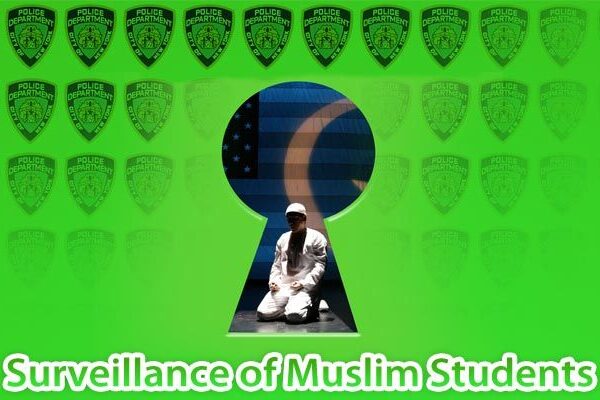
    “When will it end?” This is the thought going through the minds of Muslim Americans ever since the news first broke last August of the New York City Police Department spying on the Muslim community of New York. Not only were masjids, cafes, and other community locations targeted for surveillance and infiltration, but colleges all across the Northeast, and in some cases even Islamic schools attended by minors, were monitored. A total of 250 locations were scrutinized, not as a result of some questionable activity, reported or even suspected, but rather as “preventive measures.”

    Every day more of our civil liberties are being trampled upon and all American citizens must be concerned

    The NYPD apparently considered it acceptable to spy on an entire religious community to see if they could find a crazy few who might be of interest to them. This surveillance operation began in 2002, a year after the September 11 attacks, with the launch of the “Demographics Unit” set up with the help of the CIA to comprehensively map “29 ancestries of interest” within a hundred miles of New York City. While it is illegal for the CIA to spy domestically, we are supposed to accept the fact that the nation’s intelligence agency aided the NYPD to set up its own surveillance network to “monitor” Muslims. The NYPD claims they only follow leads. But how many leads could they have to account for spying on more than 250 locations, many outside of the state of New York? With such extensive monitoring, the message conveyed is that being Muslim is the only lead they need, despite their disclaimers about using racial or religious profiling.

    The NYPD’s intelligence-gathering unit worked secretly – so secretly that the New York City Council, whose job it is to oversee the police department, was not informed of the all the details. Further obscuring the surveillance operation is the fact that the City’s comptroller does not audit the NYPD’s intelligence unit. New York City’s Mayor Michael Bloomberg promised a more transparent police department when he first ran for office; it is now his third term and the NYPD, under police commissioner Ray Kelly, has never had such free rein, with so little oversight, as it has now.

    As part of the surveillance operation, a report was issued by NYPD entitled “Radicalization in the West.” It called for officers to be on the lookout for Muslim individuals exhibiting signs of radicalization. These signs include the giving up of alcohol and smoking, avoidance of interest-based loans, growing a beard, or traveling to Mecca for Hajj. These are all indications of a Muslim becoming more devout. Yet to the NYPD surveillance operation, these are signs pointing to radicalization. This is not surprising considering the prevalence of inaccurate information which has been used to inform those involved in the operation. For example, as part of its training of officers, the NYPD showed a film by the Clarion Fund, a conservative organization known for its Islamophobic activities, called the “The Third Jihad” which depicts all Muslims in America as potential terrorists. The film ran “on a continuous loop” while officers were filling out papers and, according to Paul Browne, an NYPD spokesman, the officer responsible for that has been disciplined.

    When the news first broke last year about the surveillance at local colleges in New York City, faculty members and administrators were quick to condemn the NYPD for these activities. There was an outcry amongst activists and advocacy groups for this attack on Muslim Americans’ civil liberties. The ones who were shaken the most, however, were and still are college students. According to the Associated Press, an informant befriended some Muslim students at Brooklyn College, and went on so-called “militant paintball trips” with them in 2006. Another infiltrator working for the NYPD took a whitewater rafting trip with 18 students from City College to upstate New York, noting particulars about each of the individuals including how many times they prayed each day. These tactics serve to create fear, paranoia, and distrust of government and police authorities amongst Muslim college students. Their trepidation is not unfounded when they end up in some NYPD file because they sent and/or forwarded emails announcing upcoming university events which included mainstream Muslim scholars, speakers, or activists.

    Such attack on the privacy of American citizens is unacceptable in an open, democratic nation such as the United States. Every day more of our civil liberties are being trampled upon and all American citizens should be concerned. With the passage of such laws as the Indefinite Detention Bill, recently signed by President Obama, no one is safe from the increasing incursions on our civil rights. While all Americans share the goal of protecting the country, and certainly New York City, from any threat or harm, no one who cherishes our constitutional rights can condone the tactics used to ostensibly achieve that end.