
بسم الله الرحمن الرحيم

Tag: women leadership

  • Beyond Stereotypes

    Beyond Stereotypes

    Ilhan Omar

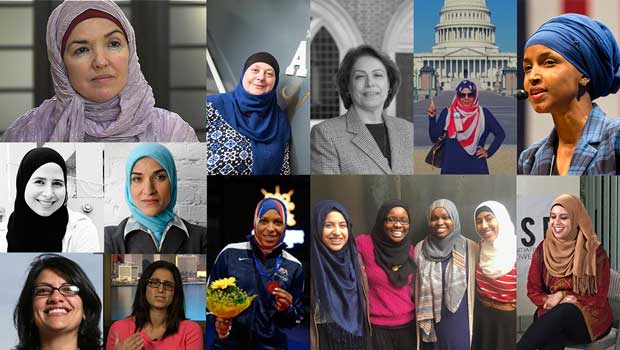
    Ilhan Omar, the 35-year-old Somali-American who has become one of two Muslim women elected to Congress in 2018, spent four years in a Kenyan refugee camp and then immigrated with her family to the U.S. at age twelve. She ran on a progressive platform which she calls “a politics of moral clarity and courage.” She will work toward cancelling student debt, tweeting in October, “Instead of providing a tax cut to the top 1%, we need to cancel the $1.4 trillion dollars in student debt weighing us down.” She also wants to reduce funding for “perpetual war and military aggression” and supports criminal justice reform. She has been recognized for her hard work with the “Commitment to Service Award,” the “Champion of Change Award” given by Minnesota Urban Debate League, “The Jeanne and Joseph Sullivan Award” given for commitment to advancing human rights and women’s leadership, “Hall of Fame Award” given by the National Association of Women’s Business Owners for women who advance business leadership of women, and the 2018 “Citizen of the Year” Award given by the Minneapolis Rotary Club, and more.
    Beyond stereotypes: contemporary Muslim women leaders, reformers, activists, and scholars

    Ibtihaj Muhammad

    Ibtihaj Muhammad began fencing as a 13-year-old and in 2016 became the first woman to compete in the Olympics wearing hijab. She received the bronze medal for Women’s Individual Sabre in the summer Olympics in Rio de Janeiro. “It’s a tough political environment we’re in right now. Muslims are under the microscope,” Muhammad said. “It’s all really a big dream — I don’t think it’s hit me yet. The honor of representing Muslim and black women is one I don’t take lightly.” She was a 3-time NCAA All-American and the 2005 Junior Olympic Champion. Ibtihaj graduated from Duke University in 2007 with a double major in international relations and African American studies. She serves on the U.S. Department of State’s Empowering Women and Girls Through Sport Initiative and gives of her time teaching fencing to inner city youth, a mentoring foundation started by Olympian Peter Westbrook.
    Beyond stereotypes: contemporary Muslim women leaders, reformers, activists, and scholars

    Rana Abdelhamid

    Rana Abdelhamid founded the Women’s Initiative for Self-Empowerment (WISE), a self-defense, leadership and entrepreneurship program for young Muslim women in New York City. She also created the photography series, “Hijabis of New York,” a social media project aimed at presenting Muslim women, through photographs and interviews, in their everyday lives. Abdelhamid has worked with Amnesty International USA for eight years on campaigns supporting women’s rights, and to advocate for the end of the use of torture. She is currently the youngest serving board member of Amnesty International USA. She earned her bachelor’s from Middlebury College in International Politics and Economics and a master’s degree in public policy from the John F. Kennedy School of Government at Harvard University. She has conducted extensive research on civic participation and mobilization of minority communities. Abdelhamid is a recipient of the United Nations Association of the USA Leo Nevas Human Rights Youth Award and received the Harry S. Truman Scholarship for public service leadership.

    Muslim Girls Making Change

    Kiran Waqar, Balkisa Abdikadir, Hawa Adam, and Lena Ginawi are high-school students in the small city of Burlington, Vermont. But once they created their slam poetry quartet, Muslim Girls Making Change, their voices could not be ignored. They perform their passionate poetry on issues of social justice and aim to break down stereotypes about Muslims and other minority communities. They have performed both in the U.S. and on the international stage. In June 2018, they won a National Education Association Human and Civil Rights Award — the SuAnne Big Crow Memorial Award, recognizing their social justice outreach. “Whenever you hear the word terrorism, I don’t want the first thing you think about is Islam, because Islam, to me, is a religion of peace,” Ginawi told the Associated Press.

    Zaineb Abdulla

    After Donald Trump became president, Muslims and others in minority communities felt increased fear. Hate-filled rhetoric filled the air waves. Iraqi-American Zaineb Abdulla, based in Chicago, took action. Trained in Brazilian Jui Jitsu, she launched a seminar for Muslim women who long have been targets for bigots. Her Hate Crime Survival Seminars “are designed to give women the tools they need to stand up and fight back,” says Abdulla. She added, “By working to increase self-esteem and self confidence in addition to basic self-defense knowledge, we are strengthening women in body, mind and spirit.” Abdulla, who is deaf, also co-founded Deaf Planet Soul, a non-profit organization in Chicago that serves and empowers the deaf and hard of hearing. She is currently pursuing her masters in deaf education and nonprofit management.

    Dr. Ingrid Mattson

    Dr. Ingrid Mattson is on outspoken academic and religious leader. Soon after 9/11, she wrote in an article, “So often, it seems, we have to apologize for reprehensible actions committed by Muslims in the name of Islam. We tell other Americans, ‘People who do these things (oppression of women, persecution of religious minorities, terrorism) have distorted the true Islam.’ And so often we have to tell other Muslims throughout the world that America is not as bad as it appears. We say, ‘These policies (support for oppressive governments, enforcement of sanctions responsible for the deaths almost 1 million Iraqi children, vetoing any criticism of Israel at the United Nations) contradict the true values of America.’ But frankly, American Muslims have generally been more critical of injustices committed by the American government than of injustices committed by Muslims. This has to change.”
    Mattson is currently the London and Windsor Community Chair in Islamic Studies at Huron University College at the University of Western Ontario, London, Canada. Since 2012, she has been a professor at Huron University College, teaching courses in classical Islamic thought; Islamic thought, culture and practices; Islamic ethics; and interpreting the Quran. She has her bachelor’s degree from the University of Waterloo in philosophy and fine arts and a doctorate in Near Eastern Languages and Civilizations from the University of Chicago. Dr. Mattson has received numerous awards and is the recipient of honorary doctorates from Trinity College, Hartford, and the Chicago Theological Seminary.

    Dr. Azizah al-Hibri

    Dr. Azizah al-Hibri was a Professor Emerita at the University of Richmond School of Law until her retirement in 2012. Her academic focus was the development of Islamic jurisprudence and law that are “gender equitable and promote human rights and democratic governance.” Dr. al-Hibri served as a commissioner on the U.S. Commission on International Religious Freedom, appointed by President Obama. She received the Virginia First Freedom Award from the Council for America’s First Freedom in 2007, the Dr. Betty Shabazz Recognition Award from Women in Islam in 2006, and the University of Richmond’s Distinguished Educator Award in 2004. She was named a Fulbright scholar in 2001. Dr. al-Hibri is also the founder and chairwoman of KARAMAH: Muslim Women Lawyers for Human Rights, a nonprofit organization “committed to promoting human rights globally, especially gender equity, religious freedom and civil rights in the United States.” Dr. al-Hibri earned a B.A from the American University of Beirut and a Ph.D. in philosophy as well as her J.D. from the University of Pennsylvania.

    Dalia Mogahed

    As former executive director of the Gallup Center for Muslim Studies, Dalia Mogahed combined her interest in collection and analysis of data and religion, particularly Islam. The organization is a non-partisan research center that surveys and analyzes the views and opinions of Muslims around the world. She has a B.S. in chemical engineering from the University of Wisconsin and an MBA from the Joseph M. Katz Graduate School of Business at the University of Pittsburgh. Mogahed was born in Cairo, Egypt and immigrated with her family to the U.S. when she was four-years-old. She is currently the Director of Research at the Institute for Social Policy and Understanding (ISPU) which “conducts objective, solution-seeking research that empowers American Muslims to develop their community and fully contribute to democracy and pluralism in the United States.” Her TED Talk on “What it’s like to be a Muslim in America” has been viewed 2.8 million times. In an interview, Mogahed said, “We can challenge Islamophobia like how we challenge any other form of bigotry or racism; we first have to learn what it is, and we have to educate ourselves on its fundamental manifestation…There are many subtle and insidious ways that racism and bigotry manifest, so when we educate ourselves on what those are, and how we can ourselves conform to them and have these implicit biases, we develop an awareness and ability to conquer those things.”

    Rashida Tlaib

    Palestinian-American Rashida Tlaib, along with Ilhan Omar, will take office on January 3. They are two Muslim women elected to Congress in November of last year. Tlaib, 42 years old, is a lawyer who was elected to represent Michigan’s 13th congressional district in the U.S. House of Representatives. She served in the Michigan House of Representatives from 2009 to 2012. Some of Tlaib’s priorities in Congress will be raising the minimum wage to $15, preventing cuts to Social Security, Medicare, and Medicaid, equal pay for equal work for women, overturning Citizens United, and restoring the Voting Rights Act. Tlaib is a progressive Democrat, along with others in the progressive wing including Elizabeth Warren, Bernie Sanders, and Kamala Harris. After serving in the Michigan legislature, Tlaib worked for the non-profit Sugar Law Center for Economic and Social Justice as an attorney and advocate. In that role, she worked on various campaigns including efforts to stop the dumping of toxic chemicals into the Detroit River, to stop tax breaks for the wealthy, and to combat bigotry.
  • Women Scholars of Hadith

    Women Scholars of Hadith

    History records few scholarly enterprises, at least before modern times, in which women have played an important and active role side by side with men. The science of hadith forms an outstanding exception in this respect. Islam, as a religion which (unlike Christianity) refused to attribute gender to the Godhead, and never appointed a male priestly elite to serve as an intermediary between creature and Creator, started life with the assurance that while men and women are equipped by nature for complementary rather than identical roles, no spiritual superiority inheres in the masculine principle. As a result, the Muslim community was happy to abide the equal worth of men and women in God’s sight. Only this can explain why, uniquely among the classical Western religions, Islam produced a large number of outstanding female scholars, on whose testimony and sound judgment much of the edifice of Islam depends.

    At every period in Muslim history, there lived numerous eminent women traditionists  treated by their brethren with reverence and respect

    Since Islam’s earliest days, women had been taking a prominent part in the preservation and cultivation of hadith, and this function continued down the centuries. At every period in Muslim history, there lived numerous eminent women traditionists, treated by their brethren with reverence and respect. Biographical notes on very large numbers of them are to be found in the biographical dictionaries.

    During the lifetime of the Prophet, many women had been not only the reason for the dissemination of many traditions, but had also been their transmitters to their sisters and brothers in faith. After the Prophet’s death, many women Companions, particularly his wives, were looked upon as vital custodians of knowledge, and were approached for instruction by the other Companions, to whom they readily dispensed from the rich repository of doctrine, understanding, and wisdom which they had gathered in the Prophet’s company. The names of Hafsa, Umm Habiba, Maymuna, Umm Salama, and A’isha, are familiar to every student of hadith as being among its earliest and most distinguished transmitters. In particular, A’isha is one of the most important figures in the whole history of hadith literature — not only as one of the earliest reporters of the largest number of hadith, but also as one of their most careful and insightful interpreters.

    In the period of the Successors too women held important positions as traditionists. Hafsa, the daughter of Ibn Sirin,Umm al-Darda the Younger (d.81/700), and ‘Amra bin ‘Abd al-Rahman, are only a few of the key women traditionists of this period. Iyas ibn Mu’awiya, an important traditionist of the time and a judge of undisputed ability and merit, deemed Umm al-Darda to be superior to all the other traditionists of the period, including the celebrated masters of hadith like al-Hasan al-Basri and Ibn Sirin. ‘Amra bin ‘Abd al-Rahman was considered a great authority on traditions related by A’isha. Among her students was Abu Bakr ibn Hazm, the celebrated judge of Medina, who was ordered by the caliph Umar ibn Abd al-Aziz to write down all the traditions known on her authority.

    Furthermore, ‘Abida al-Madaniyya, ‘Abda bin Bishr, Umm Umar al-Thaqafiyya, Zaynab the granddaughter of Ali ibn Abd Allah ibn Abbas, Nafisa bint al-Hasan ibn Ziyad, Khadija Umm Muhammad, ‘Abda bint Abd al-Rahman, and many other women excelled in delivering public lectures on hadith. These devout women came from the most diverse backgrounds, indicating that neither class nor gender were obstacles to rising through the ranks of Islamic scholarship. For example, Abida, who started life as a slave owned by Muhammad ibn Yazid, learnt a large number of hadiths with the teachers in Median. She was given by her master to Habib Dahhun, the great traditionist of Spain, when he visited the holy city on this way to the Hajj. Dahhun was so impressed by her learning that he freed her, married her, and brought her to Andalusia. It is said that she related ten thousand traditions on the authority of her Medinan teachers.

    Zaynab bint Sulayman (d. 142/759), by contrast, was a princess by birth. Her father was a cousin of al-Saffah, the founder of the Abbasid dynasty, and had been a governor of Basra, Oman, and Bahrayn during the caliphate of al-Mansur. Zaynab, who received a fine education and acquired a mastery of hadith, gained a reputation as one of the most distinguished women traditionists of the time, and counted many important men among her pupils.

    This partnership of women with men in the propagation of the Prophetic Tradition continued in the period when the great anthologies of hadith were compiled. A survey of the texts reveals that all the important compilers of traditions from the earliest period received many of them from women shuyukh. Every major collection gives the names of many women as the immediate authorities of the author. And when these works had been compiled, the women traditionists themselves mastered them, and delivered lectures to large classes of pupils, to whom they would issue their own ijazas (certificates of knowledge).

    In the fourth century, we find Fatima bint Abd al-Rahman (d. 312/924), known as al-Sufiyya on account of her great piety; Fatima (granddaughter of Abu Daud of Sunan fame); Amat al-Wahid (d. 377/987), the daughter of distinguished jurist al-Muhamili; Umm al-Fath Amat as-Salam (d. 390/999), the daughter of the judge Abu Bakr Ahmad (d.350/961); Jumua bint Ahmad and many other women, whose classes were always attended by reverential audiences.

    The Islamic tradition of female hadith scholarship continued in the fifth and sixth centuries of hijra. Fatima bin al-Hasan ibn Ali ibn al-Daqqaq al-Qushayri was celebrated not only for her piety and her mastery of calligraphy, but also for her knowledge of hadith and the quality of the isnads she knew. Even more distinguished was Karima al-Marwaziyya (d.463/1070), who was considered the best authority on the Sahih of al-Bukhari in her own time. Abu Dharr of Herat, one of the leading scholars of the period, attached such great importance to her authority that he advised his students to study the Sahih under no one else, because of the quality of her scholarship. She thus figures as a central point in the transmission of this seminal text of Islam. As a matter of fact, writes Godziher, “…her name occurs with extraordinary frequency of the ijazas for narrating the text of this book.” Among her students were al-Khatib al-Baghdadi and al-Humaydi (428/1036-488/1095).

    Aside from Karimaal-Marwaziyya, a number of other women traditionists occupy an eminent place in the history of the transmission of the text of the Sahih. Among these, one might mention in particular Fatima bint Muhammad (d.539/1144; Shuhda “the Writer” (d.574/1178), and Sitt al-Wuzara bint Umar (d.716/1316). Fatima narrated the book on the authority of the great traditionist Said al-Ayyar; she received from the hadith specialists the proud title of Musnida Isfahan (the great hadith authority of Isfahan). Shuhda was a famous calligrapher and a traditionist of great repute. The biographers describe her as “the calligrapher, the great authority on hadith, and the pride of womanhood.” Her great-grandfather had been a dealer in needles, and thus acquired the sobriquet “al-Ibri.” But her father, Abu Nasr (d. 506/1112), had acquired a passion for hadith and managed to study it with several masters of the subject. In obedience to the sunna, he gave his daughter a sound academic education, ensuring that she studied under many traditionists of accepted reputation.

    She married Ali ibn Muhammad, an important figure with some literary interests, who later became a companion of great favor and benefit to the caliph al-Muqtadi, founding a college and a Sufi lodge, which he endowed most generously. His wife, however, was better known, gaining her reputation in the field of hadith scholarship, and was noted for the quality of her isnads. Her lectures on Sahih al-Bukhari and other hadith collections were attended by large crowds of students; and on account of her great reputation, some people even falsely claimed to have been her disciples.

    Also known as an authority on Bukhari was Sitt al-Wuzara who was acclaimed for her mastery of Islamic law, and was called “the musnida (great hadith authority)of her time, and delivered lectures on the Sahih and other works in Damascus and Egypt. Classes on the Sahih were likewise given by Umm al-Khayr Amat al-Khaliq (811/1408-911/1505), who is regarded as the last great hadith scholar of the Hijaz. Still another authority on Bukhari was A’isha bint Abd al-Hadi.

    Apart from these women, who seem to have specialized in the great Sahih of Imam al-Bukhari, there were others whose expertise was centered on other texts. Umm al-Khayr Fatima bint Ali (d.532/1137) and Fatima al-Shahrazuriyya delivered lectures on the Sahih of Muslim. Fatima al-Jawzdaniyya (d.524/1129) narrated to her students the three Mu’jams of al-Tabarani. Zaynab of Harran (d.68/1289), whose lectures attracted a large crowd of students, taught them the Musnad of Ahmad ibn Hanbal, the largest known collection of hadiths. Juwayriya bint Umar (d.783/1381) and Zaynab bint Ahmad ibn Umar (d.722/1322), who had travelled widely in pursuit of hadith and delivered lectures in Egypt as well as Medina, narrated to her students the collections of al-Darimi and Abd ibn Humayd; and we are told that students travelled from far and wide to attend her discourses. Zaynab bint Ahmad (d.740/1339), usually known as Bint al-Kamal, acquired “a camel load” of diplomas; she delivered lectures on the Musnad of Abu Hanifa, the Shamail of al-Tirmidhi, and the Sharh Ma’ani al-Athar of al-Tahawi, the last of which she read with another woman traditionist, Ajiba bin Abu Bakr (d.740/1339). “On her authority is based,” says Goldziher, “the authenticity of the Gotha codex … in the same isnad a large number of learned women are cited who had occupied themselves with this work.” With her, and various other women, the great traveler Ibn Battuta studied traditions during his stay at Damascus. The famous historian of Damascus, Ibn Asakir, who tells us that he had studied under more than 1,200 men and 80 women, obtained the ijaza of Zaynab bint Abd al-Rahman for the Muwatta of Imam Malik. Jalal al-Din al-Suyuti studied the Risala of Imam Shafii with Hajar bint Muhammad. Afif al-Din Junayd, a traditionist of the ninth century AH, read the Sunan of al-Darimi with Fatima bin Ahmad ibn Qasim.

    Other important traditionists included Zaynab bint al-Sha’ri (d.524/615-1129/1218). She studied hadith under several important traditionists, and in turn lectured to many students, some of who gained great repute including Ibn Khallikan, author of the well-known biographical dictionary Wafayat al-Ayan. Another was Karima the Syrian (d.641/1218), described by the biographers as the greatest authority on hadith in Syria of her day. She delivered lectures on many works of hadith on the authority of numerous teachers.

    In his work al-Durar al-Karima, Ibn Hajar gives short biographical notices of about 170 prominent women of the eighth century, most of whom were traditionists, and under many of whom the author himself had studied. Some of these women were acknowledged as the best traditionists of the period. For instance, Juwayriya bint Ahmad, to whom we have already referred, studied a range of works on traditions under scholars both male and female and taught at the great colleges of the time, and then proceeded to give renowned lectures on the Islamic disciplines. “Some of my own teachers,” Ibn Hajar said, “and many of my contemporaries, attended her discourses.” A’isha bin Abd al-Hadi (723-816), also mentioned above, who for a considerable time was one of Ibn Hajar’s teachers, was considered to be the finest traditionist of her time, and many students undertook long journeys in order to sit at her feet and study the truths of religion. Sitt al-Arab (d.760-1358) had been the teacher of the well-known traditionist al-Iraqi (d.742/1341) and of many others who derived a good proportion of their knowledge from her. Daqiqa bint Murshid (d.746/1345), another celebrated woman traditionist, received instruction from a full array of other women.

    Information on women traditionists of the ninth century is given in a work by Muhammad ibn Abd al-Rahman al-Sakhawi (830-897/1427-1489), called al-Daw al-Lami, which is a biographical dictionary of eminent persons of the ninth century. A further source is the Mu’jam al-Shuyukh of Abd al-Aziz ibn Umar ibn Fahd (812-871/1409-1466), compiled in 861 AH and devoted to the biographical notices of more than 1,100 of the author’s teachers, including over 130 women scholars under whom he had studied. Some of these women were acclaimed as among the most precise and scholarly traditionists of their time, and trained many of the great scholars of the following generation. Umm Hani Maryam (778-871/1376-1466), for instance, learned the Qur’an by heart when still a child, acquired all the Islamic sciences then being taught, including theology, law, history, and grammar, and then travelled to pursue hadith with the best traditionists of her time in Cairo and Mecca. She was also celebrated for her mastery of calligraphy, her command of the Arabic language, and her natural aptitude in poetry, as well as her strict observance of the duties of religion (she performed the hajj no fewer than thirteen times). Her son, who became a noted scholar of the tenth century, showed the greatest veneration for her, and constantly served her towards the end of her life. She pursued an intensive program of learning in the great college of Cairo, giving ijazas to many scholars, and Ibn Fahd himself studied several technical works on hadith under her.

    Her Syrian contemporary, Bai Khatun (d.864/1459), having studied traditions with Abu Bakr al-Mizzi and numerous other traditionalists, and having secured the ijazas of a large number of masters of hadith both men and women, delivered lectures on the subject in Syria and Cairo. We are told that she took especial delight in teaching. A’isha bin Ibrahim (760/1358-842/1438), known in academic circles as Ibnat al-Sharaihi, also studied traditions in Damascus and Cairo (and elsewhere), and delivered lectures which eminent scholars of the day spared no efforts to attend. Umm al-Khayr Saida of Mecca (d.850/1446) received instruction in hadith from numerous traditionists in different cities, gaining an equally distinguished reputation as a scholar.

    So far as may be gathered from the sources, the involvement of women in hadith scholarship and in the Islamic disciplines generally, seems to have declined considerably from the tenth century of the hijra. Books such as al-Nur al-Safir of al-Aydarus, the Khulasat al-Akhbar of al-Muhibbi, and the al-Suluh al-Wabila of Muhammad ibn AbdAllah (which are biographical dictionaries of eminent persons of the tenth, eleventh and twelfth centuries of the hijra respectively) contain the names of barely a dozen eminent women traditionists. But it would be wrong to conclude from this that after the tenth century, women lost interest in the subject. Some women traditionists who gained good reputations in the ninth century lived well into the tenth, and continued their services to the sunna. Asma bint Kamal al-Din (d.904/1498) wielded great influence with the sultans and their officials, to whom she often made recommendations which, we are told, they always accepted. She lectured on hadith and trained women in various Islamic sciences. A’isha bint Muhammad (d.906/1500), who married the famous judge Muslih al-Din, taught traditions to many students, and was appointed professor at the Salihiyya College in Damascus. Fatima bint Yusuf of Aleppo (870/1465-925/1519) was known as one of the excellent scholars of her time. Umm al-Khayr granted an ijaza to a pilgrim at Mecca in the year 938/1531.

    The last woman traditionist of the first rank who is known to us was Fatima al-Fudayliya, also known as al-Shaykha al-Fudayliya. She was born before the end of the twelfth Islamic century, and soon excelled in the art of calligraphy and the various Islamic sciences. She had a special interest in hadith, read a good deal on the subject, received the diplomas of a good many scholars and acquired a reputation as an important traditionist in her own right. Towards the end of her life, she settled at Mecca, where she founded an extensive public library. In the Holy City, many eminent traditionists attended her lectures and received certificates from her. Among them, one could mention in particular Shaykh Umar al-Hanafi and Shaykh Muhammad Sali. She died in 1247/1831.

    Throughout the history of female scholarship in Islam it is clear that the women involved did not confine their study to a personal interest in traditions, or to the private coaching of a few individuals, but took their seats as students as well as teachers in pubic educational institutions, side by side with their brothers in faith. The colophons (publishers’ inscriptions at the end of a book or manuscript) of many manuscripts show them both as students attending large general classes, and also as teachers, delivering regular courses of lectures. For instance, the certificate on folios 238-40 of the al-Mashikhat ma al-Tarikh of Ibn al-Bukhari, shows that numerous women attended a regular course of eleven lectures which was delivered before a class consisting of more than five hundred students in the Umar Mosque at Damascus in the year 687/1288. Another certificate, on folio 40 of the same manuscript, shows that many female students, whose names are specified, attended another course of six lectures on the book, which was delivered by Ibn al-Sayrafi to a class of more than two hundred students at Aleppo in the year 736/1336. And on folio 250, we discover that a famous woman traditionist, Umm Abd Allah, delivered a course of five lectures on the book to a mixed class of more than fifty students, at Damascus in the year 837/1433.

    Various notes on the manuscript of the Kitab al-Kifaya of al-Khatib al-Baghdadi, and of a collection of various treatises on hadith, show Ni’ma bin Ali, Umm Ahmad Zaynab bint al-Makki, and other women traditionists delivering lectures on these two books. Sometimes independently, and sometimes jointly with male traditionists, they lectured in major colleges such as the Aziziyya Madrasa, and the Diyaiyya Madrasa, to regular classes of students. Some of these lectures were attended by Ahmad, son of the famous general Salah al-Din.

    [Editor’s note: This article is taken with slight modification from “Hadith Literature: Its Origin, Development, Special Features & Criticism” (chapter 6, pp. 142-153) by Dr. Muhammad Zubayr Siddiqi  (published by Calcutta University, 1961). This original book is out of print. A revised edition is now available, rearranged and modified under the title, “Hadith Literature: Its Origins, Development & Special Features” published by Islamic Texts Society (Cambridge, 1993)].