بسم الله الرحمن الرحيم

Tag: women in islam

  • Muslim Women’s Day: Gender Equity, Equality, and Roles in Islam

    Muslim Women’s Day: Gender Equity, Equality, and Roles in Islam

    So often, we, the female community, are told that we aren’t capable. And we witness the cultural narration of male superiority that stains people’s minds, still evident in our contemporary world. We experience or witness the cultural gender gap and female oppression in predominantly Muslim countries. I specify “culture,” because culture is where the injustice and oppression against women originates. Culture is what systematically and psychologically warps people’s minds about women. Islam, in contrast, honors women. Islam has established women rights, their dignity, and their worthiness. Any culture which does not implement fully the Islamic dictums and principles with regard to gender will fail to honor women in the way that Allah SWT ordains. We must banish the dark clouds of ignorance and seek to enlighten people about the Islamic view of gender identity, relations, and rights.

    Gender Equality Versus Gender Equity

    Gender equality can be defined as rights, responsibilities, and opportunities being accorded regardless of gender. Equality thus does not take into account the biological and natural tendencies of each gender. Yet, in the Qur’an, Allah SWT affirms the gender differences of the male and the female. The wife of Imran had made du’a to Allah SWT, wanting to dedicate her unborn child (Maryam, the mother of Jesus) to His service. The Qur’an says, “But when she delivered her, she said, ‘My Lord, I have delivered a female.’ And Allah was most knowing of what she delivered, and the male is not like the female…” (3:36). Gender differences are biological, an intrinsic nature. Because of gender differences, Islam aligns more with the views of gender equity than with gender equality. Gender equity means, according to a UNESCO summary review, “fairness of treatment for men and women according to their respective needs. This may include equal treatment or treatment that is different, but which is considered equivalent in terms of rights, benefits, obligations, and opportunities.”

    An example of gender equity is in sports. There are separate leagues in most sports for men and for women. The obvious reason is that males and females have biological differences. Therefore, the separation promotes fairness rather than males and females competing together regardless of natural advantages or disadvantages. Males and females are not the same physically, mentally, or emotionally. With the specific strengths and weaknesses specific to each gender, Allah SWT gave each gender certain responsibilities in accordance with their nature.

    The responsibility that has been firmly directed to men is to support his family financially (Qur’an 4:34). This includes any household costs and any and all costs to support members of the family. Although a woman does not have the responsibility of financial support of the family, she can rightfully earn, spend, and keep her money without interference. The responsibilities of women are to take care of the husband in the home as well as the children if there are any offspring. The high value and level of dignity accorded to the role of the mother is depicted in the Prophet (s) saying, “Paradise lies under the feet of mothers.”

    The roles of men and women are meant to be complementary. This division of labor makes perfect sense and suits the intrinsic natures of the genders. The importance of the woman as the heart of the family rather than as a domestic worker is underscored by the behavior of the Prophet. He used to help his wife Aishah with household chores. When Aishah (r) was asked what the Prophet (s) when he was at home, she said, “He used to keep himself busy serving his family and when it was the time for prayer, he would go for it.” Men and women are expected to be “allies” to one another (Qur’an 9:71) and in a marriage, their roles are complementary. Both women and men equally have the right to consent to or reject a marriage proposal and each has the right to a divorce. However, men must pay a mahr (dowry) to the woman. If the woman initiates a divorce, she must pay back the mahr to the man.

    Spiritual Equality

    In the Qur’an, Allah SWT says, “And whoever does righteous deeds, whether male or female, while being a believer – those will enter Paradise and will not be wronged, by as much as the speck on a date seed” (4:124). In Islam, there is spiritual equality of the male and the female. The deeds of men and women are justly determined on the same scale. And as Shaykh Yasir Qadri points out, “The potential to enter Jannah is the same regardless of gender.”

    In fact, the Qur’an does not attribute superiority based on biological gender. Allah SWT says in the Qur’an, “Surely the most noble of you in the sight of Allah is the most righteous among you” (49:13). That applies to all human beings, male and female. The Prophet’s wife, Umm Salama, once asked the Prophet (s) why Allah SWT addressed men in the Qur’an but not women specifically. Allah SWT soon revealed this verse: “Indeed, the Muslim men and Muslim women, the believing men and believing women, the obedient men and obedient women, the truthful men and truthful women, the patient men and patient women, the humble men and humble women, the charitable men and charitable women, the fasting men and fasting women, the men who guard their private parts and the women who do so, and the men who remember Allah often and the women who do so – for them Allah has prepared forgiveness and a great reward” (Qur’an 33:35).

    Securing Our Space

    The theme for this year’s Muslim Women’s Day is “Securing Our Space.” This is about learning to get out of our comfort zone and advocate for ourselves. Cultures stereotype women in various ways. Some characterize her as a domestic worker, no better than a servant. Some sexualize her and make it like her appearance is the most important thing about her rather than her character or her soul. Some cultures depict women as emotionally unstable. It is up to us to carry ourselves with respectability and embody the character that Islam enjoins upon human beings. We advocate for ourselves by working on ourselves, purifying our hearts, and emulating the Prophet in the way that he lived — with the greatest strength, dignity, and integrity. In this way, we are best capable of speaking up and demanding the full rights accorded to us by Islam.

  • Amerian Muslim Women’s Conference

    Amerian Muslim Women’s Conference

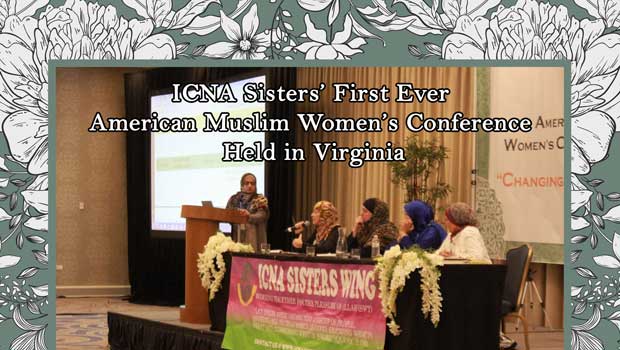
    Women from across the nation attended ICNA Sisters’ first ever American Muslim Women’s Conference Saturday, Oct. 7, in Chantilly, Virginia to talk about “Changing the Narrative” of Muslim women in the United States. The approximately 400 invited guests included female leaders not only from within ICNA’s own divisions, but also from several other prominent U.S. organizations, distinguished professors, civil rights organizers, doctors, and Islamic scholars.

    During the welcome address, ICNA Sisters president Sadia Salman said, “The women here represent the diverse Muslim women that make up our society. Which is why with the current situation of our nation, the world and our Ummah, it is more important than ever before for us to stand united as one. ”She added that despite the various organizations and platforms the women at the conference were a part of, it was their “duty to stand up and work together” regarding the challenges in society. The conference aimed to unite women leaders from across the nation to hear about, discuss, and highlight possible solutions to several pressing issues facing the American Muslim woman, according to Faizah Aslam, secretary general of ICNA Sisters.

    The morning portion of the event began with speakers Dr. Zainab Alwani, Aisha al-Adawiya, Farhana Matin, and Shaikh a Anse Tamara Gray discussing topics ranging from how the Muslim woman is defined in today’s society and the journey of American Muslim women in the U.S., to how American Muslim women are not only the backbone of the household but are also the rising leaders in society; and finally, how American Muslim women can tap into the power they have and use it to contribute to a successful society.

    Following lunch, the audience had the chance to attend two parallel panel sessions, “Oppression: What, Where, & When” with Alwani, Salma Abugideiri, Nahela Morales, and Zahra Billoo and “Through the Filters: Myth vs Reality” with Alia Salem, Hena Zuberi, MaryaBangee, and Rowaida AbdelAziz. The first highlighted and answered questions of how Muslim women are oppressed in the U.S. and what are the different forms of oppression, while the other handled questions of the portrayal of Muslim women in media and what can be done to change the perception of women in film and news media.

    The last main hall session focused on areas where American Muslim women are already contributing and building a counter-narrative to the one seen most frequently in media. The conference ended which opinions and feedback collected during the sessions which were read as a way to share with the audience possible initiatives and solutions to some of the issues discussed.

    “It was more successful than I anticipated,” Abeer Sher, ICNA Sisters vice-president said. “The reason being I didn’t expect to gather that many Muslim women leadership from across the United States under one roof, but alhamdullilah it happened. My heart is so warm from hearing during the sessions just how ready the Muslim women were to unite on every level.”

  • An Islamic Model of Marriage

    An Islamic Model of Marriage

    The image of marriage that we are advised to strive for as portrayed in the Qur’an and Sunnah is based on three foundations: taqwa (consciousness of Allah SWT; love of pleasing Him and hope for His mercy, which is balanced by fear of displeasing Him and earning His wrath; virtuousness), mawadda (abundant love), and rahma (mercy). Taqwa guides the practice of abundant love and mercy as will be explained in more detail. We can experience paradise on earth if we really strive to live the Islamic model of marriage. Let us begin by exploring taqwa and its importance in marriage.

    Taqwa

    If we are asked to choose one trait that is essential for marriage, our unequivocal answer should be “Taqwa!” Taqwa emanates from the heart and envelops the whole of the human being. In fact, it is the core foundation from which love, mercy, and caring flow. There are many reasons why taqwa is essential to the success of marriage. Many marital issues in Qur’an and Sunnah are left open to the application of ma`roof, i.e. in accordance with Shari`ah (divine law), justice, fairness, respect, equity, caring, compassion and kindness. Ma’roof also encompasses what is Islamically customary, such as issues of obedience, gender roles, divorce, maintenance and provisions, or even the simple act of just living together as spouses. Only inner God-consciousness, taqwa, guarantees that couples fulfill their marital duties and apply the principles of Islam as justly and as fairly as possible.

    “…They are your garments and you are their garments” (Qur’an, Al-Baqara, 2:187). The word garment conveys feelings of warmth, closeness, protection and security.

    Taqwa of Allah (SWT) is the only reason why a person in his/her sane mind would counter evil with good for fear of transgressing and in hopes of high rewards from Allah (SWT). Abu Huraira (RAA) narrated that the Messenger of Allah said: “…do not hate one another; do not turn away from one another; and do not undercut one another, but be you, O servants of Allah, brothers (and sisters). A Muslim is the brother of a Muslim – he neither oppresses him nor does he fail him; he neither lies to him nor does he hold him in contempt. Taqwa is right here” – and he pointed to his breast three times” (Muslim). The Prophet (SAW) is pointing out that taqwa is the safeguard to help stay away from the evil behaviors he mentions. Taqwa means putting our trust in Allah (SWT). By trusting and following Allah’s (SWT) commands, we can ensure a successful marriage in this life. With taqwa we can trust that fitra (pristine human nature), common sense, and goodness will rise above egoistic tendencies for conflict, power seeking, and vengefulness.

    Taqwa empowers us to live in harmony with our spouses. We may have come from homes where verbal or physical abuse was accepted and regularly engaged in. However, it is not befitting or acceptable for someone with taqwa to follow in the footsteps of such ugly behavior. Both spouses raise their standards when they practice taqwa. Taqwa is the best garment one can wear, whether during marriage, parenthood, work, or any other aspect of life. “…But the garment of righteousness [taqwa], that is the best. Such are among the Signs of Allah, that they may be reminded” (Qur’an, Al-‘A`raf, 7:26).

    Only a person clothed with taqwa will be a comforting companion and a merciful friend. Such an individual becomes a cover and shield for his/her spouse in full embodiment of the following beautiful verse: “…They are your garments and you are their garments” (Qur’an, Al-Baqara, 2:187). The word garment conveys feelings of warmth, closeness, protection and security. It is interesting that the root meaning of taqwa includes to safeguard, to protect, to preserve, to shield, to shelter, and to prevent. It is easy to see why taqwa is the perfect garment for the two individuals in a marriage relationship. Let us look at the following verse: “And among His Signs is this – That He created for you mates from among yourselves that you may dwell in tranquility with them and He has put abundant love and mercy between your [hearts]. Verily in that are Signs for those who reflect” (Qur’an, Ar-Rum, 30:21). Allah (SWT) establishes a beautiful image of an amazing bond between a man and a woman; one of closeness, shelter, warmth, and abundant mawadda (love) and rahma (mercy). These two Arabic words encompass many meanings. Let’s look at each one more closely.

    Mawadda

    In the verse above, mawadda is best defined as abundant love. Couples need to gather and increase their provisions of love, lots of it, to keep the ship of their marriage sailing. Abundant love encompasses many meanings such as affection, appreciation, attention, commitment, joy, respect, responsibility, sacrifice, security, trust, and intimacy. For the marriage to be happy, enduring and fulfilling, couples need to engage in the continuous exercise of loving and nurturing each other. If we do not nurture our marital relationship daily, it withers and dies like a plant without water or sunlight. Loving each other on a daily basis is about feeling close, connected, individually and mutually fulfilled and appreciated.

    At the heart of many marital problems is a poor perception of a spouse, which usually involves our focusing on the other’s shortcomings rather than on our own, letting negative thoughts run wild and building a mental case against the worst aspects of the spouse rather than building an emotional support system for their best aspects.

    There are unlimited ways to demonstrate love, affection, and caring toward your spouse. Tell your spouse frequently how much you love him/her. Loving your spouse is not just about realizing this in your heart but also about telling them. The Prophet (SAW) said, “If any of you loves his brother, let him tell him that he loves him.” This applies to family, friends, fellow Muslims, and most significantly, to spouses. You can call your spouse during the day or send him/her an email checking how things are going. When you call, tell them you miss them or any other sentiment of your choosing that expresses affection and appreciation. In fact, giving a gift of appreciation has great impact. This does not have to be elaborate or expensive; it just needs to be thoughtful. Give something that tells your spouse that you listen to them and are aware of what makes them happy. A preferred dessert, a book he/she has mentioned wanting to read, or a flower may be more than enough. The Prophet said, “Give each other gifts and you will love each other.” And, as simple as it seems, smiling when you see your spouse has a positive and heartening effect. The Prophet (SAW) guided us by saying, “To smile in the face of your brother is a charity…” Always aim to be cheerful, uplifting and humorous. Sometimes we feel this is an obligation towards our Muslim brothers and sisters, but we forget to practice this in our daily interactions with our spouses.

    Most couples are able to discover more about their specific nurturing and love needs as they get to know each other better. The main point is to infuse your life with demonstrations of abundant love that make the bonding between you close and strong. In fact, the bonding was so close and strong between the Prophet (SAW) and Khadija, his first wife, that long after she had died he would remember her and praise her as the first believer and his closest ally on the path of Allah (SWT). In fact, loving each other for the sake of Allah (SWT) is the best type of love between spouses, it is true and enduring love, not just short-term affection. This love helps each spouse grow and guarantees success, true success. In fact, this love makes us lovable by others. “Lo! Those who believe and do good works, the Beneficent will appoint for them love” (Qur’an, Maryam, 19:96). My observation is that of the couples who seek counseling, those who improve significantly are those who learn to nurture their marriage on a daily basis with loving words and actions. The Prophet (SAW) used to kiss his wives frequently, drink from the same cup in the same spot where A’isha put her lips, and help out with household chores. Strive to make your spouse feel like the most special person in the world to you. Here are three examples of how to create this environment, in your own mind and in your home:

    Realize that your spouse is precious: Reflect on this profound reality and it will slowly become engrained in your mind and actions. Indeed, we have a great example in the deep love that the Prophet (SAW) had for his wife A’isha (RAA): “When the Prophet was asked which person he loved most in the world, the Prophet replied, A’isha’…”

    “Believe” in your spouse: This is absolutely essential in strengthening the marital bond and helping your spouse achieve his/her goals. Khadija (RAA), sets a great example for us. Long after she passed away, the Prophet (SAW) would often remember her and say: “…she believed in me when everyone else disbelieved in me; when they belied me she trusted me; when no one would help me, she helped me with her money. Allah (SWT) gave me children from her and denied me children from any other woman.” Having a positive and loving perception of our spouses has a great impact on how we interact with them. Having a negative perception of our spouses has a negative impact on our interactions with them. At the heart of many marital problems is a poor perception of a spouse, which usually involves our focusing on the other’s shortcomings rather than on our own, letting negative thoughts run wild and building a mental case against the worst aspects of the spouse rather than building an emotional support system for their best aspects.

    We know that the Prophet’s wives were actual participants in relaying the transformational message of Islam to the world. In this regard, the Prophet (SAW) and the whole community supported them. This has practical implications for us today. Husbands must understand the tremendous need in our society for the talents, creativity, insights, and wisdom of women. What follows from that is providing practical support for a wife to pursue her dreams and fulfill her obligation as an active participant in society. All this, of course, would occur while keeping a balance between the duties of a home and the demands of society. That is giving fullest support to our spouses: believing in their capabilities and helping them achieve their goals.

    Give your spouse your undivided attention: Spend uninterrupted time wholeheartedly listening to his or her dreams, fears, insights, thoughts, needs or whatever they want to talk about. This also means that we have to create a safe haven in our homes, where our spouses can speak their minds without fear of being judged or ridiculed.

    When we love someone abundantly, we are inclined to being more merciful, tolerant, and patient with his/her shortcomings. And rahma is the third foundation of a healthy Islamic marriage.

    Rahma

    Rahma has many meanings and levels. With regard to the spouse, it means having mercy with his/her faults and mistakes as well as protecting and covering their shortcomings. In fact, the root word of rahma is the same as the word rahem (the womb), thereby evoking more intimate, beautiful meanings of mercy. The womb is safe and nurturing, allowing growth without impediment. Marriage should be naturally easygoing and nurturing for both spouses to appreciate each other’s differences and to grow together without obstacle. Spouses live together day in and day out and gradually let most of their guards down. Therefore, they may be very vulnerable and sensitive because their deficiencies and weaknesses are readily visible to the other.

    One of the greatest ways of showing rahma is being the advocate for your spouse, especially in situations when they are reluctant to speak up for themselves, such as tense moments with the in-laws.

    It is clear that without rahma, a marriage would be a daily struggle and a slide into depression, chronic stress, and even physical illness. Then just the act of being “at home” becomes a struggle, let alone being able to face the many other challenges outside the home. Lack of mercy impedes growth in any relationship, preventing a spouse from feeling confident enough to reveal his/her weaknesses and to work on overcoming them. With rahma, tranquility and peace envelop the house. Only when we feel truly accepted, can we flourish to our highest potential. People feel relaxed when living in an atmosphere of tolerance and understanding. We become truthful with nothing to hide. There is no longer any need to wear a mask or feel tense. There are many elements of mercy such as acceptance, approval, compassion, connectedness, consideration, flexibility, gentleness, humility, kindness, self-awareness, tranquility, tolerance, and understanding. All these elements should guide our demonstration of rahma towards our spouses. There are many ways to show rahma to the spouses:

    Showing rahma with their faults: when something is not major, let it go.

    When they are weak, sick, or stressed, cater to their special needs and do something extra, such as buying them their favorite foods, taking time off from work to care for them, serving them breakfast in bed, calling them at work/home to see how they are doing, offering warm soup or a nicely brewed cup of tea.

    Be flexible. In his book, “Finding the Love of Your Life,” Dr. Neil Clark Warren talks about flexibility as the one personality trait that covers a multitude of differences. “It is this quality that can take over when two people discover, after their wedding, that they have some critical differences. If both people have a generous portion of flexibility woven into their personalities, they can make important adjustments.”

    One of the greatest ways of showing rahma is being the advocate for your spouse, especially in situations when they are reluctant to speak up for themselves, such as tense moments with the in-laws.

    Show tolerance and acceptance of your spouse’s extended family and the people he/she cares about. This is a crucial element for any couple and can often make or break a marriage. In counseling, I have seen many conflicts arise from one of the spouse’s lack of attention to their partner’s need to host or welcome their extended family.

    Be creative about the possible ways to show rahma to your spouse. The key is to stay attuned to their rahma needs by seeking feedback from them about what you can do to assist and make life easier for them.

    The Benefits of the Islamic Model of Marriage

    A marriage based on the solid foundations of taqwa, mawadda, and rahma is sure to reap many bounties and blessings from Allah (SWT). In the company of such spouses and insha’Allah healthy and pious offspring, our marriage can truly be the answer to the following supplication: “…Our Lord! Grant us in our spouses and offspring the comfort and delight of our eyes and give us [the grace] to lead the righteous” (Qur’an, Al-Furqan, 25:74). Marriage is conducive to our emotional, psychological, spiritual and intellectual growth. It helps us become useful contributors to society. When we have such peaceful and happy homes, built according to the teachings of Islam, we will live in a heaven on earth. We can have very calm and easeful souls in the middle of life filled with challenges and difficulties only when we believe in Allah (SWT). This is the true joy of living Islam.

  • The Role of Muslim Women at the Time of the Prophet (s.)

    The Role of Muslim Women at the Time of the Prophet (s.)

    When we think of the role of women around the Prophet (pbuh), the thought that often comes to mind is of prominent historical figures such as Sumayah (RA), the first female martyr in the early days of Islam, and Nusaybah (RA), the female companion who fought valiantly with her family to protect the Prophet (pbuh) in battle. While these women are no doubt role models in their piety, devotion, and commitment to the deen, there are many other admirable women as well who helped shape the role of the Muslim woman at the time of the Prophet (pbuh) and the roles that we strive to fulfill in society today. To truly understand and implement these roles, we should look no further than the Prophet’s own household. His wives and daughters truly provide the best of examples of the female role in our Islamic history.

    Interestingly, today we see feminists arguing to define and redefine the role of women in society. The question of what it means to be a woman today is debated in open forums and in circles of academia. Yet the most simple and most direct answer to this question of defining gender roles lies in our own faith and in the way Islam positions both men and women in the family and in society. In Surat Al-Ahzab, we are reassured that both men and women will be judged not by their gender but by the merit of their deeds. “Indeed, the Muslim men and Muslim women, the believing men and believing women, the obedient men and obedient women, the truthful men and truthful women, the patient men and patient women, the humble men and humble women, the charitable men and charitable women, the fasting men and fasting women, the men who guard their private parts and the women who do so, and the men who remember Allah often and the women who do so – for them Allah has prepared forgiveness and a great reward” (Quran 33:35).

    Along with this validation from the Quran, one need only look to the Sunnah to clearly see that while men and women are undoubtedly different from biological, psychological, emotional and social perspectives, the purpose of the creation of both males and females remains the same—to worship Allah (SWT). How is this achieved within the existing realm of gender differentiation? By following the guidelines of the deen and by excelling in what Allah (SWT) has commanded each of us to be, whether male or female — strong and faithful believers.

    Islam Elevates Female Status

    During the time of the Prophet (pbuh), we see the role of Muslim women changing. In pre-Islamic Arabia, female infanticide was rampant because the value of the female was scorned. The Quran makes clear that this practice is heinous and each person will be held accountable: “When the female infant buried alive is questioned for what crime she was killed, when the scrolls are laid open, when the World on High is unveiled, when the Blazing Fire is kindled to fierce heat, and when the Garden is brought near — then shall each soul know what it has put forward” (81: 8-14). Further, the Quran prohibits this abominable custom: “And do not kill your children because of poverty. We provide sustenance for you and for them” (Quran 6:151).

    The banning of female infanticide coincided with the elevation of female status, and through the unfolding of the Islamic message, her rights were instituted, including the right to own property, to inherit, to accept or refuse a marriage, to seek knowledge and obtain education, and to worship Allah SWT as a full and independent individual. In tandem with those rights, the injunction of maintaining modesty was revealed in Surat An-Noor (24:30-31) and it is addressed to both men and women, along with prescribing hijab for all believing women. Thus, women were further elevated, no longer to be married off to the highest bidder, or treated like property or sex object. This change in the status of the female as commanded by Allah (SWT) and as practiced by the Prophet (pbuh), met with a great deal of resistance from those committed to the status quo, those who felt threatened by the progressive and enlightened tenets of Islam.

    Khadija (RA): A Woman of Strength and Independence

    The beauty of this enlightenment regarding the shift in perspective of the female role in Islam can be seen in the life of the first woman to accept Islam. Khadija (RA) was a woman who was respected in her own right, and even through today’s standard, would be seen as a woman of strength and independence. Although older than the Prophet (pbuh) at the time of their marriage, and previously twice widowed, she knew what it meant to seek strong characteristics in a spouse—trustworthiness, honesty, honor, and integrity. She understood the magnitude of the Message and the Prophet’s mission and provided the support, both emotionally and financially, that strengthened the Prophet on his journey of providing divine guidance and spiritual truth to the world.

    Khadija (RA) not only fulfilled the honorable role of mother and wife in a way that we can all learn from today, she also was a strong business woman who knew what it meant to view marriage as a partnership and a shared responsibility. It is reported that she had two sons from her first marriage, Hind and Hala, and a daughter from her second marriage, Hindah. Her marriage to the Prophet (pbuh) yielded the only living progeny who continued the line of ahl-ul-bayt. This noble woman, Khadija (RA), provided the comfort and support for the Prophet (pbuh) in his most difficult times, while also struggling through her own tests such as their two male sons dying in infancy. She raised their surviving daughters to be incredibly strong and well-respected women.

    Khadija (RA) not only fulfilled the honorable role of mother and wife in a way that we can all learn from today, she also was a strong business woman who knew what it meant to view marriage as a partnership and a shared responsibility.

    During their 25 years of marriage, Khadija (RA) never doubted her role as the supportive wife and mother in the home. The Prophet said after her death: “She believed in me when no one else did; she accepted Islam when people rejected me; and she helped and comforted me when there was no one else to lend me a helping hand.” The ease and grace with which Khadija (RA) carried out her role is something that many women today tend to struggle with. With changing societal expectations, many women today have struggled to define and manage their roles in life. In American society, there is often an inner debate about choosing a career or motherhood, or facing the challenges of doing both. However, when we look at the role of the wives of the Prophet (pbuh), and women, in general, during that time, we understand the honor of being a mother and raising children who become strong believers, while also fully participating in society’s affairs and helping to build a just society with support, courage, and the tenacity of faith.

    Role Models of Virtue and Versatility

    Three years after the death of Khadija (RA), the Prophet (pbuh) married Sawda (RA), a widow who had endured a great deal for the sake of Allah (SWT) and was the epitome of selflessness and caring. She helped raise the Prophet’s daughter, Fatima (RA), who was still young at the time of Khadija’s death.

    Upon reaching old age, she selflessly gave her allotted personal time with the Prophet (pbuh) to Aisha (RA) so that she would remain married and in the company of the Prophet, without burdening anyone.

    Aisha (RA) was one of the Mothers of the Believers who factored largely in the transmittal of hadith long after the death of the Prophet (pbuh). As the daughter of Abu Bakr (RA), she had the same strength and characteristics of leadership as her father. Her role as a wife was more than just as companion, but also as a person of great faith, in her own right, who received so much Islamic knowledge through the words and actions of the Prophet and her interactions with him. This precious knowledge she transmitted faithfully throughout the years of her life to the believers. Spending her formative years under the tutelage of the Prophet, given her youthful energy and sharp intellect, and because she was one of the Prophet’s closest companions, she became a great source of information and understanding of the Sunnah for all generations of believers.

    Following his marriage to Aisha (RA), the Prophet married Hafsa (RA), the daughter of the companion Umar Ibn Al-Khattab (RA). Similar to her father, Hafsa was of strong opinion and did not hesitate to voice her views. She freely shared her thoughts on different topics with the Prophet (pbuh), and he encouraged her to freely engage in open and honest communication with him. She was among the companions who memorized the Quran and was among those who verified the written copies recorded after the death of the Prophet. Again, the role of wife did not limit Hafsa (RA) or make her question her worth as an important member of the community, and her contributions to the ummah are important and distinguished.

    Women around the Prophet (pbuh) were versatile individuals who excelled in whatever roles they assumed in life.

    After his marriage to the daughters of Umar and Abu Bakr, the Prophet (pbuh) married Zaynab bint Khuzayma, a widow whose husband died during the Battle of Badr. She died shortly after the marriage, but even during that brief time she became known for her generosity and was called, with great regard, the “Mother of the Poor.” Next, the Prophet married Umm Salama, widowed after the Battle of Uhud, who was known for her wisdom, her mercy, and her faith. The Prophet would often ask her advice on matters of importance with regard to the ummah. This connection and mutual respect shows how the role of wife did not limit any of the wives of the Prophet but instead elevated them in status and allowed them to flourish in their versatile roles.

    Among the later Mothers of the Believers is Zaynab Bint Jahsh (RA) who had been divorced from Zayd, the young man who was raised as a child in the household of the Prophet. We see here that even as a divorced woman, the marital status of Zaynab (RA) did not define or limit her in anyway. This is a far cry from the stereotypes and societal restrictions that are too often placed by Muslims on divorced women today. This disesteem is largely cultural rather than religious. Following the marriage to Zaynab, the Prophet (pbuh) married Juwayriyya (RA), who was known as a blessing to her people of Banu Mustaliq; Umm Habiba (RA) who was known for her strength of faith and character; Saffiya (RA), who was known for her kindness and piousness; Maymuna (RA) “the blessed”; and Mariya (RA) who was known for her fortitude — these were the last women to join the household of the Prophet (pbuh).

    Delving deeply into the roles of the women who surrounded the Prophet (pbuh), we can understand that they did not define themselves by any one role. They were versatile individuals who excelled in whatever roles they assumed in life. At the core, however, their virtues of faithfulness, generosity, piety, loyalty, persistence, kindness, and courage defined these female role models in Islamic history. We should strive to emulate their example rather than bow to the expectations and pressures imposed upon us by society today.