بسم الله الرحمن الرحيم

Tag: who are muslim

  • Mercy for a Suffering World: The Islamic Model

    Mercy for a Suffering World: The Islamic Model

    In the Islamic faith, there is one phrase that is recited more frequently than any other. It begins every chapter of the Quran except for one. It is the opening for every prayer and the invocation that begins each action — whether it is eating and drinking, facing the most difficult of challenges, or starting the most mundane and routine of tasks. This phrase is “bismillah ir-Rahman ir-Raheem,” a few short but powerful words so often recited habitually, routinely, and ritually, but, nonetheless, a phrase that conveys one of the most beautiful expressions of faith: in the name of Allah, the Most Merciful, the Most Compassionate.

    The mercy of Allah (SWT) is captured in this awe-inspiring phrase with which we are commanded to begin so many actions in our lives. The reminder that our Lord is the most Merciful and the one who is truly filled with compassion is meant to be on our minds, on our tongues, and always in our hearts. The question plagues us as to why something difficult must befall us or another human being, when we are in the midst of suffering or see the suffering of others. The most critical pivot in those moments is to return to the words of Allah (SWT) and the reminder that is not meant to be far from our thoughts. For in the recognition of a most Merciful and Compassionate God exists the answers that we are so often seeking. Encompassed within His rahmah (mercy) is an implicit promise that whatever befalls us in this dunya, it is meant to be, and is, a blessing for us, even as we experience the test. As the one who has created us, we understand that He is closer to us than a mother is to her child. We are reminded in an authentic Sahih Muslim hadith that “Verily, Allah has one hundred portions of mercy. From one portion, the creation has been given mercy between themselves, and ninety-nine portions are reserved for the Day of Resurrection.”

    The Mercy of Allah (SWT) Is So Much Greater

    Imagine knowing that here on earth, the acts of kindness and mercy we see and engage in, such as feeding the hungry, caring for the sick, donating to charities, taking care of our families, and so much more, are just a tiny portion of Allah’s mercy towards His creation. In the beautiful narration of a situation witnessed by Aisha (RA), we see the mercy of a mother to her children and are in amazement of the fact that the mercy of Allah (SWT) is so much greater than that. “A woman entered, upon Aisha, with her two daughters, and she [Aisha] gave her three dates. [The woman] gave each of her daughters a date, then she split the last one between them. She [Aisha] said, ‘Then the Prophet (pbuh) came and I told him about that.’ He said,’ Why are you surprised? She will enter Paradise because of that.’” Although the mother herself was hungry, knowing that her daughters were also hungry, she willingly gave them the dates in an act of caring and compassion. We see glimpses of such mercy in humanity on a regular basis.

    The infinitely greater mercy of Allah (SWT) can be understood in the examples of His rahmah in forgiving our sins and in rewarding us for our repentance. We are reminded of the beautiful verse in the Quran which commands us to never despair of the mercy of Allah: “Say, ‘O My servants who have transgressed against themselves [by sinning], do not despair of the mercy of Allah. Indeed, Allah forgives all sins. Indeed, it is He who is the Forgiving, the Merciful’” (39:53). When we give in to despair, it becomes easy to fall into a depression that questions the mercy of our Creator. If we find ourselves in this dark place, then it becomes very difficult to hold onto the hope of relief through repentance and forgiveness, and we may turn away from Allah. Yet, it is He who is Most Merciful and Most Compassionate, and in the darkest hour, we need the connection with our Creator the most.

    The Man Who Killed 100

    There is a hadith that beautifully illustrates the immeasurable mercy of Allah (SWT). Abu Said Al-Khudri (RA) reported that the Prophet said, “There was a man from among a nation before you who killed ninety-nine people and then made an inquiry about the most learned person on the earth. He was directed to a monk. He came to him and told him that he had killed ninety-nine people and asked him if there was any chance for his repentance to be accepted. He [the monk] replied in the negative and the man killed him also, completing one hundred. He then asked about the most learned man in the earth. He was directed to a scholar. He told him that he had killed one hundred people and asked him if there was any chance for his repentance to be accepted. He [the scholar] replied in the affirmative and asked, `Who stands between you and repentance? Go to such and such land; there are people devoted to prayer and worship of Allah; join them in worship, and do not come back to your land because it is an evil place.’

    So, he went away and hardly had he covered half the distance when death overtook him, and there was a dispute between the angels of mercy and the angels of torment. The angels of mercy pleaded, ‘This man has come with a repenting heart to Allah,’ and the angels of punishment argued, ‘He never did a virtuous deed in his life.’ Then there appeared another angel in the form of a human being and the contending angels agreed to make him arbiter between them. He said, `Measure the distance between the two lands. He will be considered belonging to the land to which he is nearer.’ They measured and found him closer to the land [of piety] where he intended to go, and so the angels of mercy collected his soul” (Bukhari and Muslim). It is purely from the mercy of Allah (SWT) that his intention to do good was known and that the weight of that intention, by the measure of Allah’s compassion, carried him away from his past wrongdoings and towards mercy and forgiveness.

    In fact, rahmah comes from the same root in Arabic as rahm (womb). In a hadith qudsi, Allah SWT says, “I am al-Raḥman and created the rahm – and I named it after Me” (Ahmad). We know that the bond of the mother to her child is profound, and the love, kindness, and compassion she feels is sublime and awe-inspiring. Yet, the merciful Lord cares for those He has created more than a mother cares for her child, His rahmah so great and all-encompassing that it cannot be conceived fully by the human mind or experience.

    Prophet Muhammad: A Mercy to the Worlds

    The story of the first humans created, Adam and Eve, is also a story of repentance and rahmah and lays the foundation for our understanding of what it means to seek forgiveness and to always maintain our hope that despite our frailties and wrongdoings, that when we sincerely repent, Allah (SWT) will forgive us. The story of Adam and Eve is a lesson about repentance and forgiveness, and the centrality of rahmah in the design of life by Allah SWT. Extending that theme, the world was also sent Muhammad (pbuh) as a mercy for all mankind. We are reminded of this in the Quran: “Indeed, in this [Quran] is message for a worshiping people. And We have not sent you, [O Muhammad], except as a mercy to the worlds” (21:106-107).

    The mercy of the Prophet (pbuh) is evident in his actions with both those closest to him in his own family and those who were harshest with him from among the disbelievers. From being pelted with garbage and harassed in the streets, to being constantly cursed and belittled by the leaders of Quraysh, the Prophet (pbuh) never swayed from his mission to worship Allah (SWT) and to spread the message of Islam with mercy and compassion. There are many hadiths that document the demonstration of love, kindness, and mercy in the actions of the Prophet (pbuh). In Sunan Ibn Majah, Aisha (RA) narrated, “Some Bedouin people came to the Prophet (pbuh) and said, ‘Do you kiss your children?’ He said, ‘Yes’. They said, ‘But we, by Allah, never kiss [our children]’. The Prophet (pbuh) said, ‘What can I do if Allah has taken away mercy from you?’”

    Being merciful for the sake of Allah (SWT) includes actions that show genuine caring about the well-being of others. In a hadith, we are told the Prophet said, “…removing a harmful thing from the path is a charitable act” (Bukhari and Muslim). Such a simple act, removing a harmful item from the path of another, is a beneficial act of mercy for all, not in any way self-serving. In many situations where others may have reacted harshly, we again see the Prophet (pbuh) exhibiting the utmost rahmah. Anas bin Malik narrated, as recorded in Sahih Bukhari and Muslim, the following: “While we were in the Mosque with the Messenger of Allah, a Bedouin came and stood urinating in the Mosque. The companions of the Messenger of Allah said, ‘Stop it! Stop it!’ and were about to attack him. But the Messenger of Allah said, ‘Do not interrupt him; leave him alone.’ So, they left him until he had finished urinating, then the Messenger of Allah called him and said to him, ‘In these Mosques it is not right to do anything like urinating or defecating; they are only for remembering Allah, praying and reading Quran,’ or words to that effect. Then he commanded a man who was there to bring a bucket of water and throw it over [the urine], and he did so.”

    Recognizing that the Bedouin did not know any better, the Prophet (pbuh) showed him compassion and tolerance in response to his action in the masjid. Today, we often see things that are much less offensive in our masajid and yet we react with less tolerance and compassion. Such intolerant, condemning reactions only serve to alienate the person and make him defensive. The beauty of a merciful act and a merciful word can also be seen in the way the Prophet (pbuh) responded to the people of Taif who had treated him so badly and caused him great physical harm. When Jibreel (AS) told him Allah (SWT) could command the angels of the mountains surrounding Taif to crush the people therein as a punishment for their actions, the Prophet (pbuh) said “no” because he maintained hope that some of the offspring of the people of Taif would believe. And his hope was borne out and his rahmah was rewarded in seeing that day when the children of Taif and the grandchildren of Taif accepted Islam and became among the staunchest believers.

    Allah (SWT) Ordains that We Extend Mercy to Those on Earth

    While we may be well-acquainted with the narrations of the seerah and able to easily recognize the rahmah of the Prophet (pbuh) and the signs and manifestations of the rahmah of Allah (SWT) all around us, it can be difficult to consistently extend acts of mercy to those around us. When we view someone suffering today, often if the suffering feels very far away, we throw some money at the problem and hope that it will help in some way. But, truly living in a way that demonstrates caring, kindness, tolerance, and compassion requires that we take action, extending kindness also to those who are not of our own families or communities. In the reminder of the oft-repeated phrase that began this article, there exists a recognition that no matter what we experience in this dunya, there is a Merciful Lord who wants us to return to Him and who will see us through our most difficult trials. But in the midst of our lowest moments, it is also our own mercy, towards ourselves and others, that must lift us up and bring us closer to our Creator. To truly be a mercy, we must live according to the phrase “bismillah ir-Rahman ir-Raheem,” and we must deepen our gratefulness to the most Merciful Creator; and we must celebrate His praises with “al-hamdulillahi Rabb il-alameen (praise be to God, Lord of the worlds).

    Let us always remember what the Messenger of Allah, peace and blessings be upon him, said: “Those who are merciful will be shown mercy by the Most Merciful. Be merciful to those on the earth and the one in the heavens will have mercy upon you” (Sunan al-Tirmidhi).


  • It’s Your Life – Balance It with Your Faith

    It’s Your Life – Balance It with Your Faith

    It’s easy to get overwhelmed with life — school, career choices, family, friends, social activism, political involvement, worship, etc. Sometimes you just wonder, “where is the right balance.”

    Being a young American Muslim means navigating social, political, cultural, and personal challenges

    The Quran and the teachings of the Prophet (peace be upon him) don’t just lay out a simplistic or doctrinaire formula to follow for balancing one’s life because human beings are complex, diverse in our demographics and personal attributes. Rather than giving a formula, the Quran and Sunnah of the Prophet (pbuh) give us guidelines on how to tackle the personal, social, spiritual, cultural, political, and occupational challenges in our lives.

    Inspiring Social Change

    It all begins with one’s connection to Allah. That connection, revisited five times a day with daily prayer, is the foundation for the right spiritual orientation that serves as the basis for balancing every other aspect of one’s life. An important result of the right spiritual orientation, related to the social, political, and cultural aspects of life, is social activism. When faith becomes fully absorbed and embraced, it not only becomes a means of change in the individual, but a means to change the society he/she lives in as well.

    I recently read and was inspired by the biography of Badsha Khan (1890 – 1988), the Pathan social worker and activist who founded the non-violent volunteer social group Khudai Khidmatgar (Servants of God) and established schools/literary centers throughout the forsaken Northern Indian Frontier. This was key to changing the cultural stagnation of his people and bringing about India’s independence from British colonialism. Even Gandhi was a fan and joined forces with him, calling him an “unquestionable man of God.” Badsha Khan was indeed a man of faith, and that faith became a catalyst for change in him, and then for the society around him.

    A key to finding balance in your life with your career is just finding what makes you happy, and being excellent at that

    When Pope Francis visited America last year and gave his historic speech to congress, he mentioned Dorothy Day amongst his four most notable figures in American history that were so vital for making this country great. Dorothy Day (1897-1980) was a convert to Catholicism, a journalist and social activist who started the Catholic Worker Movement. This became the foundation for the many hundreds of soup kitchens and other Catholic charities we see around the country today. During her time, anti-Catholic sentiment was very high. But with the establishment of many Catholic orphanages, schools, and hospitals, all building blocks of positive social change, the Catholic religion became “normalized,” woven into the fabric of American culture.

    The social activism of people like Badsha Khan and Dorothy Day is very inspiring, and is exactly the kind of contributions that young Muslims of America can offer today. No one is more equipped with creativity, energy, intelligence, and American authenticity to “normalize” Islam and combat the current trends of Islamophobia, than the Muslim youth of America today. At the same time, their social activism can also serve to make the country a better place for all Americans. Not everyone needs to be a Badsha Khan or Dorothy Day, but part of finding the balance in one’s faith is using it not just as a means of self-improvement, but improvement and bettering of the society you live in as well. The Prophet (pbuh) said, “the best people are those who are the most beneficial to others.”

    Identity: ‘O My People’

    The reason that the likes of people like Badsha Khan and Dorothy Day were so successful is that they were able to see their fellow Indians and Americans, respectively, as “their people.” This is the prophetic spirit that serves as a most essential aspect of embracing an identity that is conducive for social change, and balancing between one’s Muslim and American roots. I say it is the prophetic spirit because all throughout the Quran, the prophets (peace be upon them) addressed their people as “O my people” (ya qawmy). That is a term of endearment, and a term that suggests belonging to, and identification with, the very people they were addressing. This despite the fact that the people they were addressing were mostly pagan or polytheist. Thus, it is possible to belong to a people, feel deep concern for their welfare, and have feelings of affection for them even if they don’t share your religion. They may not be your ummah (religious community), but they are a part of your qawm (people).

    Faith should not just inspire how to interact with and change the larger society you live in, but how you see yourself and your place in that larger society as well

    A question then arises. How many of our Muslim youth can look at their neighbor, be he/she ethnically, demographically, racially and/or religiously different, and truly, honestly feel in their hearts that they are “my people.” Perhaps a more important question follows: how can we be a catalyst of social change and benefit for them if we don’t feel that belonging, identification, and affection? And how can we have a balanced approach to a Muslim-American identity if we don’t embrace that? Faith should not just inspire how to interact with and change the larger society you live in, but how you see yourself and your place in that larger society as well.

    Political Involvement

    Political awareness and engagement on local, state, and national levels are essential to giving Muslims the voice they need to achieve relevance and consideration of our interests on the national level. Interestingly, the Prophet (pbuh) stated that using one’s voice to instigate change for the better is a religious obligation. He said, “When one sees a wrong, let him change it by his hand, and if he cannot, then by his tongue…” The tongue is what produces voice. Tasweet in the Arabic language means to produce a voice, but it also means to vote.

    Many Muslims may not see political involvement as a necessary part of faith — and it isn’t. But producing change with one’s “voice” is, and there is no greater or more effective way of doing that than voting. Especially now, when the country’s soul is essentially up for grabs in this historic election. Young Muslims have many opportunities for more political involvement, whether it be on the local or national level. Organizations such as MPAC and CAIR are good places to start. Regardless of the approach, having a strong political awareness and voice is a key component to a faith-driven balanced life for the American Muslim.

    Aim High and Pursue Your Passion

    I once gave a talk about career choices and was approached by a well-intentioned “uncle” afterwards. He told me that this idea of pursuing one’s passion as a life career choice was ridiculous, and that I did not understand the “rule of fours.” I asked him what that was, and he told me in his culture you are either a doctor, lawyer, engineer, or failure. Yup – that’s it — four options. Unfortunately, this kind of sentiment is all too pervasive in the Muslim community. If everyone is a doctor, lawyer, or engineer, not only would that create imbalance in our communities, but psychologically it would create imbalance in anyone who is not naturally passionate about those fields. A key to finding balance in your life with your career is just finding what makes you happy, and being excellent at that. Muhammad Ali was not a doctor, lawyer, or engineer, but he became an honorable and beloved man by being true to himself and sincere in his faith; and he pursued his passion until he became great at it. American Muslims need to follow that example, and aim high in their careers. The Prophet (pbuh) said at the end of a longer hadith, “…If you ask of Allah, ask Him for Firdaus [the highest place in Paradise]” (Sunan Ibn Majah). We can infer from this that we are meant to aim high in all our endeavors. In fact, of the three dimensions of faith — Islam, eman, ihsan — ihsan is the pinnacle. The basic meaning of “ihsan” is excellence, the pursuit of perfection; and we are instructed, as Muslims, to strive for excellence in all aspects of our lives, in our intentions, words, and actions. Thus, it is the sunnah of the Prophet (pbuh) to aim high in one’s career, whatever that career choice is — not limiting oneself to a few possible professions.

    Allah said that the parable of a good word (meaning any utterance or idea that is true and good and beneficial) is like a good tree, “…its roots firmly fixed, and it’s branches [reaching out] toward the sky…” (Quran 14:24). One beautiful commentary about the “branches [reaching out] toward the sky” states that Allah said that to show that for the person of faith, there is no end to their potential. Such should be the psychology of the young American Muslim, with whatever career path they choose in life. I’m reminded of the hadith where the Prophet (pbuh) put his hand on the shoulder of Salman Al-Farsi and said “If this faith were to reach the constellation of Pleiades (tharya), it would be someone from this person’s type that would reach it” (Bukhari). What better way of showing that the real sunnah of the Prophet (pbuh) is to really “reach for the stars.” The only real way to find balance in one’s life with their career is to follow the Prophet’s sunnah and aim high. The only way to really do this is truly to pursue your passion.

    Making Time for Family, Friends, and Fun

    We are social creatures, and without a constant dose of healthy social engagement, our lives will not be balanced. This is a prophetically recognized need. When Ibrahim (pbuh) left his family in the barren land of Becca (now called Mecca) he made dua for them, asking Allah to “incline people’s hearts towards them” (Quran 14:37). That is essentially the foundation for a social network.

    Having a strong network of friends and family in one’s life is not just an important part of a balanced life, but a healthy part of life in general. In fact, it’s likely a part of why some communities in the world tend to live longer than others. That is what Dan Buettner shows in his bestseller book, “Blue Zones,” that looks at places in the world where people live the longest — Sardinia, Italy; Okinawa, Japan; Nicoya, Costa Rica; and a community of Seventh-day Adventists in Loma Linda, California). Amongst other factors, all had strong social networks, with large and frequent family and friend get-togethers. Having family and friends in our lives is one of the most important components of a balanced life, as they see us from an angle we don’t see ourselves, and have our best interest in mind with their advice, support, and constructive criticism.

    And in the midst of it all, don’t forget to have some time to yourself and just have fun! We know about sleep debt, but few people know that we can also have a “play debt,” as detailed by Dr. Stuart Brown in his bestseller book “Play.” Whether it be sports, games, or simple playfulness, don’t forget to include some play in your life. Even the Prophet (pbuh) would take time to race with Aisha (R). Having a faith-driven balanced life means having fun too.

    In conclusion, being a young American Muslim means navigating social, political, cultural, and personal challenges. These challenges apply in many ways to every person, but also in other ways are unique to each individual. The Quran and teachings of the Prophet (pbuh) provide timeless advice for navigating those challenges, and balancing one’s life in healthy, happy, and successful ways.

  • Detecting Early Signs of Risk in Our Youth

    Detecting Early Signs of Risk in Our Youth

    Young children and teens today are bombarded from all around them via fellow peers, enticing ads, music, movies, and more, all calling them to engage in harmful behaviors. They are told to do whatever will make them “happy” or “fulfilled,” messages that turn them away from modesty, decency, common sense, and wisdom. It is essential that we, as community leaders, parents, educators, and medical and mental health professionals be aware of the constant struggle that is faced by today’s youth. We must not dismiss or deny signs of risky behavior, or believe that our youth are immune to such things as alcohol or drug use, or becoming sexually active.

    My question to the parents is always “What prevented you from seeking help when you started noticing a change in your child’s behavior?”

    We must also learn to recognize the warning signs and take action right away before things progressively become worse. In order to understand the struggle, we must first take a look at what could lead to psychological, spiritual, and/or social decline in our youth and what we can do to prevent that. Although these three categories are intertwined and influence one another, we will look at them separately to more deeply understand the impact of each.

    Psychological

    In her recent article, 12 Warning Signs Your Child May Have a Mental Health Issue, Dr. Susan Newman discusses “parent radar,” an essential tool all parents have that can help them discern if there is a psychological issue to be dealt with. The parent radar is the innate sense that something is not right with your child even though others may be telling you that it is a phase or a stage and the child will grow out of it. It is the feeling deep down that the mood swings, aggressive behavior, or overeating are not just part of growing up and learning how to cope with and navigate the complexities of life, but are a result of a deeper issue the child is dealing with. Trusting that feeling is essential because ignoring it could lead to dire consequences. When there is a feeling that something is just not right, it is time to seek help to rule out any mental health issues the child may be struggling with. Ignoring the feeling and hoping the issue will go away is where many parents go wrong. The issue will only increase in intensity and will become that much more difficult to resolve.

    I often have parents come into my office with a child who is being disruptive or disrespectful to the parent, a child who is failing in school, a girl who is being aggressive with her siblings, or a boy who has become withdrawn and non-communicative with family members. When I ask how long this has been going on, they typically answer: a few months, over a year, or sometimes a few years. My question to the parents is always “What prevented you from seeking help when you started noticing a change in your child’s behavior?” The answer is not always the same, but most often it is: “We didn’t think it was a big deal” or “We thought it would go away on its own.”

    It is essential to reach out for help when any warning signs present themselves. Ann Douglas, author of Parenting Through the Storm: Find Help, Hope, and Strength When Your Child Has Psychological Problems, discusses the warning signs to look out for. A few of these are frequent mood swings; display of intense emotions such as angry outbursts or extreme fear; difficulty sleeping or having nightmares; a lot of physical complaints. These are just a few of the many warning signs in children that may indicate that a psychological component is playing a part. It is important to be aware of the fact that any significant, extreme, or negative change in your child’s normal mood or behavior should be looked into. As parents, we must keep the communication open with our children, preteens, and teens so that we are able to discuss honestly and directly with them any concerns we may have with regard to their behavior. When children feel comfortable talking to their parents, they are more likely to turn to them for help.

    Spiritual

    Too often parents clash with their children or teens over religion, urging them to pray salah and read Quran, and wondering where they went wrong when their child refuses to comply or follow through. There is a common fear among Muslim parents that their children will go astray and completely denounce the deen or not wish to live a life of obedience to Allah’s commands. Parents spend many nights on the prayer rug earnestly seeking Allah’s help in guiding their children. Prayers are a huge step in the right direction, but so is patient, loving communication and interaction with our children. From a very young age, the parent is the role model when it comes to religion. They must be authoritative (not authoritarian), yet kind and fair. If religion is associated with any misbehavior or less than mature words and actions on the part of the parent(s), the child is likely going to feel alienated from Islam. Educating your child about the deen, demonstrating on a daily basis its values and principles, and imbuing it with meaning and purpose and joy through your love and encouragement – all this is essential, especially in the teen years.

    Warning signs of spiritual decline include a lack of interest in going to the masjid, in reading the Quran, or in praying. These may seem obvious but what may not be as clear is the feeling underneath the lack of interest. What is occurring inside the child/teen that is leading to this distance from deen? This must be unearthed in order for the spiritual decline to be understood and addressed. I have often seen in my practice teens who have lost hope in Allah because of prayers being unanswered, or others who have committed sins that they do not believe they could be forgiven. Trust, hope, and belief in Allah’s mercy are essential discussions to engage youth in so that they can relate these valuable principles to their own situations. Again, communication is always key. A connection to your teen and awareness of what he/she is going through is necessary in order to be a mentor, a compelling influence, and a source of guidance and comfort to him or her.

    Social

    The social life of preteens and teens is so important to them. This stage of life is when they are discovering themselves and, therefore, depend very highly on their peers. We know it well that Prophet Muhammad (pbuh) has said: “Man is influenced by the faith of his friends. Therefore, be careful of whom you associate with.” This statement must be focused on in this stage of a person’s life because the early teen years are when strong friendships are being developed. As parents, we must be aware of the people who are spending time with our youth, and the influence they may have on them, for good or ill. If our children are showing any signs of disinterest in being around family, mistreating others, becoming non-communicative, isolating themselves, etc., we must take note and remedy the situation before it worsens.

    Perhaps greater than the influence of friends is the influence of the Internet. Social media has grown so exponentially that many parents are unable to keep up with the different apps and social media outlets that the youth connect to and engage in on a daily basis, often multiple times a day. Inappropriate words, pictures, and videos can be shared in an instant, and access to them has become easier than ever before. Dr. Carolyn C. Ross, in her article, Overexposed and Under-Prepared: The Effects of Early Exposure to Sexual Content, notes the danger:

    Research has long established that teens who watch movies or listen to music that glamorizes drinking, drug use or violence tend to engage in those behaviors themselves. A 2012 study shows that movies influence teens’ sexual attitudes and behaviors as well. The study, published in Psychological Science, found that the more teens were exposed to sexual content in movies, the earlier they started having sex and the likelier they were to have casual, unprotected sex.

    It is simple common sense that there are detrimental effects on children from exposure to sexual and violent content. We as parents must strive to minimize such exposure via phones, tablets, and computers. Limits must be placed on when and where the device is used and for how long. There are numerous parental controls that are available on devices so that parents can control what their children are being exposed to. Some warning signs to look out for include: a decrease in time spent with family, an increase in time spent on devices, a decrease in communication/interaction with others, and any negative attitude or behavior change. Constant monitoring and open discussions with teens about sex, alcohol/drugs, and violence can prevent exposure and the more feared result, addiction. Children as young as nine years old are being exposed to pornography, and we simply cannot ignore this issue any longer; we must openly discuss in our homes and in our Islamic centers the danger to our children.

    Prevention is Key

    Unfortunately, parents so often seek professional help only when a situation with their child has reached crisis proportions. We as a community need to encourage one another to ask for help, to seek counseling, and to attend workshops so that we can work to prevent psychological, spiritual, and social problems in our youth. We must be proactive in creating resources within the community to protect the youth from harmful influences. The greatest need for children is connection and a sense of belonging. When they feel a lack of connection to their parents and to their community, that is when the need for something else comes into the picture. These feelings of loneliness and isolation drive teens to turn to drugs and sex, and also make them susceptible to depression, anxiety, and other mental health conditions.

    Communication is essential among families, friends, and community members so that we can assist one another when a warning sign presents itself. Counseling should never be a last resort but, instead, must be a resource that we encourage one another to utilize in times of chronic or acute stress, or any alarming concern. This can prevent even larger problems from taking hold of our families and communities. It is time we moved forward, from burying our heads in the sand to facing the problems head and heart on.

  • Seeking His Shade: Growing up in the Worship of God

    Seeking His Shade: Growing up in the Worship of God

    Have you ever heard the saying — Youth is wasted on the young? Those of us who can still lay claim to being young often have no real sense of the value of our youth. We’re strong in body, passionate in emotion, and have ample free time that makes older folks envious. There are young people who use their youthful years wisely, and others who fritter it away as though it holds no worth, thinking, “I’ll change sooner or later but I’ve got time to do whatever I want now.”

    Youth is a time of exploration. Older youth don’t yet have the family, financial, and civic responsibilities of an adult; but they have time, energy, health, and exuberant curiosity to explore, develop skills, and grow in knowledge

    Prophet Muhammad (pbuh) said, “Take benefit of five before five: your youth before your old age, your health before your sickness, your wealth before your poverty, your free time before you are preoccupied, and your life before your death.” Youth is mentioned as one of the categories here because it involves the part of your life where you are at your peak health. It’s the time when you’re in a position to lay a foundation for the rest of your life, to institute habits of discipline, to practice virtues, to learn how to think and reason and use common sense. This is the time when you’re able to begin an exciting journey of discovery, of contribution and service, of beneficial impact on your community and the world.

    In the era of the Prophet (pbuh), youth was not seen as a barrier to accomplishing things. There were military leaders who were teenagers. There were Quranic scribes who, in our times, would be considered too young to take on such an important task. There were scholars who were raised in the presence of the Prophet, listening to his words and absorbing his wisdom at tender ages. For these individuals, their youth was an asset, never a limitation. We’re often (mistakenly) taught that as young people we do not have the skills, patience, or dedication to contribute in a substantive way to our communities and to the larger ummah. But as we’ve mentioned, throughout Islamic history many young people achieved great things.

    The very act of having good people in your life can make or break your status with God. Your peers affect you in ways that you may not comprehend at first glance.

    Prophet Muhammad (pbuh) said, “There are seven whom Allah will shade in His Shade on the Day when there is no shade except His Shade.” Among the seven he mentioned is a young person who grows up in the worship of Allah. How can we ensure that Allah (SWT) grants us this status on the Day of Judgment? And how can we capitalize on our time to make sure we’ve fulfilled our greatest potential during the dynamic and bountiful years of our youth?

    Surround Yourself with Good Friends

    I couldn’t be more grateful to my parents who strove to put me in the presence of intelligent and well-mannered people, including my peers. They always knew where I was and with whom. They knew my friends’ parents, and the kinds of people they were. I’ll openly admit that as a child, this was often irritating to me. I didn’t want to have to answer a million questions about who my friends were or where we were going and for how long. I wanted my “freedom.” Now, as an adult and as a parent, I have come to sincerely appreciate the effort that my parents exerted so that I would be in the company of good, trusted people. The very act of having good people in your life can make or break your status with God. Your peers affect you in ways that you may not comprehend at first glance.

    For example, in Surat al-Kahf, Allah (SWT) mentions the story of a group of young men who escaped their town and secluded themselves in a cave because they were the only ones who believed in one God. Allah (SWT) caused them to sleep for 309 years. As part of the story, Allah (SWT) describes the group, saying: “They will say there were three, the fourth of them being their dog; and they will say there were five, the sixth of them being their dog – guessing at the unseen; and they will say there were seven, and the eighth of them was their dog. Say, [O Muhammad], ‘My Lord is most knowing of their number. None knows them except a few. So do not argue about them except with an obvious argument and do not inquire about them [among the speculators] from anyone’” (18:22). It may seem like the dog is mostly irrelevant in the story, but the fact that Allah (SWT) mentions him several times is no coincidence. Scholars of tafseer have explained that the reason the dog is mentioned so often is that it was in the company of these righteous young people. Being in the company of these believers was enough for the dog to be honored to the level of being mentioned three separate times in this Quranic verse. This is the blessing of righteous companionship!

    Not only do we need to surround ourselves with good people, we also need to ensure that we become the sellers of musk. Every person who sits with us should leave with something beautiful.

    Similarly, in a beautiful hadith Qudsi, Allah (SWT) explains that the angels search for groups of people who are remembering Allah, and they surround them with their wings. At the end of the hadith, Allah (SWT) says: “Bear witness that I have forgiven them.” Then one of the angels would ask, “Among those assembled, there is one who is not of them [i.e., a sinner]; he only came for some other need.” Allah would reply: “Even so, they are one another’s companions and their companions shall not suffer.” Just our presence with the people who remember Allah can be a means for us to be forgiven!

    Having righteous companionship can affect our status with Allah (SWT). Good people remind us of our blessings and remind us to be grateful for them. Good people can lift us up in times of distress so that we don’t get lost in our pain. Good people help our hearts stay open and receptive to Allah’s message and guidance. Prophet Muhammad (pbuh), said, “The likeness of a righteous friend and an evil friend is the likeness of a perfume seller and a blacksmith. As for the perfume seller, he may either bestow something on you or you may purchase something from him, or you may benefit from his sweet smell. And as for the blacksmith, he may either burn your clothes or you may be exposed to his awful smell.”

    Not only do we need to surround ourselves with good people, we also need to ensure that we become the sellers of musk. Every person who sits with us should leave with something beautiful.

    Read, Read, and Read Some More

    As a child, I would walk to the nearby library with my siblings and we would each take out at least ten books at a time. Once we got home, we would hole ourselves up in our rooms, devouring the books one by one. This was our entertainment before the advent of hand-held devices. Our mother would have to pry books out of our hands in order for us to eat or sleep at a decent time.

    Growing up this way made us into voracious readers. Although many of us have succumbed to the allure of hand-held devices, there is still no greater pleasure than holding a book and reading in silence. Reading opens the mind to frames of reference other than our own. It enriches our vocabularies so that we might become articulate speakers and writers. It lets us glimpse realities that we haven’t lived, and helps us develop understanding and empathy. “Read!” was the first word ever revealed to our beloved Prophet (pbuh). Years later, after a victorious battle in which the Muslims captured a number of their enemies, Prophet Muhammad advised that if any of them would teach ten children how to read and write, they would be freed. The ability to read and write was given such significant value that teaching it was considered enough of a ransom to warrant an enemy’s freedom. Allah (SWT) tells us in the first verses revealed: “Read! — in the Name of your Lord Who created, created man from a clinging substance. Read! — and your Lord is the Most Generous, Who taught by the pen, taught man that which he knew not” (96:1-5).

    In the Quran and the Prophetic traditions, there is great emphasis placed on reading, learning, and contemplating. Attaining to knowledge is given such a high status that even the Prophet himself would supplicate to Allah, saying “My Lord! Increase me in knowledge.” Reading is the gateway into the world of learning. It is the start of a life-long journey of reflection and exploration. The Quran advises, “Say, [O Muhammad], ‘Travel through the land and observe how He began creation. Then Allah will produce the final creation. Indeed, Allah is able to do all things’” (29:20).

    Reading isn’t just an intellectual exercise. It’s about expanding your mind to a point where you start to recognize and appreciate all the signs that Allah (SWT) has placed on this earth. So for a portion of each day, put aside social media, gaming, and TV and read! Read and strive to understand the Quran; read about the amazing scholars, writers, and inventors who came before us. Read about history, politics, economics, psychology, physics, linguistics, alternative energy sources, health and fitness… the list is endless. And the capacity to expand our minds and deepen our understanding is relatively endless as well.

    Grow Your Passions and Be Active

    Once you reach the age of puberty, you are held accountable for all that you do, and that thought can be daunting. But you also have the opportunity to do good and therefore cement your status as a “youth who grew up in the worship of God.” Youth is a time of exploration. Older youth don’t yet have the family, financial, and civic responsibilities of an adult; but they have time, energy, health, and exuberant curiosity to explore, develop skills, and grow in knowledge.

    Take courses outside of school, develop interesting hobbies, volunteer with your school’s MSA or other groups, work on neighbourhood projects or political campaigns that you believe in. You can even start a small business on your own or with a group of other like-minded peers. The opportunities are quite literally endless. But above all, remember that you are doing all of these things so that Allah will accept you as a youth who took advantage of his or her years before old age. And most of all, remember that you are doing all of these things as part of your worship, as a demonstration that your words and deeds flow from your eman; and your eman, in turn, is constantly growing and informing your daily living with a believer’s sense of meaningfulness and purpose. Ensure that this intention is present, and He will bless all that you do.

    Remember that Your Surroundings Don’t Define You

    I know how difficult it is to grow up in a place where others often belittle your identity, or look at you with suspicion. Perhaps you may feel that you’re at a disadvantage because you live somewhere remote, unable to learn at the feet of scholars, or you live in an environment not conducive to Islamic beliefs. But I remind myself constantly of the examples of the righteous people who came before me – some of whom had to live and preach in much more difficult circumstances. Prophet Musa (pbuh) was raised in the household of one of the worst oppressors and transgressors in history — Pharaoh himself. His adoptive mother Aasiya (may Allah be pleased with her) was in the same boat, but she had it even worse – she was married to Pharoah. And yet both of them rose above these toxic influences surrounding them – Musa (pbuh) became a prophet and messenger whose brilliant example is immortalized in the Quran. Aasiya became a martyr whose strength inspires us to this day, and whose dying words have become part and parcel of our beliefs: “My Lord, build for me near You a home in Paradise.”

    The opposite is also true. You can grow up in the best and most loving, supportive environments for a believer and still go astray. Take for example Prophet Nuh’s (pbuh) son. Regardless of the fact that his father was a prophet, Nuh’s son vehemently disbelieved in the truth. Even as the waves of the flood were getting higher and more violent, he refused to board his father’s ark and eventually perished. You are not defined solely by your surroundings. You are defined only by your own worship of God and your dedication to goodness in all facets of your life. Despite your flaws and sins (we all have them) – you’re so much stronger than you think.

    I pray that I and each person reading this meet under the Shade of Allah (SWT) because we used our youthful years to worship Him (SWT). Ameen.


  • Protecting Our Muslim Youth in a Gender-fluid and Hyper-sexual Society

    Protecting Our Muslim Youth in a Gender-fluid and Hyper-sexual Society

    When I was invited to write an article about preparing youth for marriage, I eagerly agreed. I was excited to tackle the topic, not because this has become my field of expertise as the subject of my doctoral research and the focus of a great deal of my work as a youth counselor, but because I saw an opportunity. I had an opportunity to address marriage preparation, one among a list of important topics focusing on the well-being of our youth, including mentoring, developing leadership, time management, and other skills for success, or finding balance in one’s life. However, rather than simply discussing the importance of premarital education and counseling, I decided to focus instead on the issue of moral decline as it relates to sexuality, an issue that is plaguing our youth and causing a detrimental ripple effect deep into the bedrock of young marriages. This article focuses on the hyper-sexuality and shifting views of gender identification that our youth are currently exposed to. We, as parents, educators, community leaders, and activists must come to understand these issues if we are going to protect our children and youth.

    At an increasingly younger and younger age, youth are exposed to very mature content for which they are completely unprepared to process in the context of family, faith, and personal well-being

    As Muslims, we don’t talk about sex. And we definitely don’t talk about sexuality or sexual orientation with our youth. The taboo topic that often results in tongue-tied parents and red-faced religious leaders is not discussed in a healthy way with youth who are already socially exposed to these concepts through a variety of mediums. In neglecting the discussion of these topics, we are left instead with a multitude of curious teens and young adults seeking to learn about sexuality from the many sources that do offer open dialogue: friends, books, magazines, school, television, and, of course, the Internet. While the information may be plentiful and easily accessible, without guidance, a teenager may be left to his or her own devices to make sense of a very grown-up topic. Yet, our faith clearly indicates that we must have conversations with our youth in preparing them for dealing with the real world, as the Prophet (peace be upon him) instructed that there should be no shyness in matters of religion when legitimately seeking knowledge.

    Social Influences

    Today, our youth are surrounded by books, movies, shows, and songs that glamorize intimacy removed from the sanctity of marriage. At an increasingly younger and younger age, youth are exposed to very mature content for which they are completely unprepared to process in the context of family, faith, and personal well-being. Songs by popular figures aim to normalize homosexuality and/or bisexuality, such as Katy Perry’s “I Kissed a Girl,” in which Perry sings, “and I liked it.” Popular family shows such as “Modern Family” present same-sex parents Mitchell and Cameron.

    At the same time, books aimed at a young audience such as “See You at Harry’s” by Jo Knowles encourage exploration of teen and preteen sexual identification rooted in same-gender relationships. “Adult” books such as the infamous “Fifty Shades of Grey” by E.L. James completely subvert the idea of sexuality, presenting the content as romantic while filled with sexual and emotional abuse of women characters. Teenagers can covertly access this book despite warnings to stay away. Without a doubt, the impact of exposure to sexuality outside of marriage, and sexual lifestyle choices, is a corruption of the eyes, ears, and hearts, particularly in youth; and this is highly destructive to their developing worldview, sense of self and identity, and perceptions of marriage.

    With every open conversation we have with a teenager, there are ten more conversations that we need to have. Education, communication, patience, love, and prayer—lots and lots of prayer—form the cornerstone of open dialogue with our youth

    Every day, we see media icons such as Caitlyn Jenner (formerly known as Bruce Jenner) who are portrayed as heroes for choosing to “become” a gender they are more comfortable with, while the famed offspring of that same notorious family (Kim, Khloe, Kylie, and the other Kardashians) consistently flaunt their hyper-sexuality in the grossest form of shameless media exposure. Early teens and preteens are encouraged to explore not only what they will be when they grow up, but also what gender they select, as if it is a choice as easily negotiable as dying your hair or wearing colored contacts. Gender is currently viewed by pop culture as completely unbound by biology and genetics, resulting in the emergence of the cisgender identification (referring to the alignment of one’s gender identity with one’s biological sex assigned at birth) so as to normalize the transgendered choice.

    What can help our youth withstand the tide so as not to be swept away by the appeal to satisfy every fleeting desire? In a world that constantly preaches individualism and unbridled fulfillment of self, children are taught to feed the nafs al-ammara (base, lower self), to satisfy all worldly desires regardless of moral or religious reservations. This message of satisfying the self at all times and at all costs is a problematic contradiction for Muslims who believe in controlling desires of dunya as the ultimate form of submission to the will of Allah (SWT). But this message pales in comparison to the glitzy appeal of a world that advocates for the unfettered attainment of all desires. Consistently raising the bar on what will satisfy the nafs becomes a major factor in the lack of contentment pervading the marriage realm. When presented with a buffet of lifestyle choices, the singular distinction of monogamous marriage is seen as restrictive and confining. Marriage then becomes synonymous with monotony rather than being viewed as a path towards tranquility, stability, and, according to hadith, completing “half the deen.”

    Opportunities

    As Muslims in the West, we find ourselves working so hard on the constant defense of our faith from threats external to our communities that we sometimes lose sight of what threatens our youth internally. At one time, parents could easily warn their children about staying away from relationships with the opposite gender, which of course often occurred anyway but were considered scandalous when news inevitably reached the ears of the community. Yet, the parents of today have a whole other slew of sexual stances and definitions to warn their children about, things that they themselves may not fully understand. Trying to keep up with the constant barrage of LBTQ+ messages and identities from transsexual to pansexual to everything in between, is difficult for a generation that understands sexuality and gender identities as their parents and grandparents did, and their religion sanctions. Despite the religious rejection of these identities and actions, the exploration of such identities among our youth is growing at a terrifyingly rapid rate. The Internet provides an ever-changing menu for a variety of identifications, and our youth, decidedly more tech-savvy than us, are exposed to this confusing and harmful phenomenon.

    One may argue that the youth of the ‘60s, ‘70s, and ‘80s also grew up in a sexually permissive society and that the generation of that era turned out just fine. In those days, however, family values were still at the core of society and children were not indoctrinated to believe they had a choice in sexual orientation and gender identity. Traditional families and gender roles still held sway.

    As a Muslim community, we have yet to find the antidote for exposure to today’s sexual permissiveness, or the words to address it. We prefer to remain reticent on the topic of gender identification and homosexuality. Unlike the vocal faith groups who actively speak out against same gender relationships and the breakdown of the traditional family, we tend to tiptoe around the situation and prefer not to discuss something that we feel has nothing to do with our community. We try to avoid “planting the seed” in the minds of our youth without realizing that the seed has already been planted by others and that our reticence causes more confusion than clarification.

    Into the Future

    Protecting our youth in a gender-fluid and hyper-sexual society begins with talking to our own children. It begins by bringing down the barriers and allowing our youth the safe space needed to discuss with us openly what may be on their minds, what they are confused about, and what challenges they face as they attempt to navigate psychologically and emotionally through such turbulent times. Our work continues with identifying the factors that may influence our children and promoting a healthy consciousness of what a traditional faith-based relationship looks like. We must model purposeful, mature, and peaceful living in our own relationships. We are the stewards of the coming generation. With every open conversation we have with a teenager about the topics discussed in this article, there are ten more conversations that we need to have. Education, communication, patience, love, and prayer—lots and lots of prayer—form the cornerstone of open dialogue with our youth.

    What More Can We Do?

    After understanding the identity threats that impinge on our youth’s emotional, physical, and spiritual well-being, our natural response is “what more can we do?” The seemingly insurmountable mountain can be scaled by opening the lines of dialogue and discussion with our children. Here are some suggestions:

    • Begin discussion with your children from a young age about biological elements of the body. Don’t let their natural curiosity lead them down the path towards asking the wrong people or looking for information in the wrong places.
    • Refer often to the Quran. Teach your children the verses of Surat Ar-Rum regarding marriage and the creation of males and females as mates for one another, and other verses from the Quran that emphasize the beauty and sanctity of the marital relationship.
    • Keep hay’aa (modesty) as a central reference point in your home. Teach youth what modesty in action, in thoughts, in glances, and in interactions means, in addition to modesty in dress. Emphasize the importance of hay’aa for both girls and boys.
    • As your pre-teens and teens begin to enter the world of changing emotions and fluctuating hormones, be sure to discuss with them the difference between desire and action and how they can mitigate the emotions that they may not yet understand fully.
    • Help your children to recognize and fully appreciate the beauty of tawbah (repentance) and the love that Allah (SWT) has for those who sincerely repent; also talk about His love for those who are tested with desires but guard against sin because of their love for pleasing Him (SWT).
    • Use the words of the Quran regarding our prophets to exemplify guiding principles that can help protect our youth. For example, reference the story of Prophet Yusuf (pbuh) and how he was pulled by a woman’s desire, and he preferred to be put in prison than to be placed in that position. Explain to them also the situation of Prophet Lut (pbuh) and how he stood against those who acted in a way that was not pleasing to Allah (SWT) in trying to satisfy their lustful desires.
    • Finally, make a great deal of dua for the protection of your children and all the children of the ummah. Let your children see and hear you making dua often, and talk to them about the power of dua. Let them know that your dua is sincere and heartfelt, coming from a place of love for Allah (SWT) and for them.

    Finally, if you find it difficult to have these conversations with your children or teens, find a trusted mentor, an older sibling, or a youth group leader who can help guide your child in the right direction. May Allah (SWT) guide us all and guide all our children to the straight path. May He protect our coming generations from the fitnahs that we see today and the ones that we may not yet see.


  • Muslim Youth: Developing Leaders for Today and Tomorrow

    Muslim Youth: Developing Leaders for Today and Tomorrow

    “The youth of today are the leaders of tomorrow.” This concept has been drilled into our heads. Both in Islamic contexts and elsewhere, we hear about youth potential and how one day they will be leaders of society. While experience and maturity is important, the role of Muslim youth is not to sit back and wait for the future to arrive. Prophet Muhammad, peace be upon him, told all Muslims that when we see something wrong, we should first change it with our hands. If we cannot change it with our hands, then change it with our tongues, by speaking up, and if we cannot do that, then at the very least we must recognize that evil and in our hearts, support changing the situation.

    Young Muslims presents and stresses core concepts of Islamic character and leadership, helping youth deepen their understanding of Islam and implement virtuous traits crucial to their success

    Muslim youth in America face challenges that can stifle their potential. One of the biggest challenges is the lack of necessary Islamic knowledge. Oftentimes Muslim youth in America are taught only the basics of their faith and sometimes not even that. They typically learn how to read and write Arabic without learning the meaning. It is no mystery why many young Muslims are not confident in their faith. Many do not understand Arabic enough to understand the Quran for themselves. Their own holy book can seem strange and foreign. If they want to truly understand their faith, they must go out of their way to seek Islamic knowledge.

    Another hurdle for Muslim youth in America is the lack of support in Muslim communities. Mosques sometimes feel to young people like a place of judgment and close-minded attitudes. Mosques are meant to be community centers where anyone can find help and support. Sadly, youth find that the issues they deal with are considered by adults to be too taboo or uncomfortable to discuss amongst Muslims. Youth end up turning to other sources for guidance, whether peers, social media gurus, or non-Muslim teachers or advisers. Their advice, while often well-intended, may contradict Islamic principles. Who can blame youth for taking that advice when Muslim mentors aren’t available to give them credible information and guidance suitable for young Muslims?

    Muslim youth are also constantly surrounded by vulgarity in pop culture. Every day they are exposed to music, movies, TV shows, and media filled with obscene messages. Living in a culture where modesty is rejected and “doing whatever you want” is celebrated can drain anyone, especially young people who are still building identities and figuring out their boundaries. Young Muslims in America are in a constant struggle between being accepted by society and firmly adhering to their faith. It is easier to follow the crowd and gain acceptance than to reject societal norms and risk being an outcast.

    Despite the challenges, Muslim American youth are part of history in the making. Being a Muslim in America today means you are contributing to the ever-changing portrait of Islam in America. Whether through standing up and driving change, or staying silent and allowing politicians, journalists, or even Islamophobes to speak for them, Muslim youth affect the image of Islam in America every day. The passion and energy of youth is an incredible asset. Young people can accomplish amazing feats in life when their efforts are channeled correctly. Some of the most esteemed companions of the Prophet (pbuh) gained respect and leadership positions at a young age. They used their passion and youth to help their communities grow and prosper. Their age did not limit them, instead their youth helped them further contribute to society. In order for Muslim youth to succeed as they have in the past, they must be given the proper tools.

    Safe spaces are crucial for developing dynamic youth. Muslim youth need to be in an environment where good deeds and good character are celebrated, somewhere they can to turn to receive wholesome Islamic advice without being looked down upon for their flaws. Being around people who encourage good deeds and discourage bad is a positive form of peer pressure that builds confidence and strength of character. Communities can implement this by encouraging youth to participate in community affairs, providing space to grow and learn from fellow community members while contributing to discussions and activism with their unique perspectives.

    Young Muslims, a division of ICNA, connects Muslim youth throughout America. This grassroots organization provides the tools youth need to grow and develop. YM presents and stresses core concepts of Islamic character and leadership, helping youth deepen their understanding of Islam and implement virtuous traits crucial to their success. Through weekly meetings, YM gives youth the opportunity to explore their faith and build bonds of companionship that last a lifetime. Organizations like YM give Muslim youth the tools they need to become the leaders of today and tomorrow.

  • Anti-Muslim Rhetoric and Its Violent Consequences

    Anti-Muslim Rhetoric and Its Violent Consequences

    It’s been a volatile summer for American Muslims.

    In New York, an Imam and his assistant were brutally murdered outside a local mosque shortly following prayer services. In Oklahoma, a 37-year-old Arab American man was gunned down on his porch by his neighbor who presumed he was Muslim, less than an hour after contacting police to express fear that his soon-to-be murderer would harm him. The neighbor had previously run over the family’s matriarch with his vehicle, and then left the scene of the crime where the victim was seriously injured.

    election2In Illinois, two American Muslim women were assaulted by another female in a parking lot. The perpetrator called them “ISIS” and bystanders encouraged her. In Texas, a caller threatened a local mosque, saying, “We will cut all of your heads off,” while describing Islam as a “violent religion” and calling for a “Christian crusade.” In South Carolina, a postcard threatened an attack against a mosque unless Dylan Roof, the white supremacist responsible for a mass shooting at a black church last year, was released.

    And, that’s just a snapshot of the most egregious acts or threats of anti-Muslim violence reported in the news media during the first few weeks of August, 2016. The month commenced with Republican presidential nominee Donald Trump’s disparaging statements about Khizr and Ghazala Khan, Gold Star parents of an American Muslim soldier who lost his life while serving his country in a controversial war in Iraq, a war premised on a claim of WMDs that never were.

    As you may recall, Khizr Khan had publicly criticized Mr. Trump at the Democratic National Convention for consistently attacking the character of the American Muslim community. He questioned Mr. Trump’s sacrifices for our nation and his knowledge of the U.S. Constitution while, now famously, offering to lend his copy after pulling it out from his suit jacket pocket. Significantly, the harrowing acts and threats of anti-Muslim violence described above fit a larger pattern that has emerged during the current 2016 U.S. presidential election season.

    election4Indeed, earlier this year, Georgetown University’s Bridge Initiative, where I research, write and speak about Islamophobia, released a study titled, When Islamophobia Turns Violent: The 2016 U.S. Presidential Elections. Our study examined the relationship between anti-Muslim political rhetoric by presidential candidates and acts and threats of violence targeting the minority faith community, from March 23, 2015 through March 2016.

    We made the following key findings:

    • The 2016 U.S. presidential season began against a backdrop of already rising Islamophobia in 2015, threatening American Muslim religious freedom.
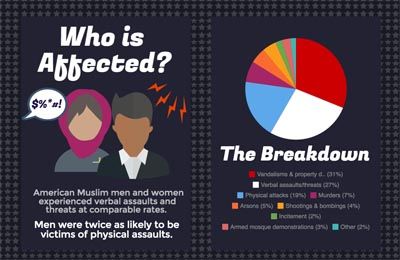
    • During the course of 2015, there were approximately 174 reported incidents of anti-Muslim violence and vandalism, including: 12 murders; 29 physical assaults; 50 threats against persons or institutions; 54 acts of vandalism or destruction of property; 8 arsons; and 9 shootings or bombings, among other incidents.
    • Anti-Muslim violence remained significantly higher in 2015 than pre- 9/11 levels with American Muslims approximately 6 to 9 times more likely to suffer such attacks. The number of incidents in 2015 is also higher than the total number of anti-Muslim hate crimes reported in 2014: 154.
    • In 2015, American Muslim men were twice as likely to be victims of physical assaults and 5 to 6 times more likely to be victims of murder than American Muslim women.
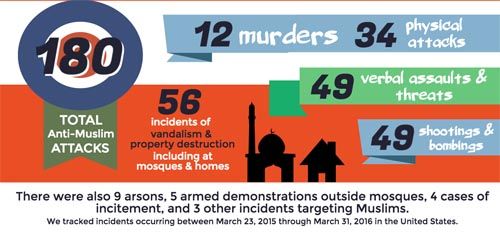
    • Since the first candidate announced his bid for the White House in March 2015, there have been approximately 180 reported incidents of anti-Muslim violence, including: 12 murders; 34 physical assaults; 49 verbal assaults or threats against persons and institutions; 56 acts of vandalisms or destruction of property; 9 arsons; and 8 shootings or bombings, among other incidents.election3
    • Since the start of the presidential election cycle, American Muslim men have been twice as likely to be victims of physical assaults and about 11 times more likely to be the victims of murder than their female counterparts.
    • Also during each period, Muslim murder victims were most likely to be aged 18 to 24.
    • Children and youth – as young as 12 years old – were among those responsible for acts and threats of anti-Muslim violence.
    • Although Islamophobia made an appearance during the first GOP debate in August 2015, the first surge of anti-Muslim political rhetoric occurred in September 2015.
    • It corresponded with an international development: the Syrian refugee crisis. The deepening crises dominated news media headlines in the U.S. and Europe potentially highlighting the media impact on political discourse.
    • This surge in September 2015 was accompanied by approximately 10 reported incidents or threats of violence, including 3 murders. In comparison, there was one (1) such incident in August 2015 representing a significant increase in anti-Muslim violence over the course of one month.
    • Donald Trump escalated anti-Muslim vitriol in the wake of the terrorist attacks in Paris, France in November 2015 rather than urge calm or international unity. The attacks signify an international event that triggered a second surge in Islamophobic rhetoric in addition to the uptick in bias attacks.
    • Trump made many anti-Muslim statements during televised appearances on mainstream news media outlets, impacting millions of viewers across the U.S. and around the world.
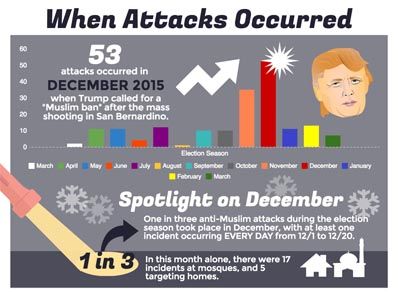
    • As Mr. Trump called for shutting down mosques in the wake of the Paris terrorist attacks and the mass shootings in San Bernardino, California in December 2015, anti-Muslim attacks initially tripled with nearly half of those attacks directed against mosques.
    • Anti-Muslim attacks surged once more in December 2015. There were 53 total attacks that month, 17 of which targeted mosques and Islamic schools and 5 of which targeted Muslim homes. By comparison, when the presidential election season began just 9 months earlier, there were only 2 anti-Muslim attacks. Attacks on Muslims during this month constitute approximately 1/3 of all attacks last year. In fact, in December 2015, anti-Muslim attacks occurred almost daily and often multiple times a day.
    • At least three separate incidents of violence involved perpetrators who were public supporters of presidential candidate Donald Trump. There was otherwise a strong perception among American Muslim leaders that political rhetoric created fertile ground for threats and acts of anti-Muslim violence.
    • While anti-Muslim political rhetoric gives cause for alarm, the ensuing violence has inspired expressions of solidarity with the American Muslim community, too.

    Several additional observations are worth noting here. First, as highlighted above, our research demonstrated a spike in anti-Muslim violence post-Paris attack in November 2015 and again in December 2015, in the aftermath of the San Bernardino mass shooting. While the violence appeared to level off in the beginning of 2016, it still remained 3 to 5 times higher than pre-election levels. Significantly, the Paris and San Bernardino attacks by self-identifying Muslims were also accompanied by anti-Muslim political rhetoric and policy posturing by GOP presidential candidates, including now Republican presidential nominee Donald Trump.

    election1In the immediate wake of the San Bernardino attack, Trump issued a public statement calling for his now notorious ban on Muslim immigration that he continues to revisit and expand upon during press interviews and campaign rallies. It is important to highlight that many of his discriminatory remarks and proposed policies have received massive coverage in the news media, thereby amplifying the reach and impact of Trump’s Islamophobic message. His rhetoric is not only impacting hundreds or thousands of attendees at political campaign events or rallies, but millions of Americans across the country and even more people around the world.

    Second, the violence our report exposes is part of a larger trend of growing Islamophobia that pervades so many aspects of American life today. Indeed, research suggests that there has been a steady rise in Islamophobia in recent years. The FBI’s 2014 hate crime statistics, for example, show that bias crimes generally went down across the board except where American Muslims were concerned. Similarly, in 2015, the Equal Employment Opportunity Commission (EEOC), the federal government agency responsible for handling employment discrimination cases, experienced an increase in religious discrimination claims involving Muslim employees. While Muslims constitute approximately 1% to 2% of the entire U.S. population, their claims account for 40% of cases.

    In addition, anti-Muslim bullying in our schools seems to be getting worse, if not evolving. A recent report from the Southern Poverty Law Center examining the impact of the presidential elections on students found that at least a 1/3 of the teacher respondents saw an increase in anti-Muslim sentiment in their classrooms. Some reported suicidal ideation among some Muslim students related to bias-based bullying. But there is an alarming trend that goes beyond conventional bullying. Whereas we typically think of school bullying as peer-on-peer harassment, research suggests that adults – essentially the very people responsible for ensuring a healthy learning environment – are increasingly the perpetrators of Islamophobia. Indeed, all of these indicators evidence Islamophobia as a growing American problem.

    Finally, as our report suggests, anti-Muslim political rhetoric during the course of the presidential election season has contributed to this very real religious-freedom challenge. It is important to acknowledge other factors, however, that may help contribute to this dangerous phenomenon. The rise of ISIS, as well as actual terrorist attacks on U.S. and European soil, has also played a role, for example. This, together with foreign military interventions in Muslim majority countries such as Iraq and Afghanistan, has contributed to American fears concerning a potential enemy within our borders that constitutes a potential national security threat.

    Additionally, news media coverage of terrorism as an exclusively Muslim phenomenon — even though study after study suggests that a greater domestic threat lies with far right extremists and white supremacists — helps perpetuate the stereotype of Muslims as the “terrorist other.” When an American knows a Muslim or Muslims personally, this helps counter the negative media depictions. Since Muslims only represent about 1% to 2% of the total population, however, the chances of an average American encountering Muslims at work, school or in their neighborhood is slim. Most Americans get their information about the minority faith community from whatever they consume on the computer, TV and smart phones. Research shows that last year alone, 9 out of 10 news media stories about Muslims and Islam in the U.S., U.K. and Germany were in the context of violence: war or terrorism.

    So, is it truly surprising that there is a palpable fear of and hostility towards Muslims, or those perceived to be, particularly in absence of any alternative positive portrayals of the minority community? And, of course, there is the multi-million-dollar Islamophobia industry that has been exposed in the Center for American Progress’s report, Fear Inc., as well as in various CAIR publications. If there is a silver lining to growing Islamophobia in the U.S., it may be the responses of American Muslims — which have proven just as diverse as the community itself — to the stereotyping, bigotry, and threats of violence, which have proven just as diverse as the community itself. During the election season alone, we have witnessed heroic efforts to counter anti-Muslim prejudice and discrimination by the most ordinary citizens, from Rose Hamid to Khizr and Ghazala Khan. We have witnessed social media campaigns from American Muslim women, like #CanYouHearUsNow, to challenge stereotypes about, and attacks against, the minority faith community. We have also seen increased political engagement, from more voter registration drives to visible participation of Muslims at the Democratic National Convention and other political forums. We have also seen American Muslim youth showing extraordinary strength and resiliency in the face of bigotry, from Texan “clock boy” Ahmed Mohamed to Oklahoman Samantha Elauf who took her religious discrimination claim against the popular retailer Abercrombie & Fitch all the way to the U.S. Supreme Court — where she won.

    It’s rather extraordinary.

    election0

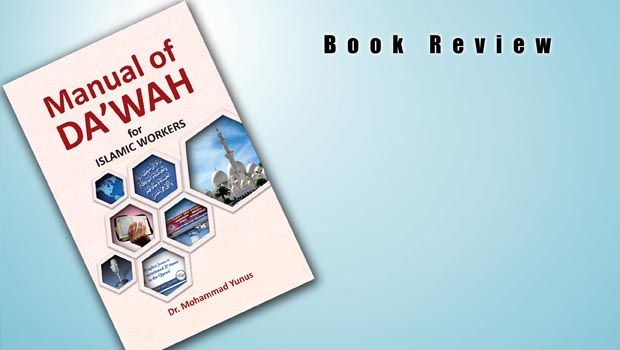
  • Book Review: Manual of Dawah for Islamic Workers

    Book Review: Manual of Dawah for Islamic Workers

    Paperback:  151 pages
    Author:  Dr. Mohammad Yunus (former Ameer of ICNA)
    Publisher: Islamic Circle of North America (ICNA)
    Year Published: 2016 (revision #4)

    Library of Congress Catalog Card #: 83-82068
    International Standard Book #: 0-9691479-1-0

    Review by Dr. Talat Sultan, former Ameer of ICNA

    Dawah, or sharing the true message of Islam, is a fundamental responsibility of every Muslim. It is also a collective obligation of the Muslim ummah. The Quran proclaims: “Thus have we appointed you as a community of the middle way so that you may be witness to mankind and that the Messenger may be a witness to you…” (Baqarah, 2:143). The Quran also tells us: “You are the best community that has been raised up for mankind. You enjoin the doing of what is right and forbid the doing of what is wrong, and you believe in God…” (Ali Imran, 3:110). And Prophet Muhammad (peace be upon him) said, “You should pass it on to others even if you know just one sentence [of Islamic knowledge].”

    Islamic Circle of North America, as an Islamic movement, has been carrying out this task over more than four decades as a leading dawah, educational, and social service organization. The “Manual of Dawah for Islamic Workers,” prepared by Dr. Mohammad Yunus for ICNA’s dawah department, was first published in August, 1983 as a guidebook for Muslims in general, and ICNA workers in particular, to carry out the obligation of dawah in a well-informed and effective manner. Now, ICNA has published its completely revised and updated 4th edition.

    The book starts out by introducing the concept of dawah in the light of Quran and of the sunnah of our beloved Prophet (pbuh) so that the reader understands clearly why it is important to carry out this essential obligation of outreach to people, a legacy of all the prophets of Allah. The book then outlines the contents of the dawah message to fellow Muslims and to non-Muslim audiences, as suitable to each. It then emphasizes that the character and conduct of the daiyah is of paramount importance, as the backbone and embodiment of the words of dawah.

    Various techniques of dawah are presented, geared to individual or collective audiences, from spouse and children in one’s own home, to other relatives and friends, to people in the larger community. Part V provides the reader with information about Christianity, its various doctrines, its scriptures, and the position of Jesus (peace be upon him) in the Quran. Part VI presents the activities and accomplishments of WhyIslam (WhyIslam.org) and Gain Peace (GainPeace.com), two highly successful dawah projects of ICNA. Their various programs are outlined, with statistics showing the encouraging results of the ongoing dawah work. Finally, a list of recommended books is provided for those who are serious and determined to further develop their skills in dawah. There is also a list of books that are recommended for distribution to individuals and groups who are the recipients of one’s dawah activities and efforts.

    The preface of the 1983 manual says, “The act of submitting to Allah requires that every heart beat of a Muslim must carry the message to those around him, that there is no god but Allah and therefore, He alone is the final authority. Concern and unequivocal commitment to Allah’s orders are not the only tools for an Islamic worker. He employs the best available technique of mass communication in a systematic manner for taking Allah’s message to all.” That message is compelling today as it was three decades ago. The “Manual of Dawah” has helped many over the years who thus strive to carry out dawah work, whether on their own or through an organization such as ICNA.

    This valuable manual is recommended reading for every Muslim who realizes that it is his/her obligation to share the truth and the beauty of Islam with fellow citizens.

  • Helping Hand (HHRD) Strengthens Muslims in Mexico

    Helping Hand (HHRD) Strengthens Muslims in Mexico

    While most children his age attend school fulltime, our young brother Nooruddin spends many of his days making sweet desserts to sell on the streets of Mexico City. Each batch takes him three hours to prepare. Once the desserts are finished, he cools and wraps them to sell for a small profit of 15 pesos each, about $1USD. On a good day, he can sell 30 desserts, earning about $30 to help his father, who suffers from heart problems, provide for their family. Nooruddin and his family are among a growing minority of Mexicans who have come to accept Islam as their religion, and like millions of other people across Mexico, poverty is their way of life.

    Helping Hand for Relief and Development (HHRD) is one of the few Islamic NGOs focusing attention on aiding Muslim families in Mexico with long-term relief and development programs. Since 2012, HHRD has been working in various parts of Mexico to aid families with food packages including Zabihah compliant meals and Ramadan iftars, diabetes screening programs, school supplies, and gift bags for children. “I don’t know if maybe the impression is that Muslims in Mexico are self-subsidized and self-supporting, but it’s not true,” said the Libyan Ambassador to Mexico, Muftah Altayar.

    According to a 2009 PEW report, the number of Muslims in Mexico is approximately 110,000, accounting for less than one percent of the total population. However, by the mercy of Allah and then the outreach efforts of both Mexican and immigrant Muslims, Islam in Mexico is spreading. “Alhamdulilah, in Mexico it is very easy to talk in the universities and the high schools. They invite us to talk about Islam because the people really want to learn about Muslims,” said Imam Isa Rojas, the first Mexican graduate of the Islamic University of Medina, Founder of the Al-Hikmah Center in Mexico City, and active caller to Islam in Mexico. “The people want to know about Islam because they don’t have a negative opinion about Muslims like they do in Europe or perhaps in the United States.”

    Mexico City, the bustling capital located in the center of the country, has upwards of 3,000 Muslims living within its borders, many of whom are converts. In the Southeast region of Mexico lays the Free and Sovereign State of Chiapas. It is a lush and culturally rich land with an estimated 100-300 Mexican converts to Islam who have established a small but growing Muslim community in the city of San Cristobal de las Casas. However, many of the brothers and sisters in this area struggle with basic necessities such as job security, education and healthcare.

    While in Chiapas this past year, HHRD volunteers were given a tour of the community by Brother Yahya Gómez, one of the prominent Mexican converts to Islam and activists in Chiapas. The homes were simple structures of wood plank walls and metal sheet roofs, made to house only a few people. However, it was not uncommon to see extended families of 15 or more relatives living together in the same space. Men in the community can only secure work as manual laborers, if they are able to find work at all.

    “It’s in very bad shape. You have a few families living in one house. It’s more a kind of temporary shelter; I cannot say it is a house. It needs renovation… I say they need a new house in its place,” said HHRD International Program Director, Irfan Khurshid, when he witnessed the poor living conditions.

    For only $27,000 per home, HHRD’s Home Renovation and Building Project can provide for current homes in Chiapas to be upgraded or completely redone to provide safer, more spacious homes for growing families, including all necessary plumbing, electric, and construction costs. Some homes will even be completely rebuilt in safer neighborhoods that are closer to the local masjid.

    To further aid Muslim families in Chiapas, HHRD is implementing a Micro Finance Initiative that will provide interest-free small business loans to individuals with the ambition to become self-sustaining. With small loans ranging from $1,500 to $4,000, participants in the program can learn skilled trades and begin to operate their own businesses in the fields of carpentry, sewing, baking, or auto mechanics to help raise themselves and their families out of poverty.

    “This micro financing project is so amazing because it takes a simple donation, you know somebody can give $1,000 or $2,000 to help a Muslim start up a company,” said Boonaa Mohammed, a volunteer who recently traveled with HHRD to Chiapas. “It will take that money and allow them to buy whatever necessary tools are mandatory for the specific trade. It will give them the bare minimum. And then once they have actually been able to become successful in their trade and they have that money, they give it back to the charity which then gives it back to another Muslim that wants to, again, prove themselves through a trade.”

    HHRD is also in the process of establishing a Skills and Vocational Training Center in Chiapas to assist unemployed individuals gain the education and training needed to earn steady and halal sources of income. “In this center we can teach them different skills and they can learn a trade so that they can start their own business or find different jobs,” said Khurshid. “This will help them economically and will help them educate their children because many of the children from these unemployed and low income families have not had access to an education.”

    In addition to these large scale development projects, HHRD is also in the process of starting an In-Kind Gift Program to provide immediate necessities to families in Chiapas, Rosarito, and Mexico City, as well as an Educational Support Program where donors can sponsor a child for only $1 per day to help provide them with necessary school supplies.

    “Often times, in North America, when we look at converts and reverts, there are so many difficulties they have integrating within our Muslim communities,” said Mohammed. “Now imagine a community of reverts and converts trying to integrate into a non-Muslim society that doesn’t have a strong basis of Islam for them to fall back on. It is imperative that we offer our support in whatever way that we can and know that whoever gives for the sake of Allah, subhana wa ta ala, the sadaqa will never go to waste.”

    To get involved with Helping Hand for Relief and Development programs in Mexico, visit their website www.hhrd.org, contact info@hhrd.org, or call 1-888-808-HELP (4357).

  • Serving the  Mexican Community

    Serving the Mexican Community

    It was only four years ago that the first story about WhyIslam in Mexico was written, but many exciting events have transpired since then. The Mexican campaign began with a desire to deliver Islamic attire and literature to a growing community in Mexico City, Al Hikmah Center. Seven organizations joined forces to contribute to the cause, donating everything from Islamic CDs to siwaks. During her vacation, Nahela Morales, a Mexican convert, distributed the items to the Islamic community in June of 2012. The trip was so successful that it became an annual effort and each year expanded to cover more than five cities within the country.

    Interest really took off when well-known lecturers and personalities such as Nouman Ali Khan, Omar Suleiman, and Boonaa Mohammed endorsed the projects in Mexico. In 2013, Nouman Ali Khan even traveled to the Mexican state of Chiapas, to the Islamic village in San Cristobal de las Casas, as part of the second annual dawah trip to Mexico. He was so moved by the poor living conditions of the indigenous Muslim families that he filmed a video tour of a typical home, a humble structure with walls made of planks and plastic covering to keep out the rain, a tin rooftop, and a dirt floor. The video was released on WhyIslam’s YouTube channel and has over 215,000 views.

    The goal for that year was to begin plans to renovate the town’s masjid Al Kauthar. Through the use of social media and fundraising campaigns, Morales was able to gather over $30,000 for Islamic material and food for distribution during Ramadan, and the masjid renovation project. However, future goals were to offer continuous support to needy families in this sector and to provide home renovations and reconstructions. This sparked plans to launch Mexico Relief Project by Helping Hand for Relief and Development.

    In 2014 Boonaa Mohammed traveled with HHRD and film crews to Mexico to produce documentaries that bring the necessary attention to this cause.

    The Prophet Muhammad, peace be upon him, once advised Aisha when she desired to offer a gift to a neighbor, that she should give, “to the one whose door is nearer to you.” The idea of helping our brothers and sisters in Mexico is one that stems from neighborliness, in the sense that Mexico is one of only two countries which share a border with the US. It is also the largest Latin American country with the smallest Muslim population; however, the Muslims are growing in number and need assistance. Alhamdulillah, we have been blessed with the ability to aid our brethren so we ask for your continued support and prayers.

    We hope that you will enjoy reading some stories and informative articles from our Mexican and Spanish-speaking brothers and sisters, and that you will also remember them in your prayers. JazakumAllahu khaiyran.