Since the inception of the United States approximately 245 years ago, the exercise of the ballot has remained one of the most cherished rights and expressions of American citizenship. The 13 British colonies that gained independence, and subsequently established the United States of America, crafted the U.S. Constitution which limited electoral participation to property-owning White males. The unfettered right to vote was not afforded to White females, enslaved or free Blacks, or Indigenous persons until the 20th century. The 19th amendment to the Constitution was ratified in 1920, giving women the right to vote. It granted all women the franchise by law, but in practice women of color were often still denied the right to vote. The 1924 Snyder Act granted Native Americans born in the United States full citizenship and the right to vote. Even though the 15th Amendment, adopted in 1870, granted African American men the right to vote, many states put in place barriers aimed at preventing them from doing so. African Americans would have to wait until the passage of the 1965 Voting Rights Act before federal legislation finally gave the full franchise to them.
The Reconstruction Era, from the end of the Civil War in 1865 until 1877, represented the young nation’s brief tryout of non-racialized democracy. For the first time in U.S. history, formerly enslaved Blacks not only voted, but were elected to city, state, and federal offices throughout the South. P.B.S. Pinch back was the first African American governor when he was elected as Louisiana’s chief executive in 1872. Hiram Revels, born free in North Carolina in 1827, became the first mixed-race person to serve in the U.S. Senate when, in 1870, Mississippi voters favored him over other candidates. Blanche Bruce was elected to the Mississippi Senate in 1875.
The Ku Klux Klan was formed in Pulaski, Tennessee in 1865 to terrorize and thus discourage newly freed Blacks from benefiting economically, socially, or politically after emancipation. Voter suppression and deadly terrorist attacks against Black voters and office holders accelerated after federal troops stationed in the South were removed by then-president Andrew Johnson. The North may have won the Civil War, but the reactionary post-reconstruction battle was clearly won by the South through its near-total disenfranchisement of Blacks and reimplementation of a labor-intensive plantation economy that virtually re-enslaved Black workers.
Suppression Through Law and Violence
According to an article written by the senior editor of Encyclopedia Britannica, voter suppression may be defined simply as, “Any legal or extralegal strategy or measure whose purpose or practical effect is to reduce voting, or registering to vote, by members of a targeted racial group, political party or religious community. The overwhelming majority of victims of voter suppression in the United States have been African Americans.” Throughout the history of the American republic, voter suppression has been the tool of choice used by White supremacists to re-establish or maintain control over the policy agendas of local, state, and federal legislatures. From 1865 until 1968, racial segregation and systemic anti-Black discrimination were codified in laws known as Jim Crow laws. Jim Crow was a character in a minstrel show who was wildly popular with racist Whites because of his reinforcement of negative stereotypes of Black people.
During the modern Civil Rights era, 1953-1968, African Americans were murdered, lynched, burnt or bombed out of their homes for attempting to register themselves or others to vote. Medgar Evers, former NAACP Mississippi Field Secretary and civil rights activist, was murdered in his driveway by White supremacist Byron De La Beckwith in 1963. The murder was, to a large degree, because of Evers voter registration efforts among Blacks. A comprehensive report by the Poor People’s Campaign (PPC), “The Souls of Poor Folk, Auditing America 50 Years After The Poor People’s Campaign,” states that “More than 50 years after the Voting Rights Act, people of color still experience a broad range of attacks on their voting rights, including racialized redistricting, voter ID laws, proof of citizenship, voter registration hurdles, reduction of days for early and absentee voting, felony disenfranchisement, purging of voter rolls, preemption laws, and emergency financial manager appointment…” A major boom to the voter suppression movement was the June 2013 decision by the Supreme Court in Shelby v. Holder. The Court essentially concluded that participation by African Americans in the electoral process had progressed to a point that special protections by federal law were no longer needed. The decision struck down provisions in the 1965 Voting Rights Act that required jurisdictions with significant histories of voter discrimination to preclear any new “standard, practice, or procedure,” that is, to get federal approval from the Department of Justice, to show that that they do not have discriminatory purpose or effect.
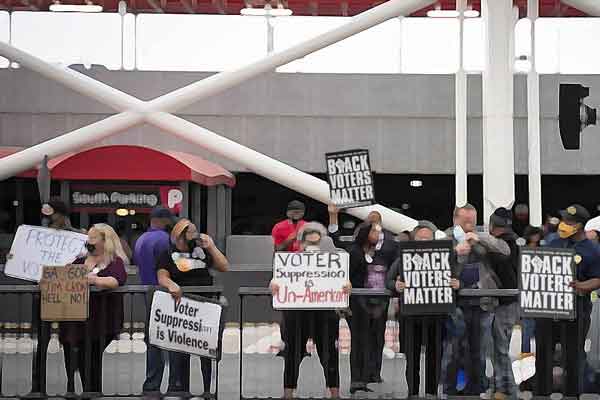
The practical outcome of the Court’s decision speaks volumes about the ongoing agenda to disenfranchise citizens. Quoting further from the PPC’s report, we find that “By 2016, 14 states had new voting restrictions in place for the first time in a presidential election: Alabama, Arizona, Indiana, Kansas, Mississippi, Nebraska, New Hampshire, Ohio, Rhode Island, South Carolina, Tennessee, Texas, Virginia, and Wisconsin. These steps disproportionately target low-income residents and neighborhoods of color. When including felony voter disenfranchisement, eight out of the ten poorest states have enacted voter suppression laws, or only recently saw such laws overturned in federal court.” Voter suppression is a tool for electoral control and manipulation of the process.
Trying to Turn Back the Clock
During the 2020 electoral season, the state of Georgia had a historic massive voter turnout resulting in the state casting a majority of votes for Democrats — Joe Biden for president, and Rev. Raphael Warner and Jon Ossoff for U.S. Senate. Their wins turned the state from being a proverbial red state to a blue state. Rev. Warner is the first African American senator in the state’s history. The Georgia state legislature wasted little time in passing two voter suppression bills that seem to target Blacks, other people of color, and poor communities. The measures will eliminate automatic voter registration, ban drop boxes for mail-in ballots, and repeal no-excuse absentee ballots. Former president Jimmy Carter observed, “As our state legislators seek to turn back the clock through legislation that will restrict access to voting for many Georgians, I am disheartened, saddened, and angry.” Such voter suppression measures seem to echo Georgia’s inglorious past political history when staunch segregationists like former Georgia governors Eugene Herman Talmage and Lester “Axe Handle” Maddox overtly championed discrimination against Blacks at the polls.
It is revealing that 50 years after the passage of the 1965 Voting Rights Act a vigorous nationwide campaign is taking place to suppress the vote of citizens who are part of minority and poor communities. Voter suppression in this country affects all Americans. Native American political prisoner Leonard Peltier stated, “We need to do more than what is right. We need to join together to right what is wrong.” As Muslims, we are charged with the responsibility of taking a stand for justice for all human beings, irrespective of religion, race, ethnicity, country of origin, or social status. When we know better, we must do better. Allah, in the Qur’an, enjoins us, “O you who believe, stand out firmly for justice, as witnesses to Allah, even though it be against yourselves, or your parents or your kin, be he rich or poor; Allah is nearer to them both” (Qur’an 4:135).