

بسم الله الرحمن الرحيم

Tag: unity

  • The Unity of Muslims Worldwide

    The Unity of Muslims Worldwide

    There seems to be an impression among many that it is impossible to unite the Muslim world. However, unity does not imply: 1) unanimous agreement at all levels of government and society, and 2) unity does not imply conformity of views.

    Firstly, unity is not conformity. There are certain aspects of Islam that unite people across lines of jurisprudence, and even across theological lines (e.g., Sunni and Shia), and one clear-cut example of that is the profound issue of Palestine. Unity does not imply conformity of views; in fact, coalition-building itself, socio-political charters, like that of the Madinah Charter, did not imply that Muslims, Jews, and others held identical views. Prophet Muhammad (s) established a charter that governed all of Madinah, and it included non-Muslims, each with rights and responsibilities as citizens of the city. Unity is a political, societal, and structural tool, with a goal in mind. It’s critical to challenge the misconception that social cohesion requires conformity. The 1400-year-old Islamic tradition, especially within the vast community of 1.8 billion Sunni Muslims, is a testament to the strength found in diversity. The problem with equating unity and conformity is that some people, unfortunately, see disagreement as a cause and an evidence of conflict and enmity.

    Allah SWT’s words form the bedrock of unity in Islam: “And hold firmly to the rope of Allah all together and do not become divided” (3:103).  This divine directive calls for unity that transcends worldly resources or constructs like wealth, political power, nation-states, citizenship, ethnicity, language, or any other distinction. In Islam, unity is a powerful, spiritual bond that brings together hearts and minds in a diverse yet harmonious collective, striving towards a common goal.

    In 7th century Arabia, an era dominated by the chains of slavery, the arrogance of the elites, and the social hierarchy that marginalized the weak, Allah SWT delivered a revolutionary message: “O mankind, indeed We have created you from male and female and made you peoples and tribes that you may know one another. Indeed, the most noble of you in the sight of Allah is the most righteous of you. Indeed, Allah is Knowing and Acquainted” (49:13). This profound verse shattered the entrenched class systems of Arabia, igniting a powerful transformation. It empowered Muslims to rise above societal norms and aspire for God-consciousness and piety, placing these virtues above all else.

    Moreover, this verse stands as a formidable beacon of diversity in Islam. It commands Muslims to acknowledge, respect, and celebrate the rich tapestry of differences in language, skin color, ethnicity, and all worldly distinctions. It’s a call to unity in diversity, where the true measure of nobility is not in one’s lineage or status but in their righteousness and love and fear of God. This is a clarion call for a world where equality and understanding must triumph over division and prejudice, echoing through the ages as a timeless reminder of the true essence of humanity.

    When the innocent in Palestine endure suffering, it sends waves of anguish across the globe to Muslims in New Zealand. The displacement of Muslims in Sudan resonates as deep sorrow in the hearts of their brethren in Pakistan. The trials faced by the Rohingya, Uighur, Yemeni, Syrian, and suffering Muslims anywhere around the globe, ripple through the ummah, a shared agony that unites us all. This collective empathy is akin to a person trying to sleep while besieged by a relentless fever or a throbbing headache, finding no solace in rest. Prophet Muhammad (s) profoundly stated: “The believers in their mutual kindness, compassion, and sympathy are just like one body. When any part of the body suffers, the whole body feels pain” (Sahih Muslim). We are that singular, interconnected body – transcending borders, transcending birthplaces. Our unity is not defined by geography but by the shared pulse of our passionate belief in Islam, feeling each other’s pain as if it were our own, standing in solidarity against the tide of suffering — unwavering and resolute.

    The Muslims who fled persecution from the pagan elites in Makkah and migrated to Madinah were known as the Muhajiroon (those who emigrate). The Muslims of Madinah, who welcomed and supported them upon their arrival, were called the Ansar (supporters). Upon their arrival in Madinah, Prophet Muhammad (s) paired each individual from the Muhajiroon with a member of the Ansar. This pairing aimed to facilitate assimilation, provide financial support, if possible, and extend a warm welcome to the families of the Muhajiroon in Madinah. Among the Ansar, individuals like Sa’d bin Rabi’ exhibited extraordinary generosity— he offered half of his wealth to his Muhajiroon companion, Abdulrahman bin ‘Awf. Abdulrahman, an intelligent businessman, politely declined the offer but requested to be shown to the marketplace so he could start building his livelihood from scratch.

    Whether Family or Society, Differing Opinions Are Expected

    Muslims are consistently instructed in the Qur’an and authentic hadith to maintain familial bonds, exercise patience and forgiveness, even towards those who may not reciprocate kindness, and to embody a higher standard of character. This ethos aims to foster family unity. However, this guidance should not be misconstrued as a tolerance for injustice or as overlooking urgent situations that necessitate intervention to prevent abuse and harm. It primarily addresses everyday interactions with relatives and family members who may be rude, irritating, argumentative, or unkind, despite one’s own kindness and exemplary character. Prophet Muhammad (s) stressed the importance of sustaining family ties, even when another family member may sever them. This does not mean, however, that family members are expected to have unanimous views on all matters. Should differences of opinion within a family lead to enmity and conflict? Of course not.

    Just as families are encouraged to embrace diverse viewpoints while working together and avoiding division, so too is the Muslim ummah expected to operate in a similar spirit of unity amidst diversity.

    There is unity of belief in the foundational principles of Islam such as the five pillars, the primary pillar of tawheed (oneness of God) serving as a perfect example. Here there is a unity of belief and understanding that does not admit any differences or disagreement. However, in the details, priorities, or approaches to practical matters — issues of fiqh such as the diverse opinions on voluntary aspects of prayer or wudu’ — there can be differences or variance in interpretation of sources. That a diversity of opinions exists is evidenced by the different schools of fiqh. This diversity of opinion is a kind of disagreement known as ikhtilaaf al-tanawwu’ (disagreement of variance, or variant views) and we are invited to embrace the plurality of opinions within the framework of Islamic orthodoxy while following scholars seeking to clarify the strong evidence of one opinion over others.

    Another type of disagreement is tadaad (ikhtilaaf tadaad), which represents differences that are contradictory, beyond the bounds of varying interpretations. Not all differing opinions stem from interpretation of the sources of Islamic legislation. Some opinions are false, deviating from proper Islamic methodology and resulting in ideas or innovations that fall outside the scope of orthodox Islam. This can lead to confusion among those who assume that all varying or conflicting views are valid. That is not the case.

    However, embracing the plurality of opinions within the framework of Islamic orthodoxy is not only permissible but also encouraged in the interest of maintaining social harmony among Muslims, and it is the role of scholars and advanced students of knowledge to discuss the deeper issues of differences among these opinions and to pursue what is strongest based on their methodologies. Whichever school of jurisprudence one follows (among Sunni Muslims — Hanafi, Maliki, Shafi’i, and Hanbali), or for those who pursue Islamic knowledge while remaining outside of these schools of jurisprudence, the caution is to avoid divisions and disputes among the masses of Muslims. Thus, each individual and/or group is to recognize and respect the validity of the other fiqh interpretations that are based on Qur’an and sunnah and orthodox Islamic methodology.

    Consistent Efforts to Unite

    It is not the responsibility of laypeople or the general masses to engage in debates and disputes about the principles of fiqh, as this is not their area of expertise. Such actions may only serve to legitimize divisions and disputes. These academic discussions are best left to qualified scholars who are actively engaged in addressing the needs of diverse Muslim communities in today’s globalized world.

    Conversely, as mentioned above, some Muslims mistakenly believe that all differing opinions are valid, so in the name of liberalism, inclusivity, and tolerance, they open the floodgates of all possible views on what Islam is or isn’t. People are legally free to define themselves as they wish, but we do not believe that Islam is open to postmodern hijacking or secular reformulation. College students, in particular, must exercise caution in their understanding of inclusivity. Islam is a big umbrella insofar as it invites any and all people to learn about it, to investigate its teachings, and to join its ranks, regardless of their current religious belief, political orientation, or personal identity. But Islam does not allow its tenets to be modified to accommodate concepts or practices that are contrary to its teachings. It can be, especially for young adult Muslims, a thin line to walk between being welcoming, kind, and respectful to individuals with other beliefs and ideologies and, at the same time, remaining faithful in thought, word, and deed to orthodox Islam.

    Certain topics have the power to unite, and shared hardships, whether through physical and emotional experience or through witnessing and empathy, can bring hearts closer. The ummah is in need of many things, and the issue of Palestine consistently demonstrates our potential for unity. What is required is wisdom, sincerity, and consistent efforts to unite strategically, in planning and organization, throughout the year, for the sake of Allah SWT.
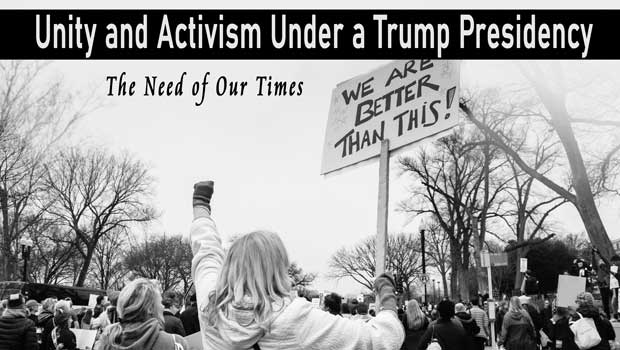
  • Unity and Activism under a Trump Presidency: The Need of Our Times

    Unity and Activism under a Trump Presidency: The Need of Our Times

    On a rainy January 20, 2017 Donald J. Trump became the president of the United States after winning the Electoral College and losing the popular vote by over three million. The pomp and ceremony, military and police presence, even the somberness of the day lacked the celebration of at least the previous two inaugurations. The twitter-verse remarked that the “sky was crying” and dissent filled the air blocks away amid a wide range of socially disparate individuals from Muslims, immigrants, blacks, Latinos, and gays, to whites who blocked roads and held bold signs demanding impeachment and likening Trump to Hitler. With a nation politically divided along many fissures that have been growing over the past several decades, Muslims also found themselves separated along similar lines. Muslim Republicans, Democrats, and Independents voted their conscience and helped usher in one of the most divisive administrations America has ever seen. Economic concerns and social issues like illegal immigration, abortion, and gay marriage were uppermost in the minds of conservative Muslim voters. Most Muslim voters were concerned about eroding civil liberties, continued wars, and America’s foreign policies.

    Unity is a necessary goal, but not easy to achieve. Muslim-led organizations need to work with other groups on a grassroots level. There is certainly strength in numbers and the many diverse organizations working toward the same over-arching goals can achieve much more than singular, non-allied groups.

    The inauguration was a historic moment in many ways, the least of which was the visibly low turnout of spectators which Trump, in narcissistic fashion, continued to rail against in his early morning twitter rants. Nothing could stop the juggernaut ascension of Trump to the highest office in the land. The fervent wishes and voting choice of the majority of Americans got swallowed up by the Electoral College system, and the prayers of believers did not change the course that America has been set upon, for good or ill. What then is left in the repertoire of activists as they prepare for the coming years of a presidency run by an ill-equipped, self-obsessed, money-hungry, politically clumsy elitist, along with his chief strategist, Steve Bannon, a white nationalist, White House Chief of Staff Reince Preibus and Vice President Mike Pence, both right-wing powerhouses. Rule by oligarchs, corporate corruption, criminal war-making, oppression and occupation, and layers of disinformation — these all exist in the world today, but it can get so much worse. However dire the future looks, fear and hopelessness must be displaced by courage and conviction in hearts and minds of those aligned against this new world order.

    The Role Muslims Can Play

    For Muslims, particularly, it is a matter of faith. We should fear only Allah since we know that all things happen according to His will and plan. So we make our choices day to day, and determine to the best of our ability the course we are going to follow. We then leave the rest up to Allah (SWT). What remains then is how Muslims participate in this new political reality. Representation in government at the local, state, and federal levels, of Muslims and their concerns, is still limited but slowly increasing. In the fledgling Somali voting block of Minneapolis, Minnesota they elected the first Somali woman to state office. As more Muslim American state representatives continue to be elected, some of them will find themselves in national positions within the next ten years. The primary concern now is how to represent Islam in its totality, from its politics to its social ideals, and to advocate for Muslims. Imam Omar Suleiman, President of the Yaqeen Institute for Islamic Research, summed up in a speech at the ICNA/MAS convention in December, 2016 what the Muslim activist position should be: “If we allow fear to drive us to continue to do away with notions of our faith that others find problematic because of their ignorance and because of their racism and their bigotry, rather than standing boldly and explaining and defining those concepts and showing them in motion and in action and how they contribute to the betterment of society then we will slowly see our identity disappear.” He went on to say that Islam “should be in motion” as an active religion that betters all societies. Sometimes that means dissent within the confines of a unified front.

    Never has there been a more urgent time to stand tall and firm in speaking about Islam and countering all misrepresentations of the faith. Steve Bannon is an avowed Islamophobe with a belief in a coming apocalyptic battle between the Judeo-Christian world and Islam. And Jared Kushner, Trump’s son-in-law, is now senior advisor to the president. He is also purportedly being considered for the role of peace broker between Israel and the Palestinians, while his family has donated tens of thousands of dollars to illegal West Bank settlements, according to their tax forms. A negative perception of Islam is at the heart of this administration’s immigration and foreign policy agendas. It matters little to these ideologues in power how high American flags fly at Islamic centers, how often Muslims leaders and organizations condemn terror, or how often public officials are welcomed to address Muslim community and masjid events.
    ‘Get Up, Stand Up, Don’t Give Up the Fight’

    It is understandable that many Americans are worried, but we must maintain a long view and broad perspective. Allah (SWT) tells us in the Quran, “And obey Allah and His Messenger, and do not dispute and [thus] lose courage and [then] your strength would depart; and be patient. Indeed, Allah is with the patient” (Quran 8:46). Already there is some light shining in the politically divisive gloom — an unintended consequence of the new future with Trump is that a robust and growing opposition has risen against him and his absolutist, autocratic inner circle. Uniting to push back against hate, against division, is a myriad of groups who are protesting, filing legal actions, and vowing to keep America the land of diversity and tolerance.

    Trump has become the symbol of both ultra-right zealotry and crass, profit-driven opportunism. Organizations and individuals working towards social and racial justice, immigration and migrant rights, national universal health care, women’s reproductive rights, and environmental protections have naturally and spontaneously united against the threat to our civil liberties and even our survival. The “Stop Trump” mantra speaks of a fragile unity, organic, without structure. It is reactive rather than a deeply entrenched, planned revolt. Yet, it took hold. The tiny spark of unified dissent was launched the day after the inauguration as the Women’s March took place across major cities in America and in several countries abroad as well, collectively numbering in the millions. An estimated 650,000 to over one million women and men took to the streets of Washington D.C. The signs held aloft on that day spoke eloquently of the fervor protestors felt: Get up, stand up, don’t give up the fight; We are better than this; Another world is possible; Babies against bigots; No white supremacists in the White House; Senate, have a spine, block Trump’s cabinet of horrors; Billionaires in the swamp; Muslim rights are human rights; Jews & Muslims stronger together; Refugees welcome; United we stand, divided we fall; No human being is illegal; Hate is un-American; Hatred’s greatest weapon is complacency.

    The march in Washington was co-organized by a young Palestinian-American Muslim woman, Linda Sarsour. You may be a social conservative and have an issue with Sarsour aligning herself with Planned Parenthood and various LGBTQ groups for the march, but we cannot deny the political impact that such an historic event had and will continue to have. Protests are the matchstick that sets a movement on fire. “It’s more than just a release for anger – taking to the streets is a necessary way to participate in democracy” notes Sarah Jaffe, a writer for Rolling Stone magazine. But without direction, a movement can fizzle out and disappear from the front pages or evening news as new distractions emerge, or it can organize and grow so as to significantly impact the political reality. So what comes after the euphoria of speeches, the camaraderie of protest, the zeal and fervor for change?

    For now, the motivation to continue standing up and being counted is strong, as Trump has been busy signing controversial executive orders and pushing through divisive cabinet appointments. In his first week he signed orders to gut major provisions of the Affordable Care Act, expedite infrastructure projects through environmental and business-related deregulations, build a 1,900-mile long wall, deport undocumented immigrants, and impose a travel ban against seven Muslim-majority countries. He also green-lighted the Keystone and Dakota Access Pipelines, the latter being close to Standing Rock Sioux tribal lands in North Dakota, threatening their sources of water.

    Jeremi Suri, in The Atlantic, warns, “With his barrage of executive orders, Trump is taking America back to the historical nightmares of the world before December 1941: closed borders, limited trade, intolerance to diversity, arms races, and a go-it-alone national race to the bottom. His executive order on ‘rebuilding the U.S. armed forces’ calls for ‘peace through strength,’ but this document and the others he signed offer nothing but unilateralism and militarization: more military spending, more nuclear weapons, more use of torture (which is illegal), and more promises to destroy ISIS and other terrorist threats. The executive orders promise to curtail American participation in international organizations, prohibit whole categories of foreigners from entering our country, and limit exchanges of ideas and goods.” David Leonhardt, writing in the New York Times, points out that countering Trump initiatives will demand a sustained effort. “If progressives want to have an effect — if they want to defend civil rights, protect the environment and keep millions of people from losing health insurance, among other things — the hard work hasn’t even begun.”

    Protests as Well as Political Participation

    People spontaneously took to the streets and airports to protest the most immediately executed of the executive orders — a ban on refugees and travelers on the basis of protecting American borders. Muslims were not at the forefront of those protests, but at the heart of it. Ordinary Americans, from all walks of life, came out to protest the discriminatory action against Muslims. When protests are needed for Mexicans facing deportation, native Americans protecting the land and vital resources, blacks losing more voting rights and facing increased police brutality, will Muslims stand and march and protest with them?

    Protests are imperative, but so is political participation. As David Brooks of the NYT put it, “Change happens when people run for office, amass coalitions of interest groups, engage in the messy practice of politics.” Organizations and even cities have filed lawsuits, including the Council for American-Islamic Affairs (CAIR) and the ACLU. In a February, 2017 article in Glamour magazine, Linda Sarsour summed up the immediate needs of activists at least until the midterm elections in 2018: “We need to translate the emotions and the frustrations right now, and the fear that people have right now, into massive polls numbers to win back the House of Representatives. Right now there are no checks and balances. We need to get control back of at least one branch of government.”

    Unity is a necessary goal, but not easy to achieve. Muslim-led organizations need to work with other groups on a grassroots level. There is certainly strength in numbers and the many diverse organizations working toward the same over-arching goals can achieve much more than singular, non-allied groups. Together, individuals and groups can support and inspire one another. Just remember the messages of the grass-roots demonstrators, holding high their heads and their ideals…and their signs, declaring that we must not give up; that as Americans we are better than this, and that another world, a better world, is possible. They said it, and it is true, that united we stand, divided we fall. As to hatred, bigotry, discrimination, and worship of profits over people — the greatest weapon of demagogues and vulgar profiteers is the complacency of people. To quote Omar Suleiman once again, “Now is the time dear brothers and sisters, now more than ever to stand up and to define ourselves, to show our Islam in motion, to stand with the oppressed and the vulnerable.”